This study aims to construct an evaluation system for farmers’ livelihood capital in minority areas and evaluate the impact of relocation in response to climate change on farmers’ livelihood capital.
According to the characteristics of Yunnan minority areas, the livelihood capital of farmers in minority areas is divided into natural, physical, financial, social, human and cultural capital. The improved livelihood capital evaluation system measures farmers’ livelihood capital from 2015 to 2021. The net impact of relocation on farmers’ livelihood capital was separated using propensity score matching and the difference-in-difference (PSM-DID) method.
The shortage of livelihood capital makes it difficult for farmers to resist climate change, and the negative impacts of climate change further aggravate their livelihood vulnerability and reduce their livelihood capital. Relocation has dramatically increased the livelihood capital of farmers living in areas with poor natural conditions by 15.67% and has enhanced their ability to cope with climate change and realise sustainable livelihoods.
An improved livelihood capital evaluation system is constructed to realise the future localisation and development of livelihood capital research. The PSM-DID method was used to overcome endogeneity problems and sample selection bias of the policy evaluation methods. This study provides new ideas for academic research and policy formulation by integrating climate change, poverty governance and sustainable livelihoods.
1. Introduction
In recent years, the impact of climate change on people’s livelihoods has been recognised as one of the most substantial challenges facing human society (Nasrnia and Ashktorab, 2021) and has aroused widespread concern in academic research and policymaking (Ani et al., 2021; Dube and Phiri, 2013; Mabon et al., 2021). Climate change considerably influences people’s lives, especially because farmers’ production is highly dependent on climate resources, and the negative effect of climate change on farmers’ livelihoods is more serious (Ofoegbu et al., 2017). Farmers’ vulnerability is caused not only by climate change but also by the environmental, material, economic, social and cultural factors that interact with it (Thomas et al., 2007). The impact of climate change on farmers also depends on their economic and social performance (Davidson et al., 2003). Although some coping mechanisms have been established to alleviate the livelihood vulnerability caused by climate change, farmers in some areas lack physical capital and have low income, narrow social networks, low education levels and insufficient cultural activities, which makes them unable to resist the livelihood vulnerability caused by climate change; moreover, various coping mechanisms are challenging to implement (Ofoegbu et al., 2017). To better cope with the influence of climate change, it is necessary to pay more attention to local infrastructure, education and culture, economic development, social security and other comprehensive fields to achieve the sustainable development of farmers’ livelihoods (Aryal et al., 2017).
Livelihood is a core issue in all studies on the impact of climate change on farmers (Ofoegbu et al., 2017). Sustainable livelihood is the key to achieving the goal of sustainable development (Miani et al., 2023). Robert Chambers first proposed that livelihood refers to the activities of people who use their capital and abilities to survive. According to the theory of sustainable livelihood, when people’s external environment changes, if their capital can be maintained or even increased and provide development opportunities for the next generation, they are considered to have achieved sustainable livelihoods (Natarajan et al., 2022). The United Kingdom Department for International Development (DFID) provides a scientific framework for studying sustainable livelihoods (Ankrah et al., 2023; Guo et al., 2022). The sustainability analysis framework consists of five aspects: background vulnerability, livelihood capital, structural and institutional transformation, livelihood strategy and livelihood results (Delgado Jiménez et al., 2022). Among them, vulnerability background is a comprehensive reflection of the speed, amplitude and characteristics of climate change faced by farmers (Turner et al., 2003). The most direct effect of climate change on farmers is on their livelihood capital. The accumulation and flow of farmers’ livelihood capital will eventually affect their livelihood activities and results (Li et al., 2020). Livelihood capital is the core and foundation of this framework, and it includes natural, physical, financial, social and human capital (Ghazali et al., 2023). A scientific theoretical framework for studying farmers’ livelihood vulnerabilities enables different government departments to achieve an effective division of labour and close cooperation. It is beneficial not only to find the shortcomings of livelihoods in the natural, physical, financial, social and human fields and identify the key factors that restrict sustainable livelihoods but also to provide a comprehensive guarantee for clarifying the responsibilities of various departments and improving the livelihood vulnerability caused by climate change (Jacobs et al., 2014). The richer the livelihood capital farmers have, the more capable they are of resisting the risks brought by changes in external conditions, such as the environment and climate, and the easier it is to achieve sustainable livelihoods (Guo et al., 2022). Moreover, climate change will alter the ecosystem in which farmers live, inevitably affecting their livelihood strategies and the realisation of their goals (Chia et al., 2013). Farmers’ livelihood strategies differ because of their different livelihood vulnerabilities; at the same time, different livelihood strategies also restrict or aggravate farmers’ livelihood vulnerability (Somorin, 2011; Sonwa et al., 2012). Therefore, the theory of sustainable livelihood can integrate the fields of climate change, resource utilisation, poverty eradication and policy implementation, and it is a necessary method for studying the sustainable development of poor farmers in the context of climate change (Guo et al., 2019; Pandey et al., 2018).
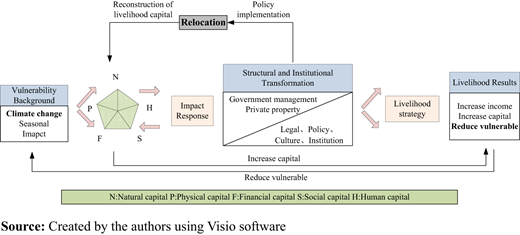
To cope with the adverse effects of climate change, governments of various countries have formulated several plans to improve people’s livelihood adaptability (Jacobs et al., 2014), and relocation is considered the most effective measure to fundamentally deal with the risk of climate change (Hermans-Neumann et al., 2017; Mueller et al., 2020). Vulnerability to climate change and poverty are closely linked and mutually reinforcing (Al-Humaiqani and Al-Ghamdi, 2022; Dube and Phiri, 2013; Wang and Tan, 2018). To improve the farmers’ living environment, help them escape poverty and realise sustainable livelihoods, the Chinese Government organised a large-scale relocation program called poverty-alleviation relocation. Farmers in Yunnan minority areas have weak income-generating abilities; thus, they can only rely on the mountains to eat. Their production and daily lives depend considerably on local natural resources. Climate change in Yunnan Province has recently intensified, and extreme climate has increased dramatically. Disasters caused by climate change have resulted in catastrophic losses to farmers’ crops, houses, personal safety and the economy. The vulnerability of farmers’ livelihoods has intensified, making it challenging to achieve sustainable livelihoods (Natarajan et al., 2022). Poor farmers are more vulnerable to climate change, which makes it difficult for them to get rid of poverty and further aggravates the fragility of their livelihoods, making them fall into a vicious circle. Therefore, appropriate intervention measures must be implemented, with relocation being the most effective method (Li et al., 2021; Rogers et al., 2020). Relocation aims to help poor farmers living in areas with frequent natural disasters caused by climate change, harsh natural conditions, poor living environments and lack of development conditions to move out of their original place of residence, eliminate the harsh environment, resist climate change, obtain safe and stable living conditions and achieve long-term development (Dza et al., 2021; Liu et al., 2023; Rogers et al., 2020). The change in geographical location and the concerted efforts of a series of supporting policies have improved the livelihood capital of relocated farmers and reduced their livelihood vulnerability, enabling them to better cope with the adverse effects of climate change. Figure 1 shows the impact of relocation on farmers’ livelihood capital in response to climate change.
Most of the existing studies have acknowledged that climate change has a substantial impact on people’s livelihoods (Chandio et al., 2022a; Chandio et al., 2023; Chandio et al., 2022b; Chandio et al., 2019; Hurlimann et al., 2021; Leal Filho, 2022; Ofoegbu and New, 2021; Ojo and Baiyegunhi, 2021; Quandt, 2018; Quinn et al., 2011; Sonwa et al., 2012; Zhang et al., 2022), intensifying the occurrence of poverty and also proving the critical role of natural capital (Koirala et al., 2022; Ojo and Baiyegunhi, 2021), physical capital (Evans, 2003), financial capital (Keshavarz and Moqadas, 2021; Peng et al., 2022), social capital (Gwg et al., 2020; Omolo and Mafongoya, 2019), human capital (Ankrah et al., 2023; Guo et al., 2022) and cultural capital (Leiserowitz, 2006) in reducing the vulnerability of livelihood and coping with climate change. However, research on sustainable livelihoods in the context of climate change has often focused on the macro level, and research on the impact of farmers’ behaviour is insufficient (Guo et al., 2022). Research on farmers in minority areas still presents many gaps. In addition, existing research has generally used the classic DFID sustainable analysis framework to analyse farmers’ livelihood. However, the need for farmers to survive is constantly changing, and their livelihood capital is more diverse. These five traditional types of capital cannot meet farmers’ needs (Carr, 2020). Moreover, as relocation is the most effective measure for dealing with the risks and disasters caused by climate change, research on the influence of relocation on farmers’ livelihood capital is insufficient.
Therefore, how can climate change, relocation and sustainable livelihood issues be integrated to reduce the livelihood vulnerability caused by climate change? How can we scientifically evaluate farmers’ livelihood capital in minority areas? How do we determine the net impact of relocation on farmers’ livelihood capital in response to climate change? This research provides a valuable reference for farmers to better cope with climate change and realise sustainable livelihoods. This study improves the traditional sustainable analysis framework for farmers in Yunnan minority areas and adds cultural capital to the livelihood capital evaluation system. Based on the statistical data of farmers in Cangyuan County, Yunnan Province, from 2015 to 2021, the influence of relocation on farmers’ livelihood capital is clarified using the propensity score matching and difference-in-difference method (PSM-DID), and the actual effect of the policy is separated, thus opening the “black box” of the policy’s influence.
This study contributes to the existing research in the following ways. First, it expands the evaluation system of livelihood capital. Based on the DFID sustainable livelihood analysis framework and considering the actual production and life of farmers in minority areas, cultural capital is added to the original sustainable livelihood analysis framework to construct the livelihood capital evaluation system for farmers in minority areas. Second, this study optimises the method of policy evaluation, which is not random, and existing regression methods produce sample selectivity bias and endogeneity problems. In this study, the relocation of farmers is regarded as a quasi-natural experiment and the PSM-DID method is used to isolate the net impact of relocation on farmers’ livelihood capital. Third, this study integrates climate change, poverty alleviation, relocation policies and sustainable livelihood. Improving livelihood capital is the starting point of climate change and poverty alleviation policy research, whereas eliminating the vulnerability caused by climate change and solving poverty is the foothold of livelihood capital research; their combination is the focus of future sustainable development research.
The remainder of this study is organised as follows. Section 2 presents the construction of an evaluation system of livelihood capital. Section 3 introduces the study area and data. Section 4 uses the PSM-DID method to evaluate the impact of relocation on farmers’ livelihood capital. The final section summarises the study.
2. Livelihood capital evaluation
2.1 Construction of evaluation system of livelihood capital
In the traditional sustainable livelihood analysis framework, livelihood capital includes five aspects: natural, physical, financial, social and human capital. Various colourful minority cultures in Yunnan minority areas are related to farmers’ lives and production, combined with folk customs and habits, and they use people’s established values to unify and standardise their behaviour. Therefore, the analysis framework of sustainable livelihood is expanded in Yunnan minority areas to increase cultural capital.
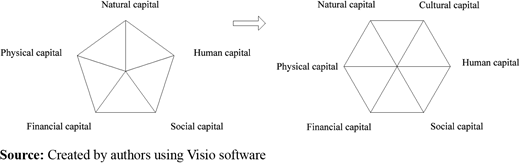
Pierre Bourdieu proposed the concept of “cultural capital” (Çiftçi and Karadag, 2022). In addition to being substantial capital, cultural capital can also be transformed into financial or social capital (Jæger and Møllegaard, 2017). Inheriting cultural capital is an effective method of economic development and national cultural protection in minority areas. It is necessary to identify the advantages of local culture by respecting the development of national culture and guiding the transformation of cultural capital into economic capital to promote the quality and efficiency of assistance measures. Therefore, adding cultural capital to the composition of livelihood capital can effectively supplement relevant research on farmers’ livelihood capital in minority areas and expand the composition of farmers’ livelihood capital in Yunnan minority areas, as shown in Figure 2.
2.2 Index selection
2.2.1 Natural capital.
As farmers’ most important capital, natural capital includes all kinds of natural resources, such as pasture, forest and land, and it is most closely related to the vulnerability of livelihood (Nasrnia and Ashktorab, 2021). The excessive use of natural capital increases the frequency and harm caused by climate change (Sina, 2019). Many disasters caused by climate change, such as rainstorms, debris flows and droughts, reduce natural capital.
2.2.2 Physical capital.
Physical capital includes the tools and infrastructure for farmers to make a living, including road conditions, means of transportation, safe shelter, perfect drinking water, sanitation facilities, clean energy, production tools and equipment (Delgado Jiménez et al., 2022; Nasrnia and Ashktorab, 2021). In general, the difference in the location and area of farmers’ houses considerably affects their physical capital: farmers living in dangerous houses face greater livelihood vulnerability because it is difficult for them to meet their basic safety requirements.
2.2.3 Financial capital.
Financial capital is a source of finance such as cash, savings and income, which helps farmers adopt specific livelihood strategies and achieve targeted livelihood outcomes (Nasrnia and Ashktorab, 2021). Farmers in minority areas lack employment opportunities, and it is difficult to conduct various income-generating activities, which leads to persistent poverty and restricts their ability to face climate change (Barjis et al., 2013).
2.2.4 Social capital.
Social capital plays a vital role in resisting the risks associated with climate change (Omolo and Mafongoya, 2019). The connections generated by interpersonal interactions are the foundation of social capital, and the expected results can be achieved using relational resources in social organisations (Burt, 2000). Social capital includes social networks and interpersonal relationships from social networks (Rodgers, 2019). Improving social capital can enhance mutual trust and enable people to efficiently accomplish tasks through sharing and cooperation (Jones et al., 2014; Levin et al., 2016). Social capital is essential for healthcare and medical care (Zhang et al., 2006). Low health service coverage and insufficient social capital cause farmers to suffer additional pressure from climate change and increase their livelihood vulnerability (Ofoegbu et al., 2017).
2.2.5 Human capital.
Human capital reflects people’s education, skills and abilities (Delgado Jiménez et al., 2022; Quandt, 2018). Human factors such as age and education level affect vulnerability to climate change and significantly impact farmers’ livelihoods (Omolo and Mafongoya, 2019). People’s low level of education makes them unable to engage in income-generating activities outside agriculture, and they often show more serious livelihood vulnerability when experiencing severe climate change and disasters.
2.2.6 Cultural capital.
Cultural capital is essential to promote social development (Tubadji et al., 2017), as it can provide employment opportunities for people, who can further expand their social networks and enhance their competitive advantage by participating in various cultural organisations (Wojciechowska and Topolska, 2021). Cultural capital in the form of cultural activities can enrich farmers’ lives and promote the improvement of social and financial capital, which have both cultural and economic value.
Based on the above analysis, the evaluation system of farmers’ livelihood capital in Yunnan minority areas is shown in Table 1.
2.3 Calculation of livelihood capital
A scientific method for calculating indicators is essential to ensure the accuracy of farmers’ livelihood capital measurements. The entropy method can effectively avoid the interference of subjective factors and obtain a more accurate and effective evaluation index weight and evaluation value of livelihood capital (Fan et al., 2022; Guo et al., 2017). In addition, the traditional entropy method uses cross-sectional data, which lacks the investigation of the time dimension. To analyse the three-dimensional spatio-temporal data formed by indicators, regions and time more comprehensively, the global entropy method is used to improve this deficiency, and the steps are as follows.
2.3.1 Constructing global evaluation matrix.
n indicators () are used to calculate the livelihood capital of m farmers in T years, and the annual cross-sectional data tables are arranged in chronological order to form a global evaluation matrix of mT × n, which is recorded as:
where i represents the farmers; j specifies the indicators; m denotes the number of farmers, and T denotes the number of years.
2.3.2 Standardisation of data.
Because different data are rather different in dimensions, orders of magnitude and units of measurement, the range method is used to standardise the data, and the formula is as follows (Guo et al., 2017):
2.3.3 Calculate the weight of indicators.
Based on the standardised values, we calculate the weights of each indicator in the evaluation system as follows:
2.3.4 Calculation of livelihood capital.
Based on the standardised values and weights of various indicators, the value of farmers’ livelihood capital can be calculated:
3. Study area and data
3.1 Study area
The study area was Menglai Township, Cangyuan Wa Autonomous County, Yunnan Province, China. Cangyuan County borders Myanmar to the west and south, with a border of 147.08 kilometres, and the mountainous area accounts for 99.2% of the county’s total area. As the largest Wa county in China, the Wa population accounts for approximately 85%, 40% and 15% of the Wa population in the county, China and the world, respectively. The Menglai Township is located in the middle of Cangyuan County. The relative elevation difference in the township is as high as 1,605 metres, and the mountainous area accounts for 98% of the total area. The natural environment is harsh and is typically representative of minority areas. In recent years, farmers in Menglai Township have suffered from the negative impacts of severe climate change, which threatens the safety of farmers’ lives and property considerably and hinders them from achieving sustainable livelihoods.
The relocation of farmers in Menglai Township has been fully completed. Before relocation, farmers lived in areas with harsh natural conditions, severe climate change, frequent geological disasters and high livelihood vulnerability. After relocation, the natural environment has become more liveable, and road traffic is more convenient, greatly enhancing farmers’ natural and physical capital. At the same time, with the gradual improvement of supporting policies, the accessibility of relocated farmers to education, health, cultural products and services has improved substantially; the social network has further expanded, and the ability to increase income has been steadily enhanced, which has extensively promoted farmers’ livelihood capital.
3.2 Data
The data used in this study were obtained from the continuous and in-depth field investigation in Menglai Township, Cangyuan County, from 2015 to 2021. Data were collected from 7,084 samples, including 1,012 farmers in this township from 2015 to 2021, of which 144 relocated were farmers and 868 non-relocated farmers, covering all poor farmers in this township. Moreover, we referred to the Statistical Bulletin of National Economic and Social Development, Yearbook of Lincang, Yearbook of Cangyuan Wa Autonomous County and related government documents in Cangyuan County from 2015 to 2021 to provide a suitable database for this study.
4. Empirical analysis
4.1 Methodology and model
4.1.1 Propensity score matching method.
To explore the influence of relocation on farmers’ livelihood capital, relocated farmers were taken as the treatment group and non-relocated farmers as the control group. However, because the relocation of farmers is not randomly selected but related to the local natural environment, climate conditions and development level, evaluating the impact of relocation would involve selective bias; thus, a more effective solution is the PSM method (Dza et al., 2021).
Although PSM can balance the data between treatment and control groups based on observable factors, samples from different groups show significant differences in many unobservable characteristics. Therefore, it is necessary to use the DID to eliminate the deviation caused by unobservable factors and address the endogenous problem (Huang et al., 2017).
4.1.2 Difference in difference method.
DID is considered the most effective scientific method for evaluating the impact of policies or shocks (Li et al., 2018; Luo et al., 2023) and regards relocation as an independent quasi-natural experiment. By making twice differentials between the two groups of samples, we obtained the net effect by which farmers’ livelihood capital is entirely affected by relocation. The DID model is expressed as follows:
where i signifies the farmer; t specifies the time, and Yi,t denotes the livelihood capital of farmer i in year t. The estimate α1, coefficient of didi,t, is the DID estimator that we focused on, indicating the change degree of livelihood capital of relocated farmers compared to those not relocated. α0 is a constant term, and α2 is the estimation coefficient vector of the control variable Xi,t; uiandλt control for individual and time effects, respectively, and εi,t is the random error term.
However, the premise of the DID method is to ensure that the policy is exogenous, that is, the assumption of a parallel trend should be met, and that farmers’ move is entirely random (Dehejia, 2005). Therefore, it is necessary to use the PSM method to match before the difference, obtain the sample that is least affected by endogenous problems and satisfy the parallel trend hypothesis (Fu et al., 2021).
4.1.3 Propensity score matching and difference in difference method.
The advantage of the PSM method is that it can avoid sample selection bias. However, it is difficult to solve the endogenous problems caused by the missing variables. The advantage of the DID method is that it can deal with the endogenous problems based on two differences and achieve the “policy treatment effect”; however, it cannot solve the sample selection bias. Combining these two methods can yield the net impact of relocation on farmers’ livelihood capital (Shao et al., 2020). The PSM-DID model is as follows:
where reflects the livelihood capital level of farmer i in the t year after matching; β0 is a constant term; β1 is the change degree of livelihood capital of farmers in the treatment group compared with those in the control group after matching; β2 is the estimation coefficient vector of control variables Xi,t; and the meanings of other variables are the same as those in Formula (9).
4.2 Variable selection
The variables include explained variable, explanatory variable and control variables. Table 2 presents descriptive statistics for each variable.
4.2.1 Explained variable.
Based on the livelihood capital evaluation system constructed above, the value of farmers’ livelihood capital from 2015 to 2021 was calculated as the explained variable, and the influence of relocation on farmers’ livelihood capital was calculated according to the changes in farmers’ livelihood capital in the treatment and control groups after relocation.
4.2.2 Explanatory variable.
The interactive item did is the core explanatory variable, which is defined as “Treat×T”, where Treat is a dummy policy variable. Treat = 1 indicates that the farmer moved in 2017; otherwise, Treat = 0. T is a time dummy variable, and T = 1 represents the year after relocation, that is, 2017–2021. T = 0 indicates the year before relocation (i.e. 2015 and 2016). The coefficient of did is a difference estimator representing the net impact of relocation on farmers’ livelihood capital.
4.2.3 Control variable.
This study also controlled for other factors affecting farmers’ livelihood capital, such as family population, causes of poverty and administrative villages. With an increase in population, the demand for livelihood capital has increased (Wang et al., 2021), and the causes of poverty reflect the shortcomings in farmers’ livelihoods. According to the actual development in this area, the causes of poverty are divided into capacity loss, increased burden, factor shortage, accidental impact and lack of self-development motivation, and they are assigned values from 1 to 5 to control for the effects of different causes of poverty. An administrative village is a comprehensive reflection of the natural environment and infrastructure where farmers live. The different administrative villages to which farmers belonged were assigned a value of 1–9, effectively controlling for the influence of different administrative villages on farmers’ livelihood capital.
4.3 Empirical results and analysis
4.3.1 Analysis of matching quality
4.3.1.1 Balance test.
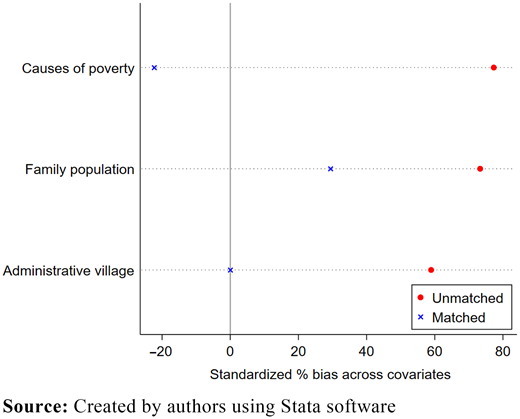
It is necessary to test whether the variables significantly reduce individual differences after matching. The matching quality is ideal if the standardised deviation between the two groups is dramatically reduced (Rubin, 1985). As shown in Figure 3, the differences in variables before matching are significant. In contrast, the standardised deviation of the variables after matching is reduced, and the matching is effective.
The details of the balance test are listed in Table 3. The standardised deviation of each variable decreased from 58.9% to 77.3% before matching to −22.3% to 29.4% after matching, and the absolute value of the standardised deviation decreased by 59.9%–100.0%. Differences in the individual characteristics of each variable were controlled, indicating that matching was successful. In addition, the model’s pseudo R2 value decreased from 0.182 to 0.017, and the statistics of LR chi2 decreased from 1055.18 to 46.76; this means that the matching satisfies the conditional independence hypothesis, which reduces the distribution difference of variables between the treatment group and the control group and eliminates the estimation bias caused by sample self-selection. All the above conclusions show no significant difference between the treatment and control groups after matching, and the two groups of samples are similar in various pre-treatment characteristics; thus, the matching passed the balance test (Fei and Xza, 2021).
4.3.1.2 Common support test.
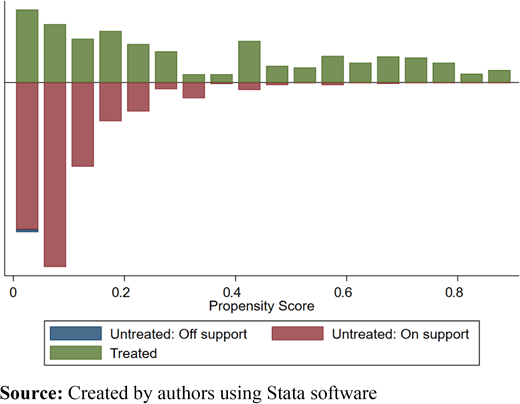
Although the above results show that the deviation is reduced by matching, if all the farmers in the treatment group have higher tendency scores and the farmers in the control group have lower tendency scores, the matching quality is still poor, and only matching in the common support domain is effective. As shown in Figure 4, the observed values of the samples in the two groups are primarily within the common value after matching, and only a few samples are lost (all 1,008 samples in the treatment group are matched, and only 31 samples in the control group are lost). The overlapping area of the tendency scores of the two groups of samples is large, and the common support hypothesis is satisfied, further ensuring the accuracy of the net impact of relocation.
4.3.2 Analysis of propensity score matching and the difference-in-difference.
Table 4 reports the regression results of the PSM-DID. Models (1)–(3) adopt the stepwise regression method of adding control variables including family population, causes of poverty and administrative villages. The coefficients of did are significantly positive after the control variables are gradually added. Model (3) shows that at a significance level of 1%, the effect of relocation is approximately 0.1567. In other words, relocation can significantly increase farmers’ livelihood capital by 15.67%, improve the livelihood capital of relocated farmers and effectively reduce their livelihood vulnerability and the adverse impact of climate change.
4.4 Robustness test
The above analysis shows that relocation significantly improves farmers’ livelihood capital. To ensure the reliability of this conclusion, a parallel trend test, a replacement matching method and a placebo test are used to verify the robustness of the results.
4.4.1 Parallel trend test.
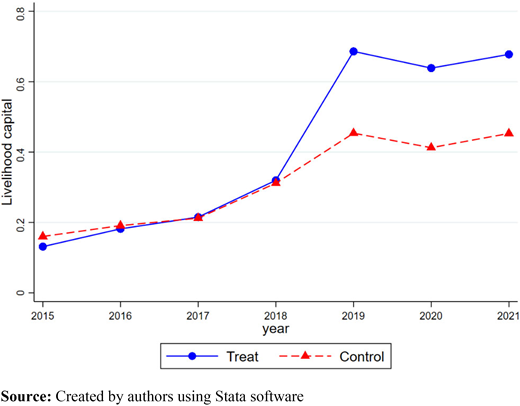
The DID method requires that farmers in the treatment and control groups maintain a consistent development trend when relocation does not impact them, and will not have systematic differences over time; that is, they will meet the assumption of a parallel trend; otherwise, the estimation will be biased (Zhang et al., 2019). Based on an existing study (Tan et al., 2018), Figure 5 shows the development trend of farmers’ livelihood capital in the treatment and control groups from 2015 to 2021. The development trends of farmers’ livelihood capital in the two groups almost coincide before relocation, and the changing direction shows no significant difference. However, the changes in livelihood capital trends between the two groups after relocation suggest that relocation has had a specific impact on farmers’ livelihood capital. The assumption of a parallel trend can be satisfied, and it is reasonable to regard relocation as a quasi-natural experiment.
4.4.2 Replacement matching method.
Different matching methods have different weights and matching values, which leads to different matching results. Generally speaking, with the increase in sample size, various matching methods become more accurate. If the conclusions obtained by different methods are consistent, the results can be considered robust (Del Prete et al., 2019). Thus, we use radius matching (RM), kernel-based matching (KBM), spline matching (SM) and local linear regression matching (LLRM) to match the treatment and control groups. Table 5 presents the regression results for the four matching methods. Regardless of the matching method adopted, the coefficient value and symbol of did have not change substantially, which is consistent with the results of the benchmark regression. At the significance level of 1%, relocation increased the livelihood capital of farmers by 15.53%–15.67%, which shows that the research conclusion is robust.
4.4.3 Placebo test.
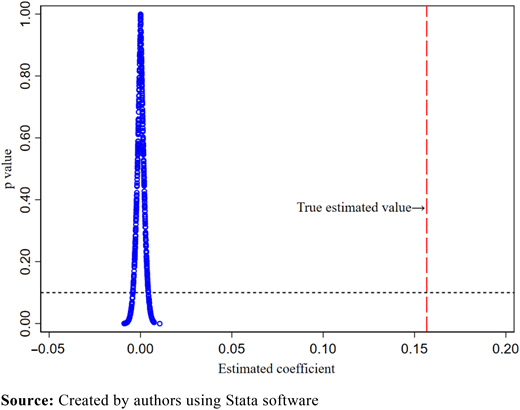
We randomly select the treatment group and relocation time and repeat the placebo test 500 times, from which 500 estimation coefficients can be obtained. Figure 6 shows the kernel density distribution of the coefficients. The coefficients of did evaluated by random sampling are mostly insignificant. Moreover, the true estimated value in the benchmark regression is far from the random sampling distribution map and significantly different from the coefficient obtained in the placebo test. This shows no significant difference in the livelihood capital of farmers in the treatment and control groups after removing the impact of relocation and excluding the influence of other unknown factors. Therefore, relocation significantly enhances farmers’ livelihood capital, and the estimation of the PSM-DID model is robust.
4.5 Discussion
The low stock and unreasonable structure of livelihood capital are the fundamental reasons why it is difficult for farmers to cope with the negative impact of climate change and the vulnerability of livelihoods. Vulnerability caused by climate change is closely related to sustainable livelihoods, which is mutually causal. Relocation is a powerful measure to fundamentally break and reconstruct farmers’ original livelihood capital. The results show that farmers’ livelihood capital significantly increased by 15.67% after relocation; further, farmers reduced their dependence and pressure on natural capital, making them less vulnerable to the negative impact of climate change. Moreover, it can broaden income sources and increase opportunities to obtain social and financial capital (Birk and Rasmussen, 2014). However, many government departments are often more concerned about economic development and infrastructure construction, ignoring that farmers need the coordinated development of various types of capital in the context of climate change. At the same time, meteorological and environmental protection departments failed to combine economic and social development planning when formulating countermeasures to cope with climate change, which led to a relatively fragmented division of labour among various departments and failure to form a joint force for development (Luo et al., 2023). Therefore, the conclusion of this study provides essential insight for farmers to eliminate livelihood vulnerability caused by poverty and climate change and realise sustainable livelihoods.
5. Conclusion
As the “first project” in the battle against poverty, the poverty-alleviation relocation is a remarkable feat in the history of human migration and an essential part of the “China Plan” to deal with climate change and eliminate poverty in the new era. However, relocation not only brings about a change of spatial position but is also a complicated process of “disintegration-reconstruction” of farmers’ capital. Improving farmers’ livelihood capital and realising its optimisation and sustainable development can fundamentally enhance farmers’ ability to cope with climate change, reduce their livelihood vulnerability and achieve sustainable livelihoods.
Based on the characteristics of minority areas, this study constructed an evaluation system of farmers’ livelihood capital in Yunnan minority areas and increases the consideration of local cultural capital. Based on a continuous and in-depth field survey in Menglai Township, Cangyuan Wa Autonomous County from 2015 to 2021, the PSM-DID method was used to evaluate the effects of relocation on farmers’ livelihood capital. The parallel trend test, replacement matching method and placebo test further proved the robustness of the results. The results show that relocation increased the livelihood capital of farmers by approximately 15.67%, reduced their livelihood vulnerability and significantly improved their livelihood capital.
This study has theoretical and practical significance for academic research and policymaking. Based on the characteristics of minority areas, the original sustainability analysis framework was improved to provide scientific theoretical references for studying sustainable livelihood issues. A scientific and practical evaluation system of farmers’ livelihood capital in minority areas is conducive to a more systematic and clear understanding of the livelihood capital level and existing shortcomings of farmers in minority areas after relocation and the implementation effect of policies; Thus, it provides a scientific basis for relevant decision-making departments to establish a long-term mechanism to promote the steady improvement of farmers’ livelihood capital after relocation in minority areas and realise comprehensive and sustainable development in minority areas. However, it also provides a policy reference for farmers in other poor areas to better deal with climate change and achieve sustainable livelihoods. To achieve the goal of sustainable development, the government needs more functional departments to participate in the formulation and implementation of environmental policies, combine economic and social development planning and form a joint development force with relevant departments in the natural, physical, financial, social, human and cultural fields to ensure the close connection of different policies and avoid resource waste and policy failure.
The limitation of this study is that the data collection, evaluation system construction and empirical analysis only focus on one region, and whether the research conclusion is universal requires further discussion. Therefore, in future research, it will be necessary to expand the research area and compare different areas to provide more universal conclusions and suggestions.
Funding: (1) This work was supported by the National Natural Science Foundation of China [grant numbers 72064025]; (2) and the Ministry of Education Planning Fund [grant numbers 20XJA630002].