The purpose of this paper is to investigate whether awareness to climate change and its adverse impacts have any significant linkages to behavioral changes amongst individual managers who undertake initiatives to minimize/mitigate the impacts.
A theoretical framework based on different aspects of awareness possibly leading to behavior change has been proposed. Subsequently, the results from an empirical research based on a survey questionnaire as research instrument, are analyzed using exploratory factor analysis and structural equation modeling to validate the framework and the research question.
Awareness to the climate change phenomenon does lead to significant behavioral change amongst managers in the industry, alleviating the potential and existing threats of climate change phenomenon. In particular, the awareness to health impacts of climate change has significantly impacted individuals taking up the cause to lead climate change campaigns to counter its onslaught.
The research is conducted in a population confined to a single region in India. Its scope needs to be broadened to encompass the entire country.
The findings should lead to widespread awareness campaigns emphasizing on awareness to adverse health disorders as a direct result of climate change and its other adverse impacts, and also the individual initiatives that can be taken up as well as what the industry can do.
1 Introduction
Over the last couple of years, there has been an upsurge of public concern on the phenomenon of climate change. According to Pachori (Whaley, 2008a, b), the level of public awareness to the underlying causes and implications of climate change is quite unprecedented and unexpected. The public has largely become convinced about the “human signature” on climate change and Pachori feels that correct information associated with the matter needs to be provided to communities so that their concerns and interests are focused in the right direction and allocated efficiently.
Among the many causes leading to the phenomenon of climate change, global warming is seen as the main driving force behind climatic degradations. Human activities such as industrialization, use of fossil fuels, and deforestation are widely accepted as the main contributors to global warming. Consequently, these activities lead to unusual temperatures and variability in rainfall which cause heat stress, diseases (cholera, malaria, and diarrhea), mass migration, increase in morbidity, and rise in sea‐level, etc. In fact, all these effects are being discussed at policy forums and being taken up by international/multilateral bodies such as the United Nations and other national organizations, to bring about public awareness of the severity in this matter (Asian Development Bank (ADB), 2007, 2008).
However, after policy makers have designed their instruments for climate change abatement and have suitably drawn out the strategies, it is ultimately up to the leaders, managers and public at large to take it upon them to translate the policies into action plans, implement them in real terms and bring about actual changes in abatement. For this to happen, leaders, managers, and the public first have to be aware of the phenomenon and its drastic implications; this awareness would perhaps lead to a behavioral change in terms of taking up initiatives which could address the climate change concerns.
One of the key human activities which have been widely accused of contributing exponentially to global warming are “industries” involved in fossil‐fuel consumption chimneys, thermal power plants, green house gas (GHG) manufacturing processes, and vehicular transportation. Keeping all these factors in mind, the role of responsible managers in leading industries towards sound development, while in a sustainable manner so as not to harm the health of society due to lack of sufficient climate change control, is of primary importance in today's world.
Managers need to act as catalysts for activity and commitment to the climate change cause, take responsibility for innovating capturing plants with better capturing design for energy efficient technology free of GHG emissions, and lead, promote and campaign for organizations and individuals to be involved in public work towards preventing the perils of climate change.
Hence, managers themselves need to gear their behavior towards becoming changed leaders who promote climate sustainability. The following questions must be addressed before proceeding:
Does increased awareness regarding climate change lead to any behavioral changes amongst managers and leaders to actively take up mitigation and abatement projects?
What are the main drivers for significant impact on behavioral change amongst managers – is it the awareness of the phenomenon of climate change, or is it the awareness of climate change implications on mankind, or is it both?
To answer these questions, the current research undertakes an empirical study of managers in India, using a survey questionnaire. A questionnaire survey is used as a research instrument to measure the awareness level on different aspects of climate change and to determine any statistical significance between awareness and behavioral change.
However, before going into the conceptual framework, it is important to first consider climate change implications in Asia and evaluate the distinct features associated with the region.
2 Climate change implications in Asia
In recent times, Asia has witnessed an unprecedented economic growth: “As if overnight, where was once a village, a metropolis now stands” (ADB, 2007); where new industries have risen and populations and incomes have increased. However, along with this development, demand for energy, transportation needs and land use has skyrocketed, accelerating fossil fuel use and deforestation. All these features have put a tremendous burden on the environment and must have surely contributed significantly to climate change. In other words, Asia is “fast becoming a major source of GHG emissions” (ADB, 2007).
To confirm that under the current scenario the energy growth is startling in Asia, as per the estimates given by the International Energy Agency, energy use in Asia will increase to 112 percent by 2030, when Asia would represent 36 percent of the world's energy consumption and 42 percent of global energy consumption related to CO2 emissions. Also, a vehicle boom is currently driving Asia's demand for transportation, which may further aggravate the climate change scenario due to the direct link between transportation and GHG emissions.
Apart from a startling growth in energy sector, Asia's unsustainable land use practices have put large volumes of GHGs into the atmosphere. For instance, in Indonesia, more than 75 percent of total GHG emission comes from deforestation.
Talking of impacts, water scarcity on account of climate change would be of great particular concern in Asia (Whaley, 2008a, b). The melting of glaciers, particularly in the Himalayas, may affect all communities who depend on stable water supply coming from these glaciers and would even raise sea‐level. The rise in sea‐level can lead to intrusion of saline, brackish water into the groundwater systems in many Asian countries, making it difficult for people to meet their needs for safe drinking water and other basic requirements.
Because of the warmer climate in Asia, this continent is at risk of greater climate‐sensitive diseases such as malnutrition, malaria, and cholera. Food scarcity would give rise to malnutrition, warmer temperatures conducive to breeding of larger mosquito and other insect populations which potentially carry malaria, and flooding of unclean water increasing incidences of cholera.
Further, one must also keep in mind that along with all these impacts, climate change is an important issue from the point of view of development and equity because the poorest population is normally the most affected. According to Pachori (ADB, 2008), “Poor people, not only in developing countries but also the poor in developed countries, will be the hardest‐hit victims.”
At this point, the authors would like to clarify that the impacts of climate change as described above might come upon on account of a totality of different factors. Consequently, in addition to climate change, other factors like the population growth, unsustainable use of resources and perhaps wrong governance may also have significant impact on the results obtained. So, the effects would really be on account of a host of factors but climate change certainly would be a dominant one.
3 Knowledge and awareness of climate change
There have been many endeavors to assess climate change and its various impacts in the form of adaptations and vulnerability. These actions have come through a range of physical, biological, and social science disciplines, which have consequently emphasized a wide range of methods and tools. These studies include detection of climate change in biotic and physical systems which identify causes and consequences of change, cost and relocation effects, treating uncertainties, integrating effects across sectors and regions and applying decision analytic frameworks for understanding adaptation (McCarthy et al., 2001).
Over the last few years, there have also been numerous research initiatives to explain the gap between environmental awareness, environmental knowledge, and actual display of pro‐environmental behavior (Kollmus and Agyeman, 2002). Among the frameworks researched for analyzing pro‐environmental behavior, the oldest and simplest models were based on a linear progression of environmental knowledge which lead to environmental awareness and concern, and consequently to pro‐environmental behavior (Burgess et al., 1998).
Using the learning from the research, it was assumed that educating people about environmental issues would automatically result in more pro‐environmental behavior (Burgess et al., 1998). On the contrary, later research proved that increased knowledge and awareness did not necessarily lead to pro‐environmental behavior. Though many non‐governmental organizations (NGOs) and government agencies use the above‐mentioned assumption (Owens, 2000) to develop public understanding of sustainable development, behavioral change is much more complex, and leads to large discrepancies in results (Newhouse, 1991).
Thus, one may observe that knowledge and awareness, along with various other variables such as societal pressures and an individual's ability to change behavior, can lead to pro‐environmental behavior. Drawing from such insights, the authors now try to relate awareness and knowledge of climate change to actual behavioral change. However, we need to have a clearer understanding as to what are the characteristics of awareness and knowledge on climate change that are observed globally in recent times.
Generally speaking, climate change is acknowledged as a global concern. But it is also important to emphasize on the fact that every human being has the capacity to make a difference in fighting climate change. For instance, even small behavioral changes in daily life can contribute to reducing GHG emissions without affecting the quality of life. On the contrary, sometimes such endeavors may also save money.
However, since awareness itself is a very broad construct, research does not establish what aspects of awareness are clearly understood by individuals globally. On a general level, the communities in the UK do express high concern regarding climate change (Pidgeon et al., 2003; Norton and Leaman, 2004). Still, the importance of climate change is often superseded by other pressing issues in people's lives such as family, safety and finances (Norton and Leaman, 2004; Poortinga and Pidgeon, 2003).
Although individuals generally understand the principles of climate change, the consequences are perceived as distant and more relevant to other vulnerable communities or future generations. The current research also revealed that individuals had difficulties relating climate change to their everyday lives and behavior, and hence, individuals tended to psychologically distance themselves from the issue. Individuals also raised many questions in terms of how climate change could be addressed and who should take responsibility for it. Also, there exists a gap between the perceptions regarding climate change and actual action taken towards mitigation.
Providing information about the foundation of climate change has often been considered to be the first step, although this alone does not change behavior (Fischoff, 1995). However, spreading awareness and knowledge have been identified as important elements in addressing the climate change issue. The communication maybe on various levels of interaction – whether on an individual's understanding of the phenomenon and its impacts, whether on possible initiatives which individuals themselves can take to address the concern, or whether communities should force industry to take action to address the issue. All these preceding points still need to be determined and decided upon as a function in the context of the local socio‐cultural characteristics of the region.
Incorporating the insights and findings of many such models undertaken during research studies, the authors in this paper set up a conceptual framework for a behavioral change model in the Asian setting in the context of climate change scenario in the region. Starting from the linear progression model, where knowledge and awareness lead to behavioral change, the research considers awareness of climate change on different aspects and in different phases, exploring whether these factors have any significant impact on behavioral change.
It may be pertinent to explain, at this stage, that the research was undertaken for academic purposes and to help management students appreciate that they could have a role to play in helping the region face the challenges of climate change and to help their organizations to spread awareness and take up measures to mitigate the impacts and prevent it from becoming worse.
Hence, the research compares awareness of the nature of the climate change phenomenon, the probable reasons leading up to it, awareness of what an individual can do to help address the concern, and awareness of what industry can do. The research is conducted in an Asian economic context.
As indicated in Section 1, since managers do hold a key position in leading and bringing forth behavioral changes to address climate change, the authors try to implement the framework on a target population of junior to middle to top managers in the greater Kolkata area where many industries abound.
4 Developing the conceptual framework
As indicated in the previous section, the authors would like to start with the basic model of linear progression (Burgess et al., 1998). Here, understanding the phenomenon of climate change, the awareness regarding the same, reasons leading to it and what individuals and industry can do to instill behavioral change for pro‐climate change friendly behavior are realized by studying the following different aspects of awareness.
General awareness of reasons causing the climate change phenomenon consist of industrialization, burning fossil fuels, deforestation, and unlimited consumption of resources and energy leading to GHG emissions.
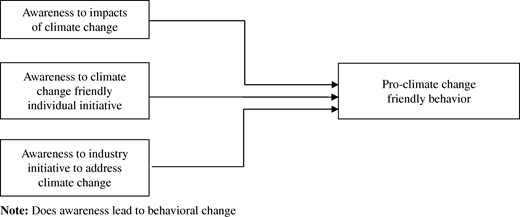
Subsequent to awareness of causal factors of climate change, three specific pillars of an individual's awareness will be considered (Figure 1):
- 1.
Awareness of effects/impacts of climate change
This aspect of awareness is comprised of the atmospheric temperature rise in the next decade, melting of glaciers, prevalence of disease, submerging islands, sea‐level rising, water scarcity, increased stress and disease, increased morbidity from diarrheal disease, increased endemic mortality, rise in coastal water temperature which would exacerbate toxicity of cholera, mass migration, suffering of crop production, and cut revenues and increased spending needs worsening public finances.
Each of the above items was measured on a four‐point Likert scale: 1 – not very aware, 2 – little aware, 3 – aware, and 4 – very aware.
- 2.
Awareness of an individual's own initiative to address climate change
This aspect of awareness includes an individual's knowledge to use solar lighting systems, energy efficient lighting (light emitting diode (LED)‐based decorative lighting), emission‐free cars, car pools to reduce trips, public transport rather than private cars, environment friendly refrigerators, climate change friendly hair sprays, environment friendly transformers which reduce paper usage (saving trees), and other resources in place of gasoline.
These variables were also measured on a four‐point Likert scale: 1 – not very aware, 2 – little aware, 3 – aware, and 4 – very aware.
- 3.
Awareness of an individual's awareness of what their respective industries can do
This aspect of awareness includes an individual's realization that industry can really contribute to mitigate the impacts of climate change by using non GHG‐emitting production systems such as energy‐efficient input materials, cleaning agents, boilers, and cooling systems. Furthermore, industries can ensure that buildings have adequate insulation in order to minimize the energy needed for cooling in summer, use natural light wherever possible in order to reduce demand for energy, carry out regular energy audit to identify where it is being lost, use renewable energy in production by using/putting waste heat back into production through co‐generation.
These variables were also measured on a four‐point Likert scale: 1 – not very aware, 2 – little aware, 3 – aware, and 4 – very aware (ADB, 2007).
Exploring the link between the three pillars of awareness of behavioral change mentioned above would help address the climate change phenomenon. The authors now need to set up constructs to define what aspects of behavioral change are being looked at.
Following the ADB publication referred to above, the authors consider the pro‐climate change behavior in terms of: behavioral change to pro‐climate change friendly initiatives, such as promoting (3R) reduce, reuse, and recycle, starting social campaigns to increase awareness of climate change, using emission‐free cars, using solar energy, reducing gasoline use, using GHG‐free items, investing in climate change funds, and donating monies to climate change movements (Figure 1).
To measure the variables under this section, the question considered was how keen are you to get involved in the following initiatives to prevent/minimize the effect of climate change? Not keen, little keen, keen, and very keen.
In order to validate the above framework and determine what factors significantly lead to behavioral change, the researchers/authors proposed an empirical research using a survey questionnaire as the research instrument. The questionnaire followed the same structure as presented in the conceptual framework above, having a section each for gathering demographic information from the respondents, measuring awareness of climate change, measuring awareness of individual initiative to address/mitigate the impacts of climate change, measuring awareness of individuals with regard to what initiatives industry can undertake to address climate change, and finally, measuring willingness/propensity in behavioral change to pro‐environmental behavior.
5 Methodology
Under each construct measuring awareness, there were many items necessary for inclusion. For instance, under the construct of individual awareness with regard to what industry can do, the following items were included: using climate change friendly production systems, input materials, cleaning agents, boilers, non GHG‐emitting cooling systems, adequate insulation for minimizing energy use in the summer, and natural light wherever possible for reducing energy demand.
Hence, to identify sub‐categories of variables with commonalities or similar themes under each construct, exploratory factor analysis, in particular principal component analysis (PCA), was used to show groups of significantly correlated variables. This was carried out under each aspect of awareness and also on the construct for behavioral change.
The appropriateness of using factor analysis was measured by the Kaiser‐Meyer‐Olkin (KMO) index and by Barlett's test of sphericity. KMO measure of sampling adequacy predicts if the data are such that factor analysis can be carried out in a reliable manner and the factors thus extracted can be accepted with statistical significance. This measure is calculated based on correlations and partial correlations observed within the data and a value of greater than or equal to 0.50 is considered statistically acceptable. The Barlett's test of sphericity also determines if the data are appropriate for factor analysis. For the factor analysis to be appropriate, the correlation matrix of the items constituting a factor must be close to an identity matrix. Barlett's test measures if this is indeed so. If χ2 associated with this test is less than 5 percent, it implies that the correlation matrix is indeed close to the identity matrix. Hence, factor analysis can be carried out.
The number of factors to be retained factor analysis was determined by eigen values and scree plot. Furthermore, the varimax method of rotation was incorporated to clearly identify which variable loaded on which factors. The factors obtained thereby, were then considered as unobserved variables, or latent constructs, in the next part of the analysis, which consists of a linear structural equation modeling (SEM) approach (Jöreskog and Sörbom, 1993) to validate different models of causal relationships between the unobserved variables determined earlier from the factor analysis section.
In the SEM scenario, the unobserved variables identified in the three phases of awareness, the impacts of climate change, the individual's initiative to address climate change, and awareness of what industry can do, were regarded as independent variables, although allowed to correlate with one another. The unobserved variables identified in the construct for behavioral change were thereafter considered as dependent variables, which again could well correlate with each other.
The significance of the model was evaluated by the χ2‐value, the corresponding degrees of freedom and the associated p‐value. The individual links between any two variables were tested by using the critical ratio, which is an observation on a random variable that has approximately standard normal distribution.
Using a significance level of 0.05, any critical ratio that exceeded 1.96 in magnitude was significant. The conventional t‐test was exact under the assumptions of normality and independence of observations, regardless of the sample size. The test based on critical ratio depended on the same assumptions, but with a finite sample size the test was only approximate. All the same, the critical ratio was interpreted as if there were a significant link between, say awareness and behavioral change, which implied that the former latent construct directly influenced the latter. In our analysis, the study considered different structural models, which were essentially causal in nature. For each of these models, the various parameters of the fit were considered and the final model with the best significance level was presented in detail.
The latent variables in each model were measured by the manifest or indicator variables (items in the questionnaire) used in the research instrument. A limitation of this approach was that the multivariate normality was assumed although the tests were conducted for testing univariate normality by plotting normal probability plots.
6 Empirical research (Kolkata area)
Using the survey questionnaire as the research instrument, the empirical research was implemented on individual managers in the greater Kolkata area.
For this purpose, a multistage sampling procedure was proposed in which a random sample of manufacturing companies was drawn up and within each company five selected managers were asked to answer the questionnaire. However, many companies declined, saying that they were facing a down turn because of the economic recession prevalent.
Finally, the authors requested a senior industrialist, Dr Basudeb Sen – former Chairman of Industrial Investment Bank of India, former Executive Director of Unit Trust of India, President of Calcutta Business School – to help them obtain a sample of responses on which data analysis could be carried out. Under his supervision, managers from different manufacturing facilities answered the questionnaire and the following data below was available to the authors for analysis.
The final sample size was 58, with a 12 percent margin of error. The small sample size and the fact that it was not a random sample remained a limitation to this research. Nonetheless, the data were answered by real operating managers and this had significant value on which insights could be drawn. So, despite this limitation, we now proceed to present the data analysis.
7 Data analysis
As explained earlier, the questionnaire had one section on demographic information with regard to the respondents' educational qualification and income age. The next section, which we refer to as Question 1, pertained to awareness of reasons leading to global warming/climate change along with awareness of effects and impacts of climate change.
The section Question 1 is followed by awareness of what individuals can do, which hereafter we refer to in Question 2. This is followed by awareness of what industry can do, referred to in Question 3. Finally, keenness/propensity to change behavior to act pro‐climate change friendly is looked at in the last section, referred to in Question 4.
Exploratory factor analysis: PCA.
We present the results of factor analysis for each of the four sections in the questionnaire:
- 1.
Reasons and impacts of climate change.
- 2.
Awareness of individual initiative.
- 3.
Awareness of what industry can do.
- 4.
Propensity for behavioral change.
7.1 Factor analysis results on reasons and impacts on climate change
The basic indicators of the “goodness of fit” of factor analysis to the data obtained were given in Table I.
Since the KMO measure was 0.851, a figure considered quite high, the data were appropriate for factor analysis.
Also, the Barlett's test had a significance level of <0.05, which validated the suitability of factor analysis.
Now using PCA, three factorsz having eigen values more than 1.00 were extracted. PCA involves a mathematical procedure that transforms a number of (possibly) correlated variables into a (smaller) number of uncorrelated variables called principal components.
The three factors with their eigen values and total cumulative variance are given in Table II.
Using varimax rotation and considering the loading plots generated thereby, the three factors loaded on the following variables and were labeled accordingly (Table III).
7.2 Factor analysis on awareness of individual initiatives to address climate change
In this section of the questionnaire, there were 25 variables. Upon carrying out factor analysis on these variables, the following measures of goodness‐of‐fit of the data to the factor analysis approach were generated (Table IV).
Six factors were generated here, having eigen values more than 1.00. Of these six factors, the first four which explained approximately 63 percent of the total variation in the data are presented in Table V.
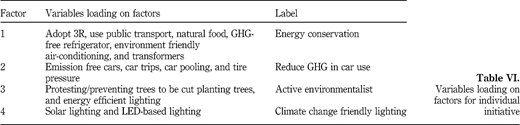
Upon carrying out varimax rotation and observing the loading plots, the following variables were found to load heavily on the above four factors (Table VI).
7.3 Factor analysis on awareness of industry initiatives to address climate change
Upon carrying out factor analysis on 15 variables included under this section of the questionnaire, the following measures of the goodness‐of‐fit of the factor analysis approach to the data were obtained (Table VII).
In this case, three factors were generated with the eigen values and the cumulative variances explained, as presented in Table VIII.
Further to varimax rotation and upon looking at the factor loadings on the associated variables the factors were labeled in Table IX.
7.4 Factor analysis on variables measuring behavioral change addressing climate change
In this section of the questionnaire, there were eight variables measured on the four‐point scale as.
Not keen, little keen, keen, and very keen.
The factor analysis yielded the following measures of goodness‐of‐fit to the data obtained in Table X.
Factor analysis generated two factors, with the following eigen values and cumulative percentage of variation explained by the two factors (Table XI).
Subsequent to varimax rotation we looked at the loading plots and the factors having the following variables loading on the two factors (Table XII).
The exploratory factor analysis of the variables included in the different sections of the questionnaire yielded the factors as presented above. These factors were used as unobserved variables or latent constructs in the next part of our analysis, SEM or confirmatory analysis, to identify, if any, links between different aspects of awareness and behavioral change.
7.5 SEM for behavioral change
SEM estimates a series of separate but interdependent multiple regression equations simultaneously. The authors have drawn upon the existing research, as indicated in a previous section, the logic of climate change phenomenon and the research objectives to determine which independent variables would predict which dependent variable. The proposed relationships are then translated to a series of structural equations for each dependent variable. The structural model expresses these relationships among the dependent and independent variables, which in this case are the unobserved variables or latent constructs identified in the exploratory factor analysis.
This confirmatory analysis which is carried out under the SEM considers the following eight latent constructs, variables 1, 2, 3, 4, 5, 6, 7 and 8, from the total number of 12 constructs as identified above: these variables/latent constructs are referred to as LC1, LC2, LC3, LC4, LC5, LC6, LC7 and LC8.The constructs were selected on the basis of Cronbach alpha values, only the constructs with Cronbach alpha of more than 0.7 were considered in the structural model:
(LC1) Awareness of health impacts. Including variables: such as prevalence of disease, mortality/morbidity from diarrhea, toxicity of cholera, water borne disease, and crops suffer.
(LC2) Awareness of rise in sea‐level. Glaciers will melt, islands will go under water, and sea‐level will rise.
(LC3) Awareness of individual initiative on energy conservation. Adopt 3R, use public transport natural food, climate change friendly, refrigerator, and air con.
(LC4) Reduce GHG in car use. Emission free car, reduce trips, car pooling, and ensuring tire pressure.
(LC5) Awareness of industry initiative on energy conservation use solar energy. Minimize energy use by insulation, use waste heat back, and bio gas.
(LC6) Awareness of industry using pro‐climate change technology and materials. Input materials, cleaning agents, and boilers.
(LC7) Behavioral change to climate change. Use solar energy, reduce gasoline use, GHG‐free items, invest in climate change funds, and donate to climate change movements.
(LC8) Lead climate change campaign. Promote 3R start social campaign.
The definition of latent constructs described above originally comprised more items, manifest variables, from the questionnaire than what was presented here. However, reliability analysis of the internal consistency of the different manifest variables within each latent construct identified certain items that should be excluded from the final analysis.
For the subsequent SEM, confirmatory factor analysis, the conceptual model involving all the constructs was run using AMOS Graphics for Windows Version 3.6, estimating the regression weight of each link (arrow) and the associated significance given by critical ratio. The estimation procedure used was under the maximum‐likelihood estimation (MLE) procedure, which was known to provide valid results with sample sizes as small as 50. In addition to p‐value which should be greater than 0.05, we used χ2/df<2, goodness‐of‐fit index (GFI), adjusted goodness‐of‐fit index (AGFI), and root mean square residual as additional indicators to evaluate the validity of the model.
Several sets of analyses were conducted with the input being descriptive statistics of the indicator variables and their correlation matrix. Also, iterations of sets of structural equation models were run to test variations of the model with alternate paths deleted to assess the importance of different aspects of the models.
8 Results from the SEM
The empirical survey on the target population of managers at different levels at the greater Kolkata area finally yielded a sample size of 58 which related a 12 percent margin of error to a 95 percent confidence level. Because the sample size was not large enough we resorted to MLE procedures only, which are known to yield valid results even for a sample size of 50.
The latent constructs, LC1, LC2, LC3, LC4, LC5 and LC6, which referred to awareness levels of the different aspects of climate change, were considered as independent variables, although it was not necessary for them to be uncorrelated with one another. The latent constructs LC7 and LC8, which pertained to the behavioral change towards pro‐climate change behavior, were taken as dependent variables. The dependent variables were also allowed freely to correlate amongst each other and LC7 was allowed to lead to LC8 and vice versa.
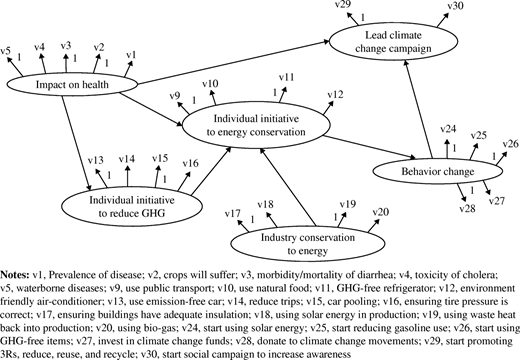
The final model, which converged to a good fit, as given by χ2‐value and other indicators, is presented below. Please note that out of eight latent constructs only six emerged as significantly linked to each other. Please also note that though originally 30 manifest variables from the questionnaire were included, in the final model not all of them survived. So, the diagram below shows only the ones which did.
The level of the overall model fit, the associated significance and various other parameters are now presented in Table XIII.
The χ2‐values and associated p‐value are highly acceptable, indicating a good fit for the model. However, GFI and AGFI, both of which are measures that represent overall degree of fit (squared residuals from prediction compared to the actual data) are on the lower side. For both of these, higher values would indicate better fit but no absolute threshold levels had been established for GFI (Hair et al., 2007). This might be expected given the sample size, which made the estimates of maximum‐likelihood parameters not significant. Conversely, the measures of χ2/df=1.153, which fell within the recommended levels of 1.0‐2.0, indicated a significant model.
One should also consider CFI equal to 0.968, which was highly acceptable. Thus, given the limitation of small sample size, we accepted the validity of the model.
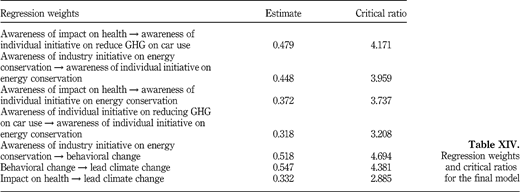
Of course, the structural model does require a multivariate normality assumption of the variables included. We tried to test the univariate normality by plotting the normal probability plots and the corresponding univariate distributions and more than 70 percent of the variables conformed to univariate normal distributions. However, the multivariate normality had to be assumed and this did become a limitation of the model (Table XIV).
From the results presented above, the evidence suggests that awareness of impact on health leads to individual initiatives that incorporate both energy conservation and reducing GHG in car use. These coupled with awareness of industry initiative towards conserving energy, lead to behavioral change, which in turn again leads to individuals promoting climate change campaigns.
Though originally the structural model was constructed with six independent variables and two dependent variables, the variables on awareness of rise in sea level and awareness of industry initiative on climate change friendly technology and materials, variables V2 and V6, did not have significant levels of critical ratio and were thereby dropped from the final model. This suggests that as per evidence, these two variables did not impact behavioral change in any significant manner as yet.
Perhaps, the most significant finding which emerges from the research is that awareness of impact on health is the most important factor which triggers individual initiative, leading to behavioral change and ultimately even to individuals taking up the cause in promoting conservation and social campaigns to enhance awareness. Awareness of industry initiative for energy conservation also leads to individual initiative and thereafter to behavioral change.
9 Concluding remarks
This research was started with the basic premise of addressing the burning issue of climate change globally, which includes awareness of the phenomenon and its implications on human life, nature, and the economy. Awareness of climate change phenomenon might lead individuals and managers to undergo behavioral change towards pro climate change friendly motives.
Thus, in a very simplistic form, behavioral change was looked upon as a dependent variable on the predictor variables/constructs: awareness of effects/impacts and reasons leading to the global warming/climate change phenomenon, awareness of what individuals can do in terms of initiatives to address the concern, and awareness of what industry can do.
This simplistic format was refined and elaborated upon to carry out the exploratory factor analysis. There were a total of 12 factors, of which eight were give primary importance. Among these eight, six were finally included in the structural model. The dependent variable constituting attitude/behavioral change also was further factored into two constructs, behavioral change and climate change campaign.
In the final analysis, the awareness of health lead to individual initiative, through both energy conservation and GHG conservation; this consequently lead to behavioral change and finally induced individual managers to lead climate change campaigns. In addition, awareness of industry initiative on energy conservation had a similar impact.
Attitude and behavioral change can be looked upon as pre requisites to a much stronger behavior that promotes climate change campaigns. From the final structural model (Figure 2), it appears that awareness of health impacts directly leads to this critical construct, without even passing via other intermediate constructs. Thus, awareness of health impact can certainly be considered as a major factor contributing to managers directly leading to climate change campaigns. In other words, in promoting awareness of different aspects of the climate change phenomenon, priority should potentially be focused on the awareness of adverse health impacts associated with climate change. This would not only trigger individual initiative towards behavioral change but also lead to managers taking up the cause in the form of a climate change campaign directly.
In concluding this empirical analysis on Indian managers, one can say that awareness does in fact impact behavioral change towards strengthening the environment and alleviating the potential and existing threats of the climate change phenomenon.
References
Further Reading
About the authors
Indrani R. Halady joined Signet Capital Management from Lehman Brothers Inc. in 2008. At Signet Capital, she works on the Fund Derivatives desk focusing on structured products covering a client‐base primarily in Continental Europe. She holds a BA (Hons) in Business Economics from Brown University. In addition to focusing on the structured product at business for Signet Capital Management, she helps in promoting Environmental Awareness and Policy.
Purba H. Rao, has been a Full Professor at Asian Institute of Management (AIM), Manila, Philippines, over the last 20 years. On January 2009, she took voluntary retirement from AIM and is currently teaching in Indian business schools as visiting faculty. She has many research publications in international journals, such as International Journal of Operations & Production Management, Journal of Cleaner Production, etc. and has written books such as Greening the Supply Chain: A Guide for Asian Managers (Sage, 2008) and Predictive Modeling for Strategic Marketing (Prentice‐Hall India, 2008). Purba H. Rao is the corresponding author and can be contacted at: purba.h.rao@gmail.com