


The New Zealand (NZ) Government's commitment to a sustainable, low‐emissions energy future may be met, in part, by expanding bioenergy systems fuelled by short‐rotation forestry through utilising lower quality land affecting soil organic matter content and soil CO2 flux. The purpose of this paper is to investigate the carbon sequestration potential of a range of soil conditioners in order to minimise or offset carbon emissions due to ground disturbance.
Seven soil conditioners are evaluated using incubation chambers to measure the affect of their incorporation within three NZ soil types on soil respiration.
Charcoal is found to produce a distinct and significant carbon sequestering trend, as did newspaper and whey. Conversely, vegetable oil, paper mill pulp, biodiesel and methanol showed overall carbon emitting trends.
The research is limited as only CO2 is monitored within the incubation chambers rather than the whole gaseous carbon profile. No microbial observations are conducted.
The investigation concludes that of the conditioners observed, charcoal, newspaper and whey warrant further observation as carbon sequestration soil conditioners.
The study forms part of the foundations within the development of soil conditioners specifically designed for carbon sequestration.
1. Introduction
In 2007, New Zealand (NZ) had an annual primary energy demand of 441 PJ, with biomass resources supplying 45 PJ per annum (Hall and Gifford, 2007). Firmly committed to implementing a sustainable, low‐emissions energy policy, in 2008 the NZ labour government aims to become carbon neutral in electricity production by 2025, industrial energy by 2030, and in transport fuels by 2040 (NZ Ministry of Economic Development (NZ MED), 2007; Hall and Gifford, 2007). Driving the policy forward are initiatives and supporting legislation including the NZ Energy Strategy to 2050 (NZ MED, 2007), the Efficiency and Conservation Act (NZ Parliamentary Counsel Office, 2000) and the NZ Energy Efficiency and Conservation Strategy (EECA, 2007).
Observing the NZ government's objectives, Hall and Gifford (2007) developed a concept strategy outlining the creation of a national energy forest consisting of 3.2 million hectares of short‐ and medium‐rotation forestry (S/MRF). Taking 25 years to establish and costing between NZ$2 and 3 billion per annum, part of which could be offset by carbon credits, the purpose‐grown forest could provide a further 60 PJ of bioenergy by 2050 (Hall and Gifford, 2007).
It is generally agreed that NZ has enough land to be more than self sufficient in biofuels given sufficient land use change (The Royal Society of NZ, 2006a, b; NZ MED, 2007; Hall and Gifford, 2007). However, due to the necessary demands of food production for high‐quality land, a national energy forest would need to utilise lower quality land. Nevertheless, even utilising steep terrain and marginal grazing land, many influential organisations, including the Royal Society of NZ (2006a, b) and Scion (2008) agree with Hall and Gifford (2007), and believe that woody biofuels would be capable of making a significant contribution to future energy demands.
Many experts agree that afforestation and changes in land use can affect soil organic matter content and in turn CO2 emission rates (Ross et al., 1999; Paul et al., 2002; Zheng et al., 2005; Markewitz, 2006). If the proposal of a national energy forest is accepted, the expansion of S/MRF onto steep terrain and marginal grazing land could result in a decrease in soil carbon thereby contributing to greenhouse gas emissions (Scott et al., 1999; Paul et al., 2002; Halliday et al., 2003).
The scale of the impacts associated with soil disturbance and afforestation will be directly related to the area of land affected. Even if the effect of afforestation on soil carbon stocks is minimal, when applied over the area proposed by the national energy forest, the regional carbon budget and long‐term balance would be significantly affected (Paul et al., 2002). Turner et al. (2005) reported that poorer quality pastures accumulate less carbon than those of higher quality, furthermore, forested soil systems tend to accumulate more carbon when rotation lengths are significantly increased (Nabuurs et al., 2008). Furthermore, soil disturbance caused by short‐rotation forestry (SRF) establishment (Grigal and Berguson, 1998), and serial harvesting activities due to short rotation length (Nabuurs et al., 2008) can result in a progressive decline in soil carbon (Scott et al., 1999). Therefore, any problems caused by plantation development would be compounded by land quality and the rotation length as well as the very nature of M/SRF (Nabuurs et al., 2008).
Since the 1950s, many materials have demonstrated the ability to act as soil conditioners to prevent soil loss, increase hydraulic conductivity and porosity, increase water holding capacity and soil moisture balance, or improve nutrient storage and soil fertility (Sutherland and Ziegler, 1998; Öztürk et al., 2005). Considering the possible need for high levels of fertilisation and soil conditioning of poor‐quality land in the establishment of a national energy forest, could using such a soil amendment mitigate carbon loss? As the results herein are one aspect of a study to estimate the carbon sequestration potential of a range of novel soil conditioners (Table I), this paper reports the investigation undertaken to identify the affect of these soil conditioners on soil respiration.
The overall objective of the study was to identify if any of the seven contrasting conditioning treatments evaluate their propensity for soil carbon sequestration or flux. The aim was to measure the conditioners' effect on the respiration of three contrasting NZ soils (Table II).
The studies results provide an indication of their suitability for use in the field to maintain soil carbon stocks and/or sequester carbon throughout the development of a short‐rotation energy forest.
2. Methods and materials
Soil respiration was measured using contained atmosphere CO2 percentage levels obtained using a gas‐calibrated auto‐analyser. The results were mathematically transformed to allow the determination of the rate of carbon efflux and ultimately whether the studied soil conditioners facilitated carbon sequestration.
2.1 Soil conditioners
The rationale behind the selection of the soil conditioners was threefold. First, a reasonable carbon content; second, a history of use within the soil environment, and finally, a previous academic observation but with no or little data collected on their affects on soil carbon and soil respiration within different soil types. A further preferred but not required criterion was that the conditioner could also be considered a waste product and therefore in need of constructive method of disposal. Using these criteria, the seven soil conditioners chosen for observation were charcoal, whey, vegetable oil, shredded newspaper, biodiesel, paper mill pulp (PMP) (a 50:50 mix of primary and secondary sludge) and methanol. The rationale behind including shredded newspaper in the study came through reviewing investigations into alternative paper disposal methods and its use as a soil conditioner by USDA‐ARS National Soil Dynamics Laboratory (Raper et al., 1995). This was backed up by El‐Saied et al. (2007) suggesting an agronomic application of newspaper as a soil conditioning hydrogel.
2.2 Soil selection and harvest
Using the NZ soil classification system (Landcare Research, 2008), three contrasting NZ soils, differing in evolutionary stage, parent material, drainage and fertility, were chosen for use in the study. These were:
- 1.
Soil A – Manawatu Fine Silt Loam, a stage (III) recent alluvial soil.
- 2.
Soil B – Tokomaru Silt Loam, a stage (IV) argillic‐fragic perch‐grey pallic soil.
- 3.
Soil C – Egmont Black Silt Loam, a stage (IV) typic orthic allophanic soil.
Locations for soil harvest were chosen predominately for their soil type producing inevitable topographical differences between harvest sites. Variations in ground flora, ranging from eucalyptus litter (Soil A) to a perennial ryegrass (Lolium perenne) and white clover (Trifolium repens) ground flora (Soil B) to native NZ Bush (Soil C) also occurred.
Soil was collected from the top 20 centimetres of the soil profile for each soil type ensuring, prior to use, all organic debris such as roots and stones or pebbles were extracted.
2.3 Laboratory analysis
Once collected, the field capacity and field moisture content of the soil samples were determined using methods outlined by Cassel and Nielsen (1986) and Hedley and Daly (2004), respectively. The mean carbon and nitrogen content was then measured using a LECO CN‐2000 Dry Combustion Analyser as described by Wright and Bailey (2001).
Samples were placed in pre‐prepared incubation chambers, within which atmospheric moisture content and temperature were stabilised as described by Saggar et al. (1999). Atmospheric CO2 concentrations within the chambers were measured using an auto‐analyser. Once soil respiration levels had stabilised, the soil conditioners were added to achieve a 4.8 per cent increase carbon equivalent of the soil dry mass as used by Sonnleitner et al. (2003b). Adjustments were then made to bring the soils back to field capacity. Maintaining conditions within the chambers, soil respiration was monitored.
2.4 Statistical analysis
To determine whether any of the soil conditioners significantly affected soil respiration, the data were statistically analysed in two stages. Stage 1 consisted of a one‐way repeated measures analysis of variance (ANOVA) conducted to determine any differences among treatments on incubation headspace atmospheric CO2 percentage. Combining the variables into a mean value, analyses were also conducted for each soil type, and for the sample as a whole (termed the overall sample (OS)). As the control incubations were used as a reference, all the parameter estimates were interpreted as a comparison between each treatment and the control.
Stage 2 of the analysis sought to measure the effect of each treatment on mean carbon flux for a 24 hour period, the data were mathematically transformed and a two‐way ANOVA was conducted to compare the average value over the entire population. Since there were a total of seven treatments and two periods (pre‐ and post‐treatments), a 2×7 ANOVA was used.
In the event of the two‐way ANOVA identifying significant differences between samples, a multiple comparison test, in this case Fisher's least significant difference (LSD), was used to compare treatment group means. The LSD would identify those that were significantly different from one another. Within the LSD the dependent variable was carbon efflux.
3. Results
The carbon and nitrogen content of the soil conditioners used are given in Table I. Table II summarises the observed characteristics of the three soils.
The repeated measures ANOVA illustrated that all effects were significant at the 0.001 level, indicating that there were significant differences between atmospheric CO2 percentage when comparing:
pre‐ and post‐treatment application; and
across the various treatment types (Table III).
According to the F‐values (where the larger the value the greater the evidence supporting a difference between the observed groups), Soil B showed the greatest evidence to support a difference between the groups and Soil C the least, with the OS showing comparatively little evidence.
When comparing each treatment with the control (Table IV), the p‐value was observed and indicated the level of evidence to support the null hypothesis of “the CO2% levels within the chambers, prior and post conditioner application, were equal to those of the control”.
Where p>0.10, no evidence against the null hypothesis was presented. Where p<0.001, extremely strong evidence against the null hypothesis in favour of an alternative explanation was indicated. Therefore, the lower the p‐value, the less likely the variation observed occurred by chance. The beta coefficient (B) represented the difference in response between each treatment and the response variable or estimated average change in standard deviation. Therefore, B indicated the degree to which the independent variable (in this case, soil conditioner treatment) affects the outcome of the dependent variable (C efflux).
With respect to the incubations prior to conditioner application, Soil A showed no significant differences when compared to the control with the exception of chambers allocated to charcoal, which was significantly lower. Soil C also demonstrated no significant differences with just one exception, that being the PMP chambers that showed significantly higher levels of CO2. Soil B also showed significantly higher levels of CO2 percentage in the chambers for charcoal, whey and PMP but that for methanol was significantly lower. The OS was found not to be significantly different from the control for any of the treatments, suggesting that the starting levels of CO2 percentage were similar for all of the chambers within the study.
Post‐conditioner application results showed very similar trends for all three soils and the OS with significant gains in CO2 levels associated with biodiesel, vegetable oil, PMP and methanol.
The results of the two‐way ANOVA rejected the null hypothesis that “the effect on carbon flux over a 24 hour period of the soil conditioner treatments was equal” at the 0.001 level for Soils A, B, C and the OS (Table V).
The F‐value indicates varying degrees of evidence to support the differences between these groups. Since the effects of treatments were different, a post hoc LSD test was conducted to determine which specific treatments were significantly different. The results are presented in Table VI.
The carbon flux per 24 hours per soil conditioner per soil is shown in Figures 1‐3. The mean total carbon emissions per soil conditioner per soil are shown in Figure 4.
With just a few exceptions, probably due to interaction between soil type and conditioner composition, the carbon flux induced by charcoal proved to be significantly different to the other conditioners in all three soils and the OS.
These exceptions were the shredded newspaper and whey in Soil A, and methanol, newspaper and whey in Soil B. For Soils A, C and the OS, charcoal was found to have a lower carbon flux over a 24 hour period than all other conditioners and produced a sequestering trend (Figures 1, 3 and 4).
Soil B, however, showed charcoal to have a higher mean than conditioners of methanol and shredded newspaper. When considering these results alongside Figure 2, the shredded newspaper showed a remarkably similar C flux trend to charcoal.
In contrast, methanol showed an initial strong sequestering effect, followed by an emitting trend, ultimately leading to a mean similar to that of newspaper and methanol. From the mean total carbon emissions (Figure 4) within Soil B, methanol remains almost carbon neutral, while charcoal, whey and shredded newspaper sequester.
The PMP treatment was significantly different to all the other conditioners for all three soils and the OS, with the exception of vegetable oil in Soil C. PMP showed a lower total carbon flux than biodiesel, vegetable oil, and for Soil A alone, methanol (Figure 4). When observing both carbon flux over time (Figures 1‐3) and mean total carbon emissions (Figure 4) PMP showed a distinct emissions trend.
Shredded newspaper proved to be significantly different to all conditioners within the OS, Soils C and A (with the exception of charcoal) (Table VI). Soil B did not follow this trend, and showed statistically significant differences for PMP, biodiesel and vegetable oil alone. The carbon flux for newspaper within all soil types demonstrated a very stable reaction with emissions over time barely deviating from the x‐axis (Figures 1‐3). Only when viewing in Figure 4 could the sequestering trend can be seen.
The observed sample mean of whey was not significantly different to that of charcoal and shredded newspaper within Soils A and B, and methanol within Soil C, but was significantly different to all conditioner treatments within the OS. Carbon flux for whey showed a similar carbon flux trend over time to that of newspaper (Figures 1‐3) and similarly, only when shown in Figure 4 could the sequestration properties of the whey can be seen.
Methanol was not significantly different to vegetable oil in Soil A, charcoal and newspaper in Soil B or whey in Soil C, however within the OS methanol was significantly different to all conditioners. When comparing the sample means methanol showed a very mixed reaction, demonstrating a lower mean carbon flux than all other conditioners within Soil B. In contrast, only charcoal, the shredded newspaper and whey had a lower observed sample mean in Soil C, biodiesel alone had a lower mean for Soil A. Figures 1‐3 showed the carbon flux for methanol ultimately presented a distinct emissions trend for all soils. However, the final outcome regarding total carbon emissions was less clear as soil type played a greater role (Figure 4).
Biodiesel was significantly different to all the other conditioners for Soils A, B, C and the OS without exception. Figures 1‐3 showed biodiesel created the largest effect on carbon flux over time with a distinct, and most dominant, emissions trend of all the conditioners regardless of soil type (Figure 4).
Vegetable oil was also significantly different to all conditioners within Soils A, B and C with the exception of methanol in Soil A and PMP in the OS, and had the second largest effect on carbon flux after biodiesel (Figures 1‐3). Similar to biodiesel, vegetable oil also showed distinct carbon emissions trend within all three soils and hence also created a comprehensive carbon efflux result (Figure 4).
4. Discussion and conclusion
The soil treatments of charcoal, newspaper and whey clearly demonstrated sequestration potential (Figure 4), although these results need to be considered alongside the following issues.
First, there is the issue of sample homogeneity. As three very different soil substrates were used it is inescapable that there will be differences in their quality. Statistically, as a group no significant differences were found between the pre‐treated conditioner incubations and the control regardless of soil type. However, when viewed individually differences were identified for Soil B. This could have been the result of inadvertently sampling two different soil profile horizons, a variation in microbial populations, or changes of vegetation within the harvesting area. The lower CO2 percentage levels in Soil A and higher levels in Soil B when compared to the control may be due to this lack of homogeneity. This suggests that the degree to which charcoal showed sequestering properties may be less than shown in Figure 4 for Soil A and greater for Soil B. Similar issues may also exist with whey in Soil B, and PMP in Soils B and C. Of these, the only one affecting sequestration capability assessment would be whey in Soil B, the incubation chambers having shown significantly higher CO2 percentage levels than those seen in the control, inferring a potential for greater sequestration.
The results should also be considered in the light of research carried out by others. For example, the addition of charcoal to soils has been noted to stimulate the colonisation of indigenous arbuscular mycorrhizal (AM) fungi by providing a microhabitat to colonise (Saito and Marumoto, 2002). Assuming the soils used within the study possessed some natural populations of AM fungi it follows that given past research evidence this populous would increase, potentially increasing soil respiration and reducing the charcoal's sequestration effect. The degree to which this relationship might have affected the results within this study has not been determined.
Previous studies observing the effects of whey as a soil conditioner have noted that dry aggregate size increases in the long‐term after application, creating soils that are more resistant to the dispersive effects of water (Sonnleitner et al., 2003a). Within this study, the short observation time period and lack of water mechanics within the incubation chambers indicate that it is doubtful that whey acting upon aggregate size would account for the results seen. However, whey additions have also been observed to produce high‐fungal additions to the soil carbon biomass (Sonnleitner et al., 2003a). The effects of whey on fungal populations within Soils A, B and C would require further examination for any conclusions to be drawn.
Furthermore, in a field trial by Bullock et al. (1995) where whey was as a soil amendment to an alfalfa crop grown on silt loam calcareous soil, the results showed high emissions of carbon monoxide (CO) from the site, with no measure of CO2. Considering the increased carbon sequestration shown for Soil B, similarly a silt loam and considering the results of Bullock et al. (1995) the increase may be due to the production of CO instead of CO2.
When compared with other organic wastes, the biodegradability of newspaper is especially low due to its lignin content (Fox and Noike, 2004). Although resistant to microbial degradation, in a composting environment lignin can be degraded or transformed extensively. Outside this environment, complex compounds such as lignin, are difficult to breakdown, especially in the absence of thermophilic microfungi such white‐rot fungi, and actinomycetes (Tuomela et al., 2000). Conditions within the incubation chambers in this study were far from those experienced within a composting environment, hence leading to slow degradation and an overall carbon sequestration effect. Whilst the hardened structure of newspaper requires specific conditions to successfully degrade making it a good method of carbon sequestration whether or not it can be applied to soil and still maintain a sustainable environment within a landscape needs to be determined.
Finally, it is interesting to also note that, should monitoring have been ceased earlier in the study methanol would also have been found to have sequestering abilities within Soil B. The longer length of monitoring period allowed the emissions produced after day 140 to be counted and render methanol approximately neutral within Soil B. This highlights the importance of monitoring time scale. A short observation period would have changed the interpretation of the results and hence the suggestions made regarding the use of methanol as a soil conditioner.
To conclude, Charcoal, newspaper and whey produced distinct and significant carbon sequestering trends, warranting further investigation with the aim of utilising them for carbon sequestration purposes.
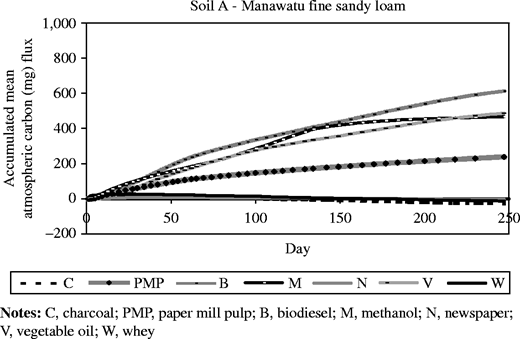
Cumulative mean carbon flux (mg) per 24 hours for each soil condition applied to Soil A
Cumulative mean carbon flux (mg) per 24 hours for each soil condition applied to Soil A
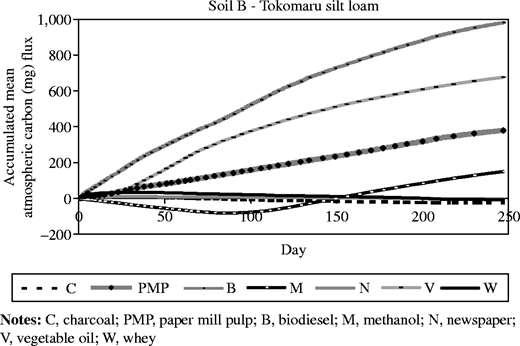
Cumulative mean carbon flux (mg) per 24 hours for each soil condition applied to Soil B
Cumulative mean carbon flux (mg) per 24 hours for each soil condition applied to Soil B
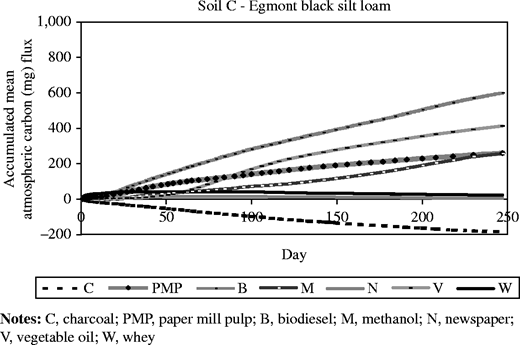
Cumulative mean carbon flux (mg) per 24 hours for each soil condition applied to Soil C
Cumulative mean carbon flux (mg) per 24 hours for each soil condition applied to Soil C
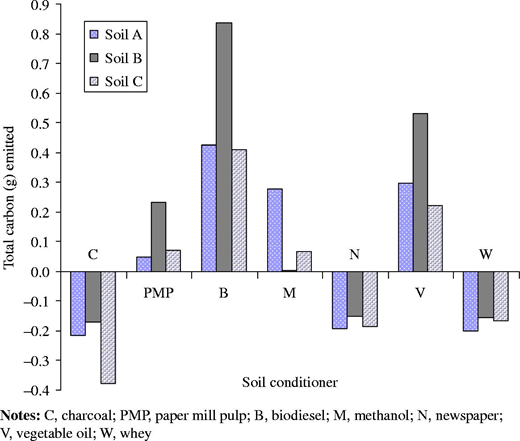
Total carbon emitted (g) (after basal soil respiration, background atmospheric carbon (CO2) levels, and carbon additions through conditioner application have been accounted for) per soil conditioner per soil type
Total carbon emitted (g) (after basal soil respiration, background atmospheric carbon (CO2) levels, and carbon additions through conditioner application have been accounted for) per soil conditioner per soil type
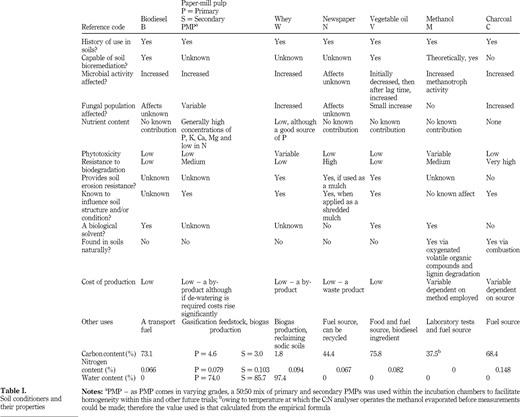
Soil conditioners and their properties
Soil conditioners and their properties
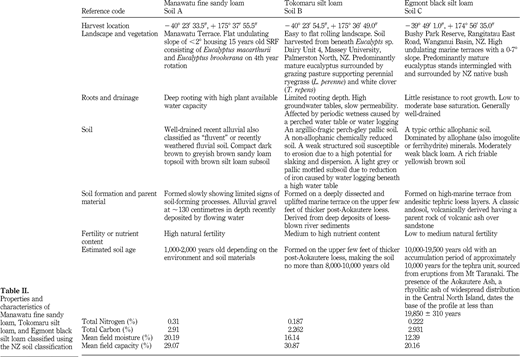
Properties and characteristics of Manawatu fine sandy loam, Tokomaru silt loam, and Egmont black silt loam classified using the NZ soil classification
Properties and characteristics of Manawatu fine sandy loam, Tokomaru silt loam, and Egmont black silt loam classified using the NZ soil classification
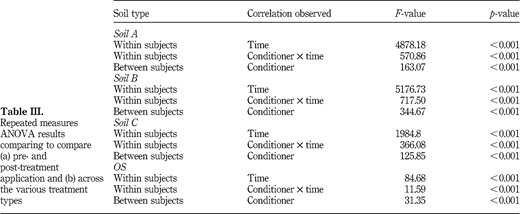
Repeated measures ANOVA results comparing to compare (a) pre‐ and post‐treatment application and (b) across the various treatment types
Repeated measures ANOVA results comparing to compare (a) pre‐ and post‐treatment application and (b) across the various treatment types
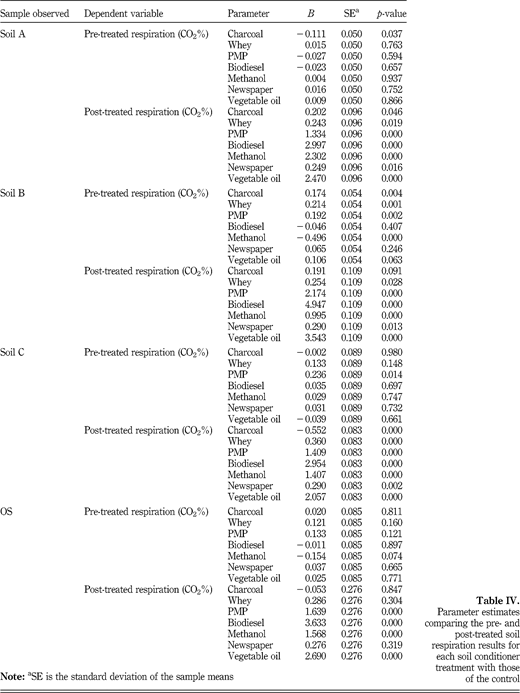
Parameter estimates comparing the pre‐ and post‐treated soil respiration results for each soil conditioner treatment with those of the control
Parameter estimates comparing the pre‐ and post‐treated soil respiration results for each soil conditioner treatment with those of the control
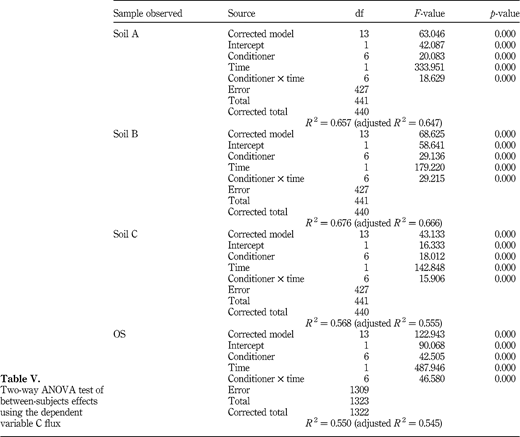
Two‐way ANOVA test of between‐subjects effects using the dependent variable C flux
Two‐way ANOVA test of between‐subjects effects using the dependent variable C flux
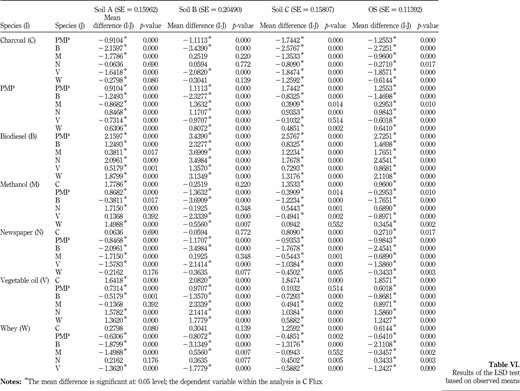
Results of the LSD test based on observed means
Results of the LSD test based on observed means
C:N analysis was conducted by Anne West, a Technical Officer at Massey University, NZ. Sue Nicholson provided auto‐analyser technical support. Funding was provided by C. Alma Baker Fund and the Foundation for Research Science and Technology. Kinleith Pulp and Paper Mill provided paper mill sludge, Commodities NZ Limited provided charcoal supplies, and Fonterra Research Centre provided casein whey.
References
About the authors
A.J.C. Coles is a part of the Agriculture and Environment Research Unit (AERU), University of Hertfordshire. Through working with AERU, she has been involved in several projects relating to agriculture, the environment and sustainability; including, the Hardy Nursery Stock Audit, Priorities for the Environmental Protection of Soil and Environmental Management for Agriculture. Her recent research studies have expanded her expertise into the area of soil conditioners and amendments, carbon sequestration and climate change mitigation. Her research interests also include habitat restoration and rehabilitation, sustainable management of lifestyle blocks and smallholdings, and livestock husbandry. A.J.C. Coles is the corresponding author and can be contacted at: A.J.C.Coles@herts.ac.uk
K.A. Lewis is a Research Leader for the AERU, University of Hertfordshire, UK. Her main areas of interest include environmental management of agriculture, horticulture and land‐use, in particular environmental pollution and the impacts arising from agricultural processes taking a whole farm perspective. She is a Fellow of the Institute of Analysts and Programmers and an Associate Member of the Institute of Environmental Management and Assessment and is a qualified environmental auditor. She is also a committee member of the SCIs BioResources Group and their Honorary Treasurer.
R.E.H. Sims is currently a Senior Analyst in Renewable Energy and Climate Change at the International Energy Agency, Paris whilst maintaining the position of Professor of Sustainable Energy at Massey University, NZ where he began his research career over three decades ago as an agricultural engineer. He was the Co‐ordinating Lead Author of the “Energy Supply” chapter for the 4th Assessment Report of the Intergovernmental Panel on Climate Change, the 2007 Nobel Peace Prize recipient and is a Lead Author for the forthcoming IPCC Special Report on Renewable Energy. He has been a major contributor to several key publications at the IEA, including World Energy Outlook 2008, Renewable Energy Heating and Cooling, Energy Technology Perspectives 2008 and recently Transition from 1st to 2nd‐Generation Biofuels. He has acted as a consultant to many energy companies, is a Chartered Engineer and a Companion of the Royal Society of New Zealand. Two books and several papers on biomass and bioenergy have been produced.

