


The purpose of this paper is to identify and characterize a geological storage site at more than 800 m depth that is capable of storing large quantities of carbon dioxide (CO2) in the Alberta Basin and is close to a large CO2 supply.
Five criteria are used to select the site: total volume of the pore space of the formation for CO2 (i.e. capacity); accessibility of the pore space in the storage site to CO2 (i.e. permeability or injectivity); ability of the storage site to retain the CO2 once the CO2 has been injected (i.e. containment); protection of other resources from contamination; and cost of the whole process: capture of the CO2, transport and storage (i.e. economics).
The Heartland Redwater Leduc Reef is identified as a site that has large capacity, good injectivity, and is an excellent trap. Contamination of the oil in the oil reservoir at the top of the reef (the third largest oil reservoir in Canada) is avoided by co‐optimizing CO2 storage and oil production.
The Heartland Redwater Leduc Reef is ideally located at relatively shallow depth (1,000‐1,200 m), has a large amount of residual oil and is close to large CO2 sources which make it one of the most economically attractive sites in the Western Canadian Sedimentary Basin.
The Heartland Redwater Leduc Reef Saline Aquifer CO2 Capture and Geological Storage Project (HARP) is investigating the technical and economic feasibility of injecting significant volumes of CO2 into the large water‐saturated portion of a huge Devonian reef that is capped by a comparatively small oil reservoir, nevertheless the third largest oil pool in Canada. The reef has a total areal extent of nearly 600 km3, is more than 1,000 m deep and is up to 275 m thick. Based on the high‐water injectivity in the reef, the potential exists to inject sustainably in excess of 1,000 tonnes of CO2 per day per well in the aquifer portion of the reef. Preliminary storage capacity estimates for the aquifer are in the order of one gigatonne of CO2. The Heartland Redwater Leduc Reef has the combination of a large oil reservoir sitting on top of a much larger local aquifer. This is a unique site for storage in Canada and could be a model for the rest of the world for carbon dioxide capture and storage.
Introduction
Global warming is the term commonly used for the change in the climate attributed to the greenhouse effect. More specifically, it refers to climate change resulting from the addition of anthropogenic (man‐made) greenhouse gases (GHG) (water vapour, carbon dioxide (CO2), methane (CH4), nitrous oxide, ozone, and chloroflorocarbons) to the atmosphere. The main sources of anthropogenic CO2 are fossil fuel utilization, cement production, and land‐use changes; while CH4 build up is a byproduct of agriculture (rice, sheep, and cattle), garbage decomposition, wet lands, and escape of fossil fuels.
The introduction of large quantities of additional anthropogenic CO2 and CH4 into the atmosphere cannot be ignored. There has been a long‐term increase in the global mean temperature during the last 120 years which correlates with an increase of CO2 and CH4 in the atmosphere (Crystal, 1994; Intergovernmental Panel on Climate Change (IPCC), 2005) and thought to be due to the abrupt increase in anthropogenic emissions as a result of the industrial revolution since the mid‐1700s. Such trends, when extrapolated into the future, predict substantial climate change leading to considerable environmental damage (IPCC, 2005).
Sources of anthropogenic CO2 can be centralized, as in a power generating station, or diffuse, as in the use of motor vehicles. No single method of CO2 emissions reductions will be adequate to meet international, national or provincial reduction objectives, since no single method can address the issues related to both large central and diffuse emission generators. Reduction of anthropogenic CO2 emissions into the atmosphere can be achieved by a variety of means, which is summarized in a modified form of the Kaya equation (Gunter et al., 1998): Equation 1 where CO2⇑ is the total CO2 released to the atmosphere, POP is population, GDP/POP is per capita gross domestic product and is a measure of the standard of living, BTU/GDP is energy consumption per unit of GDP and is a measure of energy intensity, CO2⇑⇑/BTU is the amount of CO2 released per unit of energy consumed and is a measure of carbon intensity, and CO2⇓ is the amount of CO2 sequestered in biosphere and geosphere sinks. Of the first two measures, reducing the population or the standard of living is not likely to be considered. Consequently, only the three remaining methods can be employed (i.e. reducing energy intensity, reducing carbon intensity and carbon sequestration). All three options are needed to reduce GHG emissions to the levels required.
A very attractive and cost effective solution (which will reduce energy intensity) is energy conservation, although it will require tough policy measures and change of societal habits. Solutions are to improve energy and material efficiency or modify industrial processes, which will lead to a lowering of the rate of CO2 generation. An option to reduce carbon intensity of the energy system is to increase the use of renewable resources such as wind and solar, and/or use of nuclear energy. However, until such energy sources can be developed and applied on a large‐scale, fossil energy resources will continue to be the primary energy sources around the globe. During this period, reduction in carbon intensity could be achieved by switching to low carbon alternative fuels (for example, switching to natural gas). While most of these options are probably solutions for the long‐term, more short‐ and medium‐term solutions need to be found to deal with the problem of increasing CO2 emissions. The issue of emissions reduction is a complex one, and will only be solved by innovative responses that include both reducing the quantities of these gases emitted by anthropogenic activities, and enhancing and using GHG sinks by carbon sequestration (the biosphere in plants, geosphere in deep geological formations, and in carbon‐containing industrial products). An important sink is found in the geosphere, which comprises natural reservoirs for CO2 found in deep geological media in sedimentary basins, but require human intervention in order to make use of the sink. Members of this class include oil reservoirs suitable for enhanced oil recovery (EOR), coal beds, salt caverns, depleted oil and gas reservoirs, and deep saline aquifers.
Carbon dioxide capture and storage (CCS), the process to utilize geosphere sinks, represents an emerging and important sector of the Canadian economy – one which can play a critical role in the continued progress towards truly sustainable energy development. This technology involves capturing the CO2 from the waste gas streams from large individual industrial emitters, transporting it and injecting it into deep geological formations in sedimentary basins, thus eliminating its release to the atmosphere (Gunter et al., 2004, 2005; IPCC, 2005). It helps us reduce CO2 emissions and affords us the time for an orderly transition from fossil fuels to renewable forms of energy. Both the Canadian Federal Government and the governments of energy producing provinces (Alberta and Saskatchewan) see this technology playing an important role in formulating a comprehensive climate change response plan.
The Alberta Basin and the Redwater Leduc Reef
Identification of early opportunities for geological storage is based on five criteria (Bachu, 2000, 2003):
- 1.
capacity;
- 2.
injectivity;
- 3.
containment;
- 4.
resource protection; and
- 5.
economics.
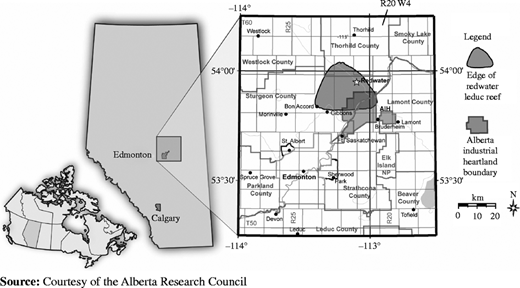
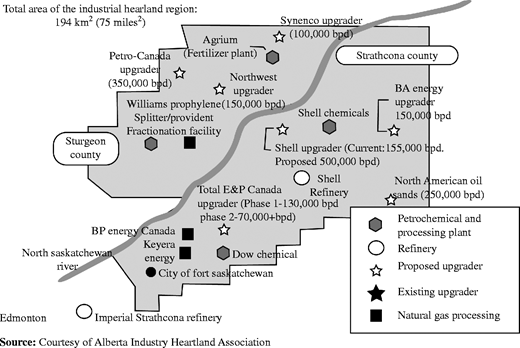
The Alberta Basin is unique. This basin has significant endowment of fossil fuels such as oil, gas, and coal, in addition to many deep saline aquifers. The same geology where fossil fuels were stored can also provide a safe site for storing CO2 for similar time periods. This region is also an area where large emitters of CO2 are located. The Alberta Basin offers the potential to link our CO2 storage capacity with the ability to pursue value‐added opportunities by enhancing petroleum resource recovery from oil and gas reservoirs and coal beds. Based on current day economics, some CO2 enhanced oil recovery projects may go ahead if low‐cost sources of high purity CO2 (>90 per cent) are available. The Alberta Industrial Heartland (AIH) area in Alberta is well positioned because it has a high concentration of large CO2 emitters and a variety of oil and gas reservoirs close by (Figure 1), including the Redwater Leduc Reef.
Oil and gas reservoirs and deep saline aquifers in Alberta Basin have CO2 storage capacity that spans several orders of magnitude, respectively. The smallest capacity is in oil reservoirs, including EOR, estimated to be in the order of a few hundred million tonnes (Mt) (Bachu and Shaw, 2005), compared to Alberta's annual emissions from large final emitters (emitters with emissions greater than 100,000 t CO2/year) in the order of 160 Mt. The storage capacity in gas reservoirs is one order of magnitude larger, estimated to be in the order of 8 to 10 Gt CO2 (Bachu and Shaw, 2005). Yet the largest capacity, at least one order of magnitude higher than in gas reservoirs, is in deep saline aquifers. In many cases, deep saline aquifers underlie oil and gas reservoirs, in which case both may be used for CO2 storage. The Devonian Redwater Leduc Reef and the underlying Cooking Lake Aquifer in the Redwater region of Alberta northeast of Edmonton (Figures 1 and 2) may constitute an integrated system that combines both CO2 storage opportunities, with the access point to the system being located in the Heartland Industrial area, one of the major CO2 Hubs in Alberta. Recent planning documents (CANiSTORE – Gunter et al. (2004); CANiCAP – Gunter et al. (2005); and the Canada's CCS Technology Roadmap – Natural Resources Canada (2006)) all advocate early demonstration of CCS technology in Canada. In this respect, the Redwater Reef offers an unparalleled opportunity for early demonstration of CCS on a commercial scale. The multi‐faceted opportunity lies in reducing the costs for bringing CO2 from the oil sands region to storage sites, commercial demonstration of CO2‐EOR and aquifer storage, advancement of the science and technology in close vicinity of a major industrial and research centre (Edmonton), capacity build up of new professionals in the field of CCS, and communication to the public.
The Redwater Reef
Based on the five criteria described above, one of the more attractive plays suitable for geological storage in the Alberta Basin is the string of Leduc Formation Reef complexes of the Devonian Woodbend Group (Figure 3). The Leduc Formation Reef complexes in central Alberta are underlain by the platformal carbonates of the Cooking Lake Formation which forms an extensive aquifer that provides support to oil and gas reservoirs in the Leduc Formation reefs.
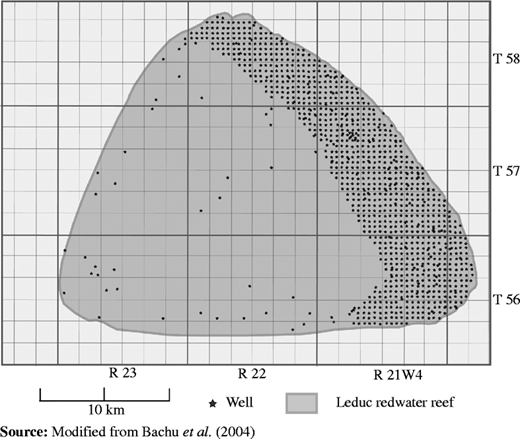
The Leduc reef at Redwater (Figure 4) is one of the largest of the Leduc reefs and is the third largest oil reservoir in Canada (OOIP reserves of 1.3 billion barrels). The Redwater Reef is ideally situated in the Heartland Industrial area close to large sources of relatively pure CO2 in the Redwater‐Fort Saskatchewan‐Edmonton region. The reef complex has a triangular‐rounded shape (Figure 3) with a total areal extent of nearly 600 km2 and lies at approximately 1,000 m depth (Figure 4), is up to 250 metres thick and had an original oil cap approximately 50 m thick. The initial pool pressure was 7.4 MPa (coincidentally almost equal to the CO2 critical pressure Pc=7.38 MPa) and temperature of 34°C (slightly higher than the CO2 critical temperature Tc=31.1°C). The formation water in the reef is of NaCl type with salinity of 107,000 mg/l total dissolved solids. The reef experiences a strong water drive from the underlying highly permeable Cooking Lake Formation aquifer. The Redwater Reef is currently under the last stages of water flooding for oil production, with concurrent sour water disposal. ARC Resources Ltd plans to convert the Redwater oil pool to a CO2 tertiary recovery scheme.
The Redwater Reef developed directly on platform carbonates of the Cooking Lake Formation and is capped by shales of the Ireton Formation which are 10‐50 m thick immediately above the reef and thicken to approximately 120 m in the East Shale Basin (Figures 3 and 5). The Cooking Lake Formation is in turn underlain by shales and nodular limestones of the Waterways Formation of the Beaverhill Lake Group, which are generally thicker than 50 metres and have very low porosity and permeability. The overlying shales of the Ireton Formation are in turn overlain by the carbonates of the Winterburn and Wabamun groups. Figure 6 shows the stratigraphic and hydrostratigraphic delineation in the Heartland Industrial region of Alberta. Thick shaly aquitards separate the aquifers in the sedimentary succession from the shallow aquifers in the region (Figures 4 and 6).
The Leduc Formation carbonates in the Redwater Reef consist mainly of medium light brown to light gray fossiliferous limestone (84 percent) with minor amounts of secondary, patchy replacement dolomite (15 percent). Porosity (averaging 7 percent) consists mainly of intercrystalline interparticle, and mouldic porosity as well as fractures. Permeability spans several orders of magnitude, ranging from 0.01 to 4,000 md in the horizontal direction and 0.02 to 670 md in the vertical direction.
All aquifers in the Upper Devonian – Lower Cretaceous succession (Cooking Lake to Lower Mannville, Figure 6) show a similar generalized flow pattern on a regional scale: updip flow from the southwest and downdip flow from the northeast converging into generally northwesterly channelled flow in the Redwater area. Converging flow in the northern part of the Lower Mannville aquifer coincides with successively lower hydraulic heads in the underlying Wabamun, Winterburn and Cooking Lake aquifers and the presence of Leduc reefs, suggesting hydraulic communication and downward flow from the Lower Mannville aquifer into the Cooking Lake aquifer that continues northward towards the Grosmont formation carbonate platform, forming a preferential flow path and effective drainage system for the regional flow in central Alberta. The downward flow is facilitated by the sub‐Cretaceous unconformity, along which different Devonian aquifers come in direct contact with the overlying Lower Mannville aquifer. The Clearwater‐Upper Mannville aquitard (Figure 6) is an effective barrier to cross formational flow, hydraulically separating the Upper Mannville aquifer and younger overlying formations from the underlying system formed by the Lower Mannville aquifer and the various underlying Devonian aquifers.
The Redwater Reef is penetrated by more than 1,000 wells (Figure 7), the great majority of which are along the northeast rim where the oil reservoir is and only penetrate the top 50 m of the reef (Figure 5). The storage site can be selected away from the oil cap if the integrity of these wells is in doubt (Figure 5). Figure 8 shows the status of these wells.
The CO2 supply and transportation
Currently, the AIH region comprises approximately 25 plant sites (Figure 9). The representative companies which are large CO2 producers include: Dow Chemicals Canada (ethane extraction, ethylene, ethylene oxide/ethylene glycol, polyethylene, ethylene dichloride/vinyl chloride monomer, a chlor‐alkali unit, a Styroform plant, and a cogeneration plant); Shell Canada (ethylene oxide, synthetic crude refinery and a bitumen upgrader); Agrium (ammonia fertilizer); Sherritt (ammonia fertilizer); Air Liquide (liquid CO2 and a cogeneration plant); and Praxair (liquid CO2). The CO2 waste gas streams from these plants include:
CO2‐rich stream from processing of feed ethane;
CO2‐rich stream from ethylene oxide production;
exhaust combustion gas from ethane cracker furnace;
exhaust combustion gas from natural gas fired cogeneration units;
pressure swing adsorption (PSA) off‐gas stream from hydrogen production; and
CO2‐rich stream from potassium carbonate absorption in hydrogen production.
In the AIH region, significant amounts of high‐purity CO2 are available from feed gas processing, ethylene oxide production and from hydrogen production in the ammonia plants. Currently, total CO2 production from these sources amounts to about 2,500 t/day (approximately 1 Mt/year; Alberta Environment, 2007). The first opportunity is to capture CO2 from these high‐purity sources. Owing to their high‐CO2 concentration (80 percent and greater), their processing is rather straight forward, and involves gathering, dehydration, and compression. Air Liquide and Praxair already have plants in the AIH region recovering some CO2 for sales. The full amount can be captured with relative ease once the demand for CO2 in the region increases.
The second opportunity is the capture of CO2 from PSA off‐gases which have CO2 concentrations ranging from 38 to 44 percent. Currently, the CO2 from these sources ranges between 4,000 and 6,000 t/day (approximately 2 Mt/yr). CO2 recovery can be accomplished by capturing the CO2 in the off‐gas using an appropriate solvent. The remaining combustible gases can be recycled to the plant and used as fuel. The alternative approach of oxy‐fuel combustion accomplishes a similar result by combusting the PSA off‐gas with high‐purity oxygen, producing almost pure CO2 and water, which can be easily condensed out of the CO2 stream. However, both absorption techniques and oxy‐fuel combustion must be demonstrated in this application before wide commercial deployment can take place.
In the next 20 years, many more plants, bitumen upgraders in particular, are planned in the AIH region (Figure 9), including: Heartland Upgrader (BA Energy), Scotford Upgrader expansion (Shell, Chevron, and Western), North West Upgrader (Northwest Upgrading), Northern Lights Upgrader (Synenco Energy), and two‐phase hydrogen production plants (Air Products). The North West Upgrader will use the HC3 process for upgrading and will gasify the bitumen residues using a Lurgi process for hydrogen production. The Heartland Upgrader uses a two‐step process to provide a claimed low‐cost upgrading route to high recovery of light products – an asphaltene extraction step which removes a portion of the asphaltene fraction as solid and a pyrolysis process which converts the heavy fraction of bitumen and the solid asphaltene into light oil. The process proposed by Synenco for the Northern Lights Upgrader is delayed coking with the gasification of asphaltene for hydrogen production, although a hydrocracking/hydrotreating process has not been ruled out. In addition, a training facility (Upgrading Technology Training Center) and a coal gasification pilot are also planned in the region. These plant additions will add new CO2 streams for processing.
The third opportunity is in the CO2 capture from the gasification of coal, petroleum coke or bitumen residues for either hydrogen or electricity production via integrated gasification combine cycle. Physical solvent, solid sorbents, membranes, and hybrid processes are some of the technologies available to capture the CO2.
The AIH region also produces large amounts of combustion flue gases. The long‐term opportunity is in the capture of this highly diluted CO2 (10 percent or less) in the combustion flue gas stream. Chemical absorption using amines is the process of choice to extract CO2 from these flue gases. This process is very expensive using conventional solvents. Improved solvents, increased mass transfer rate and better heat integration are the keys to reduce the capture costs. Figure 10 shows a mid‐term forecast of CO2 capture in the AIH region, conservatively assuming that the planned upgraders will use steam CH4 reforming for H2 production. If this was replaced by gasification, the emissions would roughly double. In any case, the intermediate term predictions are for 50,000+t/day (approximately 18 Mt/year) of an enriched CO2 stream over the next 25 years.
In addition to the projected emissions from the AIH region, the federal and Alberta governments have announced in the spring of 2007 financial support for the study of a CO2 pipeline that will bring CO2 from oil sands emitters in the Fort McMurray area in northeastern Alberta, where there are no opportunities for CO2 geological storage because the basin is too shallow (Bachu and Stewart, 2002), to oil fields in central Alberta. The following companies are behind the Integrated CO2 Network (ICO2N) project: Suncor, Husky, Nexen, Shell, and Air Products as primary participants, and CNRL, ConocoPhillips, Syncrude, Imperial Oil, Transalta, Sherritt, and Agrium as secondary participants. It is worth noting that Sherritt, and Agrium are located in the town of Redwater, and Imperial Oil and Shell have refineries and an upgrader in Fort Saskatchewan and Strathcona County southwest of Redwater. Figure 11(a) shows diagrammatically the ICON concept.
Stage I of the proposed ICON CO2 pipeline system envisages building a CO2 pipeline from Redwater to Fort Saskatchewan in the Heartland region, and then, bypassing Edmonton to the north, going west to the Pembina oil field, which is the largest conventional oil reservoir in Canada. Stage II proposes to build a second pipeline from Fort McMurray to the Swan Hills and Judy Creek oil pools. However, another alternative could be to link in Stage II the Fort McMurray area with Redwater (Figure 11(b)), and this option has several merits over the previous one. First, most major pipelines run along a right‐of‐way corridor between Fort McMurray and Fort Saskatchewan, and it makes sense to build a CO2 pipeline in the same corridor. Second, the huge CO2 storage potential of the Redwater Reef can be utilized.
Carbon capture and storage assessment of the Leduc Redwater Reef
Based on OOIP and other reservoir characteristics, the Redwater oil pool alone has an estimated CO2 storage capacity in the order of 50 Mt CO2, but this represents only a small fraction of the reef (Figures 5 and 7). There are another 40 oil pools in the Redwater oil field, all of them higher up in the stratigraphic succession (Mannville Group and Viking Formation), but their cumulative storage capacity is negligible, estimated to be less than 0.5 Mt CO2.
The water saturated part of the Redwater Leduc Reef could store a much larger amount as the following calculation suggests: Equation 2 where A is reef area, h is reef thickness, φ is porosity and SirrCO2 is CO2 irreducible saturation. For Redwater Reef characteristics and assuming a residual saturation of 0.22, the estimated theoretical CO2 storage capacity in the water leg of the Redwater Leduc Reef is in the order of 2 to 3 Gt CO2. Of course, this assumes that CO2 will reach every pore space in the reef. Regarding the geology of the Redwater Leduc Reef (Figure 5), successive reef layers were interpreted in terms of their thickness, depositional facies and reservoir quality (i.e. porosity and injectivity), including the interconnectivity of the various porous units within the reef. Embayments along the reef margins and a large interior lagoonal region in the middle of the reef may have the effect of reducing the storage capacity of the Redwater Leduc Reef due to their low porosity and permeability (Gunter et al., 2008). Even if reduction coefficients are applied to account for completion and effectiveness, still it seems that the CO2 storage capacity in the Redwater Leduc Reef should be in the order of several hundred Mt CO2 to more than 1 Gt CO2, “which increases the potential for CO2 storage by more than an order of magnitude compared to that in the Redwater oil pool alone.” The current cumulative CO2 emissions from large CO2 sources (>100 kt/year) in the Fort McMurray – Fort Saskatchewan area are in the order of 40 Mt/year. By the time new oil sands mines open in the Fort McMurray area and upgraders are built in the Heartland region, the cumulative CO2 emissions may reach 50 to 60 Mt/year. This means that the Redwater Leduc Reef alone has the capacity to store all these emissions for roughly the next 20 years. This back‐of‐the‐envelope calculation indicates that “the Redwater Leduc Reef meets the first condition for CO2 storage, namely it has the necessary storage capacity.”
The second condition for CO2 storage, that of injectivity, is also being met, as proven by oil production, water injection, and disposal of sour water by gravity only and would imply that sustainable daily injection rates of 50,000 t of CO2 are achievable.
The third condition for CO2 storage, that of containment, is very likely to be met. The CO2 injected in the water leg of the reservoir will tend to rise driven by buoyancy and will become trapped by residual saturation. At the same time, CO2 will dissolve in formation water, which will become heavier and will tend to flow downward, possibly creating free convection flow that will accelerate CO2 dissolution. The CO2‐saturated water will likely drop to the bottom of the reef and then to the bottom of the underlying Cooking Lake aquifer (Figures 4 and 5). There the CO2‐saturated formation water will continue to be subjected to the hydrodynamic forces in the natural flow system of the Cooking Lake aquifer that flow with velocities of roughly 1 cm/year, and to the negative buoyancy which will drive the water downdip to the southwest. “This hydrodynamic trapping of the CO2 saturated water from the Redwater Reef in the Cooking Lake aquifer further increases the storage potential for CO2.” Unless CO2 is injected beyond the spill point of the Redwater Leduc Reef, no free‐phase CO2 should reach the Cooking Lake aquifer. All the injected CO2 should be contained in the Redwater Leduc Reef. The reef itself is capped by the tight shales of the Ireton Formation (Figure 5).
Leakage of CO2‐saturated water will not happen because of its negative buoyancy driving it downward. Leakage of free‐phase, buoyant CO2 may occur only through and along wells which are concentrated along the eastern rim of the reef (Figure 7). A total of 47 wells are used for sour water disposal in the reef. Four wells are used for gas storage in salt caverns in the underlying Lotsberg Formation. Additionally, more that 1,000 wells penetrate the eastern rim of the Redwater reservoir where the oil has been trapped. Close to half the wells are already abandoned and most of the others are now producing from the overlying Mannville Group. Most of the wells were drilled in the late 1940s and 1950s using the technology and cements available at that time and conform to regulatory requirements in force then. Furthermore, if CO2 is injected deep downdip in the reef, most likely the CO2 will be trapped at irreducible saturation in the pore space and/or will dissolve, such that only a small fraction of free‐phase CO2 may reach the reef top where the vast majority of wells are. These wells can be regularly monitored and remediated in case leakage is detected. Furthermore, if leakage occurs into overlying strata, the leaked CO2 will be trapped by the overlying succession of shaly aquitards (Figure 6). Only if the well cement is completely missing and a free pathway exists will CO2 reach shallower strata and possibly the surface, but such wells should be detected and fixed before the start of operations.
The fourth condition for CO2 storage, that of resource protection, is being automatically met. For overlying oil and gas reservoirs, meeting the third condition (containment) automatically ensures their protection. In regard to the Redwater Leduc oil pool, the pool is at the end of its production, and CO2‐EOR will only produce additional oil, hence increasing reserves.
Only the fifth condition, that of economics, is currently not being met. Under current conditions, CO2 storage is a net cost. However, with increasing regulations and requirements in regard to reducing the intensity of atmospheric CO2 emissions, CO2 storage will become a very attractive option.
The opportunity in using the Redwater Leduc Reef for CO2 storage lies in its location and in its huge capacity that can be used for many years by many of the major CO2 sources in the Fort McMurray – Fort Saskatchewan corridor in Alberta, allowing meantime to build the CO2 pipeline to central Alberta and further south. In addition, some additional oil may be produced from the oil cap of the reef if CO2‐EOR is viable and is implemented.
Conclusions
The Redwater Reef provides a unique opportunity for commercialization of CCS, in that it is a confined structure, saturated with water except for the oil cap in the east, has huge storage capacity and is close to major CO2 sources and a major industrial and research centre (Edmonton). The Redwater Reef has the potential to store all the current and future CO2 emissions from the east Edmonton – Fort McMurray region for a few decades during which an integrated CO2 infrastructure can develop in the province. Development of this site for CO2 storage would alleviate the need to construct a CO2 pipeline all the way from Fort McMurray to the oil fields in central Alberta west of Edmonton (e.g. Pembina). A much shorter backbone pipeline will need to be built from Fort McMurray and Fort Saskatchewan to Redwater, and this pipeline can take advantage of already existing right of way for the oil and gas pipelines running in this corridor. Satellite pipelines off of the backbone pipeline can deliver the CO2 to the oil fields in central Alberta.
In addition to the opportunity for industry to lower its CO2 emissions, using the Redwater Leduc Reef for CO2 storage presents a significant technical and scientific opportunity. First, this would be a commercial‐scale implementation of CO2 storage in the order of several million tones CO2 per year in the first years, and growing afterwards. Owing to the unique presence of both the oil pool at the top of the reef and of the water‐saturated huge trap represented by this reef, it will be possible to study and monitor the behavior of CO2 in both an oil‐dominated environment and in a water‐saturated environment, including all trapping mechanisms except for CO2 adsorption onto coals. The relative shallow depth (roughly 1,000 m) increases the probability of successful geophysical monitoring. The Redwater Leduc Reef is located within driving distance from Edmonton, which facilitates easy and speedy access for carrying out a monitoring program. The existence of so many wells may offer the opportunity to study the effect of CO2 on well materials, hence contributing to the development of corrosion‐resistant materials. The regional hydrogeology and CO2 storage capacity of the Cooking Lake aquifer need to be better defined if its larger hydrodynamic trapping capacity is to be evaluated. This would be a longer term project as CO2 dispersion to the aquifer would not occur until tens of years after a commercial CO2 storage operation was initiated in the Redwater Reef.
The Alberta Heartland Industrial region is located near major population centres in central Alberta and is developing an EcoPark concept to deal with the integration of large industry and the public. Addressing environmental issues will be a major component of the EcoPark Program. Owing to the booming industrial expansion in the Heartland region connected with oil sands processing, the region will become one of the biggest emitters of CO2 in western Canada and in the country. The opportunity to reduce CO2 emissions by storing a large amount of the CO2 in the Redwater Reef complex could be an integral part of the EcoPark plans since the reef is located in the Heartland region at Redwater. The fact that most of the oil sands processing plants being built are relying on gasification to supply the hydrogen for upgrading offers an attractive high‐purity CO2 waste stream to be captured for storage. None of these plants are designed to be “Capture Ready”.
A fourth opportunity is the involvement of the public that lives in the region. Public outreach programs will have to be developed and delivered. Learnings from the proposed capture and storage demonstration projects will not only develop new technology, but will also allow risk management practices to be developed and applied with the public aspect being of major concern. The development of good risk management practices will lead to good environmental policy formulation and appropriate regulations for CCS.


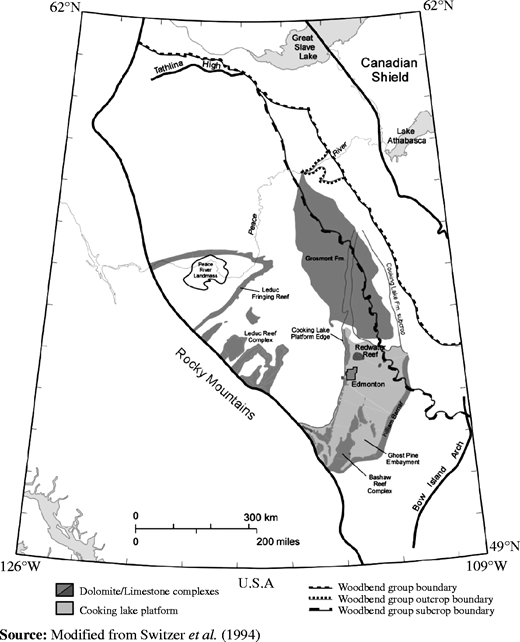
Location of Cooking Lake Formation. platform, Leduc Formation Reefs and Grosmont Formation platform of the Upper Devonian Woodbend Group in the Alberta Basin
Location of Cooking Lake Formation. platform, Leduc Formation Reefs and Grosmont Formation platform of the Upper Devonian Woodbend Group in the Alberta Basin
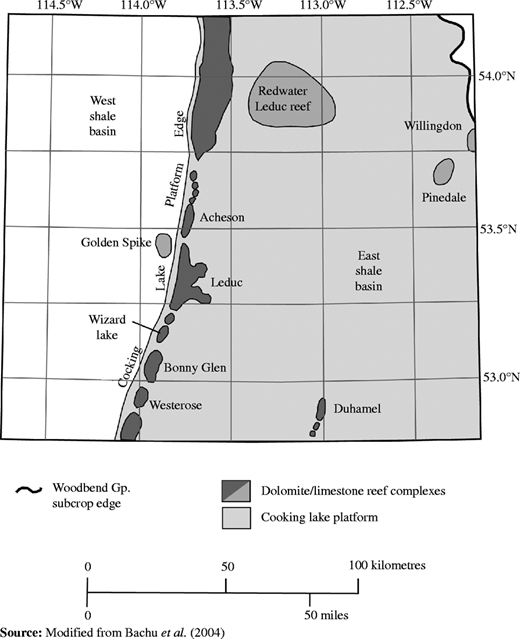
Location of the Redwater Reef in central Alberta in relation to the underlying Cooking Lake platform
Location of the Redwater Reef in central Alberta in relation to the underlying Cooking Lake platform
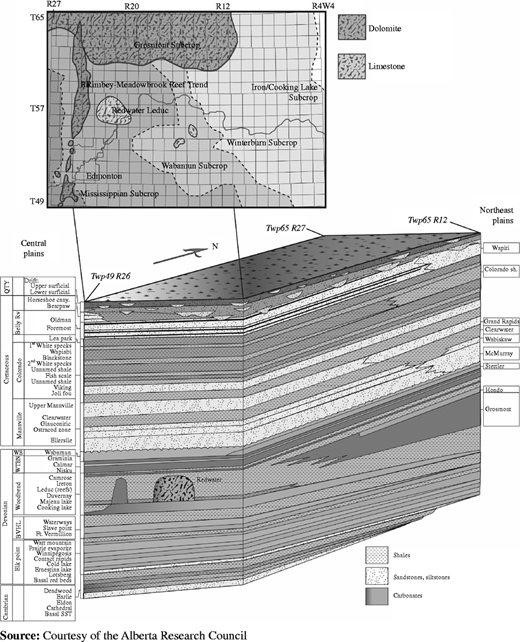
Schematic lithostratigraphic block diagram (SW‐NE) through central Alberta showing the location of the Redwater Reef
Schematic lithostratigraphic block diagram (SW‐NE) through central Alberta showing the location of the Redwater Reef
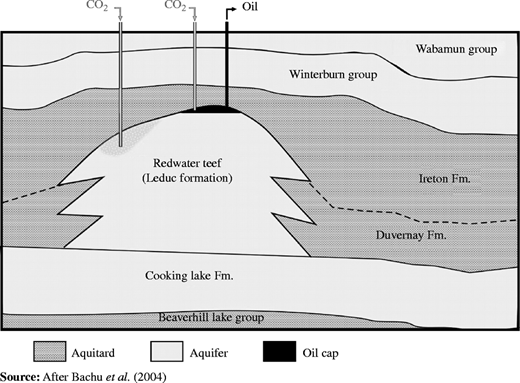
West‐to‐east schematic representation in cross‐section of the Redwater Reef and hydrogeology of the reef and adjacent strata showing potential CO2 storage schemes
West‐to‐east schematic representation in cross‐section of the Redwater Reef and hydrogeology of the reef and adjacent strata showing potential CO2 storage schemes
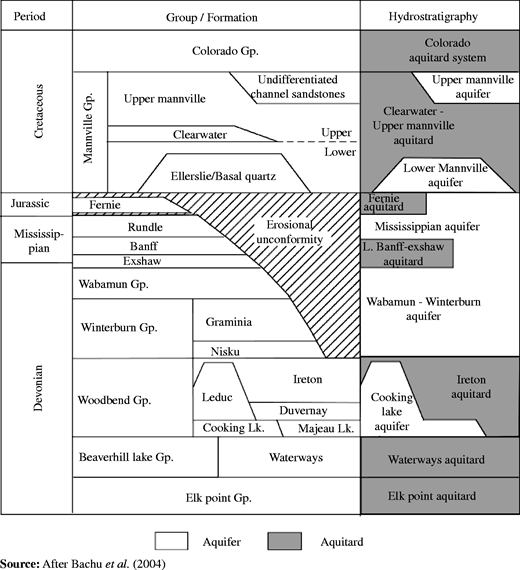
General stratigraphy and hydrostratigraphy in the Heartland region of Alberta
General stratigraphy and hydrostratigraphy in the Heartland region of Alberta
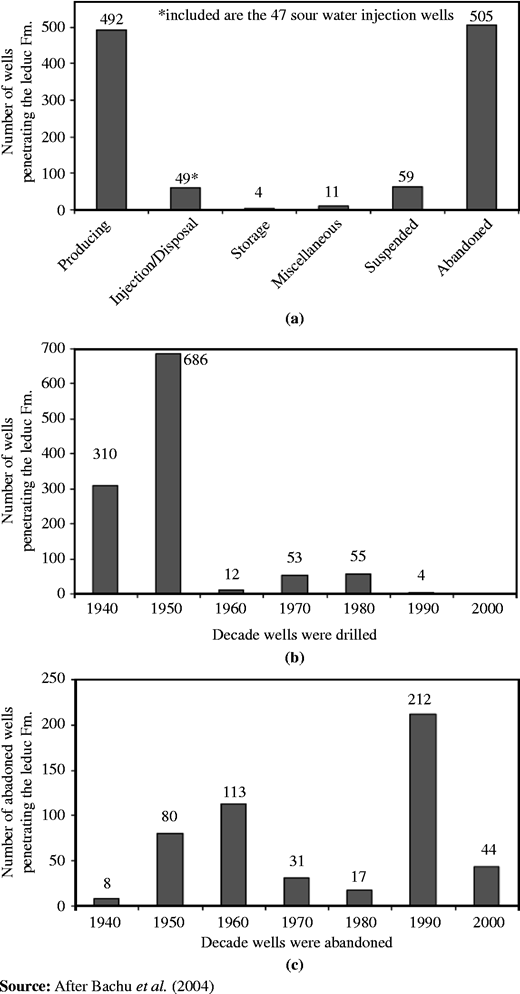
Histograms for wells that penetrate the Redwater Reef: (a) well status; (b) time of drilling; and (c) time of abandonment for abandoned wells
Histograms for wells that penetrate the Redwater Reef: (a) well status; (b) time of drilling; and (c) time of abandonment for abandoned wells
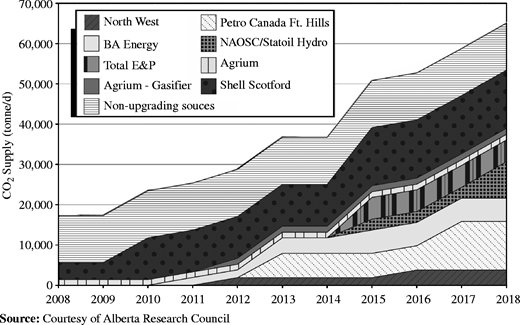
Estimated CO2 supply distribution in Heartland region from 2005 to 2018 if only steam CH4 reforming was the source of H2
Estimated CO2 supply distribution in Heartland region from 2005 to 2018 if only steam CH4 reforming was the source of H2
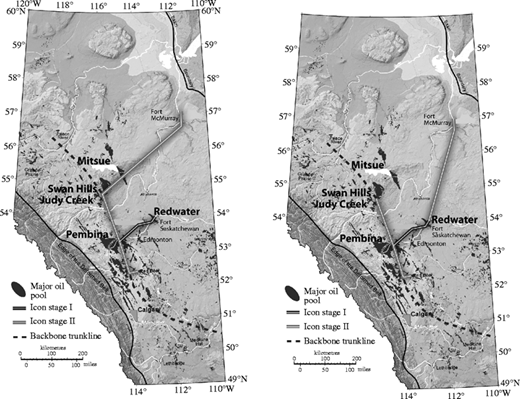
Concept of the ICO2N CO2 pipeline: (a) original (after ICO2N, 2007); and (b) modified
References
About the authors
W.D. Gunter is a Professional Geologist practicing in Alberta, an international consultant on carbon dioxide capture and geological storage (CCS) and the Principal Consultant for the Alberta Research Council on CO2 Geological Storage. His expertise is in geochemical processes (stressing use of field data, experiments and modelling) as they impact on the environment, and on the oil and gas industry. He recently received the Greenman Award for lifetime achievement in CCS from the International Energy Agency, GHG R&D program. W.D. Gunter is the corresponding author and can be contacted at: gunter@arc.ab.ca
Stefan Bachu is internationally recognized as an expert on CO2 storage in geological media, and is an Associate Editor of the International Journal of Greenhouse Gas Control.
Maja Buschkuehle has a PhD in Petroleum Geology from the University of Alberta. Until 2007, she was employed at the Alberta Geological Survey in Edmonton, Canada, working on the geological characterization and geochemistry of acid‐gas injection operations and potential CO2 geological storage sites in Alberta. She currently works as a Petroleum Geologist for Strike Oil in Perth, Australia.
Karsten Michael currently works as a Petroleum Hydrogeologist at the Petroleum Resources Division of CSIRO and for the Corporate Research Centre for Greenhouse Gas Technologies in Australia. Until 2007, he was employed at the Alberta Geological Survey in Edmonton, Canada, working on the hydrogeological characterization of acid‐gas injection operations and potential CO2 geological storage sites in Alberta.
Guillermo Ordorica‐Garcia holds doctoral and Master's degrees in Chemical Engineering from the University of Waterloo. A graduate from the Autonomous University of the State of Mexico, he has expertise in the areas of carbon capture, energy modelling, process simulation, optimization, and oil sands operations. His seminal work on energy and emissions modelling/optimization of oil sands operations has been featured in peer‐reviewed journals and presented internationally. He is currently working on developing optimal CO2 mitigation strategies for the oil sands industry.
Tyler Hauck obtained his Masters degree in Sedimentology and Ichnology (the study of trace fossils) from the Earth and Atmospheric Sciences Department of the University of Alberta in January of 2008. He has been with the Alberta Research Council for nine months, and is currently working on the geological characterisation for a number of geologic storage projects, including that of the Heartland Area Redwater Project.

