– This paper aims at understanding how smallholder farmers are adapting to drought and what shapes their vulnerabilities and ability to adapt. Considering that their capacity to adapt to climate change has been undermined not only by the natural vulnerabilities due to their geographic location but also by the social context, gender and institution that interact to influence and determine household and individual vulnerability and responses to drought.
– Both primary and secondary data were used. Primary data were collected by use of structured questionnaires from 128 male-headed households and 122 female-headed households in eight villages in the Nguru Local Government Area, as well as from key informant interviews and focus group discussions.
– Climate change is not a concept recognized by most farmers and does not have standard translation in the local language; farmers believe the term refers to change in weather. Drought and crop failure are causing despair and frustration, and farmers reported that they are struggling to adapt. The resources and support inputs required for responding to climate change and variability are socially differentiated by gender, women’s and men’s responses to drought impacts as well as their access to adaptation resources and support differ significantly. Women are in particular unable to access the favored adaptation strategies promoted by Yobe State Agricultural Development Programme as a government support institution assigned with the responsibility of helping farm households adapt to climate change in ways that will increase their adaptive capacity.
– These findings are essential for informing policy decisions by ensuring that the experiences of both women and men and the context in which they operate are embedded into policy design.
1. Introduction
Nigeria, with an estimated population of 158 million in 2010, is the most populous African country (UNDP, 2011). Despite the dominant role of petroleum in foreign exchange earnings of the country, agriculture currently employs approximately 67 per cent of Nigeria’s workforce and accounts for 42 per cent of the gross domestic product. The production chain of smallholder farming holds fundamental economic importance in Nigeria, and is responsible for about 90 per cent of the agricultural output. Critically, most of this agriculture is rain-fed and thus largely depends on the climate (Yila and Thapa, 2008; Ishaya and Abaje, 2008). With the projected long-term changes in rainfall variability and fluctuating temperature regimes, climate change is significantly expected to lower agricultural productivity and crop failures, which could intensify the country’s food insecurity and lower economic growth. These various impacts have been known to affect many social groups differently and people have in turn responded differently to these conditions according to their capacities and access to resources, leading to more or less positive or negative outcomes for the different social groups. To effectively respond to climatic stressors, it is necessary to know who is most vulnerable and why, and least able to adapt to the risk (Yila and Resurreccion, 2013; Vincent, 2007).
In the past 30 years, the semiarid zone of Nigeria has experienced droughts of varied extent and intensity in 2008/2009, 2005/2006, 1999/2000, 1998, 1996, 1994, 1987, 1984 and 1983 (YSADP, 2009). As a result, crop failures and food shortages have become a recurrent phenomenon, having serious consequences on the nature and sustainability of the agriculturally dependent livelihood. The smallholder households that are continuously affected by such severe disasters are ill-equipped to deal with shortages of food that occur; not to mention when there is an intensified or prolong drought, this would lead to a catastrophe with unprecedented repercussions. The 1968-1974 Sahelian drought is one of such known catastrophic years when a combined effect of drought and desertification killed hundreds of thousands of people, with dead animals counted in the hundreds of thousands, leaving images of desolate land and starving children and livestock (Mortimore, 2010).
Gender consideration within climate change debates has been fairly rudimentary both within science and policy, despite the fact that a gender dimension to both the causes and consequences of climate change has been seen (Vincent, 2007; Denton, 2002). Several studies have been undertaken to measure the impact of climate change on agriculture in Nigeria (Odjugo, 2010; Ishaya and Abaje, 2008; Adepetu and Berthe, 2007; Nyong et al., 2007). However, most of these studies were hinged on the analysis of the monetary or yield impact of climate change, but failed to indicate the gender dimension and differentiated vulnerability and adaptive capacity. This presents an important limitation, as farmers’ response to climate change or their choice of adaptation strategies is dictated by a host of socioeconomic and environmental factors. This study provides a basis, as well as point of departure from other studies, as the gender outlook has potential to assist policy to strengthen adaptation at the local level. The aim of this study is therefore to contribute to both academic and policy demand for an empirical investigation of the way in which people’s vulnerability and adaptability are affected through a micro-scale analysis of vulnerability of men and women and to explore what enables or constrains effective adaptability of different groups in the Nguru LGA. This is based on the background that though individuals can and are indeed adapting to climate change, they need to be fully equipped with the necessary means to constantly adapt and reduce their vulnerabilities.
Besides an introduction, this paper is organized into six substantive sections. Section 2 presents the conceptual framework of consequences of gender relations for men and women’s vulnerability and adaptation to drought. Section 3 presents the study area. Section 4 discusses the data sources. Section 5 provides discussions on the findings, and Section 6 presents conclusions and policy implications.
2. Conceptual framework: consequences of gender relations for men and women’s vulnerability and adaptation to drought
To cope and be able to adapt to the changing ecological conditions, adaptation involves the building capacity and ability of people to increasingly transform adaptive capacity into action by way of implementing effective adaptation actions. This will require including the non-climatic forces in reviewing and formulating policies toward enhancing the adaptability of all individuals in response to actual or expected changes in climate as a necessary form of adaptation (Adger et al., 2005). The individual and/or household adaptive capacity is a precondition that enables actions which are dependent on both social and biophysical elements (Vincent, 2007). However, gender relations, as a power relation between women and men, place women in a subordinated position in society with respect to men. The sexual division of labor, unequal access to resources and women’s lesser participation in decision making have significant repercussions on women’s vulnerability to climate change and their capacities for adaptation (Jungehülsing, 2012).
The Intergovernmental Panel on Climate Change (IPCC) defines vulnerability as “the degree to which a system is susceptible to, or unable to cope with, adverse effects of climate change, including climate variability and extremes” (IPCC, 2007a). “Vulnerability is therefore a function of the character, magnitude, and rate of climate variation to which a system is exposed, its sensitivity, and its adaptive capacity” (IPCC, 2007a). The vulnerability of a population group to climate change depends on three factors: its degree of exposure to climate change phenomena, its sensitivity to these phenomena and its capacities for adapting to these changes.
In this study, the spatial and temporal distribution of drought is considered as being the climatic “exposure” factor to which farmers in semiarid zone are subjected. Sensitivity emerges from the interface between the climate event and the socioeconomic characteristics of the farmers (e.g. status, assets and livelihood), reflecting the susceptibility of a household – in terms of damage or impact – to a drought event. While adaptive capacity as a component of vulnerability is determined by a wide variety of social, political, economic, technological and institutional factors, some of which are generic, others are specific to climate changes that influence communities, countries and regions’ propensity or ability to adapt (Tschakert, 2013)). For example, northeastern Nigeria was, in 1996, exposed to a severe drought, and due to its vulnerability, more than five million people suffered from food insecurity (Yila and Resurreccion, 2013). This was due partly to the sensitivity of the country, shaped by both environmental and socioeconomic conditions such as the preexisting malnutrition in the area. The losses were also due to the relatively low extent to which communities had coping (short-term) and adaptation (long-term) strategies, due to, for example, poor harvests, which resulted in low resilience. Exposure and coping and adaptation capacities often look different for men and women. These differences lead to gender-differentiated vulnerability (i.e. vulnerability that differs due to the social construction of female and male identity).
For the purpose of this study, we define drought vulnerability as the inability to:
prepare for the likelihood of drought;
make immediate adjustments in the event that drought conditions occur; or
adapt in the aftermath of a drought and develop a greater capacity to withstand the effects of future drought events.
Gender vulnerability then is simply the inability to prepare, adjust or adapt due to constraints inherent in a particular form of gender relationship.
It is important that the specific vulnerabilities of groups of individuals are taken into account when adaptation measures are developed. Adaptation is defined as “initiatives and measures to reduce the vulnerability of natural and human systems against actual or expected climate change effects” (IPCC, 2007b). Using this definition, we find that while adaptation includes the reduction of risks from disasters associated with climate change and variability, it goes beyond this: to be effective, the adaptation measures carried out must be focused on reducing the vulnerabilities of individuals or population groups – and this includes their economic, social, geographic and political marginalization (IPCC, 2007a). Adaptation measures must also have the objective of modifying inequitable gender relations – as the latter are one of the key factors in women’s vulnerability to climate change (Jungehülsing, 2012).
3. Study area
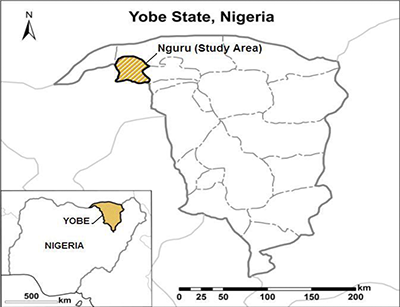
The semiarid area of Nguru LGA is located in semiarid northeastern Nigeria (Figure 1). Covering an area of about 916 km2, with an average elevation of about 343 m above sea level and a population of 150,632 (YSADP, 2009). Nguru LGA is a marginal environment of low agricultural potential, where smallholder rain-fed agriculture and livestock keeping are the two main sources of livelihood. The area’s mean annual rainfall and temperature for the period 1940-2005 was 552 mm and 30.5°C, respectively. The climate of the area is influenced by the migration of the Intertropical Convergence Zone, which annually reaches its most northerly position above Nigeria in July or August and whose influence produces the distinct wet and dry seasons characteristic of sub-Saharan West Africa (Hess, 1999). The rainy season starts in late May or early June, peaks in August and finishes quite rapidly in September or October.
The area is known to exhibit low and variable rainfall and experience regular drought-related harvest failure. The major crops grown are millet (Pennisetum typhoides), sorghum (Sorghum bicolor), maize (Zea mays), cowpea, beniseed and groundnuts (Arachis hypogea). In most seasons, the value and amount of the labor invested in crop farming are greater than the amount and value of the harvest. In addition, as a drought-prone zone, the past 30 years have experienced droughts of varied extent and intensity (Yila and Resurreccion, 2013). To ensure their food security as well as their overall well-being under the difficult conditions of farming in these drought-prone areas, smallholder farmers diversify their livelihoods. Men and women each play key roles in this process of diversifying livelihoods to contribute to food security at the household level.
The soil of the area is dominated by two soil types, according to parent material. The most extensive are aeolian deposits (dune sands), this soil is poorly graded, with low clay content and is susceptible to erosion and has a low water-holding capacity and soil moisture limits crop production (Hess, 1999). The second are alluvial deposits (Fadama)[1], soil which is fine-textured with relatively higher water-holding capacity and higher organic matter, which occur in the major drainage valleys of the Nguru-Hadejia river system. The ecology of the study area falls within the typical “Sahel Savanna”, typified by a mixture of grasses, shrubs and trees, and has been classified as “sub-arid wooded savanna” by Hess (1999).
The study area is still predominantly governed by traditional values and norms with a patriarchal system where the husband is the head of the household. Although the traditional values and norms have partly become obsolete with the advance of the market economy in the area, they to a great extent influence the definition of roles for both men and women. An increasing prevalence of female-headed households was observed. These are households where the principal position is occupied by a woman, most often due to the death of a husband, or perhaps divorce (de jure female-headed households), and de facto female-headed households, where the day-to-day running of the household is directed by a woman, in the absence of a husband who may be away for varying periods exceeding three months.
Various types of agricultural land tenure systems exist in the study area, among which are inheritance, renting, purchasing, borrowing and share cropping. Majority of households own farmland under the inheritance system whereby land belongs to the family and is passed on from one generation to another by the household head. However, as crucial as land is as an asset, women generally have limited access to land because they are not recognized as beneficiaries in terms of inheriting land. Most women do not own land, although they have access to it through their husbands, fathers or adult sons, and they usually lose the rights to land following divorce or the death of their spouse.
4. Methodologies
The fieldwork was conducted from December 2010 to April 2011. The first stage involved key informants’ interviews with village leaders, elderly farmers and extension workers, with the aim of identifying significant environmental change patterns in the past 30 years.
The second stage consisted of focus group discussions with farmers in each of the eight villages with the aim of:
verifying and complementing data from key informant interviews and household surveys; and
exploring in greater detail the experiences and vulnerability of men and women and extent to which people believed climate change had affected them.
Two focus group discussions in each village were carried out with separate group of adult males and females.
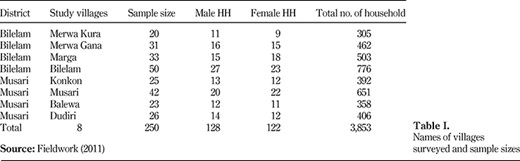
The third stage of the survey involves household survey, using a structured questionnaire that provided the basis for quantitative characterization of household socioeconomic characteristics, perceptions of climate change and variability and adaptation strategies over the past 30 years. The sample size for the survey was determined using the sampling method devised by Arkin and Colton (1967). A sample size of 250 households was calculated from a total of 3,853 households in the two selected districts at confidence level of 95 per cent, with a precision level of ± 4 per cent. The two districts, Bilelam and Musari, were purposively selected out of the four districts of Nguru LGA (Figure 1). Musari is located off the main highway, while Bilelam is transverse by the Nguru–Machina highway. Four villages were randomly selected from each district. Sample sizes for the selected villages were determined commensurate with the total number of households in the respective villages (Table I). A list of household heads in the eight selected villages was obtained from the respective village heads. In each village, households were numbered 1 […] n. The female household head (FHH) were purposively selected in view that they are not many, while the male household head (MHH) were randomly selected in a stratified way such that each third household was picked from the list for the interviews. Prior to the survey, the questionnaire was translated into Hausa (the widely spoken language in the area), after which it was pre-tested by administering it to selected respondents, and then revised. Information collected through the household survey was analyzed using Statistical Package for the Social Sciences (SPSS) version 20.
Relevant secondary data available from books, reports, journal and information from the Internet supplemented primary data. Gray literature obtained from extension staff was also consulted for information on national strategies for agriculture and climate change adaptation and how they are implemented at the local level.
An increasing prevalence of female-headed households was observed. These are households where the principal position is occupied by a woman, most often due to the death of a husband, or perhaps divorce (de jure female-headed households), and de facto female-headed households, where the day-to-day running of the household is directed by a woman, in the absence of a husband who may be away for varying periods exceeding three months. Of the FHHs surveyed, 73 of the women are de jure, while 49 are de facto.
5. Results and discussions
5.1 Farmer’s socioeconomic characteristics
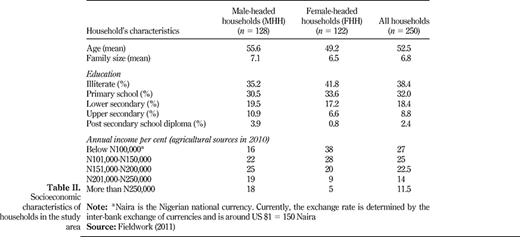
As in other places, farm household heads in Nguru are responsible for the management of the farm and for key decision making regarding agricultural production. Their ability to receive, interpret and process information from a range of sources that affect production and adaptation to the changing climate is determined by a number of factors. Table II presents the socioeconomic characteristics of the entire sample (250 farmers) based on the household headships. The discussion in the remaining part of this section is partly based on this table.
According to the data shown in Table II, the average age of MHH is about 55.6 years, against 49.2 years for FHH. Age of head of household often has a direct relationship with farming experience, which increases the farmers’ likelihood of adapting to climate change strategies. This is due to the fact that the knowledge of the recommendations and application of these strategies is gained over time with practice. On average, household heads in the study area have been engaged in farming for 23.5 years. Differentiating on the basis of gender, MHH have an average 26.2 years, while women 20.7 years. The village head of Bilelam remarked:
[…] farming experience increases the probability of uptake of all adaptation options because experienced farmers have better knowledge and information on changes in climatic conditions and crop and livestock management practices. In reality, it is farming experience that matters more than merely the age of the farmer when it comes to adaptation to climate change.
Ishaya and Agbaje (2008) in a study in North Central Nigeria found similar results where older farmers are applying adaptation measures to cope with drought than younger ones. This indicates that farmers with more years of farming experience are more likely to notice changes in climatic conditions, due to their prior experiences.
Another significant factor in determining household adaptation is family size. The average family size of the sample 250 is 6.8 persons, with MHH having average family size of 7.5 than FHH, which have 6.5. The influence of household size on the decision to adapt is ambiguous. Family size as a proxy to labor availability may influence the adaptation of many strategies, as its availability reduces the labor constraints. With the absence of a husband, either through migration, death or divorce, in FHH, labor available for operating labor-intensive adaptation measures is reduced, thereby restricting FHH from carrying out some necessary adaptation activities. However, it should be noted that adaptation strategies are rather diverse and not only affecting agricultural production but livelihood generation. Furthermore, there is a possibility that households with many family members may be forced to divert part of the labor force to off-farm activities in an attempt to earn income to ease the consumption pressure imposed by a large family size.
The education level of household heads is another social factor often hypothesized in determining the probability of adaptation options by increasing one’s ability to receive, decode and understand information relevant to making innovative decisions. In the rural context of northern Nigeria, household heads are responsible for decisions that affect the use and management of farmlands. A regression analysis of factors influencing climate adaptation in the same study area by Yila and Resurreccion (2013) reveals that farm household heads with long years of formal education are better at obtaining information, and more apt to process and make use of this information. They are also more successful at getting necessary support from agencies involved in promoting climate change adaptation strategies than illiterate or less educated farmers, because education strengthens farmers’ analytical capability and provides them with the cognitive ability to understand the application of climate adaptation strategies and use of sphere of influence within their network circle. These findings corroborate Deressa et al.’s (2009) work in Ethiopia, which shows that knowing how to read and write plays a key role in empowering farmers to access social benefits such as credits, which can consequentially enhance climate change adaptation. Table II revealed FHH are lagging behind the MHH in terms of educational attainment, placing them at a disadvantaged position. Variance in terms of level of education in the study area revealed gender–schooling gap, women were much more likely than men to have no formal schooling – 29 (11.5 per cent) with secondary education and only one (0.8 per cent) with post-secondary education against 39 (15.6 per cent) males with secondary education and five (3.9 per cent) with post-secondary qualification (Table II). This implies that MHH may have a higher probability of adapting strategies during extreme climatic events than FHH. Thus, increasing women’s access to education and narrowing the gender–schooling gap would directly improve women’s capacity to adapt.
Higher income is another important feature that contributes to the adaptability of smallholder agriculture to drought. Evident from Table II, MHH have higher income from agriculture than FHH, thus making MHH likely more active in applying adaptation options to cope with drought. As reported during focus, participants agree that men in Nguru typically have more assets and money than women. The savings they possess can likely grant them buffer during and after drought period, making it easier for them to invest in alternative livelihoods. Therefore, improving the socioeconomic conditions of farmers is essential in strengthening and building adaptive capacity as a key strategy in reducing local vulnerabilities to drought.
5.2 Drought causes and impacts
Due to the nature of drought as a slow-onset hazard, the existence of drought relative to expected variability only becomes apparent sometime into the event. The complexity involved in pinpointing the start and end points of a drought also means that it can be difficult to distinguish coping strategies from those used to deal with general variability of water availability.
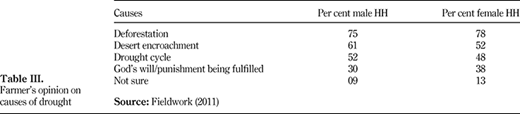
In a multiple-response frame, from Table III, it can be seen that participants expressed their views about the possible causes of drought in the area.
A significant number (more than 70 per cent) of MHH and FHH attribute the main cause of drought to local deforestation, as 53-year-old de jure FHH from Marga says: “As we all know, forests […] attract rain, so if the forests are cut down, there is drought”. People say that the loss of trees has affected rainfall patterns, depleted local water sources and contributed to the loss of soil moisture and subsequent erosion.
While many respondents think the absence of rain is caused by deforestation, some also believe desert encroachment through the southward expansion of the Saharan desert and changes in weather pattern and drought cycle contribute to the decline in rainfall and increased frequency of drought in recent years. The lack of rain means crop failure and that many do not have enough food or water for themselves or their animals. Many also say that drought affects them economically. Inadequate harvests force farmers to buy food, yet lower crop yields reduce their available income.
More commonly, some of the respondents, especially women (38 per cent), accept that human activities have an influence on the climate, but feel that some of the extreme weather events they are experiencing are because God is punishing them for bad behavior. “It is through our own sins that we have these problems”, says an older woman from Bilelam. “The time has come to be punished; God is punishing us for our deeds”. “It is the will of God for these things to happen,” explains a widow in Dudiri, adding: “When it comes to rainfall, it looks as though God has changed his calendar”. Another old man tells of the besetting and growing aridity in Marga village: “Now the whole place is dried up and there is no single water in that place now – [it was] Allah’s will”.
People in Nguru are responding to drought by addressing local deforestation and by trying to counteract its impacts in any way they can. Tree-planting is an ideal solution for many, although not necessarily an achievable one. As a 67-year-old male farmer from Musari explains:
I might be aware that my brother or neighbor burns charcoal […] [if] I go ahead and report him I will be destroying his family and that’s what he depends on. I do not think it will be easy.
The impacts of these changes are striking. Majority of women during the focus group discussions recounted that their lives have become more difficult and that their traditional livelihoods are no longer sustainable. A 58-year-old male farmer from Merwa Gana echoed the complaints of farmers and pastoralists alike:
Since people started cutting down trees and spoiling the environment, this forced us to move to other places that have not been tampered with. But this place is a desert now.
).
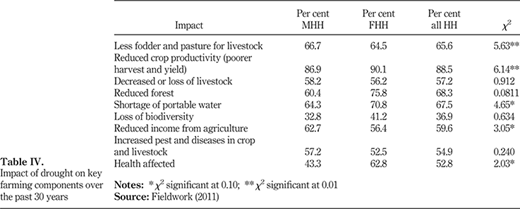
The findings in Table IV revealed significant gender differentiation on roles and relationships as to the different responses. Men significantly more than women reported there was less fodder and pasture for livestock, reduced or loss of livestock, reduced income from agriculture, increased pest and diseases in crop and livestock and health affected. (Table IV). Whereas, women more than men reported effects on health, shortage of portable water and loss of biodiversity.
These significantly indicate that women are more concerned about and affected through their own health and/or the health of the family, while men were more focused on the farming production issues. As with most African societies, women’s roles in Nguru continue to be centered on the home, such as preparation of food, fetching water for domestic use, collection of firewood and providing nurture for children to grow.
5.3 Farmers’ perception and knowledge on climate change and climate variability
On what farmers know and understand about climate change, we found that despite articulating local challenges and recognizing differences in nature, weather and the surrounding environment, farmers rarely link such changes to the global phenomenon of climate change. Not only does climate change terminology not resonate with people, they also generally do not have a clear and accurate understanding of climate change concepts. Most farmers tend to understand the term to refer to seasonal changes or immediate changes in the weather. A 62-year-old man from Balewa is typical in describing climate change as “when weather changes from the dry to the wet season”. During the fieldwork, local farmers therefore often relate the term “climate change” to the weather. As a result, discussions about the causes of climate change often evolve into discussions of wider environmental issues.
A lack of understanding of climate change by farmers is not exclusive to the developing world; a review of research on climate change perceptions in the developed countries reveals public understanding as “patchy, but generally poor”. Similarly, people were often found to have basic misconceptions about climate change. Despite high levels of media coverage on climate change, this has not always highly educated the public; some research suggests this is because climate change is seen as a remote and non-urgent issue. But this is less likely to be the case in sub-Saharan Africa, where most people are already experiencing the impacts in their daily lives.
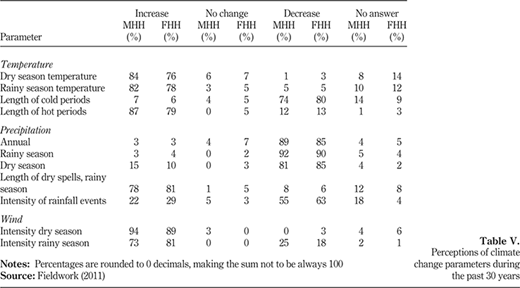
Long-term temperature, precipitation changes and wind are key parameters related to climate change in Nguru LGA. The perceptions of these climate parameters were assessed at household levels (Table V). The surveyed household heads were asked questions regarding their observations about the patterns of rainfall, temperature and wind over the past 30 years.
Table V shows that majority of the household heads (more than 75 per cent) perceived an increasing temperature in Nguru evidenced by the high rate at which surface water sources such as ponds, streams and lakes are drying up, wilting of crops after a short spell of precipitation and outbreak of epidemics such as cerebrospinal meningitis often associated with dry season. Most pointed out that temperatures have become hotter than before. They specifically mentioned that in the past five years, the weather is a bit warmer than it used to be. Season they refer to as winters has in recent years been shortened to early February instead of ending at beginning of March, a factor which household heads linked with the unpredictability and the late onset of the rains. This is consistent with a study done across ten African countries that included neighboring Niger and Ghana, where farmers generally regarded precipitation to have decreased and temperatures to have risen (Maddison, 2007).
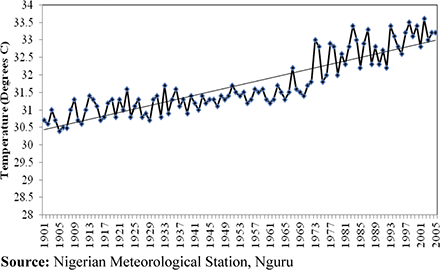
The statistical records of temperature data from Nguru between 1901 and 2005 show an increasing trend (Figure 2). The air temperature anomalies relative to 1970-2005 average also support the evidence of increasing temperature trend, which was more from the early 1970s (Figure 2).
However, more than 80 per cent MHH and FHH also observed changes in annual rainfall pattern over the past 30 years (Table V). Thus, the overall perception on long-term changes in precipitation is that the area is getting drier with pronounced changes in the timing of rains and frequency of droughts. Majority of respondents also pointed out that the past few years’ rainfall has become highly unpredictable and that they could not predict the time of onset of seasonal rainfall, with more frequent dry spells.
Most of the household heads we spoke to cited lower rainfall, shorter rainy seasons, rising temperatures, dwindling vegetative cover and declining soil fertility as evidence of climate change. The village head of Dudiri explained:
Rains are more irregular and rainfall is lower. This reduces agricultural production and grazing for livestock, and has made living conditions difficult. Agricultural production activities are gradually disappearing, and people have to find alternatives in order to survive, such as emigration or activities in the commercial and services sectors. In the past it was older people who emigrated, but as living conditions have become more difficult lots of young people are leaving to try their luck elsewhere.
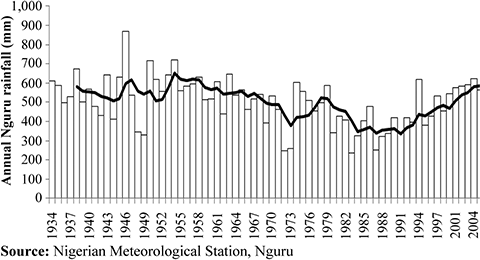
), Nguru LGA has experienced a significant decline in annual rainfall over the period 1934-2005, with an average reduction of 8 mm/year. This decline has been dominated by a reduction in the number of rain-days during the rainy season, rather than any shortening of the season, or reduction in mean rainfall per rain-day (
Many respondents cited the 1996 drought as the particularly severe in the recent past, often referred as “Farin Agades” or “Famine of Agades”, a famine that led to migration of many Nigeriens from Agades in search of food in many parts of northern Nigeria, followed by year 2009, 2008, 1998, 1987 and 1983. These six years coincided with period when recorded rainfall was low in the area.
On wind, it was almost unanimously pointed out that winds are stronger, especially during the dry season. The explanations in the focus group discussions corroborated generally with the findings in household surveys, as the respondents expressed concern about the increasing wind speeds both during the dry and wet season (Table V).
It is clear from Table V that the perceptions of climate parameters by female and male focus groups were similar. However, more MHH than FHH indicated witnessing changes in all the three climatic parameters discussed in Table V. This could possibly be associated to the fact that there are significantly more MHH than FHH having access to weather information. The underlying assumption here is that while households may already have a certain way of perceiving climate variability, access to weather information enhances awareness about climate changes. Several research works highlighted the critical role that access to weather information plays in shaping farmers’ perceptions of climate change and variability (Deressa et al., 2009; Gbetibouo, 2009).
The overall analysis of farmers’ perception showed that farmers in Nguru LGA have quite elaborate knowledge of climate-related factors, and most of the farmers are aware of the fact that temperature in the study areas is increasing, while the level of precipitation is declining.
Findings suggest that although most farmers in Nguru do not know about climate change in the scientific sense, they have certainly experienced it. Observable changes in the weather and the seasons constitute most farmers’ knowledge of climate change; they live with the impacts of the changing climate in their day-to-day lives. Men and women farmers reported similar observations of temperature and rainfall trends over time coinciding with climate record which confirmed Nguru LGA’s history of drought and trends toward worsening drought conditions.
5.4 Farmers’ adaptation practices toward drought
Adaptation to drought event is a two-way process, first it requires the perception of the occurrence of drought by farmers and then responding to the hazard through adaptation (Mortimore, 2010). Thus, farmers’ perception of drought has been a necessary prerequisite for their initiation of adaptation strategies. Studies of farmers’ perceptions of drought indicate that the majority of farmers in drought-prone areas already perceive drought as a recurring feature of their environment (Habiba et al., 2012; Mortimore, 2010; Deressa et al., 2009).
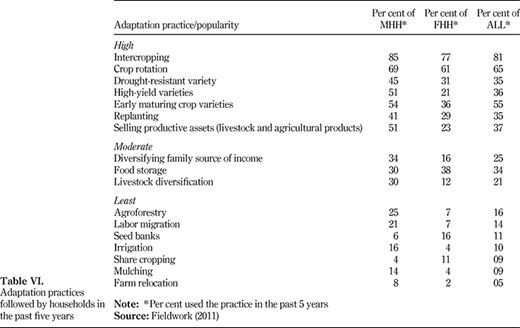
Table VI shows how farmers are adopting an assorted array of adaptation practices to address the effects and impacts of drought. However, the relative level of adoption of such practices varied across households. For easy discussions about the practices, we developed an indicator to group the practices into three categories of popularity based on the proportion of households using a particular practice. The practices adopted by more than 35 per cent of the respondents were considered to be highly popular, while 20-34 per cent considered as moderate and practices adopted by less than 20 per cent as the less popular.
Six practices emerged from this survey as the most practiced strategies by majority of the households, namely, intercropping, crop rotation, drought-resistant variety, replanting, high-yield varieties, early maturing crop varieties and selling of productive assets (livestock and agricultural products). These results are consistent with findings by Deressa et al., 2009, who reported all these strategies among the strategies by farmers in the Nile Basin of Ethiopia.
On the highly popular practices, majority of the farmers (81 per cent) ranked intercropping high (Table VI). Farmers mentioned intercropping provides a safe valve, as they are confronted with a lot of uncertainty, among which is irregular rainfall. Although intercropping helps farmers to obtain maximum returns on their efforts, the ultimate goal, as pointed out by most farmers, is the stable provision and quick return on investments. The crops being intercropped in the area include legumes such as cowpea, groundnut, soybeans and melon with cereals. In some instances, it is root crops with cereals. However, in spite of the many benefits of intercropping; the shortfall of women (77 per cent) compared to men (85 per cent) practicing this strategy attributes to the fact that it requires higher amounts of inputs such as labor and fertilizer, which often is a constraint to FHH (Table VI).
We find crop rotation to be popular among the farmers on the basis that it has the capacity to improve soil fertility, control weeds and reduce the risk of pest infestation. Nevertheless, a number of FHH are unable to embark on this practice due to the fact that it leads to the disturbance of the traditional cereal crop-based system, as they have limited land and must ensure to grow the stable cereal for their family consumption.
Diversifying family source of income, food storage and livestock diversification are the moderately popular adaptation practices in the study area (Table VI). Considering the long experience of using these practices, farmers identify them as ways they use to mitigate and withstand drought periods. It was noted that more MHH (34 per cent) play part in diversification of family income than FHH (16 per cent). By virtue of the fact that they are more completely bound by domestic responsibilities, women have less time available to earn a private income. Thus, their inability to diversify household income as much as males do. Although livestock is a major household asset, MHH often raise the large stock like cattle, sheep and goats and control the sale of both large and small stock like poultry raised by women, hence men have strong influence in determining livestock diversification. Some of the multitude of alternative sources of food and income that households engage in includes collecting indigenous and exotic fruit, selling livestock and poultry and doing casual labor on other people’s farms. A few relied on a skilled job, salary, petty trading or producing charcoal, handicraft, honey and bricks for sale.
Food storage appears to be the practice in which FHH (38 per cent) take the lead over MHH (30 per cent). The finding is consistent with results of Mutekwa (2009), who established that food storage and preparation is one of the major roles of women in the household, and why their strong involvement also in food preservation, which is vital in places where harvest failure occurs, is a common denominator.
Agroforestry, labor migration, seed banks, irrigation, share cropping, mulching and farm relocation are the least popular adaptations practiced by less than 20 per cent. Although a relatively small percentage, farmers gave some insights revealing their understanding of the environmental and economical importance of some of these practices. Even though many farmers appreciate the role of agroforestry in increasing soil fertility and in diversifying income for households, the major constraints they kept pointing to included, especially, that it takes away the merger land at their disposal meant for field crop production. Even though the less popular practices are at the lowest ebb, considering the many important roles of the practices, there still remain wide prospects of their adoption looking at the potentials they hold to help alleviate the pressure that households face in event of recurring droughts and crop failure.
In the event of extreme drought conditions, farmers also mentioned some options they embarked on to mitigate drought impacts, such as borrowing money from middlemen and mortgaging their farmlands, and similar types of results were found by Habiba et al. (2012) in northwestern Bangladesh, where it is common practice for households to liquidate whatever assets they may have to generate cash for the purchase of food during times of drought distress.
5.5 Adaptation practices and enabling agencies: how gender and institutions influence adaptation
Nigeria has undergone political and institutional changes in the recent past, and although households make decisions that aim to reduce vulnerability to climate change and variability, these decisions are embedded in the institutional framework. Until 1999 with return to democracy after a long period of military rule in Nigeria, a traditional local governance system prevailed, based on communal authority in Nguru LGA. Local-level institutions and collective action based on social capital were the main mechanisms for responding to livelihood risks. Since 1999, communities in Nguru LGA have had access to democratic governance structures and associated policy frameworks; a wide variety of institutions, therefore, now play a role in affecting the livelihood decisions of these households, particularly the Yobe State Agricultural Development Programme (YSADP). This agency promotes climate change adaptation through extension. Extension workers educate farmers on the advantages of such practices and persuade them to adopt strategies through setting up experimental demonstration farms. This has implications for vulnerability to drought, as the decisions taken at household level are now embedded within a new institutional framework whose landscape can, intentionally or otherwise, influence local adaptations. But what are the implications of the co-existing governance structures and how do they affect the households of different headship?
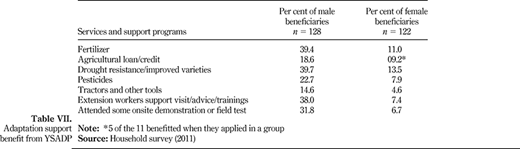
In this study, the results of the survey, interviews with YSADP staff/extension workers and women and men group discussions revealed the differences in how farmers make use of or benefit from government support institutions to make adaptation choices and enhance their adaptation capacity (Table VII).?
Farmers generally reported that they are no longer supplied with and are unable to buy agricultural inputs directly from the assigned government office/officers as it used to be practiced. Instead, such important support resources have been contracted and subcontracted by the government as a major conduit to reward political allies and reprimand opposition even at the local level. Consequently, farmers now buy inputs at an exorbitant price dictated by the contractors; as such, the poor are excluded. Our findings reveal that a much higher number of men than women accessed and benefitted from all the services and programs of YSADP. The schemes with the highest number of women beneficiaries are the improved varieties (13.5 per cent) and fertilizers (11 per cent). When the women were asked during focus group discussions how they were able to access that, they explained that their relative accessibility to loan was aided by their male partners and other women when they applied in a group; making gender component a factor in determining who can access inputs for adaptation strategies. Other schemes and programs that women benefitted from, as shown in Table VII, include agricultural loan/credit (9.2 per cent), pesticides (7.9 per cent), onsite training demonstration (6.7 per cent) and tractors and other tools (4.6 per cent). Onsite training and the use of tractors remain the least of all programs used by women, as explained by the YSADP staff; the timing conflict with women’s responsibilities at home regarding when the demonstrations are conducted and when the few tractors are available for their use.
The low numbers of women beneficiaries of YSADP programs and schemes compared to men can be explained by the cultural restrains; many married women cannot sit alongside their male counterparts to participate in discussions and trainings or attend a field test visit. But many of the male beneficiaries chose the adaptation practices they adopted due to the influence of YSADP from field test reports, discussions and site visit. Hassan and Nhemachena (2008) noted that farmers’ participation in promotional activities enhances the high probability for adaptation options. Similar to the findings of this research, other studies noted that some of YSADP’s activities around the country might gradually lead to depriving lower-class peasants of their livelihoods due to progressive farmers hijacking project benefits and “the land grabbing in rural areas by rich and powerful bureaucrats who have the connection and the resources to engage in large-scale agriculture” (Yila and Thapa, 2008).
On the contrary, the result of Olujenyo’s study on the impacts of YSADP on the level of agricultural innovations adopted by rural dwellers in developing economies described farmers who adopted only one to three innovations out of ten introduced by YSADP as low adopters, while those who adopted more than seven as high adopters (Olujenyo, 2006). However, the analysis in this research revealed that the inability to adopt certain agricultural innovations promoted by YSADP was constrained by the prevailing context of marginality, stereotype and exclusion. Thus, these individuals cannot be termed low adopters as though it is their own making and choice. To this effect, the different causes of vulnerability in all its different ramifications of political, economical and social scales must be first understood and identified for proper intervention. Hence, there is need to re-examine the adoption and non-adoption of certain policy-proposed strategies.
How farmers interact with extension workers is an important factor influencing the adaptation of climate change strategies. Through focus group discussion, many farmers were impressed with the extension agents’ use of participatory approaches, viewing them as facilitators in agricultural production processes rather than providers of technical solutions. This has led to a tendency toward increasing adaptation of drought-resistant varieties among men and women. Similar to the findings of other studies (Deressa et al., 2009; Mortimore, 2010), access to information and adaptation knowledge for climate change is having a significant effect on farmers’ adaptability, as described by male group discussion.
6. Conclusions and recommendations
Farmers in Nguru LGA have been faced with threat of climate change-induced drought. As agriculture has always been their economic mainstay, they are making strenuous efforts to maintain crop production and land productivity in the face of climate variability, by adapting an array of climate change strategies.
The research results show how MHH and FHH perceive and experience drought impacts and demonstrate how these experiences lead them to make choices about adaptation. The evidence presented here supports the hypothesis that, due to gender roles (the tasks, behaviors and responsibilities a society defines as “female” or “male”) and due also to differential gendered access to resources, women and men experience drought impacts differently and have diverse adaptation strategies. The results reveal that gender is a significant factor in adaptation. The overall adaptation of these measures varies from one household to another. Results of the focus group and survey analysis clearly indicated the MHH are better posed than FHH in adapting practices, which is determined by the social context, gender and institution (in which they experience and express the realities of the changing climate), how they interact to influence and determine household and individual vulnerability and responses to drought.
The central conclusions of this research are that vulnerability to climate change does exhibit gendered elements, and that the existing institutional environment in Nigeria, while addressing absolute vulnerability, is inadvertently promoting differences in relative vulnerability between female- and male-headed households. Our research makes an empirical contribution to debates on social vulnerability, where social factors have been theorized to cause differentiation of vulnerability, but not hitherto empirically proven.
Understanding the gendered nature of vulnerability is, however, useful for identifying and understanding the driving forces that contribute to vulnerability in households of different headship. This, in turn, has important policy implications. Analysis of the implementation of formal policy frameworks shows that there are gender-differentiated effects, largely reflecting the different stocks of human and social capital held by women and men which affect their access.
This knowledge can be applied more broadly to ensure that developmental initiatives and policies do not have unintended consequences that reinforce difference between male- and female-headed households. While Nigeria’s democratic constitution enshrines gender equality, there are still gendered roles within society, and it will take some time for these changes to be seen. The educational legacy, for example, whereby girls typically received less schooling than boys, means that many middle-aged women are still currently constrained relative to their male counterparts in the range of employment for which they have adequate skills, potentially increasing their vulnerability. Thus any local projects aimed at increasing employment need to ensure that they cater for men and women, so as not to run the risk of potentially increasing vulnerability for female-headed households. Ensuring gender neutrality of outcome may require gender-differentiated processes, for example, actively involving and targeting de jure female-headed households through information and awareness campaigns.
More generally, this research has policy implications for promoting adaptation and reducing vulnerability to climate change. Social protection policy reduces vulnerability to climate change by improving income levels and providing a cushion against the variability of climate-dependent livelihoods. However, this distancing from variability reduces the incentive for coping and adaptation strategies to respond to variations in climate and thus means that many households will be less well placed to deal with the projected impacts of climate change. Although there is little evidence that it has happened to date, increasing dependence on government support also runs the risk of eroding community-based institutions and mechanisms for coping with risk.
Recommendations made below will encourage farmers and policymakers in efforts to help farmers adjust to the challenges of drought.
It is clear that communication and information provision is going to be central to farmers’ response to these challenges. Many extension workers spontaneously mention the need for better communication on climate change and all agree that the general public needs more information. Although this research sets out to present the perceptions of the farmers on climate change, and not to detail a climate change communications strategy, various communications implications can be drawn from it. Thus, the media has a critical role to play in providing information on climate change and supporting others to do so, including governments, national and international non-governmental organizations, scientists, religious and community leaders.
Government should build the technical and human capacity of farming communities for technology diffusion and technical assistance, as almost all smallholder farmers are reliant on obsolete and inefficient agricultural practices. The promotion of less labor-intensive, but more remunerative strategies would also motivate farmers to apply climate change strategies effectively to plots that are in a relatively good state.
Farmer-to-farmer extension also affects adaptation to climate change positively. Specifically for women, there is need to increase this interaction among women farmers by training and encouraging women extension staff.
Policy interventions which encourage increasing means for off-farm employment in both informal and formal sectors can promote the involvement of women and improve their adaptive capacity and options for adaptation to climate change.
Due attention also needs to be paid, apart from cost-effectiveness and technical suitability, to labor necessity for adaptation practices, whether local or foreign. To facilitate farmers’ investment in long-term adaptation options, government should ensure that tenure arrangements, even in communal smallholder farming systems in the country, are secure. Similarly, policies that target women farmers could help them measure in adaptation practices, given the specific vulnerability of women and their heavy involvement in the agricultural labor.
References
Further reading
About the authors
Jummai Othniel Yila is a PhD Research Student in the School of Environment, Resources and Development at the Asian Institute of Technology (AIT), Thailand. Alongside her studies she served on some ground-breaking research projects, namely: “global climate change adaptation funds sources and mechanism” with the Institute for Global Environmental Strategies (IGES) and “assessing and monitoring of vulnerability and adaptation to climate change in Southeast Asia for responsive planning” with the Center of Excellence for Sustainable Development in the context of Climate Change (CoE SDCC). Her main areas of interest include vulnerability assessment, development of policy tools to help societies reconcile ecological and economic concerns, gender, sustainable agriculture and climate change adaptation governance. Her ongoing PhD dissertation focuses on the adaptability of smallholder farmers to climate change in Northeastern Nigeria. Jummai Othniel Yila is the corresponding author and can be contacted at: jummai.yila@ait.ac.th
Bernadette P. Resurreccion is a Senior Research Fellow at Stockholm Environment Institute (SEI) Asia Centre, Bangkok, Thailand, and Adjunct Associate Professor of Gender and Development Studies at the Asian Institute of Technology (AIT), Thailand. Her major areas of specialization and research interests are in gender in relation to rural livelihoods and natural resources management, migration and livelihoods, climate change adaptation and discourses and practices of gender mainstreaming in policy environments and local institutions.
The authors would like to acknowledge the support of the farmers in Bilelam and Musari districts of Nguru LGA, Nigeria, who participated in the household survey and focus group discussions. They also thank the Asian Institute of Technology (AIT), the International Tropical Timber Organization (ITTO), the West African Research Center (WARC) and the International Federation of University Women (IFUW) for providing the financial resources in conducting the research.
Note
Fadama is a Hausa word meaning seasonally waterlogged or flooded depression or flood plain.