


– The purpose of this paper was to determine if there is an association between farmers’ socio-economic profile and their perception of climate change and related events (drought). Understanding of farmers’ perceptions of drought and climate change may assist in informing policy decisions and development of appropriate intervention strategies.
– Discriminant analysis was used to assess the relative importance of the discriminating characteristics (socio-economic characteristics) through the utilization of the weights of the discriminant function.
– Age, education, literacy level, farm type, location and gender were important predictors of how farmers perceive climate change and drought phenomena.
– Most of the studies carried out in the study area were largely descriptive and did not find the association between farmer socio-economic profiles and how they perceive climate change and drought events. This paper also uses discriminant analysis which has been rarely used in this type of study.
Introduction
A number of studies suggest that climate change effects such as global warming are causing more frequent and intense droughts throughout the world. The Southern African region, with its relatively low rainfall index and a variability that even exceeds that of the Sahel region, is prone to frequent drought occurrences (Gommes and Petrassi, 1996). Climate change is regarded as a key emerging environmental issue in South Africa, as the country is located in one of the regions most prone to the phenomenon (International Federation of Red Cross and Red Crescent Societies, 2012). There is global variation in the impact of climate change vulnerability; however, the adverse effect of climate change is particularly devastating in developing regions, especially Sub-Saharan Africa (Ngaka, 2012). This has been attributed to:
rapidly declining precipitation levels;
increasing temperatures;
low adaptive capacity;
high dependence on natural resources;
inability to detect the occurrence of extreme hydrological and meteorological events due to low technology adoption;
limited infrastructure;
illiteracy;
lack of skills;
low management capabilities; and
weak institutions and the absence of comprehensive national adaptation policy among others (Nti, 2008).
Drought, in comparison to other natural disasters such as floods and hurricanes, affects a much larger spatial area, is not localised, difficult to determine the onset and the end and far more frequent and costly (Singh, 2006).
South Africa is a water-stressed country, and lack of sufficient water is the most significant constraint on development (IFRC, 2012). This constraint is particularly important in agricultural development. The country’s geographical positioning and features make it especially vulnerable to the adverse effects of El Niño- and La Niña-induced events (IFRC, 2012). Severe metereological droughts are not uncommon in South Africa. Between 1960 and 2004, there have been eight rainfall seasons where rainfall in drought-affected areas was less than 80 per cent of normal (Rouault and Richard, 2003). The frequency and impact of natural disasters in the farming community in South Africa have increased significantly in the past decade, with drought being the notable and the most common type of disaster (Olaleye, 2010). The adverse effects of drought in South Africa are major, not only in terms of the number of people affected but importantly also the enormous economic losses. People living in rural areas and resource-poor farmers are often cited as more vulnerable to the impact of drought (Olaleye, 2010).
The greater adverse impact of drought on resource-poor farmers has been attributed to, among other things, the inability to detect the occurrence of extreme hydrological and meteorological effects and the lack of knowledge and experience in effective drought management strategies. Understanding of farmers’ perceptions of drought and climate change may give location-specific insights and may also assist in informing policy decisions and development of appropriate intervention strategies. Most of the studies carried out in South Africa, and Limpopo Province in particular, have largely dealt with:
socio-economic impact of droughts (Ngaka, 2012);
human responses and adaptation to drought (O’Farrell et al., 2009);
the impact of drought on food accessibility and scarcity (Maponya and Mpandeli, 2012a; Maponya and Moja, 2012); and
climate change strategies adopted by farmers (Maponya and Mpandeli, 2012b).
There is limited information on the following:
the link between the socio-economic characteristics of farmers and how they perceive drought as a problem currently and in the future;
the association between the socio-economic characteristics of farmers and whether they plan mitigating strategies against drought; and
the association between the socio-economic profile of farmers and their awareness of climate change.
The objective of the study was therefore to determine if there is an association between socio-economic profile of farmers and the following:
climate change awareness;
perception of drought as a problem; and
plans for drought mitigation.
Methododology
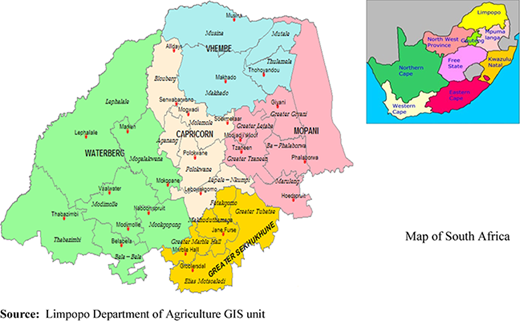
The study was conducted at five local municipalities (Molelemole, Aganang, Blouberg, Polokwane and Lephalale) of the Limpopo Province (Figure 1) in South Africa.
Data were collected through the use of a questionnaire to capture information on the socio-economic characteristics of farmers (sex, age, education level, literacy level, farming experience, access to agricultural extension, farming income, off-farming income, farming organization, farming size, farming type, location [municipality]) and their responses to the following four questions:
Is drought a problem? (Ordinary, Serious or Critical)?
Do you plan for drought? (Yes or No)
Do you see drought as a major problem in the future? (Yes or No)
Are you aware of climate change? (Yes or No)
A random sample of 122 purposively (livestock farmers) sampled farmers were interviewed. In total, 25 farmers were interviewed in each municipality, except Lephalale, where 22 farmers were interviewed. In Lephalale municipality, 25 farmers participated, but three records were discarded due to incomplete filling of the questionnaires. Of the total farming area of 10,548,290 ha in Limpopo Province, 8,847,848 ha are used for grazing livestock, with only 16 per cent suitable for crop production. Most farmers in the study area are thus livestock farmers.
For data analysis, discriminant function analysis procedure was used. Discriminant analysis allows a researcher to study the difference between two or more groups of objects with respect to several variables simultaneously, determining whether meaningful differences exist between the groups and identifying the discriminating power of each variable (Klecka, 1980). The analysis determines which variables discriminate between two or more classes and derives a classification model for predicting group membership of new observations (Worth and Cronin, 2003). To discriminate between classes or groups, a linear discriminant function that passes through the centroids of the groups is used (Pohar et al., 2004). The relative importance of the discriminating characteristics is determined through the utilization of the weights of the discriminant function (Gwary et al., 2012).
The discriminant model used in this study was: Equation 1
where:
D = discriminant function;
vi = discriminant coefficient or weight for each independent socio-economic variable (age, sex, literacy, education, access to agric extension, farm income, etc.);
Xi = independent socio-economic variables; and
a = constant.
Characteristics with a large number of missing values were omitted from the final analysis. These included farm income, off-farm income and farm size.
Group statistics and tests of equality of group means (Wilk’s Lambda and F-ratio) were used to examine whether there were any significant differences between groups on each of the independent variables. The standardized canonical coefficients, structure matrix, eigenvalues, structure coefficients and Wilk’s Lambda values were used to evaluate the importance and contributions of each socio-economic characteristic.
Results
Is drought a problem? (Ordinary, Serious or Critical)?
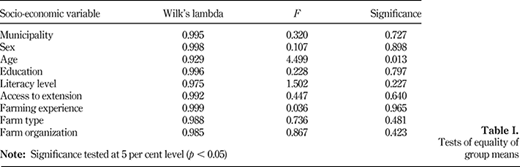
Preliminary investigation of the importance of discriminating socio-economic variables is presented in Table I.
Higher F ratio and low Wilk’s Lambda indicate more importance and contribution of the variable as a discriminator between groups (John et al., 2011). Age had the lowest Lambda value, the largest F-ratio and was statistically significant. All other socio-economic characteristics were not significant.
Results of discriminant analysis on the effects of socio-economic characteristics on the perception of drought are presented on Table II. The first discriminant function, with an eigenvalue of 0.226, accounted for 87 per cent of the variation. The variables with large coefficients were age, education and literacy level, indicating their importance as predictors. Municipality, gender, access to extension service, farming experience, farm type and farm organization were less successful as predictors. The discriminant function, F2 was not significant.
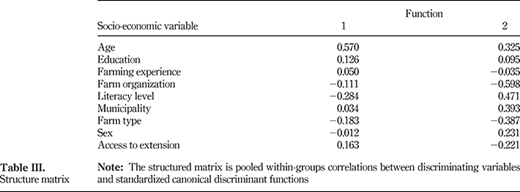
The structure matrix which provides another way of indicating the importance of the predictors is presented in Table III. The structure matrix is considered to be more accurate than the standardized canonical discriminant function coefficients (John et al., 2011).
The total structure matrix coefficient of greater/equal to 0.30 is considered meaningful, suggesting the usefulness of the variable as a discriminating factor (Rach et al., 1993; John et al., 2011). In F1, only age (s = 0.570) was of importance, as it had the highest correlation with the discriminant function, F1. Variables with the highest correlation with F2 were age (s = 0.325), literacy level (s = 0.471), municipality (s = 0.393), farming organization (s = −0.598) and farming type (s = −0.387). However, given that F1 explains most of the variation, it can be concluded that age variable is the only successful predictor. Wilk’s Lambda and F values also support this.
The unstandardized coefficients (b) were used to create the discriminant equation. The coefficients indicate the partial contribution of each variable to the discriminate function controlling for all other variables in the equation. Equation 2
Do you plan for drought?
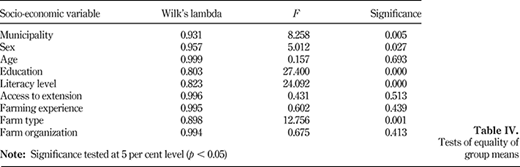
Preliminary investigation of the importance of discriminating socio-economic variables is presented in Table IV.
Municipality, sex, education, literacy level and farm type were all significant, suggesting that these may be good discriminators.
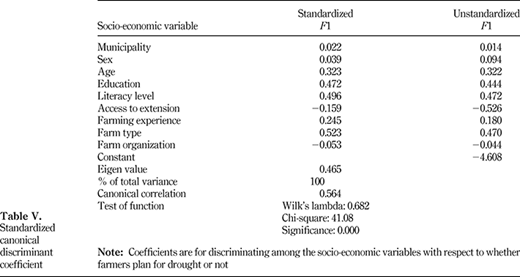
The discriminant analysis of whether farmers plan for drought is presented in Table V. Seven out of nine socio-economic characteristics/variables made positive contribution, while two made negative contribution. Age, education level, literacy level, farming experience and farm type had large coefficients, indicating their importance as predictors.
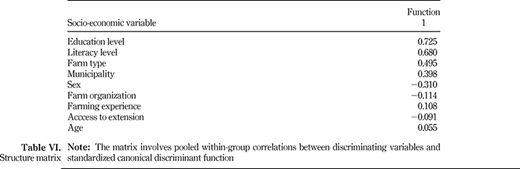
The structure matrix which also serves to indicate the importance of variables as discriminating factors is presented in Table VI.
Education, literacy level, farm type, municipality and sex had values larger than 0.3, indicating their usefulness as discriminating factors.
From the unstandardized discriminant function coefficients, the discriminant equation is as follows: Equation 3
Do you see drought as a major problem in the future?
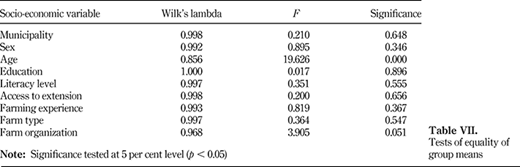
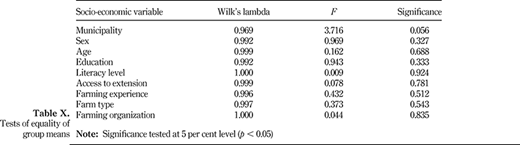
Preliminary investigation of the importance of discriminating socio-economic variables is presented in Table VII.
All variables, except age and farm organization, were insignificant, suggesting that these (age and farming organization) may be good discriminators.
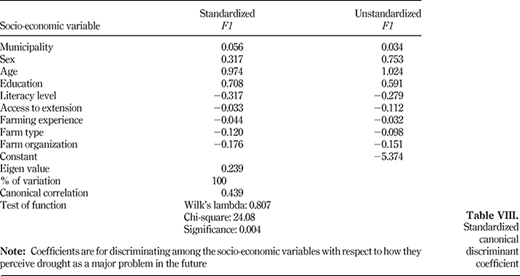
The discriminant analysis of how they perceive drought as a major problem in the future is presented in Table VIII.
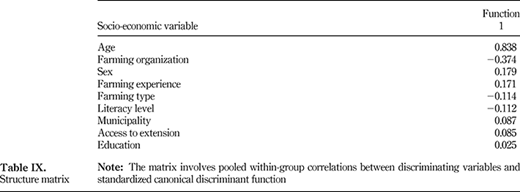
Age, sex, education level and literacy level had large coefficients, indicating their importance as predictors or discriminators. However, the structure matrix (Table IX) shows only age and farm organization as being important as predictors. This is in agreement with Wilk’s Lambda and F-ratio tests in Table VII.
From the unstandardized discriminant function coefficients, the discriminant equation is as follows: Equation 4
Are you aware of climate change?
Preliminary investigation of the importance of discriminating socio-economic variables is presented in Table X.
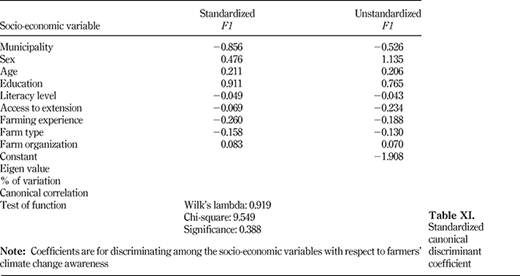
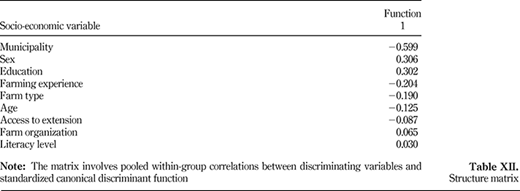
None of the variables was significant. However, at 10 per cent significance level, municipality (location) was significant, indicating the importance of location as a discriminator. The discriminant analysis of how they perceive drought as a major problem in the future is presented in Table XI.
Large coefficients were observed for municipality, sex and education level. The importance of these variables as important predictors or discriminators is also observed in the correlations between discriminating variables and the standardized canonical discriminant function (Table XII). However, it should be noted that the discriminant function was not statistically significant. The results of the prior probabilities for groups showed that 92 per cent of the farmers were aware of climate change which would indicate that there are no group distinctions influenced by the tested variables. The test of equality of means shows no statistical difference in group means.
From the unstandardized discriminant function coefficients, the discriminant equation is as follows: Equation 5
Discussion
The manner in which humans perceive, respond and adapt to long-term climatic change are of interest to nature and social researchers, as it has bearing on adaptation strategies (Diggs, 1991). Maponya and Mpandeli (2013) indicate that there is varying perception among farmers about climate change, its related climatic events and adaptation. Perception of climate change and related occurrences affect how people will respond and adapt to climate variations (Diggs, 1991). The findings of this study showed that age had an influence on how farmers perceive the problem of drought. Older farmers tended to perceive drought as critical. This could be due to the fact that they have lived long to observe changes in the severity and frequency of droughts. With respect to the question of whether farmers planned for drought, education and literacy levels, farm type, location and gender were associated with whether farmers planned for drought. Age and farming organization were associated with how farmers perceive future drought. The discriminating function in the analysis of climate change awareness was not significant, implying that there is no association between any of the socio-economic variables and climate change awareness. The priori probabilities showed that nearly all farmers were aware of climate change. In the study by Diggs (1991), 75 per cent of farmers believed that climate is changing, while, in the present study, 92 per cent believed that climate is changing. The percentage in Diggs study could have increased, given that it was conducted over 20 years ago.
Individuals and communities are differently exposed and vulnerable based on inequalities expressed through wealth, education and health status, as well as gender, age and other social and cultural characteristics (IPCC, 2012). The study by Deressa et al. (2010) indicates that farmers’ perception of climate change is significantly related to the age of the household head, wealth, social capital and agro-ecological settings. Legesse et al. (2012) assessed differences among gender and social groups in perceptions to climate variability and change and observed unified perceptions to climate change and variability. Household wealth (farm income and off-farm income and livestock ownership) increased awareness of climate change and adaptation. In a study by Maponya and Mpandeli (2012c), it was reported that farmers were aware of climate change, and the awareness was influenced by gender, access to information on climate change, access to extension information and whether a farmer was either full- or part-time on farming. Farmers in this study indicated that they have observed Limpopo Province to be getting warmer with increased frequency of drought and changes in the timing of rains. Additionally, they indicated observing low rainfall during rainy seasons. In this study, farmers also observed increases in windy conditions.
Maponya and Mpandeli (2013) observed a strong association between gender, employment, information of climate change, extension information and how farmers perceive climate change. Other studies have shown that farmers perceive that the climate has changed and these perceptions are influenced by socio-economic and environmental factors (Ishaya and Abaje, 2008; Mertz et al., 2009; Hassan and Nhemachena, 2008).
Studies by Nesamvuni et al. (2012a, 2012b) which assessed the impact of heat stress on cattle productivity and reproductive performance under projected future climate conditions indicate that over most of South Africa, cattle might be severely stressed under present and intermediate future climate scenarios, while, in the more distant future, climate scenario the study projected very severe stress on dairy cattle in parts along the northern periphery which include the study area. The implications of this projected severe stress are that cattle in those areas might experience a reduction of about 10 to over 25 per cent in production performance. The fact that most farmers are aware of climate change not only through information provided via extension services and other media but also through their own observations make it possible for farmers to understand and accept the implications of studies such as that of Nesamvuni et al. (2012a, 2012b) and thus could readily use this information to plan future mitigation strategies.
Conclusions
Socio-economic characteristics of farmers (age, education, literacy level, farm type, location and gender) had an association with how farmers perceive drought phenomena and climate change. Adaptation to climate change and related environmental conditions requires farmers to realise that the climate has changed so that they may identify useful adaptation strategies (Ofuoku, 2011). The findings of this study show a high level of climate change awareness among farmers. Factors that influence perceptions of farmers on climate change and related drought phenomena should be incorporated into long-term planning and adjustment of adaptation and mitigation programs. The findings of this study have potential significance for future farmer education efforts and policy aimed at reducing vulnerability to climate change and its related events. As a policy priority, for instance, the government should provide safety nets to farmers who are most vulnerable to climate change and drought effects. This may entail provision of safety nets that support their production and consumption requirements. Government intervention efforts in mitigating against climate change and drought effects may also call for policies that take into cognizance gender and age differences of farmers in addition to improved literacy level of farmers.





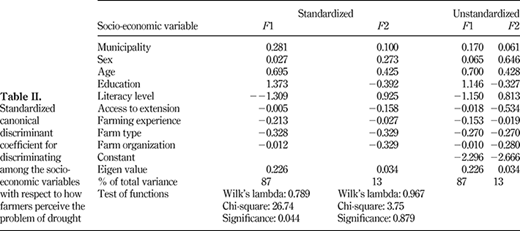
Standardized canonical discriminant coefficient for discriminating among the socio-economic variables with respect to how farmers perceive the problem of drought
Standardized canonical discriminant coefficient for discriminating among the socio-economic variables with respect to how farmers perceive the problem of drought
References
About the authors
Mmofa Amos Rakgase recently studied for Masters in Risk and Disaster Management at the Free State University and holds the following qualifications: BAgric, North West University; B Inst Agrar Hons (Pasture Science); B Inst Agrar Hons (Animal Science), University of Pretoria; Certificate in Seed Science; Certificate in Geographic Information Systems; and Certificate in Drought Management Training (Needs Analysis). Mmofa Amon Rakgase is the Head of Agriculture at Bakgatla Ba Kgafela Traditional Council. Responsibilities include, providing strategic management services, farmer support and development services, agrarian reform and development services and risk and disaster management services.
David Norris has a PhD in Animal Breeding and Genetics (Michigan State University), an MSc in Animal Science (University of Reading) and a BSc in Physics & Biology (University of Botswana). D Norris’s research interests include genetic improvement of indigenous livestock resources and rural development. He is currently serving as the Director of the School of Agricultural and Environmental Sciences at the University of Limpopo, South Africa. David Norris is the corresponding author and can be contacted at: david.norris@ul.ac.za

