– This paper aims to facilitate the joint assessment of issues related to the agricultural systems, i.e. agriculture, aquaculture and climate change (CC) response strategies, in the coastal districts with a panel of stakeholders; and to evaluate the level of agreement on the topics under consideration and potentially identify the most promising approaches to assessing CC affecting agricultural systems in the area and identify relevant and adequate response strategies.
– Stakeholder Delphi technique – its assessment is an interactive method of qualitative research used to facilitate the interactive participation of varied and conceivably hierarchical and antagonistic stakeholder groups.
– The most important result for the province is that the impact of climate change on agro-ecological landscapes (poverty and near river areas) is the duration of cold weather, more frequent and extreme. Moreover, Kendall’s W test gave a score of 0.547, which indicates a “strong” stakeholder agreement and the “confidence in ranks” being “high” in Thai Binh (Vietnam).
– The scientific results in this study are intended to serve as relevant knowledge-inputs and direct contributions to capacity-building for the local partners (stakeholders and local authorities). These local partners are engaged in policy-making and effective planning and implementation of climate response measures in the districts in the province of Thai Binh.
1. Introduction
In Vietnam, particularly the water resources are threatened by climate changes (CC) (ALM [Adaptation Learning Mechanism], 2009). The two largest deltas of the country, the Red River in the North and Mekong River in the South, are strongly affected by CC. The Vietnamese Assessment Report on CC in 2009 (MONRE, 2009a) provides insight into the projected effects of global CC in Vietnam. The expected sea level rise (SLR) in Vietnam ranges between 65 and 100 cm by 2,100, and SLR at a rate of 0.5-0.6 cm per year has also been estimated (MONRE, 2009a). In the Northern region, approximately half the Red River Delta coincides with high human population density in the Hanoi-Haiphong area (Yusuf and Fransisco, 2009). The delta with three coastal provinces (Hai Phong, Thai Binh, and Nam Dinh) at the estuary is strongly influenced by the migration of summer and winter monsoons.
The Thai Binh province is part of the north of Vietnam. The capital city is Thai Binh. The province is a rural area with small-scale industry, agriculture and aquaculture. Moreover, it is one of the most densely populated provinces in Vietnam (1,200 people per square km and about 15 per cent of people who live in urban areas) (DONRE, 2011). Previously, the province was primarily an agricultural area. However, in recent years, industry has intensified (e.g. gas, brown coal mining, etc.) along with increasing population density and environmental problems. In addition, population out-migration from trading villages in the area is due to industrial operations, lost jobs and environmental pollution. Moreover, Tien Hai, one of two coastal districts, is a site of international importance for wetland conservation under the Ramsar Convention (Tien Hai People’s Committee, 2009).
Consequently, to support and optimize the climate response action plans, it is appropriate to include additional methods and forms of communication as an integrated part of the research activities. One such method is the “Stakeholder Delphi Technique”. This is an interactive method of qualitative research (Delphi technique) used to facilitate the interactive participation of varied and conceivably hierarchical and antagonistic stakeholders. Acknowledging possible limitations reviewed here and advocating mitigating measures discussed, the stakeholder Delphi could facilitate interactive participation and consensus-building among disparate, hierarchical and possibly antagonistic groups that may require representation when assessing other aspects of sustainable aquaculture development (Bunting, 2008a). The technique also aims to capitalize on stakeholder knowledge and opinions. The result provides a valid input using semi-quantitative research. The research aims:
to facilitate the assessment of issues on agriculture, aquaculture and CC response strategies in the coastal districts of the case study using the concerted opinion of stakeholders; and
to evaluate the level of agreement on the topics under consideration and to identify the most promising approaches to assess CC affecting agricultural systems in the area and the relevant and adequate response strategies.
The results will contribute to designing a plan of action related to agriculture in the coastal districts (Tien Hai and Thai Thuy) of the Thai Binh province. To achieve this objective, theories on communicative planning and governance suggest that data-collection activities should integrate existing knowledge and perceptions held by the local authorities and stakeholders, and that the findings should be shared with and appropriated by these local partners (Lund et al., 2011). The need for a two-legged approach to manage CC is internationally (IPCC, 2007) and nationally recognized in Vietnam (MONRE, 2009a) and involves both mitigation (reduction of greenhouse gas [GHG] emissions) and adaptation strategies for SLR even in the hypothetical and unlikely event of worldwide fast mitigation actions. Adaptation provides an opportunity to transform society toward sustainability goals. Adaptation can also exacerbate GHG emissions and vulnerability to CC and cause new development problems (Eriksen et al., 2012).
2. Delphi technique
Internationally, the Delphi method is widely used to inventory scientific consensus and facilitate the formation of a group judgment or consensus statement (Helmer-Hirschberg, 1967; Hai et al., 2013). In this research, the stakeholder Delphi technique is used as a main method to facilitate the interactive participation of varied and conceivably hierarchical and antagonistic stakeholder groups, and to capitalize on stakeholder knowledge and opinions (Bunting, 2008b; 2010). By including non-expert stakeholders as legitimate members of the panel, the stakeholder Delphi is a derivative of the traditional Delphi approach where only experts are consulted. Based on the iterative nature of this process, to facilitate joint assessment, sharing information and perceptions, this approach has the potential to achieve a joint assessment in a development context. Applying the stakeholder Delphi approach is an attempt to cut across social, sector and physical divides to build a consensus and share references (frameworks of understanding) (Lund et al., 2011). The Delphi approach involves an iterative survey of experts (Hugé et al., 2009). It is a useful communications device that provides a structured process for collecting and distilling knowledge from a group of experts, using a series of questionnaires interspersed with controlled opinion feedback (Adler and Ziglio, 1996).
The Delphi process is adapted from the HighARCS project using the stakeholder technique that is applied to enhance the involvement of different partners in the coastal areas of Thai Binh and to reconcile possible disagreements or conflicting views on the situation or on (in)appropriate response strategies. The technique is an iterative method of semi-quantitative research to describe degrees of consensus.
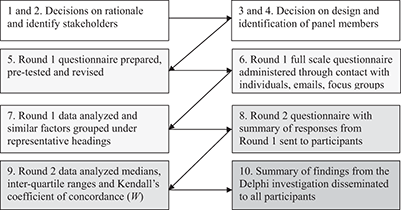
The outcome of this research, i.e. pilot (test) and Rounds 1-2, could be used as input for the discussion on the overall strategy for involving local stakeholders. As shown in Figure 1, the stakeholder Delphi process involves a series of ten activities and rounds.
The ten steps of the stakeholder Delphi process in Thai Binh from November 2011 to March 2012 are:
The rationale of a stakeholder Delphi study: The process starts by defining the purpose and main questions that the study should explore and bring about consensus on. There are two main objectives: to facilitate the joint assessment of issues related to the agricultural systems, especially agriculture and aquaculture in the areas of plain, coast and estuary, and the relevant CC response strategies in the province with a panel of stakeholders; and to define a level of agreement on the topics under consideration and potentially identify the most promising approaches for assessing CC impacts on agricultural systems and identifying relevant and adequate response strategies within an overall strategy of sustainable development (SD).
Identifying the stakeholders and deciding about the size and composition of the panel board: In a full-scale stakeholder Delphi, running meaningful statistical tests on the distribution and concordance of the answers would require a minimum of three to five persons from each of the most important stakeholder groups (e.g. representatives/owners of local industries, commercial agents from seeds, fertilizer and other agricultural input companies and teachers) and authorities acting within/playing a role in agricultural responses to CC in a given local area. Therefore, the size of the panel could easily reach 40-50 members. Delphi studies frequently involve 15-60 participants (Hasson et al., 2000).
Selection of the members of the stakeholder panel: The panel members selected for the pilot study were from the mountainous zone. Five of the selected respondents work for the province and ten for the districts. Responses were received from 10 stakeholders out of the 15 invited, i.e. representatives/owners of local industries, commercial agents from seeds, fertilizer and other agricultural companies and teachers. The selected stakeholders are true and fair representatives of the important stakeholders in the province. A cross-sectional community-based study was conducted where participants ranged between 18 and 75 years. A random digit table was used to select the first household in a community (Hai et al., 2010). Thereafter, a “door-to-door” strategy was applied to select the next household until enough households in each community were included. If a community did not have enough households, the investigators extended the sample size with households from a neighboring one. In each household, one representative spokesperson was interviewed. The completed questionnaires were manually checked before the results were transferred to the computer.
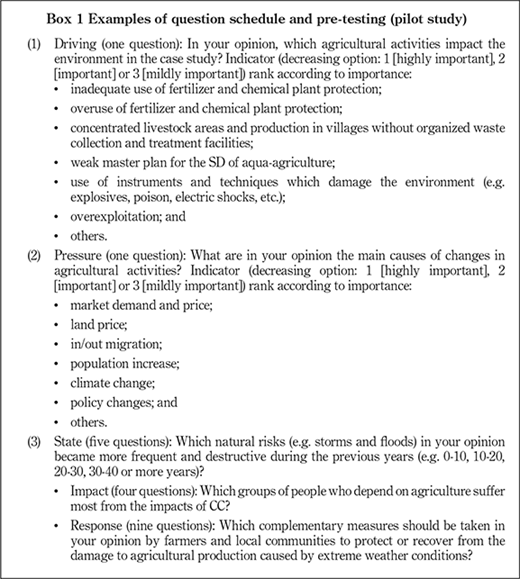
Question schedule and pre-testing (pilot study): In this step, all questions (20) are opened for discussion, as shown in Box 1.
A questionnaire based on research by Lund et al. (2011) in the framework of the P1-08Vie2 was published. The questions focus on issues about agriculture and CC and belong to a framework of Driving–Pressure–State–Impact–Response (DPSIR) framework. As an answer to the questions,(one or more alternatives are offered. The test questions showed that some panel members had difficulties understanding some of them. Consequently, the formulation was revised. The final version is used during the next step (Round 1):
Round 1: To complete the full stakeholder Delphi, the following steps require a list of 20 open questions sent to the panel members to answer. Once the rationale and main questions have been decided upon, designing a stakeholder Delphi study implies undertaking stakeholder mapping to identify relevant stakeholder groups to be included. As studied by Bunting (2008a), approximately 40 stakeholders were invited to participate in the study and 24 individuals responded in Round 1. In this research, 50 out of 55 stakeholders participated in completing the questionnaires. Each question shows a number of answers, as most selections cover 50 participants (e.g. ×/50).
Analysis of the data: Once the responses from the first round of the Delphi process are collected, the results are combined, similar responses are aggregated into statements and sent back to the panel members during Round 2. The answers to the questions of Round 1 are the input for the statements of Round 2.
Round 2: The responses of the panel-participants of the first round are grouped in a (reduced) number of statements about the issue, its importance, causes and solutions. These statements are then sent back to the panel members without mentioning their origin. The panel is informed to which extent the members “support” each statement (“frequency of occurrence”). The panel members (43 out of 50 previous people) were invited to rank their agreement or disagreement with each statement using a scale ranging from 1 (0 per cent – total disagreement) to 10 (100 per cent – total agreement).
Data analysis: After the data of Round 2 have been collected, the results are analyzed. The mean score is calculated for each statement. Importantly, two preliminary statistical analyses of the data are prepared. By using a pair-wise statistical comparison, it was tested to assess whether the questions really differ in terms of agreement among the group of respondents. This allowed identification of the most significant questions using Kendall’s coefficient of concordance (Lund et al., 2011), as shown in Table I.
It focuses on the difference of scores (ranking or agreement with) given by the panel members as a whole between the different questions or propositions submitted. Confidence in the degree of agreement can be assessed with Kendall’s coefficient of concordance (W). This measures rank convergence (ranging 0-1), and is recommended for interpreting data from Delphi investigations. The coefficient provides a measure of the degree of consensus achieved and the level of confidence in mean ordinal ranks (Schmidt, 1997).
Once these technical issues have been decided on, the actual stakeholder Delphi is performed in two to three rounds. In this study, a strong agreement on all the issues (questions) emerged; therefore, organizing a third round proved unnecessary.
Reporting to the stakeholder panel: Follow-up: Recording the stakeholder comments and sending the final report with the conclusions to all the participants.
3 Results
The results of three rounds (test, 1 and 2) are presented. However, most emphasis is given to the results of Rounds 1 and 2, as they provide the most important outcomes.
3.1 Test round
Each questionnaire took about 30-35 minutes. Six out of 20 questions required modification to be more accurate and understandable.
3.2 Round 1
All 20 questions present the contents of the framework of Driving (one question) – Pressure (one question) – State (five questions) – Impact (four questions) – Response (nine questions).
3.2.1 Driving (one question).
The responses indicated that agricultural activities affecting the environment include: overuse and inadequate application of fertilizers and pesticides (22/50 in the first option) and use of fertilizer and chemical plant protection (14/50). Therefore, these elements (Q_1.1) will be included as a statement (S_1.1) in Round 2.
3.2.2 Pressure (one question).
Most responses indicated that the main changes of agricultural activities are driven by CC, market demand and price (25/50 in the first option). Therefore, CC, market demand and price are (Q_2.1) included as a statement (S_2.1) in Round 2.
3.2.3 State (five questions).
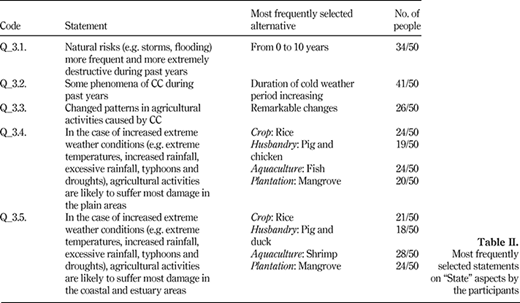
Table II lists the five questions describing the seriousness of extreme weather conditions on agriculture: Q_3.1: Natural risks (e.g. storms and flooding) occur more frequently and were extremely destructive during the previous 10 years (34/50); Q_3.2: CC is related to the longer cold weather periods increasing (41/50); Q_3.3: Changed patterns of the agricultural activities induced by CC are important (26/50); Q_3.4: Under extreme weather conditions (e.g. high temperatures, increased rainfall, excessive rainfall, typhoons and droughts), the production of crops (i.e. rice), husbandry (i.e. pigs and chicken), aquaculture (i.e. fish) and plantations (i.e. mangroves) is likely to be affected most in the plains; and Q_3.5: In the case of the increased extreme weather conditions, agricultural activities such as crops (i.e. rice), husbandry (i.e. pigs and ducks), aquaculture (i.e. shrimps) and plantation (i.e. mangrove) are likely to suffer most damage in the coastal and estuary areas.
The answers showing the highest incidence for each question are turned into statements, i.e. S_3.1, S_3.2, S_3.3, S_3.4 and S_3.5 for Round 2.
3.2.4 Impact (four questions).
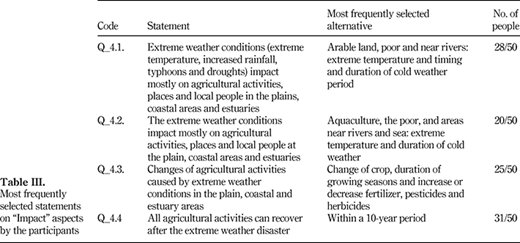
Table III summarizes the answers on four questions describing impacts of increased extreme weather conditions on agriculture. The table shows that Q_4.1: Extreme weather conditions (extreme temperature, increased rainfall, excessive rainfall, typhoons and droughts) having most impact are extreme temperature and duration of cold weather period for aquaculture, arable land, poor people/farmers and areas near rivers (28/50); Q_4.2: The extreme weather conditions that have the greatest effect on agricultural activities, places and local people in the plain, coastal and estuary areas are extreme temperatures, the length of cold weather periods for aquaculture, poor people/farmers along the rivers and in the coastal areas (20/50); Q_4.3: Changes of agricultural activities caused by extreme weather conditions in the plains, coastal areas and estuaries involve crop production, length of the growing season and increasing or decreasing use of fertilizers and pesticides (25/50); and Q_4.4: Agricultural activities that can overcome the effects of extreme weather disaster are within a 10-year period (31/50).
The answer with the highest incidence to each of the questions, Q_4.1, Q_4.2, Q_4.3 and Q_4.4, is turned into a statement, S_4.1, S_4.2, S_4.3 and S_4.4, which is submitted to the panel during Round 2.
3.2.5 Response (nine questions).
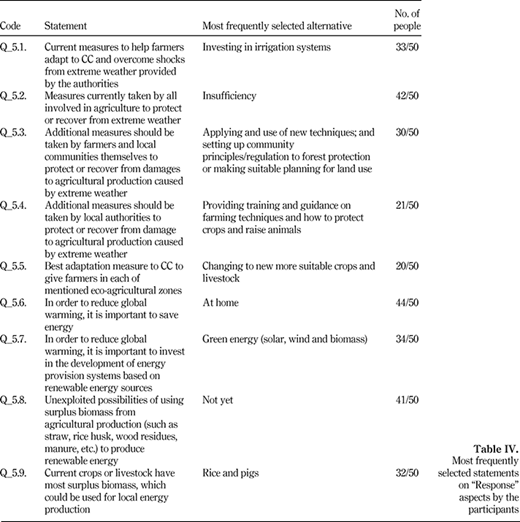
Table IV shows the dominant answers to nine questions describing impacts of increased extreme weather conditions on agriculture: Q_5.1: Investing in irrigation systems is the most often formulated response (33/50) when it comes to helping farmers to overcome shocks from extreme weather conditions; Q_5.2: Current measures to protect or recover from extreme weather are insufficient (42/50); Q_5.3: Complementary measures farmers and local communities should take to protect or recover from damage, applying and using new techniques and developing community principles and regulations to protect the forest and to adopt a suitable planning for land use (30/50); Q_5.4: Complementary measures that should be taken by local authorities include training and guidance on farming techniques, and on the protection of crops and animal husbandry (21/50); Q_5.5: The most appropriate adaptation is changing to new more suitable crops and livestock (20/50); Q_5.6: Reducing global warming requires also saving energy at home (44/50); Q_5.7: Reducing global warming equally requires investment in renewable and green energy (solar, wind and biomass) (34/50); Q_5.8: Using biomass surpluses and waste from the agricultural production (such as straw, rice husk, wood residues, manure) to produce renewable energy. These energy sources are currently unused in Thai Binh (41/50); and Q_5.9: Most appropriate biomass sources are the by-products from rice and pigs production (32/50).
The answer which obtained the highest incidence to the questions, Q_5.1, Q_5.2, Q_5.3, Q_5.4, Q_5.5, Q_5.6, Q_5.7, Q_5.8 and Q_5.9, is turned in a statement a statement, S_5.1, S_5.2, S_5.3, S_5.4, S_5.5, S_5.6, S_5.7, S_5.8 and S_5.9, which is used during Round 2.
3.3 Round 2
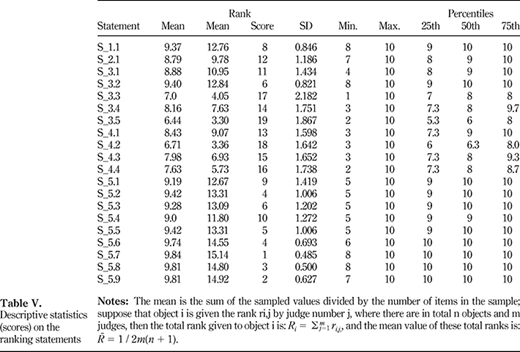
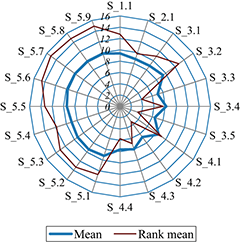
The 20 statements which were extracted during the first round are core elements of the Driving (one statement) – Pressure (one statement) – State (five statements) – Impact (four statements) – Response (nine statements) logic (Figure 2 and Table V).
Figure 2 shows means and the ranking of the statements. The larger the areas covered by the means and their rank, the higher the value (the stronger the agreement) on the ranking questions.
As shown in Table V the results include for each statement, the mean (ranging from 6.44 to 9.84), the ranking of the means (from 3.3 to 15.14), the rank of the score (from 1 to 19), the standard deviation (from 0.49 to 2.18), minimum (from 1 to 8), maximum (from 9 to 10) and percentiles, i.e. 25th, 50th and 75th (from 6 to 10).
When the results are grouped according to the DPSIR framework, the outcome is as given in the following text.
3.3.1 Driving forces.
The results of the statement (S_1.1) of “Impacts on the environment such as overuse of fertilizers and chemical plant protection” are the mean (9.37) and rank score (8.0).
3.3.2 Pressure.
The results of the statement (S_2.1) of “CC, market demand and price are the main causes of change to agricultural activities” are the mean (8.79) and rank score (12).
3.3.3 State.
The statement (S_3.2) of “Phenomenon of CC during past years is the duration of cold weather period increasing” has the highest mean and rank score of 9.40 and 6, followed by the other statements such as S_3.1, S_3.4, S_3.3,and S_3.5 with the mean (8.88, 8.16, 7.0 and 6.44) and rank score (11, 14, 17 and 19), respectively.
3.3.4 Impact.
The statement (S_4.1) of “Extreme weather conditions with the timing and duration of cold weather period having the greatest impact on arable land, the poor and near river areas” has the highest mean and rank score of 8.43 and 14, followed by the statements such as S_4.3 (7.98 and 15.0), S_4.4 (7.63 and 16.0) and S_4.1 (8.43 and 13.0).
3.3.5 Response.
The statement (S_5.7) that to reduce global warming, it is important to invest in the development of energy provision systems based on renewable energy sources and green energy (solar, wind and biomass) has the highest mean and rank score of 9.84 and 1, followed by eight statements such as S_5.9 (9.81 and 2), S_5.8 (9.81 and 3), S_5.6 (9.74 and 4), S_5.2 (9.42 and 5), S_5.5 (9.42 and 6), S_5.3 (9.28 and 7), S_5.1 (9.19 and 9) and S_5.4 (9 and 10). Moreover, Table V also shows summarized pair-wise comparisons as shown by the rank mean. Our interpretation is that there is the least agreement with S_3.5 and S_4.2; intermediate agreement with S_5.1, S_3.1 and S_2.1; and the most agreement with S_5.7 and S_5.9.
3.4 Kendall’s W test
Finally, Kendall’s W test (Table VI) shows a score of 0.547, which indicates a “strong” stakeholder agreement, and the “confidence in ranks” on the ranks of the questions is “high”. As compared to another study in Vietnam on the impacts of the CC on different eco-agriculture landscapes in the Quang Nam province (P1-08Vie – Sub-project 8) (Lund et al., 2011), this is a good result. For the Quang Nam study, the test provided a score of 0.473, which points to a “moderate” stakeholder agreement, while the “confidence in ranks” is “fair”.
This strong agreement on all aspects and questions of the DPSIR framework indicated that a third round is not needed.
4 Discussion
Global warming includes SLR at a global average rate of 1.8 (1.3 to 2.3) mm per year between 1961 and 1992 and about 3.1 (2.4 to 3.8) mm per year from 1993 to 2003 (IPCC, 2007). Vietnam is increasingly affected by CC. During the period 1958-2007, the average temperature increased by 0.5-0.7°C. By 2050, an increase of another 0.4°C is expected as compared to the 2020 average temperature. Typhoons will move more southwards and increase both in frequency and in intensity (MONRE, 2009a). It links CC adaptation closely to SD and highlights the importance of recognizing the interactions and links between property and social justice, and environmental sustainability, when considering responses to CC (Brown, 2011).
To support the actual conversion of the research findings into climate response action plans, it may be wise to include additional methods and forms of communication as an integrated part of the research activities based on the opinion of interviewed stakeholders who are non-experts, but socially involved. It is interesting to undertake such stakeholder Delphi exercises as a method to facilitate various stakeholder meetings to enable a more sophisticated analysis of factors such as location, eco-agricultural zone, occupation, wealth, etc. (Lund et al., 2011).
In this case study, the overuse of fertilizer and chemicals for plant protection emerges as a problem. The atmospheric and marine environment changed because human activities trigger extreme climate events such as storms (Trenberth, 2012). Chemical fertilizers and inappropriate use (timing and type) of pesticides increase the pressure on soil, water and air.
From 1996 to 2000, the use of urea as a fertilizer increased by 58 per cent, nitrogen phosphorus and potassium (NPK) six times. Pesticide use increased by 15 tons per hectare (Thai Binh People’s Committee, 2009).
This study analyzed the effects of CC and market demand as the main drivers of current and future changes in agriculture. Scenarios are used in climate research to provide plausible descriptions of how the future may evolve with respect to a range of variables including socioeconomic change, technological change, energy and land use and emissions of GHGs and air pollutants (Vuuren et al., 2011).
Natural disasters such as storms, floods, droughts and extreme weather events have increased during the past 10 years. In 2008, the province faced a prolonged cold period that lasted 38 days. During the period 1960-2010, the average annual temperature increased by 0.8°C in Thai Binh (DONRE, 2011). In recent years, storms not only occur in summer but also appear in winter (IHE, 2011). In Vietnam, the potential impacts of CC are expected to have critical effects on water resources and key socioeconomic sectors such as agriculture, forestry, fishery, energy, transportation and health (MONRE, 2009b). In Thai Binh, CC has caused significant changes in agriculture. Plants and animal species are affected by extreme weather. However, the statements selected by the stakeholder representatives diverge from figures of MONRE (2009a) that, generally, cold weather periods decreased in Vietnam during the past two decades. It is important in research for policy makers, managers and teachers to open discussion in practice.
Specifically, in coastal areas and estuaries, rice, pig, chicken, fish and shrimp are most affected by recent extreme phenomena (Ngan, 2012). The link between CC, disasters and development is well-documented (Wisner et al., 2004; UNDP, 2004). Extreme weather phenomena and natural disasters increase the risk of spreading pests, diseases in plants and animals, affecting the growing season, impacting crop productivity and the growth and reproduction of plants and animals. Extreme weather also causes changes to the onset of the planting season and the amount of fertilizer, pesticides and herbicides required. For example, heavy rains cause changes in salinity and pH that then result in the death of shrimp populations. Moreover, river floods spread pollutants, which are stored in the water bottom. A longer cold period influences the species in the lagoon and results in reduced aqua-cultural outputs.
The focus of the National Target Program of the Vietnamese Government is on adaptation (Beckman, 2011). Adaptation in agriculture to CC is important for assessing the impact and the vulnerability, and for developing policy (Smit and Skinner, 2002). To help the farmers and the local people to adapt to CC and overcoming the consequences of damage caused by natural disasters, the local government implemented measures including construction and upgrading of dyke irrigation systems, inland transport, training courses for farmers on farming techniques, fertilizer and pesticide use, subsidies for agricultural production and agricultural materials. In particular, the government aims to mitigate the damage by stabilizing the lives of farmers and the local people and consolidating agricultural production. In coastal villages, reforestation of mangroves contributes to preventing erosion and salt-water intrusion.
In Thai Binh, measures for agricultural protection and recovery from severe weather are still lacking. Additional measures should protect agricultural production or restore losses caused by natural disasters. These measures should include adjustment of farming techniques and processes to comply with fertilizer distribution, care process, nursing and environmental hygiene. The province should also invest in constructing irrigation systems, inland transport and agricultural insurances. The province should help farmers in turning scientific and technical data into daily practice by organizing training courses and raising awareness among coastal communities. They should establish model farms demonstrating cultivation, animal husbandry and bio-security (Thu, 2012).
In coastal areas and estuaries, regional planning of aquaculture and changing varieties of plants and animals need to be considered. In the deltas where rice prevails, regional planning on the plant and animal breeds suitable for production should include transferring areas less effective for the purpose to other uses to ensure SD and to meet the criteria of the new rural planning (Ngan, 2012; Thu, 2012).
An inverse relationship between SD and the local factors (e.g. age, gender, education, corruption, etc.) has been demonstrated (Hai et al., 2010). However, one should avoid considering local stakeholders as people who continuously learn, and absorb and address uncertainties in decision-making (Prabhakar et al., 2009). Local governments and citizens need to reduce household energy consumption and mobility to reduce GHG emissions. Equally important is the need to develop renewable and green energy based on solar, wind and biomass. Many consider natural gas as a transitional fuel, which causes continued dependence on fossil fuels, although GHG emissions are relatively reduced as compared to oil or coal (Pacala and Socolow, 2004). However, the use of biomass from agriculture (e.g. straw, corn and cattle) to produce energy has been insufficiently explored in Thai Binh.
The Delphi technique in a DPSIR context shows the 20 statements and 20 questions to deal with CC locally. Furthermore, all 20 statements can be used as criteria and indicators for the SD of agriculture in the study area. The results compared with international results are more or less the same as “Identify national park selection criteria” by Kuo and Yu (1999) was performed in one round and 28 experts were questioned; “Develop global and local visions for assessment; stakeholder involvement; and evaluation of water resource management” by Zanetell (2003) was performed in three rounds and 30 experts were questioned, etc.
5 Conclusions
Based on three rounds (test, 1, and 2) of questions, a full picture of the Delphi DPSIR was obtained, the answers cover a DPSIR-based response to CC for agriculture in Thai Binh.
In Round 1, 50 stakeholders replied to the invitation to participate in the panel. As a result, the answers to 20 open questions (Q_1.1-Q_5.9) allowed as many statements to be formulated (S_1.1-S_5.9). These were submitted to the panel members during a second round in which stakeholders participated. This round enabled stakeholders to participate fully.
Taken together, the five statements which obtained the highest rank constitute the joint assessment of issues related to agriculture, aquaculture and CC response strategies in the coastal districts according to a panel of stakeholders in a DPSIR context. They lead to the following recommendations:
Driving forces: Overuse of fertilizes and pesticides impact seriously the fields and the aqua-culture ponds. Therefore, the use of fertilizers and pesticides should be limited. This will also contribute to a decrease of the CO2 emission by the chemical industry (Need, 2013).
Pressures: CC, market demand and price are the main causes of change for agriculture in Thai Binh. These pressures should be carefully considered. From a macroeconomic perspective, the climate is not primarily affected by the economic sectors, but rather by the industrial and household demand for goods, services and energy (Bosello et al., 2007).
State: The main CC-induced weather phenomenon during recent years is the longer cold periods.
Impact: Extreme weather conditions, and in particular longer cold periods, are considered as having the most important impact on arable land, poverty and the river areas.
The state and the impacts described above require agriculture to adapt in particular during the winter season. Moreover, adaptation differs according to the local conditions. In Australia, pasture species and livestock types vary according to the ecological zone and the local environment (Wolfe, 2009).
Response: Reducing global warming necessitates investments in renewable and green energy (solar, wind and biomass). As the global and the national energy consumption is expected to grow considerably during the coming decades, major investments in renewable energy are needed to meet the rising demand while mitigating the GHG emissions (REN21, 2012).
The outcomes of this study indicate a “strong” agreement among the stakeholders and that “confidence in ranks” is “high” for the ranking of the questions.
These results contribute to capacity-building among the local partners (stakeholders and local authorities) engaged in policies responding to CC in the province and the country.
The questions can be used as criteria and indicators for the development of a sustainable agriculture in the Thai Binh. It is important for farmers to be prepared for the impacts of CC on agriculture and for policy makers to understand better the needs of farmers. Vietnam is currently developing a low carbon economy and a number of strategies to adapt the impacts of CC so as to reduce the vulnerability of societies (MONRE, 2009b).
The authors are most in debt to the households, the provincial and district authorities who were most collaborative in completing the questionnaires, and in providing discussion opportunities on the results. The authors would like to thank also Mr J.L. Silver (England) and Mrs Kate Grarock (Fenner School of Environment and Society, ANU College of Medicine, Biology and Environment, the Australian National University, Australia), who helped us in correcting the English. They also thank Mrs Chu Thi Thuy Ngan and Mrs. Pham Thi Thu (Hanoi University of Science) for helping them with the interviews and the questionnaires.
Acknowlodgement
This study is a part of the project: “A scientific base for establishing an indicator system for sustainable development: a case study in Thai Binh province, Vietnam” funded by the Vietnamese National Foundation for Science and Technology (NAFOSTED) under grant number 105.99-2011.08; the key-point project QGTÐ.13.10 funded by Vietnam National University (VNU).
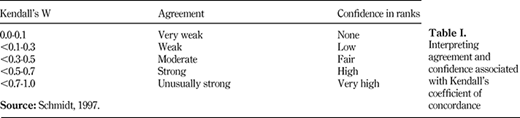
Interpreting agreement and confidence associated with Kendall's coefficient of concordance
Interpreting agreement and confidence associated with Kendall's coefficient of concordance