


– This paper aims, using a case study-based research approach, to investigate the role of climate and non-climate drivers in shaping three commercial marine sectors: fishing, aquaculture and marine tourism. Essential elements of climate change research include taking a whole of systems approach, which entails a socio-ecological perspective, and considering climate challenges alongside other challenges faced by resource users.
– The analysis is based on information gained using in-depth semi-structured interviews in a coastal community in southeast Australia. Even though climate drivers differ, the economic sectors of this community are representative of many similar coastal communities around Australia.
– Results show that at a community level, people involved in, or associated with, marine sectors are aware of climate change impacts on the marine environment. Even though many may not see it as a pressing issue, the potential effect of climate change on business profitability was recognised. Both the profitability of commercial fishing and aquaculture (oysters) was affected through mostly a downward pressure on product price, while marine tourism profitability was mainly affected through changes in the number of visitors.
– A case study approach is inherently case study-specific – although generalities from complex system representation, built on local survey respondent observation and knowledge of the combined and linked physical–biological-, social-, economic- and governance drivers. This study shows the importance of a holistic approach; yet, researchers must also consider all community sectors and cross-regional investigations to avoid future resource conflicts.
– A number of positive impacts from climate-driven change, mainly from windfall economic benefits of geographically relocated species, were reported for commercial- and charter fishing. However, no positive impacts were reported for the aquaculture- and dive sector. In the aquaculture sector, climate drivers were of great significance in industry participation, while participation in commercial fishing was mainly driven by socio-economic factors.
– To ensure the combined marine sectors retain a viable component of coastal communities’ economic focus, there is a need to understand what drives participation in the marine sector, and what the role of climate change is in this. To fully understand the ramifications of climate change in the marine environment, it is essential to understand its impacts across all marine sectors.
– Combining the different domains with climate drivers allows for identification and assessment of targeted adaptation needs and opportunities and sets up a comprehensive approach to determine future adaptation pathways.
1. Introduction
Changes in marine environments due to climate change have been occurring in many regions around the world (Burrows et al., 2011). Some of these regions have been identified as climate change hotspots, including the south-eastern region of Australia (Hobday and Pecl, 2014). Even though there are significant uncertainties associated with the timing, location and magnitude of future climate change (Hobday, 2010), biological impacts from climate-driven change include alterations to marine species abundance (Simpson et al., 2011), distribution (Perry et al., 2005; Nye et al., 2009; Last et al., 2011), physiology (Neuheimer et al., 2011) and phenology (Dufour et al., 2010). Climate change will almost certainly affect future fisheries' catches and profitability in some areas (Grafton, 2010) and may challenge sustainability and food security (Rice and Garcia, 2011). Climate change threatens to push some marine systems beyond their historical ranges, creating a complex and unpredictable mix of challenges (Perry and Ommer, 2010). Consequently, the impact of climate change on the users of these changing marine systems is the subject of much research (Galland et al., 2012).
Climate change assessment studies for commercial users of the marine environment have been undertaken with respect to fishing, tourism and aquaculture (Pecl et al., 2009; Pecl et al., 2011). In all three sectors, many of the impacts from climate change are expected to be mainly negative through the effect on species abundance and new pests and diseases, although there are some positive impacts, e.g. commercially valuable geographically relocated (range-shifting) species (Gössling et al., 2008). Climate change drivers that will impact commercial fisheries include, for example, sea temperature change, sea level rise, lower ocean pH levels and changes in ocean circulation (Stenevik and Sundby, 2007).
In a commercial fishing context, climate change-associated increases in the cost of fishing and projected decreases in fisheries yields (Caputi et al., 2010) are predicted. While most climate change-related studies on commercial fisheries have focused on changes in production, the impacts on the human system have broader consequences. For example, projected increases in the frequency of high wind events (and storms) will impact on the number of “fishable” days, insurance costs and the maintenance of shore-based community infrastructure. Climate change also directly impacts on individual fisher health and well-being, and social capital (Marshall et al., 2007; Marshall, 2010). Increased health and safety risks faced by fishers through greater exposure to extreme weather events affect both physical and mental health. Furthermore, threats to income and livelihood will place stresses on family, community and other social networks (Perry and Ommer, 2010). However, the net impacts of climate-driven change may be difficult to determine, especially over larger spatial scales (Cheung et al., 2010) for instance, where climate change changes the markets for inputs, such as fuel, and forces responses in demand and supply (Perry et al., 2011).
For the tourism sector, climate change is predicted to have both positive and negative impacts through its expected effect on the attractiveness of tourist destinations (Smith, 1993; de Freitas, 2003; Gössling et al., 2006; Jopp et al., 2010; Marshall et al., 2011; Ruhanen and Shakeela; 2012). Climate is one of the most important factors in a traveller’s decision-making process (Agnew and Palutikof, 2006; Hamilton and Lau, 2006; Amelung et al., 2007) and can be directly influenced by media coverage of climate events, which, in some cases, misrepresents the impacts (Weingart and Engels, 2000; Rick et al., 2011). Through changes in visitor numbers, climate change has the potential to substantially impact income streams and social benefits derived from tourism (Scott et al., 2007). For example, the opportunity costs associated with rougher sea conditions and more days in port for vessels will apply to tourism and fishing (Zeppel, 2012). In addition, geographical relocation of pests or marine species that pose a threat to human health, such as box jellyfish and irukandji, will negatively impact tourism and local aquatic recreational users (Harrison et al., 2004; Richardson et al., 2009). In addition, climate change may affect profitability through increasing insurance costs and damage from cyclones and storms (QTIC, 2008).
Marine aquaculture also relies on ecosystems that will be affected by climate change (Callaway et al., 2012). Climate change drivers are mainly expected to impact the aquaculture sector as a result of the sector’s dependence on the marine environment for culturing various life-history stages of marine animals (Harvell et al., 1999; Karvonen et al., 2010). Changes in the frequency and strength of storms will also pose a risk to infrastructure, such as salmon cages (Battaglene et al., 2008), while sea level rise will shift shoreline morphology, reducing the area suitable for the industry (e.g. oysters). Changes in rainfall patterns will increase the turbidity and nutrient loading of rivers, potentially triggering harmful algal blooms and negatively affecting bivalve farming (Batley et al., 2010). In addition, ocean acidification may disrupt the early developmental stages of shellfish, while pests and diseases may also increase in prevalence due to rising sea temperatures and altered currents.
For the three marine sectors, individual-, sectoral- or community-level ecological and socio-economic vulnerability will be different. The sectors are also likely to follow different adaptation pathways to deal with predicted climate-driven change (Allison et al., 2005; Adger et al., 2005; O’Brien et al., 2007; Allison et al., 2009). For instance, with respect to resilience at an individual or sectoral level, fishers have been characterised as being well-placed to deal with climate-driven change, as they naturally adapt to a changing ecological system at sea (Goodwin, 2001). Their working environments are typically dynamic, characterised by shifting patterns of ecology and productivity, for example, certain fish species are spatially patchy, or may undergo wide fluctuations in abundance (Goodwin, 2001). Similarly, tourism operators working in the marine environment are required to adapt to short-term “natural variations” in resource quality and quantity. Aquaculture, in comparison to wild fisheries and tourism, may have a greater level of control over the production environment, for example, by controlling water flows, temperature (if land-based), water quality, food provision and, to a lesser extent, breeding and disease (Brander, 2007).
However, the link between individual resilience and natural variability in resources is complex. Adaptive capacity is defined as the capacity to adapt by resisting or changing to reach and maintain an acceptable level of function and structure (Adger and Vincent, 2005; IPCC, 2007). Some individuals and industries will be better able to plan and reorganise than others (Paavola and Adger, 2006; Doria et al., 2009). For instance, flexibility may be low where there are multiple household- and family-level economic ties to fishing (Binkley, 2000) with a strong role of kinship in the labour process (Davis and Gerrard, 2000). Similarly, fishing communities with strong cultural beliefs about the importance of fishing (Olson and Clay, 2001; Jacob et al., 2005) with visible on-land and at-sea networks and infrastructure connections (i.e. boats, gear, fishing-related businesses) may display high levels of inertia (Clay and Olson, 2007) and susceptibility to the sunk cost effect (Janssen and Scheffer, 2004).
Adaptation to climate-driven changes in the marine environment is constrained by a complex and dynamic socio-ecological system that is linked to multiple changes in the ocean’s physical and biological components. Moreover, adaptation takes place against a background of often competing marine users, heterogeneous fishing communities and different institutional settings. Limited attention has been given to the combined impacts across multiple sectors on regional communities, and this research addresses this by identifying potential adaptation needs and opportunities given the impacts of climate change on the fishing, aquaculture and marine tourism sectors. In this current research, information on different socio-economic and climate drivers is brought together and a comprehensive representation of the role of climate drivers in a socio-ecological system for three commercial marine user groups is developed. Although adaptation options that were developed as part of a larger study are not discussed in detail, this study provides insights into the types of categories of climate and non-climate drivers that need to be considered prior to developing adaptation options. A mixed-method approach is applied to a case study coastal community, St. Helens in southeast Australia (Tasmania), which is already impacted by climate-driven change in the marine environment.
2. Case study description
The southeast of Australia is a “marine climate change hotspot” with the oceans warming at approximately four times the global average (Cai et al., 2005; Ridgway, 2007). The coastal community of St. Helens, situated within this rapidly warming region, was selected as a case study, as its experiences may provide an early warning signal for other communities. In conjunction with climate-driven physical changes in the marine environment, there is also increasing evidence of changing biology. For instance, warming oceanic waters driven by the extending range of the East Australian Current (EAC) (Hill et al., 2008) have been linked to geographical relocation of species (Poloczanska et al., 2007; Last et al., 2011).
In south-eastern Tasmania, there is evidence of fish (Last et al., 2011), invertebrate species (Ling, 2008; Pitt et al., 2010), algae and plankton (Hallegraeff, 2010) shifting in their distribution, such as the long-spined sea urchin (Centrostephanus rodgersii) moving south along the east coast of Tasmania as a consequence of warming waters (Ling et al., 2009; Ling, 2008). In addition, there are a number of commercially fished species that are currently undergoing geographical relocation, including eastern rock lobster (Jasus verreauxi), yellowtail kingfish (Seriola lalandi) and snapper (Pagrus auratus) (Pecl et al., 2011).
Our case study community of St. Helens has just over 2,000 permanent inhabitants (Australian Bureau of Statistics, 2011). Anecdotally, the population is said to increase between four- and tenfold with temporary residents (“holiday shack owners”) and tourists adding to the normal population in the summer months. Census data (Australian Bureau of Statistics, 2011) for Tasmania indicates that in this State alone, there are 26 coastal regions containing towns of similar size to St. Helens.
Three commercial marine sectors operate in St. Helens: commercial fishing, aquaculture and marine tourism (charter fishing and diving sectors). An estimated 28 people are owner operators of these commercial marine businesses. In February 2012, an estimated 25 full-time and 47 part-time jobs are provided by these three commercial marine sectors to the local community, the vast majority of which are employed in the aquaculture sector.
Commercial fisheries in St. Helens can be loosely grouped into three types. The first comprises single-species fisheries, including southern rock lobster (Jasus edwardsii), abalone (Haliotis spp.), scallops (Pecten fumatus), crab (Pseudocarcinus gigas) and clams/cockles (Katelysia spp.). Mixed-species fisheries include blue-eye trevalla (Hyperoglyphe antarctica), squid (Sepioteuthis spp.), banded morwong (Cheilodactylus spectabilis), wrasse (Notolabrus spp.), octopus (Octopus spp.), striped trumpeter (Latris lineata), orange roughy (Hoplostethus atlanticus) and mako shark (Isurus oxyrinchus). Since 2010, a new fishery in St. Helens targets the invasive long-spined sea urchin (C. rodgersii).
Rock lobster and abalone, Tasmania’s highest-value wild fisheries exports, are significant contributors to the local St. Helens economy. The size of the commercial fishing sector operating out of St. Helens has declined over the past 30 years due, for instance, to changes in the management system (Hamon et al., 2009) and environmental variables (Ling et al., 2009). The locally based fleet has fallen from around 35 vessels 20 years ago to around ten vessels in 2012[1]. However, since the 1980s, growth in employment in aquaculture has somewhat counterbalanced the fall in employment in commercial fishing. Oyster aquaculture production is no longer growing in terms of size (hectares of water occupied), but employment and economic returns from aquaculture activities are still rising. Self-guided recreational fishing and charter fishing have also grown over time, with large pelagic fish highly valued by tourists (Mounster, 2012).
To determine adaptation pathways for small coastal communities requires an in-depth understanding of the socio-ecological system in which they are embedded. Moreover, it is not sufficient to consider climate-induced alterations in a vacuum; rather, these changes must be placed in the context of other relevant social, governance and economic changes (Productivity Commission, 2012). There is a need to understand both the dynamic nature of the socio-ecological systems themselves and the changing environment in which they operate (Kalaugher et al., 2012). It is against this background that the current case study research was undertaken.
3. Methodology
In this research, change in the socio-economic domain was considered alongside biological and climate change using a holistic approach. Qualitative mixed-methods were developed to gather information for a broad range of sectoral drivers of participation and change for three marine sectoral activities in St. Helens. The case study provided insight into a specific issue, that is, the effect of climate change in marine sector participation (Stake, 2000). The St. Helens community was chosen, as it was already dealing with the impacts of climate change in the marine environment (Flyvbjerg, 2006).
A semi-structured interview approach was used in this study to allow the evaluation of observations and existing adaptations occurring within the specific social setting of a coastal town. Gathering knowledge of marine user groups is integral to understanding marine sectoral development and adaptation. As such, an intimate knowledge of the marine environment and, more specifically, of available marine species and their abundance was gained using this approach (Goodwin, 2001). In addition, detailed knowledge of social, economic and governance changes driving marine sectors and the broader coastal community was obtained. As a result, local observed knowledge of climate drivers was captured and climate-driven change contextualised (Ruhanen and Shakeela, 2012). The links between the drivers were based on verbal connections made by the respondents. Qualitative models were also developed on the basis of the semi-structured interviews and are the subject of another study (Metcalf et al., 2014). Qualitative models depict cause-and-effect relationships among the most important variables in complex socio-ecological systems and assess feedback and system stability (Dambacher et al., 2002; Dambacher and Ramos-Jiliberto, 2007).
In addition to the local community-level information, an expert-driven high-level cognitive mapping (modelling) exercise was undertaken to connect climate drivers to the marine environment and marine sectors. Cognitive maps are often applied to gain an understanding of the overall system (Kitchin, 1994; Jones et al., 2011). Mapping interactions and feedback between climate drivers, biology and each of the marine sectors is an “intuitive” approach easily understood by both lay-persons and experts (Checkland and Scholes, 1990). The cognitive model for this current project was developed by a group of 15 marine science, assessment and management experts at a two-day workshop held in February 2012. This modelling exercise was undertaken to ensure all impacts and interactions that were deemed relevant by experts were considered during community surveys. The model produced was a generic representation of an Australian coastal community and therefore contained additional variables and links for which the relevance was determined by community stakeholders in St. Helens. The cognitive model was used solely for illustrative purposes in this study to compare expert and community observations. In our analysis, we did not compare the information gained through these two different processes (community-based surveys and expert-based mental models) but simply integrated them to gain additional insights.
Data were collected in St. Helens through semi-structured interviews of 45 community members (further referred to as community respondents) and industry informants during February and March of 2012. Industry informants in this context are people who were networked and have privileged access to information about specific impacts, groups of persons or decision processes. Regional extension staff with existing contacts to the marine industries was used to facilitate contact with key community participants. A small number of individuals were attracted through snowball sampling (Goodman, 1961) where a community survey respondent recommended another person of interest who was then approached. For the semi-structured interview format, it was considered appropriate to select experts, as it was not feasible to survey large samples of the population (Ruhanen and Shakeela, 2012). The majority of experts in our survey included individuals employed in fishing, aquaculture, charter fishing or dive sectors, who had connections to the marine industry. The indirect impacts of change in the marine environment on the community were assessed through interviews from a broader range of individuals including those working in restaurants, news agencies, accommodation and general retail.
The survey was pre-tested with two local participants and minor changes were made to the survey questions. A media release, a radio interview and an information sheet were available approximately one week prior to the survey to communicate the aim and focus of the study and garner interest in the community. The interviews lasted between 1 and 2 hours, as dictated by the participant, and were taped with the permission of each individual. The surveys were held in the participant’s location of choice.
The survey approach applied here investigated all change deemed relevant to individual respondents and avoided potential anchoring to climatic change issues. This was important to maximise participation by avoiding adverse reactions to participation in a study focussing solely on climate change, as climate change has become a very politically charged issue (Nursey-Bray et al., 2012). Applying this survey technique also avoided “tactical” survey responses. For instance, fishers may be reluctant to link climate change to resource abundance, fearing the government may use this as an argument to reduce their individual quota allocation.
Survey respondents were asked to explain their local business interest or service activity. The semi-structured survey questions were centred on the following areas of interest:
observed changes in local and marine industries and the marine environment (i.e. reduced fleet size, increase administrative requirements, increased rainfall events, new species in summer);
impacts and opportunities from these changes for businesses, community and the environment (i.e. charter sector benefitting from new species, increased aquaculture sector closures from rainfall events, increased travel costs due to reduced local species abundance);
perceived flow-on effect of changes throughout the wider community (social and economic implications) (i.e. shutting down of local slipway, increased business for local tackle shop);
past adaptations to changes (diversification, purchase quota of other species); and
expectations of future adaptations (relocation to urban centre, improved fish marketing).
The authors interpreted over 50 hours of interviews, and the distillation of the most important drivers of change is presented in the next section.
4. Results
The physical, biological and marine resource user domains were modelled according to the opinions of experts attending the two-day workshop (Figure 1). Even though this is not a qualitative model, the positive (←) and negative (Fixed graphic 1) links between climate drivers, ecological groups and marine sectors are shown using the standard notation. These effects denote changes in abundance within ecological groups, employment in marine sectors or prevalence and strength of climate impacts. These abundance effects were due to a variety of reasons, including distributional relocation (Madin et al., 2010), habitat loss (Ling et al., 2009) and exploitation. Figure 1 summarises community respondents' observations of the effect of climate-driven change on the marine environment and marine sectors. The negative and positive links and feedback between the drivers, ecological groups and marine sectors also show the community respondents' observation and understanding of this complex system. The dashed lines in Figure 1 indicate occurrences where a variable or feedback was identified by experts and was observed or expected to occur in other Australian coastal communities, but was not observed or expected by St. Helens community survey respondents.
Community survey respondents focussed on the direct links between ecological groups in the marine environment and marine sectors[2], rather than indirect links between climate change drivers and these marine sectors identified by experts. As supported by evidence in the literature, community respondents understood the impact of climate change based mostly on what they observed or the “visible (environmental) effects” of change (Bord et al., 1998; Stamm et al., 2000; Höhle, 2002; Kirby, 2004; Kuruppa and Liverman, 2011).
Community survey respondents identified a link between currents and sea temperatures (Figure 1), but they did not consider the three other climate drivers (sea level rise, wind and cyclones and storms). For instance, while sea level rise was an issue recognised by researchers attending the workshop, it was not perceived to be an issue by community survey respondents. Sea level rise might be perceived as a “terrestrial” issue and not directly connected to marine industries, even though indirect effects of sea level rise occur through damage to infrastructure. Climate change was reported to affect commercial fishing through changes in sea temperature and currents. Community respondents reported a mostly negative effect on retained species abundance, but a positive effect was also observed for emergent species abundance. An example of the latter is the geographically relocated commercially valuable long-spined sea urchin (Ling et al., 2009). Community respondents also reported a negative impact of the long-spined sea urchin, as they degrade the ecosystem by overgrazing kelp beds and decreasing species diversity and abundance (Ling, 2008).
Detailed schematic diagrams summarising all drivers affecting participation in commercial fishing, aquaculture and marine tourism mentioned by community respondents were developed. Species catchability and abundance was central to assessing the climate and non-climate impacts on participation in marine sectors. More specifically, fishing pressure and climate affected species catchability and abundance (Figure 2). In fact, community respondents indicated that any observable climate change effects were overwhelmed by the impact of fishing pressure. Respondents questioned whether it was, in fact, possible to separate the effect of fishing and climate change.
Changes in abundance affected commercial fishing activity through a price effect, which in turn affected profitability. Profitability was also affected by labour-, variable- and fixed cost, which depended on a series of non-climate drivers. This was most prominently felt by the way in which sectoral quota ownership characteristics (i.e. quota-owner vs quota-leaser) affected variable costs. More specifically, the price of lease quota was affected by decreasing family quota ownership and increasing investor quota ownership. These socio-economic drivers exerted upward pressure on variable fishing cost, thus squeezing profit margins. Fishers also identified the increasing amount of paperwork and administrative requirement associated with fishing, shaped by governance arrangements, to be an increased burden and to also increase variable costs. Furthermore, competition from higher-paid jobs in the oil and gas industry attracted particularly younger people, thus increasing present labour cost in the commercial fishing sector.
Community respondents identified access to harbour facilities (due to bar-way issues) and diversification options as two non-profit-related drivers of change in commercial fishing activity. The bar-way restricted entry to Georges Bay by larger vessels that consequently turned to more accessible harbours to offload, moor and restock their vessels. The absence of possibilities for innovation and diversification into currently unexploited species, seen as a result of governance of exploratory fishing licences, was thought to further inhibit growth in an already contracting sector.
The pathways by which aquaculture activity were reported to be affected by climate change are shown in Figure 3.
In comparison to commercial fishing, climate-driven change had a greater and more “direct” impact on participation in the aquaculture sector. Respondents identified three major climate change drivers for the aquaculture sector: rainfall, sea temperature and currents. The pathway by which the aquaculture sector was most affected by climate-driven change was through terrestrial features and land-based activities in the surrounding catchment area. Rainfall intensity and frequency affected fresh water inflow and run-off events, thus increasing erosion and pollutant loads washing into Georges Bay. Both rainfall intensity and frequency affected profitability via impacts on product price and production costs which were affected by product quality and business closures[3] impacting reputation. For instance, evidence from interviews suggested that visitors to the area might still eat oysters collected from the rocks when aquaculture farms in Georges Bay are closed. Incidence of human illnesses from such activity could negatively affect the reputation of oyster aquaculture in the region, as their branding relies on the existence of a natural and clean environment.
Social and governance (or non-monetary) variables also impacted aquaculture activities. Importantly, public perception [e.g. increased regional employment (positive) or negative perception of visible oyster racks] had a bearing on potential industry establishment or expansion through council approvals.
For the small but growing marine tourism sector, climate change drivers were perceived to impact four different ecological groups: retained, emergent and non-retained species and ecosystem integrity (Figure 4). An important driver of change in this sector at present was the increasing abundance of new emergent species, such as yellowtail kingfish, which attracted a considerable number of visitors to the area. This increased visitation was aided by a large amount of publicity given to the attractive game fishing opportunities in the area. In 2012, articles were published in all the major Tasmanian newspapers (Mounster, 2012) and an international documentary was filmed at St. Helens about game fishing (Robson and Green Fishing Adventures).
Overall tourism was negatively affected by the value of the Australian dollar, which has meant fewer international visitors and domestic tourists choose to visit overseas destinations. By far the most important contribution to growth in the marine tourism sector was the number of visitors mostly driven by the perceived fishing opportunities and season (Figure 4). Respondents acknowledged that ecosystem integrity was potentially affected by climate change, but similar to commercial fishing, the relative contribution of other factors such as fishing pressure was considered to “swamp” climate change effects. At present, an important influence on the sector was the ability for operators to cross-subsidise their activity with another form of income, such as other seasonal employment, local part-time employment and a spouse’s contribution to the family income. Visitor numbers and seasonal characteristics were currently inadequate to sustain full-time employment without cross-subsidisation of income. If charter fishers were only just covering their costs, lifestyle might explain why charter fishers continued to undertake this activity.
In summary, comparing the drivers of participation in the three commercial marine-based activities, we observed that sea temperature and currents were important perceived climate drivers for commercial and marine tourism activities. The main climate driver for participation in the aquaculture sector was rainfall. Non-retained species were important for marine tourism activities because of the relevance of the “sporting” component and aesthetics to these activities. Pests and diseases were relevant mainly to aquaculture activities in this current study, even though the urchin may have been perceived as a pest in the past before it was commercially exploited.
Perceived climate change impacts on aquaculture were strongly linked to inputs to Georges Bay from land activities, such as agriculture, clearing and sewage treatment overflow. By contrast, the climate change impact on commercial fishing and the marine tourism was perceived secondary to fishing pressure.
5. Discussion
Combining community climate change understanding with local ecological knowledge, and coupling this understanding with socio-economic drivers, sets up a comprehensive framework to assess adaptation needs and target opportunities for future adaptation. In developing adaptation options for commercial marine sectors, a recognition that climate change is only one factor contributing to observed changes is paramount (Kuruppa and Liverman, 2011). Gaining community understanding of the pathways by which climate-induced biophysical changes flow through the socio-economic system and affect participation in marine sectors can give a sense of the drivers that are ultimately responsible for shaping these commercial marine sectors. This understanding is also important for being able to anticipate how communities might respond to possible interventions (e.g. policies and adaptation strategies).
In this study we gained insight into the relevance of specific climate pressures to different marine sectors (e.g. ocean temperature increases, current changes, increasing rainfall events and intensity) and the mechanism by which these climate pressures affected marine sectoral operations (i.e. abundance changes, geographic relocation). The pathway by which climate change was perceived to affect different marine sectors could be either positive or negative. When asked how climate drivers impact the marine sector, almost all commercial operators see this occurring through variation in product price and, consequently, profitability as abundance levels change. Commercial fishing and marine tourism profitability is a key determinant of economic resilience (Adger et al., 2005). The positive impacts were thought to occur as a result of the commercialisation of new geographically relocated species such as the long-spined sea urchin. This benefit was predicted to flow as long as a market for this product continued to exist and high abundance allowed a profitable harvest sector to operate.
In aquaculture, climate change was perceived to negatively affect product quality and business reputation, ultimately also affecting profitability. Businesses with low profit margins have a reduced ability to diversify their operations or to engage in other income-earning activities and are not well-placed to absorb either slow or sudden increases in operating costs (Smit et al., 2001). Additional climate pressures may push some marginal fishing and marine tourism activities over the edge.
We also gained insight into the mechanisms of climate change that were most clearly linked to changes in the marine environment. Even though the link between new species and climate change drivers was abundantly clear to community respondents, the link between climate drivers and changing abundance of existing commercial species was less so. The negative impacts of climate change on existing commercial species suffered from a pervasive attribution problem that masks climate impacts. Community respondents identified fishing pressure as the main factor, and to a lesser extent poaching, that masks climate change impacts on current species abundance (schematic relationship is shown in Figure 5). Fishing pressure in turn was affected by the fisheries management settings [total allowable catch (TAC), quota management and marine reserves].
Community respondents indicated that the link between, for instance, sea temperature and the abundance of rock lobster was obscured by fishing pressure for this species, and they were thus unable or reluctant to acknowledge the impact of climate. Even though expert scientific opinion indicates that recent decreased recruitment in the Tasmanian rock lobster fishery, resulting in a 30 per cent decline in quota, is due to ocean warming and thus attributable to climate change[4], community members questioned this connection. This is a commonly known attribution problem between climate change and fishing pressure (Parmesan et al., 2011). The complexity introduced by the attribution effects threatens sustainability on a time scale relevant to policymakers (Parmesan et al., 2011). To enhance community preparation for future adaptation, and potential changes in TAC, requires better targeted scientific information to be made available to fishing sectors and the community, thus increasing sectoral understanding.
Aside from the attribution problem, in this study, we identified several categories of non-climate drivers that affected marine sectoral activities (management, technology, market, labour, socio-economic, operating and land-based activities). It was clear from community responses that adaptation options should consider climate pressures alongside non-climate drivers to avoid the development of perverse incentives and unexpected outcomes.
Social, economic and management drivers in the commercial fishing sector currently seem to overwhelm climate impacts and sectoral participation. Potential adaptation options aimed at maintaining participation and ensuring sustained employment in commercial fisheries appear to be more expedient through adjustment of non-climate-related drivers. For instance, in the case of commercial fishing, product price was directly impacted by climate pressures. A sectoral adaptation pathway may thus be aimed at gaining more control over prices at the production end of the supply chain through product value adding or a more evenly spread seasonal supply. A more indirect route to influencing price may be through lowering variable fishing costs by increasing quota ownership by active fishers. This may halt the trend of concentration of ownership by investors and reduce their ability to set prices. Ironically, these other (non-climate) drivers may not have anywhere near the same magnitude of impact on the fishery as the recent climate-driven reduction in TAC.
Climate drivers were perceived to have a very direct impact on aquaculture through product quality and product price, but it was the on-land drivers that were the main concern. In the aquaculture sector, adaptation to climate change can be addressed by managing terrestrial activities that affect water quality in Georges Bay. Through greater control of these activities, either though changes in land management or through technological fixes (like upgrade of sewage treatment facilities or greater stormwater pipes), the impact of climate-driven increases in rainfall events and intensity would be reduced. However, this is not the only adaptation option. For instance, improved marketing and community perception of aquaculture could facilitate the success of future development of this sector.
Participation in marine tourism was foremost driven by tourism numbers. However, community respondents indicated that climate-driven increases in game fishing opportunities and the publicity given to this had worked to the sector’s considerable advantage. Marine tourism had mainly benefitted from climate-driven change with exciting emergent species attracting (game fishing) visitors to the area. However, future adaptation pathways will need to consider the lack of adequate off-season visitor numbers, which inhibited participation in this sector. For instance, through developing diversification in marine-based tourism attractions and activities in the area or effective marketing campaigns, off-season tourism numbers may be increased. The need for cross-subsidisation with another occupation or family income will also need to be overcome to continue benefitting from climate change-driven marine tourism opportunities and labour diversification opportunities for off-season employment may need to be developed. Further, if emergent species are targeted by the charter sector, this could potentially create conflict with the commercial sector wishing to develop a new fishery. Adaptive management at government level is required in this regard.
6. Conclusion
Over the past decades, the nature of small coastal communities has changed with the diminishing role of commercial fishing and the focus on alternative marine sectors such as aquaculture and marine tourism. To ensure the combined marine sectors retain a viable component of coastal communities’ economic focus, there is a need to understand what drives participation in the marine sector, and what the role of climate change is in this. To fully understand the ramifications of climate change in the marine environment, it is essential to understand its impacts across all marine sectors. The same climate driver may have both negative and positive outcomes for different marine industries, and mal-adaptation could occur if a marine sector was researched in isolation. However, the marine sector is not totally independent of other issues, and there is a need to consider the cumulative climate and non-climate impacts across all the community’s marine sectors.
Complex system representation, built on local survey respondent observation and knowledge of the combined and linked physical–biological-, social-, economic- and governance drivers, can provide evidence and insight into the seemingly complex relationships between drivers of participation and climate change (Kalaugher et al., 2012). This type of approach gains insight into the ability of locals and communities to adapt to “climate change” and the pathways by which adaptation can be encouraged.
However, before any adaption measures are developed and implemented, this research showed that it is important to increase marine sectoral understanding of the link between climate change, fishing pressure and abundance change to overcome any inertia in undertaking action which may be created by the commonly encountered attribution problem. Future research into how to best communicate complex scientific issues and to better target scientific information made available to fishing sectors and the community is much needed.
The systematic approach applied in this study to gain an understanding of marine sectoral differences and sector-specific relevance of different climate drivers (i.e. sea temperature and currents for commercial fisheries and marine tourism, and rainfall for aquaculture) is easily applicable in other climate change hotspot regions. Moreover, gaining insight into community member understanding of the perceived impact of climate change through price (commercial fishing), product quality (aquaculture) and tourist numbers (in marine tourism) provides information important for future climate change communicators and in the development of adaptation pathways.
This study shows the importance of a holistic marine approach, yet researchers must also look more broadly at all community sectors and at cross-regional investigations if future resource conflicts are to be avoided (Miller, 2000; Stenevik and Sundby, 2007).
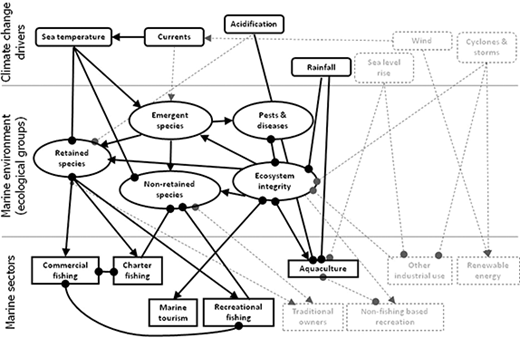
Simplified qualitative model showing the links between climate drivers, ecological groups and marine sectors. The variables and links shown by dashed lines were identified by experts as observed or expected in some Australian coastal communities but were not identified by St. Helens community respondents. Negative effects are represented by () and positive effects by (←)
Simplified qualitative model showing the links between climate drivers, ecological groups and marine sectors. The variables and links shown by dashed lines were identified by experts as observed or expected in some Australian coastal communities but were not identified by St. Helens community respondents. Negative effects are represented by () and positive effects by (←)
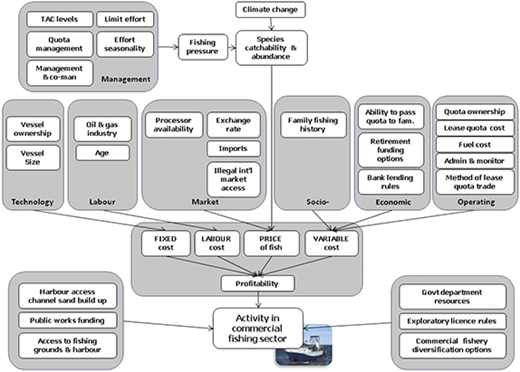
Schematic diagram of the relative role of climate change in the context of other drivers of participation in the commercial fishing sector as reported by community respondents
Schematic diagram of the relative role of climate change in the context of other drivers of participation in the commercial fishing sector as reported by community respondents
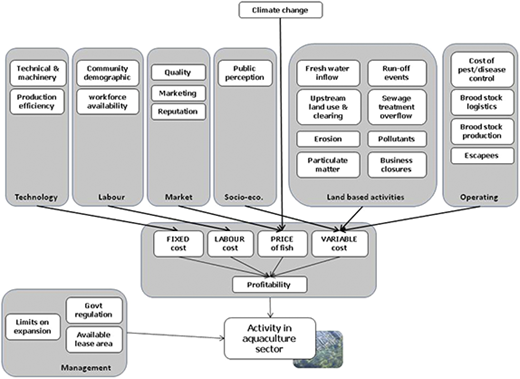
Schematic diagram of the relative role of climate change in the context of other drivers of participation in the aquaculture sector as reported by community respondents
Schematic diagram of the relative role of climate change in the context of other drivers of participation in the aquaculture sector as reported by community respondents
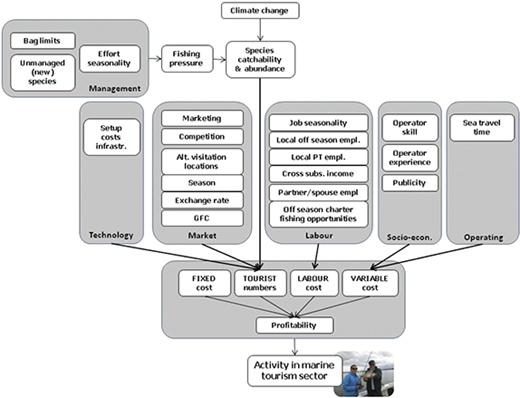
Schematic diagram of the relative role of climate change in the context of other drivers of participation in the marine tourism sector as reported by community respondents
Schematic diagram of the relative role of climate change in the context of other drivers of participation in the marine tourism sector as reported by community respondents
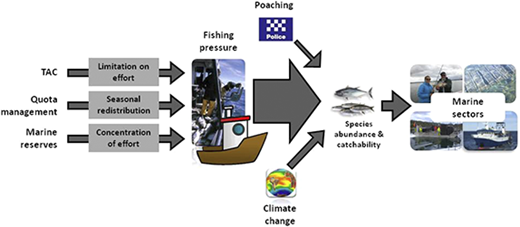
Schematic representation of the problem of attributing climate change and other factors to species abundance and catchability
Schematic representation of the problem of attributing climate change and other factors to species abundance and catchability


References
About the authors
Ingrid van Putten is a Researcher with the ecosystems modelling team at the CSIRO Centre for Marine and Atmospheric Research in Hobart, Australia. Her research focuses on the social and economic behaviour modelling of interaction with the biophysical marine environment and understanding coupled social-ecological systems. Ingrid van Putten is the corresponding author and can be contacted at: ingrid.vanputten@csiro.au
Sarah Metcalf is a Researcher at Murdoch University focussing on the integration of ecological, social and economic information into models for use in investigating multidisciplinary problems. The majority of her work has been in fisheries management and the marine environment; however, she has also worked with general governance, estuarine, salinity and water table problems.
Stewart Frusher is an Associate Professor who leads the Estuaries and Coasts Program at the Institute for Marine and Antarctic Studies. Within the program, he leads a theme exploring the impacts of climate change on marine resources. His research interests include the coupling of biophysical and human systems to understand the implications of the use and competing values for optimal management of marine resources.
Nadine Marshall is a Senior Social Scientist at James Cook University working in the areas of climate change, vulnerability, adaptation and resource dependency. She works across primary industries such as cattle, farming, fishing and tourism and mostly within Australia.
Professor Malcolm Tull is an Economist who undertakes research in maritime economics, including fisheries socio-economics and port management. He is a member of Murdoch University’s Centre for Fish, Fisheries and Aquatic Ecosystem Research.
This research was funded by the Fisheries Research and Development Corporation and the Commonwealth Department of Climate Change. The authors thank the Tasmanian experts Jeff Dambacher, Marcus Haward, Alistair Hobday, Neil Holbrook, Sarah Jennings and Gretta Pecl for their input. This research would not have been possible without the help, positive engagement and pleasant company of Anita Paulsen (SeaNet) and the local participants in the beautiful town of St. Helens, Tasmania.
Notes
Estimated numbers based on interviews with community members.
In the remainder of the analysis, charter fishing, marine tourism and recreational fishing are considered together.
In this context, “Georges Bay closures” and “business closures” indicate the same thing.
The first sign of recruitment decline came as abundance and egg production were increasing.

