– This study aims to provide a methodology for constructing farm household-level adaptation metrics for agriculture and water sectors. The livelihood of farm households is at risk now and in the foreseeable future, as both agriculture and water sectors are vulnerable to climate variability, particularly in developing nations. Adaptation is critical to protect their livelihood. Vulnerable farmers have adopted various adaptation mechanisms to counteract negative impacts of climate variability, though the extent varies temporally and spatially.
– It is, therefore, imperative to understand current adaptation practices for successfully implementing them. A few studies have emerged so far in this context, investigating different issues associated with micro-level adaptation strategies related to agriculture and water sectors, e.g. output and cost-effectiveness, and constraints related to farm, household and institutional levels.
– While such analysis is critical to enhance micro-level adaptation measures, there is a felt need to formulate adaptation metrics that can investigate the underlying factors in an integrated manner. For empirical assessment, 146 farmers were interviewed from different agro-ecological zones of Tamil Nadu, India, regarding seven adaptation measures, such as micro-irrigation, rainwater harvesting, resistant crops, use of bio-fertilisers, crop insurance, income diversification and community-based efforts.
– These adaptation measures were evaluated through an Analytical Hierarchy Process using four criteria: effective awareness, economic viability, individual and institutional compatibility and flexibility and independent benefits.
– The present study provides a methodology to identify barriers that limit implementation of adaptation measures, and enable target-oriented policy measures to promote appropriate adaptation strategies at the local level.
1. Introduction
Both agriculture and water sectors are frequently cited as vulnerable to climate variability, particularly in developing nations (Rosenzweig and Parry, 1994; Adams et al., 1998; Parry et al., 2007; Mendelsohn, 2009). This vulnerability is largely attributed to three reasons:
geographical location;
large dependence on sensitive sectors like agriculture and water; and
low adaptive capacity (Stern, 2007).
Since agriculture is the major source of income in developing nations, a large proportion of farm households’ livelihood is at risk now and in the foreseeable future due to climate variability (Mendelsohn, 2009).
As known from existing studies, designing an adaptation policy is crucial to deal with the impacts of climate variability (Adger et al., 2003; Stern, 2007; Pielke et al., 2007). But, various adaptation measures have already been undertaken by farmers to reduce potential impacts of climate variability (Jodha, 1991; Mwinjaka et al., 2010), and the extent of taking up these options differs from one farmer to another. Adger et al. (2003) state that the success of an adaptation strategy or adaptation decision depends on how that action meets the objectives of adaptation, and how it affects the ability of others to meet their adaptation goals. It is, therefore, imperative to examine various issues associated with the existing adaptation measures, such as barriers, effectiveness (cost and/ or output) and determinants. Addressing these issues help in finding ways to enhance adaptive capacity of farm households in developing nations. While a few studies have recently emerged to investigate such issues (Kurukulasuriya and Mendelsohn, 2007; Nhemachena and Hassan, 2007; Seo and Mendelsohn, 2008; Hassan and Nhemachena, 2008; Gbetibouo, 2009; Deressa et al., 2009; McKinsey, 2009; Bryan et al., 2009; Wang et al., 2010; Di Falco et al., 2011; Panda et al., 2013; Piya et al., 2013), which is critical to enhance micro-level adaptation measures, there is a felt need to formulate adaptation metrics that can investigate the underlying factors in an integrated manner; the present study addresses this gap.
Rosenzweig and Tubiello (2006) define metrics as a system of measurement, one that can be used in an objective, transparent and reproducible manner to describe the characteristics and transformations of observable systems. In particular, metrics help rank, prioritise and evaluate different adaptation options because they provide a means to compare levels of adaptation reached across locations, regions, societies and nations (Prabhakar and Srinivasan, 2011). Previous studies have been conducted in assessing the adaptive capacity of sectors like agriculture, water and natural resource using metrics (Mizina et al., 1999; Dolan et al., 2001; Rosenzweig and Tubiello, 2006; TERI and IISD, 2006; see Prabhakar and Srinivasan, 2011). Research initiatives focusing on the development of farm household-level adaptation metrics for agriculture and water sectors using case study approach are very limited.
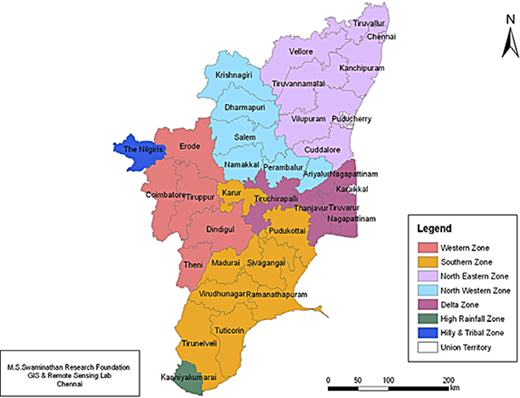
The present study, therefore, aims to provide a methodology for constructing farm household-level adaptation metrics for agriculture and water sectors. Based on this, one can identify not only the most successful adaptation measure but also barriers that arise during the implementation process. Further, a set of metrics, once developed, would serve as a tool to gauge the success or failure of an adaptation practice so as to incorporate the benefits and to overcome the barriers while formulating new policies and strategies. Such a study would provide useful feedback for effective policy framing. To provide an empirical thrust, a number of farm households from different agro-climatic zones of Tamil Nadu, in the southern coastal region of India were interviewed (Figure 1). Seven adaptation measures were prioritised and selected, such as micro-irrigation, rainwater harvesting, resistant crops, use of bio-fertilisers, crop insurance, income diversification and community-based efforts (e.g. farmers’ associations, women’s self-help groups, gene banks, etc). These options are implemented by the sampled farmers to cope with the current climate variability and are not mutually exclusive.
2. Description of study region
The State of Tamil Nadu is situated along the southern coast of India with the Indian Ocean in the south and the Bay of Bengal on the east (Figure 1). The state covers a coastal length of about 1,076 km, which is the second largest sea coast in India. In the north and west, Tamil Nadu adjoins Karnataka, Andhra Pradesh and Kerala. The state lies between 8°5′-13°35′N latitude and 76°15′-80°20′E longitude, and encompasses an area of 0.13 million Km2 (Government of Tamil Nadu, hereafter GoTN, 2011). It has a sub-temperate to temperate climate, with the temperature ranging from 22 to 36°C and normal rainfall – 911.6 mm (GoTN, 2011). Traditionally, Tamil Nadu is divided into five physiographic divisions, e.g. mountainous area, forest, arid zone, fertile region and coastal region (GoTN, 2003). The main river is the 760-km-long Cauvery, which flows along the entire breadth of Tamil Nadu.
Tamil Nadu is predominantly an agrarian economy where nearly 40 per cent of the total labour force depends on agriculture, as of 2011 census; out of them, an overwhelming 70.72 per cent are marginal and small farmers (GoTN, 2011). The total cultivated land in the state was 5.57 million hectares in 2009-2010 (GoTN, 2011), which is about 43 per cent of the state’s total area (GoTN, 2011). The state is the leading producer of agricultural products, mainly rice, in India. Rice is the dominant crop constituting 73.87 per cent of the total cereal production and 31.69 per cent of the total area sown during 2009-2010 (GoTN, 2011). A few impact studies ascertain that climate variability negatively affects India’s agricultural output (Kumar et al., 2004; Kumar and Parikh, 2001a and 2001b; Kumar, 2011; Mall et al., 2006b), particularly in Tamil Nadu (Palanisami et al., 2009). In the state, a decreasing trend in the net sown area (NSA) has been observed (i.e. compound annual growth rate was about −0.4 per cent between 1960-1961 and 2009-2010; GoTN, 2010). Climatic variability could be one of the reasons for this decline. Additionally, agriculture sector is the largest consumer of water in Tamil Nadu – 75 per cent (Palanisami et al., 2011b). This indicates that the variability in water resources (see Mall et al., 2006a) could influence agriculture sector in a big way, ultimately affecting the farm households. On the other hand, Tamil Nadu is one of the well-developed states in India as its Human Development Index (HDI) value is higher than that of the overall HDI of India. The HDI for Tamil Nadu was 0.570 as compared to 0.467 of India as of 2007-2008 (Gandhi et al., 2011). But, 11.28 per cent of people of the state were below poverty line during 2011-2012 (Government of India, hereafter GoI, 2013).
3. Material and methods
3.1 Sample size and area
Five districts in the state of Tamil Nadu falling under different agro-climatic zones, namely, Kancheepuram, Pudukottai, Ramanathapuram, Namakkal and Dharmapuri were randomly selected for the present study (Figure 1), to capture the heterogeneity of climatic condition, crops produced and agricultural policies specific to geography and crop.
A purposive sampling method was adopted to select farmers in the different districts. With the help of district-level agricultural extension officers, we identified farmers, who would most likely respond to the survey. As the focus of this study is to develop a methodology to construct a farm household-level adaptation metrics and also to show its usefulness in the context of designing adaptation policy rather than giving any generalised adaptation policy suggestions for a state or nation, each selected farmer was approached individually and interviewed between January to March 2011. All farmers practiced at least one of the adaptation measures listed in the introduction. To capture a heterogeneity of responses from the farmers, our sample included farmers belonging to different land holding classifications, e.g. marginal (0.01 to 2.5 acres), small (2.51 to 5 acres), medium (5.01 to 10 acres) and large (above 10 acres), and farmers producing both cash and non-cash crops. A total of 146 farmers (i.e. 30 farmers from each district, except Kancheepuram, where we interviewed around 26 farmers) were interviewed. They were asked to report various impacts of climate variability that they have experienced in the past 20-30 years, and about the degree of adoption of aforementioned adaptation mechanisms. Further, a questionnaire was framed with a simple table, where the aforementioned adaptation measures were tabulated against the barriers (a detailed discussion on it is given below), and a simple yes/no question was directed to the respondents.
3.2 Criteria for evaluation of adaptation measures
Prior to the farm household-level survey, we have conducted a few focus group discussions with a group of farmers in the selected districts, where we have particularly asked them about the barriers they encounter in the process of adapting to the current climate variability. As a result, we found a wide range of barriers that farmers come across to undertake adaptation options in agriculture and water sectors in the study districts of Tamil Nadu, e.g. lack of credit, insecure property right, soil quality, agro-climatic information and literacy, etc. We have categorised them into four broader aspects:
effective awareness (farmers having information about the effectiveness, i.e. output/cost-effective, of adaptation mechanisms);
economic viability (availability of finance, self and/or sponsored);
individual and institutional compatibility (lack of complexity and compatibility with existing policy, law, institutions and farm households’ characteristics); and
flexibility and independent benefits (fitting with a wide range of changing climatic conditions, and provide benefits independent of climate variability, i.e. no-regret adaptation option) (see Dolan et al., 2001).
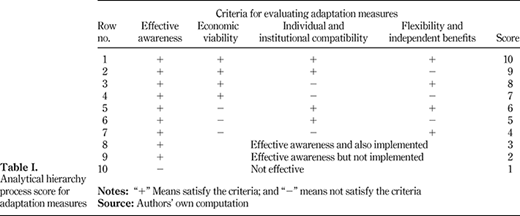
Based on the farmers’ response, effective awareness was given the highest priority, followed by economic viability, individual and institutional compatibility, and flexibility and independent benefits. We use these pointed barriers as criteria for evaluating adaptation measures. The Analytical Hierarchy Process (AHP), one of the most widely used multiple-criteria decision-making tools (Vaidya and Kumar, 2006), was used to develop adaptation metrics. Also, Dolan et al. (2001) report that a multi-criteria method is more useful against a single criteria approach such as cost-effectiveness or cost-benefit analysis. Based on this, we created a table of possible permutations that would satisfy the criteria (Table II).
Every adaptation measure may or may not satisfy all the criteria according to any of the ten possibilities indicated in Table I. When questioned about a specific adaptation measure, a farmer may admit facing one or more of the aforementioned barriers. It can be logically assumed that the fewer barriers the farmer face, the better is the adaptation measure. Each adaptation measure is graded by which and how many criteria it satisfies for the sample farmer. The chosen option may fall under any of the ten possibilities indicated in Table I. If an adaptation option satisfies a criterion (+), it is given a higher score than the ones that do not satisfy the same criterion (−). The scores are assigned based on the order of priority.
Consider each row in the metrics table as representing a single possibility. Row 1, for example, indicates an adaptation measure that satisfies all the criteria, and so is given the highest score as 10. If effective awareness, which is given the highest priority, is not satisfied (i.e. farmer is unaware), it is logically assumed that none of the other criteria will be satisfied. This means an adaptation option with no effective awareness will be given the lowest score as 1 (Row no. 10). Row 9 depicts a scenario, where the farmers might have been aware of adaptation options, but did not implement them and, therefore, a score of 2 is assigned. Similarly, Row 8 indicates that the farmers were both aware and had taken steps to implement the adaptation measures and, therefore, a score of 3 is assigned. Rows 2, 3 and 4 have been assigned higher scores because economic viability is given higher priority than individual and institutional compatibility. In Rows 2 and 3, an adaptation option satisfies both effective awareness and economic viability. As higher priority is given to individual and institutional compatibility as compared to flexibility and independent benefits criteria, a higher score was assigned to Row 2 than Row 3. The same logic has been followed to assign scores for the other rows. The scores are assigned to establish a hierarchy to compare different adaptation options.
3.3 Calculating the effectiveness score
Finally, we followed four steps to evaluate the “effectiveness score” for each adaptation measure. First, each respondent was given a score, based on how according to him/her, an adaptation measure satisfies the above criteria (Table I). For example, in case of improved irrigation systems, if one respondent reports all four criteria satisfied, then a score of 10 was allotted for this option against that respondent. Similarly, the score was allotted for each respondent based on the AHP table (Table I). Second, the sum of individual scores of respondents for that particular measure was calculated as the actual sum. Third, in an ideal case where all the criteria are satisfied for all the respondents, the sum would be 10 × Total number of Respondents, which is considered as the ideal sum. Fourth, the effectiveness score for each adaptation option was calculated as the ratio of actual sum and ideal sum. The individual effectiveness scores for different measures were calculated and tabulated to compare them with one another.
4. Results and discussion
In this section, we analyse the farm households’ observation on impacts of climate variability and farm household-level adaptation metrics.
4.1 Farm households’ observation on climate impact
It is important to understand farmers’ observation of the impacts of climate variability, as the literature suggests that perception is a necessary prerequisite for adaptation (Maddison, 2007; Bryan et al., 2009). There are two steps involved in the adaptation process:
households have to realise the impacts of climate variability; and
they have to make an attempt to counteract (Deressa et al., 2009).
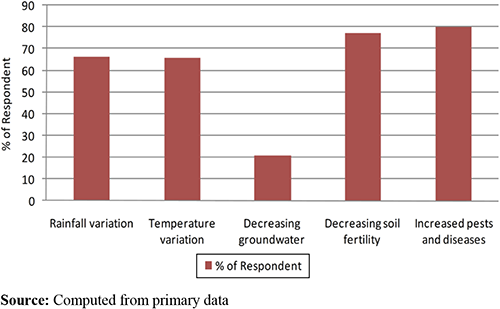
The sampled farmers reported that they experienced five major impacts due to climate variability as shown in Figure 2. Nearly 80 per cent of the farmers reported that they faced increased incidence of pests and diseases and decreased soil fertility. This was mostly observed in Kancheepuram, Pudukottai and Ramanathapuram, where there is a high possibility of intrusion of salt water that reduces soil fertility. Following this, more than 60 per cent of the farmers experienced both rainfall and temperature variation (Figure 2). This suggests that a majority of respondents in the study region have experienced the impacts of climate variability, and henceforth, it is expected that they are more likely to undertake various adaptation measures to counteract.
4.2 Farm household-level adaptation metrics
4.2.1 Adaptation measures and sample farm households.
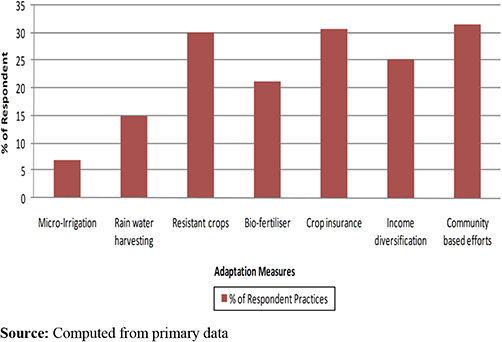
Figure 3 shows the distribution of respondents, who have adopted the selected adaptation measures listed in the introduction. The options such as micro-irrigation, rainwater harvesting and resistant crops help the farmers to cope with water scarcity in the state of Tamil Nadu (see Palanisami et al., 2011a). Burney et al. (2010) also find that solar-powered drip irrigation significantly augmented both household income and nutritional intake in the rural context of West Africa. The use of bio-fertiliser addresses the problem of decreasing soil fertility to increase the yield, particularly of rice in Tamil Nadu (Geetha Lakshmi et al., 2012). While income diversification assists the farmers to smoothen both income and consumption (Morduch, 1995), crop-insurance smoothens consumption with sharing the burden of loss that occurred due to climate variability. In the context of Tamil Nadu, around 1 million farmers are covered under crop-insurance in the year 2010 by Agricultural Insurance Company (AIC) of India; out of them, 84.05 per cent are small and marginal farmers (collected from AIC, Chennai). Constructing dams and flood embankment, establishing farmers’ association, women’s self-help groups and seed banks through community-based efforts also help to reduce the level of vulnerability (see Tiwari et al., 2011).
The highest percentage of farmers adopting any of the measures is less than 35 per cent, indicating that a majority of farmers have not implemented these adaptation measures. Though a large number of farmers have faced the impacts of climate variability, there is still a lack of information and awareness among them about availability (discovery-stage lag) and effectiveness (evaluation-stage lag) of undertaking different adaptation measures. Around 30 per cent of farmers have adopted community-based efforts, crop insurance and resistant crops, and only 5 per cent have taken up micro-irrigation (Figure 3). As a large number of farmers cultivate paddy crops, micro-irrigation is not a suitable option for them. Apart from this, 20 to 25 per cent of farmers have adopted the use of bio-fertilisers and income diversification, and 15 per cent of farmers have implemented rainwater harvesting.
4.2.2 Barriers for adaptation.
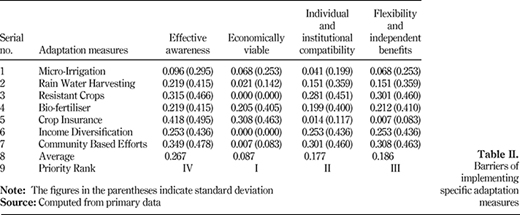
In the above analysis, differences in the extent and prevalence of various adaptation measures among the farm households were observed. To examine the possibility of these differences, respondents were asked whether they faced any difficulties in adapting to the climate variability. They are represented in Table II, and these were used as criteria to determine the most successful adaptation measure. The barriers were prioritised based on the logic that the barrier, which has the least proportion, must be the most limiting, and hence must be given highest priority while evaluating the adaptation measures.
The average values of households experiencing the four barriers are in the range of 0.087 to 0.267 (Table II). This suggests that we need to focus on all four barriers to increase adaptive capacity of farmers, so that they can undertake various adaptation measures. Economic viability appears to be the most significant barrier among the four criteria, and effective awareness is the least significant one. Additionally, individual and institutional compatibility, and flexibility and independent benefits have occupied second and third place, respectively. It appears that most of the farmers are not able to implement these measures due to a lack of institutional support and higher adaptation cost, even if they have information about the benefits of taking up these adaptation measures. For example, 31.5 per cent of farmers are aware of the positive benefits of resistant crops. But all of them reported that it is not economically viable for them to practise (Table II).
Analysing the four barriers for each adaptation option separately, we found that the lack of effective awareness is the major barrier for adaptation measures such as micro-irrigation. Micro-irrigation is mostly used for commercial crops like sugar cane, banana, coconut, maize and groundnut and particularly by large farmers in Tamil Nadu (Palanisami et al., 2011a). Marginal and small farmers mostly sow paddy crops and, therefore, do not have information about the usefulness of micro-irrigation, which saves water and increases yield and income at farm-level (Palanisami et al., 2011a).
Except bio-fertilisers and crop-insurance, economic viability is the major barrier for other adaptation measures. Therefore, the government has to provide targeted support measures for different adaptation options and/or increase farmers’ well-being by generating off-farm employment opportunities at the local-level. The GoTN, for example, announced 100 per cent subsidy for marginal and small farmers to practice micro-irrigation since 2011; because of this, around 27,000 hectares land covered under micro-irrigation in the year 2011-2012, which was around 7,000 hectares in the year 2007-2008 (based on information given by Tamil Nadu Horticulture Development Agency, GoTN). In addition, collective action is necessary to develop appropriate infrastructure to support agriculture (e.g. check dams, dykes, flood embankment and water sheds) that can reduce vulnerability (see Tiwari et al., 2011) and also enhance the probability of taking up different farm-level adaptation options. For instance, if water availability is increased, farmers can practice crop diversification rather than growing a single crop. Additionally, individual and institutional compatibility, and flexibility and independent benefits are barriers for micro-irrigation and crop insurance. Although the government is providing subsidy to implement micro-irrigation, farmers are facing problems in availing subsidy and technical help for repairs during the operational period. In addition, micro-irrigation is only suitable for commercial and horticulture crops (e.g. out of total land covered under micro-irrigation, 68.85 per cent of land are devoted for horticulture crops in Tamil Nadu, according to the Tamil Nadu Horticulture Development Agency). Therefore, we have found that all the four barriers have to be factored in for proposing policy measures to promote micro-irrigation.
4.2.3 Effectiveness scores and most effective adaptation measure.
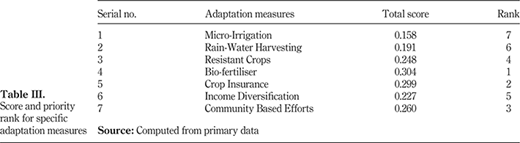
Table III shows effectiveness score (i.e. on a scale of 0 to 1) and the ranking of adaptation measures, identifying the best adaptation measure among those implemented. The use of bio-fertilisers has scored the highest, i.e. 0.304 (which roughly indicates that it is 30.4 per cent effective), which is still a low score. As it has scored highest among the other measures, one can conclude that of the seven adaptation measures, it is the most successful adaptation option. Following this, crop-insurance (0.299) and community-based efforts (0.260) occupy second and third place, respectively. Micro-irrigation is the least successful adaptation option with an effectiveness score value of 0.158. This type of assessment has three advantages:
it analyses various issues related to adaptation together instead of looking at them individually;
it helps compare significant barriers and their deterrence potential in the light of implementing different adaptation measures; and
it identifies the most successful adaptation option.
Before implementing any adaptation measure to counter the effects of such impacts, two points need to be considered with regard to the impacts themselves. One is that the farmer might not know that he/she is facing the impact due to climate change, and two, the impact need not necessarily be due to climate change but due to other factors. However, taking into account the fact that even if currently the impacts do not appear significant, such impacts due to climate change are going to become more significant in the future, and existing practices can be improved or used as adaptation measures (if they already are not), this study provides a framework to evaluate the usefulness of such practices. It may also be reasoned that the farmers have adopted such adaptation measures because of the necessity created by changes in previously existing conditions, which could be attributed to climate change.
5. Concluding observations
The present study has been carried out with an objective of developing farm household-level adaptation metrics for agriculture and water sectors using a case study approach in the context of a developing nation. In doing so, we have come up with few conclusions, which are imperative for implementing adaptation measures at the local-level. The key conclusions derived from this case study are:
the sampled farmers experienced five types of impacts of climate variability, and among them, increased incidence of pests and decline in soil fertility level are the major impacts;
among the four barriers, lack of awareness is the significant barrier, followed by independent benefits, lack of institutional support and economic viability; and
use of bio-fertilisers is the most successful adaptation measure among the implemented adaptation measures.
Farm household-level adaptation metrics give an idea of how each adaptation measure compares with the co-existing adaptation options, and serve as a useful tool for identifying the gaps in implementation of various adaptation measures. For instance, if the score of an adaptation measure is low due to a lack of effective awareness, necessary changes should be made in the policy to promote awareness about that specific measure. The present study has a few limitations that can be addressed by further research, such as limited number of samples drawn on a random basis. More research is required to refine the selection of respondents, the criteria used and the choice of adaptation measures. In addition, the ranking of barriers is based on the farmers’ perception which may be sample-specific.
References
About the authors
A. Arivudai Nambi is the Director of Climate Change Programme at the M.S. Swaminathan Research Foundation, Chennai, India. Broad areas of his research interests include adaptation to climate change, climate policy, natural resources management, institutions and governance issues. His main contributions are in the fields of climate change – vulnerability assessment, community-based adaptation, impacts on agricultural sector and bio-energy. He has contributed many popular articles and journal papers on a range of environment and development issues.
Chandra Sekhar Bahinipati is currently working at Gujarat Institute of Development Research, Ahmedabad, India. His research areas are climate change economics, risk and vulnerability, economics of adaptation, economics of natural disaster and environmental economics. Chandra Sekhar Bahinipati is the corresponding author and can be contacted at: chandrasekharbahinipati@gmail.com
Ranjini Raghunath completed her Master’s degree in environmental engineering at the Center for Environmental Studies, College of Engineering, Guindy. Her master’s research focused on climate change adaptation in agriculture. She currently works as a freelance science writer.
R. Nagendran is a Professor at Centre for Environmental Studies, Anna University, Chennai, India. Currently, he is also an expert member in National Green Tribunal, Southern Bench, Chennai. Broad areas of his research interests include Ecology, Ecological Engineering and Industrial Ecology.
This article is an outcome of the study conducted as part of the Asia-Pacific Network (APN)’s CAPABLE programme, Japan, under the project “Strengthening capacity for policy research on mainstreaming adaptation to climate change in agriculture and water sectors” (CRP2009-02NMY-Pereira). The authors thank M.S. Swaminathan, S.V.R.K. Prabhakar, Joy Jacqueline Perira, Ancha Srinivasan and Nguyen Vom Thang for their intellectual inputs. The authors would like to thank the Editor and two anonymous referees for the useful and constructive comments. The authors extend our thanks to K. Muniyappan for his help in the field study. All the remaining errors and omissions are our responsibility.