– This paper aims to identify the priorities on water sector planning. The priorities are identified by comparing the climate change impact on water consumption and the impact of using domestic water illegally to irrigate the urban agricultural holdings in suburban areas.
– Metered water consumption in summer and winter in both urban and suburban areas was studied in Rafah city. A backward chronological linear model of climate change (precipitation and temperature) influence on water consumption was developed using software STATISTICA 10. The developed statistical relation was used to predict the impact of various climate change scenarios for domestic water consumption. Hence, four climate change scenarios were hypothesized – an increase in temperature by 1 and 20°C and a reduction in the rainfall by 10 and 20 per cent, respectively.
– The most influential climate change scenario was the increase of temperature by 20°C, which caused an increase of 1.4 per cent on the average domestic water consumption compared to the current value. The hypothesized reduction of 20 per cent in precipitation caused a negligible increase in water consumption by 0.1 per cent from the current value. Urban agriculture and current practice of using municipal water to irrigate cultivated urban holdings have a significant negative influence on domestic water consumption. The aforementioned practice led to a high percentage of unaccounted for water (UFW) of 33, 38 and 45 per cent for the years 2010, 2011 and 2012, respectively.
– The concerned decision-makers should consider the right track in prioritizing dilemmas for planning water sector in suburban areas.
– This research could be considered the first of its kind because impacts of urban agriculture and climate change on domestic water consumption have never been previously considered in the Gaza Strip.
Introduction
The Gaza Strip, like most of the Middle East regions, is suffering from the lack of water resources and drought. There are other factors that have potentiality of worsening the water crisis in the Gaza Strip such as climate change, which includes decrease in precipitation, drought and seawater intrusion (Al-Khatib and Al-Najar, 2011; Qahman et al., 2009. There are accumulated effects of climate change on the water resources management and water consumption regime, where the start and duration of seasons are expected to change, which would expose the Gaza Strip to more vulnerability (Al-Najar and Ashour, 2013). Thus, in suburban areas, the combination of decrease in water recharge, over extraction from the groundwater, along with seawater intrusion has worsened its water crisis, adding the potential negative impact of climate change on the south and east Mediterranean regions.
Changes in climate along the Mediterranean coast have received particular attention in the literature owing to their potential negative impact on water resources in the region. The recent published study by Al-Najar and Ashour, (2013) showed that an increase in temperature by 1 and 2°C caused an increase in the annual average reference evapotranspiration by 45 mm and 91 mm leading to an increase of irrigation requirements by 3.28 and 6.68 per cent, respectively. Intergovernmental Panel on Climate Change (IPCC, 2007) in its fourth assessment report predicts that for the southern and eastern Mediterranean, warming over the twenty-first century could be larger than global annual mean warming between (2.2-5.1°C), while the annual precipitation rates would likely to fall in the eastern Mediterranean decreasing 10 per cent by 2020 and 20 per cent by 2050, with an increased risk of summer drought. All indicators point to an increase in environmental and water scarcity problems, with negative implications towards current and future sustainability. Water management in the Mediterranean countries is challenged by these pressures and needs to evolve to reach the target of increasing population with reliable access to freshwater (Garrido and Iglesias, 2005). Additional previous studies showed that the climate change will result in increasing temperature and negatively affecting water availability in the Mediterranean and the Middle East (Mizyed, 2008). The main and the most important climate changes in the Mediterranean region are those related to temperature and to precipitation. Although global climate change might result in a small increase in global annual precipitation rates, annual precipitation is very likely to be decreased (Christensen, 2007) in most of the Mediterranean areas. Most critical months in the Mediterranean related to precipitation are those months with high precipitation rates, which are December, January and February. In these months, precipitation usually is greater than evapotranspiration, and thus, recharge of groundwater aquifers usually occurs in these months. Therefore, reduction of rainfall will significantly affect recharge of groundwater aquifers and thus, water availability for domestic uses; so, the water consumption regimes will not stay the same. Almost the majority of the researches in the region confirmed that climate change will have a direct effect on regional water resources, through water supply and demand, which will increase water consumption (Alpert, 2004; Ben-Gai et al., 1998; Pe’er and Safriel, 2000). The expected change in the precipitation is worsening the water crisis in the Gaza Strip, where the over extraction from the Palestinian portion of the Coastal Aquifer was estimated at about 170 million cubic meter (MCM) per year, while the annual rainfall recharge was estimated for 60 MCM per year (CMWU, 2011). Despite the limited area of the Gaza Strip, there are significant variations in rainfall; the average seasonal rainfall is 522 mm in the north and 225 mm in the south (Palestinian Water Authority, 2012a, 2012b). There are some evidences that climate change is clearly affecting the Gaza Strip, where Jaber (2011) stated that in the past eight years, it has been noticed considerable reductions in the amount of rainfalls received, as the average rainfall for the Gaza Strip during 2008-2009 was 12 per cent, below the historic average of 316 mm.
Rafah city is the focal point of this study as an example of suburban areas in the Gaza Strip located at the southern part, with an area of 64 Km2. Its area is considered as a part of the desert, as the rainfall intensity hardly reaches 200 mm/year (Ministry of Agriculture/Rafah Directorate Records, 2012). A common feature of many projections is declining annual precipitation over much of the Mediterranean region south of 40 or 45°N, with increases to the north. Even areas receiving more precipitation may get drier than today due to an increased evaporation and changes in the seasonal distribution of rainfall and its intensity (Karas, 2010).
This research examines the potential impacts of climate change (precipitation and temperature) on domestic water consumption in a suburban area that has water scarcity and disaggregated irrigation water consumption from municipal water network.
Methodology
The research methodology was built on the primary and the secondary data collection for metrological data – metered domestic water consumption and urban agricultural in Rafah. By analyzing the collected data, water distribution regime and the distribution zones characteristics were identified. A recall period was used to interpret domestic water meters’ readings and identify the per capita consumption for each distribution zone. Finally, a statistical model was utilized to expect the influence of hypothesized climate scenarios on domestic water consumption. This statistical model will test the research hypothesis, which states that “Using municipal water to irrigate cultivated lands in urban areas causes an increase in domestic water consumption more than the climate change impact”.
Water supply and customers’ meter readings
To assess the differences between produced quantities (supply), and hence the actual quantities reach to the households (consumption), households’ meter readings were collected on monthly basis from the Coastal Municipalities Water Utility (CMWU) archiving system for the period between 2010 and 2012. In the meantime, pumped water to the network was recorded.
Statistical model to assess water consumption under different climatic scenarios
The available metrological and demographical data during the intended time series were refine and analyzed, using statistical model (STATISTICA 10). Consequently, the linear relationship between water consumption and climate change (temperature and precipitation) was defined. In the hypothesized climate change scenarios, the different impacts on water consumption per capita per day were obtained.
STATISTICA is statistical software that has a specialized tool for analyzing neural networks, determining sample size, designing experiments, creating real-time quality control charts, reporting via the Web and much more features. STATISTICA 10 can provide lots of statistical analysis, including basic statistics, multiple regression, ANOVA, non-parametric and distribution fittings among other statistics. In addition, it enables statisticians and researchers to conduct data mining to validate their models’ accuracy (STATISTICA, 2011).
Results and discussion
Seasonal variation in the current water consumption in suburban areas
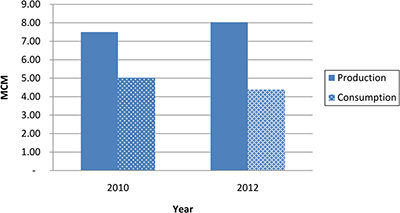
Registered water production from the CMWU’s wells’ records up to 2013 – revealed the monthly variant water production amounts. The level of accuracy of the available data is a slight matter of concern, as before 2010, the data were recorded by field operators. The most reliable data collected under a professional engineering supervision are available for the years of 2010, 2011 and 2012, with recorded supply reaching 7.5, 8.0 and 8.0 MCM/year, respectively, while the collected customers’ meter readings accounted for 5.0, 4.9 and 4.3 MCM/year, respectively, as shown in Figure 1. There is a slight chronological increment in produced water quantities. This increment is not very clear due to the short reference duration of three years. Data analysis revealed that consumed quantities verified by Households’ water meter readings for the past three years are significantly lower than the supplied quantities. The average gap between the annual produced and metered consumed quantities reached 2.5, 3.1 and 3.6 MCM/ year, i.e. the unaccounted for water reached 33, 38 and 45 per cent for the years 2010, 2011 and 2012, respectively.
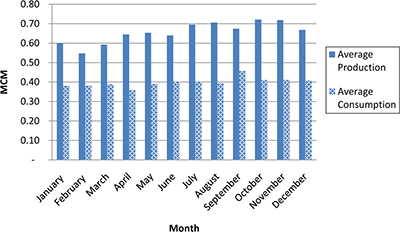
As shown in Figure 2, interpreting the available water supply data revealed that the least quantities were supplied in February during the average of the three reference years, while July, August, September and October had the highest supply associated with highest customers’ meter readings. February recorded the minimum averaged unaccounted for water supply of 165,852 m3, while August recorded the maximum of 310,873 m3.
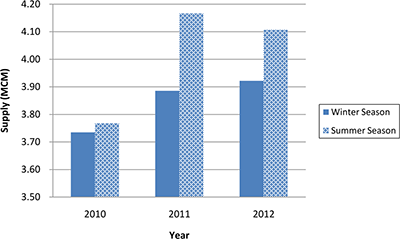
These findings emphasize the positive relation between temperatures and unaccounted water due to the illegal use of domestic water for irrigation of urban agriculture, especially in summer season, as can be seen in Figure 3. The study area is characterized by urban agriculture – the difference in water supply between summer and winter refers to the rainfall which reduces the demand for irrigation from the domestic water supply system.
The cultivated area in Rafah is 13.29 km2. Cultivated areas in plastic houses, which reached 5.6 km2, in addition to 7.7 km2, are dedicated to permanent crops in open fields; this means that 20.3 per cent of Rafah area is cultivated land. Considering arable lands in Rafah, which are estimated to be 27.6 Km2, this would lead to a total agricultural and arable lands’ area of 40.9 Km2 out of 65.5 Km2, which occupies 62.5 per cent of Rafah’s area.
These figures illustrate the urban agricultural nature of Rafah city. Crops and trees are being cultivated near and among the town; this mix of land use considering the narrow area of Rafah was reflected negatively on water consumption behaviors. A common practice among the Gaza Strip’s urban farmers showed that farmers were using the municipal water resources for irrigation purposes, especially in summer season (Al-Najar et al., 2013; PCBS and ARIJ, 2005). Such a behavior overwhelmed the limited and scarce water resources in the Gaza Strip and particularly the suburban areas such as Rafah, increasing its vulnerability and weakening its resilience and readiness for any climate hazards or extra water demands. Climate change will affect agriculture through higher temperatures and more variable rainfall, with substantial reductions in precipitation likely in the mid-latitudes, where agriculture is already precarious and often dependent on irrigation. Water resource availability will be altered by changed rainfall patterns and increased rates of evaporation. Rainfed farming will become more precarious in the mid- and low-latitudes (FAO, 2003).
Effect of land use on supply and metered water
Water operators in Rafah are using intermittent supply because of limited water resources. Water distribution cycle is being completed every 48 hours. In comparison to other countries, in most of the developing countries, the water supply system is not continuous but intermittent. Only 11 per cent of the consumers are provided with a piped supply. In most of Middle East countries, there is a severe shortage of water resources leading to regulate the supply to the customers on timely manner not exceeding 4 hours a day (Fisher et al., 2005). Nigeria received water once in two days, while in Mombasa, the average duration of the service is 2.9 hours a day (Hardoy et al., 2001). Intermittent supply is a common coping strategy among developing countries suffering from water scarcity.
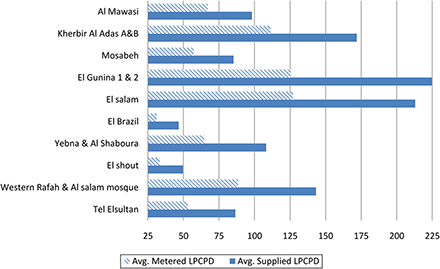
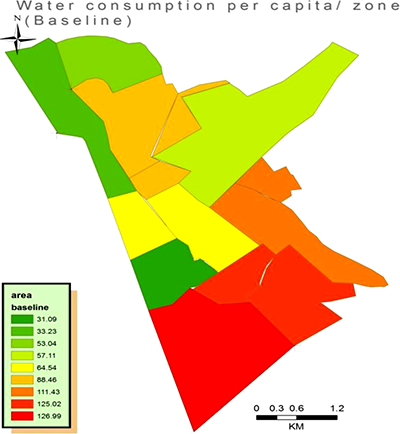
Rafah city is divided into ten water distribution zones. As shown in Figure 4, the critical per capita domestic water consumption gap is more obvious in the localities which have urban agriculture of small holdings. El-Gunina is known for its small urban agricultural holdings. This locality has the highest supplied water quantity and receives about double of the metered quantities, followed by El-salam, Kherbet Al Adas and Western Rafah and Al Salam Mosque. Localities known for agriculture business in a large scale have more agricultural wells; therefore, the domestic supply networks is not the mere source of water. These localities are not receiving high amounts of municipal water in addition to the low per capita consumption. Al-Mawasi area is the most crowded area of agricultural wells, and it receives 98 liter per capita per day (LPCPD) of municipal water. El-Gunina area almost has no agricultural wells, and it is known for its urban agriculture in small holdings, and it receives the highest per capita municipal water of 224 LPCPD, followed by El-Salam area with 213 LPCPD and also barely no agricultural wells.
The interviewed key informants from Ministry of Agriculture (MoA) and urban farmers revealed that people in El-Gunina & El-Salam localities are using municipal water for irrigation purposes, which increases their quota of the supplied domestic water. Figure 5 illustrates distribution zones in Rafah and the current per capita metered water consumption in each of these zones.
Influences of climate change on water consumption in suburban area
Due to the lack of municipal water production and metered water for the period of climatic data, a reference period of 10 years (2003-2012) was used. Influences of precipitation and temperature on water consumption were studied and analyzed separately.
Precipitation versus seasonal domestic water consumption
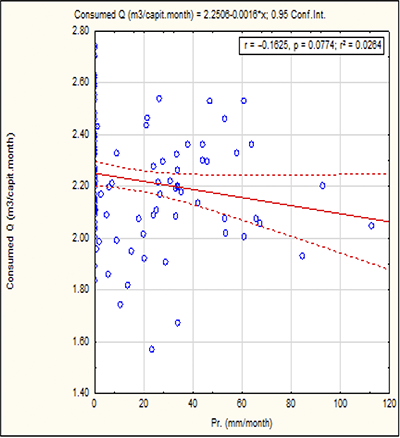
There is a correlation between average precipitation and municipal water monthly supply. Water consumption during the reference 10 years (2003-2012) revealed an increment in the consumed water when precipitation levels are reduced. Customers’ meter readings per capita is less than the supplied water in suburban areas; in some intensively urban agricultural areas, the water losses reached 45 per cent due to illegal connections to irrigate the surrounding urban agricultural. The relation between precipitation and consumed per capita is shown in Figure 6 and equation (1), where Pr is the average rainfall per month: Equation 1
It can be seen in the above graph that the relationsship between precipitation and water consumption per capita is a weak linear relationship. To test the validity of a linear regression and relationship between average temperature and average monthly water consumption per capita, least squares line methodology was used, and the slope of the regression line should not equal zero. The null hypothesis will be H0: β1= 0, and the alternative hypothesis will be H1: β1≠ 0. Using MS Excel 2010, we found the values: covariance of precipitation and water consumption Sxy = −0.76739, variance of precipitation Sx2 = 596.6929 and slope of least squares line β1 = −0.00129 ≠ 0.
To triangulate checking the significance of correlation, testing of the statistical significance of the estimated coefficients was done by t-statistic via (STATISTICA 10). The null hypothesis will be H0: t = 0, and the alternative hypothesis will be H1: t ≠ 0. Using STATISTICA 10, we found t = −1.55242 ≠ 0. So, the null hypothesis is rejected, and the relationship between precipitation and water consumption can be presented in linear regression, as shown in Table I.
The aforementioned findings emphasized the weakness between precipitation and domestic water consumption, but it will be used to provide a tangible sense for the influence of precipitation reduction on domestic water consumption.
Temperature versus domestic water consumption
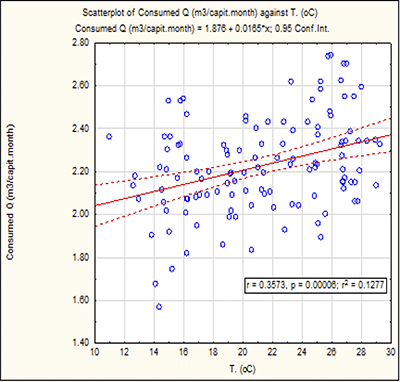
The per capita entitlement from the metered municipal water is a clearly verified indicator of the temperature change influence on domestic water consumption, as shown in Figure 2, where hot dry months are associated with the highest water consumption. Water consumption during the reference 10 years (2003-2012) revealed an increment in the metered consumed water when temperature levels were increased. The relation between consumed per capita consumption and temperature is illustrated in Figure 7 and equation (2).
To test the validity of a linear regression and relationship between the average temperature and the average monthly water consumption per capita, the slope of the regression line should not equal zero. Null hypothesis will be (H0: β1= 0) and the alternative hypothesis will be (H1: β1≠ 0). Using MS Excel 2010, we found the values: covariance of temperature and water consumption Sxy = 0.380557, variance of temperature Sx2 = 23.00463 and slope of least squares line β1= 0.016543 ≠ 0. To triangulate checking the significance of correlation, testing of the statistical significance of the estimated coefficients was accomplished by t-statistic via STATISTICA 10. Table II shows the regression significance between temperature and water consumption. The null hypothesis will be H0: t = 0, and the alternative hypothesis will be H1: t ≠ 0. Using STATISTICA 10, we found t = 4.15724 ≠ 0. The null hypothesis was rejected, and relationship between precipitation and water consumption can be presented in linear regression.
From the above illustrated figure, it is revealed that temperature has a more significant linear relationship with the per capita water consumption. Equation 2
Climate change scenarios and domestic water consumption
Climate change scenarios include studying each single predictor influence of temperature and precipitation on the average monthly per capita consumption.
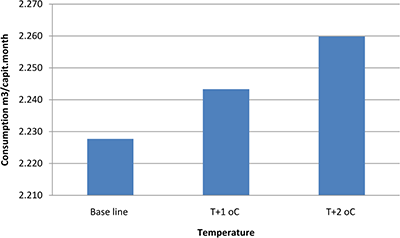
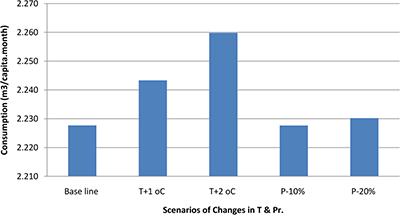
As shown in Figure 8, if the average temperature has risen by 1 and 2°C, then the average monthly water consumption per capita will increase by 15 and 32 liter, respectively.
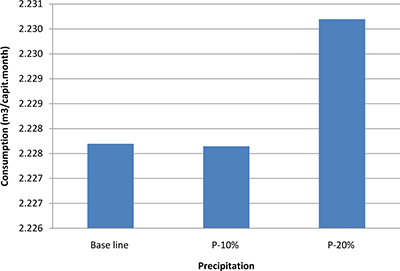
Figure 9 shows that when the average monthly rainfall declines by 10 and 20 per cent, the average monthly water consumption per capita will increase by 0 liter and 2 liters, respectively.
Both above interpretations emphasize the lower impact of precipitation than of temperature on the domestic water consumption (Figure 10) and clarifies the comparison between temperature and precipitation in influencingdomestic water consumption.
Conclusion
A linear statistical relationship between water consumption and climate factors (precipitation and temperature) was developed and validated using (STATISTICA 10). This relation is used to predict the influence of climate change scenarios on domestic water consumption.
Temperature rising has a significant influence on increasing the per capita domestic water consumption than declining in precipitation. The alleged climate change four scenarios emphasized an increase on domestic water consumption. The most influential scenario was the increase of temperature by 2°C (T+2°C), while the average domestic water consumption reached 2.260 m3/month compared with the current consumption (baseline scenario) of 2.228 m3/month. The reduction of precipitation causes a slight increase in the water consumption and accounted for 2.230 m3/month at 20 per cent reduction of rainfall, which could be negligible.
Urban agriculture and current consumption behavior for the use of municipal water for irrigation have a crucial negative influence on domestic water consumption, leading to high percentage of unaccounted water accounted for 33, 38 and 45 per cent for the years 2010, 2011 and 2012, respectively.
The concerned decision-makers, planners, designers and technicians should consider the right track in regard to prioritizing dilemmas for planning water sector in suburban areas, where urban agriculture and climate change on water consumption have never been considered for water sector planning in the Gaza Strip. In addition, they should address uncertainties about climate changes on how domestic water consumption behaviors will have to adapt.
Public awareness should be raised regarding the potential risk of using municipal water for irrigation purposes in light of the water crisis that we are living, and the responsibility to ensure the right to water of the future generations.
Governmental and non-governmental organizations should promote the culture of using gray water rather than domestic water for irrigation purposes after adequate treatment inside the household. Then, sufficient technical capacity building on water-saving strategies should be provided.
References
Further reading
About the authors
Mahdy Jarboo received the MSc and BSc degrees in Civil Engineering/Infrastructure Engineering from the Islamic University, Gaza, Palestine in 2013 and 2008, respectively. Starting from 2009, he joined several international and local highly regarded non-governmental organizations (I/NGOs), as a civil engineer specialized in water management and monitoring and evaluation specialist as well. His current research interests include water management, water governance, climate change and environmental engineering.
Dr Husam Al-Najar has a PhD in Water and Environmental Sanitation. He has worked several years for local as well as international consultancy firms and gained a wide experience in the field of water and environmental sanitation. Moreover, he has leaded training and research groups in the field of water resources and management, infrastructure planning and soil and environmental protection. Currently, he is the head of environmental engineering department at the Islamic university of Gaza. Husam Al-Najar is the corresponding author and can be contacted at: halnajar@iugaza.edu.ps