– This paper aims to determine and compare the vulnerability of selected indigenous communities in the Philippines using several integrated index development approaches. Better understanding on how negative impacts of climate change could be effectively reduced is the identification of appropriate vulnerability assessment approach that is applicable to the local and cultural contexts. Critical in the case of indigenous communities is the analyses of determinants of vulnerability by and with themselves.
– Using the survey data of combined 169 households, vulnerability scores of two adjacent Alangan Mangyan indigenous communities were quantified utilizing a set of 31 indicators that were systematically combined via the balanced-weighted (composite index) and unbalanced-weighted (principal component analysis) approaches.
– The computed vulnerability scores of the Alangan Mangyan communities using several approaches yielded varying results. In both study sites, the degree of vulnerability is differentiated even among households of indigenous communities of comparable socio-economic characteristics. The developed indices confirm that typhoons, level of education, literacy rate and monthly income were found to have direct effect on the Alangan Mangyan communities’ vulnerability.
– The study has successfully tested various methodological frameworks in implementing vulnerability assessment applicable in the context of indigenous communities in the Philippines. Results highlighted the need to simultaneously implement several vulnerability assessment approaches to allow comparison of results instead of solely basing climate change vulnerability-reduction programs to be implemented to a single assessment approach.
1. Introduction
Climate and its projected changes have direct, profound effects to human socio-ecological systems (Turner et al., 2003). As a global problem, climate change demands collective actions, because of its vast impacts on the natural and man-made environments across different sectors and regions. As climatic patterns change, so too do the spatial distribution of agro-ecological zones, habitats, plant diseases, fish populations and ocean circulation, which can have significant impacts on agriculture and food production (FAO, 2007).
Vulnerability to climate change differs considerably across socio-economic groups (Intergovernmental Panel on Climate Change [IPCC], 2007). Tol et al. (2004) proposed that low-income populations are impacted the most by climate change, because of being more exposed to hazards and having lower adaptive capacity. Indigenous peoples (IPs) in particular are highly dependent on marginal ecosystems for their livelihood and considered as among the poorest sectors (ADB, 2009). People living in marginal areas face additional challenges because of limited management options to reduce impacts, such as the case of IPs who inhabit the hilly and mountainous interiors of a number of major islands in the Philippines (Monsod and Monsod, 2003; Cruz et al., 2007).
Despite the disproportionate burden, IPs are rarely the subject of academic, policy and public discourses on climate change (Salick and Ross, 2009; Mearns and Norton, 2010). Although several studies have been conducted related to the IPs in the Philippines, these did not directly evaluate climate change effects on IPs (Lasco and Pulhin, 2000; Allen, 2006; Acosta-Michlick and Espaldon, 2008; Gaillard et al., 2009). Recent developments highlight the need to explore the inherent adaptive capacity of the IPs, as they interpret and react to climate change drawing on traditional knowledge (Salick et al., 2009).
The vulnerability of the IPs to climate change needs to be studied, especially that their livelihood and production systems are directly related to changing environmental services. So far, few studies that take into consideration the socio-ecological systems of the upland indigenous communities in the Philippines were designed. Better understanding on how negative impacts of climate change could be effectively reduced starts with the identification of an appropriate vulnerability assessment approach that is applicable to local and cultural contexts. Critical in the case of indigenous communities is the analyses of determinants of vulnerability by and with themselves. Thus, the main objective of this study was to determine and compare the levels and determinants of vulnerability of the Alangan Mangyan indigenous communities in the Philippines using a combination of methods.
2. Theoretical framework
Vulnerability has been conceptualized in different ways and determined by a wide range of factors. Following IPCC (2007, p. 48), this study defines vulnerability as follows:
The degree to which a system is susceptible to, or unable to cope with, adverse effects of climate change, including climate variability and extremes, and is a function of the character, magnitude and rate of climate variation to which a system is exposed, its sensitivity and its adaptive capacity.
Its components are exposure, sensitivity and adaptive capacity in relation to climate change impacts (Turner et al., 2003; Olsson and Folke, 2004; Leurs, 2005; Metzger et al., 2005; Adger, 2006; Folke, 2006; Gallopin, 2006; Smit and Wandel, 2006; Fussel, 2007; Prato, 2008, Yusuf and Francisco, 2009).
Exposure refers to the characteristics of the natural hazards in relation to climate change and variability (IPCC, 2007). It is related to the degree of climate stress upon a particular system (O’Brien et al., 2004). It may be represented by either a long-term change in climate conditions, including the magnitude and frequency of extreme events. As has been used by a number of studies, this study utilized the frequency of typhoons experienced by a household for the past five years as an indicator of exposure. Although occurrence of typhoons is a common phenomenon in the area, several local studies (Amadore et al., 2005; Anglo, 2006) have shown that the frequency and intensity of typhoons in the Philippines have increased. Hilario et al. (2010) pointed out that the frequency of extreme daily rainfall in most parts of the Philippines is generally increasing.
Sensitivity refers to the degree to which a system is modified or affected by internal or external disturbance or set of disturbances (Gallopin, 2006). It is a function of the overall human and environmental conditions of the ecosystem. Variables included under the sensitivity component of the Alangan Mangyan communities’ vulnerability are related to health, food and water access.
Finally, the adaptive capacity refers to the ability of a system to adjust to climate change, to moderate potential damages, to take advantage of opportunities or to cope with the consequences particularly in the IP’s ability to plan, prepare for, facilitate and implement adaptation measures (IPCC, 2007). Factors that determine adaptive capacity of human systems could include wealth, technology, information and skills, infrastructure, institutions, social capital and equity (Klein and Nicholls, 1999).
Vulnerability of any system could be measured following a number of ways depending on how it is defined. In topics such as climate change vulnerability that intersect a number of integrated concerns in environment, economic and well-being, there is a need to apply a mixed-methods approach to better analyze the problem as basis for more informed interventions (Mertens, 2015). In contrast to the use of a single method, mixed-methods approach uses a combination of several analytical techniques to provide a comparative analysis of a given problem. Thomas and Johnson (2002) explained that mixing of methods could “tell different stories” as a product of cross-disciplinary approaches that would result to a better understanding of phenomena. The use of mixed methods may be found appropriate given the peculiarity of the indigenous groups and the complexity of their vulnerability (Kohrt, 2009).
3. Methodology
3.1 Overview of the study area and the Alangan Mangyan communities
The Mangyan indigenous communities of Mindoro Island are composed of seven distinct tribes recognized by the Philippine Government through its National Commission on Indigenous Peoples (NCIP). The province of Oriental Mindoro and its adjacent Occidental Mindoro province both constitute the island of Mindoro, which is considered as a distinct faunal region in the Philippines (Ong et al., 2002). In terms of biodiversity, the Philippines is one of the world’s mega-diversed countries (Mittermeir et al., 2005). The province of Oriental Mindoro is composed of 14 municipalities. As with other parts of the Philippines, the province is frequently subjected to several typhoons annually.
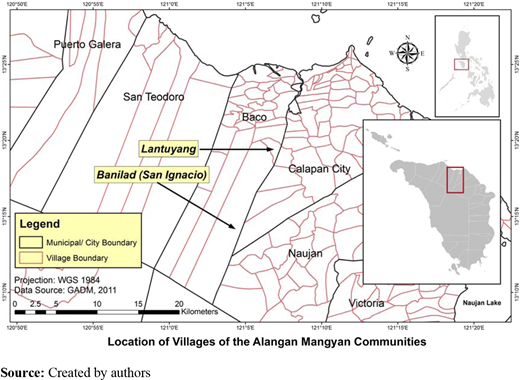
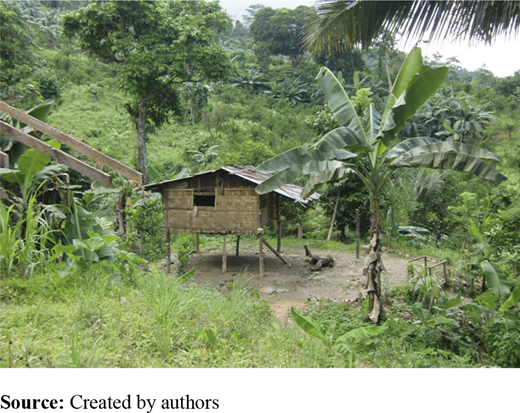
This study focused on the Alangan Mangyan, one of the seven Mangyan tribes more known to occupy the interior and mountain areas in the municipality of Baco, Oriental Mindoro. Specifically covered were the two selected adjacent villages occupied by the Alangan Mangyan, San Ignacio and Lantuyang, and with land areas of 668.84 km2 and 215.40 km2, respectively (Figure 1). These communities are located in a sloping area about 11 kms from the town center of Baco, Oriental Mindoro. Majority of the houses of the Alangan Mangyan are made up of local materials (Plate 1). In the case of San Ignacio, Alangan Mangyan could only be found in the sitio (sub-village) of Banilad. In contrast, the Alangan Mangyan indigenous community occupies the entire village of Lantuyang. In both sites, the household sizes (average = 7) and number of children (average = 4) of the Alangan Mangyan are relatively higher as compared to the national average. The average number of years they have attended formal education is only 2.8, and about 50 per cent of them were not able to attend any formal education. The Alangan Mangyan receive an estimated monthly income ranging from 400 to 5,000.00 pesos (1 US$ = 43 PhP). They rely on subsistence farming for their food source tilling an area ranging from 0.5 to 6.0 ha.
In the lower altitudes of both Alangan Mangyan communities are several orchard plantations tilled mostly by the non-indigenous Tagalog group. In the higher altitudes are the respective farm lots of the Alangan Mangyan communities and the Mount Halcon protected forest. Two rivers and several creeks maintain adequate drainage conditions in the area. One of which is Cararayan River that serves as the boundary of the two barangays. With newly improved road networks, the area is easily accessible by automobile that allows the Alangan Mangyan to more easily interact with the nearby lowland communities. Although some traditions have been subjected to mainstream cultural forces, the Alangan Mangyan communities still organize themselves as one common culture and community.
The Alangan Mangyan communities occupy the foothold environment of Mount Halcon (2,582 m above sea level), a critical mountain ecosystem within the biodiversity-rich Oriental Mindoro province of the Philippines. Owing to its unique geographical and physiographic characteristics, this province is also prone to climatic events, particularly typhoons. Almost 80 per cent of disasters occurring in the Philippines over the past 100 years have been weather-related, with typhoons and floods contributing to the two highest event categories (Amadore et al., 2005). Other natural hazards such as sea-level rise, earthquake, drought and tsunami pose threats as well. The socio-economic and cultural characteristics of the Alangan Mangyan are representative of the many indigenous groups in the Philippines and, thus, chosen as the focus of this study.
3.2 Vulnerability indicators and data sources
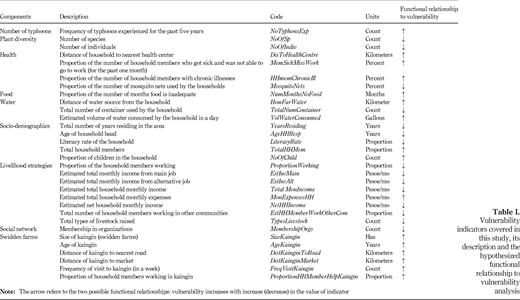
This study used the indicator method to analyze the Alangan Mangyan communities’ vulnerability to climate change. This method quantifies the vulnerability of a given system by selecting and systematically combining a set of socio-economic, ecologic and biologic indicators. After intensive literature review and cross-validation with key Alangan Mangyan community members, 31 variables were selected for this study, categorized into nine components set forth in the 2007 IPCC Fourth Assessment Report (Table I).
The data were gathered from structured interviews conducted at 169 randomly sampled households. Ninety-six households were located in Lantuyang, while 73 resided in Banilad. Respondents of the study were household heads, although their respective spouses were also allowed to provide assistance in answering some questions. Community-mapping exercises were also conducted to explore the extent of their farm lots (kaingin). These were complemented by a series of focus group discussions participated by several members of Alangan Mangyan communities to validate their vulnerability to climate change as well as to determine the implemented adaptation measures at the community level. The UNDP (2004) suggested that standardization of the included variables, which were measured in different scales/units, should be conducted to make them comparable and was done in this study by using the following formula: Equation 1
Standardization of variables resulted in scores ranging from 0 to 1. Two types of functional relationships were possible:
vulnerability increases with the increase in the value indicator; or
vulnerability decreases with the decrease in the value of the indicator (UNDP, 2002).
As the value of each variable can range from 0 to 1, it was interpreted that a score of 0 (minimum) suggests the least vulnerability, while the score of 1 (maximum) indicates the most/highest amount of vulnerability.
Following Deressa et al. (2009), vulnerability analysis was performed utilizing two different methods. The first method assumes that all indicators in the vulnerability analysis are of equal importance and were assigned equal weights. The second option follows the assignment of different weights to avoid the uncertainty of equal weightings of the included variables. It is hypothesized that the decision to implement the first or second option of indicators methods could produce varying results even using the same data set of a given system. In effect, the determination of the respective weightings and the needed aggregation of the vulnerability variables as applied in this study represented both these two approaches.
3.3 Balanced-weighted approach using composite index
The balanced-weighted approach used two procedures outlined in Hahn et al. (2009): the composite index approach and the IPCC framework approach. Both methods applied equal weights to the 31 variables. The composite index approach was computed by averaging each of the standardized nine sub-components of vulnerability using the following formula (Hahn et al., 2009): Equation 2
Where M = one of the nine major vulnerability components; index represents the sub-components indexed by i that make up each major component; and n is the number of sub-components in each major component.
The computed values for all nine sub-components were averaged using the formula below to obtain the vulnerability score for Banilad and Lantuyang (Hahn et al., 2009): Equation 3
Where Vcomposite is the vulnerability index. The weights of each major component, n, were determined by the number of sub-components that make up each major component and were included to ensure that all sub-components contribute equally to the overall vulnerability calculation (Sullivan et al., 2002, Hahn et al., 2009).
The IPCC framework was also utilized for analysis using the standardized and normalized data set. However, these variables were recategorized based on the IPCC’s definition of vulnerability, which is composed of the following dimensions: exposure (E): sensitivity (S) and adaptive capacity (AC): Equation 4
Where V is the vulnerability of Alangan Mangyan communities in either Banilad or Lantuyang.
Exposure (E) is composed of two sub-components such as the number of typhoons and plant diversity. The sensitivity component (S), on the other hand, encompasses variables falling under health, food and water. The adaptive capacity encompasses socio-demographics, livelihood strategies, social networks and characteristics of the Swidden farm of the Alangan Mangyan. Variables under each vulnerability components (E, S and AC) were aggregated using the following formula (Hahn et al., 2009): Equation 5
Where CF is the computed value of the major vulnerability components (E, S and AC), M is the sum of the major components for Alangan Mangyan communities indexed by I, w is the weight of each major component and n is the number of cases in each community.
After values of each vulnerability component were determined, these factors were combined using the following equations for comparison purposes (Hahn et al., 2009; Deressa et al., 2009): Equation 6 Equation 7
Where VIPCC is the calculated vulnerability score for an Alangan Mangyan community, E is the calculated CF score of exposure (E), AC is the calculated CF score of adaptive capacity (AC) and S is the CF score of sensitivity (S).
3.4 Unbalanced-weighted approach
Cutter et al. (2003) recommended that when the number of determining variables of vulnerability becomes too many, statistical methods can be applied to only significant variables. This study used principal component analysis (PCA) to allow the determination of major variables along with the weights per variable. The SAS 9.1.3 Portable was used to run the PCA. Only components maintaining cumulative variance of at least 75 per cent were retained. The most significant components were determined using the mineigen criterion (eigenvalue>1) (Morrison, 1967; Vyas and Kumaranayake 2006). The generated factor scores of the significant variables in component one (PC1) were used in constructing the vulnerability index. This was done by multiplying the factor scores with the standardized raw scores of significant variables per household respondent (Morrison, 1967; Vyas and Kumaranayake, 2006). The community vulnerability scores for Banilad and Lantuyang were determined using the mean value of the calculated vulnerability scores of all households.
Several studies have shown that the frequency and intensity of typhoons in the Philippines have increased (Amadore et al., 2005; Anglo, 2006). On the average, 20 tropical cyclones hit the country each year with nine making landfall (Amadore et al., 2005). Based on a five-year running average (between 1948 and 2005), the trend showed that tropical cyclones with velocity greater than 150 kph were on the rise, while strong cyclones were more frequent during El Niño events (Anglo, 2006). For the purpose of exploring the likely impacts of an increased frequency of typhoons, a separate PCA analysis was performed. The frequency of typhoons (NoTyphoonsNormal) was multiplied by two, serving as an additional variable, NoTyphoons2x. This analysis assumes that a two-fold increase in typhoon occurrence would yield different vulnerability values for these same communities holding socio-economic and ecological characteristics constant.
While an increasing trend of typhoons in the Philippines is commonly assumed to be an effect of climate change, current research has challenged this assumption, as such a trend depends on the time window used for analysis (Sajise et al., 2012; Comiso et al., 2015). Recent studies suggested that an increase in intensity and/or frequency of intensified typhoons is the more likely impact of climate change (Knutson et al., 2010; World Bank, 2013; David et al., 2013). Typhoons have been more hazardous because of their increased strength (Hilario et al., 2010). Nonetheless, there is a consensus that high natural variability of tropical storms and typhoons is being experienced on the ground (David et al., 2010). This ongoing debate whether climate change would lead to increase in frequency or increase in intensity of typhoons in the Philippines raises a limitation of this study, which assumes the former to be the case. Hence, interpretation of the results of this study may only be valid within the context of such assumption.
3.5 Data analysis
Correlation matrices were constructed to explore associations among the 31 vulnerability variables with the calculated vulnerability score. Preliminary analyses confirmed the assumptions of normality, multi-collinearity and homoscedasticity were not violated. Multiple linear regression analyses using STATA software were conducted to analyze the determinants of the vulnerability index scores of the Alangan Mangyan communities in various scenarios. This tested the statistical association between the 31 vulnerability variables (independent variables) and the calculated vulnerability scores (dependent variable) using the weights generated by PCA.
4. Results and discussion
4.1 Levels of vulnerability of the Alangan Mangyan communities
4.1.1 Balanced-weighted approach: composite index approach and IPCC framework approach.
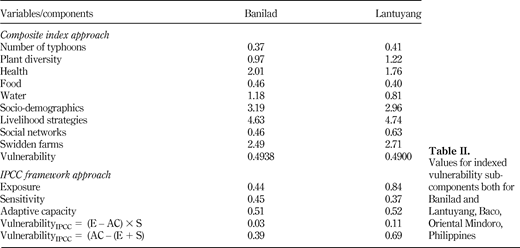
The Alangan Mangyan communities in Banilad and Lantuyang both had high vulnerability index scores (Table II). Although the computed vulnerability scores of Banilad (V = 0.493) were slightly higher than Lantuyang (V = 0.490), the difference was not statistically significant (p > 0.05). In both areas, the top factors contributing to vulnerability were similar. As variables indexed under livelihood strategies and swidden farms characteristics both pertained to the economic base of the Alangan Mangyan community, vulnerability levels of these indigenous communities were affected by their socio-economic condition. This association has been confirmed by previous studies (Adger, 2006; Gaillard et al., 2009). Hence, vulnerability could be significantly reduced if their resource and income-generating activities were enhanced.
In both equations following the IPCC approach, the Alangan Mangyan communities were found to have relatively lower vulnerability scores compared to using the composite index approach. Using the Hahn et al. (2009) equation, the computed vulnerability score of the Alangan Mangyan in Lantuyang (V = 0.11) were found to be slightly higher than those in Banilad (V = 0.02) (p > 0.05). Similarly, Lantuyang scored a higher vulnerability score (V = 0.69) compared to Banilad (V = 0.39) using the Deressa et al. (2009) equation.
Variation in terms of contributing factors to vulnerability could be observed between sites. The exposure (CF = 0.84) contributed more for Lantuyang, while adaptive capacity scored the highest for Banilad (CF = 0.51). The overall higher vulnerability score of Lantuyang over Banilad was due to variables under exposure and adaptive capacity components which both had higher values. It should be noted, however, that exposure was composed of two sub-components: number of typhoons and plant diversity (Table I). Assuming that both study sites had the same number of typhoons being adjacent to each other, the likely major contributor of the difference of the levels of exposure between Lantuyang (CF = 1.22) and Banilad (CF = 0.97) could be related to difference in plant diversity. Based on key informants, it was confirmed that the Alangan Mangyan community in Lantuyang has larger forest areas compared to Banilad.
Plant resources are critical to the coping mechanisms of the Alangan Mangyan in response to severe weather events. Their coping mechanisms to typhoons include reading the movements of the clouds and observing wind direction. Through their tribal elders, Alangan Mangyan closely observes the wind pattern that signals a typhoon, which determines whether the community needs to vacate to safer places. At the onset of a typhoon, they move to nearby safer areas to immediately construct their family libaog, a pyramid-shaped tent used for shelter. It is constructed with the stems of young trees and covered with the leaves of several local plants. Families will stay in their libaog for five to 10 hours, depending on the intensity and duration of the typhoon.
4.1.2 Unbalanced-weighted approach: principal component analysis.
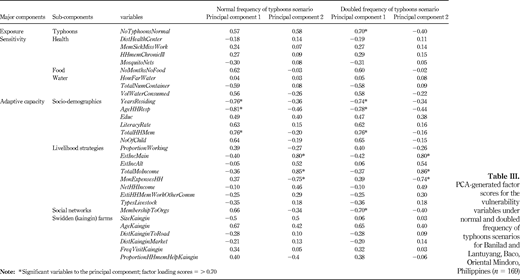
Two components with computed eigenvalues greater than 1 and with a total variance equal to 83 per cent were extracted (Table III). The number of years residing (YearsResiding), age of the respondents (AgeHHResp) and total household members (TotalHHMem) were found to be significant in Principal component 1 that was subsequently labeled as “socio-demographics”. Variables YearsResiding and AgeHHResp were found to be negatively associated with the first component, which suggests that respondents who were both older and had been staying in the area longer tend to have lower vulnerability. The positive association between the total number of household members (TotalHHmem) to Component 1 suggests that Alangan Mangyans with larger family sizes would tend to be more vulnerable. On the other hand, Principal component 2 was labeled as “livelihood strategies” and variables estimated monthly income from main job (EstIncMain), total monthly income (TotalMoIncome) and monthly household expenses (MoExpensesHH) were found to be significant with factor loading scores ≥0.70.
Twelve components were extracted in the doubled number of typhoons (NoTyphoons2x) scenario with a cumulative variance of 83 per cent. Two of the 12 extracted components contained eight significant variables, which were based on factor loading scores of ≥ 0.70. Along with the number of typhoons (NoTyphoons2x), the years of residence (YearsResiding), age of household respondent (AgeHHResp), total household members (TotalHHMem) and membership in organizations (MembershipToOrgs) comprise the Principal component 1 or “socio-demographics” component. In contrast, the significant variables found in Principal component 2 or “livelihood strategies” component, include the estimated total monthly income from main job (EstIncMain), total monthly household income (TotalMoInc) and monthly household expenses (MonExpensesHH).
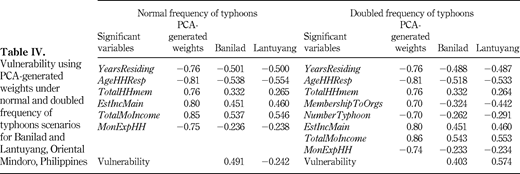
Overall, the low vulnerability score of the Alangan Mangyan communities under the normal typhoon frequency scenario suggests that the IPs were not vulnerable if there was no climate change. However, they became drastically vulnerable with climate change (doubled number of typhoons). In terms of the calculated vulnerability scores for the normal typhoon scenario, Banilad had a higher vulnerability score (V = 0.491) as compared with Lantuyang (V = 0.242). However, a reverse trend was observed in the increased typhoon scenario, in which Lantuyang scored higher on the vulnerability index (V = 0.574) than Banilad (V = 0.403). While the vulnerability scores for Banilad appeared to be comparable regardless of typhoon scenario, a sharp increase in vulnerability scores in the case of Lantuyang was observed. This sharp increase could be attributed to exposure to weather-related hazards that may be beyond the community’s adaptive capacity. It would be expected that the Lantuyang community would be more vulnerable if an increase in typhoon frequency was projected in the future. It is recommended that the Alangan Mangyan community in Lantuyang be prioritized over the community in Banilad in future adaption programs and interventions (Table IV).
4.2 Determinants of vulnerability of the Alangan Mangyan communities
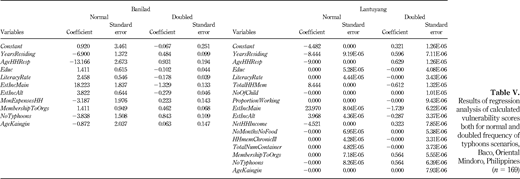
Ten out of the 31 variables were found to be significant in determining the calculated vulnerability scores of Banilad under the normal frequency of typhoons scenario (Table V). Many of these variables, however, were found to be inconsistent with the earlier set of functional relationships to the vulnerability scores. For instance, education, literacy rate, estimated household monthly income from main job, estimated household monthly income from alternative jobs and organization membership whose increase in values were expected to result in a decrease in vulnerability scores. In contrast, these were achieved in separate regressions of the vulnerability index scores under the doubled number of typhoons scenario. Variables such as education, literacy rate, estimated monthly income and estimated monthly income from alternative jobs had negative coefficient loadings in this scenario, which could be responsible for the reduced vulnerability index score.
In the case of Lantuyang, vulnerability index scores under the normal number of typhoons scenario showed that the total number of household members (TotalHHMem), estimated monthly income from main job (EstIncMain) and estimated monthly income from alternative jobs (EstIncAlt). While a larger number of household members (TotalHHMem) were expected to be positively associated to the household vulnerability index, the two former variables were assumed to reduce the vulnerability of a community, rather than increase it for any community.
Higher access to various types of capital can be instrumental in reducing a given household’s vulnerability to climate change, while increasing its ability to adapt (Bebbington, 1999; Adger, 2006). However, results of this study suggest that any increase in income may not automatically lead to a decrease in vulnerability, unless these are clearly invested in vulnerability-reducing actions. It is posited that both the years of residence (YearsResiding) and the age of the household head (AgeHHResp) contributed to a household’s familiarity with the likely impacts of a particular hazard (i.e. typhoons), thereby making them more strategically able to adapt. Adaptive capacity could be further enhanced by higher income (EstIncMain).
The separate regression analysis of the vulnerability index scores under the doubled number of typhoons scenario provides that variables such as frequency of typhoons, age of household respondents and number of years residing in the community would predict an increase the vulnerability scores. Education, literacy rate, total household members, proportion of household members working, estimated income from alternative jobs and total number of water containers owned by the household were all found to be significant in reducing vulnerability index scores under doubled number of typhoons scenario. Thus, to significantly reduce the vulnerability of the Alangan Mangyan to future climate change impacts, intervention programs should address these significant variables.
It is interesting to point out that previous variables that were previously negatively associated with vulnerability index scores became positive under doubled number of typhoons scenario (Table V). For instance, under normal typhoon scenario, the Alangan Mangyan who are older and have stayed for longer period in the area were predicted to have lower vulnerability index scores. However, the reversed coefficient signs in the regression analyses under the doubled number of typhoons scenario for Lantuyang signified that those who are older and have stayed longer would be more vulnerable to climate change.
Adaptive capacity is the ability of a system to adjust, both in terms of moderating potential damages and/or in taking advantage of opportunities, or cope with the consequences of climate change (Brooks, 2003; Adger, 2006; Fussel and Klein, 2006; Ribot, 2010). Central to adaptive capacity of indigenous communities is the ability to utilize adaptive mechanisms at the community level. Older members of an indigenous community may have developed adaptive mechanisms in response to any climatic hazards. In general, IPs could be repositories of traditional ecological knowledge passed down over generations, which has enormous potential to complement and enrich existing scientific knowledge about climate change (Mearns and Norton, 2010). In the case of the Alangan Mangyan communities, tribal elders have traditional meteorological knowledge that gives guidance prior to, during and after typhoon conditions. However, a sudden and unpredicted exposure to unusually extreme events could limit the current adaptive mechanisms practiced among the IPs. Smit and Wandel (2006) related that while most communities and sectors can cope with normal climatic conditions and moderate deviations from the norm, exposures involving extreme events (i.e. Typhoon Haiyan) may lie outside the community’s ability to adapt.
4.3 Comparisons of vulnerability indices
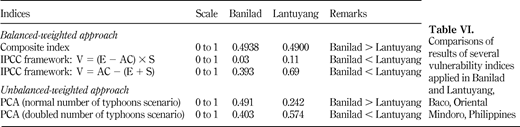
Using the same data set but applying various methodological approaches yielded varying vulnerability index scores of the Alangan Mangyan communities (Table VI). Using the composite index approach, the Alangan Mangyan communities in Banilad and Lantuyang were both found to be vulnerable to climate change. Although the computed vulnerability scores of Banilad (V = 0.493) were slightly higher than Lantuyang (V = 0.490), the difference was not great enough to be considered significant (p > 0.05). In both areas, the top contributing factors to vulnerability among Alangan Mangyan were livelihood strategies, socio-demographics and swidden (kaingin) farms characteristics.
On the other hand, vulnerability was also computed following the IPCC framework comparing two equations. In both equations, Alangan Mangyan communities in two study areas were found to have low vulnerability scores as compared to calculations following the composite index approach. The overall higher vulnerability score of the Alangan Mangyan communities in Lantuyang was due to exposure and adaptive capacity. However, Banilad (CF = 0.45) was found to have higher sensitivity (S) scores than Lantuyang (CF = 0.37).
For the unbalanced weighted approach, the PCA performed allowed the comparison of the vulnerability scores of each community between the varying numbers of typhoons scenarios. In the case of Lantuyang, a large difference between the calculated vulnerability scores was observed between NoTyphoonsNormal (V = 0.242) and NoTyphoons2x (V = 0.403) (p < 0.01). Although the vulnerability scores were found to be within the same range, a decrease of the calculated vulnerability scores was observed between the NoTyphoonsNormal (V = 0.491) and NoTyphoons2x (V = 0.403).
Further comparisons among the indices could also be done by looking into the difference between the calculated vulnerability scores in each of the computed indices (Table VI). Overall, the calculated vulnerability index scores did not follow a clear, directional trend. Under the composite index approach and PCA for normal number of typhoons scenario, Banilad had higher vulnerability scores compared to Lantuyang. However, the vulnerability scores in Lantuyang were higher in the IPCC framework approach using the Hahn et al. (2009) equation. Having similar top contributing factors for both Banilad and Lantuyang, the contrasting results in terms of computed vulnerability scores could be attributed to the difference in the aggregation approach. This result supports the earlier hypothesis of this study that computed vulnerability scores of a given system would indeed be different under various index development approaches. Thus, it is imperative that any vulnerability study uses various aggregation approaches to allow comparison.
4.4 Implications of the study
The computed low vulnerability scores of the Alangan Mangyan communities in Banilad and Lantuyang suggest that IPs may not automatically be considered vulnerable in contrast to the commonly assumed notion. However, this may only be true under the normal typhoon scenario as currently experienced by the Alangan Mangyan because they have developed coping mechanisms for such condition. While this study demonstrated that vulnerability is predicted to increase as the frequency of typhoons increases, it is unclear how vulnerability could be affected by increasing intensity of typhoons. Given that new studies suggest that such a scenario is likely to be the new normal, it is strongly recommended that future studies be conducted to shed light on this association/relationship (i.e. Typhoon Haiyan).
Results of this study confirm that vulnerability levels would also vary across households of the indigenous communities that are usually considered as homogenous. This differentiation in vulnerability across households could be related to differences in socio-economic and biophysical attributes. However, the lower vulnerability levels among the Alangan Mangyan communities should not be interpreted that IPs do not need any climate-related interventions. The lower vulnerability of the Alangan Mangyan could be attributed to their higher adaptive capacity, which is related to the important yet untapped indigenous knowledge system. It could be suspected, though, that such lower level of vulnerability at present have a tipping point. For instance, the change in intensity and frequency of weather extremes, such as typhoons and droughts, could threaten the resource base of the Alangan Mangyan. Thus, in contrast to implementing purely externally determined adaptation programs among the IPs, there is a need to capitalize on their traditional knowledge systems to make programs more culturally responsive and effective. Any future programs and measures could only be rated as appropriate if they would enhance the adaptive capacity of the IPs.
The identification of feasible and practical adaptation strategies is the major aim of vulnerability assessments (Smit and Wandel, 2006). Several policy recommendations could be drawn from this study in relation to climate change adaptation among IPs elsewhere and in the Philippines. One, there is an urgent need to implement an integrated socio-economic development program that must improve the socio-economic status of the indigenous communities and enhance their adaptive capacity. Second, the productivity of the swidden farms needs to be improved by implementing sustainable farming strategies that must not jeopardize environmental considerations as well, i.e. agroforestry. The importance of these swidden farms as source of food for the Alangan Mangyan communities can not be understated. The government and interested non-governmental organizations must institute programs that would ensure sustainability of these swidden farms. Howden et al. (2007) raised the need for diversification of production systems and livelihoods as an example of systematic changes in resource allocation. Finally, indigenous adaptation strategies and practices need to be documented and supported, as these are critical in maintaining their low vulnerability level. Future studies must analyze how cultural practices could be complemented with current social and technological advances to achieve effective decision-making process (i.e. early warning system devices).
In addition, comparisons among the indices show that the calculated vulnerability index scores using various approaches do not follow a direct trend. As the vulnerability of any system could be measured following a number of ways, the computed vulnerability levels of an indigenous community may indeed differ depending on the approach used. Results of this study show that the computed vulnerability levels of the IPs differ between the two tested approaches. The inconsistency of the vulnerability levels of a given indigenous community across various approaches would, therefore, necessitate the use of various methods for comparisons, as it may afford more bases for climate change adaptation planning and action.
5. Conclusions
This study provides an integrated vulnerability analysis of two indigenous communities in the Philippines by using and comparing several index development methods. Overall, the low vulnerability scores of the Alangan Mangyan communities under the normal number of typhoon scenario signify that IPs are not vulnerable if there is no climate change. However, they become drastically vulnerable when climate change (doubled number of typhoons) is considered or taken into account. Hence, the high vulnerability scores using the composite index approach and the unbalanced-weighted approach are consistent with the hypothesis that climate change increases the vulnerability of people.
Analysis of the vulnerability of IPs indeed requires particular attention to the approaches being used. The study has successfully tested various methodological frameworks in implementing a vulnerability assessment applicable to the context of indigenous communities in the Philippines. This study has confirmed that vulnerability levels of an indigenous community may not be consistent across various approaches used. Results highlighted the need to implement simultaneously several vulnerability assessment approaches to allow the comparison of results. Therefore, it is wise to use a mixed-method approach to vulnerability assessment, which affords a more comprehensive analysis of the complex socio-ecological systems of the indigenous communities in relation to climate change. As vulnerability is conceptualized in different ways and determined by a wide range of factors, the use of mixed-method approach provides a better basis for planning climate change adaptation. This is particularly necessary for indigenous communities that require more effective, careful and long-term planning.
References
Further reading
The authors wish to thank the Philippine Commission on Higher Education-Zonal Research Center (CHED-ZRC), the Provincial Government of Oriental Mindoro, the Municipality of Baco and the NCIP-Oriental Mindoro. The assistance of Joan Talubo, Jesamine Rebugio, Elizabeth Gatchalian, Charles Schwartz and Mary McGillicuddy are gratefully acknowledged along with the inputs of two external experts during the Student Conservation Science Conference held at the American Museum of Natural History, New York.