


The recently released fifth IPCC report indicates a high agreement among global actors on the need to integrate climate change adaptation (CCA) and disaster risk reduction (DRR). However, there remains little local level evidence on how DRR and CCA could be linked, the sorts of adjustments that are required for the two concepts to be integrated and the challenges ahead. This paper aims to provide an empirical insight on the possible links and departures between DRR and CCA.
The study used a qualitative case study approach to excavate lessons from an existing DRR intervention for CCA using a local-level adaptive capacity assessment framework as a normative criteria. Data was collected both from primary and secondary sources. The primary data collection involved the use of participatory rural appraisal techniques with village communities in Chifra District, Afar Regional State, Ethiopia.
The findings showed that the DRR interventions studied addressed parts of the elements of adaptive capacity at the local level. The findings also showed the limitation of the DRR intervention, which could be attributed to both the nature of the DRR interventions in general and implementation problems of the case study intervention in particular. The limitations show cases where full integration of DRR with CCA could be challenging.
The paper argues why the two approaches may not be integrated fully and also shows the need to focus on the design of DRR interventions in achieving both short-term (reducing disaster risks) and long-term objectives (enhancing adaptive capacity).
1. Introduction
The recently released fifth assessment report of the United Nations International Panel on Climate Change (IPCC, 2014) states that “warming of the climate system is unequivocal” and is linked to an increase in greenhouse gas emissions. Therefore, climate change adaptation (CCA), defined here as “the process of adjustment to actual or expected climate and its effects” (IPCC, 2014), is high on the international climate change agenda, despite ongoing debates on what exactly constitutes adaptation (Dessai et al., 2009; Giddens, 2009; Stakhiv, 1996). Disaster risk reduction (DDR), on the other hand, refers to:
[…] the concept and practice of reducing disaster risks through systematic efforts to analyse and manage the causal factors of disasters, including through reduced exposure to hazards, lessened vulnerability of people and property, wise management of land and the environment, and improved preparedness for adverse events (UNISDR, 2009).
One of the debates has been on the link between development, DRR and CCA. The overall conclusion of reviews made so far is that CCA should be integrated in the existing risk- and vulnerability-reduction efforts rather than re-inventing itself (Mercer, 2010; Birkmann and von Teichman, 2010; Schipper and Pelling, 2006; O'Brien et al., 2006).
This paper aims to provide an empirical insight into the possible links and departures between DRR and CCA. Such insights are essential to direct efforts towards using experiences in DRR to address current and future climate vulnerability of communities. Therefore, the main research question that the paper aims to address is:
What are the possible links and departures between disaster risk reduction and climate change adaptation?
2. Concepts and approaches
A review by Schipper (2009) on the linkages between DRR and CCA identified factors such as the focus on reducing risk and vulnerability, the call for linkage with development, the holistic and long-term nature of both approaches, the concern for local communities and the link with environmental degradation as points of convergence between the two concepts. On the other hand, Birkmann and von Teichman (2010) identify scale-, norm- and knowledge-related issues as hurdles towards integration. Spatially, the climate change community focuses more on global models and long-term impacts and responses, while the DRR community mostly focuses on local and specific places. Temporally, although in principle DRR is supposed to be a long-term endeavour, it is still entangled with short-term response strategies which sometimes lead to further risks to lives and livelihoods (Schipper and Pelling, 2006; O'Brien et al., 2006). With regard to norms, DRR communities, with their longer experience, have developed lots of tools, frameworks and standards to monitor and evaluate effectiveness of their interventions, while the climate change community is still new and lacks such tools (Birkmann and von Teichman, 2010). Knowledge-wise, lack of basic knowledge, conflicts in the use of scientific and traditional knowledge and weak links between scientists in both communities create rifts in effective communication (Birkmann and von Teichman, 2010).
However, there have been some developments in the integration of DRR and CCA at conceptual, political and practical levels (Gero et al., 2011). These developments have been reflected in the recent IPCC reports. For example, the 2012 IPCC special report was exclusively devoted to developing the link between the two. The recently released fifth IPCC assessment report (IPCC, 2014) also confirms the existence of “robust evidence and high agreement” on the need to integrate development policy, CCA and DRR. Despite these developments, there is still little local-level evidence on how DRR and CCA could be linked, the sorts of adjustments that are required for the two concepts to be integrated and the challenges ahead (Gero et al., 2011).
The body of existing literature argues that adaptation requires a proper understanding of social vulnerabilities which expose people to risks in the first place (IPCC, 2012; Ribot, 2011). It also argues that responding to current vulnerability is the best available option given the high degree of uncertainty regarding the future climate (IPCC, 2014; Ireland, 2010; Füssel and Klein, 2006). These two arguments serve as the first ground to assess the link between DRR and CCA interventions.
Early works on vulnerability research, however, were trapped in their neo-Marxian structural explanations of social vulnerability (Boehle, 2001). Vulnerable groups are considered helpless and unable to mobilise their own resources or unable to resist external stresses. Chambers (2006) was the first to indicate that vulnerability has two components, an internal and an external one. Boehle (2001) picked up Chambers’ point and argued that people’s vulnerability is a function of both external pressures and their internal capacity to mobilise their resources to deal with environmental stresses. He called this internal capacity as a coping capacity. In the climate change literature, coping refers to actions and measures taken in response to a specific hazard, whereas adaptation is futuristic aiming at mid- or long-term strategies and often involves reforms of existing institutional contexts for better response (IPCC, 2012; Birkmann, 2011). While the coping capacity refers to a bundle of currently available resources that can be used to survive an immediate disaster intact, adaptive capacity focuses on longer-term and more sustained adjustments (IPCC, 2012; Gallopín, 2006; Smit and Wandel, 2006).
Adaptive capacity is usually expressed as a bundle of characteristics of a system, or how such bundles of characteristics can be used. Degree of urbanisation, access to public health facilities, community organisations, existing planning regulations at national and local levels, institutional and decision-making frameworks, existing warning system and protection from natural hazards, and good governance are often regarded as the bundle of characteristics of an adaptive system (IPCC, 2012; Gallopín, 2006; Smit and Wandel, 2006). These capacities can be used to anticipate risk, respond and/or recover and change (IPCC, 2012).
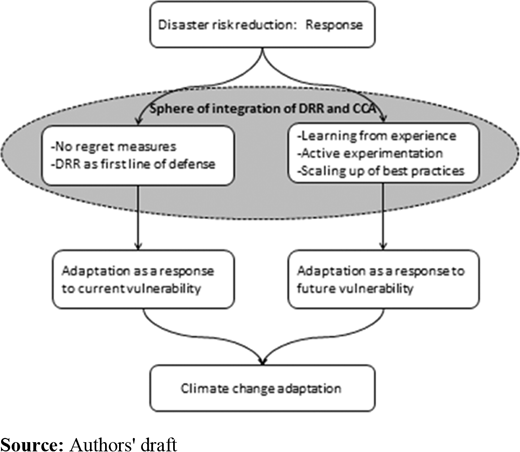
The framework used in this study is adapted from a “Local Adaptive Capacity Framework” (LACF) developed by Jones et al. (2010). As the name implies, the framework focuses on local-level adaptive capacity unlike most previous studies which focus on the adaptive capacities of national and regional levels (Brooks et al., 2005). The framework moves away from asset-based approaches of adaptive capacity to understanding processes of decision-making and governance, innovation, experimentation and institutional structures. This is a move from “simply looking at what a system has that enables it to adapt, to recognising what a system does to enable it to adapt” (Jones et al., 2010). This is done through focusing the analysis on not only the individual components but also the interrelationship between the components in building a coherent capacity to act. The sphere of integration between DRR response measures and CCA lies in two areas:
in the ability of DRR responses to serve as a no-regret adaptation option and/or serve as “first-line defence” for adaptation (Ireland, 2010); and
in its ability to serve as a platform to learn from experience, active experimentation and scaling up of best practices (Birkmann et al., 2013).
While the former is concerned with current vulnerability, the latter is concerned with future vulnerability (Figure 1).
3. Research methodology
3.1 The research framework and description of the case study intervention
This research was part of a bigger research initiative by the African Climate Change Resilience Alliance (ACCRA). ACCRA has been working in Ethiopia, Uganda and Mozambique with the aim of increasing the use of evidence in designing and implementing humanitarian and development interventions that increase poor and vulnerable communities’ capacity to adapt to climate change. This paper presents one of the case studies dealing with the link between CCA and DRR. The authors adapted the “Local Adaptive Capacity Framework” (LACF) developed by Jones et al. (2010) to guide the study. The original framework has five components, but it was modified to have four components, as the authors felt that the last component could be subsumed in one of the other components. As the name implies, the framework focuses on local-level adaptive capacity as opposed to most previous studies which focus on national- and regional-level adaptive capacities (Hinkel, 2011; Brooks et al., 2005). The four areas of focus of LACF include (Jones et al., 2010):
Asset base: Availability of key assets that allow the system to respond to evolving circumstances.
Institutions and entitlements: Existence of an appropriate and evolving institutional environment that allows fair access and entitlement to key assets and capitals.
Knowledge and information: Ability of the system to collect, analyse and disseminate knowledge and information in support of adaptation activities.
Innovation: The ability of the system to create an enabling environment to foster innovation and experimentation, as well as its ability to explore niche solutions to take advantage of new opportunities.
The case study focuses on the PILLAR (Preparedness Improves Livelihood Resilience) project funded by the European Commission Humanitarian Aid and Civil Protection (ECHO). PILLAR was established as a component of ECHO’s Drought Preparedness Programme with the principal objective of increasing self-reliance and resilience of pastoral communities in the Horn of Africa. It seeks to improve drought preparedness through increased capacities of all stakeholders to prevent and respond to emergencies and enhance, protect and diversify livelihood assets of pastoralists in the drought-prone areas of southern and eastern Ethiopia. During the fieldwork, two phases of the project had already been implemented: PILLAR I from April 2008-2009 and PILLAR II from July 2009-June 2010. The interventions were implemented in seven core and four emergency districts in Afar and Somali regional states. The project activities were organised around four result areas, namely, enhancing community capacity and resilience to cope with drought and vulnerability, increasing capacity of state and non-state actors in livelihoods-based food security and early warning information management systems, harmonising and improving coordination between government and NGOs in drought preparedness response and reducing impact of drought on pastoral livelihoods. A number of activities were implemented under these pillars, namely, baseline survey, training and support of community animal health workers and deworming and vaccination campaigns, natural resource mapping and community management planning, natural resource management training, area enclosure, fodder production, water point rehabilitation, establishment of livestock marketing, cereal stocking and milk marketing groups. The people pillar consisted of training for early warning systems and contingency planning, refresher training for community animal health workers on early warning data collection, organising and using the data and development of a common approach for livestock health care during drought among district-level actors through the creation of forums, promotion of the national guidelines for relief intervention and formation of district-level emergency disease response teams.
3.2 Description of the study area, sampling and data collection
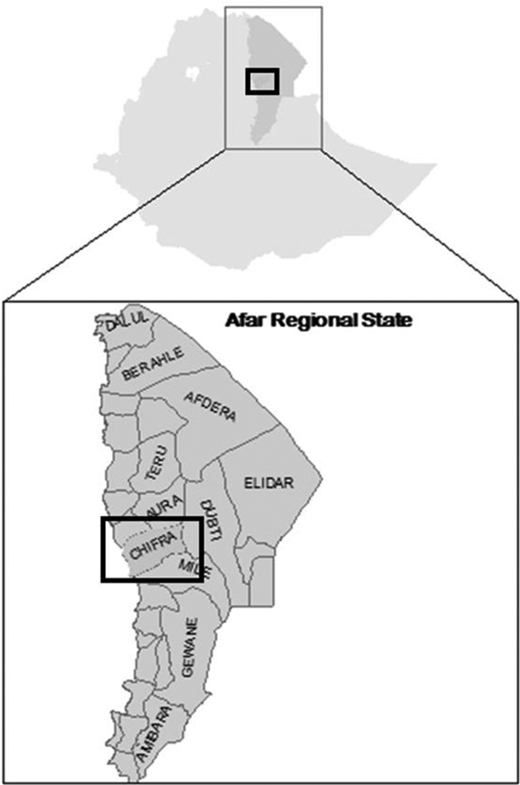
The study was conducted in Chifra District, Zone 1, Afar National Regional State, Ethiopia (Figure 2). The climate of the district ranges from arid to semi-arid with a mean annual temperature range of 28-40°C. The district has two distinct rainy seasons separated by a dry season. More than 50 per cent of the total annual rain falls in the main rainy season, namely, Kiremit/Karma (occurring from June to September), while the small rainy season, namely, Belg/Sugum, occurs from April to May. The annual rainfall in the district ranges between 200 and 600 mm. The district has a total population of 91,078, of which about 61 per cent are pastoralists and the rest are agro-pastoralists. The wealth category includes poor (37.5 per cent), middle (40 per cent) and better-off (22.5 per cent). The district falls under the “Araamis ke Adaar pastoral” livelihood zone which is predominantly livestock based, mainly cattle, goat, sheep and camels. Three of the 19 villages in the district grow crops. School enrolment in the district is 23 per cent which is low compared to the national average of close to 90 per cent (The Livelihoods Integration Unit, 2010).
The study approach was qualitative, mainly using the participatory rural appraisal (PRA) approach with a multi-disciplinary research team (Chambers, 1994). The study used both primary and secondary sources of data. Secondary data included historical climate data, project documents and basic background data, collected from the Ethiopian Meteorological Agency, Save the Children UK field offices and local agricultural bureaus. Primary data included climate-related hazards, private and communal assets, institutions of resource governance, climate-related knowledge and information and innovations collected using PRA techniques such as resource mapping, hazard ranking, seasonal calendars and timelines, local histories, key informant interviews and focus group discussions. All the PRA exercises were made with separate male and female participants. The resource-mapping exercise involved mapping of grazing areas, watering points, rivers and mountain areas. The hazard-ranking exercise involved identification of major climate and non-climate hazards that the respondents consider important and prioritisation based on the frequency of the hazard and its damaging potential. The seasonal calendar was prepared by identifying the major raining seasons, dry seasons and variability of pasture and water availability. This information is then overlaid on the months of the year. Finally, the historical timeline was constructed by first identifying major events that respondents consider important. These events were the years of political regime changes and that of major droughts. Respondents were then asked about the conditions of pasture and water availability during different historical times, including major drought years and their impacts.
Participants in the primary data collection include Save the Children UK field staff, experts from the local bureau of agriculture and village communities with a total of 80 respondents (59 men and 21 women). Respondents from the village community were recruited on a voluntary basis, representing old and young, rich and poor, men and women and project beneficiaries and non-beneficiaries. Finally, the results of the PRA exercise were shared and feedbacks received (Chambers, 1994) using separate workshops for village community members and district-level government and non-governmental organisation experts.
4. Study findings
4.1 Hazards and exposure
Afar is an Ethiopian Regional State where large-scale agricultural investments are expanding. For example, over 36,000 ha of land has already been given away for investment, and over 120,000 ha was in the pipeline back in 2014 (Headey et al., 2014). The expansion of one of the state farms, Tendaho-Kesem, is estimated to have taken away an additional 80,000 ha of land from the area (Rettberg, 2010). These investments coupled with a fragile and vague pastoral land right deprive Afar pastoralists of important dry season grazing land, undermining their livelihood (Reda, 2014).
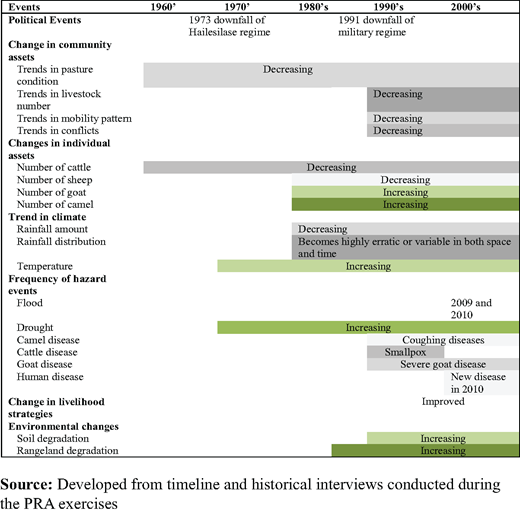
The communities in the study area identified and ranked the major climatic and non-climatic hazards they faced in the past 10 years from the time of data collection (Table I). They identified multiple hazards, including rainfall variability, human and animal diseases, resource degradation, flooding and strong wind. It is important to notice that the level of exposure to these hazards is not the same for all groups within the village. This could be seen from the difference in hazard ranking between pastoralists and agro-pastoralists and between men and women members of the community. There was a high degree of agreement between both male and female agro-pastoralists and pastoralists on the critical hazard threatening their livelihood, all identifying “drought” as the major hazard. Drought, however, does not occur in isolation. As can be seen in the historical trends (Figure 3), the discussion with local elders revealed that deterioration of the pasture condition has a long history, going as far back as the 1960s. The conditions worsened with the drought years of the mid-1970s and 1980s which led to further rangeland degradation and shortage of pasture. With this and other complex social and natural factors, mobility has become restricted, and new livestock diseases have appeared since the 1990s. Hence, while disaster responses might be tempted to focus on responding during drought years, adaptation responses require a more comprehensive and long-term approach to climate hazards.
Natural hazards identified and ranked by livelihood and gender
| Hazards | Rank by livelihood and gender | |||||
|---|---|---|---|---|---|---|
| Pastoralist men | Agro-pastoralist men | Pastoralist women | Agro-pastoralist women | Severity of impact | Frequency of occurrence | |
| Drought | 1 | 1 | 1 | 1 | Very high | Every year |
| Erratic rainfall | 2 | 2 | 4 | 2 | Very high | Every year |
| Animal diseases | 3 | 5 | 5 | 6 | High | Every year |
| Shortage of water | 4 | 3 | 3 | 3 | Very high | Every year |
| Human diseases | 5 | 4 | 2 | 5 | High | Every year |
| Rangeland degradation | 6 | 6 | 6 | 4 | Very high | Increasing |
| Soil erosion | 7 | 9 | 8 | 10 | High | 1 in 9 years |
| Flooding | 8 | 8 | 7 | 7 | Very high | 3 in 10 years |
| Strong wind | 9 | 10 | 9 | 8 | High | 3 in 10 years |
| Crop diseases and pests | – | 7 | – | 9 | Very high | Every year |
The results indicate that pastoralists in Afar have been under threat for a number of years. They have been subjected to frequent droughts and floods which cause rangeland degradation and loss of pasture land owing to restrictive national parks, state and private farms. This led to a discursive risk construction by state agencies and international donors which assert that pastoralists are backward and the cause of their own environmental demise (Rettberg, 2010; Fratkin, 2001; Leach and Mearns, 1996).
The Afar pastoralists are also in constant battle with their neighbours. Over the past century, the Afar have seen their land shrinking. They were pushed by the Isa, a Somali Clan from the east, and fight a constant battle with their Amhara neighbours who resist Afar intrusion during drought times. These phenomena are said to be the reason why the Afar “remain isolated, unsophisticated and restricted to raising livestock” (Markakis, 2003, p. 447). Hence, the root causes of the threat to Afar livelihoods are outside the Afars’ control (Getachew, 2001). Climate risks are only part of the broader vulnerability context. Their livelihood is locked into a livestock herding system which gives an increasingly diminishing return owing to recurrent drought and weakening of the people’s ability to recover (Reda, 2014; Headey et al., 2014).
4.2 Building adaptive capacity
This section assesses the potentials of building the adaptive capacity of the local community. The existing coping capacities are presented first and then an assessment of the potential of the project interventions in enhancing those coping capacities are presented.
4.2.1 The asset base.
Assets are one of the core elements of capacity to cope with climate-related hazards. Access to and control over resources is said to be a critical aspect of the community’s coping capacity (Smit and Wandel, 2006; Adger et al., 2004). In this section, the major assets that were found to be relevant for the community’s adaptive capacity are presented. The natural assets include: rangeland, cropland, a river that crosses the village and underground water resources that are available to both pastoralists and agro-pastoralists. The major changes over recent decades reported by both pastoral and agro-pastoral groups include loss of rangeland, vegetation and biodiversity. The main coping strategy has been migration to less-affected areas. The distance that the people decide to migrate with their livestock depends on the severity of the situation in the surrounding areas. In situations where the neighbouring areas are better off, they migrate to those areas. At times, however, pastoralists have to migrate with their livestock to far-off areas when the drought is severe.
With regard to their physical assets, which include small enclosures for growing animal feed, wells for domestic water use, irrigation diversion and canal, veterinary clinics, all-weather roads, a human health post and a school, the impact of climate-related hazards were reported to be less frequent but detrimental when they happen. For example, strong winds have torn the roofs of schools and clinics, and carried away the fences of enclosures, and in the 2010 floods, the storm damaged the only irrigation canal in the village. As for financial assets, the main asset owned by pastoralists is their livestock, while agro-pastoralists also own their crops (maize, sesame, onion, sweet potato and sugar beet). The respondents reported a drastic reduction in individual assets, such as the number of cattle, sheep, goats and camels. However, a central statistics agency data showed a general increase in livestock population in the past 15 years, both for Afar Region and for Zone 1, where the study district is located. The explanation for the disparity of the community perception and that of the statistical data could be that despite overall growth in the number of livestock in the area, per-capita shares have been dropping because of population increase in the areas. With regard to human assets, indigenous knowledge of livestock production was found to be the main asset of the people in the study area. A recent change is the increased value that families give to education, as they have started sending their children to school. One older respondent explained: “Education is an asset; if you are educated you do not go hungry”. Some people as old as 40 years are also attending school on a part-time basis.
Coping capacities can be translated into adaptive capacity through learning from experiences, active experimentation and scaling up of best practices (Birkmann et al., 2013). The PILLAR-II project in Chifra District was implemented in five villages, including the study village. The potential learning avenues created by the project intervention are briefly assessed in this section. The traditional pastoral livelihood depends on livestock-keeping using natural pasture. The intervention tried to introduce new practices such as supplementary feed and rangeland enclosure as a response to the worsening of the rangeland situation owing to drought and other stressors. The intervention managed to improve livestock nutrient intake by distributing mineral blocks during stress times and establishing communal dry season grazing area enclosure. The enclosure enabled the community to preserve pasture for times of drought, especially “home-based” milking animals and calves, which are an important source of nutrition for children and family members who do not migrate with the livestock. To increase the income which pastoralists could gain from their reduced herd sizes, a livestock marketing group was formed in the village with 27 women, providing seed money and business skills training. The group was further strengthened by the emergency response project which procured donkeys for re-stocking. The intervention also attempted to build the asset base of the women’s group through irrigated crop and forage production. In the case of crop production, a group of 53 women enclosed 2 ha of land, 1.75 ha for fodder production and 0.25 ha for the production of crops such as sesame.
However, in terms of building the asset base of households, the achievements of the intervention were not adequate, both because of implementation-related factors and poor coverage. For example, the crop farm of the women’s group was destroyed by camels during the intervention time, so the women managed to produce only meagre harvests. Livestock feed production on a plot less than 2 ha in size was not sufficient to ensure a viable feed supply for the animals of the 53 members. Also, although livestock health was targeted by the project activities, the success of this endeavour was curtailed by the inability of the trained community animal health workers to secure drug supplies and low coverage of the vaccination and treatment provided through the intervention.
On the other hand, there were signs of positive learning experiences which motivated some residents of the village to realise their potential. For example, the women’s group which was engaged in fattening small ruminants was planning to expand its operation. Many people started to experiment with crop production, albeit with repeated failures due to scant rainfall, and they were motivated to start enclosures of their own livestock.
4.2.2 Institutions.
Institutions are broadly defined as “habitualized behavior and rules and norms that govern society” (Adger, 2000). These include formal and informal arrangements in respect of land tenure and property rights, as well as social support networks. Institutions are believed to be a core component of adaptive capacity (IPCC, 2012). Formal institutions include the Ethiopian Constitution of 1994 which declares that “pastoralists have a right to free land for grazing and cultivation as well as the right not to be displaced from their own lands” (FDRE, 1995). Despite this provision, the broader policy environment towards pastoralism in Ethiopia is tilted towards looking at pastoralism as economically and ecologically unviable production system, accompanied by state-led interventions which focus on settlement of pastoralists and the promotion of crop farming in pastoral areas (Nori et al., 2008; Hesse and MacGregor, 2006). This involves resettlement and villagization programs together with privatisation of land ownership. Although these interventions are mainly pushed through by the federal government, the Afar Regional Sate officials, the Afar youth close to the government power also show their support for the interventions (Reda, 2014). The study respondents were found to be divided in this regard, some arguing for and some against pastoralism. The following are examples of quotations from two male respondents:
We pastoralists are experts; we know how to rear livestock. Our ancestors were pastoralists and we learned livestock keeping techniques from them. Hence, the Government needs to tap this potential and develop the livestock economy with us (Pro-pastoralism respondent).
There was a time when it was viable to rely on mobile livestock production. That was when the rain was plenty and the pastures abundant. Now things have changed. The rains are erratic and our rangeland is degraded. We cannot continue this way. We have to look for opportunities in agriculture. Our land is fertile; we only need the Government to bring us irrigation water. (Pro-agriculture respondent).
Traditionally, the community in the study area is organised along family, neighbourhood and clan lines. Respondents described the strong culture of supporting each other during difficult times such as drought. They confirmed that traditional support continues despite herd sizes being greatly reduced. One of the male discussants said:
We will continue helping one another until the end. If I have only a cow which is pregnant and my fellow brother comes for help, I will promise to give him the calf when it is born. We know we are getting poor together, but we also know we will not starve to death while our clan members are having something to eat. We survived the past horrible years because of this culture and we will continue to do so.
However, discussions showed that the social support system is under pressure and the amount of support given is dwindling because of the reduced ability of clan members to help each other.
One of the components of the intervention was natural resource management through establishment of an enclosure for access to pasture during drought. In line with this, 2 ha of land was enclosed and terracing and other soil and water conservation structures were introduced. Traditional leaders were sent to another region to learn about rangeland management practices. Although the intervention was intended to promote the cut and carry system of feeding, the elders on their return were not able to put into practice what they had learned. The level of exposure and the extent of support was not enough for the handful of local elders to change a well-established institutional system. Despite the enclosure performing well, there was no clear arrangement as to who would be allowed to use the pasture by the time the project phased out. This highlights the challenges of enclosing land within a communal land tenure system. The community has suggested that future interventions should involve the whole community and the community should be allowed to own the end product. Involvement of the whole community in the process would also ensure that the creation of enclosures does not block key migration routes.
The intervention also aimed at improving the existing market institutions which favour only men and traders. Two groups of men and women beneficiaries were organised in groups to engage in fattening of small ruminants. They were trained and also linked to the nearest abattoir, which would allow them to avoid unnecessary exploitation by middle-men traders. While a male group in a neighbouring district succeeded in this, the women’s group was not able to negotiate prices, hire a vehicle and transport their pigs to the abattoirs as this was a new experience for them. Support and coaching is required to facilitate such market links.
4.2.3 Knowledge and information.
Using weather forecasts to make production decisions is attracting more attention. Such information could assist decisions on mobility, sale of livestock, purchase of grains and administering vaccination (Luseno et al., 2003). In the study area, only a few people who have access to a radio said they receive weather forecasts provided by the National Meteorological Agency. Traditional methods are still the main source of weather forecast for most people. Even those with access to the information through the radio tend to have less confidence in the modern forecast information because of lack of location specific information. The most effective way for pastoralists to access information about past and present rangeland conditions is the traditional Dagu system. Dagu is a traditional information exchange system. When two family or clan members meet in markets or social gatherings, they greet each other and exchange information. The persons tell one another information on the condition of rangelands, water availabilities and, condition of livestock in different areas and other relevant information. This helps families in deciding where pasture and water are available and planning the next move.
Mobility, the longstanding coping strategy in pastoral areas, enables pastoralists to exploit the potential of dry lands, even in the case of extreme weather events. Mobility requires information on pasture conditions in other areas around the village and in far distance. The villagers use their traditional information-sharing system to direct their mobility. Marketing is also an important strategy to deal with drought hazards, and it involves the sale of livestock before their physical condition deteriorates. Ensuring that marketing efforts boost income requires families to access information mainly from their traditional sources.
The use of seasonal forecasts for decision making was not considered by the intervention, neither was the community asked if they would find such information useful during intervention planning. Information on alternative feed sources and irrigated agriculture was provided to a women’s group, but did not spread further. A small number of community members were taken for a field visit to southern Ethiopian pastoral areas where large scale enclosures are common and well established. Those who participated in the visit felt that it opened their eyes for possible resource management options. This study shows that efforts to provide information to pastoralists could benefit from ensuring its integration in traditional information transfer mechanisms. Greater efforts should be made to ensure that a range of wealth groups can benefit from information on new practices; these could become important income sources for households which have lost most of their livestock.
4.2.4 Innovation.
The ACCRA framework explains that a key characteristic of adaptive capacity relates to the system’s ability to support innovation and risk-taking. Innovation can be planned, high-tech orientated, and geared towards large-scale innovations, or autonomous, local-level initiatives that help people adapt to changes to the local climate. Viable innovation systems not only help create knowledge, they provide access to knowledge and foster learning. A variety of practices have been introduced to people in the study village, although they are mostly practised by very small numbers of people. Irrigated agriculture has become more widely practised because the government provided a check dam and irrigation canal and the PILLAR II project organised a women’s group for forage seed and crop production. However, despite these supports some pastoralists are still wary of agriculture and perceive it to be a high-risk endeavour owing to the repeated failure of rain-fed agriculture, lack of confidence in their own farming skills and the damage to their irrigation infrastructure due to a recent flood. Area enclosure was also a new innovation in the study area. According to the respondents, some of them enclose areas for keeping young animals around the village, while others do so for producing feed for their animals for use during the dry season. Some individuals provide exceptional examples of how to invest resources and energy and transform livelihoods. Two examples, one man and one woman impressed the research team because they have done exceptional work in the village. The man is the only agro-pastoralist in the area who has been able to develop a fruit orchard, eucalyptus plantation and beehives in the village. He narrated his story as follows:
[…] when I started cultivation and refused my daughter’s marriage, the community called me “crazy” person […] now people appreciate my garden and I am taken as a model.
The women agro-pastoralist narrated her story as follows:
[…] because of the increasing frequency of drought and shortage of feed, I decided to have area enclosure for my animals from which I produce feed and also keep my young animals. I also have a plot of land from which I produce grass seed, field crops and some vegetables. Mostly, I grow maize because its residue is a good source of feed for my animals. My farm and area enclosure is near to the water source and I usually irrigate both. I bought farm implements myself and I pay for the labour of the people who irrigate my fields. I am the first woman who fenced in an area for feed and crops in this area[…]
These two agro-pastoralists are an exception in the study village and they set an example for others of what is possible even with no substantial external support.
Interventions through the PILLAR II project were able to introduce some new ideas and practices. Organising females into groups and cooperatives enabled the women to engage in crop and forage seed production for the first time. The livestock marketing component brought the idea of business to the women and the potential to work together to generate income. In addition, whilst the introduction of enclosures did not achieve its objectives, the project generated awareness of the importance of rangeland management. Older residents in the village said they were not aware of how to rehabilitate rangelands by simply avoiding grazing. The PILLAR II project helped the community to try new things, to diversify their income and rehabilitate their environment so that they could better adapt to the changes that they are facing.
However, there are still a number of aspects which are missing from the intervention if it is to support innovative behaviour. Communities need access to information that can help them experiment and build their skills in farming and rangeland management. Community members feel that greater mentoring and community support is needed for them to make unfamiliar and new activities successful. The new PILLAR Plus project has started addressing these challenges by creating a centre for supporting experimentation and dissemination within the community via the introduction of the Pastoralist Field School. The provision of seed money to invest in new practices is also essential for communities which have a very limited ability to make productive investments. The initiation of saving schemes might be used to help with this, though clear institutional arrangements and follow up are required for them to be successful. Simply introducing new ideas is inadequate; significant follow-up and support is needed to encourage innovation and to identify successful approaches for replication.
5. Discussion
The paper started with the research question “What are the possible links and departures, between disaster risk reduction and climate change adaptation?” The findings showed that the disaster case study intervention studied addressed parts of the elements of an adaptive capacity of local communities (see Table II for summary of the results). It built assets of the beneficiaries of the intervention, developed local resource use institutions, introduced new knowledge and information relevant to improve local livelihoods and fostered local innovation. In line with the argument in most adaptation literature, the DRR intervention studied addressed the drought disaster from a broader vulnerability reduction perspective (Ribot, 2011), showing its linkages with CCA. Examples include interventions on improving coordination of government and non-government actors for disaster prevention and preparedness and investing on local livelihood diversification. The DRR intervention on early warning systems also links it well with an adaptation intervention which is often forward-looking.
Summary of links and divergences between disaster risk reduction and climate change adaptation
| DRR responses in the intervention | Links and divergence from climate change adaptation | |||
|---|---|---|---|---|
| No-regret/DRR as a first line of defence | Learning and scaling up of best practices | |||
| Links | Divergences | Links | Divergences | |
| Asset building | Built assets of those affected by drought | Scale of the intervention was limited | Lessons for local government and community members on how to develop and protect livelihood assets | There were no concrete measures to ensure implementation of lessons |
| Institutions | Attempted to build institutions of marketing and resource use | Institutional design not inclusive of all stakeholders in the community | Attempted introduction of new institutions | The new institutions crated were not aligned with existing local institutions |
| Knowledge and information | Provided early warning information | No attempt to provide climate information | Attempted to establish an early warning system | Opportunities for sharing climate change knowledge and information sharing were lost |
| Innovation | Introduced mixed farming system | Limited scale of the intervention | Opened opportunities for experimentation with new ideas | Support provided for experimentation was limited |
The findings also showed the limitation of the DRR intervention to support climate adaptation which could be attributed to both the nature of DRR interventions in general and specific implementation problems of the case study intervention in particular. The limitations show cases where integrating DRR with CCA could be challenging. For example, although the DRR intervention studied attempted to build local community’s asset base, it did not sufficiently do so partly because of the completion of the project period which ended before the project activities were completed. This is often a problem of DRR interventions in practice, which tend to work with limited time frame. On the other hand, an adaptation intervention requires longer time frames. On institutions, the DRR intervention targeted the most affected. However, building institutions only for most affected does not sound pragmatic from an adaptation perspective. For example, the institutions of managing enclosures showed that despite the interventions’ good intention of targeting the most affected, resource management institutions often require cooperation of the whole community. The interventions also lacked concrete actions which build local community members’ knowledge and foster their innovation on climate conditions and risks, such as weather forecast or some form of scenario planning which are often an integral part of adaptation planning (Table II).
With regard to the nexus between DRR and CCA, two major points can be emphasised. First, with regard to addressing the current vulnerability, the studied DRR intervention reveals the contribution of DDR intervention to CCA (Birkmann and von Teichman, 2010). As shown in the result section, the intervention was operational in only few villages and within these villages, it was targeted at only a few beneficiaries, mainly women. This is understandable given the nature of the funding of the intervention by ECHO, which was limited in amount and tied to humanitarian response. In areas such as Afar, where common property resource management and a culture of sharing and mutual support is the norm, such interventions would require wider scope and coverage. A case in point is the attempt to introduce enclosures. Despite its well-intentioned implementation and success in terms of regenerating pasture, its usefulness was questionable simply because it was too small. The same could be said of the women’s group for fodder production and fattening. The number of women targeted was too small and the benefits they received were too meagre to meaningfully change their lives. If adaptation interventions are to reach a wider range of communities and transform their livelihoods (Pelling, 2011), they require a bigger budgetary commitment and wider targeting.
Second, with regard to addressing future vulnerability, the use of the local-level adaptive capacity framework showed the potential and limitations of DRR interventions in building adaptive capacity among local communities to reduce their vulnerability to climate-related hazards. Birkmann et al. (2013) extend the concept of adaptive capacity and argue that it includes the capacity to anticipate, the capacity to cope and the capacity to recover. This paper has shown that the intervention studied was more successful on the concrete level, namely, asset building, and less successful on the abstract level of institutions, knowledge and information. This means that it managed to deliver more in the coping and recovery aspects of societal capacity than in respect of the anticipation aspect. It may not be reasonable to expect any intervention to be comprehensive enough to address all the four components of the adaptive capacity considered in this study. That being said, looking at all the four components together reveals that adaptation is a complex phenomenon, which requires a combination of technical, behavioural and intuitional innovation both in the local communities and among the actors working with them, such as state institutions and civil societies. In communities where natural resources are owned communally, and both formal and informal institutions play a significant role in the day-to-day functioning of society, determining the right mix of assets, institutions, knowledge and innovation seems to lie at the heart of the problem of effective adaptation.
According to the results of this case study, the assertion that adaptation should learn from experiences in the field of development and DRR interventions (Cannon and Müller-Mahn, 2010; Schipper and Pelling, 2006; Mercer, 2010; O'Brien et al., 2006; Birkmann and von Teichman, 2010) should be interpreted with caution, and it needs to be made explicit that the lessons should include both failures and successes. Experience has shown that the theory of action and the theory-in-use (Argyris and Donald, 1974) of both development and DRR are not consistent (Cannon and Müller-Mahn, 2010; Birkmann and von Teichman, 2010).
6. Conclusion
Based on the case study presented, three major conclusions are drawn on the nexus between DRR and CCA:
DDR interventions could contribute to CCA by reducing current vulnerability of communities to climate change.
DRR interventions have both potentials and limitations in building adaptive capacity at local level.
The assertion that adaptation should learn from experiences in the field of development and DRR interventions should be interpreted with caution.
What is often called “development” and “disaster risk reduction” on paper is not the same as what one sees on the ground. Hence, in order for adaptation to climate change to take advantage of past experiences in development and DRR, it is important to identify what works and what does not work on the ground.
This work was financially supported by the Africa Climate Change Resilience Alliance (ACCRA) through Oxfam Great Britain Ethiopia Office. The authors are thankful to Dr Jin-Tae Hwang and Dr Florian Weiser for their comment on the earlier version of the paper. The authors also thank the three anonymous reviewers for their critical reviews which improved the paper.

