Higher education system has a critical role to play in educating environmentally aware and participant citizens about global climate change (CC). And, as shown by the 21st Conference of the Parties of the UN Convention on Climate Change – COP 21, held in Paris in December 2015, there is still a path to be followed regarding the role played by universities in the negotiations and in influencing decision-making on a matter of such global importance. The purpose of this first study conducted within Portuguese (Europe), Mexican (Spanish-speaking North America University) and Mozambican (Africa) universities is to investigate higher education system students’ perceptions on CC.
The data were collected through a questionnaire aiming at characterising students from the socio-demography, and from their perceptions, motivations, attitudes and knowledge relating to the topic of CC. Statistical analysis was used to compare and characterise the three national groups under study.
This study did not show significant perception differences among the analysed subsamples, although there was a tendency for Mexican students to express lesser belief that CC was happening, and for Mozambicans to show a greater belief in CC issues and motivation to mitigate its effects which may be related to the specifics contexts. The results show that relevant differences among nationalities mostly concerned the magnitude of choices (e.g. most respondents of each nationality expressed interest in CC issues, but the magnitude of this expression differed according to nationality). The principal component analysis (second and third components) clearly embodied nationality profiles (discussed in the context of different cultures, educational structures and CC impacts).
Further research is warranted to understand the integration of CC into higher education curriculum to improve and target educational efforts to suit students’ needs.
How CC perceptions vary cross-nationally and how research studies that examine the integration of CC into higher education curriculum are areas for which more research is needed.
The results highlight the importance of socio-cultural dimensions of each country in relation to the understanding or perception of CC issues, namely, in what concerns aspects related with gender roles, age, active learning and citizenship. This study’s data evidenced that despite the surveyed students being familiarized with CC phenomena, this knowledge does not translate necessarily into concrete mitigation practices and behaviours.
1. Introduction
Climate change (CC) is a major issue of our time that has vast environmental, cultural and social-economic impacts. Over the past two decades, many studies have focused on the science behind climate systems. There is also a growing body of lived experiences associated with CC s, such as rising ocean level and surface temperatures and increasing variability in extreme climate episodes. Humanity is called to become aware of the urgent need to understand the causes of CC and deal with its consequences, requiring profound changes in lifestyles, production and consumption (Giddens, 2009).
There is still much public debate and uncertainty regarding the reality of CC and the degree to which human activities are responsible, but CC is a global problem and we are educating a “climate change generation” (Feldman et al., 2010). Thus, higher education has a critical role to play in educating university students (Wachholz et al., 2014; Santos et al., 2016) and in educating environmentally aware and participant citizens about global CC. Many universities across the world perform state-of-the-art research on CC matters (e.g. mitigation and adaptation). Yet, as shown by the latest 21st Conference of the Parties of the UN Convention on Climate Change (COP 21), held in Paris in December 2015, there is a path to be followed regarding the role played by universities in the negotiations and in influencing decision-making on a matter of such a global importance. So far, few studies have focused on higher education students’ knowledge and attitudes about this issue (Santos et al., 2016). CC is a matter of global concern, being a significant challenge facing society today and becoming a central issue to the society (Leal Filho et al., 2016), and specific sectors such as universities need to engage and be active in the search for regional and local solutions for what is a global problem (Leal Filho, 2010).
As stated by Adger et al. (2013), society’s response to every dimension of global CC is mediated by culture. Most individuals relate to CC through personal experience, highlighting what people know, think and believe (Lorenzoni and Pidgeon, 2006). The study of CC perceptions across cultural, political, economic, social, educational and geographical areas (demographic and regional differences) should offer more detailed insights into the effectiveness of different educational and communication strategies.
Higher education institutions (HEIs) must be called to adapt curricula, general teaching and evaluation approaches to foster a desirable growing of the willingness-to-change behaviour related to CC and its impacts on the environment and socio-environmental and climate governance (Santos et al., 2016). Universities must be able to integrate the need of this interdisciplinary vision and develop a critical role to prepare society to adapt to the impacts of climate disruption by providing intercultural research and education on adaptation strategies.
The purpose of this study was to investigate HEI students’ perceptions of CC and global warming (GW). This is the first study conducted within Portuguese (Europe), Mexican (Spanish-speaking North American University) and Mozambican (Africa) universities, and the results in this context should have meaningful implications for both national and international future CC policies, as well as university curricula adaptation to students’ perceptions (Jamelske et al., 2013; Santos et al., 2016).
Africa is the continent most vulnerable to the impacts of CC, because of increases in both droughts and floods, the epidemic potential of many infectious diseases and low capacity of nations and communities to adapt to CC (Boko et al., 2007; Patt et al., 2010). Regular, predictable rainfall is particularly critical in Africa because many countries are highly dependent on rain-fed agriculture. In the African continent, farmers’ perceptions about CC have been largely studied (Hameso, 2014; Osbahr et al., 2011; Deressa et al., 2009), and the same for Southern, Central America and Spanish-speaking North America-Mexico (Valdivia et al., 2010; Márdero et al., 2014), where CC impacts and adaptation (Peterson et al., 2002; Aparicio-Effen et al., 2016a, 2016b; Nagy et al., 2016) and mitigation issues are known. Few studies focused on university student perceptions (e.g. health students from Ethiopia; Nigatu et al., 2014).
Regarding the herein studied nationalities, Patt and Schroter (2008) reported on Mozambican CC perceptions and Sánchez-Cortés and Chavero (2011) and Márdero et al. (2014) analysed Mexico’s CC perceptions. No references were found about HEI student perceptions and comprehension of CC science in those countries. In Portugal, the first study was published by Santos et al. (2016).
2. Research methodology
2.1 Surveyed institutions and courses
Research was conducted at two European Public Universities (Portuguese Universities of Porto and Aberta), one Spanish-speaking North American University (from the Institute EPOMEX of the Autonomous University of Campeche, Mexico) and one African university (Lúrio University, Pemba, Mozambique). The survey was applied to students of four Master degrees in the areas of Ecology, Coastal and Marine Management, Biodiversity and Natural Resources, Environmental Citizenship and Participation and Sustainability.
The Master in Ecology, Environment and Territory, at Porto University, is aimed at acquisition of knowledge to understand the biological aspects that are essential to the applied fields of ecology and biodiversity, landscape ecology and planning, environmental education and nature tourism, technology of environmental management and environmental characterisation, monitoring and recovery. Also at Porto University, the Master in Biological Aquatic Resources is a post-graduation designed for the management, sustainable exploitation and preservation of the aquatic ecosystem. The two programmes are full-time, daytime attendance degrees with 120 ECTS (European Credit Transfer System) and the duration of two years.
The multidisciplinary Master in Coastal and Marine Management, from the Institute EPOMEX of the Autonomous University of Campeche, Mexico, aims to develop manpower with high scientific and analytical capacity about concept, methodologies and tools for the analysis and management of coastal and marine problems with emphasis on local, regional and national views. It is intended also that the student knows the essentials of the coastal management, to be able to study and develop sustainable activities related to fisheries, aquaculture and human activities and problems on coastal and marine pollution using broad techniques including GIS (geographic information system). The manpower formed is trained to apply their skills in the academic and government areas. The programme is full-time, daytime attendance degree with 120 ECTS and of two years’ duration: the first year is dedicated to the curricular units (60 ECTS), and the second year is dedicated to the planning, developing, writing and defending of the dissertation/project (60 ECTS).
The Master Program in Ecology of the Lúrio University, Pemba, Mozambique, aims to provide a thorough and specialized understanding of key ecological processes, issues and management of biodiversity loss, as well as its importance, including the interactions between the different components, both biotic and abiotic, and terrestrial and tropical ecosystems. It is intended also that the student knows the essentials of the proper functioning of individuals’ physiological mechanisms and feedback mechanisms involved, to be able to recognize and interpret the biodiversity present in different types of ecosystems, the major adaptations of organisms to life in these ecosystems and the main threats to the maintenance of biodiversity. These programmes are full-time, daytime attendance degrees with 120 ECTS and of two years’ duration: the first year is dedicated to the curricular units (60 ECTS) and the second year is dedicated to the planning, developing, writing and defending of the dissertation/project (60 ECTS).
Finally, Master in Environmental Citizenship and Participation, offered at the Portuguese Distance Learning University, is designed to prepare individuals to work in environmental policy-making, as well as to improve their environmental citizenship, participation and planning abilities (e.g. individuals working within government, environmental advisors, members of environmental NGOs, teachers, researchers and individuals involved in environmental practices, policies, planning, training, participation and citizenship). It is taught in an e-learning regime, and the pedagogical model underlying the learning process was developed specifically for e-learning second-cycle degrees at the Universidade Aberta (UAb) (Azeiteiro et al. 2015; Bacelar-Nicolau et al., 2009): the first year is dedicated to the curricular units (60 ECTS) and the second year is dedicated to the planning, developing, writing and defending of the dissertation/project (40 ECTS) (a total of 100 ECTS and three semesters).
2.2 Sample
The convenience samples including 40 Mexican, 40 Mozambican and 124 Portuguese students were recruited online through email invitation. The invitation to participate in the study included a short presentation of the study, its aims, responsible researchers and universities to assure an informed consent from participants, followed by a link to the questionnaire itself. Response rates were 98, 85 and 57 per cent for Mexico, Mozambique and Portugal, respectively, corresponding to subsample sizes of 39, 34 and 71 respondents.
2.3 Questionnaire
The questionnaire was composed of 30 closed-ended questions and two open questions aiming at characterising students from the socio-demography and their perceptions, motivations, attitudes and knowledge relating to CC. The questionnaire was pre-tested among faculty students, not enrolled in its application, and the results were used to refine it. The time required for filling in the questionnaire was 10 min. The questionnaire was adapted from Wachholz et al. (2014) and Manolas et al. (2010). Google Drive was used to host the questionnaire and allow for the online survey. Students were assured that their responses will remain anonymous and they willingly participated in the survey.
The questionnaire was translated into Spanish by the Mexican co-author and adapted to Mozambican Portuguese language local specificities by the Mozambican co-author.
2.4 Statistical analysis
Three subsamples, corresponding to the three student groups of different nationalities (Portuguese, Mexican and Mozambican), were analysed and compared. Crosstabs by nationality were built for all survey questions, with observed counts, column percentages, adjusted residuals and pairwise comparisons of column percentages (with Bonferroni correction). Additionally, homogeneity chi-square tests or Fisher exact tests, were computed (the latter whenever more than 20 per cent of all cells presented expected values under 5). This analysis was complemented with chi-square measures of association contingency coefficient, Phi and Cramer’s V (not presented here, as the results were coherent with the homogeneity chi-square tests and Fisher exact tests applied). A similar analysis, with results split by nationality, was used to analyse crosstabs by sex and by age, to check eventual biases from different sex and age distributions within each nationality. These results are mentioned in the results section, when characterising sub-samples.
Principal component analysis (PCA) was applied to variables where nationalities differed significantly according to the chi-square and Fisher exact tests. The use of this exploratory multivariate methodology aimed to attain a global view of the main characteristics that differentiated among the three nationalities under study.
Data were analysed using the IBM SPSS Statistics 21® software. A significance level of 5 per cent was used whenever statistical tests were applied.
3. Findings
3.1 Respondents characterisation
Sex. The majority of the Portuguese respondents were mostly male (61 per cent), while the opposite was observed for the Mozambique respondents (32 per cent male), and the Mexican respondents were nearly equally divided for sex (54 per cent male). Because Mozambicans had significantly different sex distribution than other nationalities, results were split by nationality and crossed by sex variable to identify the distinctive aspects. Only three issues raised significant sex differences among Mozambicans (one barely, with a borderline p-value of 0.047; see below).
Age. Regarding age, although the majority of the respondents were aged between 21 and 30 years, the magnitude of this proportion differed with respondents’ nationality. Almost all Mozambican respondents fell into the younger age group (<21 years; 91 per cent). Mexican respondents were mostly, 62 per cent, aged 21 to 30 years, but 33 per cent were younger (<21 years). Inversely, most Portuguese respondents (79 per cent) were aged from 21 to 30 years, and 21 per cent were above 30 years.
Because Mexicans had a significantly different age distribution than other nationalities, the results were split by nationality and crossed by age groups to identify issues where responses were age-related, within Mexican respondents. Only two queried issues were significantly related to the age groups, among Mexican respondents: one concerning the study regime (i.e. working students or full-time students; see below) and the other the belief that “humankind may successfully mitigate CC effects” (see below). As for all other survey questions, age differences were not significant among Mexican respondents; this bias sample was not considered relevant for our study.
Study regime. Concerning the study regime “full-time students” vs “working-students”, there were no clear significant differences among nationalities (p = 0.05), indicating a strong tendency for non-similitude): the wide majority of Mexican students were full-time students (85 per cent), while for Mozambicans and Portuguese students, the numbers were lower (59 and 69 per cent, respectively). The age distribution may have contributed to the observed differences.
3.2 Perceptions relating to CC and their impacts
Most respondents of all nationalities believed that CC was happening. Nevertheless, Mexican respondents were significantly less certain of its existence (82 per cent) compared with the Portuguese (98 per cent) and Mozambicans (100 per cent) (Table I).
In what concerns their interest in the topic, Mozambican were significantly much more interested in CC (88 per cent answering “very much interest”) than Mexican or Portuguese students (64 and 56 per cent, respectively). The perceived importance of the topic was also significantly different among the three nationalities: 66 per cent of Portuguese answered that they “perceived CC as a very important issue”, while 82 per cent of Mozambican and 100 per cent of Mexican students expressed the same opinion. Regarding the level of concern with the topic of CC, although globally all students shared a similar degree of high concern with CC issues (45-59 per cent were “very much concerned”), Mexican respondents expressed significantly less “somewhat concerned” (31 per cent) than Mozambican and Portuguese (44 and 54 per cent, respectively), and they also expressed significantly greater “little concern” (10 per cent) compared to others (0-1 per cent).
There was a generalised, and similar, perception that biotic communities were already being impacted by CC (90-96 per cent), irrespective of its location in the world. A considerable number of respondents also, similarly, perceived that CC impacts were already being felt in human communities in their own country (72-83 per cent), and much less perceived that CC would be felt in the next decade (1-10 per cent). The perception of CC impacts on human communities was greater concerning foreign countries than in one’s country, being significantly higher among the Portuguese respondents (92 per cent) than Mozambican or Mexican respondents (88 and 74 per cent, respectively); in accord with these result, Mexican students perceived to a significantly greater extent that CC impacts would be felt in 10 years from now (26 per cent), compared to Mozambican (9 per cent) or Portuguese respondents (3 per cent).
Most students (72-85 per cent), similarly, expressed that “the scientific community assumed that CC was happening”, although a considerable proportion expressed that “there was much disagreement amidst the scientists relating to the subject” (12-24 per cent). Nearly all students (95 -100 per cent), regardless of nationality, also perceived that human activities were an important cause of CC.
When inquired on the capacity of humanity to mitigate CC, the vast majority of the respondents expressed that humans could mitigate effects of CC (97-100 per cent), although only Mozambican were significantly more positive, 27 per cent expressing that “humans would manage successfully to mitigate the effect of CC” opposed to 4 per cent of Portuguese and 3 per cent of Mexican. Most respondents irrespective of their nationality expressed that “people did not have the will to change their behaviour to achieve mitigation” (34-48 per cent) or that “it was not clear if they would do what was necessary to achieve it” (38-59 per cent).
The collected perception data did not show significant differences among the analysed subsamples, although there was a tendency for Mexican students to express lesser belief in CC and a tendency for Mozambicans to show a greater positivism, hinting that Mexican respondents were less certain that CC was happening. However, this was not statistically significant and further studies are needed to confirm this trend.
Students’ sex did not significantly influence their perceptions of:
time scale of CC impact (both on human and biotic communities);
anthropogenic activities as a main cause of CC; or
the will or possibility of humans to alter the course of CC.
Only one queried CC issue was significantly related to sex in the Mozambican subsample: almost all Mozambican women defended that scientists believed CC were happening (96 per cent), while this opinion was lower among Mozambican men (64 per cent).
As for the age factor, this only significantly influenced the perception relating to the capacity of humankind to successfully mitigate CC effects (although p-value = 0.045). The majority of the younger Mexican respondents (aged <21 years) expressed that humankind could successfully mitigate CC effects, but people are not willing to change their behaviour (77 per cent), while lesser respondents shared this opinion in the older age groups (38 per cent aged between 21 and 30 years and no one over 30 years).
3.3 Training and knowledge of CC
Regarding student’s academic training and their perception of its focus on CC issues, their opinions were not significantly different for the three nationalities. Most respondents (61-74 per cent), shared the opinion that their training “had focused enough on CC issues”, and some (21-31 per cent) felt that “it had not focused enough”. Still, a few Portuguese and Mexican respondents were not aware of having studied it during training (6-8 per cent), or they had not studied the topic in training “but had obtained their knowledge informally” (3-8 per cent). This aspect was also significantly influenced by gender in the Mozambican subsample, where the majority of Mozambican women declared their training focused enough on CC issues (87 per cent), while only 46 per cent of men expressed the same (Table II).
The self-perceived technical knowledge on CC, significantly differed among the respondents of different nationality. Most respondents (53-78 per cent) expressed they had a “moderate technical knowledge”, although Mozambicans perceived a significantly lower “moderate technical knowledge” (53 per cent) than Mexican or Portuguese (69 and 78 per cent, respectively), and a significantly greater “technical knowledge at professional level” (21 per cent), compared to Mexican or Portuguese students (5 and 1 per cent, respectively). “Minimum technical knowledge on CC” was perceived by few (3-5 per cent) and extended knowledge by some (17 - 24 per cent), regardless of nationality.
Concerning the “knowledge of how one’s actions/behaviours influence CC”, a greater proportion of respondents, from each subsample (38-80 per cent), also expressed having a moderate knowledge was significantly less for Mozambicans (38 per cent) than Portuguese (68 per cent) or Mexican (80 per cent). “Extended knowledge of one’s behaviour effect on CC” was significantly higher for Portuguese and Mozambican respondents (27 and 29 per cent, respectively) than Mexican (0 per cent). Nevertheless, a significantly greater “knowledge at professional level” was reported by the Mexicans (15 per cent), than by Portuguese and Mozambicans (1 and 6 per cent). A “minimum knowledge on the effect of one’s behaviour on CC” was expressed to significantly higher level by Mozambican respondents (27 per cent) compared to others (4 and 5 per cent, respectively for Portuguese and Mexican).
Different opinions were found relating to the perceived need for more information on CC. Globally, the vast majority (95-100 per cent) felt they needed more information relating to CC. Among these, and in line with other results, Mexican students felt more information was needed (31, 44 and 26 per cent, respectively needed “much more”, “more” and a “little more information”), than Mozambican (12, 65 and 24 per cent, respectively, needed “much more”, “more” and a “little more information”) or than Portuguese (7, 41 and 6 per cent, respectively, needed “much more”, “more” and a “little more information”). Only among Portuguese, a small number (6 per cent) felt “no need for further information” on the subject.
Also, in what concerns their ecological footprint, most students (49-80 per cent) had not estimated it, and among these, Mexican had estimated it significantly less (80 per cent) than Mozambican or Portuguese (53 and 49 per cent). Among the students who declared having calculated their ecological footprint, a significantly greater proportion of Mozambicans (41 per cent) had calculated it during training, opposed to Mexicans and Portuguese (0 and 17 per cent, respectively). On the other hand, no Mozambican had calculated the ecological footprint outside training (0 per cent), opposed to a significantly greater proportion of Portuguese (27 per cent) and Mexican respondents (18 per cent). A low proportion, regardless of nationality (3-7 per cent) was not aware of having, or not, calculated it.
When asked about the effect of the hole in the ozone layer on CC, a significantly lower proportion (23 per cent) of Mexican respondents correctly acknowledged that this was not a main cause of CC, compared to Mozambican (50 per cent) and Portuguese (37 per cent). Only among the Portuguese subsample, 7 per cent individuals (significantly) expressed not knowing whether the hole in the ozone later was a cause of CC, opposed to other nationalities (0 per cent).
3.4 Governance and actions to mitigate CC
Opinions on who should take the main actions in mitigating CC were strongly, and significantly, dependent on the respondents’ nationality, with most Portuguese and Mozambicans (73 and 62 per cent, respectively) sharing the opinion that this responsibility should lay upon governments, opposed to only 26 per cent of Mexican respondents who expressed the same opinion. On the other hand, significantly most Mexican (64 per cent) expressed that the responsibility to mitigate CC should lay upon individual’s, opposed to Portuguese and Mozambicans (18 and 38 per cent, respectively) (Table II).
Also, without an international agreement, e.g. Kyoto’s protocol successor, most students (52-69 per cent), regardless of nationality, felt there would be still a way to mitigate CC, although many felt that such an international agreement was essential (23-40 per cent) or they “did not have an opinion on the matter” (7-8 per cent).
Regarding the behaviour of the respondents’ relational communities, this was similarly perceived regardless of their nationality: most respondents (49-59 per cent) expressed that their relational communities acted partially to mitigate CC, and a considerable proportion (31-42 per cent) expressed that their relational community did not act to mitigate CC, and only a small number (6-9 per cent) perceived that they did so.
As individuals, even though they believed CC was happening, only 27 to 55 per cent had taken some action to mitigate CC (among these, 12-23 per cent considered the measures taken were difficult to implement); nationality of the respondents did not significantly affect these results. Hence, a considerable proportion of the respondents (45-74 per cent) had taken no action to mitigate CC. Among these, a significantly greater number (50 per cent) of Mozambicans expressed that the “they believed in CC, but the actions of a single individual would not change anything”, opposed to 13 per cent Portuguese who expressed the same opinion (and 39 per cent Mexican).
When inquired if they were to reduce their contribution to CC, Mozambicans expressed a significantly greater confidence (79 per cent) that their actions to mitigate CC would increase their life quality by a lot, opposed to Portuguese and Mexican respondents (25 and 44 per cent, respectively). On the other hand, a significantly greater proportion of Portuguese respondents (21 per cent) expressed that “their actions would not have any impact in their life quality”, opposed to Mexican (3 per cent) and Mozambican respondents (0 per cent).
As individuals, most of the respondents also expressed that they would support actions to reduce greenhouse gas emissions, including measures that implied, e.g., paying more for fuel and electric energy. Among these, Mozambicans expressed a significantly greater will to support these mitigation actions (79 per cent) than Portuguese or Mexican (56 per cent). Also, a significantly lower proportion of Mozambicans expressed less uncertainty in acting, i.e. only 3 per cent “were not sure/had no opinion on the matter”, opposed to 31 per cent of Portuguese or Mexican respondents.
Again, as in most other issues assessed in the questionnaire, the respondents’ gender did not significantly affect the responses in governance aspects, actions or perception of actions, except what related to the importance of an international agreement to combat CC. In this issue, (with borderline statistical significance), 27 per cent of Mozambican men “had no opinion on the importance of an international agreement to combat CC”, and all women clearly stated their opinion, either affirmably or negatively (39 and 61 per cent, respectively).
3.5 Exploratory multivariate data analysis
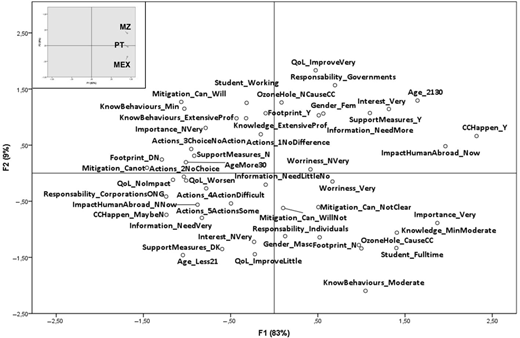
The PCA results showed that individuals did not differ greatly among the three nationality groups. Hence, the first component (F1) (Figure 1) indicates that the three groups had a similar profile (83 per cent of all data variability), with the main contributing aspects to all being the perceptions that:
CC was happening;
CC was a very important subject to them; and
human impact in human communities was being felt abroad now.
F1 embodies a size effect: answers with high response rates appear on the far-right side and further to the left, answer categories appear, and the lower their response rates tend to be. This result is coherent with that of the previous analysis, where for each question, the majority of all three nationalities tended to give the same answer, and relevant differences among nationalities mostly concerned the magnitude of that choice. For example, most respondents of each nationality considered themselves interested on CC issues, but the magnitude of that interest was different: 88 per cent of Mozambican, 64 per cent of Mexican and 56 per cent of Portuguese respondents.
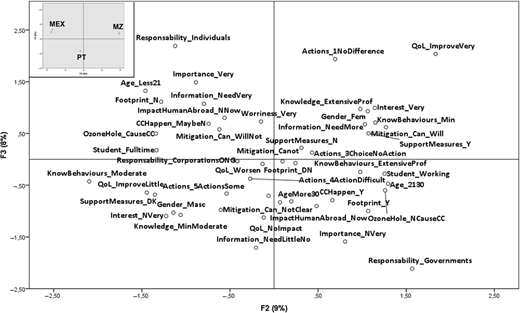
The second and third components (respectively, responsible for 9 and 8 per cent of data variability) however, did reveal profile differences associated with the distinct nationality groups (Figure 2). The second component (F2) showed an opposition between Mozambican (on the right side) and Mexican students (on the left side). The third component (F3) showed an opposition between Portuguese (towards the bottom) and the other two nationalities, Mozambican and Mexican (towards the top).
The use of this exploratory multivariate methodology allows for a global view of the main characteristics that differentiated among the three nationalities under study. Hence, Portuguese students were characterised for having – to a greater extent than other students:
perceived that CC was less important, and of lesser interest;
perceived they needed little more information on CC;
perceived their life quality would not change with their actions to mitigate CC;
attributed to governments the main responsibility in CC mitigation actions;
calculated their ecological footprint; and
were aware that ozone was not a main cause of CC.
On the other hand, Mexican students were characterised for – to a greater extent than other students:
being younger (<21 years);
perceiving that CC was very important;
perceiving they needed much more information on CC;
attributing to individuals the main responsibility in CC mitigation actions; and
not having calculated their ecological footprint.
Lastly, Mexican also shared with Mozambican students, to a greater extent than Portuguese students:
the believe that individuals’ actions were not enough to mitigate CC; and (but)
that their contribution to mitigate would improve a lot their life quality.
Besides these, Mozambican students were also characterized by attributing both to governments and to individuals the main responsibility in CC mitigation actions.
4. Discussion
Individuals’ perceptions about CC are complex and multidimensional. This paper provides the first results obtained from a second cycle among Portuguese, Mozambican and Mexican university students in the fields of ecology and environmental sciences. Towards a deeper understanding of these perceptions, which should be considered in university curricula, national policies and adaptation strategies, future studies should bring to the analysis more inquiries (e.g. the sample size) to improve representativeness: students’ gender did not significantly influence their perceptions of:
time scale of CC impact (both on human and biotic communities);
anthropogenic activities as a main cause of CC; or
the will or possibility of humans to alter the course of CC.
As in most other issues assessed in the questionnaire, the respondents’ gender did not significantly affect the responses in governance aspects, actions or perception of actions, except in what concerns the importance of an international agreement to combat CC. In this issue, 27 per cent of Mozambican men have no opinion on the importance of an international agreement to combat CC, and all women clearly stated their opinion, either affirmably or negatively (39 and 61 per cent, respectively). This is a very interesting information but also hard to explain based on the available data (e.g. socio-cultural indicators used to understand gender inequalities), in the absence of similar studies on other African countries. Previous studies highlighted that gender was a factor affecting CC views, and that women were more willing to acknowledge the need for more information on CC, as well as were more positive about increasing their life quality because of actions taken to mitigate CC, demonstrating always greater levels of concern with CC issues (Wachholz et al., 2014; Santos et al., 2016). Our data show that although Mozambican women occupy an unequal and subordinate place in the Mozambican society structure, being poorer, less educated, performing unpaid (or not formally paid) work, having a residual participation in the structure of power and decision, among other situations (Ribeiro and Chaúque, 2010; Wamukonya and Skutch, 2002), they have opinions towards the need to have (or not) international agreements to deal with CC, while men do not reveal any opinion. In this sense, the available data from other studies about gender (referred above) show the social, material and cultural conditions, justifying the disadvantaged position of women in society (Tvedten et al., 2008), filtered by “Western” indicators (that are essentialist). In this context, our research draws attention to the need for indicators adjusted to the socio-cultural contexts that we are studying. Our data also underlines the importance of taking into account the role of women in development and in the need for a changing behavior, developing mitigation and adaptation instruments and policies to cope with CC, as recognized by various international organizations, such as UN, WHO.
As for the age factor, this only significantly influenced the perception relating to the capacity of humankind to successfully mitigate CC effects. The majority of the younger Mexican respondents (aged <21 years) expressed that humankind could successfully mitigate CC effects, but people are not willing to change their behaviour (77 per cent), while fewer respondents shared this opinion in the older age groups (38 per cent aged between 21 and 30 years and no one aged >30 years). This is a thematic that does not gather consensual answering patterns, but some studies (Hibberd and Nguyen, 2013) suggest that CC scepticism is less likely to be found among younger age groups.
Future studies of CC perceptions, knowledge and attitudes should use larger samples to further analyse the gender and age distributions, both within national groups and also between nationalities.
Most respondents of all nationalities believed that CC was happening. Nevertheless, Mexican respondents were significantly less certain of their existence and in what concerns their interest of the topic, Mozambican students were significantly more interested in the topic than either Mexican or Portuguese students. The perceived importance of the topic was also significantly different among the three nationalities: 66 per cent of Portuguese answering that they “perceived CC as a very important issue”, while 82 per cent of Mozambican and 100 per cent of Mexican expressed the same opinion. These results (namely, students’ interest) may reflect the CC and Extreme Events meteorological patterns in different geographies, with African students living under more severe climatic conditions. This can also be seen in the perception of CC impacts on human communities (greater, concerning foreign countries than in one’s country), being significantly higher among the Portuguese respondents (92 per cent) than either Mozambican or Mexican respondents (88 and 74 per cent, respectively). In line with these result, Mexican students perceived to a greater extent that CC impacts would be felt in 10 years from now (26 per cent), compared to Mozambican (9 per cent) or Portuguese respondents (3 per cent). More affected geographies also seem to be more optimistic about solutions. When inquired on the capacity of humanity to mitigate CC, the vast majority of the respondents expressed that humans could mitigate effects of CC (97-100 per cent), but only Mozambican were more positive, with 27 per cent expressing that “humans would manage successfully to mitigate the effect of CC”, as opposed to 4 per cent of Portuguese and 3 per cent of Mexican students. This could be also in line with the fact that the vast majority of inquired students (95-100 per cent) felt they needed more information relating to CC. Among these, and also in line with other results, Mexican respondents felt the need for more information than Mozambican or than Portuguese students. Only among Portuguese students, a small number (6 per cent) felt no need for further information on the subject. In fact, when asked about the effect of the hole in the ozone layer on CC, a significantly lower proportion (23 per cent) of Mexican respondents acknowledged that this was not a main cause of CC, compared to Mozambican (50 per cent) and Portuguese (37 per cent) respondents. Hence, students believe that CC is happening, that their main causes are anthropogenic and they feel well informed on the topic of CC. However, when asked about particular concepts and processes of CC, their answers do not reflect their self-perceived knowledge. Similar results were reported in other studies (Löfstedt, 1991), where the greenhouse gas effect was confused with the issue of ozone depletion and other misconceptions that can be found among other European (Manolas et al., 2010; Santos et al., 2016) and American (Wachholz et al., 2014) university students. The erroneous beliefs held by university students about this environmental and socio-environmental and political problem is a concern, however, and like in other reports (Wachholz et al., 2014), students believe that CC is real and largely human-induced, and most expressed concerns about CC. For this purpose, it is interesting to note that as Stoutenborough and Vedlitz (2014) state that perceived knowledge and assessed knowledge of CC are distinct parameters, and those with more perceived knowledge tend to report less concern for CC, and – we add – that they also tend to dismiss the need to change their actions and thus, their individual responsibility in either mitigation or adaptation. Those with more assessed knowledge tend to report more concern for CC.
Opinions on who should take the main actions in mitigating CC were strongly dependent on the respondents’ nationality, with most Portuguese and Mozambicans (73 and 62 per cent, respectively) sharing the opinion that this responsibility should lay upon governments, opposed to only 26 per cent of Mexican students who expressed the same opinion. On the other hand, most Mexican (64 per cent) students expressed that the responsibility to mitigate CC should lie upon individuals, opposed to Portuguese and Mozambicans (18 and 38 per cent, respectively), which may be related to the social organization and political system of each country. In this context, Portugal has redistributive policies and the state plays a central role in welfare; Mozambique closely follows this trend in their legislation in several areas. Mexico deviates from this trend and presents a residual public supply system in all areas (Diaz-Cayeros et al., 2016), which may result in the importance of individual responsibility instead of state responsibility. Also, without an international agreement, e.g. Kyoto’s protocol successor, most students (52-69 per cent), regardless of nationality, felt there would still be a way to mitigate CC, although many felt that such an international agreement was essential (23-40 per cent) or they “did not have an opinion on the matter” (7-8 per cent). Opposition between an individual’s approach to seek solution (e.g. Mexican students) and institutional approaches (e.g. Portuguese and Mozambican students) is suggested by the results
When inquired if they were to reduce their contribution to CC, Mozambicans (79 per cent) expressed a greater confidence that their actions to mitigate CC would increase their life quality, as opposed to Portuguese and Mexican respondents (25 and 44 per cent, respectively). On the other hand, a greater proportion of Portuguese respondents (21 per cent) expressed that “their actions would not have any impact in their life quality”, as opposed to Mexican (3 per cent) and Mozambican respondents (0 per cent). As individuals, most respondents also expressed that they would support actions to reduce greenhouse gases, with Mozambicans expressing a greater will to support these mitigation actions (79 per cent) than Portuguese or Mexican (56 per cent). This optimism among more impacted and poor geographies (e.g. Mozambique) is somehow surprising, and qualitative studies are required for deepening this issue (e.g. cultural factors may enlighten senses and meanings of the data).
Data analysis revealed that most students recognized human responsibility in CC but demonstrated gaps in their understanding of the phenomenon and in the need to adopt behaviours to tackle CC. The results show that more specialized university education in natural and technological sciences did not translate into more accurate representation and action, which are affected by social and cultural factors. One interesting contribution of this study is that despite our surveyed students being familiarized with CC phenomenon, through their curricula, this knowledge does not translate necessarily into concrete practices and behaviours that mitigate CC, which is in accordance with Giddens (2009). This observation shows the complexity and multidimensionality of CC phenomena that defy us all, individuals, collectivities and governments in the needed action to change the situation.
5. Conclusions
More research (using mixed methods) into how CC mitigation measures, adaptation strategies and policies in developing countries, as well as more cross-country comparisons, would make a valuable contribution to our knowledge on how sociocultural factors affect public engagement in CC. The next step on this research project is conduct an in-depth qualitative analysis (semi structured interviews) in these three continental regions for a holistic comprehension about attitudes and willingness to take part in this climate global citizenship.
CC relates to sustainable development, and the “Transforming our World: the 2030 Agenda for Sustainable Development” clearly states “Take urgent action to combat climate change and its impacts”. In this context “Strengthen the means of implementation and revitalize the global partnership for sustainable development” includes certainly a transdisciplinary and intercultural approach to CC that goes beyond national borders and country policies (namely, educational).
Curriculum “globalization” is fundamental in today’s globalized world and the multidimensional and interdisciplinary nature of global environmental problems, such as CC. Students’ competencies must incorporate critical thinking and think beyond their disciplinary and cultural boundaries. Such intercultural studies are a tentative approach towards this objective of integrating CC in university curricula in an international perspective.