


The purpose of this paper is to explore the trends of changing temperature of Lahore in Pakistan due to invigorating urbanization process since 1950‐2007.
This research is designed by using the numerical time series data of mean minimum temperature (MMiT), mean maximum temperature (MMxT) and mean annual temperature (MAT). The growth in urban population, area and transportation are also evaluated by using the available data. Linear regression method is applied to investigate the results of change in temperature. Three different approaches to examine the MAT are testified; first as an entire period (1950‐2007), and then by dividing the entire period into two equal phases as Phase I (1950‐1974) and Phase II (1975‐2207). MMiT and MMxT are analysed for the entire period without making any division.
The results of the paper are significantly indicating an increase in MAT and MMiT which have risen up to 0.89 and 2.51°C, respectively, while MMxT remained resolute throughout the study period. Change in MMiT is observed regular and brisk than other parameters of temperature. Increase in temperature in Phase I is observed only 0.062°C and in Phase II it is observed 0.94°C.
This research can be further worked out by using different meteorological models to study the effects of urbanization on lower surface atmosphere and urban heat island effects in Lahore.
By taking into consideration these results, the town planners and government can make different strategies to mitigate the urban effects on rising temperature in Pakistan.
1 Introduction
The study of urban climates is attracting significant attention in the present world (Catherine and Sue, 2006). The hasty urbanization in Pakistan in last 60 years has significant effects on urban climate change. The enormous developments in the cities through infrastructure, residential areas, industrial zones, transportation and massive growth in urban population have produced sizable effects on the urban temperature.
The global average temperature is increasing 2‐4.5°C per century and cities are being considered the prime contributor of this change. It is also generally accepted that due to the human actions, the global climate will warm over the next decades mainly due to release of greenhouse gases and largely through fossil fuel combustion into the atmosphere (IPCC 1995, 2001). Lahore is the second principal city of Pakistan that has about eight million inhabitants. Being as the provincial capital of Punjab province, it is the hub of cultural, educational and economical activities in Pakistan.
2 Problems of case study area
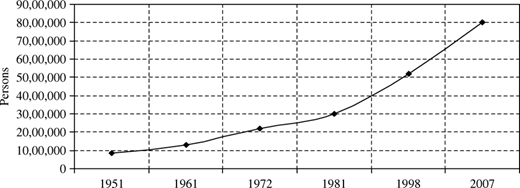
About 12 per cent of total population of Pakistan lives in Lahore. According to the Population Census, the population of Lahore Metropolitan Area in 1998 was 5.1 million (Population Census Organization, 1998). In 2007 it estimated to eight million (Figure 1). More than 90 per cent of this population lives in Lahore City District area and remaining population of it lives in its adjacent areas of tehsil Ferozewala of District Seikhupura and tehsil Kasur of District Kasur.
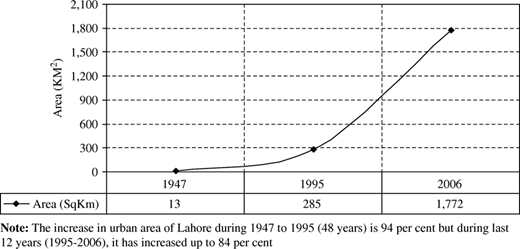
Large scale urbanization especially after 1980s in Lahore forced the government to start many projects to develop infrastructure for transportation, establish new industrial zones for employment and mega town ships for residence. With the passage of time, the city had millions of vehicles on the road which caused to produce harmful gases through the combustion of fossil fuels. Since 1947 to to‐date, the area of the city has increased many folds. In 1947, Lahore consist only 13 kilometre2 area and in 2006 it expanded up to 1772 kilometre2 (Figure 2).
According to the Punjab Development Statistics, 2007, there were 1,452 different kind of industries inside and around the Lahore city. The major source of urban transport of the city is private owned buses, Wagons and Rakshas that are greatly affecting the urban environment by producing the large quantity of smoke through incineration of large amount of fossil fuels.
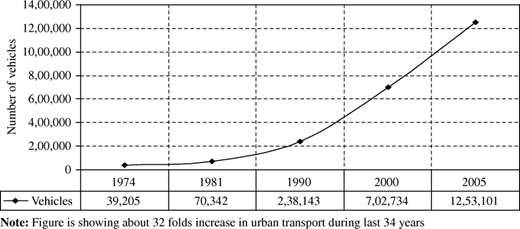
The total registered vehicles in Lahore in 1974 were only 39,205 and this figure reached up to 14,64,344 in 2006 (Figure 3). About 80 per cent of the total registered vehicles are privately owned in the city (Punjab Development Statistics, 2007). The rapid increase in population, absence of an effective and organized public transport system, services and facilities, high growth rate of privately owned vehicles, have an adverse effect on the environment of Lahore.
3 Data and methodology
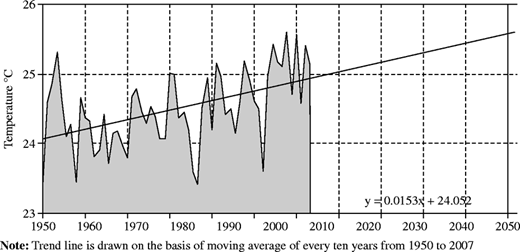
The time series data of mean minimum temperature (MMiT), mean maximum temperature (MMxT) and mean annual temperature (MAT) since 1950‐2007 is analysed in this research paper. Temperature data is collected from Pakistan Meteorological Department (PMD). The linear regression method is used for the analysis of data. For the better results and understanding about the change in temperature, MAT is divided into three parts; as a whole 1950‐2007; Phase I (1950‐1975); and Phase II (1976‐2007). MMiT and MMxT trends have been taken by for the whole period without any partition. Trend lines on each graph are used to get the clear picture of the change. Temperature is used as dependent variable while the time period is used as the independent variable as: Temperature = f(time) and Y=α+βX+μ. Where, Y=mean temperature (minimum, maximum), X=time period and μ=error/random term. Moreover, prediction MAT is also done by calculating the data using forecasting model of Yˆi=αˆ+βˆXi by taking the moving average of every ten years from 1950 to 2007.
4 Results and discussion
Large scale urbanization in Lahore has adversely affected the climate of the city. Along with the global impacts on climate change, there are many indigenous factors which affected the urban climate. The temperature trends of Lahore are showing the significant increase in urban temperature along with enormous variations in different years. The change in temperature is not constant throughout the study period. But after 1980s, the rising trend in temperature is noteworthy, steady and regular.
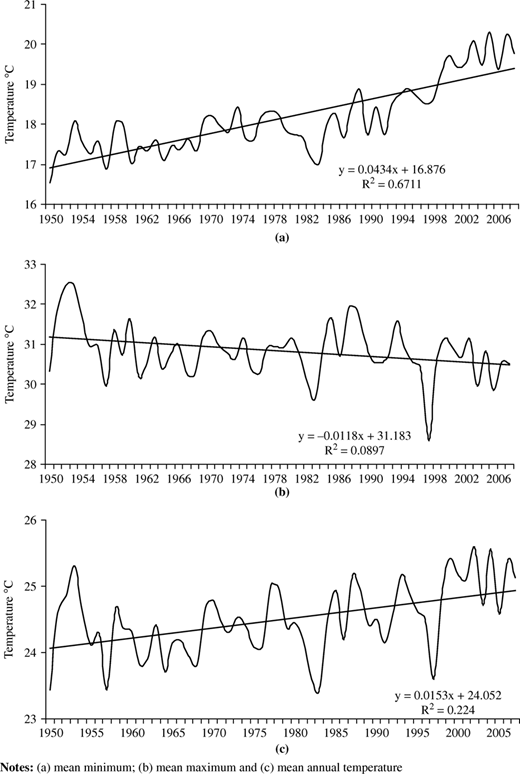
Figures 1‐3 are presenting the exponential trends of growth in urban population, area and vehicles, respectively. Out of all the analysed parameters of temperature, the trend of change in MMiT is more regular and has curious trends throughout the study period. The observed growth in MMiT during 1950‐2007 is 2.51°C. But eccentrically, maximum change MMiT is observed during last 20 years from 1988 to 2007 (Figure 4a). MMxT has slow and less significant trends of change. During 1950‐2007, it has risen 0.68°C. The increasing trend in MMxT is observed mainly during 1957‐1987 (Figure 4b).
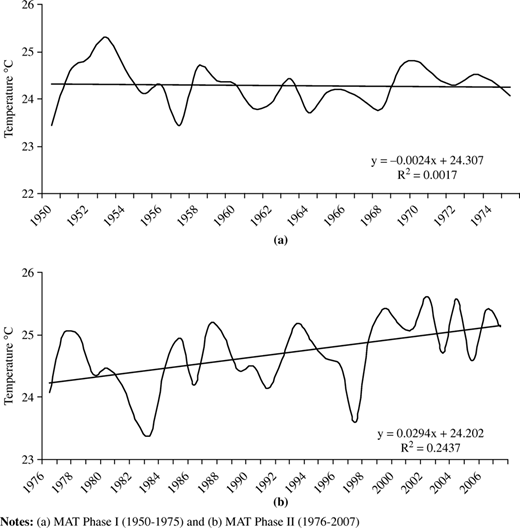
MAT is mainly affected by rapid increase in MMiT. It also has risen steadily and gradually since 1950‐2007. The observed increase in MAT during last 58 years is 0.89°C (Figure 4c). The exposure of rising MAT in Phase I (1950‐1975) is not significant than the Phase II (1976‐2007). During Phase I, there is inconsequential change that is measured only 0.062°C (Figure 5a) while in Phase II, the observed change has sharp rising trend. During this phase, temperature has augmented up to 0.94°C (Figure 5b). Generally, the period after 1980s is considered the most urbanization period in Lahore. After 1980s, where the urban area and urban population increased many folds, there they also had badly affected the urban climate of Lahore. The severity of increase in temperature of Lahore during the most urbanize period is almost 93 per cent of total increase in MAT since 1950. The prediction trends are also indicating the further growth in temperature on the basis of current analysed data. If the current situation of increasing temperature continued in future, then there will further 0.65°C increase in temperature until 2050 (Figure 6).
5 Conclusions
Cities occupy only 0.05 percent of the Earth's surface but more than half of the world's population lives in urban areas (Masson, 2006). Just 25 years ago, less than 2 per cent of the global population resided in mega cities of 10 million or more inhabitants which are now 4 per cent (Alex et al., 2007). Presently, the change in temperature of Lahore is not unique in the urban world but many of the global cities are under the threat of hazardous change in urban temperatures. Increase in temperatures of Dhaka (Mozaharul and Golam Rabbani, 2007), 2°C increase in MAT of Sao Paolo in Brazil (Freitas et al., 2007), increasing tendencies of temperatures of Beijing from 1977 to 2000 (Liu et al., 2007), change in annual mean air temperature in city‐belt of Yangtze River delta from 0.28 to 0.44°C/10a during 1991‐2005 (Du et al., 2007) and an increase of 1.5°C in MAT of Seoul during last 29 years (Chung et al., 2004) are showing the effects of urbanization on urban climate change all over the world. So the cities of developing world like Lahore are also not safe from this environmental change due to urbanization.
The results of the paper are showing significant increasing trends in MMiT and MAT. But the observed change in MMxT is not as severe as the MMiT and MAT. As far as the population of Lahore increased, the demand of the housing and vehicles increased many folds than the past and many forest and grassland areas in and at periphery of the city were cut down to get the space for housing, infrastructure development and establishment of industrial zones. Later on this change of landscape affected the local temperature of the city and the temperature started to rise. It is also clear that the increasing tendencies in temperature of Phase II (1976‐2007) is more invigorating and standard while this behaviour of the temperature change in Phase I (1950‐1975) is not noteworthy. Overall, the change in MMiT is very smooth and usual in all the years except some extreme changes.
The authors would like to greatly acknowledge Director General, Director Computerise Data Processing Centre (CDPC) and Regional Directors of Pakistan Meteorological Department (PMD) for providing the necessary climate data, ex‐Chairman Higher Education Commission Pakistan, Prof. Dr Atta‐ur‐Rehman, for his marvellous services to promote higher education in Pakistan, and Muhammad Tahir, Department of Physics of Imperial College London, for help in analysing the data.
References
About the authors
S.H. Sajjad is Lecturer at Department of Earth Sciences, University of Sargodha in Pakistan. He is engaged in different research projects of urban climate change in Pakistan. Currently, he is research scholar at Université de Nancy 2 France under Higher Education Commission, Government of Pakistan's scholarship. S.H. Sajjad is the corresponding author and can be contacted at: shsajjad@hotmail.com
Safdar Ali Shirazi is working as Professor of Climatology in Department of Geography, University of the Punjab Lahore Pakistan. He is engaged in research related to urban climate, agricultural climatology, desertification and environment. Most of his research is on demography and climate change.
M. Ahmed Khan is working as a Chairman/Director of Department of Earth Sciences, University of Sargodha in Pakistan. He has long experience of research in Pakistan and abroad in the field of Geology, Climate change and environmental hazards.
Asif Raza is a trainee as a Junior Scientist at DCIS, Pakistan Institute of Engineering and Applied Sciences (PIEAS) Islamabad in Pakistan.

