


The purpose of this paper is to look into climate and climate change in a wider setting ranging from geological time through historical to instrumental records.
The authors give an overview of the past, present, and future climates and the status of water resources of the Arabian Peninsula, and describe climatic forcings that shape the current climate, and the variables that are most prone to the change of existing atmospheric conditions.
Present weather patterns of the Peninsula are governed by Hadley circulation, and modulated by El Niño – southeastern oscillation, PDO, NAO, and IOO. The process of aridification is proceeding.
The global assessment of the imminent climate change is streamlined into predictions that are relevant for the Arabian Peninsula. Conclusions are drawn on the need for extended research effort based in countries of the Arabian Peninsula for the optimal preparation of management actions to tackle both climate change and resulting water resources issues in the region.
Introduction
Studies have shown that the Earth's climate varies on timescales ranging from decades to millions of years. The most important determinant of climate, the temperature of the planet, is known to fluctuate 20°C from its present mean value of 15°C, which causes sea levels to fall 250 m and rise 70 m above present level, and has an overriding effect on the functioning of the hydrological cycle. Some 85 percent of the planet's history, the Greenhouse Earth, has embraced warmer and more stable climatic conditions than at present. At about 250 Ma intervals, as a result of the continent forming and break‐up cycle, major glacial activity produces cold climates, the Icehouse Earth that have long‐glacial periods, and shorter interglacials. Possibly, on geological time scale, on at least three occasions an Icehouse resulted in the Snowball Earth during which the planet was entirely covered by glaciers. A Snowball Earth is a state of the dramatic slowdown of the hydrological cycle. Very little water evaporates from the surface and due to the extremely cold atmosphere, very little water resides there. Precipitation is greatly reduced and there is no river runoff, only slowly crawling glaciers. All lands are affected by permafrost, over a kilometre deep. A possible mechanism that can pull the planet out of the deep freeze is some major upheaval in the upper mantle which results in increased volcanic activity that provides the atmosphere with greenhouse gases and cover the surface with dust that decreases the albedo. Other likely events may include cometary impact, or sudden release of frozen methane deposits in the ocean floor.
All Snowballs took place in the Proterozoic, from 2.5 Ba to over 0.5 Ba ago, before the dawn of modern life, and the last one possibly set the stage for the Cambrian explosion of life that occurred 543 Ma ago. Different climatic conditions in these periods can be attributed to lower luminosity of the Sun, changes in the orbital geometry of the planet, and to the supercontinent build‐up and break‐up cycle. In the last billion years, glacial periods have started at roughly 925, 800, 680, 450, 330, and 2 Ma ago. The Earth has cooled dramatically over the last 50 Ma. The recent Icehouse has been characterized by successive advances and retreats of the glaciers and accompanying climatic fluctuations.
People have inhabited the Earth during a rather unusual climatic period and all that they have experienced has been the extremely variable climate of the latest stages of the most recent ice age which, although it may well be receding, may still yield several further glacial advances and retreats (Kotwicki, 1986). In accordance with a cyclical pattern established over the past million years, the Earth is now approaching the end of the interglacial period that was followed in the past by a 100 ka long ice age. The present interglacial commenced in 9703 BC (Steffensen et al., 2008). It appears that a typical interglacial lasts 12 ka, however, the current interglacial might be most analogous to a previous interglacial that lasted 28 ka. However, Jansen et al. (2007) concludes that it is virtually certain that global temperatures during coming centuries will not be significantly influenced by a natural orbitally induced cooling. It is very unlikely that the Earth would naturally enter another ice age for at least 30 ka.
Since human civilization has developed during a fairly short period of unusually mild and stable climate, humans have yet to experience the full range of variability that the planet's natural systems impose. Thus, the geological record has become an extremely important archive for understanding the range of natural variability in climate, the processes that cause climate change and the background variability from which greenhouse warming must be detected.
Past climates of the Arabian Peninsula
Formation of the Arabian‐Nubian Shield and the East African Orogen occurred between 870 Ma and the end of the Precambrian, ∼542 Ma (Stern et al., 2006), and major structural and tectonic events shaped the region during the Late Cretaceous. The Arabian Peninsula, as the Arabian Plate, remained in continuous contact with Africa up to the formation of the Red Sea rift in the late Tertiary.
The great Rub Al‐Khali desert began to form more than 2 Ma ago, with its climate oscillating from hyper‐arid (HA) to temperate. Excavations testify to periods of abundant rainfalls, with remains of hippopotamus teeth, buffaloes, wild cows, zebras, hyenas, sheep, and camels. Numerous lakes in the present desert were formed from 37 to 17 ka ago, and then from 10 to 5 ka ago (McClure, 2007). During the late quaternary, the previous climate of Arabia has fluctuated between periods of higher rainfall and fluvial activity, dominated by the influence of the Indian Ocean monsoon and drier to arid conditions under the influence of the westerlies.
Jensen et al. (2007) note that it is possible now to derive time series of atmospheric trace gases and aerosols for the period from about 650 ka BP to the present from air trapped in polar ice caps. The results show that atmospheric concentrations of CO2 and CH4 exceed by far the natural range of the last 650 ka, and that concentrations of CO2, CH4, and NO2 are very likely unprecedented in at least the past 16 ka. It is also likely that earlier periods with higher than present atmospheric CO2 concentrations were warmer than present.
McClure (2007) notes that stone hand axes dating back 100 ka or more have been found on the fringes of the empty quarter and that human populations flooded into this part of the world 10 ka ago, although the origin of these populations has not been not firmly established yet. Mayewski et al. (2004) identify six periods of significant rapid climate change during the time periods 9,000‐8,000, 6,000‐5,000, 4,200‐3,800, 3,500‐500, 1,200‐1,000, and 600‐150 BP. Most of the climate change events in these globally distributed records are characterized by polar cooling, tropical aridity, and major atmospheric circulation changes, although in the most recent interval (600‐150 BP), polar cooling was accompanied by increased moisture in some parts of the tropics. Several intervals coincide with major disruptions of civilization, illustrating the significance of Holocene climate variability for humans.
Weather changes in the Pleistocene brought about four consecutive ice ages alternating with warm periods. During the most recent glaciation much of the planet's water was locked up in the ice‐sheets of Asia and North America, and the sea level dropped by 120‐130 m, exposing the bed of the Arabian Gulf which has a mean depth of 35 m. The combined glacial era Tigris‐Euphratesflowed an extended reach of Shatt‐al‐Arab called the “Ur‐Schatt”, in a deep channel, to the Strait of Hormuzand into the Arabian Sea (Figure 1).
The climate of the Arabian Peninsula changed from temperate to arid across the Pleistocene/Holocene boundary, and Edmiston (2007) estimates that a 200‐year cooling period 8,000 BP reduced rainfall in the region by 30 percent. This climate change initiated a mass migration away from dry‐land farming to the creation of irrigated fields along the Tigris and Euphrates rivers, allowing the people to build some of the earliest institutions of civilization. The drought drove farmers in ancient Mesopotamia to build irrigation channels. Eventually, this allowed farmers to grow enough surplus food to feed the writers, priests, artists, politicians, and architects who lived in cities. The 4,200 year BP aridification event was one of the most severe climatic events of the Holocene period in terms of impact on cultural upheaval.
While the present climate of the Arabian Peninsula is widely considered as one of the driest on record, the still drier periods are known. For example, studies of the evolution and spread of early Homo sapiens in East Africa show periods of severe aridity between 135,000 and 75,000 BP, when the water volume of Lake Malawi was reduced by at least 95 percent. This shows that intervals of pronounced tropical African aridity in the early late‐Pleistocene were much more severe than the last glacial maximum, the period previously recognized as one of the most arid of the quaternary (Scholtz et al., 2007).
Both tradition and scientific evidence have it that Arabia was in past millennia a land of great fertility when abundant rains helped to create favorable life conditions for many and varied kinds of creatures. Water flowed in numerous rivers, and vegetation spread to make life for many animals such as camels, zebras, hyenas, and predators such as leopards, wolves, hyenas, and Asian cheetahs. Through the recent millennia the Arabian Peninsula has been undergoing a process of steady desiccation, a drying up of rivers and a spread of the desert at the expense of the cultivable land. The declining productivity of the peninsula, together with the increase in the number of the inhabitants, led to a series of crises of overpopulation and consequently to a recurring cycle of depopulation of the Peninsula, when people migrated in search of more rain (Homiedan, 2008).
Present climates of the Arabian Peninsula
At present, the Arabian Peninsula is 99 percent arid and HA, with UNESCO (1979) classification as follows (Table I).
In addition to amounts of rainfall amongst the lowest on the planet, rainfall distribution is unfavorable, coming in sudden and erratic showers, with high‐intraannual and interannual variability. More than 90 percent of the Arabian Peninsula has a mean annual temperature of 20°C, with smaller areas experiencing annual temperature exceeding 30°C.
The weather in the Peninsula is dictated by the Hadley circulation with superimposed influences of global circulation patterns of the El Niño – Southeastern Oscillation (ENSO), Designation of origin. PDO, IOO, and NAO type, and seasonally controlled by four air masses. During winter the region is under the influence of polar continental air masses that originate in Central Asia. The influx of these air masses is accompanied by dry weather with generally clear skies and fairly low temperatures. Occasionally, the Peninsula is affected by polar maritime air coming from the North Atlantic. These air movements are the remainder of the mid‐latitude depressions that have already traversed North Africa and the Mediterranean.
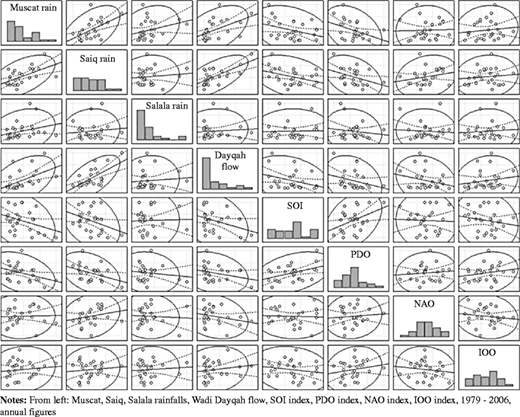
(Figure 2) shows a matrix plot of the records of four Omani hydrographic stations that include Muscat, Saiq, Salala rainfalls, and Wadi Dayqah flows, and four weather indexes that include SOI, PDO, NAO, and IOO for the period 1979‐2006. Some relationships are expected here: fore example rainfall in Muscat has a higher relationship to rainfall at Saiq than to rainfall in Salala. It can be seen that rainfall in Muscat is related to SOI and PDO, much less to IOO, and not related to NAO, whereas rainfall at Saiq shows a much stronger NAO signal. Wadi Dayqah flow shows a signal of all four weather indices. Since these indices never occur in isolation, but are interwoven into a larger fabric of weather functioning of the planet, it is of some practical interest to assess what combinations of them lead to particular weather patterns.
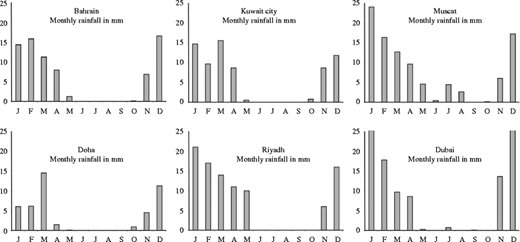
As seen in Figure 3, rainfall events in most locations of the Arabian Peninsula are confined to winter, with minor exceptions of annual monsoonal and occasional cyclones along its east‐southern rim (Muscat). Chauvin and Denvil (2007) state that extremes of precipitation also experience a change toward more intense precipitation events in winter and longer dry events in summer. Considering the predicted changes of the distribution of rainfall in higher summer/lower winter rainfall scenarios, summer rainfall increases will not contribute to much runoff, however, winter rainfall decreases will significantly reduce the amount of runoff at all locations shown in Figure 4.
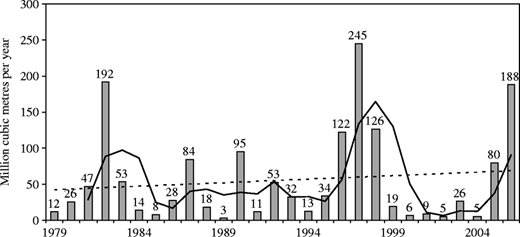
Changes of temperature and rainfall have been noted at many locations of the Arabian Peninsula. Nasrallah and Balling (1996) found that over the last 100 years, temperatures in the Arabian Peninsula increased linearly by 0.63°C. However, virtually all of this warming occurred from 1911 to 1935, and over the period 1945‐1995, the Arabian Peninsula region has cooled slightly. Precipitation records for the region show a slight, statistically insignificant decrease over the period 1955‐1995. Figure 1 shows that annual rainfall in Muscat, with a decreasing trend in the period 1895‐2006, in which the period 1997‐2006 has the lowest decadal rainfall on record (Figure 4).
Salam and Mazrooe (2007) studied the variations in the average weather parameters between two periods (1962‐1998 and 1999‐2004) in Kuwait. Compared to 1962‐1998 period, during 1999‐2004 period, there was an increase in period mean maximum temperature by 1.29°C, period mean minimum temperature by 0.73°C and period mean temperature by 1.14°C. The period average rainfall increased by 18.67 mm while the period average pan evaporation increased by 0.97 mm d−1. The period average wind speed increased by 0.21 m s−1 during the second period, and relative humidity decreased by 1.14 percent.
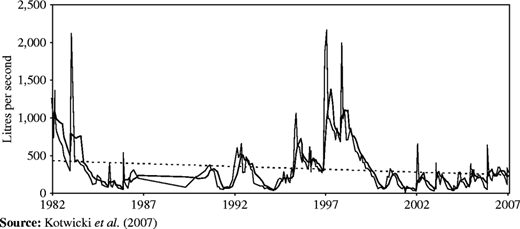
As shown in Figure 5, a downward trend of flow is observed at Daris, the largest falaj (qanat) in Oman. The same downward trend is also pronounced in many other aflaj, however, it needs to be researched whether this trend is due to climatic changes or some other factors – like over pumping in the vicinity of mother wells – which may cause drying‐up of aflaj. Most of the major flow events at these aflaj occur during La Niña events; however, some high discharges happened also during El Niños.
Wadi Dayqah in Oman, one of the few rivers of the Arabian Peninsula demonstrate a well pronounced upward trend in discharge which is strongly correlated with ENSO events (Figure 6). However, low flows shown a downward trend: both of these trends can be explained in terms of changing frequency, intensity, and duration of rainfall, and corresponding catchment response.
Future climates of the Arabian Peninsula
Climate records over the last 110 ka are dominated by large and abrupt changes with millennial spacing, many of which occurred on yearly to decadal timescales. It is understood now that changes of climate on Earth are far from gradual, and are usually governed by a number of tipping points that are specific for a given geomorphological configuration, and in recent times may include (Connor, 2008):
Arctic sea ice. The tipping point for the total loss of summer sea ice could be reached within decades.
Greenland ice sheet. Total melting could take 300 years or more but the tipping point that could see irreversible change might occur within 50 years.
West Antarctic ice sheet. Scientists believe it could unexpectedly collapse if it slips into the sea at its warming edges.
Gulf Stream. It could collapse within 100‐200 years.
El Niño. The southern Pacific current may be affected by warmer seas, resulting in far‐reaching climate change within 100 years.
Indian monsoon. Relies on temperature difference between land and sea, which could be tipped off‐balance by pollutants that cause localised cooling.
West African monsoon. In the past it has changed, causing the greening of the Sahara, but in the future it could cause droughts.
Amazon rainforest. A warmer world and further deforestation may cause a collapse of the rain supporting this ecosystem within 50 years.
Boreal forests. Cold‐adapted trees of Siberia and Canada are dying as temperatures rise.
By the end of the twenty‐first century, large portions of the Earth's surface may experience climates not found at present, and some twentieth‐century climates may disappear. The combination of high CO2 concentrations, still‐extensive ice sheets in Greenland and Antarctica, and current orbital and land‐ocean configurations are geologically unprecedented. Already, CO2 concentrations exceed any recorded for the last 650 ka years and, without a substantive intervention, are projected to increase to 540‐970 ppm (140‐263 percent relative to 2,000 levels) by 2100 AD. Global mean temperatures are projected to increase by 1.4‐5.8°C by 2100 AD, with decreases in diurnal and seasonal temperature ranges and spatially variable changes in precipitation. It is increasingly likely that some end‐twenty‐first‐century climates will include conditions not experienced at present (“novel” climates) and that some present climates may disappear (Williams et al., 2007).
There is a plethora of predictions of the effects of climatic change on water resources, and they often differ considerably. For example, Tao et al. (2003) state that water shortage is expected to worsen in western Asia and the Arabian Peninsula, while Dai et al. (2001) reckon that large precipitation increases, up to 50 percent, are to be expected over northern mid‐ and high latitudes and over India and the Arabian Peninsula. Wasimi (2008) concludes that there will be not any significant change in precipitation patterns in the MENA region as a consequence of global warming and finds no evidence of increased occurrence of extreme climatic events.
Monsoon and ENSO patterns might change, but climate models are not conclusive. The previously noted intensification of El Niño tropical precipitation anomalies in a warmer mean base state that applied when there was no appreciable change in El Niño amplitude does not hold in this paper of Meehl et al. (2005) where the El Niño events decrease in magnitude in a future warmer climate. The predicted sea‐level rise by up to 0.88 m by 2090 is expected to be a problem in some low‐lying areas, like the Southern Arabian Gulf. Fischer et al. (2006) and Arnell (2004) also project increases in water stress – the ratio of irrigation withdrawals to renewable water resources – in the Middle East (Figure 7).
Groundwater recharge is a major and often the sole source of natural water supply in the Arabian Peninsula. Döll and Flörke (2005) present a global map that depicts impact of climate change on long‐term average annual diffuse groundwater recharge. Percent changes of 30‐year averages groundwater recharge between 1961‐1990 and the 2041‐2070, as computed by WGHM applying four different climate change scenarios (climate scenarios computed by the climate models ECHAM4 and HadCM3, each interpreting the two Intergovernmental Panel on Climate Change (IPCC) greenhouse gas emissions scenarios A2 and B2).
The A2 storyline and scenario family describes a very heterogeneous world. The underlying theme is self‐reliance and preservation of local identities. Fertility patterns across regions converge very slowly, which results in continuously increasing population. Economic development is primarily regionally oriented and per capita economic growth and technological change more fragmented and slower than other storylines.
The B2 storyline and scenario family describes a world in which the emphasis is on local solutions to economic, social, and environmental sustainability. It is a world with continuously increasing global population, at a rate lower than A2, intermediate levels of economic development, and less rapid and more diverse technological change than in the B1 and A1 storylines. While the scenario is also oriented towards environmental protection and social equity, it focuses on local and regional levels.
Novel twenty‐first‐century climates are also projected for the Western Sahara, low‐lying portions of East Africa, Eastern Arabian Peninsula, Southeastern USA, Eastern India, Southeast Asia, and Northwestern Australia. The percentages of global land area with novel climates are 12‐39 percent (A2) and 4‐20 percent (B1). The clustering of novel climates in the tropics and subtropics and their scarcity in high latitudes suggest that a key determinant of the development of novel climates is the projected poleward shift of thermal zones. Tropical and subtropical areas also are projected to experience large changes in precipitation, caused by an intensified hydrological cycle and shifted moisture advection (Williams et al., 2007).
Hydrological considerations indicate that increased rain intensity combined with a reduction of annual rainfall is likely to reduce vegetation cover and increase surface runoff, leading to increased desertification. The resulting soil erosion, salinization, and loss of vegetation will further increase surface runoff. Agricultural fields will become more saline from increased evapotranspiration, and saline intrusion in coastal areas.
Increased surface runoff from major rainfall events will increase flash floods peak flows which will lead to destruction of property and crops. Possible adaptations include water‐sensitive urban planning to reduce surface runoff, promotion of structures that increase water infiltration into the soil, and conservation and rehabilitation of natural vegetation in rural areas.
As Kundzewicz (2008) stresses, climate‐related changes in freshwater resources are, from the point of view of consequences, more serious than the temperature rise. Still, our understanding of water resources of the planet leaves much do be desired, and is in a need of major quantitative improvement (Kotwicki, 2009).
Conclusions
There is a very high probability (>99 percent) that a significant climate change will affect most areas of Earth in the foreseeable future (Bates et al., 2008). Present arid and HA areas will generally become even drier. Even if the annual amount of rainfall changes little in these areas, rainfall intensity will increase due to overall acceleration of the hydrological cycle. Extreme weather events both in temperature and precipitation are likely to occur more often, leading to both more floods and droughts. It can be expected that the Arabian Peninsula, will witness more violent floods, and more severe and long‐lasting dry conditions.
The overall futuristic picture for the Arabian Peninsula is underdeveloped and sketchy, with many models in disagreement on the magnitude, and even the sign of change. Given the importance of water in this one of the driest places on Earth, the GCC countries should give consideration to the development of their own advanced forecasting tools, to be followed by the development of suitable water resources management measures. There is a need for effective adaptive measures against increased uncertainties and frequency of extreme climatic events. For example, a cursory examination of flood mitigation and protection facilities in many countries of the region shows that they are seriously under‐designed by an indiscriminate application of flood calculations that are transposed from countries with totally different rainfall and runoff regimes.
Globally, much more research is needed to improve our current status of understanding of weather and climatic phenomena, especially in arid regions. It has been proclaimed that arid zone hydrology is one of the highest forms of art and science, so it stands to reason that there is no substitute to the development of advanced local arid zone expertise. As ESCWA (2003) postulates, Arab countries should be made aware of and provide more inputs to the IPCC deliberations, and the IPCC should give more attention to guidelines on vulnerability and adaptation issues in arid areas. Capacity building efforts should include national and/or regional expertise and cooperation to collect process, analyze, and exchange, data for enhancing the preparation of national communications and planning for sustainable development.
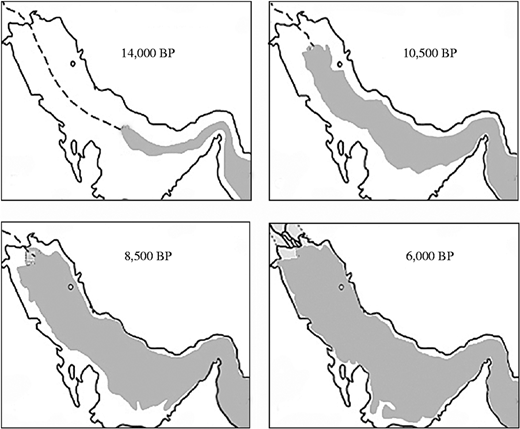
The lower Tigris‐Euphrates valley and the reflooding the Arabian Gulf, from 14 to 6 ka years ago
The lower Tigris‐Euphrates valley and the reflooding the Arabian Gulf, from 14 to 6 ka years ago
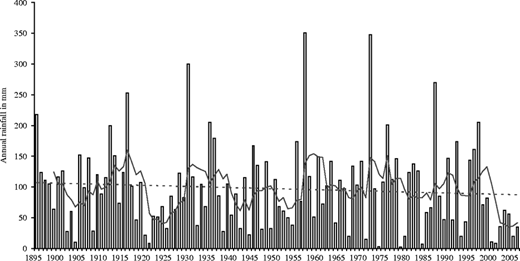
Annual rainfall in Muscat 1985‐2006, with five‐year running mean and linear trend
Annual rainfall in Muscat 1985‐2006, with five‐year running mean and linear trend
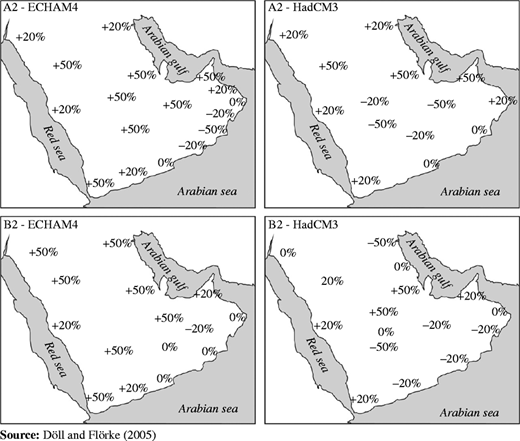
Change of groundwater recharge in 2050 in relation to a base period of 1960‐1990
Change of groundwater recharge in 2050 in relation to a base period of 1960‐1990

References
Further Reading
About the authors
Vincent Kotwicki is a Research Scientist in the Kuwait Institute for Scientific Research. He obtained his PhD from the Flinders University of South Australia in 1993, and gained experience in water industry and research in Europe, Australia, and the Middle East. He is an Associate Editor of the Hydrological Sciences Journal and has published papers and books in the area of arid zone hydrology, climate change, and water resources management. His research interests include global hydrological issues, water resources development options, and public awareness and social aspects of water resources management. Vincent Kotwicki is the corresponding author and can be contacted at: vkotwicki@safat.kisr.edu.kw
Zaher Al Sulaimani is the Director General of Projects in the Public Authority of Electricity and Water in the Sultanate of Oman. He holds BSc in Geology from Qatar University, and MSc from Bern University. He is founder member of the Geological Society of Oman, Country Technical Representative in the Middle East Desalination Research Center, Secretary of the Water Science Technology Association and Secretary of the Environment Society of Oman. His current interests focus on enhancing the principles of Integrated Water Resources Management and its applications; monitoring the climate change and its impact on water resources and environmental systems.

