


The purpose of this paper is to investigate regional variations in the international news coverage of climate change by comparing news reporting in two regional media systems.
A case study of how COP14 and a European union (EU) summit on climate change are covered by three Middle Eastern and one Danish newspaper.
The paper shows significant regional differences in the media coverage of climate change both in terms of quantity (numbers of news articles) and quality (editorial variations, sources, framing, use of graphics). Overall, the study suggests that regional differences in climate change coverage can be traced back to the financial resources, institutional practices and journalistic fields of different regional media systems.
The paper is a pilot project designed to test the analytical significance of regional variations in international media coverage of climate change.
Whereas global variations in climate change coverage have mostly been documented by (quantitative) content analysis, less research has been devoted to qualitative differences on how the media approach and frame climate change. Numerical analysis only tells half the story as qualitative differences, such as editorial priorities, or journalistic practices, can either increase or decrease the significance of quantitative variations. By acknowledging the importance of regional differences in international news reporting, this paper emphasises the role and function of regional media systems in conditioning media coverage of climate change.
1 Introduction
The relation between media coverage and public awareness of climate change is broadly recognised (Boykoff and Roberts, 2007; UNDP, 2007, pp. 9, 65‐8), although increased media coverage does not seem to result in immediate transformations of public risk perception (Leiserowitz, 2006). Media and climate change communication interact in different ways. On the one hand, media coverage of climate change is conditioned by international communication systems. On the other hand, climate change coverage is itself contributing to the global flow of communication, illustrating both the globalisation (and regionalisation) of the media and the role of news media as a risk forum.
1.1 Climate change in a globalised public sphere
Media coverage of climate change (along with other global issues like AIDS or poverty) has resulted in an emerging globalised public sphere concerned with shared public issues and arguments. Such a globalised public sphere must be conceptualised on its own premises. Rather than a simple extension of the national public sphere, it should be conceived as a multi‐layered structure conditioned by a different set of premises and constraints (Hjarvard, 2001). National public spheres have evolved through a process where political institutions and the media have developed in tandem (Habermas, 1971 [1962]). A similar process does not characterise a globalised public sphere.
Whereas national public spheres serve as intermediaries between the public and different political institutions, there are no immediate political counterparts to a globalised public sphere. Consequently, a globalised public sphere is detached from the political system, although trans‐national discussions may create an international public opinion that feeds back into the political process on different national levels. It nevertheless points to an inherent limitation of a globalised public sphere, which has the ability to “mobilise a common identity and to shape public opinion but [is] unable to translate its consensus into political outcomes” (Lynch, 2006, p. 213).
Climate change, however, may be one of the few examples that defy this otherwise correct observation. Unlike other concerns debated in a globalised (and regionalised) public sphere, such as Darfur or the Israeli‐Arab conflict, climate change questions have been translated into a political process on both national and supra‐national levels, illustrated by the Kyoto protocol or the recent EU “20 20 by 2020” strategy (EU, 2008).
1.2 The globalised public sphere as a risk forum
A second trait of global communication highlighted by climate change coverage is its role and function as an international risk forum. For several decades, climate change has been on the international media agenda, thus questioning earlier theories about issue‐attention cycles (Downs, 1972). During this time, climate change has been associated with different risks: the risk to the environment, the threat to energy supply and economic growth, and recently the risks of conflict over natural resources. United nations development programme (UNDP), for instance, points to potential national and regional conflicts related to water scarcity as just one consequence of climate change (UNDP, 2007, p. 95).
Another example of how climate change has generated broad risk discussions is the intense media attention paid to so‐called climate change sceptics from the 1990s until the mid 2000s (Boykoff and Roberts, 2007, p. 6). Part of this attention can be explained by intrinsic norms of the media system, which favours the principle of balanced reporting (Boykoff and Boykoff, 2004, 2007).
Balanced reporting entails that media reports seek pros and cons for a given topic (the “both sides of the story” principle). In most cases this make sense, as political perceptions of social conflicts are marked by a high degree of dissent. In the case of climate change, however, it has had a distorting effect, where a small minority has received a disproportional media attention compared to the consent on the issue by the large majority of climate change scientist and experts. Only recently (2006 onwards) has this imbalance been replaced by a new emerging consensus on climate change: “The existence of climate change and human implication in it, seems to constitute a new common sense, now almost taken for granted” (Ereaut and Segnit, 2007, p. 6). This has led others to conclude that: “Climate change scepticism was a flourishing industry. Today, the debate is over and climate scepticism is an increasingly fringe activity” (UNDP, 2007, p. 5).
Although no single cause can account for this shift, events like the publication of The Stern Report, the Fourth Assessment from the IPPC and the success of Al Gores documentary An Inconvenient Truth have been cited as possible contributions (Ereaut and Segnit, 2007, p. 9). This, in turn, points to the importance of a globalised public sphere, as all three events were either widely covered and discussed by the media, or itself a product of a globalised media industry.
Thus, the globalised public sphere, which to a large extend depends on international media, has become a forum where the nature and risks of climate change are negotiated. It is also a forum marked by an increasing self‐awareness, demonstrated by the exposure and debate over the different communicative strategies pursued by the scientific community on the one hand and the media on the other hand (Risbey, 2007).
A globalised public sphere, however, also functions as a forum where climate change is compared to other social risks. This has become particularly evident in relation to the recent financial crisis, which almost over night changed the current risk perception in international politics and global news media.
1.3 Regional aspects of climate change coverage
Discussions of globalised media have often centred on the opposition of the global and the local (Sreberny, 2006). Less attention has been paid to how regional traditions, structures and values condition media coverage of global issues, thereby constituting important fault lines in a globalised public sphere. Straubhaar claims that: “the role of geocultural regions need to be emphasised more”, and suggest that we: “reconsider globalisation as a set of regionally differentiated patterns of modernisation” (Straubhaar, 2006, pp. 683, 689).
It is well documented that media coverage of climate change is marked by regional imbalances (Boykoff and Roberts, 2007, p. 36; Saab, 2008), which in turn may account for regional differences in risk perception (Leiserowitz, 2007). These studies are, however, mostly based on numerical analysis. Qualitative aspects of this imbalance are consequently overlooked, including questions of how climate change is framed regionally.
One problem facing questions of regional variations in media coverage is the lack of theoretical literature on comparative media systems in general, and non‐western media systems in particular. A recent study distinguishes between a Liberal model in the Atlantic region (USA and the UK); a Democratic Corporatist model in North‐ and Central Europe; and a Polarised Pluralist model in Southern Europe (Hallin and Mancini, 2004, 2005). Rather tellingly, the model is restricted to Western media, and the authors readily admit that their framework may not, “be applied to the rest of the world without modification” (Hallin and Mancini, 2005, p. 231).
Studies of Middle Eastern media system have either emphasised the role of the nation state (Rugh, 2004) or criticised national categories of neglecting content and pan‐Arabic tendencies (Iskandar, 2007). Other studies have looked at how practices in the field of Arab journalism favour hard news and political analysis over soft news and human interest (Mellor, 2007). These studies suggest that regional practices have important consequences for climate change coverage, by, for instance, reducing climate change to the realm of international politics while excluding reports on human and domestic initiatives (or lack of initiatives) on climate change.
2 Research questions
This paper suggests a comparative regional approach to investigate climate change coverage in the international press. By taking a regional perspective the paper acknowledges the important differences between geocultural regions in terms of journalistic values, institutional resources and political constraints.
The paper focuses on two regions: Northern Europe (Scandinavia) and the Middle East (the Levant). The analysis revolves around three research questions:
RQ1. To what extent is climate change a shared topic in a globalised public sphere?
RQ2. How is news coverage of climate change conditioned by regional media systems?
RQ3. Can international media coverage of climate change be considered a (global) risk forum?
3 Research design and methods
The study is designed as a pilot project consisting of a sample of newspaper articles. It aims at testing the theoretical and methodological propositions of the research questions in preparation for a larger research project on international media coverage of climate change (starting May 2009). Consequently, the study is mainly intended to test the relevance and validity of the implied methodology.
3.1 Sampling data from regional media systems
The study is based on a sample of newspaper articles from two regions:
- 1.
The Levant: Jordan Times (Jordan), The Daily Star (Lebanon), L'Orient le Jour (Lebanon).
- 2.
Scandinavia: Politiken (Denmark).
The two regions represent what case study methodology labels “most likely” and “most unlikely” cases (Flyvbjerg, 2006). As part of a Democratic Corporatist media model, Scandinavia (here represented by Denmark) stands for a region where climate change coverage is “most likely”, due to its level of development, public assess to information, and political support for renewable energy. The Levant, part of an oil‐rich region and consisting of middle to low income countries, represents the opposite, where access to information is limited (World Bank, 2007) and where climate change coverage is less likely. If climate change is fairly covered in a “most unlikely” region like the Levant, it indicates the importance of climate change in the international news flow.
The sample from the Levant belongs to a particular segment of non‐Arabic language media. Together, these media constitute a parallel non‐Arabic media system that exists throughout the Middle East. Since most of these media are either state‐controlled or subject to the same legal and political constraints as national Arab media, the difference between Arab and non‐Arab language media is one in degree rather than substance.
The main differences are a greater variety of international subjects and opinions, as well as a tendency to promote official images of the Middle East as a modern (business friendly) region. However, non‐Arabic newspapers share a tendency with their Arabic counterparts of focusing on hard news; muting domestic criticism; respecting political traditions; and accepting editorial limitations.
Recently, a poll on Arab public opinion on environment have shown that the most important source of environmentally information is daily newspapers (71 per cent) followed by television (63 per cent) and specialised magazines (45 per cent), thus pointing to the relevance of comparing regional newspaper coverage of climate change (Tolba and Saab, 2006).
3.2 Sample period and coding
The sample covers a two‐week period (30 November 2008‐14 December 2008), chosen in order to include two major international climate change summits: the 14th conference of the parties (COP14) in Poznan, Poland, and a EU summit negotiating a new climate deal. It was assumed that the two summits would function as so‐called “trigger events” resulting in widespread media attention.
The sample period coincided with the Muslim Holyday Eid al Adha, resulting in a significantly less number of copies of Middle Eastern newspapers. Furthermore, as Politiken is published seven days a week compared to six days for the other three papers, this also adds to the difference in data material. All together, the sample contains 14 copies of Politiken, 11 each of The Daily Star and L'Orient le Jour, and nine copies of Jordan Times.
The sample includes all articles referring to either COP14 or climate change.
Since Denmark is hosting COP15 in December 2009 (aimed at presenting a follow‐up to the Kyoto protocol), a certain overrepresentation of climate change in the Danish press is to be expected, thus illustrating a widespread tendency of “domesticating” international news (Lee et al., 2005).
The data sample is coded according to the following principles:
news genres (Front‐page news, Articles, Leaders, Commentaries), use of graphics;
attribution (international news agencies or staff journalists);
domestic/international news; and
news category (politics, economy, environment, human‐interest).
The coding makes it possible to identify both institutional elements (editorial priority, attribution, use of graphics) and discursive traits (event vs process centred news, international vs domestic news, regional aspects, human‐interest stories) in climate change coverage.
The analysis draws on critical discourse analysis (Carvalho, 2005; Fairclough, 1995; Richardson, 2007), most notably concepts of intertextuality and interdiscursivity, to uncover how climate change reporting interacts (or not) with other discourses in negotiating social risks (Fairclough, 2003).
4 Findings: media coverage of COP14
4.1 The Middle East
Coverage of climate change in the Middle Eastern newspapers during COP14 is limited both in terms of numbers of articles and discursive variations. The coverage is characterised by the following traits:
Editorial priority. Neither climate change nor COP14 is front‐page news. L'Orient le Jour brings three front‐page headlines on the subject, but none of them are followed by any text; only page references to articles inside the paper. Furthermore, there are no leaders, nor any commentaries exclusively devoted to the topic of climate change.
Attribution. All articles on climate change are attributed international news agencies. The sole exception is a by‐lined weekly column in L'Orient le Jour on environmental issues that related to the risks and warnings of climate change.
Domestic/international news. Close to ¾ of all articles mentioning climate change are dealing with international politics in relation to COP14, EU or UN.
Event/process‐centred. Due to focus on international politics, press coverage is event‐centred rather than process‐centred.
Regional perspectives. There are almost no regional Middle Eastern perspectives in news reports on climate change. Practically, all articles relate to international politics.
Human‐interest. No human‐interest stories about climate change.
Graphics. Only one article features graphics to illustrate different national levels of CO2 emission.
As indicated above, the vast majority of articles on climate change are viewed from the perspectives of international politics. Almost half of all articles were directly related to COP14, whereas another quarter was about the EU climate summit. Thus, the dominating discourse is one of international politics, international summits and international leadership.
An additional theme was the expectations of a change in US climate change policies by the new Obama administration ( Jordan Times 1 December 2008, L'Orient le Jour 12 December 2008, 13 December 2008), which further underlines the preference of international politics by the news agencies.
In so far any regional perspectives were raised, it was in relation to a regional “elite nation” or to local environmental projects. An example of the former, is a paragraph in The Daily Star on the publication of a “Climate Change Performing Index”, which placed Saudi Arabia at the bottom, along with Canada and the USA, as the least emissions‐conscious states (11 December 2008).
Thus, it is mainly a political discourse that is translated into a media discourse (crisis in negotiations, international leadership by EU, a renewed role for the USA, success in reaching a deal), whereas other discourses (scientific questions, regional aspects, even the environment) are almost absent in Middle Eastern media coverage.
4.2 Denmark
Looking at the same traits that marked the Middle Eastern media coverage of COP14 reveals a radically different pattern in the Danish daily Politiken:
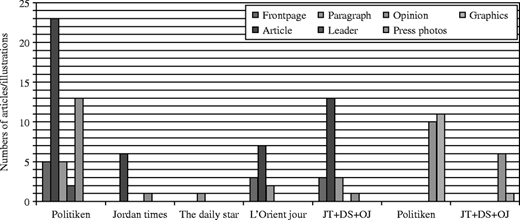
Editorial priority. Climate change has relative high priority in Politiken. The paper brings five front‐page stories related to climate change. Surprisingly, none of them are specifically about COP14 or the EU summit, and mostly related to national news (an opinion poll about climate change; Danish legislation that inhibit climate friendly behaviour; criticism of Danish support for a CO2 reducing project in Kenya). In general, climate change finds its way into all types of articles (Figure 1) and is thus both subject to opinion‐based and information‐based coverage.
Attribution. All articles are by‐lined (with the exception of one paragraph attributed the Danish news agency Ritzau).
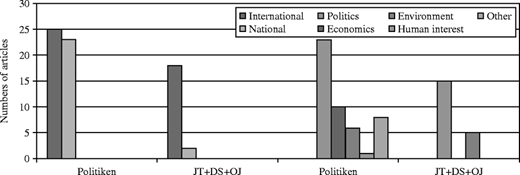
Domestic/international news. There is an almost equal distribution of domestic and international news (Figure 2). Whereas the international news is divided between COP14 and the EU summit, there is a greater variation in domestic news ranging from a debate about misinformation on climate change in a school textbook to different polls on the Danish population's view on climate change (30 November 2008, 1 December 2008, 5 December 2008).
Event/process‐centred. News from international summits like COP14 entails a certain overrepresentation of event‐centred articles, as they tend to be dominated by reports on the expectations, conflicts and out‐come of political negotiations. Politiken nevertheless contained a number of background stories on the structural conflicts underlying EU's climate package (31 November 2008, 10 December 2008), or the political challenges facing Danish diplomacy in the process towards COP15 (7 December 2008).
Regional perspectives. Besides, EU stories (coded as international news) there were no articles relating to a specific Scandinavian perspective.
Human‐interest. The only truly human‐interest story was an account by a 60‐year‐old Ethiopian shepherd who had experienced the desertification of his land and the impoverishment of his people (7 December 2008). The story served as an illustration of the impact of climate change in poor countries. However, a number of articles combined economic questions with human‐interest, or what could be called a “hypothetical” human‐interest approach. A series about Danish legislation and climate friendly behaviour all started with an account of a hypothetical person who wants to build, shop, commute or renovate in a climate friendly manner, but is discouraged by legislation that have a contra‐productive effect on energy reducing behaviour (1 December 2008, 4 December 2008, 10 December 2008, 11 December 2008).
Graphics. More than one third of articles on climate change were accompanied by some sort of visual illustration either as press photos or graphics.
In average Politiken would bring close to two daily articles (not including op‐ed) in the two‐week sample period. This is less surprising when considering that the newspaper had two journalists covering climate change and environmental issues. On top of that, the paper's EU correspondent was covering the EU negotiations on a climate package. It nevertheless points to the prominence of climate change journalism in Politiken.
More surprising is the distribution of international and domestic news in relation to climate change. Given that the two trigger events during the sample period were international summits on climate change, one could have expected more international news. Since this is not the case, it testifies to the extent to which climate change has become incorporated in domestic politics. A token of that are the numerous references to public opinion polls that trace the relation between climate change views and political convictions.
4.3 Comparative aspects
Comparing data from the different newspapers reveals significant differences in climate change coverage (Figure 1). In quantitative terms there is a considerably difference in numbers of articles. Together, the three newspapers from the Levant (JT+DS+OJ) feature less than half the numbers of articles in Politiken. Part of the explanation is, as pointed out earlier, that the sample period coincides with the Muslim Holyday Eid al Adha. Thus, there are fewer copies and presumably fewer articles on climate change in the Middle Eastern papers. In percentage, however, the difference in copies does not add up to the difference in numbers of articles.
Whereas Jordan Times (JT) and L'Orient le Jour (OJ) follow roughly the same pattern, publishing between 7 and 9 articles on climate change mainly at the beginning and end of COP14, The Daily Star (DS) is almost silent on the issue. This is rather surprising as The Daily Star is a somewhat internationally minded newspaper, which describes itself as catering to expatriates in the Middle Eastern region (The Daily Star, 2009). On the other hand, this readership indicates the very regional nature of The Daily Star, which report extensively on the Middle East and the Gulf, but is far more selective when it comes to other international news.
The internal difference in Middle Eastern coverage could be an indication that climate change is not a universal editorial priority (cf. RQ1). On the other hand, the climate change coverage in Jordan Times and L'Orient le Jour compared to Politiken seems more in line with existing studies, which find a ratio of 1:2 to 1:3 in the number of Western articles on climate change coverage compared to non‐Western regions (Boykoff and Roberts, 2007). In this case, the difference is as big as 1:4, but it still indicates that climate change is a globally covered topic.
Figure 1 also reveals a significant difference in the variety and distribution of news genres dealing with climate change. Close to 30 per cent of Politiken's articles are opinion‐based (leaders or commentaries), compared to less than 5 per cent in the three Middle Eastern newspapers put together. This indicates a significant regional difference in the way climate change is publicly addressed. Whereas climate change is a topic of public debate and political dissent in the Danish newspaper, in the Middle Eastern it is treated as part of international politics, with almost no public engagement in the matter.
The use of graphics is a formal indication of the resources, importance and communicative intentions devoted to climate change. Given that climate change issues are of a complex nature, graphic illustration is a valuable communicative tool. As illustrated in Figure 1, however, it is a resource, which is unequally employed.
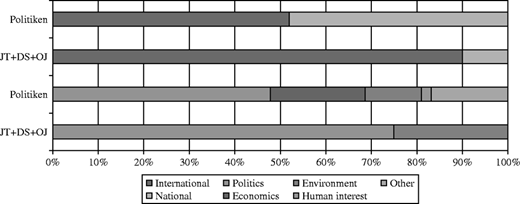
Regional differences in climate change communication are even more striking when broken down into different news categories (Figures 2 and 3). The main difference concerns the treatment of climate change as international or domestic news. Whereas Politiken treats climate change roughly equally as domestic and international news, Middle Eastern media treat climate change as predominantly international news.
Figure 3 reveals that during the sample period, climate change was mainly treated as political news in both the Danish and the Middle Eastern papers. Whereas the political perspective is dominating Middle Eastern press coverage, it amounts to roughly half the articles in Politiken, with approximately 20 per cent of articles focusing on economical aspects of climate.
Compared to Politiken, climate change coverage in the Middle Eastern newspapers appears rather narrow in terms of both formal and discursive variations. Climate change articles almost only appear in the section of international news, treated as hard news with an exclusive focus on political aspects. The economic dimension to climate change is mentioned only as a potential conflict in the international negotiations and thus subsumed a political perspective. Almost no relation between climate change and environment or human experience (human‐interest) is reported in the three Middle Eastern newspapers.
5 Discussion
This case study has been designed as a pilot project in preparation for a larger research project on regional variations in international news coverage of climate change. It has compared climate change coverage of two geocultural regions by focusing mainly on qualitative differences.
Overall, the study suggests that climate change can be studied as:
A shared topic on the international news agenda, which primarily receives international attention as a branch of international politics (united nation and EU summits). However, it is also a topic that is debated by national and international agents in relation to both economy and environment. Climate change issues can therefore be regarded as forming an issue‐based globalised public sphere that interacts with other layers of the public sphere.
The study also suggests that there are significant regional variations in the coverage of climate change, not only numerically, but also in terms of variations in news genres, editorial preferences, news selection, discursive variations and graphic visualisation. Such differences reflect institutional constraints and journalistic practices, pointing at the importance of regional media system in conditioning communicative priorities and orientations concerning climate change.
Finally, the study suggests that interactions between climate change discourses and other discourses, such as international politics and economy, can be regarded as a mediation of different risk perceptions. The numerous connections made between climate change and the current financial crisis exemplifies how media coverage and media debate act as a forum for explicit or implicit risk negotiation.
6 Conclusion
Regional differences in climate change coverage indicate a significant international imbalance in climate change communication, not only in quantitative terms (information deficit), but also in qualitative terms (communication deficit). If media coverage is the main source for public understanding and risk perception of climate change, there is reason to believe that climate change coverage focusing on, for instance, hard news and international politics may lead to a perception of climate change as removed from individual action. A too narrow focus on domestic and economic issues may, on the other hand, result in less social awareness of shared global responsibilities. This, in turn, may affect public opinion resulting in less public pressure on regional political systems to act in favour of local mitigation and adaptation toward climate change.
References
About the author
Mikkel Fugl Eskjaer is an Assistant Professor at the Department of Media, Cognition and Communication, University of Copenhagen, from where he also received his PhD. He has published research in the areas of film and media sociology. At the moment he is working on a research project on regional differences in the international media coverage of climate change. Currently, Visiting Scholar at The Danish Institute in Damascus. Mikkel Fugl Eskjaer can be contacted at: Eskjaer@hum.ku.dk

