


The purpose of this paper is to extend the previous larger‐scale climate policy studies to the local jurisdiction level to evaluate local land use planning capacity for climate change.
This paper evaluated 53 recently developed local comprehensive land use plans in California and analyzes how well these plans recognized the concepts of climate change and prepared for climate change mitigation and adaptation.
The descriptive results show that local land use plans reflect very low awareness and little analysis for climate change; however, the actions for climate change varied widely in scope and content in their plans.
This paper provides policymakers important empirical evidence to improve local land use planning capacities for climate change.
Introduction
There is increasing scientific evidence and growing concern about climate change caused by greenhouse gas (GHG) emissions and recognition of their significant adverse impacts on humans (IPCC, 2007), the local environment, economy, and safety. During the last decade, many planning researchers have focused on growth management and sustainability and have not always seen these factors as directly connected to climate change (APA, 2008).
Land use and land use planning have profound implications for climate change. Some recent studies have advanced our understanding of land use in climate change (Lindley et al., 2006; Moser and Tribbia, 2006; Moser and Luers, 2008; Travis, 2008) thus local efforts addressing climate change might change the nature of local land use patterns. Urban and land use planning is well suited to play a critical leadership role in addressing the effects of climate change by encouraging change in development patterns to reduce GHG emissions and their impacts (Minoia et al., 2009). Local land use planning is called the “constitution for future development” since it covers a local jurisdiction's entire planning area, addresses the broad range of development issues, expresses the community's development goals, and embodies public policy relative to the future. Local land use plans are critical for providing a fundamental factual basis for local land management, setting a long‐term sustainable mission, making appropriate land use policies, coordinating cross‐boundary planning issues, and implementing development decisions. Local land use planning can address climate change with a dual complementary approach:
mitigation by reduction of greenhouse gas emissions by acting directly or indirectly on the principal sources of human origin; and
adaptation by adjusting land use activities and practices so that vulnerability to potential impacts associated with climate change can be reduced or avoided.
Although many previous studies have focused on evaluating plan capacity for natural hazards (Burby et al., 2000; Nelson and French, 2002; Olshansky, 2001), ecosystem management (Brody and Highfield, 2005; Brody et al., 2004), sustainability (Berke, 2002; Berke and Conroy, 2000; Conroy and Berke, 2004), and smart growth (Edwards and Haines, 2007), no research has linked local planning capacity to climate change. Furthermore, although some studies have begun to discuss the role of local land use policy in climate change (Bizikova et al., 2007; Burton et al., 2007; Swart and Raes, 2007; Brody et al., 2008), little research has been conducted to determine how to convert the concepts of climate change into local land use planning tools and empirically integrate climate change mitigation and adaptation strategies into local land use planning. To date, no empirical model has been provided to measure local planning capacity for climate change. In recognition of this gap in the current research, this study proposes a proactive model to empirically examine local land use planning capacity for climate change. This article will extend the key concepts of climate change by converting them into specific plan components to increase our understanding of how and where to integrate climate change mitigation and adaptation approaches into local land use planning and decision making. This study examines local level support for climate change initiatives in local land use plans and develops a conceptual model for a local land use plan that effectively integrates climate change mitigation and adaptation strategies.
This study will address the following specific research questions:
RQ1. To what extent did local jurisdictions indicate awareness of climate change in their local land use plans?
RQ2. How well did local jurisdictions analyze the impacts of climate change in local land use plans?
RQ3. What actions have local jurisdictions taken to mitigate and adapt to climate change, and which strategies received the greatest and least attention?
RQ4. How can local jurisdictions be improved to address climate change in their plans?
This study will provide important information for decision makers interested in mitigating the adverse impacts of global climate change on local communities.
Theoretical framework
To enhance society's preparedness for the possible adverse impacts of climate change, decision makers should recognize three critical components, or “AAA” (UKCIP, 2003, California Climate Change Center, 2006):
- 1.
awareness;
- 2.
analysis; and
- 3.
action.
In order to address climate change, local land use planning should provide a full awareness of climate change, make a thorough analysis of these impacts, and translate awareness and concerns into concrete action. These three critical components are vital for incorporating climate change mitigation and adaptation into local land use plans. By combining existing concepts of climate change with theoretically driven local land use planning, this study has developed a framework using these three critical components to guide local planning capacities in addressing climate change mitigation and adaptation.
Awareness measures whether policy makers in local jurisdictions understand the concepts of climate change. There is currently sufficient evidence to support the idea that climate change is, and will continue to worsen in the future if no action is taken. Local jurisdictions need to be aware of the concepts of climate change, climate variability, or global warming. Additionally, GHG emissions (or CO2 emissions) are a significant factor in causing global climate change. The effect of stratospheric ozone depletion has raised concerns about climate change (Hartmann et al., 2000; Pienitz and Vincent, 2000).
Analysis identifies and assesses the risks of climate change in local land use activities and should cover the major drivers, sources, or contributors to climate change as well as possible impacts of climate change in planning areas. Analysis should incorporate geographic information system modeling tools to identify possible adverse impact areas and populations most vulnerable to climate change. A good analysis should provide weather and seasonal climate forecasts, climate change projections, vulnerability assessment of community, and specific projections of climate variables (e.g. erosion or rainfalls).
Action involves relative policies, tools, and strategies to address climate change mitigation and adaptations in the natural environment, built environment, and human health. Because the impacts of climate change cross multiple physical boundaries and organizations, successful local planning will require good communication and collaboration across agencies, sectors, stakeholders, citizens, and natural geographic and jurisdictional boundaries.
These three core plan components provide a framework to guide local planning for climate change. Under this framework, detailed indicators will be developed within each component to explain the key points that incorporate climate change concepts. When aggregated, these indicators can be statistically measured to compare the plans across multiple jurisdictions.
Methodology
Sample selection
California has pioneered climate change mitigation and adaptation through state legislation due to the fact that it is a state with high population density, intense land use demands, a rapidly growing economy and is faced with pressures from population growth, environmental management, and local development. In addition, California is also highly vulnerable and its ecosystems and socioeconomic environment are critically sensitive to climate change. The California Global Warming Solutions Act (AB 32) of 2006 is a milestone which has set forth a regulatory framework to legislate a dramatic reduction of California's greenhouse gas emissions by 2020. This unprecedented legislation envisions that a substantial portion of these reductions will come through changes in land use, thus, local comprehensive land use planning (referred to as “General Plans” in California) is playing a critical role in reaching significant state goals.
The basis of this study comprises California local comprehensive land use plans. The sample strategy is to select the plans that have been updated since 2000. By March 1, 2008 this study had collected 53 local plans encompassing approximately 10 percent of California's 534 local jurisdictions.
Scoring indicator quality
The preceding conceptualization of plan quality leads to the local evaluation coding protocol. Each component is evaluated by scanning all elements to assess whether it has addressed the 25 indicators of the three plan components, i.e‐AAA. Within these three components, each indicator is scored on a 0‐2 scale. A score of “0” means the indicator is not addressed in the plan, a score of “1” means that an indicator is considered but not in full detail, and a score of “2” means the indicator is fully addressed.
Results
Descriptive statistics for plan quality
The descriptive results are listed in Table I. As Table I indicates, the mean of the total scores for the 53 local land use plans' quality is 21.62, which is 56.9 percent out of total possible scores on a scale of 50. Of the three plan components, action received the highest score ((M=20.89) 54.9 percent of total possible scores in this component) of the three plan components, meaning jurisdictions have taken some policies, tools, and strategies to mitigate and adapt to the impact of climate change. Of course, this relatively low mean score indicates that there is still much room to improve local land use planning action in climate change mitigation and adaptation. However, both awareness ((M=0.38) 6.3 percent of total) and analysis ((M=0.36) 6.0 percent of total) stay at a very low level of planning capacities, indicating weak awareness and little analysis of climate change in their local land use plans.
In addition, there are large variations in quality across local jurisdictions' land use planning regarding climate change awareness, analysis, and action. The lowest three scores are 8.00, 9.00, and 10.00, compared to the three highest scores of 30.00, 34.00, and 37.00. A total of 33 jurisdictions (62.26 percent of 53 jurisdictions) received scores lower than half of the total scores. Only four jurisdictions received a score of more than 30.00 on a scale of 50. These results indicate that local jurisdictions have various capacities to address climate change issues in their local land use plans.
Indicator performance
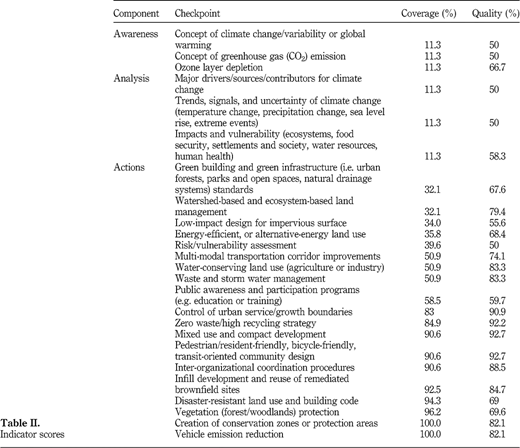
Indicator performance results are listed in Table II.
Awareness performance
Although climate change has been widely identified as a critical topic in the research field, only six (11.3 percent of total) plans identified the concepts of climate change, climate variability, global warming, GHG emissions, CO2 emissions, or ozone layer depletion. The quality of these three indicators is also very low (50, 50, and 66.7 percent, respectively). The results indicate a very weak awareness of climate change in current local land use plans.
Analysis performance
Only six (11.3 percent of total) plans identified major diverse sources or contributors to climate change. Additionally, the trends and signals of climate change (e.g. temperature change, precipitation change, sea level rise, or extreme events) were mentioned in only six plans. Also, only these six plans mentioned the impact and vulnerability (e.g. ecosystems, food security, settlements and society, water resources, human health) of climate change in their land use planning. The low coverage and quality scores indicate that little analysis was conducted for climate change in most current local land use plans.
Action performance
In the action component, there are large variations among policies, tools, and strategies, some of which have been well covered in current land use plans to address climate change. However, in some recently developed plans, incentive strategies have received little attention. Details are listed as follows.
All local jurisdictions have adopted policies to reduce vehicle emissions (coverage 100 percent, quality 82.1 percent), and create conservation zones or protection areas (coverage 100 percent, quality 82.1 percent). At the same time, local jurisdictions have adopted many traditional planning tools (e.g. mixed use and compact development (coverage 90.6 percent, quality 92.7 percent), infill development and reuse of brownfield sites (coverage 92.5 percent, quality 84.7 percent), disaster‐resistant land use and building code (coverage 94.3 percent, quality 69.0 percent), and vegetation (forest/woodlands) protection (coverage 96.2 percent, quality 69.6 percent)). A majority of local jurisdictions have adopted policies to control urban sprawl and growth boundaries (coverage 83.0 percent, quality 90.9 percent). Many jurisdictions have also adopted recycling strategies (coverage 84.9 percent, quality 92.9 percent). Pedestrian/resident‐friendly, bicycle‐friendly, and transit‐oriented community designs have been adopted as a planning strategy by most jurisdictions (coverage 90.6 percent, quality 92.7 percent). Also, inter‐organizational coordination procedures have been widely recognized (coverage 90.6 percent, quality 88.5 percent). These results mean that local jurisdictions have implemented traditional land use planning policies to address climate change even though some of them were not aware of the concept of climate change.
Approximately, half of the jurisdictions adopted policies for multi‐modal transportation corridor improvements (coverage 50.9 percent, quality 74.1 percent), water‐conserving land use (coverage 50.9 percent, quality 83.3 percent), and waste/storm water management (coverage 50.9 percent, quality 83.3 percent). Also, only slightly more than half of jursidictions identified public awareness and participation programs (e.g. education or training) for environmental stewardship (coverage 58.5 percent and quality 59.7 percent).
However, in some recently developed plans, incentive strategies were rarely covered by current land use plans. Only 32.1 percent of jurisdictions adopted watershed‐based and ecosystem‐based land management (quality 79.4 percent), and only 34 percent jurisdictions adopted low‐impact designs for impervious surfaces (quality 55.6 percent). Few plans emphasized energy‐efficient, or alternative‐energy land use (coverage 35.8 percent, quality 68.4 percent), or developed a risk or vulnerability plan for possible hazards (coverage 39.6 percent, quality 50.0 percent).
Discussion
The findings of this study highlight the following critical issues in current planning.
First, current local land use planning generally lacks a basic awareness of climate change as well as the understanding and the motivation to address climate change. As the preliminary findings from this study indicate, most local jurisdictions are currently unaware of or unconcerned about climate change. They fail to understand their responsibility to address the potential impacts of climate change in their spheres of planning. Most (88.7 percent) of the 53 local jurisdictions still lack active awareness and adequate understanding of climate change. Some recent studies also show that strategic, large‐scale environmental issues have generally been omitted in current land use planning (Tang, 2008a, b; Tang et al., 2008, 2009). Lack of adequate awareness causes local planners to underestimate the impacts of climate change and overconfidently believe that they are not vulnerable to its risks. It is important to increase decision makers' awareness of the future impacts of climate change and help them understand how preparedness for climate change can be integrated into their planning. Those jurisdictions which are most vulnerable and sensitive to the effects of climate change may have a higher awareness of the necessity to deal with climate change (Tol et al., 2004).
Another issue relating to awareness is planning priority, which can result in low awareness of climate change in local plans. Nicholls (1999) stated that some common “cognitive illusions” or biases are contrary to absorbing and understanding uncertain information. Uncertainty and debate in regard to climate change may cause local jurisdictions to wait for additional clearer official information to impel them to adopt action. Planning almost always addresses immediate and complex issues, thus long‐range issues frequently have a lower priority for local planners (Lindell and Meier, 1994). Many recent studies have found that long‐term mitigation or adaptation (e.g. natural hazards) are a low priority compared to the pressures of responding to more immediate community problems such as economic development, housing, and transportation (Lindell and Whitney, 1995; Wolensky and Miller, 1981).
Significant differences in expressed perceptions and priorities were observed among jurisdictions (Briechle, 1999; Wood and Good, 2005). A majority of local governments put economic development as their first priority and relatively few of them selected long‐term items (hazards, environment) as a priority (Briechle, 1999) since they primarily pay attention to ongoing and near‐term growth concerns affected by limited time, attention, and resources. One important way to breach the gaps in planning priorities is to make a significant educational effort along with necessary incentives and support to motivate decision makers to incorporate this topic in their planning activities. The nature of uncertainty and complexity in climate change may distract decision makers' attention. In addition, staff turnover and an expected wave of retirements will eliminate significant stores of institutional knowledge (California Climate Change Center, 2006). Strong leadership and dedicated commitment to climate change will be required to change planning priorities for climate change mitigation and adaptation.
Second, local jurisdictions are not sufficiently equipped to analyze climate‐relevant information and use it in decision making since they still do not completely understand climate change information and its impacts; thus they cannot integrate climate change awareness into their land use planning. Although much large‐scale information on climate change has been widely disseminated, local planning agencies have insufficient ability to incorporate this information. Also, local jurisdictions sometimes feel that climate change is a global issue that creates an inability or reluctance to integrate global scientific input into regional plans. For example, it is still a challenge to link the data between sea‐level rise projections and planning analysis to determine the setback distances or buffer zones along coastlines. Thus, it is necessary to provide professional training to enhance institutional capacity to stay abreast of the trends in relevant climate change information. Since most of the current climate change studies are conducted at regional, national, or global levels, it is definitely a challenge for local jurisdictions to consider integrating the information. One important reason is that the effects of climate change are not equally distributed across jurisdictions and regions (Tol et al., 2004; Baer et al., 2000). The most vulnerable regions and communities are those most exposed and sensitive to the effects of climate variability and change and least able to cope with or adapt to these impacts (Tol et al., 2004). Further study is needed to investigate whether these most vulnerable jurisdictions have stronger planning capacities than others since the jurisdiction types (coastal vs inner jurisdictions), which did not show significance in this study. To effectively address local vulnerability and risks of climate change, interdisciplinary cooperation and cross‐boundary coordination is essential to develop strong local analytic ability in this field.
Third, local jurisdictions need more innovative policies, tools, and strategies to respond to climate change. Although the strategies for climate change mitigation and adaptation have increasingly gained attention in research and policy, the results indicate that local jurisdictions' discourse remains limited in regard to the many critical strategies for mitigation and adaptation. For example, in this study, emission reduction strategies have been limited to automobiles to minimize air pollutants. Some new policies (such as carbon tax, parking fees adjustment) may need more times to be accepted by either the planning decision makers or public citizens. Even though there are problems with awareness and analysis, actions are still being taken. One reason is that planners may lack the knowledge of climate change, and may fail to incorporate climate change when making land use decisions; however, many existing policies have already benefited climate change mitigation. Another possible explanation is that planners' only emphasis is on actions for immediate action. Results found in this study are similar to some previous literature (Travis, 2008) that shows that local planners are well prepared to contribute to mitigation as well as respond to mandated emission reductions by some established planning policies such as growth boundary control, mixed land use, transit‐ and pedestrian‐conducive design, solid waste management, and building codes that can reduce the local carbon footprint. However, current policies, tools, and strategies are still not enough to mitigate and adapt to climate change. The barriers to climate change mitigation and adaptation may come from insufficient staff resources, lack of committed funding, lack of legal mandates, lack of scientific certainty, lack of perceived importance to decision makers, lack of perceived solution options, lack of necessary technical assistance, lack of public support and social acceptability of action, information uncertainty, or opposition from stakeholders. However, the reality is that local jurisdictions can play a critical role in climate change mitigation and adaptation although in many cases large‐scale climate change is beyond the ability of a local jurisdiction to monitor, mitigate, and adapt (Collins, 2005). Many previous hazards have shown that society tends to repeat the lessons and subsequently adapt to them (Weichselgartner and Obersteiner, 2003; Glantz, 2005), but local jurisdictions should act more quickly to address climate change to mitigate adverse impacts. Local jurisdictions must develop increasingly more appropriate policies, tools, and strategies to readily deal with uncertainty and unexpected surprises (Kartez and Lindell, 1987; Brooks, 1986; Gallopin, 2002; Kates, 1985; Kates and Clark, 1996; Berkes and Jolly, 2001). Climate change mitigation and adaptation should be a social learning process that can be facilitated by flexible institutional mechanisms.
Theoretical and policy implications
This study makes small but significant contributions to planning theories by taking the broad theoretical principles of rationalism and converting them into a model showing how to actually achieve planning objectives for climate change. First, this study adds to the theory of rational planning by integrating climate change (which is rarely covered in current local level planning decision making) into local land use plans. This study also provides a conceptual model, supported by specific indicators, to guide local jurisdictions' development of plans to address climate change mitigation and adaptation. By understanding the areas in which their plans are deficient, policy makers can more effectively improve their planning capacity for climate change. Specifically, local land use plans should address climate change in aspects of awareness, analysis, and action.
First, local jurisdictions should be aware of climate change. Adequate awareness can encourage local jurisdictions to commit themselves to climate change mitigation and adaptation which can be difficult because planning for climate change has a low priority in many jurisdictions. Local jurisdictions must realize that climate change is occurring and must educate themselves on ways to mitigate climate change and adapt to the changing climate. Certain barriers must be overcome to raise awareness of climate change:
a refusal to believe climate change is happening;
general belief that climate change is “not‐in‐my‐back‐yard,” and hence a global and future issue rather than a local and present one;
lack of adequate knowledge of possible risk and adverse impacts of climate change; and
inadequate information on climate change.
Local jurisdictions need to be encouraged to feel that they have a role to play and be made aware of what they can do. In addition, local jurisdictions need to be aware of the social, financial, and environmental benefits that can result from taking simple measures. Since three planning variables (planning staff, plan age, and consulting resources) are correlated with planning capacity, education for planners, consultants, and potential planners (school students) is critical for raising the awareness of climate change to provide a meaningful way to change behaviors and generate proactive planning practices in the long‐term. Local jurisdictions can also increase public awareness to encourage developers and individuals to adopt climate‐friendly and environmentally efficient practices. The channels of awareness can include:
hands‐on training;
user manuals;
workshops;
school education;
web‐based information; and
dedicated listserves, etc. (for example: knowing about what types of actions can be taken).
Second, local planners must realistically analyze the impacts of climate change by reviewing major emission sources in their planning area and use a vulnerability approach to accurately identify the risks of climate change. The analysis should identify critical thresholds in climate‐sensitive sectors and analyze the socioeconomically and racially differentiated vulnerabilities from climate change. Additionally, local plans should identify constraints and stressors in climatic, economic, technological, institutional, social, legal, and ecological fields. The analysis should be based on a long‐term database with local climate and hydrology records and their links to resources of scientific advice on climate change. A climate sensitivity analysis should also examine current plans and ordinances to ensure climate change mitigation and adaptation.
Third, local jurisdictions should expand their policies, tools, and strategies for climate change. Studies have highlighted that some traditional planning policies (e.g. vehicle emission reduction, protection of natural assets) have been successfully adopted in current plans for climate change; however, new policies, tools, and strategies (e.g. carbon trade policy, tax abatement) should be considered for adoption into local land use planning. This suggests local jurisdictions should adopt more incentives to mitigate and adapt to climate change. Local plans should identify relevant information accessibility, notification and dissemination to achieve more public support. More importantly, inter‐disciplinary, cross‐boundary coordination and communication is critical to build joint efforts to address climate change. Mitigation can help avoid unpredictable but imaginable surprises. Adaptation to these impacts is an unavoidable necessity, thus, local jurisdictions have to increasingly enhance their capacity to adapt to already‐occurring and unavoidable impacts in the near future, no matter what emission‐reducing steps are taken. Adaptation is required to deal with the unavoidable impacts of climate change in the near term, while mitigation is needed to prevent more severe, negative impacts in the future (California Climate Change Center, 2006). Of course, it is not a one‐out‐of‐two game for land use planning to respond to climate change through either mitigating greenhouse gas emissions or adapting to its impacts. Since the impact of climate change depends on its pace and magnitude, local land use planning must find solutions that can best minimize potential risks or adapt their decisions while the impacts are being observed.
Conclusions
The results of this study address all four research questions.
Regarding the first question, (“How well are local jurisdictions aware of climate change in their local land use plans?”) the results indicate that most local jurisdictions in California are not aware of climate change in their local land use plans. From the established plan aspect, local jurisdictions were determined to not be equipped with the knowledge of climate change.
Regarding the second question, (“How well did local jurisdictions analyze the impacts of climate change in local land use plans?”) the results indicate that local jurisdictions have relatively low quality of analysis of climate change impacts in their local land use plans. There are still large areas for improvement in relation to the analysis of climate change.
Regarding the third question (“What actions have local jurisdictions taken to mitigate and adapt to climate change, and what strategies received the greatest and least attention?”), the results indicate that local policies addressing climate change varied in content and scope. Some traditional planning policies were successfully adopted by local plans, and local land use planning partially considered climate change, however, new incentive‐based policies, tools, and strategies received less attention. Local land use planning agencies need to learn more about new policies and integrate them in their local decisions.
Regarding the fourth question (“How can local jurisdictions be encouraged to address climate change in their plans?”), the results indicated that local jurisdictions must be aware of climate change, and improve their analytical skills, and expand their policy toolbox to mitigate and adapt to climate change. A comprehensive approach is needed to integrate science, technology, and policy with local daily land use planning decisions.
Limitations and future research
Although this study provides an initial evaluation of local land use planning capacity for climate change, it has several limitations that warrant further investigation. The relatively small sample size (n=53) may lack the adequate statistical power required to generate more robust statistical conclusions that can be applied externally to others jurisdictions.
Future research will develop a questionnaire survey to identify the direct factors that influence local planning capacity for climate change. Future studies should examine the influence of factors (e.g. current planning challenges, attitudes, and knowledge about climate change, information use and needs) on local land use plans to address climate change. Such research could assess perceptions of important aspects such as political support or opposition, impacts on economic development, and requirements for specialized knowledge or training. Identifying perceived barriers to implementation of different planning and policies would be an important step toward overcoming them. More specifically, the future research should identify the critical research questions:
RQ1. What are the most influential land use planning variables in climate change?
RQ2. What barriers do local jurisdictions need to overcome to adopt these land use planning policies on climate change mitigation and adaptation?

The authors really appreciate the two anonymous reviewers' suggestions to improve this paper. This research is supported by Hyde Professorship Fund and Layman Award from the University of Nebraska – Lincoln. The findings and opinions reported in this paper are not necessarily endorsed by the funding organization.
References
About the authors
Zhenghong Tang, PhD, is an Assistant Professor in the Community and Regional Planning Program at the University of Nebraska–Lincoln. His research interests focus on land use planning, environmental planning and policy, and climate change policy. Zhenghong Tang is the corresponding author and can be contacted at: ztang2@unl.edu
Christopher M. Hussey is a graduate student and research assistant in the College of Architecture at the University of Nebraska–Lincoln. His research areas include physical planning, urban design, and urban policy.
Ting Wei is a graduate student and research assistant in the College of Architecture at the University of Nebraska–Lincoln. Her research covers land use planning, urban design, and international urban planning.

