


The purpose of this paper is to assess the risk of a population in a given territory being harmed by climate change by distinguishing between: natural factors, which are associated with inherent vulnerability; and man‐made or policy‐induced factors, which are associated with adaptation. It is argued that this distinction is useful as a methodological approach and for policy making.
The approach utilises indices of vulnerability and adaptation, and juxtaposes them to arrive at an assessment of risk.
The major findings of this paper are that the “lowest‐risk” or “managed‐risk” category of territories are mostly port cities in high‐income countries, whereas the “mismanaged‐risk” and “highest‐risk” category of territories are vulnerable port cities located in low‐income countries.
The originality of the paper is that it highlights the distinction between natural and man‐made risks in arriving at a total assessment of risk – a distinction of utmost importance for policy making. An important, although obvious, conclusion is that adaptation does not reduce the inherent vulnerability of the territories concerned, but it serves to enable humans to withstand, bounce back from or absorb the effects of vulnerability to climate change.
1 Introduction
Many definitions of vulnerability and adaptation (Füssel, 2005; Levina and Tirpak, 2006) do not clearly distinguish between inherent and self‐inflicted changes, as is the case with the following IPCC (2007b) definition:
The degree to which a system is susceptible to, or unable to cope with, adverse effects of climate change, including climate variability and extremes. Vulnerability is a function of the character, magnitude, and rate of climate variation to which a system is exposed, its sensitivity, and its adaptive capacity.
In this case, there is no distinction between inherent (or natural) or man‐made adaptation.
The purpose of this paper is to assess the risk of a population in a given territory being harmed by climate change. The approach adopted in this paper sharpens the definition of vulnerability, by confining it to inherent and natural conditions. Man‐made or policy‐induced factors are, according to this approach, associated with adaptation. It is argued that this distinction is useful as a methodological approach and for policy making. The approach utilises indices of vulnerability and adaptation, and juxtaposes them to arrive at an assessment of risk.
The major findings of this paper are that the “lowest‐risk” or “managed‐risk” category of territories are mostly port cities in high‐income countries, whereas the “mismanaged‐risk” and “highest‐risk” category of territories are vulnerable port cities located in low‐income countries. The methodology emphasizes the benefits of policies that promote adaptation, which is an important component of risk management in the context of climate change. These policies do not reduce the inherent vulnerability of the territories concerned, but they do serve to enable humans to withstand, bounce back from or absorb the effects of climate change. The importance of this study is that it emphasizes the need to distinguish between inherent and self‐inflicted changes – a distinction of utmost importance for policy making.
This proposed methodological approach can be used for other areas of risk, such as that associated with natural disasters (Briguglio, 2003) and with external economic shocks (Briguglio et al., 2006).
The remainder of this paper is organised as follows. Section 2 distinguishes between inherent and policy‐induced realities, and presents four scenarios relating to these realities. Section 3 contains an attempt to measure the risk of being harmed by climate change on the basis of the distinction discussed in the previous section. Section 4 concludes the paper with a summary of the methodological advantages relating to the approach proposed in the study.
2 Inherent and policy‐induced realities
The basic argument proposed in this paper is that risk depends positively on natural vulnerability and negatively on human adaptation. In other words, the concept of vulnerability is confined to inherent conditions which exposes a territory to the harmful effects of climate change – these conditions are, therefore, permanent or quasi‐permanent. The concept of adaptation, on the other hand, in this study relates to the ability of humans residing in a given territory, in taking measures to withstand, absorb or bounce back from the effects of climate change. Such ability can be anticipatory or reactive and can be policy induced (Burton et al., 2006; Nicholls et al., 2007).
2.1 Advantages of the methodology
Defining risk in terms of inherent vulnerability and anthropogenic adaptation has a number of methodological advantages, including:
If the definition of vulnerability is restricted to refer to inherent features, it follows that the country or a territory having these features has practically no control over their incidence. In other words, highly vulnerable countries/territories cannot be accused of inflicting vulnerability on themselves. Examples of inherent vulnerability is the case of islands that are low lying since this renders them exposed to the harm caused by sea‐level rise. Many countries located in the tropics are inherently exposed to hurricanes and cyclones. Vulnerability can also be self‐inflicted because in many countries there are activities which exacerbate exposure to climate change, such as building on the coast, removal of mangrove cover, damage to coral reefs, etc. Self‐inflicted vulnerability, in the methodological approach presented in this paper, would be considered as the obverse of nurtured adaptation.
If the definition of adaptation is constrained to refer to what humans have done, are doing, or can do to cope with (or exacerbate) natural vulnerability to climate change, it follows that such adaptation can be nurtured, and therefore can be policy induced. Adaptation can also be inherent, but in the context of this methodological approach inherent adaptation would be included with vulnerability or lack of it.
The juxtaposition of the two factors would then refer to the “risk of being harmed by climate change”, due to inherent vulnerability features, counterbalanced to different extents, by nurtured adaptation.
This methodological approach is useful for policy making, in that it emphasises the need for adaptation to reduce the risk of being harmed by climate change. Although this reality is known and accepted in many studies, the approach allows for the possibility of “negative adaptation” that is man‐made changes that exacerbate the harm caused by inherent features, such as low‐lying coastal areas or high degree of subsidence.
2.2 Diagrammatic approach
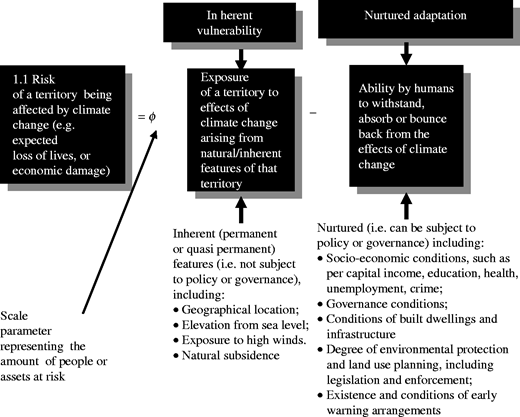
The arguments developed above are shown graphically in Figure 1.
Figure 1 shows that risk of being harmed by climate change has two elements, the first being associated with the inherent conditions of the territory that is exposed and the second associated with conditions developed by humans to absorb, cope with or bounce back from external shocks. The risk of being adversely affected by climate change is therefore the combination of the two elements. The negative sign in front of the adaptation element indicates that the risk is reduced as adaptation builds up. The scale parameter is intended to capture the amount of people or assets at risk.
2.3 Four scenarios
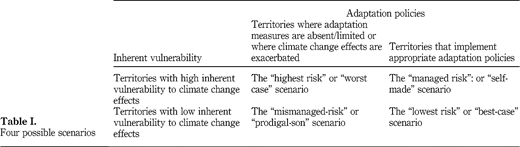
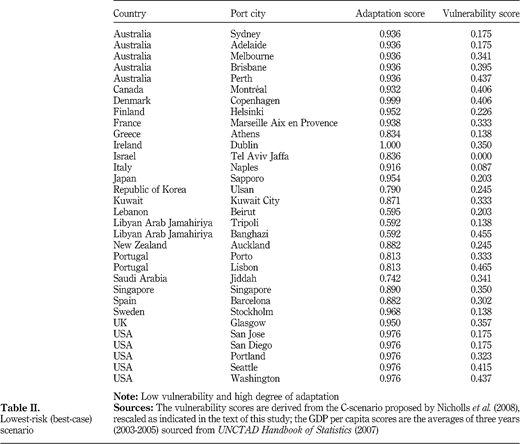
On the basis of the relationship between inherent vulnerability and nurtured adaptation, shown in Figure 1, one can consider four possible territory scenarios as shown in Table I.
The “lowest‐risk” scenario applies to territories which are not inherently very vulnerable to climate change and which at the same time adopt effective adaptation measures, possibly as part of their normal way of doing things. For example, the infrastructure in developed countries, including that intended for flood control, tends to be of better quality than in poorer countries, even when the latter are more vulnerable to flooding. This scenario can also be labelled as the “best‐case” scenario.
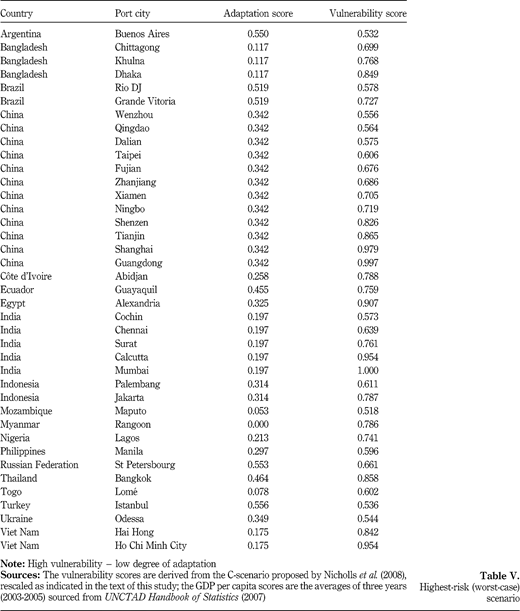
The “highest‐risk” or “worst‐case” scenario applies to territories that are inherently very vulnerable to climate change but do not or cannot adopt effective adaptation, possibly due to lack of resources. For example, a deltaic port city located in a low‐income country, exposed to high winds and experiencing natural subsidence will have a very high risk of being harmed by climate change, in line with the arguments relating to Figure 1.
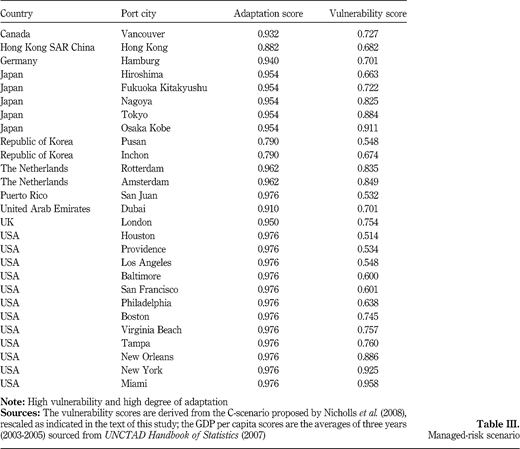
Territories classified under the “managed‐risk” category would be those with a high degree of inherent vulnerability to climate change, but which adopt or afford to adopt appropriate policies to enable them to cope with or withstand their inherent vulnerability. They can also be labelled “self‐made” in the sense that they would have taken steps to make up for their disadvantage. These territories remain inherently vulnerable, but their adaptation measures reduce the risk associated with exposure to climate change effects.
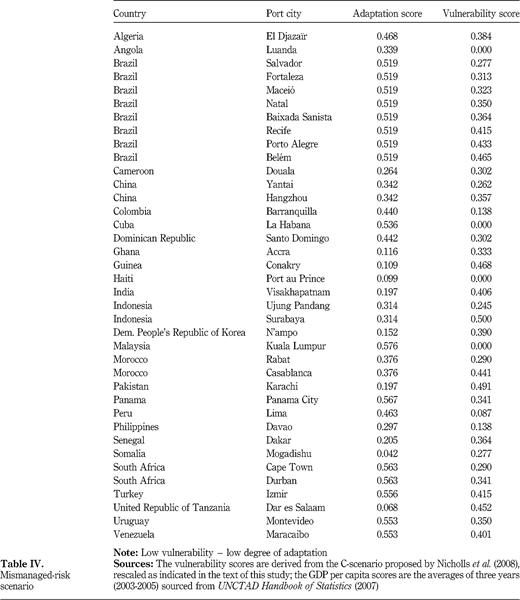
Territories falling within the “mismanaged‐risk” scenario are those with a relatively low degree of inherent vulnerability to climate change, but which do not or cannot adopt adaptation measures in the face of their exposure to climate change. At times, they allow practices which exacerbate their vulnerability. This scenario can also be labelled “prodigal‐son”, the analogically being that though “born in a good family”, the prodigal son mismanaged his riches.
It should be noted that given that vulnerability is considered to be natural and permanent or quasi permanent, movement from the lower quadrants to the upper quadrants is not possible or likely. However, given that adaptation is policy driven, movement from the left quadrants to the right quadrants is possible.
3 Measuring risk
3.1 Measuring vulnerability
This section of the paper draws heavily on Nicholls et al. (2008) for the data. This important work is essentially a global screening of the exposure of the world's large port cities to coastal flooding due to storm surge, high winds and climate change. It is confined to cities with a population greater than one million, so it excludes small island developing states, which as argued in IPCC (2007a) tend to be amongst the most vulnerable countries to climate change.
The authors found that most (about 38 per cent) of the most vulnerable port cities are found in underdeveloped Asia and many of them located in deltas with a higher coastal flood risk as a result of their tendency to be at lower elevations and experience significant subsidence. This means that many millions of people in low‐income countries are exposed to coastal flooding, with limited protection and absence of or underdeveloped early warning systems.
The authors rightly insist that exposure does not necessarily translate into impact. They argue that, in general, cities in high‐income countries have (and are more likely to have in the future) much better protection levels than those in the developing world. This is in line with the methodological approach proposed above.
The results reported by Nicholls et al. (2008) indicate that the most vulnerable cities in 2005 in terms of population exposure (including all environmental and socioeconomic factors) were Mumbai, Guangzhou, Shanghai, Miami, Ho Chi Minh City, Calcutta, Greater New York, Osaka‐Kobe, Alexandria and New Orleans. A high percentage of the exposed population is located in Asian developing countries.
The data used in this study refers to the C‐scenario proposed by Nicholls et al. (2008), which relates mainly to natural conditions of the territories concerned, taking into account global sea‐level rise, a storm enhancement factor and natural subsidence. The index proposed by the authors takes into account a degree of anthropogenic subsidence.
3.2 Measuring adaptation
Adaptation measures can take different forms (UNFCCC, 2007; Burton et al., 2006). According to Nicholls et al. (2008), the adaptation strategies with regard to climate change include a combination of:
upgraded protection;
managing subsidence (in susceptible cities);
land‐use planning to reduce vulnerability, including focusing new development away from the floodplain, and preserving space for future infrastructure development;
selective relocation away from existing city areas; and
flood warning and evacuation.
It is not an easy task to measure policy‐induced adaptation measures. One possible approach is to assign a value on a mapping scale ranging from say 1 to 5 to the adaptation measures listed above for different territories, and on this basis, create a composite index by aggregating the adaptation measures through a simple or weighted average.
In this paper, however, we take a simpler route. It is assumed that the territory's economic situation enables it to have a higher degree of adaptation standards.
As Nicholls et al. (2007, 2008) argue, cities in rich countries have much better protection levels than cities in the developing world. This is due to the ability by richer territories to afford the cost of protection infrastructures. In addition, in richer countries there is a tendency for a higher degree of risk aversion due in part to the higher value of assets involved.
Basing on these arguments, we have taken gross domestic product (GDP) per capita as a measure of the extent to which countries put in place adaptation measures. It is to be emphasized, however, that this approach is somewhat of a rule of thumb method and that further work is required to construct a more reliable adaptation index across countries.
3.3 Juxtaposing vulnerability and adaptation
As argued above, the risk of being harmed by climate change is a function of two elements, namely inherent vulnerability and nurtured adaptation. By juxtaposing the two indices described above, namely:
- 1.
that which captures inherent features derived from Nicholls et al. (2008); and
- 2.
the GDP per capital index, assumed to proxy adaptation measures, one can therefore assess the extent of risk to the effects of climate change.
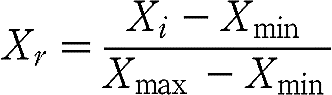
In order to combine the two indices, the country scores were rescaled to take a value of between 0 and 1 using the following formula: Equation 1 where:
Xr =the rescaled score.
Xi =the actual score.
Xmin and Xmax =the minimum and the maximum of all scores of a given variable.
In addition, the variables were measured in logs, so as to allow for decreasing marginal effects, in the sense that:
with regard to adaptation, doubling the income per capita does less than doubles the adaptation possibilities; and
with regard to vulnerability, doubling exposure does less than double the harm.
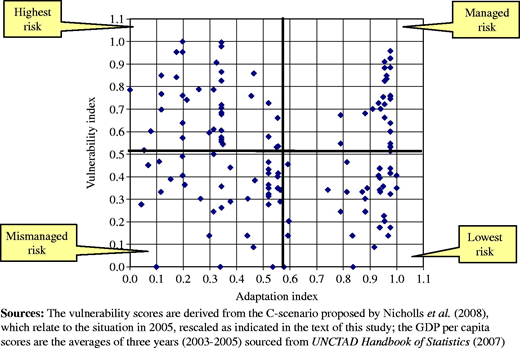
The results are shown graphically in Figure 2. The scatter points represent the 136 port cities identified by Nicholls et al. (2008), which in Appendix 1, are named and classified according to the four scenarios described above. The dividing line between one scenario and another was taken as the average of all scores of each variable.
It can be seen that 32 port cities are in the “lowest‐risk” category, where the cities concerned are shown in Table II, which also presents the vulnerability and adaptation scores. These are mostly port cities in high‐income countries.
In total, 27 port cities are in the “managed‐risk” category. These are vulnerable cities mostly located in high‐income countries, as shown in Table III.
About 38 cities are located in the “mismanaged‐risk” category. These are low‐vulnerability cities mostly in low‐income countries, as shown in Table IV.
The remaining 39 cities are the “highest‐risk” countries, with high‐vulnerability cities located in low‐income countries (Table V).
3.4 Some caveats
These results should be interpreted with some caution, due to the measurement weaknesses indicated above, including that:
the vulnerability index, which should capture natural and inherent features only, may capture some man‐made factors; and
the adaptation index is a very basic and needs to be refined.
In addition, the thresholds dividing the four scenarios are set somewhat arbitrarily, and movements of these thresholds can result in the movement of marginal scores from one scenario to another.
However, the methodological approach proposed in this study could be very useful, especially because it highlights the importance of adaptation policies. It also carries the message that territories that are vulnerable to climate change should not be complacent in the face of this reality but can and should take action to build up their adaptation capacity.
4 Conclusion
There are various advantages emanating from the methodological approach proposed in this study, based on the distinction between what is natural (inherent, permanent or quasi‐permanent) and what is nurtured and subject to policy orientations.
The methodology emphasizes the benefits of policies that promote adaptation, which is an important component of risk management in the context of climate change. As noted above, adaptation strategies include land‐use planning, upgrading of the infrastructure, management of subsidence, relocation of communities away from vulnerable areas and early warning systems.
These strategies do not reduce the natural vulnerability of the territories concerned, but they do serve to enable humans to withstand, bounce back from or absorb the effects of climate change.
The main lesson that can be drawn from this paper is that being highly vulnerable to climate change due to natural factors need not translate into being highly affected by climate change, if appropriate adaptation safeguards are put in place. Conversely, territories that are not inherently highly vulnerable to climate change may be highly affected if man‐made activity exacerbates the inherent vulnerability – a possibility labelled as “negative adaptation” in this paper.
Conceptual framework for assessing the risk of being affected by climate change
Conceptual framework for assessing the risk of being affected by climate change
References
About the author
Lino Pascal Briguglio is the Director of the Islands and Small States Institute of the University of Malta. He was one of the lead authors for Chapter 16 of the IPCC 4th Assessment Report on Adaptation and Vulnerability to Climate Change. He has written extensively on issues relating to islands and small states.

