


– The purpose of this article is to discuss the assessment and inclusion of stakeholders' perception, and citizen participation instances to implementing management options to deal with climate threats within the existing institutional framework in Uruguay.
– The approach being followed has different directional approaches and integrates them within a single assessment. First, a prescriptive climate change top-down path. Second, stakeholders' perception is assessed within a bottom-up risk-management model. Third, institutional agreements, arrangements, and consensus are reached. Considering the need for agreed and effective options, the approach is customized and turned flexible enough to accept inputs from scientists, managers, and stakeholders.
– The co-production of knowledge and the achievement of agreed and feasible options is achieved by means of a consultation process which results in adaptive co-management agreements and collective decisions. This process is seen as both an empowerment of local actors and a multi-stakeholder learning-by-doing experiment. This allows for both an increase in coping capacity to climate threats and facilitates long standing conflict resolution.
– Much literature discusses the importance of the role of social power in inclusive processes towards adaptation, and how difficult is ceding a genuine voice to stakeholders. The co-production of knowledge is a way to achieve the rapprochement of scientists with institutional and community actors. Thus, the participatory process gives stakeholders responsibility for identifying their specific needs and priorities and helps to establish community ownership.
1 Introduction
1.1 The relationship between stakeholders' perception and public participation
The process of inclusion of stakeholders' perception towards a participatory adaptation to climate change and variability threats in coastal areas is discussed in recent literature (Eisenack et al., 2007; Tompkins et al., 2008; Scally and Wescott, 2011), and advocated by national and international agencies (UNDP, 2004; IPCC, 2007).
Here, we use the term participation in the sense of securing active involvement of a broad range of stakeholders in decision-making and action (Few et al., 2007). Public participation encompasses a range of procedures and methods designed to consult, involve, and inform the public to allow those that would be potentially affected by a decision or policy to have input into the process. The latter are also known as stakeholders (IFC, 2007):
Community empowerment is more than the participation of communities. It implies community ownership and action that explicitly aims at social and political change. Community empowerment is a process of re-negotiating power in order to gain more control. It recognizes that if some people are going to be empowered, then others will be sharing their existing power and giving some of it up (Baum, 2008).
Stakeholder inclusion is deemed to be important in exploring adaptation responses because ultimately community “buy-in” and support from those affected will be required (Tompkins et al., 2008). Citizen participation during the design and formulation of a public policy provides value and legitimacy (CLAD, 2009). Some key elements are the experiences that communities have regarding their culture, understanding of the threats, local capacity, and external support from agencies to the process of implementation, that is to say understanding climate change from below (Sajid Raihan et al., 2010).
Here, we present a case study of stakeholders' perception of current and expected climate threats, and citizen participation instances within the existing institutional and legal framework towards adaptation and management in an inhabited coastal protected landscape in Uruguay. We discuss the strategy being followed to implementing feasible, politically and socially agreed measures to deal with the evolving climate. These measures are both, adaptation goals and learning-by doing actions. We prioritise stakeholders' participation through communication and the assessment of their perception so that top-down (prescriptive) and bottom-up (diagnostic) approaches merge. We aim to achieve effective institutional agreements and feasible measures by means of informed citizen participation instances in decision-making, local public management, and monitoring.
1.2 On-going adaptation initiative
The adaptation process presented in this article is undertaken by GEF project “Implementing Pilot Adaptation Measures to Climate Change in Coastal Areas of Uruguay” (PRODOC, 2008; UCC, 2011; Nagy et al., 2013; Seijo et al., inpress), from now on the project. Its main objective is to increase the resilience of coastal ecosystems as defined by Chapin et al. (2009):
[…] the capacity of a social-ecological system to absorb a spectrum of shocks and to sustain and maintain its identity and feedbacks as a result of recovery in a new context.
The means chosen for achieving this purpose is to implement measures of adaptation in two pilot sites. One of them is Laguna de Rocha (the lagoon), a coastal protected area in Eastern Uruguay because of its biodiversity of global relevance (PRODOC, 2008; SNAP, 2010; UCC, 2012a; Nagy et al., 2013; Seijo et al., inpress). To this aim, we have focused on the incorporation of climate issues into the lagoon's management plan.
1.3 The socio-ecological system of Laguna de Rocha
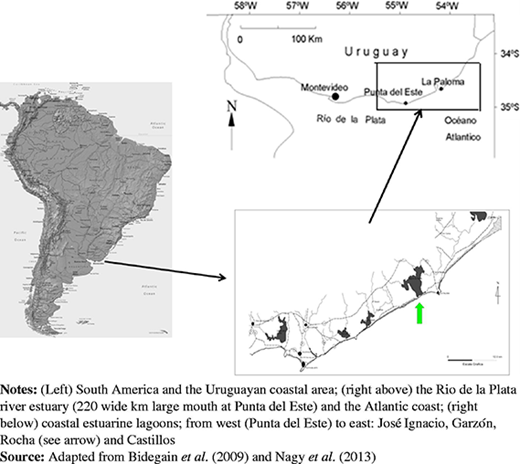
The Laguna de Rocha (the lagoon) is one of the four estuarine coastal lagoons along the Uruguayan Atlantic East coast (Figure 1).
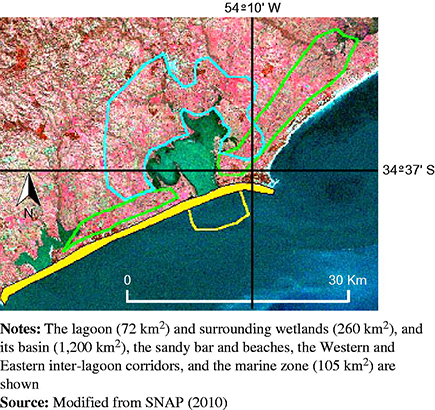
The lagoon and surrounding wetlands has an area of 260 km2. It comprises 19 environments that are the habitat for 109 species, including migratory birds from the Northern hemisphere, as well as a variety of marine invertebrates and fishes which sustain subsistence small fisheries of shrimps and fishes (Conde and Rodríguez-Gallego, 2002; SNAP, 2010; Rodríguez-Gallego et al., 2012). The lagoon has a sandy bar which remains closed most of the year (Figure 2).
The connection of the lagoon with the sea, its salinity and flooded area are naturally controlled by both the lagoon water level, related to precipitations, and storminess from the east and southeast. The natural opening of the bar allows for shrimp migration, usually during austral spring-summer months. Over the last few years, the bar only opened by storminess or human intervention. This coastal area including the bar has been subdivided for property development since a few decades ago. Land-use plans (IDR, 2010) intend to prevent the occupation of this socio-ecological system (SES), which implies a typical coastal zone conflict of interests, such as relocation. Conflicts and threats could be aggravated by the authorization given by national authorities to build a bridge over neighbouring Laguna Garzón, which would increase the accessibility to this area.
Thus, the natural vulnerability of the lagoon is expected to increase due to both natural forces and human intervention (Nagy et al., 2013). Its biodiversity is highly vulnerable to changes in temperature and precipitations (Soutullo, 2013), and/or the alteration of the bar morphodynamics. The gradual rise of sea-level and storminess increases the probability of sea flooding.
The lagoon is depicted in various ways in the local culture. For most people it is a rich in biodiversity coastal landscape surrounded by attractive beaches. For local fishermen the management of the bar and the entrance of marine waters is the key factor for the development of shrimp fisheries. Whereas for local breeders freshwater is very important for pastures and cattle watering (Seijo, 2011a). For the local government and managers the lagoon is a site which poses increasing management problems.
The socioeconomic make-up is synthesised in Table I. Most local data are not available because of very low population, about 5,000 at La Paloma municipality and a few hundreds (mostly adults) in the Eastern lagoons area.
1.4 Local observed and projected climate
The observed climate in Laguna de Rocha during the last five decades was characterised by:
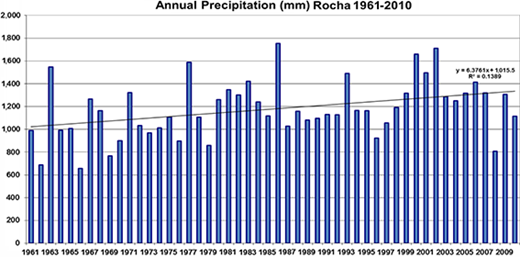
The annual mean temperature and rainfall have raised 1°C and 210 mm (ca. 20 percent) since 1961, respectively. The latter showed strong fluctuations associated with drought/wet periods influenced by ENSO (Nagy et al., 2008; Bidegain et al., 2009, 2011; UCC, 2012b).
The observed sea-level rise (SLR) follows global trends as well as the local patterns of variability of runoff and winds (Bidegain and Nagy, 2008; Nagy et al., 2008). The influence of ENSO-related variability on SLR (UCC, 2012b) is explained by the local effect of a close mouth of a great river (Nicholls et al., 2011) such as the Rio de la Plata river estuary. An increase in east and southeast winds was observed during El Niño events (Gutiérrez, 2011) favouring the accumulation of seawater and the breaking of the bar. Sea-level rose 14 cm since 1961 and yearly fluctuations exceeded 25 cm since 1996.
The future climate of the lagoon region is expected to be hotter and wetter than at present. Increases in temperature of ≥1 to ≤3°C, in rainfall of ≤3 and ≤8 percent, and in SLR of ≥5 and ≥15 cm are expected by 2030 and 2050, respectively, (Bidegain et al., 2009, 2011; UCC, 2012b).
1.5 Institutional and legal framework
The institutional and legal framework for the management and participatory process in Laguna de Rocha is based on two environmental laws of 2,000. The former states “the protection of the environment involves the society” and “stakeholders have the right and duty to participate in the process”. The latter created the National System of Protected Areas (SNAP), which declared the Laguna de Rocha site as a “protected landscape” by 2010. The National Directorate of the Environment (DINAMA) and the local Government of Rocha (IDR) are responsible for making decisions to protect its biodiversity. The participation of other interested parties is only advisory and the institutional level for their participation is the advisory committee (CAE), a co-management institutional arrangement.
Thus, according to the elements of a SES (Glaser et al., 2008), the lagoon is the bio-geo-physical unit; the fishermen and breeders are the residents, and the IDR, the SNAP, and the CAE are its associated institutions. How to manage local sustainable development within the bio-geo-physical unit is their problem context.
1.6 Working assumptions
The following assumptions to achieve an effective adaptation have guided research:
given the institutional and legal framework, the high quality of democracy, political participation, and people's trust on the political system in Uruguay (EIU, 2011; Legatum Institute, 2012; BTI, 2012), participatory processes should empower stakeholders without a perceived loss of power from the institutions;
a minimal agreement between stakeholders is central. Management options should aid to solve existing problems besides increasing the coping capacity to climate and non-climate threats; and
if stakeholder engagement influences decision-making it might be regarded as a way of empowerment.
2 Approach and methodology
Lessons emerged from coastal zone management and climate adaptation initiatives in Uruguay (Gómez Erache and Martino, 2008; Gómez Erache et al., 2010; Nagy et al., 2008, 2013) suggest the advantage of:
a customized mix of international best practices where top-down (prescriptive) and bottom-up (diagnostic) approaches merge;
a non-linear step-by-step process which favours multi-stakeholders agreements, feedbacks, and institutional arrangements; and
only widely accepted options are effective.
A diagnostic approach articulates future outcomes and then investigates the conditions that lead to those outcomes being realised. Future outcomes may be negative, in the case of critical thresholds, or positive in the case of a desired future state (Jones, 2010; Jones and Preston, 2010). In our case study the desired future state is a more resilient lagoon SES.
2.1 Addressing climate change issues and identifying adaptation options
At the beginning (2009), we focused on a top-down (prescriptive) approach which included current climate and non-climate scenarios, future IPCC SRES-type scenarios (Nakicenovic and Swart, 2000), observed impacts, and qualitative assessments of vulnerability. Vulnerability was used according to the IPCC (2007) “the degree to which a system copes with/is unable to the adverse effects of climate change, variability and extremes”.
However, we have learned from experience that even if most stakeholders are willing to accept observed climatic impacts and envision increasing future harms in a few years, they understand future scenarios with difficulty. That is why we developed a diagnostic risk-management conceptual model, where vulnerability was assessed with stakeholders following an impact-oriented perspective (Nagy et al., 2013; Seijo et al., n.d.; Nagy et al., n.d.).
In order to assess the potential risks of climate change on the pilot sites, four “cascading” supporting streams of activity were undertaken, namely:
vulnerability mapping to consider key system drivers;
baseline vulnerability reduction assessment (VRA);
development of a customized risk management conceptual model; and
multi-criteria approaches for selecting adaptation options.
This approach, later acknowledged as a success factor by project stakeholders, was the embedding of climate change into key institutions involved through the application of participatory approaches (Nagy et al., 2013).
2.2 Participatory approach and the integration of scientific and local knowledge
The study approach is intended to give stakeholders ownership of the adaptation responses rather than being devised by experts at a larger scale who are potentially removed from the local socio-ecological dynamics (Treby and Clark, 2004). As such Biesbroek et al. (2009) suggest a transdisciplinary approach which focuses on “the co-production of knowledge including natural and social scientists, policymakers, and the society in general”. Effective climate change adaptation will require informed policy making, which in turn will require research paradigms to evolve toward an integration of natural and social science approaches. There is extensive literature on the processes and practices of participatory research, or research that requires interaction between natural scientists and various types of stakeholders. Such approaches are particularly prevalent in studies that seek to have natural science understanding make an impact upon practical decision making (Lynch et al., 2008).
Our study drew on the combined knowledge, experience, and interest of three stakeholder groups of the lagoon:
scientists: those who have conducted research on the lagoon, and project's staff;
managers and elected officials: those who have a role in governance and/or planning of the exposure unit; and
community: includes residents (fishermen and breeders) and six NGOs, devoted to the protection of the environment, fisheries, and local development.
Our participatory approach is based on four pillars:
the application of scientific knowledge on vulnerability, climatic trends and projections, and future climate scenarios;
the assessment of stakeholders' perception of main observed impacts and possible threats which in turn is used to redefine a working understanding of vulnerability;
the assessment of the existing capacity and its strengthening allows prioritising measures and identifies windows of opportunity for carrying out the process; and
the elaboration of institutional agreements at several levels.
Thus, the process of implementation of adaptation measures requires:
a broad involvement of stakeholders to sustain the agreement;
to build capacity to address a specific situation; and
if the agreement is not shared, the process must incorporate additional communication, negotiation or to reject the measures.
There are 35 involved stakeholders: nine from local and regional level institutions; five from national level institutions; six from ONGs, and 15 residents (breeders, fishermen, and others).
2.3 Risk-management conceptual model
A risk-management conceptual model (called MESA) was developed on the basis of some Australian and New Zealand experiences (AGO, 2006; Jones, 2010; Jones and Preston, 2010; Preston and Kay, 2010). The process is divided into top-down and bottom-up phases. The former includes the identification of climate scenarios, stakeholders, the local champions (individuals or organisations able to promote the need for climate adaptation activities and to form effective bridges between local communities, academia and national agencies), and risk analysis. The latter includes the definition of success criteria, future time-horizons management criteria, risk thresholds, and agreed responses to the identified threats (Nagy et al., 2013).
2.4 The VRA
The assessment and incorporation of stakeholders' preferences to implementing adaptation followed four steps. First, several meetings and semi-structured and in depth interviews with identified stakeholders, scientists, practitioners (15 managers of the protected area and the directorate for the environment, NGO members, and consultants with expertise on the lagoon SES), and advisors (Kay, 2009) were held. The interviews were recorded and transcribed.
Second, a multiple question matrix based on the UNDP guidelines for the VRA (Droesch et al., 2008) was developed. Third, separate workshops and focus group discussions were conducted with different groups of stakeholders during 2010 and 2011, which included a brief communication of concepts on climate issues, and filling the matrix. The matrix included the numerical assessment (scale 1-5) of climatic stressors, threats, harms, obstacles, and supportive factors to implementing adaptation, and written comments.
Fourth, a dialogue between natural and social scientists and attendants was held which allowed having a collective agreed value for each question and oral comments. Focus group discussions and dialogues were transcribed from blackboard notes. This approach shares some criteria with the scenario-based stakeholder engagement of Tompkins et al. (2008), which brings together stakeholder analysis, climate change management scenarios, deliberative techniques, and the necessary trade-offs in order to take into account the complexities and challenges of climate change.
2.5 Multi-criteria approaches for selecting adaptation options
The process followed an international best practice approach of adaptation (NOAA, 2007, 2010; Brizikova et al., 2008; UNEP, 2009) being both an informed top-down and a participatory bottom-up process. For a detailed explanation of criteria and measures, see Nagy et al. (2013).
3 The strategy followed to implementing adaptation
The strategy followed to implementing adaptation measures was based on the cooperation between public institutions and the interested parties (Seijo et al., n.d.; Nagy et al., 2013). The project communicated scientific information to its partners (SNAP, IDR, CAE), and jointly promoted a broad participation of stakeholders in order to integrate scientific and local knowledge into decisions and actions. Emphasis was given to achieve agreements about the applicability and acceptance of best practices; especially those that help solve longstanding local management problems. A step-by-step process was followed as detailed in the following section.
3.1 Step-by-step sequence
The sequence being followed to implementing adaptation consists of eight steps with feed-backs:
informal and formal contacts with national and local authorities;
semi-structured and in depth interviews with scientists, managers, and practitioners;
communication to the stakeholders of the available scientific information on climatic trends, vulnerability, scenarios, and best management practices;
selective consultation with stakeholders and elected officials according to their responsibilities;
separate meetings with groups of stakeholders (from local fishermen to municipal legislators) to address their priorities, and assess their perception of threats, vulnerability, harms, constraints, and opportunities to carry out specific actions by VRA and group discussion;
analysis of stakeholders' perception and views pondering their involvement, conflicts of interest, and decision-making power;
participative analysis of best practices, stakeholders' priorities, social acceptance, economic and technical feasibility, need for external support, urgency, thresholds (acceptance/no acceptance of risk), no-regret options, and political acceptance and will; and
negotiation of institutional agreements and consensus.
3.2 Expert judgement
The project carried out several expert judgment surveys with project staff and partners' scientists (n=9) about climatic stressors on the subsystems of Laguna de Rocha site shown in Figure 2. Each expert had to put a value where 1 is the minimum and 5 is the maximum. In order to force priorities only one 1, 2, … , 5 values were asked for each variable (Table II).
The lagoon and the bar received the highest scores due to the temperature in relation to the biodiversity, and the wind in relation to the bar opening, respectively.
These results were not communicated to the stakeholders before the VRA in order to avoid bias.
3.3 Stakeholder perception and VRA
The search for a balanced sustainable development is a sensitive issue in the lagoon. Whereas conservation of biodiversity of global relevance and habitats is the overarching goal of both the project and SNAP, it is very important for local government (Nagy et al., 2013). For residents (fishermen and breeders) their exploited resources and related environment are the relevant issue, whereas for economic sectors (tourism and real estate) the use of landscape is their opportunity. Hence, there is a conflict of interests, and a need for a minimum agreement before planning for a sustainable management.
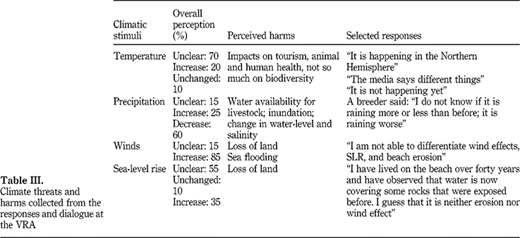
The consultation process conducted before applying the VRA allowed to define a working understanding of vulnerability which was assessed according to the harms that climatic stimuli have produced or they might produce in the exposure unit. This was done to effects of improving the communication with the stakeholders. In order to give comparable responses we here present the results obtained with the stakeholder matrix and dialogues. Seeking simplification only climatic variables were included. The responses are summarised in Tables III and IV.
All the stakeholders (n=34) expressed concern about climatic threats and harms (Table III). First impressions about climatic threats were mostly (90 percent) associated with the occurrence of extreme events such as droughts and wind storms with harms to the local assets. They expressed that climatic issues are increasingly present in the media but 80 percent responded that their perception was not mainly due to them. Most (90 percent) were confident that some adaptation actions will be taken but 40 percent had a weak trust on their effectiveness. Many (60 percent) did not envisage any specific measure, whereas 40 percent could not differentiate global and local actions, and 30 percent mixed adaptation, mitigation, and other environmental issues. All breeders perceived frequent and increasing problems related to freshwater and sea floods. One of them said: “now I guess that something must be done in relation to the sandy bar”. Fishermen and local managers expressed that human intervention to open the bar was needed more frequently than in the past. One fisherman said: “it is happening at least for 15 years” (by 2010). Another said: “It does not open naturally anymore, we need to force it”. Most (90 percent) believed there was a need for climate adaptation. This belief increased over the last three-five years. Most (95 percent) expressed some interest to cooperate with the adaptation process. However, in most cases (75 percent) it was not possible to determine their level of commitment and responsibilities. Most (85 percent) identified winds as the most important coastal climatic stimuli and threat, and 80 percent perceived recent changes (five to 15 years) in storminess.
All the stakeholders identified threats or harms to coastal assets such as erosion related to winds and expressed concern about the information on plausible future changes in wind regime. SLR was not clearly perceived and most (55 percent) could not realise the difference between windstorms, erosion, and SLR, or believed it will happen in the future.
The responses of Laguna de Rocha stakeholders were not statistically different from the ones in other coastal sites in Uruguay (Seijo, 2011b), except for the threats, because of the strong local perception of wind effects. Also, locals showed to be more distrustful in regard to obstacles and political will or effectiveness. The collective negative perception of harms increased after the individual responses. This is attributable to the low percentage of respondents with previous information on climate issues (25 percent), below the whole coast average, and the change of perception by interacting with others, including the scientists. The overall increase in awareness and concern was 11 percent after receiving scientific information and 37 percent on the baseline year (2007).
During the communication of climate concepts and the dialogues, most attendants expressed that the observed variability of rainfall, wind, and sea-level quite matched their perception. On the other hand, many did not agree with the concept of adjustment to this variability, and few thought it was possible to cope with the potential increasing threats if the observed trends were to continue for a few decades.
A selection of the identified supports, needs, constraints, and obstacles to implement adaptation is shown in Table IV. The participatory process was mentioned as the most important support (60 percent). The need to increase monitoring and research was prioritised (50 percent). The existence of other priorities rather than climate threats was ranked as the main constraint (70 percent). A political lack of foresight and planning with regard to climate threats was identified as the main obstacle (45 percent).
Most stakeholders expressed concerns about the recent observed trends and projections for five to 15 years. However, they preferred to focus on observed threats and harms on local assets and the need for anticipation. It was not possible to define critical harm thresholds. For instance, fishermen expected inputs from scientists, whereas managers were reluctant to define them. Almost all agreed that monitoring is a key element to increase resilience (the desired state).
3.4 The influence of the interested parties
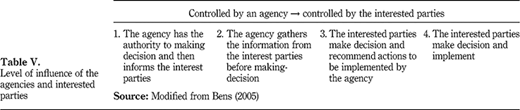
In regards to the influence of the interested parties the institutional and legal framework states that the inputs made during the consultation process do not force decision-makers. Bens (2005) defined a continuum of influences based on which of the interested parties – the agency or the stakeholders – controls the process (Table V).
Thus, according to this criterion the participatory process in Laguna de Rocha was placed by stakeholders in the second type: “the agency gathers the information from the interested parties before making-decision”.
3.5 Process outcomes: implemented measures
A list of about 15 adaptation measures was selected by the end of 2011 (Nagy et al., 2013). Five “soft” measures are already implemented or will be by mid 2013. The first implemented one was the monitoring of beach profiles and erosion along the Uruguayan coast. The other four were prioritised by means of the inclusion of stakeholders' perception in the multi-criteria participatory process. Scientists from the academia and NGOs were involved in their planning. These measures are as follows:
the incorporation of climate issues in the Laguna de Rocha Management Plan, presented by December 2012 (Rodríguez-Gallego et al., 2012);
the design of an agreed participatory multi-criteria model to manage the lagoon sand bar (the protocol);
lists of migratory birds of global relevance and endangered species under a changing climate (Soutullo, 2013); and
soft coastal bio-physical protection measures such as beach and dune vegetation, and wind fencing protection.
The lagoon Advisory Committee (CAE) delayed the acceptance of the lagoon Management Plan until the inclusion of the agreed bar management protocol which includes climatic and hydrological stressors.
4 Discussion
This paper started highlighting the importance of understanding climate change from below, securing active involvement of stakeholders in decision-making, and that community empowerment is a process of re-negotiating power in order to gain more control. These issues are central to achieve effective institutional agreements and feasible measures by means of informed citizen participation instances in decision-making, management, and monitoring.
The joint work of scientists and stakeholders contribute to explain scientific concepts in ordinary language. Eisenack et al. (2007) say:
[…] it might be of higher priority that stakeholders are enabled to apprehend coherences and the scope of the problem instead of science fulfilling demands for more concrete quantitative data or climate change scenarios.
In this regard, Jones (2010) says:
The major considerations are whether a more complex method of representing climate offers greater benefits if correct, or whether the penalty of being wrong using a simple approach is commensurate with the penalty of being wrong using a more complex approach.
The changes of perception allow generating new experiences, interpretations, and consequently the responses of the interested parties (Giddens, 1994), associated with a specific option. On the other hand, the strong variability observed and perceived over the last few years is still too recent and short to suggest that some effective adjustment was achieved by the community.
A first illustrative example of stakeholders' perception is related to the “impact-oriented vulnerability”. Wolf et al. (2013) say “despite several decades of research on the vulnerability of SES, scholars have not been able to agree on the meaning and measurement of it”. Thus, the abstract and some confuse concept of vulnerability used by scientists becomes in ordinary language “Possible harms or losses due to specific threats” (Seijo et al., inpress). This working understanding of “vulnerability” proved to be useful for stakeholders. It is possible to address subjects such as exposure, capacity, resilience, and susceptibility, not so much risk and thresholds. A second example is the fact that most stakeholders now understand the possible existence of links between the recent past and the near future. Their awareness and concerns increased after receiving scientific information. This working understanding is beyond a defined time-horizon management or the uncertainty of climate change.
The approved environmental laws, the institutional arrangements, the ongoing projects, and the political decisions since 2000, such as the categorization of the lagoon area as a protected landscape and land-use restrictions, are increasing its protection. We here argue that though participation is encouraged by law, the legitimate institutional framework might be reluctant to cede decision-making power. There is a substantial difference between consulting and losing control on the decisions. The question therefore arises as how could stakeholders' perception and willingness be effectively included in a participatory process within the existing management framework in Laguna de Rocha.
That is why we focused on public participation in decision-making processes coordinated by the local government and national agencies, rather than on processes emerging directly from the grassroots. However, we also argue that the assessment of stakeholders' perception and their participation to implementing adaptation measures empowers them: “The interested parties recommend actions to be implemented by the agency”. Nagy et al. (2013) call this process the pre-implementation phase, which is in close agreement with Eisenack et al. (2007) which referred to “pre-learning” as a precondition to the creation of adequate adaptation strategies. Thus, pre-learning represents a preliminary stage of knowledge generation. Evidence from recent research suggests that assessments of the role of local knowledge for adaptation needs to give more consideration to local power relations and the interaction with government strategies, while also addressing structural constraints to the use of local knowledge across scales (Naess, 2012).
The co-participation of the local government, the national environment agency, and the national system of protected areas (SNAP) to manage the site through the Lagoon Advisory Committee (CAE), where a broad participation exists, implies some sharing of power. This allows integrating the academia with the stakeholders in order to reach an adaptive ecosystem co-management approach in the near future.
Adaptive co-management can be thought as a making-decision and learning by-doing process in which stakeholders operate under uncertainty (Tompkins, 2005) and where policies are treated as hypotheses, and management as experiments from which managers can learn (Folke et al., 2007). Butler and Coughlan (2011) say that such an adaptive co-management requires continued reevaluation of locally and temporally relevant management strategies so that they evolve along with the climate. They suggest to adapting the concept of variability as a proxy of change. This concept is similar to the “type I” adaptation “to current climate variability and observed change” of Burton (2004), suggested by Nagy et al. (2008) for the adaptation framework of artisanal fisheries of the Rio de la Plata river estuary. This approach is such a kind of experiment where pro-active action might reduce the perception of uncertainty. Thus, the question becomes (for most stakeholders): “Why should we expect these trends will reverse over the near-future?” instead of “How uncertain are the climate scenarios for 2030? So the perceived continuity of “changing” overcomes the uncertainty or the lack of trust on what scholars says about future climate change.”
A good example of a scientific soundness and participatory institutional agreement is the multi-criteria model to manage the lagoon bar opening. This protocol should make easier to solve a longstanding problem for the local government on the basis of sharing power on agreed rational criteria. Ultimately, this reduces the local government conflicts. The protocol is an outcome of the consulting process, the assessment of stakeholders' perception, the agreed priorities, the specific institutional agreements, the Project's funds, and the engagement of an interdisciplinary team of consultants, university scientists, and NGO practitioners. The CAE will only approve the lagoon management plan once the bar protocol is finished. This protocol is a “boundary object”, a concept introduced by Star and Griesemer (1989). A boundary object needs to be both plastic enough to adapt to local needs and constraints of the several parties employing it yet robust enough to maintain a common identity across sites. “A boundary object provides a common point of reference for all participants” to achieve goals in climate adaptation (Lynch et al., 2008).
The success of integrating scientists and stakeholders into the management policy exceeds the objective of protecting the environment and the biodiversity from climate threats in a sustainable way, which remains to be demonstrated. It is a learning-by-doing lesson. The step-by-step process being followed to assess scientific and local knowledge within an institutional framework is the true success. It allows for the inclusion of stakeholders' perception of climate threats into the management framework, increasing the legitimacy of the decisions. This is in agreement with Tompkins and Adger (2004) “the learning that occurs in groups can more easily be incorporated into management processes in flexible informal institutions”. The lagoon advisory committee (CAE) is a co-management institutional arrangement which increases the level of decision-making of community and NGO stakeholders while balancing local and national responsibilities.
One of the objectives of the Project is to replicate the adaptation process. Successful implementation of the process outlined above, also sets the stage for extending the pilot analysis to a national adaptation response (Nagy et al., 2013).
Having said that, we are not sure this experience could be replicated without external facilitation and support. We also believe that achieving agreed critical thresholds remains a challenge.
5 Conclusions
The study suggests that inclusion of stakeholders' perception in the process of making-decision allowed to:
survey local knowledge and compare it to scientific views;
increase public awareness and understanding of the climatic threats on the exposure unit;
increase public support to the institutions in charge;
facilitate conflict resolution;
promote the development of specific actions on the exposure unit;
increase local coping capacity; and
implement positive actions towards the desired state of increased resilience.
The share of the existing power by the local government and national agencies places the management process in Laguna de Rocha closer to the third type of influences of Bens.
The basis for an adaptive co-management, such integrating scientific knowledge and monitoring with stakeholders' engagement, agreement, and understanding are already achieved.
The project's scientists have apprehended the importance of the interaction with stakeholders beyond what the international funding agencies and the literature say.
In order to moving forward with adaptation planning in Uruguay this experience should allow obtaining more support for new initiatives, stakeholders' commitment need to increase, and agreed critical thresholds should be explicit.
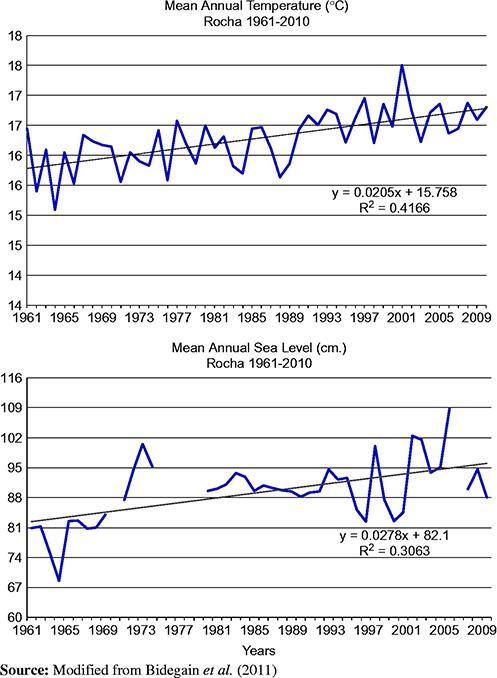
Time-series (1961-2010) and trends of mean annual temperature at Rocha and mean sea-level at La Paloma (Rocha)
Time-series (1961-2010) and trends of mean annual temperature at Rocha and mean sea-level at La Paloma (Rocha)
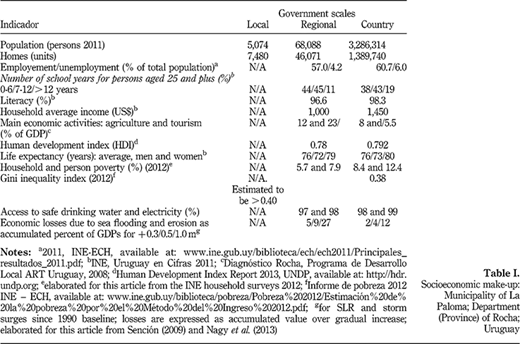
Socioeconomic make-up: Municipality of La Paloma; Department (Province) of Rocha; Uruguay
Socioeconomic make-up: Municipality of La Paloma; Department (Province) of Rocha; Uruguay
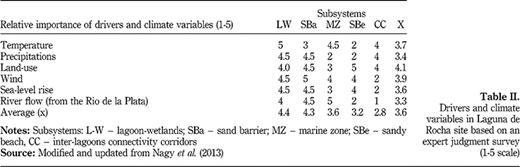
Drivers and climate variables in Laguna de Rocha site based on an expert judgment survey (1-5 scale)
Drivers and climate variables in Laguna de Rocha site based on an expert judgment survey (1-5 scale)
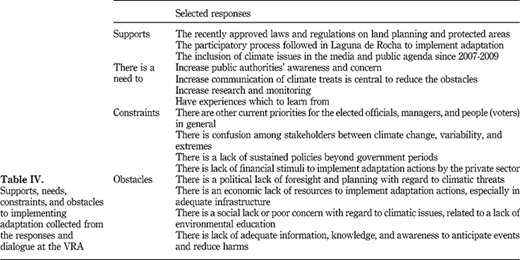
Supports, needs, constraints, and obstacles to implementing adaptation collected from the responses and dialogue at the VRA
Supports, needs, constraints, and obstacles to implementing adaptation collected from the responses and dialogue at the VRA
References
Authors' affiliations
Gustavo J. Nagy: Grupo de Cambio Ambiental y Gestión Costero-Marina, Oceanografía y Ecología Marina, IECA; Facultad de Ciencias, UdelaR, Montevideo, Uruguay and Project: “Implementing Adaptation to Climate Change in Coastal Uruguay”, UCC-DINAMA, Montevideo, Uruguay.
Leonardo Seijo: Grupo de Cambio Ambiental y Gestión Costero-Marina, Oceanografía y Ecología Marina, IECA; Facultad de Ciencias, UdelaR, Montevideo, Uruguay and Project: “Implementing Adaptation to Climate Change in Coastal Uruguay”, UCC-DINAMA.
José E. Verocai is based at Grupo de Cambio Ambiental y Gestión Costero-Marina, Oceanografía y Ecología Marina, IECA; Facultad de Ciencias, UdelaR, Montevideo, Uruguay and Servicio de Oceanografía, Hidrografía y Meteorología de la Armada, Montevideo, Uruguay.
Mario Bidegain is based at Dirección Nacional de Meteorología, Climatología, Monteyideo, Uruguay and Grupo de Cambio Ambiental y Gestión Costero-Marina, Oceanografía y Ecología Marina, IECA; Facultad de Ciencias, UdelaR, Montevideo, Uruguay.
About the authors
Dr Gustavo J. Nagy is an estuarine oceanographer and graduated from the University of Bordeaux I in France. He is an Associate Professor and Researcher on earth system science, global change, and estuarine environments at the Faculty of Sciences of the UdelaR, Uruguay since 1993. He has participated in several projects on estuarine processes, coastal management, climate change and variability, and climate adaptation. He also worked for the British Government (Stern Report), the United Nations (RECCS Latin America, Santiago de Chile), and was a Lead Author of IPCC AR-4, Group II, 13. He is currently a Consultant on adaptation of a GEF-Project on coastal climate and ecosystems in Uruguay, and an invited Professor of vulnerability, impacts and adaptation assessment at the University of Asuncion, Paraguay. Gustavo J. Nagy is the corresponding author and can be contacted at: gustavo.nagy56@gmail.com
Leonardo Seijo is a Sociologist and graduated from the UdelaR, Uruguay. He is currently writing his Master thesis in Regional Development at FLACSO, Argentina. He has worked in NGOs on environment, society, and public participation, and at the Directorate of the Environment in EIA. He is currently a Consultant on facilitation in participatory adaptation and vulnerability reduction assessment for the GEF-Project on Climate Adaptation.
José E. Verocai is an oceanographer and graduated as an MSc in ecology from the UdelaR, Uruguay. He is an Assistant Professor and Researcher on oceanography, estuaries, and extreme events at the Facultad de Ciencias, UdelaR. He is currently in charge of the Division of Physical Oceanography of the Uruguayan Navy Hydrographic Bureau. He was in charge of sea-level rise, river flow, and extreme events for two university consultancies on climate subjects for the GEF-Project on Climate Adaptation.
Mario Bidegain is a Meteorologist and MSc graduated from the USP, Brazil. He joined the Facultad de Ciencias, UdelaR in the 1980s as an Assistant Professor and Researcher on climatology. He is currently in charge of the Division of Climatology at the Uruguayan Meteorological Bureau. He has worked on several projects on climate change and variability in coastal areas, agriculture and water resources as a climate analyst and modeller. He was in charge of two university consultancies on climate subjects for the GEF-Project on Climate Adaptation.
The research was carried out within the project “Implementing Pilot Adaptation Measures to Climate Change in Coastal Areas of Uruguay” (www.cambioclimatico.gub.uy), UNDP URU 07-G32. Funding under the Global Environment Facility (GEF) is gratefully acknowledged.

