


– This paper aims to examine the perceptions and experiences of climate change by local farmers in the Northern Savannah zone of Ghana. Although recent scholarship shows that local people’s perceptions of climate change is necessary for devising strategies to deal with the problem, only a few researchers have examined local knowledge of climate change in Africa.
– Primary data were collected from six rural communities in the Northern Savannah zone of Ghana, using a questionnaire survey on a sample of 530 farmers, in-depth interviews and focus group discussions. Multinomial logistic regression was used to analyse variations in experience and perception of climate change.
– A majority of the farmers have noticed rising temperatures and declining rainfall. Their observations largely correspond with the evidence of changes recorded by weather monitoring stations. The perception of climate change is associated with locality of residence, gender and ownership of radio. The impacts of climate and variability include declining crop output, food insecurity and water stress. Respondents attributed changes in climatic parameters to economic activities and spiritual factors. It is recommended that environmental managers should actively involve local farmers in the design and implementation of policies to control climate change and variability.
– The methodology used demonstrates how multinomial logit models can be used to investigate perceptions of climate change. The research findings also provide very useful information that can be relied upon to design policies to deal with climate change and variability in Ghana.
Introduction
In recent years, there has been increased discussion in both academic and policy circles about the impacts of climate change and variability on human society (Strauss and Orlove, 2003; Couzin, 2007; Byg and Salick, 2009; Rademacher-Schulz et al., 2014). It is generally acknowledged that climate change particularly represents a serious developmental challenge in the drier regions of Africa (Huq et al., 2004; Dietz et al., 2004; Sivakumar et al., 2005; Odada et al., 2008; Mertz et al., 2009), where many people depend on rain-fed agriculture and ecosystem services for their livelihoods (Davies, 1996; Van der Geest, 2011).
In view of the negative effects of climate change, climate scientists have, for a long time, depended on statistical models to measure changes in climatic parameters and to predict their impacts on various segments of society (Held et al., 2005; Weber, 2010). As a result of the belief that local perceptions of climate change do not correspond with the scientific record, local people’s knowledge of climate variability was not adequately explored in most of the earlier studies by climate scientists (Sivakumar et al., 2005; Maddison, 2006; van Aalst et al., 2008).
In recent years, however, it has been acknowledged that scientific models that ignore local people’s perceptions about climate change are inappropriate, as local knowledge can be useful for designing policies for dealing with the negative impacts of climate change (Byg and Salick, 2009; Weber, 2010). Policy decisions based on scientific models alone may not reflect the concerns and priorities of local people. In view of recent understanding of the role of local knowledge in dealing with climate change, a number of researchers have examined local farmers’ experience of climate change and variability (West et al., 2008; Yaro, 2013). Ingram et al. (2002), for instance, examined spatial variations in farmers’ perception of climate change and ability to use forecasts in Burkina Faso. A study by Roncoli et al. (2002) also showed how farmers in Sahel use a variety of local indicators to predict rains and adapt their resource management strategies accordingly. West et al. (2008) examined local perspectives on rainfall trends in Burkina Faso, while Meze-Hausken (2004) compared local farmers’ perceptions of climate variability with measurements of rainfall variability in northern Ethiopia. In Ghana, a recent study by Yaro (2013) examined climate change perceptions among farmers in southern Ghana.
While these earlier studies are very useful, some of the factors that account for spatial variations in climate change perceptions have not been adequately explored. For instance, there is little understanding of how availability of underground water and access to information may affect farmers’ perceptions of climate change. A review of the literature also shows that apart from a few shining examples (Ingram et al., 2002; Deressa et al., 2011), most of the previous climate change studies, in Africa, adopted qualitative approaches (West et al., 2008; Yaro, 2013), and therefore, did not adequately examine the predictors of climate change perceptions.
This paper examines the knowledge, perceptions and experiences of climate change by local farmers living in the Northern Savannah zone of Ghana. The following questions are addressed:
Q1. What climate changes have farmers in the Northern Savannah zone of Ghana noticed over the past 30 years?
Q2. Do farmers’ perceptions of climate change correspond with climate data recorded at the meteorological stations?
Q3. Do perceptions of climate change vary among farmers in the study area?
Q4. How do farmers evaluate changes in climatic parameters?
Q5. What are the effects of perceived climate change on livelihoods in the Northern Savannah zone of Ghana?
We relied on both qualitative and quantitative data to answer these research questions. A unique element of our methodology is the use of a multinomial logistic regression model to examine the predictors of perceptions of climate change. These models have been used in a few climate change studies outside Ghana. Nhemachena and Hassan (2007), for instance, used the multivariate probit model to analyse factors influencing the choice of climate change adaptation options in Southern Africa. Deressa et al. (2011) also adopted the multinomial logit model to analyse factors that affect the choice of adaptation methods in the Nile basin of Ethiopia. However, there has been a limited use of multinomial models in studies on perceptions of climate change in Ghana and elsewhere in Africa. Our study will therefore throw more light on how multinomial logit models can be used to investigate local people’s perceptions of climate change and variability.
Theoretical background
Although the concept of climate change has gained much currency in recent years (Maddison, 2006; Weber, 2010; IPCC, 2014), it has been defined differently by various researchers. Following the definition provided by the United Nations Framework on Climate Change (UNFCCC), in its Article 1, climate change is defined here as:
[…] a change of climate which is attributed directly or indirectly to human activity that alters the composition of the global atmosphere and which is in addition to natural climate variability observed over comparable time periods (UNFCCC, 2014, p. 1).
The manifestations of climate change and variability may vary spatially (Gbetibouo, 2009). In arid and semi-arid regions of Africa, changes in temperature and rainfall are usually used as indicators of climate change, as these variables have significant effects on agricultural production (Maddison, 2006; Gbetibouo, 2009).
The role of local knowledge in dealing with climate change has been debated by various scholars. It is has been suggested that because memory of past events can be faulty, climate change is difficult to detect accurately based on experience of local people (Weber, 2010). It is also often argued that local people’s recall of past climatic events may largely be influenced by idealised images of how things should have been or were in the past (Madission, 1996; DiMaggio, 1997; Berkes, 2002). On the other hand, researchers who believe that local knowledge is important for dealing with climate change have argued that effective adaptation to climate change is contingent on the perceptions of farmers and the ability of policy-makers to merge these with scientific knowledge systems (Mortimore, 1989; Stern et al., 1997; Mendelsohn et al., 2006). According to Yaro (2013), perceptions of local farmers about climate change tend to have a strong influence on their willingness to accept adaptation strategies.
Resent scholarship has also shown that perceptions of climate change tend to vary spatially (Gbetibouo, 2009). Maddison (2006) reported after a study in 12 African countries that perceptions of temperature changes tend to vary among localities. Some studies have also shown that, even within the same village, perceptions of climate change may vary according to specific socio-demographic characteristics, including level of education, gender and age (Kofinas et al., 2002; Berkes, 2002; Byg and Salick, 2009). Although education can enhance farmers’ knowledge of changes in change, the relationship between educational status and perception of climate change is not universal (Gbetibouo, 2009). It is also often assumed that older farmers are more likely to notice changes in climate than younger farmers (Maddison, 2006). However, in situations where changes in climate have occurred more recently, the association between climate change and age may be negligible (Byg and Salick, 2009). Given the complex nature of the relationships between socio-demographic variables and perceptions of climate change, this study will help to explain the factors that shape perceptions of climate change in the Northern Savannah zone of Ghana.
Research methodology
Study communities
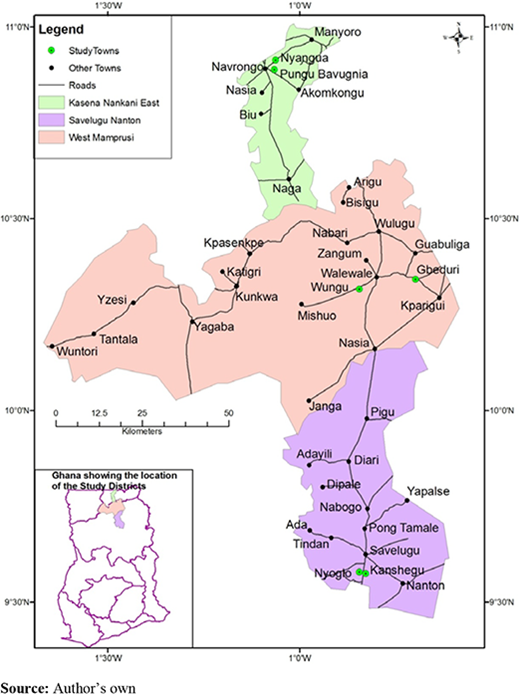
Data used for this paper were collected from six rural communities in the Northern and Upper East Regions of Ghana. These communities were purposively selected to ensure adequate representation of the Northern Savannah zone. The climate of the Northern Savannah zone is relatively dry, with a single rainy season that begins in May and ends in October. The annual rainfall amount varies between 750 and 1,050 mm. The natural vegetation of the area is that of the Guinea Savannah woodland and the Sudan Savannah.
Two villages were chosen from each of the following three districts in Northern Savannah: Savelugu-Nantong, West Mamprusi and Kassena-Nankani East (Figure 1). Savelugu Nantong is a rural district which is located in the Northern Region. It has total population of 1,39,283 in 2010. The two communities selected from this district were Kanshegu and Nyoglo. Both are farming communities where major staple crops include beans, millet, rice, maize, soybeans and yams.
The West Mamprusi District belongs to Northern Region of Ghana. The population of this rural district was 1,68,011 in 2010. The two communities selected from this district were Wungu and Gbeduri. They have similar physical features, but water stress is more pervasive at Gbeduri as a result of low water table which limits access to ground water. The Kassena Nankana East District is located in the Upper East Region of Ghana. Its population in 2010 was 1,09,944. The two communities selected from this district were Pungu-Bavugunia and Nyangua. The people living at Pungu-Bavugunia are predominantly farmers growing mainly food crops such as potatoes, millet, corn, guinea corn, pepper and tomato. Dry season gardening is possible because of the closeness of the water table to the surface. Even though a few boreholes exist, many farmers construct their own wells. On the other hand, the farmers of Nyangua engage in dry season irrigation farming where water is drawn from hand-dug wells for cultivating tomatoes, pepper, garden eggs and leafy vegetables for sale.
Data collection
The methods used to collect data were questionnaire survey, in-depth interviews and focus group discussions. A total of 530 farmers participated in the questionnaire survey. A multistage sampling technique (Bryman, 2001) was used to select the respondents. A systematic sampling technique was used to select 550 houses in the selected communities. Trained research assistants then visited each selected house, and interviewed one household head or a knowledgeable adult of the household. In cases where there were more than one household in a selected house, one of them was randomly selected for the survey. There were 530 respondents because 20 selected households refused to participate or were not available during the time of the survey.
Two focus group discussions were also held in each of the six communities. The first one comprised the traditional chief and ordinary men of all ages, numbering between 12 and 18 people. The choice of elders and young men enabled us to capture the structure of power and the different aspirations and perceptions of the elderly and the young. The second focus group discussion was made up of women of all ages, also numbering between 12 and 18 people. Women were separated from men during the focus group discussions because, in such traditional societies, women do not feel comfortable debating with men. Themes of the focus groups’ discussions included perceptions of the climate change, governance of local institutions, access to resources and adaptation strategies to climate change over time.
Expert interviews were held with district planning officers, while in-depth interviews were held with ordinary men and women in the study communities. We purposefully selected ten people from each community composed of five men and five women for this exercise. We were interested in their life stories about their perceptions of climate change and adaptation strategies.
Measurement of variables and methods of data analysis
Local farmers’ perceptions of climate change was assessed by asking them if they have noticed any changes in climatic variables over the past 30 years. We first compared trends in climate data recorded at the meteorological stations with patterns observed by our respondents. This approach is similar to the approach adopted in some previous studies (Hageback et al., 2005; Maddison, 2006; Gbetibouo, 2009).
At the bivariate level of analysis, we used cross-tabulations to examine the relationships between perceptions of climate change and certain socio-demographic variables. The multivariate analysis involved the use of the multinomial logit model to analyse the predictors of climate change perceptions. This model is deemed appropriate because the outcome variable (perception of climate change) has three independent response categories, namely:
“Yes the climate is changing”;
“No the climate is not changing”; and
“Don’t know”
The response category “Don’t Know” was chosen as the baseline. The log-odds were made to be a linear function of the predictors in a form, f(k, i) to predict the probability that observation i has outcome k, which is generally stated as: Equation 1
Where βM,k is a regression coefficient associated with the Mth explanatory variable and the Kth outcome. The regression coefficients and explanatory variables are normally grouped into vectors of size M + 1, so that the predictor function can be written more compactly: Equation 2
Where βk is the set of regression coefficients associated with outcome k, and χ (a row vector) is the set of explanatory variables associated with observation i. We considered the following explanatory variables: sex, age group, education, village of residence and radio ownership. Separate relative risk ratios (RRR) were determined for all independent variables for each category of the dependent variable. Mathematically, RRR is represented as: Equation 3
where for the ith individual, y i is the observed outcome and X i is a vector of explanatory variables. The standard interpretation of RRR is that for a unit change in the predictor variable, the RRR of outcome relative to the reference group is expected to change by a factor of the respective parameter estimate, provided the variables in the model are held constant. Having “Don’t Know” as the base outcome, we follow this interpretation to identify the factors that affect a respondent’s perception of climate change.
An indicator of overall model significance is given by the Prob>chi2 which is the probability of getting a likelihood ratio test statistic as extreme as, or more so, than the observed under the null hypothesis; the null hypothesis is that all of the regression coefficients in the model are equal to zero.
Limitations of the study
Although we would have liked to extend the climate data analysis to the 1960s, lack of accurate rainfall and temperature data made this impossible. Consequently, the climate data analysis was restricted to past 30 years (1980-2012). We are, however, confident that the climate trends established here reflect long-term changes. Although the study focused on the Northern Savannah zone, resource constraints did not allow us to select people from the Upper West Region. The Northern and the Upper East Regions were selected for the study. However, we believe that the findings are representative of the Northern Savannah zone, as the Upper East and Upper West Regions have similar characteristics.
Comparing perceptions of climate change and meteorological stations’ data
Ordinary people’s perceptions about climate change and variability are usually based on observations of climatic variables that affect their lives (Weber, 2010). In this research, therefore, respondents were asked questions about changes in temperature, rainfall and drought.
Changes in temperature
As displayed by Table I, about 80.2 per cent of the 530 survey respondents have the perception that the average temperature in their communities has increased in the past 30 years. Only 34 (6.4 per cent) respondents noticed a decrease in the temperature. In five of the six communities, more than 80 per cent of respondents perceived long-term increase in temperature. The exception is Nyangua, where only 34 (38.6 per cent) of the 88 respondents perceived the temperature in their community to be increasing. The findings suggest that perception of temperature changes slightly varies across the study communities. Our findings are consistent with the findings of Maddison (2006) who reported after a study in 12 African countries that perceptions of temperature changes tend to vary among localities.
Although meteorological data do not always support farmers’ perceptions about climate change (Ovuka and Lindqvist, 2000), our respondents’ perceptions about changes in temperature correspond with the scientific record in the region. Data obtained from Navrongo (Figure 2) were compared with responses from Pungu-Bavugunia and Nyangua, while data from Tamale (Figure 3) were compared with responses of the remaining four communities (i.e. Nyoglo, Kanshegu, Gbeduri, and Wungu). Consistent with trends established for the entire Ghana (Owusu and Waylen, 2009), the mean temperatures have increased in the study areas.
Changes in rainfall pattern
Of the 518 valid responses to the question that sought to find out if respondents have observed changes in rainfall pattern, 296 (57.1 per cent) reported noticing a decrease in rainfall amount over the past 30 years. Another 199 (38.4 per cent) have noticed extreme fluctuations in the rainfall pattern (Table II). In five out of the six villages studied, the majority of respondents believed that rainfall amount had decreased. The only exception is Nyangua where only 26.4 per cent of the respondents noticed a decrease in precipitation over the past 30 years.
Many of the respondents reported specific changes in the rainfall regime. As shown in the statement below, some farmers mentioned that, in recent years, the main rainfall season is coming late and is also very short:
We are going through serious problems which affect our families. These days the rains don’t come during the planting season. So we are not able to get enough food for our people. Most of the young ones have left here because of this problem (A 50-year-old farmer at Kanshegu, 2012).
Some respondents also complained about fluctuations in the onset of the rains. Data obtained from the nearest meteorological stations also indicate that there is a significant variability in the amount of rainfall from year to year. Figure 4 depicts rainfall amount recorded at Navrongo weather station, which is close to Nyangua and Pungu-Bavuginia. Figure 5 shows rainfall data recorded in Tamale, which is also close to four of the study areas (i.e. Nyoglo, Kanshegu, Wungu and Gbeduri). While the trend lines show that there was no significant decrease in the amount of rainfall in areas around these weather stations, significant fluctuations were noted in the amount of rainfall recorded at both weather stations. During the in-depth interviews, it came out clearly that respondents were equating these fluctuations in the rainfall regime with a decrease in the rainfall amount.
To understand how rainfall fluctuations affect farming activities, we evaluated the seasonal variations in the amount of rainfall. We categorized the rainfall data for four seasons based on planting and harvesting periods. The seasons are: December-February (i.e. period for land preparation); March-May (planting season in which rains are needed); June-August (the major rainy season) and September-November (minor rainy season). The trend lines (Figures 6 and 7) indicated that, for both stations, the rainfall amount has been declining slightly during the main planting season (March-May). Thus, although the total annual rainfall is not declining, the amount recorded during the planting period has been declining in these communities. It is, therefore, not surprising that many of the farmers reported noticing decline in rainfall amount.
Perceptions of climate change
Changes in temperature and rainfall regimes may not always mean that the climate is changing (Tschakert, 2007). When asked about their perception of climate change, 449 (84.7 per cent) of the respondents believed that the climate is changing, while 5 (0.9 per cent) believed that the climate is not changing. A number of farmers were also not certain about what climate change actually mean, although they maintained that the rainfall pattern has changed. Respondents who reported that the climate has changed cited a decline in rainfall amount as an evidence of climate change. Many of the respondents were able to give detailed accounts of recent short-term changes in comparison to longer-term trends. They have explained that, although the Northern Savannah zone is generally dry, it is becoming drier in recent years. This scenario resonates with the assertion of Jolly et al. (2002) that people tend to evaluate climate change in comparison with the amount of variability that is considered normal in their environment. Given the fact that planting is tied to the onset of the rains, some of the respondents used changes in the planting time as indication that the climate has changed. This is captured in the following statement by a focus group discussion participant at Pungu-Bavuginia:
I have lived here for about 40 years and I can say that the climate has changed. In the past the rain came early enough for us to sow millet but now it is difficult to predict when they rain will start. So the sowing season always come later than the situation some years ago.
When asked directly about the occurrence of droughts in their communities, 166 (31.3 per cent) of the respondents stated that drought occurs frequently, while another 316 (59.6 per cent) stated that drought occurs occasionally during the farming season. Only 15 (2.8 per cent) of respondents believed that drought is not common in their areas. Again, when asked if drought is threatening today, 451 (85.1 per cent) of the farmers believed that drought was threatening today than 30 years ago. On the other hand, only 79 (6.8 per cent) respondents did not believe that drought is threatening today than 30 years ago.
Bivariate analysis of variations in perceptions of climate change
We examined the relationship between farmers’ perceptions of climate change and variables such as place of residence, age, gender, level of education and ownership of radio. The bivariate analysis (Table III) shows that perceptions about climate change varied across the communities. For instance, while 98.8 per cent of respondents in Nyangua believed that the climate has changed, 82.9 per cent of their counterparts in Kanshegu observed changes in the climate. Perception about climate change is, however, not sensitive to respondents’ age. This finding was unexpected because it is often assumed that older farmers who have had the most experience of farming are more likely to notice changes in climate than younger farmers (Maddison, 2006). According to Byg and Salick (2009), a lack of relationship between age and perceptions of climate change may suggest that the changes have occurred quite recently and so even younger respondents have also noticed them. As captured in the following statement, some younger respondents have also based their arguments on what they have heard about the past:
Our parents have told us that in the past the rain was coming well. It was well distributed and crops yielded well too. But now, the rain does not come well. We will often plant our crops and the time the crops need the rain, it will stop coming (A 22-year-old farmer at Wungu, 2012).
Men were more likely to have noticed changes in climate than women (95.9 vs 89.6 per cent). Respondents with tertiary education were more likely to have noticed changes in climate than their uneducated counterparts (100 vs 93 per cent). Given that information on climate change is sometimes disseminated via radio, we examined the relationship between ownership of radio and perception of climate change. Our data show that the proportion of respondents who have noticed changes in climate was higher among those with radio (96.1 per cent) than those without radio (89.5 per cent).
Multivariate analysis of predictors of perceptions of climate change
The multinomial logistic results presented in Table IV shows that gender, village of residence and ownership of radio are the most important predictors of the response “yes climate is changing”. If the respondent were female as opposed to male, the relative risk ratio for having the perception that the climate is changing relative to not knowing if the climate is changing would be expected to decrease by a factor of 0.29, given that the other variables in the model are held constant. More generally, we can say that if a subject were to be female, she is more likely to be in the “don’t know” category as compared to the “Yes climate is changing” category. Again, if the respondent were from Nyoglo and Kanshegu compared to those from Wugu, the relative risk ratio for having the perception that the climate is changing relative to not knowing if the climate is changing would be expected to decrease by a factor of 0.06, while holding all other variables in the model constant. It would be noted that although very high relative risk ratios are associated with the respondents coming from Gbeduri village compared with those from Wugu, it did not prove significant in explaining the perceptions that the climate was changing. The very high relative risk ratios for Gbeduri can be explained by the fact that virtually all respondents from this village believed that the climate was changing, and none of the respondents chose the “don’t know” response category, thus indicating a very high degree of certainty.
A similar observation is made concerning the education variable which shows very high relative risk ratios for subjects with a tertiary level of education even though the educational level of the respondents did not prove significant in explaining their perceptions that the climate was changing. Here again, it is explained by the fact that all respondent with a tertiary level of education answered “yes” to the question of a changing climate. In both cases, there is very little or no variability in the responses, thus attracting the very high relative risk ratios on their responses. The access to information on climate-related issues is very important in shaping peoples’ perceptions on climate change. The results indicate that if the respondent does not own a radio set, the relative risk ratio for having the perception that the climate is changing relative to not knowing if the climate is changing would be expected to decrease by a factor of 0.14 while holding all other variables in the model constant. The results suggest that radio programmes play a big role in educating people on issues relating to the climate change.
On the other hand, a number of background variables are associated with the response “No the climate is not changing”, relative to don’t know if climate is changing. Given a subject in the 20- to 50-year age group, the relative risk of having the perception that the climate is not changing would be 0.11 times more likely when the other variables in the model are held constant. For females relative to males, the relative risk ratio for having the perception that the climate is not changing relative to not knowing if the climate is changing would be expected to decrease by a factor of 0.08 while holding all other variables in the model constant. If the respondent does not own a radio set, then the relative risk ratio for having the perception that the climate is not changing relative to not knowing if the climate is changing would be expected to decrease by a factor of 0.05 while holding all other variables in the model constant.
Impacts of perceived climate change and variability on livelihoods
Given that local people’s observations of changes in climatic variables usually reflect the actual effects of such changes on their livelihoods (Berkes et al., 2001; van Aalst et al., 2008), our respondents were asked to state how climate change/variability affect their livelihoods. In other studies, there were significant spatial variations in the reported impacts of climate change (van Aalst et al., 2008; Byg and Salick, 2009). In this study, however, similar impacts were reported by respondents in the various communities. The general impacts identified by respondents include declining crop output, food insecurity, high levels of poverty, water stress and health problems associated with harsh weather conditions.
Respondents reported that crop production is affected significantly by both less rainfall and increased temperatures. About 87.7 per cent of the respondents indicated that less rainfall has more or a lot more adverse effects on crop production, while 91.5 per cent believed that increased in temperatures has more or a lot more effects on crop production. The respondents complained that because of the irregular pattern of the rainfall and increased temperatures, the seeds they sow sometimes do not germinate. This causes them to lose significantly:
Yesterday, I run home from my workplace hoping it will rain so I called a tractor to come and plough for me. I had to go back and stop the tractor operator since it did not rain. So something’s like that makes us lose a lot. Sometimes some of us do not even have seedlings at home and have to buy from the market. If we sow and they do not germinate, all the cost is ours […]. You see that the area around us is all grassed. If it had rained we would have ploughed this area (A 36–year-old farmer at Gbeduri, 2012).
Some farmers also explained that as a result of unreliable rainfall and increased temperatures, their crops are sometimes destroyed by heat and they are forced to plant again:
We experienced massive crop failure last year as a result of unreliable rain and extreme temperature. This year too most of us had to uproot our crops and do second planting due to the prolonged drought that destroyed the first crops. In situations like this we become poorer (Male focus group discussion at Nyoglo, 2012).
Unreliable rainfall and increased temperatures also affect animal production, as it makes it difficult for farmers to feed their animals. An overwhelming majority (94 per cent) of the respondents indicated that less rainfall has more or a lot more adverse effect on livestock production. Similarly, 91.7 per cent of respondents believed that increased temperature has more or a lot more adverse effect on livestock production. About 98 per cent of the respondents also indicated that unreliable rainfall has a lot more or more adverse effects on food security. During the in-depth interviews, a 51-year-old farmer at Nyoglo explained how he had to struggle to get food to feed his family in the following words:
The harvest for last year is finished, we have finished consuming it and there is no rain. By now we should have been harvesting something to sustain us but the food is finished so that is the problem, we are not getting adequate food.
Ajara, a 45-year-old woman at Pungu-Bavuginia, also explained how declining rainfall has affected harvest and forced women to work to feed their families:
These days our husbands do not get good harvest because the rains do not come at the right time. So we do not have sufficient food. This has compelled women in this community to find other ways of getting money and food to feed our children but it is very difficult for us. Our businesses are now deteriorating as we use all the money we get to buy food.
On the other hand, 95.7 per cent of the respondents noted that less rainfall has more or a lot more adverse effects on cash income in the area, as they do not produce enough to sell. Relatively, a smaller percentage (69.5 per cent) of respondents believed that declining rainfall affects their health. This is not surprising given that the relationship between declining rainfall and health is not direct (Fox, 2002). Some of the respondents who mentioned that declining rainfall affects their health were able to link it with declining yield and malnutrition. Others also linked the declining yield to poverty which makes it difficult for them to take their dependents to hospital when they are sick.
Evaluation of perceived climate change
The local farmers attributed the causes of recent changes in temperature and rainfall patterns in their localities to several factors. Many respondents believed that changes in climatic parameters are caused by some acts of commission or omission on the part of some members of their communities. The causal factors mentioned by those who blamed other members of their societies for changes in climate can be divided into two categories. One category of factors has to do with economic activities. For instance, some respondents attributed increased temperatures and declining rainfall to felling of trees for sale or for firewood. Some respondents also mentioned indiscriminate bush burning by some farmers as the main cause of rising temperature and declining rainfall. The other category of causal factors identified by respondents is spiritual. As shown in the statement below, some of the respondents believed that declining rainfall is caused by their violation of taboos, such as the spilling of human blood:
Taboos and customs are no longer respected. Now people see spilling of human blood (killing) to be nothing. If these things happen in a society then you can expect drought to occur (A 53-year-old farmer at Kanshegu, 2012).
Respondents who attributed climate change to spiritual factors also believe that the problems can be solved by consulting soothsayers and offering sacrifices to the gods. This is captured in the following statement by 51-year-old-farmer at Gbeduri:
In the past, we had people who could perform certain rituals for the rains to come. When I was young, someone came here when the rain was not coming. He went to a farm and uprooted millet and placed it on the shrine, then with his hands on his head, he started crying saying that the world was on fire. Going around the shrine, the rain started falling. Today, we are no longer able to follow tradition, and that is why things no longer work well […]. Even recently, we brought a soothsayer here and when he told us to bring a goat for sacrifice, we did it and the rain came, though not as much as we would have liked.
In most cases, the behaviour identified as a root cause of declining rainfall and rising temperatures was of a general nature, such as overgrazing and harvesting trees for firewood. In some cases, however, some particular groups of people were blamed for being responsible for changes in climatic variables. For instance, some elderly respondents were also blaming the youth for failing to observe taboos. Some respondents also blamed nomadic herdsmen for over-grazing that leads to climate change. This scenario is similar to the situation in the 1970s when nomads were blamed for spreading the Sahel drought (Grainger, 1990).
A few respondents were also of the view that the changes in climatic parameters are due to natural events, which human beings do not have control over. For instance, a 24-year-old farmer in Nyoglo stated: “we can’t tell exactly what the causes are. It is the will of God. Humans have no control over rain”. Such beliefs which suggest that climate change is a divine phenomenon that cannot be influenced by human activities have been reported elsewhere in Africa (Byg and Salick, 2009).
Discussion and conclusions
The findings of this study show that a majority of the local farmers in the rural savannah zone of Ghana have noticed that temperatures are rising and rainfall is declining. Critics of subjective approaches to the measurement of climate change have suggested that climate change is difficult to detect accurately based on personal experience (Weber, 2010). Although farmers in the Northern Savannah zone have based their perceptions of changes in climatic parameters on past weather conditions, their observations generally corresponded with the evidence of changes recorded by nearby weather monitoring stations. The only difference is that they equated fluctuations in rainfall amount with declining rainfall. This is understandable because both fluctuations in rainfall regime and declining rainfall cause crop failure. These findings, thus, strongly support the assertion that local knowledge of climate change is reliable and consistent with evidence shown by scientific data (Couzin, 2007; van Aalst et al., 2008).
Consistent with results of some earlier studies (Fox, 2002; Kofinas et al., 2002), farmers’ perceptions about changes in the climate vary from one community to another. Farmers in Nyangua were less likely to notice increase in temperature and declining rainfall than people in the other five communities. Elsewhere, such spatial variations in perceptions of climate change have been explained by differences in village age, location, available technologies and predominant subsistence activities (Ingold and Kurttila, 2000; Quinn et al., 2003) as well as cultural differences (Douglas and Wildavsky, 1982; Strauss and Orlove, 2003; Leiserowitz et al., 2008; Weber, 2010). The communities we investigated were generally of the same age, and differences in available technology and culture were not significant. Variations in availability of ground water for agricultural activities may explain spatial variations in perceptions about climate change. One reason why farmers at Nyangua were less likely to notice increase in temperature and declining rainfall than those in the other communities was the fact that the water table at Nyangua is so high that many farmers easily get water from hand-dug wells to water their crops even during drought. We conclude that communities with scarce irrigation facilities are more likely to notice declining/fluctuations in rainfall than those with such facilities.
The analysis also shows that men were more likely to observe changes in climatic parameters than women. The differences here may be related to gender division of labour in the household. In many households, both men and women work on the farms. However, in some cases, the women, who were involved in trading activities, considered farming as a secondary economic activity. As Maddison (1996) noted elsewhere, people who depend on weather for all their economic activities are more likely to notice changes in climate.
Both younger and older farmers had noticed changes in the climate. This finding is in a sharp contrast with the reports by some earlier researchers that older people are more likely to notice changes in climate than younger people (Maddison, 2006; Alessa et al., 2008). According to Byg and Salick (2009), a weak relationship between climate change and age is an indication that the observable changes have occurred within a relatively short time span so that even younger respondents have noticed changes. This appears to be the case in our study communities. Although most previous studies did not examine the role that radio messages play in climate change perceptions, our findings show that ownership of radio set is strongly associated with the perception that climate is changing. This means that state agencies can rely on radio and other channels to disseminate information on environmental change.
Various impacts of climate change were identified by our respondents. The negative impacts include, declining output of agricultural products, food insecurity, poverty, water stress and poor health. Because these problems are also caused by other factors (e.g. high population growth and declining soil fertility), it can be argued that climate change interacts with other socio-economic and ecological problems, which must be addressed collectively (Fox, 2002).
While some of the farmers rightly identified economic activities, such as overgrazing and wood harvesting, as the factors responsible for climate change in the area, others believe that climate change is a divine phenomenon that cannot be influenced by human activities. Given the low level of education in the study area, it is not surprising that some of our respondents have evaluated their observations based on traditional beliefs. In many traditional societies in Africa, weather has been viewed as a local phenomenon determined largely by local deities and the ancestors (Byg and Salick, 2009). Consequently, adverse weather conditions are interpreted as a sign of the deities’ anger caused by neglect of religious duties or violation of taboos (Huber and Pedersen, 1997; Kapstein, 1998).
We argue that because climate change also has spiritual and moral aspects, the perceptions of local people are important in understanding and managing this problem. As the US Committee on the Human Dimensions of Global Change noted, people’s perception of climate change is a crucial contributor to both the problem and possible solutions (National Research Council, 1992). Given that scientists find it difficult to accept explanations that are based on spiritual concepts (Berkes, 2002; Weber, 2010), it is not likely that the causal factors identified by local farmers will be accepted by the scientific community. However, despite the variations in explanations, the local farmers are concerned about the same issues as scientists. Indeed, most of the farmers who mentioned spiritual causes of climate change also identified the role of human activities. This means that even where interpretations of causal mechanisms are different, shared environmental concerns may serve as a focal point where the interests of climate scientists, environmental managers and local farmers converge. When dealing with environmental issues, policies that are based on perceptions and personal interpretations are more likely to capture local people’s attention than those based on rigid statistical models (Erev and Baron, 2005; Byg and Salick, 2009). It is, therefore, recommended that policy-makers should combine scientific knowledge with local people’s knowledge and experiences to design policies that can help regulate the human activities that cause climate change and variability.



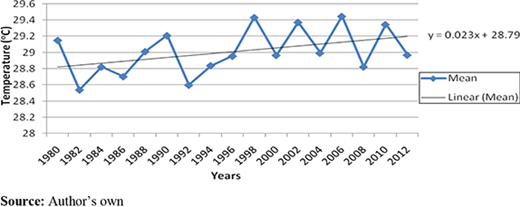
Mean annual temperature trend in Navrongo
Mean annual temperature trend in Navrongo
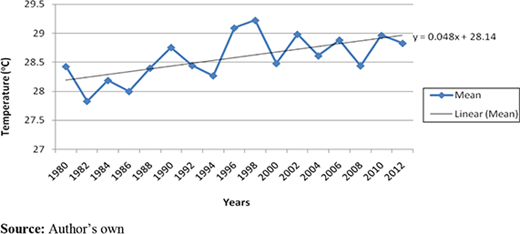
Mean annual temperature trend in Tamale
Mean annual temperature trend in Tamale
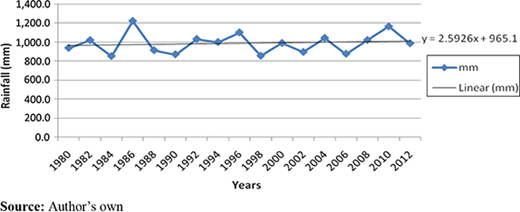
Trends in rainfall amount recorded at Navrongno
Trends in rainfall amount recorded at Navrongno
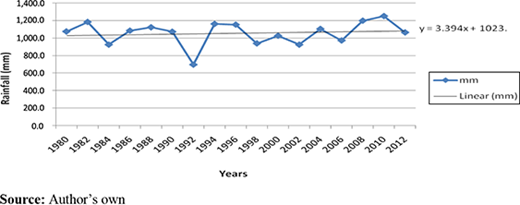
Trends in rainfall amount recorded at Tamale
Trends in rainfall amount recorded at Tamale
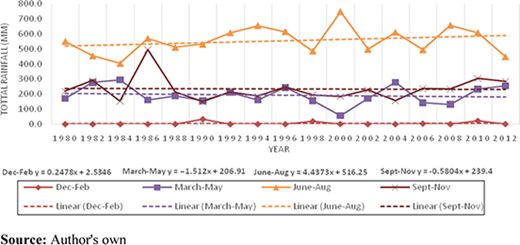
Seasonal variations in amount of rainfall in Navrongno
Seasonal variations in amount of rainfall in Navrongno
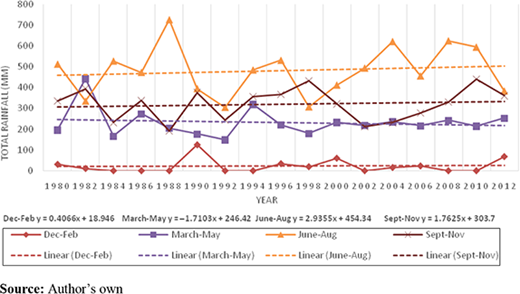
Seasonal variations in amount of rainfall in Tamale
Seasonal variations in amount of rainfall in Tamale
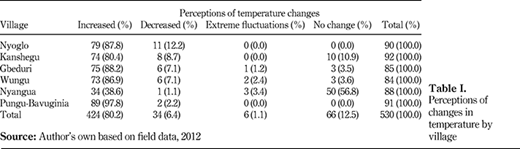
Perceptions of changes in temperature by village
Perceptions of changes in temperature by village
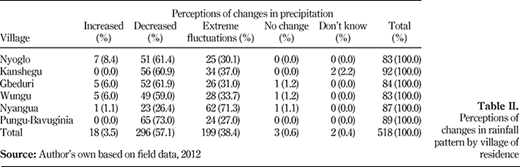
Perceptions of changes in rainfall pattern by village of residence
Perceptions of changes in rainfall pattern by village of residence
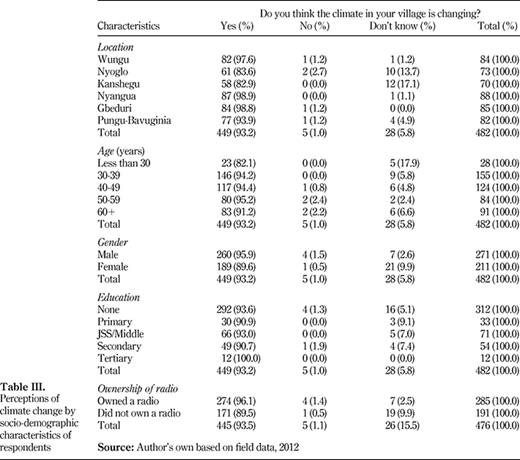
Perceptions of climate change by socio-demographic characteristics of respondents
Perceptions of climate change by socio-demographic characteristics of respondents
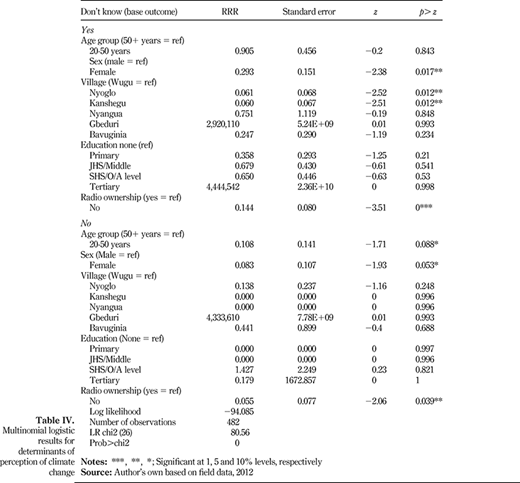
Multinomial logistic results for determinants of perception of climate change
Multinomial logistic results for determinants of perception of climate change
References
The authors would like to acknowledge the Office of Research, Innovation and Development (ORID) of the University of Ghana for funding the research project which culminated in the preparation of this article.

