


– The purpose of this study is to investigate the long-term equilibrium relationship between carbon dioxide (CO2) emissions and total biomass consumption (BC) in Turkey, which has a rich diversity of ecological conditions prevailing throughout its regions.
– Bounds tests and conditional error correction models under the autoregressive distributed lag approach have been applied to annual data that cover the 1980-2010 period.
– Results suggest that CO2 emissions are in a long-term equilibrium relationship with total BC in Turkey. BC has a negative effect on CO2 emissions; 1 per cent increase in total BC would lead to 0.029 per cent reduction in CO2 emissions. Long-term coefficient of fossil fuel consumption for CO2 emissions is positive and elastic, 1.247. Finally, conditional error correction model of the present study reveals that CO2 emission in Turkey converges to its economic long-term equilibrium very quickly by 93.7 per cent speed of adjustment through the channel of BC and fossil fuel consumption.
– Although there have been a considerable number of studies investigating the link between total energy consumption and CO2 emissions in the literature, searching the contribution of components of energy to CO2 emissions deserves attention. Therefore, this study contributes to the literature by investigating the effect of BC on CO2 emissions in the case of Turkey.
1. Introduction
There have been an extensive number of studies in the energy economics literature searching the interactions between and the sources of energy consumption and carbon dioxide (CO2) emissions. The studies have shown that energy consumption and CO2 emissions are correlated, and they also relate to output level of the economies. It is proved that while energy consumption stimulates output growth, it also contributes to continuous increase in CO2 emissions. Therefore, energy conservation policies are likely to restrict economic growth rate. Biomass as a renewable energy has found great interest from all of the regions of the world owing to the fact that it helps to reduce CO2 emissions, provides sustainable energy production and environment management and is consistent with macroeconomic targets of countries (by facilitating economic growth) (Karayilmazlar et al., 2011).
CO2 emissions are assumed to be the most important reason behind global warming (Bilgili, 2012); therefore, literature studies also focus on investigating sources of CO2 emissions. Total energy consumption has been proved to be the greatest source of CO2 emissions extensively in the literature. There are also studies that focus on the segments of energy as a determinant of CO2 emissions in the relevant literature. Acaroglu and Aydogan (2012) find that fuel use, except biofuels, is a determinant of air pollution and acid rain problems. Bilgili (2012) finds that fossil fuel consumption has a positive impact on the level of CO2 emissions. There have been attempts in the literature to investigate the factors that reduce CO2 emissions; for example, Diakoulaki et al. (2006) investigate that natural gas consumption and renewable energy consumption in the electricity sector reduce the level of CO2 emissions.
On the other hand, there have also been studies to investigate if biomass consumption (BC) reduces CO2 emissions. Bilgili (2012) confirms that BC has a negative impact on CO2 emissions, while fossil fuel has a positive impact in the case of the USA. Joelson and Gustavsson (2010) show that the use of biomass can significantly reduce CO2 emissions and oil use; however, they denote that there is a trade-off between the reductions in CO2 emissions and oil use. They also suggest that biomass gasification is an important technology to achieve large reductions, irrespective of whether CO2 emission or oil use reduction is prioritized. Grahn et al. (2009) find that biofuels may play a more important role in industrialized countries compared to developing countries in reducing emissions. On the other hand, Kaygusuz (2009) suggest that biomass energies are a promising option with a potentially large impact for developing countries, where the current levels of energy services are low.
Although there have been a considerable number of studies investigating the link between total energy consumption and CO2 emissions in the literature, searching the contribution of components of energy to CO2 emissions deserves attention. Consumption of biomass energies is one of them. To the best of our knowledge, there has been only one study in this field, Bilgili (2012), who investigated the contribution of BC to CO2 emissions in the USA by using econometric tools. Owing to this gap, this study uses Johansen and bounds test methodology comparatively to investigate the contribution of BC to CO2 emissions in the case of Turkey, which is a developing country and has a rich diversity of ecological conditions prevailing throughout its regions. Turkey is an energy-dependent country, where energy demand doubled during 2000 and 2010 and will increase fivefold during 2000 and 2025 (Kaygusuz, 2009). BC in Turkey was 1.205 per cent of total of Europe in 1980 and 0.194 per cent in 2007 (TURKSTAT, 2013). Kaygusuz (2009) estimate that while classic biomass production will decrease, modern biomass production will increase until the forecast period of 2030. Therefore, empirical investigation of the contribution of BC to CO2 emissions in Turkey will have important implications for researchers and policy makers.
The paper is organized as follows: Section 2 defines data and methodology, Section 3 presents results and Section 4 concludes the study.
2. Data and methodology
The data used in this paper are annual figures covering the period 1980-2010, and the variables of the study are carbon dioxide emissions (CO2) (kt), total biomass consumption (BC), (billion btu) and total fossil fuel consumption (FFC) (billion btu). Data for CO2 and FFC have been obtained from World Bank (2013), while data for BC have been obtained from TURKSTAT (2013) and the Titi Tudorancea Bulletin (2013).
Zivot and Andrews (ZA) (1992) test for unit root has been used in the present study to investigate the order of integration of the variables owing to the reason that there are breaks in the series; thus, time-series properties of the variables of the study are likely to be affected by these breaks. In the literature, Perron (1990) was the first to demonstrate that if there are breaks in the series, then the power of the unit-root tests may be affected in such a way that null of non-stationarity is under-rejected. Zivot and Andrews (1992) argue that under the alternative hypothesis, the breakpoint should be treated as unknown, and by not doing so, Perron (1990) biases his results in favor of the rejection of the unit-root hypothesis. Zivot and Andrews (1992) utilize the same modeling framework with Perron (1990) but with an unknown breakpoint instead of a known breakpoint as in Perron (1990). Therefore, Zivot and Andrews (1992) unit-root tests with breaks will be used in the present study to investigate the integration level of CO2, BC and FFC variables.
The following functional relationship has been developed in this study in parallel to the work of Bilgili (2012): Equation 1
The above function can be re-written in the natural logarithmic form to capture growth effects: Equation 2
where at period t, lnCO2t is the natural log of carbon dioxide emissions, lnBCt is the natural log of total biomass consumption, lnFFCt is the natural log of total fossil fuel consumption and ɛt is the error disturbance.
To investigate the long-run relationship among the variables under consideration, the bounds test within the autoregressive distributed lag (ARDL) approach will be used in this study. This approach was developed by Pesaran et al. (2001) and can be applied irrespective of the order of integration of the variables (irrespective of whether regressors are purely I (0), purely I (1) or mutually co-integrated). The ARDL modeling approach involves estimating the following error correction model: Equation 3
In equation (3), Δ is the difference operator and ɛt is serially independent random error with mean zero and a finite covariance matrix.
In equation (3), the F-test is used for investigating a (single) long-term relationship between CO2 emissions and its regressors. In the case of a long-term relationship, the F-test indicates which variable should be normalized. The null hypothesis of no-level relationship is H0: σ1 = σ2 = σ3 = 0, and the alternative hypothesis of a level relationship is H1: σ1 ≠ σ2 ≠ σ3 ≠ 0.
The CO2 emission in equation (2) may not immediately adjust to its long-run equilibrium level following a change in any of its determinants (Katircioglu, 2010). Therefore, the speed of adjustment between the short-run and the long-run levels of real income can be captured by an error correction model. Furthermore, in the case of a level relationship in equation (1) as a result of bounds test, the conditional error correction model (ECM) using the ARDL approach should be used to estimate short-term coefficients and error correction term. Additionally, as also suggested by Pesaran et al. (2001), the time-series properties of the key variables (CO2, BC and FFC) in the conditional ECMs of the present study can be approximated by double-log EC (p) (error correction at p lag levels that might be different for each explanatory variable) models under the ARDL approach, augmented with appropriate deterministics such as intercepts and time trends (Katircioglu, 2009). Then, the conditional ECM of interest using the ARDL, which is conditional upon the inclusion of error term in equation (2) as a separate independent variable to capture error correction term, can be written as: Equation 4
where β1, β2 and β3 are the coefficients for the short-run dynamics of the model’s convergence to equilibrium. The coefficient of β4 denotes the speed of adjustment and is expected to be negative (Gujarati, 2003).
After carrying out bounds test long-term relationship, the variance decomposition for CO2 will be estimated, which determines how much of the forecast error variance of CO2 emissions can be explained by exogenous shocks to BC and FFC. After variance decomposition, finally, impulse responses will be estimated to investigate how CO2 emissions react to the exogenous shocks in BC and FFC.
3. Results and discussions
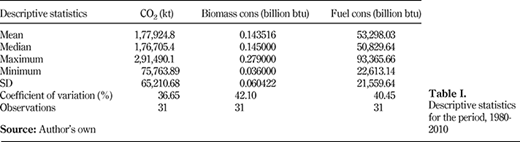
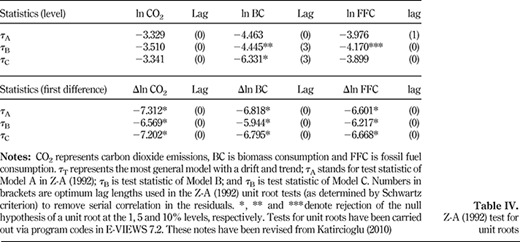
Table I presents descriptive statistics of series under consideration for the sample period. It is important to observe that coefficient of variation in BC is (42.10 per cent) higher than those of CO2 emissions (36.65 per cent) and FFC (40.45 per cent). Tables II and III present critical values to be used in unit-root tests and bounds tests of the present study. Table IV gives unit-root test results for the variables under consideration. Zivot and Andrews ' (1992) test suggests that CO2 emission in Turkey is non-stationary at level but becomes stationary at first difference. But, the variables of BC and fossil fuel consumption become stationary at their levels when trend is eliminated; their first differences are also stationary. These conclusions have been reached through using Zivot and Andrews ' (1992) tests under three scenarios: with trend and intercept, with intercept but without trend and without trend and intercept. To summarize, CO2 is integrated of order one, I(1), whereas BC and FFC are said to be integrated of order zero, I (0), in the present study.
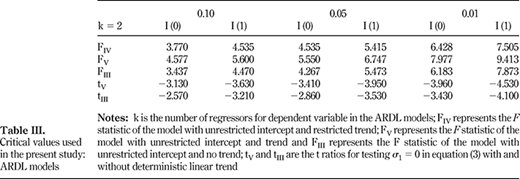
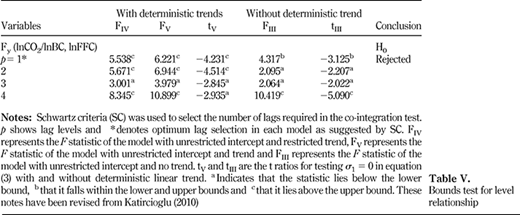
Zivot and Andrews ' (1992) unit-root tests have provided mixed results for the order of integration; therefore, bounds tests to level relationships will be used to investigate the long-run equilibrium relationship between CO2 emission and its regressors. Because the variables are of mixed order, traditional cointegration tests including the Johansen methodology, could not be used. Regressors of the present study have been found as I (0), but as CO2 emission (dependent variable) is I (1), conditions are met to use the ARDL approach. Bounds tests through the ARDL approach were proposed by Pesaran et al. (2001). Critical values for F statistics (for n = 31 observations in this study) are presented in Tables II and III, as taken from Narayan (2005). Table V gives the results of bounds test for level relationship where BC and FFC are assumed to be determinants of CO2. The test has been run under three different scenarios as suggested by Pesaran et al. (2001), which are with restricted deterministic trends (FIV), with unrestricted deterministic trends (FV) and without deterministic trends (FIII). Intercepts in these scenarios are all unrestricted[1].
Results in Table V show that the application of the bounds F-test using the ARDL approach suggests level relationship in the proposed model of equation (3), where CO2 is a dependent variable and BC and FFC are regressors. This is because the null hypothesis of H0: σ1 = σ2 = σ3 = 0 in equation (3) can be rejected according to all of the scenarios. Therefore, CO2 emission is said to be in a level relationship with BC and fossil fuel consumption in Turkey. The results from the application of the bounds t-test in each ARDL model do also allow for the imposition of the trend restriction in the models, as they are statistically significant (Pesaran et al., 2001).
The level relationship obtained from equation (3) allows for the adoption of the ARDL approach to estimate the level coefficients as also discussed in Pesaran and Shin (1999). The resulting estimate of level relationship under the ARDL specification for equation (2) (lags: 0, 3, 2) is given below (prob values are given in brackets):
Level equation of CO2 emissions: Equation 5
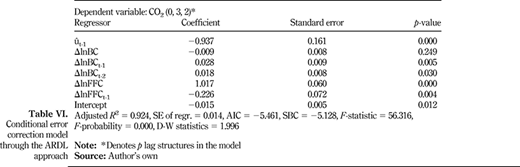
The coefficient of BC is negative as expected, inelastic and statistically significant at the 0.01 level; it reveals that 1 per cent change in total BC in Turkey would lead to 0.029 per cent change in the reverse direction. This suggests that 1 per cent increase in total BC would reduce CO2 emissions by 0.029 per cent in Turkey. The coefficient of FFC is positive, elastic and statistically significant at the 0.01 level, which suggests that 1 per cent change in total fossil fuel consumption in Turkey would lead to 1.247 per cent change in CO2 emissions in the same direction. On the other hand, intercept of the equation is negative, elastic and statistically significant at the 0.10 level. In the next stage, conditional ECM regression associated with the above level relationship as also defined in equation (4) where CO2 is the dependent variable should be estimated. The ECM estimation is provided in Table VI.
The ECT term in equation (4) when CO2 is the dependent variable is −0.937, very high, statistically significant and negative. Results in Table VI imply that CO2 emission in Turkey converges to its long-term equilibrium level by 93.7 per cent speed of adjustment every year through the channels of BC and fossil fuel consumption. The short-term coefficients of BC in lag levels 1 and 2 are highly inelastic again, positive and statistically significant; this coefficient in lag 0 is negative, but not statistically significant. On the other hand, the short-term coefficient of FFC is elastic, positive and statistically significant at lag 0, and negative and statistically significant at lag 1; this suggests that fossil fuel consumption has a reducing effect on CO2 emissions at lagged period.
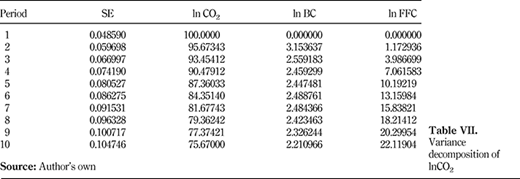
Table VII presents the results of variance decomposition of CO2 emissions, which shows that lower levels of the forecast error variance of CO2 emissions are explained by exogenous shocks to BC over time; the ratio in Period 2 is 3.153 per cent, while it is 2.210 per cent in Period 10. On the other hand, Table VII shows that higher levels of the forecast error variance of CO2 emissions are explained by exogenous shocks to fossil fuel consumption over time.
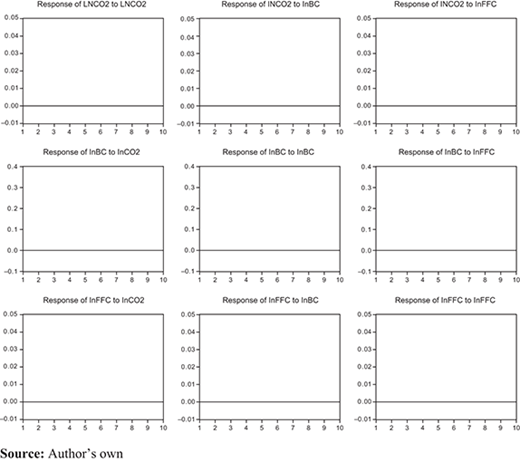
Finally, Figure 1 provides line plots of impulse responses between CO2 emissions, total BC and fossil fuel consumption in Turkey. As can be seen from the figure, the response of CO2 emissions to a shock in BC is negative and at a decreasing trend, which, for example, suggests that an increase in total BC in Turkey would lead to a reduction in CO2 emissions. On the other hand, the response of CO2 emissions to a shock in fossil fuel consumption is positive and at an increasing trend, which suggests that an increase in total fossil fuel consumption in Turkey would lead to an increase in CO2 emissions too.
4. Conclusion
This paper empirically investigated the long-term equilibrium relationship between CO2 emissions, BC and fossil fuel consumption in Turkey. Fossil fuel consumption has also been added as a control variable to the proposed model, as suggested in previous literature. As unit-root tests provided mixed results for the order of integration of series, bounds test to level relationship and conditional error correction model under the ARDL approach have been used in the present study. Results prove that CO2 emission in Turkey is in a long-term equilibrium relationship with its determinants, BC and fossil fuel consumption. BC has a negative effect on CO2 emissions in the long-term period; 1 per cent increase in total BC in Turkey would reduce CO2 emissions by 0.029 per cent. These findings are parallel to those of Bilgili (2012) reported for the USA. Conditional error correction model suggests that CO2 emission converges to its economic long-term level very quickly through the channel of BC and fossil fuel consumption in Turkey; error correction term is 0.937 and statistically significant. It has been observed from ECM and long-run models that the effects of BC on climate changes are statistically significant in the longer periods; this reveals that consumption of biomass in Turkey does not influence changes in climate immediately, but climate starts to be influenced in the later periods.
Turkey is not so rich in fossil fuel resources (Topal and Arslan, 2008). Therefore, an investigation on the use of renewable energies is essential. With this respect, biomass energy has got advantages, such as its contribution in reducing CO2 emissions and environment pollution, its availability locally and its easy accessibility. On the other hand, it is evident that environment conservation policies would restrict economic well-being of the countries, as they mean restriction on energy consumption patterns. Results of the present study have shown that renewable energies such as biomass production and its consumption should be encouraged in Turkey and especially in other developing countries too. Another important message for other countries that arises from the results of this study is that significant effects of BC on climate changes appear in the longer periods. Therefore, it will be better for countries to plan for better environment and air quality, for example, by targeting longer periods but not by short-term policies. This policy would be consistent with macroeconomic targets of countries. Therefore, similar research deserves attention from the authors to document the contribution of biomass energies to CO2 emissions in the literature and provide lessons for policy makers.






References
About the author
Salih Turan Katircioglu (PhD) is Professor of Economics in the Department of Banking and Finance of Faculty of Business and Economics, Eastern Mediterranean University, Famagusta, Northern Cyprus, Via Mersin 10, Turkey. He graduated from the same institution and earned his PhD from Uludag University, Turkey. His research interests include applied time-series econometrics, international trade, international finance, tourism economics and economic growth issues. He is the editor of International Journal of Economic Perspectives. He has previously and extensively published in international peer review journals such as The World Economy, Applied Economics, Tourism Management, Renewable & Sustainable Energy Reviews, Energy Policy, Economic Modelling, Applied Economics Letters, International Journal of Manpower, International Journal of Bank Marketing and International Journal of Social Economics. Salih Turan Katircioglu can be contacted at: salihk@emu.edu.tr
Note
For detailed information, please refer to Pesaran et al. (2001, pp. 295-296).

