


– The purpose of this paper is to identify stimuli for climate adaptation in cities and more specifically to explore whether different stimuli inspire different governance approaches to climate adaptation – e.g. dedicated (adaptation as a new policy field) or mainstreaming (integrating in existing policy fields).
– For this explorative case study research, an early adapter was selected: Philadelphia (USA). By reconstructing the organization of two climate adaptation programs, the authors have identified stimuli and whether these influence the city’s governance approach. The reconstruction is based on data triangulation that consists of semi-structured interviews with actors involved in these programs, policy documents and newspaper articles.
– The research illustrates the importance of stimuli such as strategically framing climate adaptation within wider urban agendas, political leadership and institutional entrepreneurs. Moreover, the research reveals that it is often a combination of stimuli that triggers a governance approach and that there is a possible link between specific stimuli and governance approaches, proposing that some stimuli will trigger a dedicated approach to climate adaptation, while others initiate a mainstreaming approach.
– An in-depth understanding of stimuli of climate adaptation is currently lacking in literature, as most of the studies have focused on barriers to climate adaptation. Moreover, still little is known about what explains why certain governance approaches to climate adaptation emerge.
1. Introduction
Several cities have already demonstrated awareness of the potential risks of climate change and have organized municipal responses to climate adaptation; see for example New York, Philadelphia, Chicago, Vancouver, London, Rotterdam and Copenhagen (Castan Broto and Bulkeley, 2013; Bulkeley and Tuts, 2013). With their responses, these early adapter cities aim to anticipate the expected changes in climate, such as an increase in temperature, more precipitation events and sea-level rise; and circumvent possible associated consequences such as economic damages induced by urban flooding and social disruption due to heat stress. Many researchers have argued that cities should start adapting to climate change today to avoid the high costs that are associated with future damages (Parnell et al., 2007; Runhaar et al., 2012; Tompkins et al., 2010). By addressing these consequences of climate change, these cities have taken up a major challenge in urban policy. However, many other cities have not done so thus far (Reckien et al., 2014).
In climate adaptation literature, the focus has largely been on why these cities have not been able to address climate adaptation. This has resulted in many studies on the identification and understanding of barriers to climate adaptation. Frequently mentioned barriers are, for example, uncertainty about the risks and impacts, limited financial resources, little local expertise, a lack of political support and an undefined role for local governments (Bulkeley and Betsill, 2013; Runhaar et al., 2012; Biesbroek et al., 2009). By focusing mainly on the barriers to climate adaptation, the role of stimuli has been largely ignored. Some exceptions are Burch (2010) who talks about “enablers”, Hjerpe et al. (2014) on “triggers” of political engagement in climate adaptation debates and Bulkeley and Castàn Broto (2013) on the role of climate change experiments as purposive interventions. By stimuli, we refer to factors that have triggered climate adaptation responses in cities. It is expected that the early adapters have experienced stimuli that have increased their inclination to respond to climate adaptation and subsequently assisted in avoiding or overcoming barriers. Hence, the identification of these stimuli for climate adaptation responses is also relevant for understanding and addressing the barriers to climate adaptation. In addition, we want to explore whether and how stimuli matter for the way in which climate adaptation in cities is governed. In the literature, a distinction is made climate adaptation as a new domain in urban planning with direct political commitment, allocated resources and specific adaptation policies (the “dedicated” governance approach), and the integration of adaptation objectives in existing domains and activities, aimed at establishing synergies between existing policy objectives and climate adaptation (the “mainstreaming” approach) (Dewulf et al., 2015; Kok and De Coninck, 2007; Uittenbroek et al., 2013, 2014). Thus far, little research has addressed the question what explains a city’s governance approach to climate adaptation. In this paper, we explore whether the stimuli encountered by an early adapter could explain why one city applies a more dedicated approach to climate adaptation while another city follows the mainstreaming approach.
The aim of this paper is twofold, as we identify stimuli that have triggered climate adaptation in cities and explore whether the identified stimuli have inspired the governance approach. In case of the latter, it will be interesting to learn to what extent these stimuli were deliberate strategies by the municipal organization (as opposed to be caused by external factors), as these can possibly be exploited by other cities. To clarify, our aim is not to qualify the success of the climate adaptation responses or the governance approach taken. The research is empirically illustrated by an explorative case study, which is considered a best practice when it comes to climate adaptation. For the case study, we have selected the City of Philadelphia in the USA. This case selection is based on previous research that has shown that Philadelphia has organized several climate adaptation responses (Edwards, 2014; Maimone et al., 2011; Rosenzweig et al., 2010), but that did not explain what triggered this city to develop these responses. By reconstructing the organization of two of these responses, we have been able to identify stimuli and gain insight in the city’s governance approach. The case study is based on data triangulation that consists of interviews with actors involved in these climate adaptation responses, policy documents and newspaper articles.
2. Conceptual framework
Although the main focus in climate adaptation literature has been on the identification and understanding of barriers, few researchers have highlighted possible stimuli for climate adaptation (Bulkeley et al., 2009; Bassett and Shandas, 2010; Burch, 2010). Thus far, the presentation of these stimuli has been somewhat scattered throughout climate adaptation literature. To provide structure, we developed a conceptual framework by following the questions “who, when, why and how”. These basic questions assist in identifying the different stimuli for climate adaptation independently as well as allowing for an exploration of whether there are any interdependencies between the stimuli. Additionally, this framework assists in identifying stimuli in the case study. While we aim to be thorough in our overview of stimuli, we want to stress that the overview is not exhaustive.
2.1 The identification of possible stimuli for climate adaptation
First, who is about the people who initiate the response. In adaptation literature, much attention is given to institutional entrepreneurs (Wejs et al., 2014), also referred to as policy entrepreneurs (Bassett and Shandas, 2010; Bulkeley, 2010; Kingdon, 2002; Meijerink and Huitema, 2010) or local champions (Carmin et al., 2012). These entrepreneurs take up the role of mobilizing other actors and building legitimacy for climate adaptation within municipal institutions (for example, by connecting climate adaptation to other policy objectives) (Wejs et al., 2014) but can be positioned both inside and outside the municipal organization (Kingdon, 2002). Institutional entrepreneurship is demonstrated by individuals as well as by collectives. Meijerink and Huitema (2010) point out that collective entrepreneurship holds two main advantages, as the coalition between people in different positions can apply various strategies and possess a variety of capabilities and tools. A disadvantage of institutional entrepreneurship might be that these entrepreneurs may impede other individual’s ability to take ownership of the climate adaptation issue (Storbjörk, 2010). Nevertheless, several researchers have argued that without institutional entrepreneurs, the organization of climate adaptation is difficult (Bassett and Shandas, 2010; Carmin et al., 2012). On the other hand, Bulkeley (2010) points out that while institutional entrepreneurship is important in the initial stages of organizing climate adaptation responses, a broader institutional capacity is necessary to overcome barriers that could derive from party politics or existing organizational structures. The involvement of (elected) politicians is often mentioned as an equally important stimulus in organizing climate adaptation. Politicians who demonstrate leadership can contribute directly by allocating resources (Carmin et al., 2012), but also more indirectly by stimulating learning processes. Politicians, who do actively adapt, might choose responses that are quick wins and visible and no-regret measures (such green roofs) to increase their political profile (Uittenbroek et al., 2014). However, politicians sometimes also choose to make statements about what should be done in the long run, or apply cover up strategies like setting up new research programs dates for future adaptation strategies instead of proactive adaptation (Termeer, 2009). In this way, the politicians avoid taking decisions that could damage them politically (Biesbroek et al., 2009).
Second, when is about momentum. A momentum provides an opportunity in time to adapt to climate change. Kingdon (2002) refers to this as a window of opportunity. In the case of climate adaptation, this can be a calamity or focus event (e.g. a flood or a heat wave), elections or societal pressure (Dannevig et al., 2013; Runhaar et al., 2012). For example, the City of Copenhagen dealt with a cloud burst in 2011. The damage costs of the cloudburst were more than one billion euro. This calamity triggered a response, to invest in climate adaptation measures and develop a specific cloudburst plan (Madsen et al., 2013). Penning-Rowsell et al. (2006) however stress that a window of opportunity in itself might not be sufficient to instigate policy change. They argue that to use the full potential of a window of opportunity, a proactive approach is necessary. Such an approach implies that the problem risks are understood and possible solutions are thought out in advance of a possible focus event (Penning-Rowsell et al., 2006). As also suggested by other researchers (Birkman et al., 2010; Kingdon, 2002), it is often a set of circumstances in which the coupling of problems–solutions in a favorable context provides the opportunity for change.
Third, why relates to the applied narrative or framing that motivates authorities to address climate adaptation. By framing a topic a certain way, it is possible to increase its salience (Pralle, 2009). Fünfgeld and McEvoy (2011) identified four common framings of climate adaptation: the hazard frame, the vulnerability frame, the risk management frame and the resilience frame. Whereas the first two frames illustrate the consequences of climate change and a lack of adaptation, the latter two are more opportunistic as they describe what the city can do or become if it adapts to climate change. In addition to framing climate adaptation explicitly, Bulkeley and Betsill (2013) argue that several municipal organizations have addressed the need for climate adaptation more implicitly by placing it within wider urban agendas. This is confirmed by other researchers who perceived that (more integrated) sustainability strategies are often more successful than pursuing mitigation and adaptation strategies alone (Shaw et al., 2014; Burch et al., 2014). By using concepts and terms closely related to the current framings in existing policy domains, it is possible to signify the relevance of climate adaptation within a domain, and increase the understanding of, and support to act upon climate adaptation (Uittenbroek et al., 2014).
Fourth, how refers to the available capability to respond to climate adaptation. The capability to organize climate adaptation responses can take many forms. This can vary from available and allocated resources to political pressure as well as the ability to install new regulations and skills to build networks and coalitions (Kuhlicke et al., 2011). Smith et al. (2009) argue that climate adaptation cannot be realized with just the existing resource streams and that the mobilization and allocation of resources for climate adaptation needs attention. This requires support for climate adaptation and the building of new coalitions and networks. To connect actors that have different values and objectives, the capabilities of advocacy, brokerage and perseverance are probably required (Kingdon, 2002; Meijerink and Huitema, 2010; Thaler and Priest, 2014). Access to such capabilities implies that there are opportunities for negotiation and exploitation.
There are interdependencies between the stimuli, as it takes an individual to recognize the momentum, create the narrative and practice the capability. This is not necessarily done by the same individual. By looking at the interdependencies between the stimuli, it highlights the different kinds of people (with various capabilities and tools) who are necessary to organize climate adaptation responses.
2.2 Stimuli and their possible influence on the governance approach
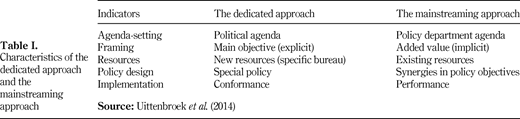
The encounter of possible stimuli and exploitation of these stimuli by early adapters may affect the governance approach to climate adaptation. In adaptation literature, two governance approaches to climate adaptation are the dedicated approach and the mainstreaming approach (Kern and Alber, 2008; Uittenbroek et al., 2014). In a dedicated approach, climate adaptation is understood as a main objective that requires its own resources and special policies. It is considered as a new policy domain. In this approach, the focus is on achieving conformance between the set adaptation goals and the realized outcomes (Uittenbroek et al., 2013). The mainstreaming approach aims to integrate climate adaptation as an objective in existing policy domains. This means that synergies between existing policy objectives and climate adaptation are established and that existing resources are used to address climate adaptation. As opposed to the dedicated approach, mainstreaming focuses on performance-based decision-making – i.e. actors focus on to what extent climate adaptation is required and feasible within the given context. This could imply that the realized outcome is less than the set adaptation goals, but this is a valid outcome as long as it is based on a deliberate assessment (Uittenbroek et al., 2013). In Table I, the differences between the two approaches are named. We are aware that cities might not strictly limit their governance approach to one of these two approaches, but instead apply a hybrid version in which the two approaches alternate or co-exist within one city (Uittenbroek et al., 2014). Yet, the framework of the two governance approaches helps to understand the adaptation policy aims of cities.
It is expected that not all stimuli for climate adaptation responses described in the former paragraph will result in the same governance approach. For example, not all individuals will have the capability to install a new policy domain with its own resources and policy goals. This might only be the case if politicians show leadership and commit to climate adaptation. In that case, political leadership could be considered as a stimulus that inspires a dedicated approach. Other stimuli, such as the use of strategic framing to establish synergies or the presence of institutional entrepreneurs, might then again result in a governance approach that resembles mainstreaming. In the following sections, the case study analysis explores to what extent this proposition about the influence of stimuli on the governance approach can be supported.
3. Data and methods
The analysis presents a singular explorative case study of an early adapter, offering tentative conclusions for stimuli that can trigger climate adaptation responses and the influence of these stimuli on the governance approach. According to Flyvbjerg (2006), a single case study can provide valid research outcomes if the case in question is expected to be rich and illustrative enough. We believe that Philadelphia presents such a case.
The City of Philadelphia is expected to deal with several impacts of climate change, such as an increase in hot weather events in summer, more frequent and prolonged heat-waves and the increase of heavy downpour events, as well as the provision of fresh water for both drinking and industrial use (Edwards, 2014). From previous research, we learned that the City of Philadelphia is adapting to these climatic changes. For example, together with the non-profit Energy Coordinating Agency, the city installed a heat alert program in 1995 (Kalkstein et al., 1996; Gartland, 2008) and more recent responses aim to make the city’s infrastructure resilient and reduce combined sewage overflow, which can be worsened by an increase in downpour events and consequently affect the provision of fresh water (Maimone et al., 2011; Edwards, 2014). Furthermore, the City of Philadelphia participates in the C40 cities network, and produced a climate change action plan in 2007, but this plan mainly focused on climate mitigation measures.
In addition to the climate change challenges, the city has been struggling in the past decades with urban decay due to departing industries, a declining population and an increase in vacant land (Edwards, 2014). Through urban regeneration, the population has increased again in the past decade. Yet, the city still has to address social issues like urban degeneration (the city counts around 40,000 vacant parcels) and poverty (28 per cent of the population live below the poverty line) (interview MOS01, 2013)[1].
Although Philadelphia is considered an early adapter, we learned during our analysis that the responses were not necessarily taken solely to adapt to climate change. Our analysis consisted out of three steps. First, we analyzed all policy documents related to sustainability, climate change, spatial planning and water management. We included, also, newspaper articles and other available online material such as Web sites and YouTube movies in this document analysis[2]. We searched for explicit and implicit references to climate adaptation. Accordingly, we determined if the reference entailed a strategy (visionary) or a project (practical) considering that this might also lead to other stimuli. This translated in a list of climate adaptation-related initiatives conducted by various actors (i.a. PCPC, SEPTA and PennPraxis). We selected two programs that at the time of research were the most actively pursued and hence, furthest in planning and implementation: Greenworks and Green City Clean Waters.
The second step of our analysis was to identify stimuli that had triggered the two programs. Therefore, 17 semi-structured interviews were held with actors responsible for the policy design and implementation of the two programs. Most of these actors worked for the municipality directly, although some of them were consultants hired for their expertise. By applying a snowballing technique, we gathered the names of relevant actors. Some of the interviews were held in a group meeting with a maximum of five people. During the semi-structured interviews, we asked the actors to explain how the program was currently addressing climate adaptation, what the aim was of the program, and subsequently, to provide a reconstruction of the process of policy design and implementation of the program they were working on. We did not ask the actors to identify stimuli themselves, but did this ourselves based on the conceptual framework. If we had established a stimulus with one actor, we tried to verify this with another actor by posing open questions (e.g. who was responsible for initiating the program and how did he/she engage others in the program). Additionally, field trips in Philadelphia were made to study several projects that have been realized within Green City Clean Waters.
In the third step of the analysis, we assessed if the programs would resemble one of the governance approaches based on the list of characteristics provided in Table I. In this way, we would learn if certain stimuli could be associated with a specific governance approach. Knowing what stimuli inspire a specific governance approach and, moreover, to what extent these stimuli were deliberately induced might be useful for other cities who wish to apply a similar governance approach to climate adaptation.
4. Greenworks
During the elections of 2007, a group of organizations had formed a coalition that focused on creating safer, healthier and cleaner neighborhoods. This coalition was called Next Great City and consisted of 130 organizations with different backgrounds (Next Great City, 2014). The coalition created a list of ten action steps that would lead to a more sustainable city as follows:
create public riverfronts;
expand recycling;
improve transit stops;
stop sewer backups and flooding;
adopt modern zoning;
use clean energy and construct energy efficient buildings;
replant neighborhood trees;
maintain healthy parks;
clean and green vacant lots; and
reduce asthma caused by soot (Next Great City, 2014).
The action steps of reducing sewer backups and flooding (no. 4) as well as replanting trees and creating green lots (no. 7 and 9) are implicitly linked to climate adaptation: sewer backups and flooding are caused by downpours and more green infrastructure can reduce heat mortality and soak up rainwater. The Next Great City coalition was in no way connected to the municipal organization, but demanded political leadership and commitment in making Philadelphia a sustainable city. Because the diverse groups had united in this coalition, they could reach out through different channels and gain support, but at the same time, speak with one voice – making their message (the ten action steps) clear for politicians to hear. While all the running candidates for mayor could have picked up this list, it was only picked up by one of them. This person anticipated the action steps and used them to his advantage during his election campaign (interview MOS02, 2013). He won the elections, and accordingly, as mayor, he showed political leadership by installing a Mayor’s office of Sustainability and developing a policy program addressing the ten action steps: this is Greenworks.
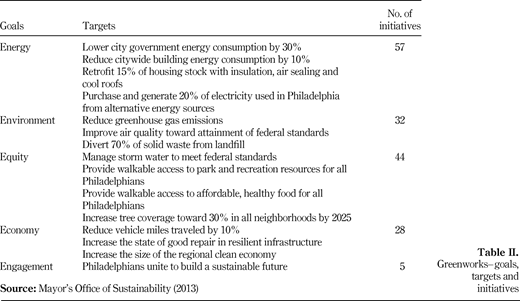
Greenworks includes five goals, 15 targets and around 170 initiatives that need to be realized over a period of seven years (Table II). The targets are linked to a metric. For example, the target of providing walkable access to park and recreation resources for all Philadelphians is measured in acres of open space. The metrics provide a way to illustrate the yearly progress in a report. The first report was drafted in 2008 by the then policy director of sustainability and a small group of policymakers working on sustainability (interview MOS01, MOS02, 2013). They not only took the ten goals of the Next Great City coalition as a guideline but also explored what policies the policy departments had already developed that could be placed within the framing of sustainability (interview MOS02, 2013). When the then policy director of sustainability was writing Greenworks, he looked at the first generation of sustainability and climate change plans such as those of New York, Chicago, Toronto and Vancouver (interview MOS02, 2013) and he picked out the elements which would make the Philadelphia plan distinctive:
PlaNYC was multidimensional with six issues and Chicago’s plan used metrics [to measure progress]. This spoke to me. So we wanted to take both of these things and put them together. So we ended up with five goals and 15 targets (interview MOS02, 2013).
The selection of these goals and targets was strategic. On the one hand, these derive from existing policies and plans of the Philadelphia policy departments and on the other hand, the aim was to distinguish the Philadelphia plan from other cities. As the then policy director said “I am a strategic policymaker, not a sustainability activist. So I was paying attention to what targets New York did not have and that we could add to our list of goals and targets” (interview MOS02, 2013).
In the early progress reports, climate adaptation is not explicitly addressed. Although targets could be affiliated with climate adaptation (for example targets 8, 9, 11 and 13 in Table II), an explicit link is not made in the Greenworks reports of 2009, 2010 and 2011. According to a policy advisor at the Mayor’s office of Sustainability responsible for the implementation of Greenworks, this was on purpose:
It is a messaging thing. We are doing this [addressing climate change] already and although you might not think climate change is happening, these things [goals and targets] are valuable in any case. … Climate change does not mean a lot to a lot of people. … For us, it is about figuring out how it adds value to everyday life (interview MOS01, 2013).
Hence, goals such as energy, environment, equity, economy and engagement were formulated that could be understood and supported by both politicians and the public. Several of the climate adaptation-related targets, such as those affiliated with water and green infrastructure (targets 8, 9 and 11), are framed within the goal of equity (MOS, 2012).
As of 2012, the framing concerning climate adaptation became more explicit. The Greenworks 2012 progress report identifies extreme heat, pluvial flooding, sea-level rise and storm surges as possible climate risks to Philadelphia (p. 47). Several key areas have been pointed out to initiate Philadelphia’s adaptation process, such as the intention of formalizing a comprehensive climate adaptation plan by 2014 (MOS, 2013) and the aim to “develop approaches for mainstreaming climate adaptation strategies into planning, design, operation, and maintenance activities of City departments” (MOS, 2012, p. 48). At the time of research, there was only initial research conducted: “reviewing current information, identifying gaps in knowledge, cataloguing existing efforts, and scanning for best practices from other cities and organizations” (MOS, 2013, p. 24). According to one of the interviewees, the Mayor’s office was in the process of hiring a consultant to bring in the expertise on “this [climate change] science and then understanding how … to relay this knowledge to the policy domains” (interview MOS01, 2013). Yet, an explicit link is made between climate adaptation and the program’s resilient infrastructure target (target 13) (MOS, 2013). Here, referring to gray infrastructure such as roads, bridges and public transit, and not what might be expected when thinking of climate adaptation the city’s water and green infrastructure.
The Mayor’s office of Sustainability is responsible for the implementation of Greenworks. The implementation of the plan means largely that the policy makers of the Sustainability office provide expertise and network to the policy departments who have to realize the targets and initiatives. The office has no budget to assist in financing the initiatives which means that policy departments themselves have to fund and invest in the realization of the targets and initiatives. Furthermore, the office makes the yearly progress report, using the metrics to monitor the progress within the policy departments. The metric entails a baseline, the current status and the 2015 target (for example, target 8 is measured in new greened acres. For this the baseline is zero in year 2011, current status is 102.4 in year 2012 and 2015 target is 450 new greened acres) (MOS, 2013). The policy departments are responsible for providing the information on the metrics to the Mayor’s office (interview MOS01, 2013). For some metrics, the data gathering has been difficult (interview MOS01, 2013). According to the then policy director of Sustainability:
[t]he whole idea [of the metrics] was about direction and ambition. And you are going to learn things as you go, and as you go, change the targets. Make them smarter, make them harder, make them easier. Change them, because so you learn (interview MOS02, 2013).
Hence, some of the metrics were subjected to alterations. But after they were officially introduced in the 2012 report, the metrics have not changed. Although the metrics provide a clear measurement for progress, the solution linked to the metric might not necessarily be the only solution to achieve the target. For example, the target to manage stormwater (target 8) is measured in greened acres[3]. PWD, responsible for the metric, spends a lot of time organizing a green acre, while this time could be spent on other measures that manage stormwater but do not necessarily fit within the description of a green acre (interview PWD08, 2013).
4.1 Greenworks’ stimuli and governance approach
During the analysis, we learned what stimuli have triggered Greenworks. Societal pressure in combination with elections provided the window of opportunity to initiate a new policy program. The Next Great City coalition played a significant (entrepreneurial) role in forming the goals, but it was the mayor who showed leadership and placed the goals on the political agenda. He is responsible for the installment of the Mayor’s office of Sustainability and Greenworks. The framing used in Greenworks is that of sustainability in relation to everyday values (such as economy and equity). Climate change is one of the challenges that influences these values and therefore requires attention. Climate adaptation is considered an extra argument for the work that the Mayor’s office is already doing, but is to gain more explicit attention in the future – see the initiative to develop a specific climate adaptation plan (MOS, 2012, 2013). In terms of capabilities and tools, several can be identified: from political power and human resources to the metrics. It was the mayor’s prerogative to install a special office. Yet, although this office has a specific position and function in realizing Greenworks, it only holds human resources – i.e. five policymakers who can provide networking and lobbying skills, but no financial resources. The metrics are a stimulus to enforce the policy departments that are responsible for a certain target to realize initiatives. If policy departments do not illustrate their progress in the yearly report, this might be noticed by the readers of the report and result in bad publicity for the department. The nature of the response is largely about visibility and political profiling: showcasing what the city is doing (differently than other cities) concerning sustainability and climate change. Table III summarizes all identified stimuli.
Based on the list of characteristics of governance approaches (Table I), it could be argued that Greenworks can be associated with a dedicated governance approach. Yet, this is a dedicated approach to sustainability rather than to climate adaptation alone. The research findings illustrate that Greenworks is part of the political agenda, it has its own special bureau and policy and uses the metrics that impose conformance – not so much conformance between the goal and the outcome, but in terms of how the goal is achieved (e.g. in greened acres). Although the Mayor’s office is working on a specific climate adaptation plan, this plan will still fall under the banner of Greenworks (thus not really standalone) and interestingly enough, will include strategies that focus on mainstreaming adaptation measures in other policy domains (MOS, 2012). This indicates that climate adaptation is framed within the wider urban agenda of sustainability and resilience. In Greenworks, climate adaptation is presented as an objective that requires the attention of all policy domains as opposed to its own “silo”.
5. Green City Clean Waters
Green City Clean Waters is a policy program that is designed and implemented by the Philadelphia Water Department. The aim of this response is to deal with the combined sewage overflow. Combined sewage overflow occurs when excessive water (for example as a result of heavy rainfall) in the combined sewage system (a combination of stormwater and wastewater) goes untreated in the watershed system (PWD, 2009). Based on the expected changes in climate, combined sewer overflow (CSO) is likely to occur more frequently in the near future. This means more pollution of the watershed system. To circumvent this, adaptation was necessary (Interview PWD08, 2013).
In 1997, the US Environmental Protection Agency enforced the Clean Water Act (1972) and mandated the Water Department to update their long-term control plan for CSO. The Water Department first looked at traditional gray infrastructure solutions such as sewer pipes. As the costs for the gray infrastructure (estimated at US$9 billion) were high, a group of people within the Water Department started to look at other alternatives such as green stormwater infrastructure (GSI). Examples of GSI are retention and detention ponds, permeable pavement, water crates, tree trenches and green roofs. GSI can be considered a climate adaptation measure, as it reduces the effects of urban heat islands, increases the soak-up of rainwater and results in climate change offsets (through carbon sinks) (PWD, 2009). An alternative plan based on GSI would require a relatively smaller investment of US$2 billion (Maimone, 2013). In 2009, the Water Department presented Green City Clean Waters as their updated long-term control plan for combined sewage overflow.
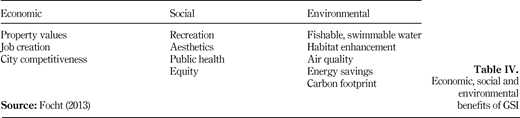
Green City Clean Waters focuses specifically on addressing the future challenges for and pressures on Philadelphia’s water system. These challenges vary from environmental (climate change) to social (urban regeneration) and financial (economic crisis) (PWD, 2011). According to the Water Department, “[m]eeting these challenges requires either a significant new investment in infrastructure, or a paradigm shift in our approach to urban water resources” (PWD, 2011). Green City Clean Waters aims to deal with 85 per cent of the calculated combined sewage overflow, but it is expected to also obtain economic and social benefits as well as environmental benefits (Table VI). For example, the deputy commissioner argued that gray infrastructure will most likely be engineered by companies from abroad, which means that local investments flow out of the community, while GSI can provide green jobs for the community (Channel DE estuary, 2011). Also, the mayor supports Green City Clean Waters as opposed to the gray infrastructure solution because of the plan’s benefits: “We recognized we could save money, not dig up half of town, and improve our parks and green spaces” (Aston, 2012).
The Water Department is responsible for the design and the implementation of Green City Clean Waters and has approximately US$2 billion to invest over a 25-year time period. The first five years are used as “proof of concept”. This means that in this five-year period, pilot projects are set up to “provide information for optimal design and program development” (PWD, 2012, pp. 3-2). The entrepreneurs leading the “proof of concept” actions have initiated several learning processes on different fronts (communication, design and maintenance) to stimulate an organizational change. A consultant working for the Water Department said:
[…] it is a complete learning process. Nobody has done this on this scale. The complexity [of the transition from grey infrastructure to GSI] was what everybody was afraid of. They feel that it is taking away of our core mission (interview PWD05, 2013).
Some of the engineers working at the Water Department have been following routines for a very long time (interview PWD02, 2013). These routines will be subjected to change as the implementation of GSI continues: “We design with the equipment that we have today. But we also have to justify how to alter equipment and routines to make them more cost-effective” (interview PWD02, 2013). Furthermore, GSI requires the PWD to have employees with landscaping skills. Hence, employees are schooled in this and new employees attracted (interview PWD05, PWD08, 2013). The consultant emphasizes that mistakes are allowed during the “proof of concept” period:
It is a change of course. It will not work out as we have envisioned it. We might not make the target in year ten and people get depressed about it [but they should not]. We are making a huge change (interview PWD08, 2013).
To implement the plan, the Water Department also needs to collaborate with other municipal departments, actors in the private sector and the community, as they are no longer putting the solutions underground, but above ground, making them visible and part of other policy domains. The Water Department has to convince these actors of the benefits of GSI. The Water Department already learned that other departments can be reluctant to collaborate: “they want to know ‘what is in it for us?’” (interview PWD08, 2013). Although the Water Department is eager to implement its plan, its enthusiasm for action can be overwhelming for the other municipal departments. For example, in its contact with the Department of Parks and Recreation, the Water Department sent different people of different levels to every meeting to advocate its plan. This proved intimidating and the Water Department had to pull back (interview PWD08, 2013). The Water Department had to think of other ways to learn how to integrate GSI in the projects of other departments. For example, the Water Department placed water managers in other departments to learn about the routines of these departments (interview PWD08, PWD02, 2013). However, this did not necessarily prove productive, as one of the water managers “went native” – i.e. started working for the other department (interview PWD08, PWD02, 2013). Overall, the Water Department noticed that in their collaborations with other departments, they needed to take up tasks that were not part of their job before. For example, they now also search for additional monies so that they can realize the goals of other municipal departments to get them to collaborate. An illustrative example is the Water Department’s application for funding for playground equipment for the Department of Parks and Recreation (interview PWD05, 2013).
Yet the actions of the Water Department have not been without success, as approximately 400 projects have been completed or are on the way to being accomplished. These are programs in which the Water Department worked together with neighborhoods communities and school districts (see photo 1 and 2). They also continue to stimulate citizens to invest in GSI solutions by providing information and financial incentives. The stormwater billing initiative is such an incentive. With a change in billing structure from a charge based on a property’s water meter size to charges based on the total size of the property and the amount of impervious area, the Water Department aims to stimulate property owners to apply GSI solutions. By implementing GSI, property owners can obtain credits that reduce their stormwater fee (interview PWD04, 2013; PWD, 2015).
5.1 Green city clean waters’ stimuli and governance approach
The stimuli that triggered the window of opportunity for Green City Clean Waters are regulations (Clean Water Act) together with financial limitations (the high costs for gray infrastructure). The Philadelphia Water Department was responsible for making a new plan to address the CSO, but it was a group of entrepreneurs within the department who thought to act differently and started to advocate and lobby for another solution: GSI. The framing does not focus solely on climate change and the need for adaptation, but also addresses other challenges in the city to gain support for implementation from other municipal departments and the public. In addition to applying their capabilities of advocacy and brokerage to gain support, the entrepreneurs also focused on knowledge exchange and had the financial resources to organize responses. Moreover, they showed perseverance as illustrated by the 12-year time gap between the Environment Protection Agency’s mandate (1997) to the first Green City Clean Waters plan in 2009. They continued to advocate their plan, but adjusted their approach each time a barrier emerged. This demonstrates flexibility. The response focuses on structural organizational change. To learn how to manage this change, the first five-year period (proof of concept) focuses on pilot projects, stimulating learning processes and establishing a network.
Based on the characteristics listed in Table I, Green City Clean Waters seems to resemble a mainstreaming approach. It implicitly addresses climate adaptation as the program primarily focuses on reducing CSO which is caused by heavy rainfall by adapting with GSI. Other characteristics of the mainstreaming approach can be identified, such as climate adaptation in terms of CSO being part of the policy department agenda (of the Water Department), the search for synergies and the focus of the program being on performance to stimulate organizational learning. To elaborate, the institutional entrepreneurs used the financial limitations as a stimulus to promote other practices (GSI) and seek synergies between GSI and existing policy objectives inside and outside their policy department. For this, GSI was strategically framed as a solution that results in possible social, economic and environmental benefits. The entrepreneurs used their networks and advocacy skills to establish pilot projects and learning processes. These projects and processes were allowed to fail as long as this led to new insights, which is in line with performance (Table V).
6. Discussion and conclusions
The aim of this paper has been twofold: first, to provide insight into what stimuli have activated climate adaptation responses and second, to explore whether different stimuli trigger different governance approaches to climate adaptation. In the Philadelphia case, which was conducted to refine our initial conceptual framework and illustrate the working of stimuli, several stimuli were identified: political leadership, elections (as window of opportunity), institutional entrepreneurship, strategic framing (by stressing multiple benefits of climate adaptation) and several capabilities and tools such as advocacy, perseverance, flexibility and metrics. To an extent, these findings support the previous work of researchers who have argued the relevance of similar stimuli before; see, for example Wejs et al. (2014) on the key role for institutional entrepreneurs, Burch (2010) and Hjerpe et al. (2014) on (political) leadership and engagement, Storbjörk (2010) on organizational learning and Bulkeley and Betsill (2013) on the framing of climate change within wider urban agendas.
Still, three valuable insights for the governance of climate adaptation literature can be retrieved from the Philadelphia case. First of all, the Philadelphia case illustrates that climate adaptation responses are not organized in a vacuum. Stimuli for climate adaptation are often presented as single triggers, but independently these stimuli might not be sufficient for organizing a response. More likely, it is a combination of stimuli. To clarify, one institutional entrepreneur will not hold all capabilities or tools necessary to organize a climate adaptation response and a political leader might not be triggered to act upon climate adaptation without elections. The organization of responses to climate adaptation is a process in which several stimuli bring the process forward (or barriers hold the process back).
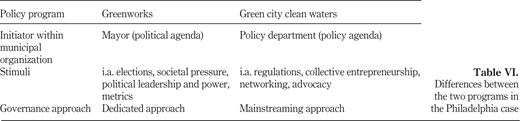
In addition to this, the Philadelphia case provides empirical data that could indicate a possible link between stimuli and governance approaches. The research findings illustrate that the two programs are triggered by other (combinations of) stimuli and resemble other governance approaches (Table VI). Yet, more research is necessary to support this hypothesis, future research could, for example, compare the stimuli of two programs that resemble similar governance approaches. If similar stimuli are found during this research, this would strengthen the hypothesis of the possible link between stimuli and governance approaches. In the case that more evidence is found, further research could focus on to what extent the identified stimuli can be deliberately triggered by municipal actors. As cities might then search for and/or trigger these stimuli to initiate the desired governance approach.
The Philadelphia case illustrates another insight, namely, it presents a case in which the dedicated and mainstreaming governance approaches co-exist. To some extent, the two approaches even influence each other: the mayor’s dedicated program influences the mainstreaming of the Water Department as the department’s responses have to comply with the mayor’s metrics. Some researchers have argued before that both governance approaches need to be present for the organization of climate adaptation responses and that possibly a hybrid version of the two governance approaches is more likely to occur (Bulkeley, 2010; Carmin et al., 2012; Uittenbroek et al., 2014). The Philadelphia case illustrates such a hybrid governance approach, in which the two governance approaches occur on different levels in the municipal organization. To some extent, they could be labeled as each other’s stimulus to organize climate adaptation responses. But also here, further (longitudinal) research is necessary to explore how these governance approaches truly interact and how this will affect the implementation of climate adaptation responses on the long term.
We encourage other researchers to follow up on our suggestions for further research and, for example, explore the link between stimuli and governance approaches in other cases, as this assists in refining our understanding of stimuli for climate adaptation in cities. This is not only valuable for the scientific community but could also benefit municipalities in recognizing stimuli within their own (policy) context and subsequently, assist in the exploitation of all or some of these stimuli to initiate a governance approach to climate adaptation.


References
Further reading
This research was supported by the Dutch national research program “Knowledge for Climate”.
Notes
Each interviewee has received an abbreviation that relates to their policy department and a number: MOS = Mayor’s Office of Sustainability, PWD = Philadelphia Water Department. A list of interviewees is available on request.
A list of studied material is available on request.
A greened acre is an acre in which the first inch of runoff is managed by stormwater infrastructure before it heads toward the combined sewer system. Both the area of the stormwater management feature itself and the area that drains to it, is considered part of the green acre (PWD, 2012).

