


Ongoing climate risks require all levels of society to be resilient. Urban areas, which are densely developed with huge levels of population and infrastructure, are critical places to develop adaptation and resilience strategies. This study aims to conceptualize evolutionary urban climate resilience strategies with a step-by-step analytic framework that will be called 3R: Recognition–Readiness–Response.
This analytic framework is then applied to assess whether and to what extent the components of urban climate resilience are incorporated into the pertinent ordinances and policies of the Seoul Metropolitan Government, including climate change, urban planning and disaster management.
The findings of this study suggest that the climate change ordinances of Seoul have focused on climate mitigation rather than resilience.
Thus, comprehensive efforts are required to incorporate evolutionary urban climate resilience strategies into ordinances and practices.
This paper contributes to build an analytic framework that provides a step-by-step process with check-list questions based on the sub-components of urban climate resilience procedure.
1. Introduction
The Intergovernmental Panel on Climate Change (IPCC) Fifth Assessment Report reconfirmed that climate change is real and caused by human activities that are based on the dominant fossil fuel energy system. The report also confirmed that ongoing climate change poses risks for human and natural systems (IPCC, 2013). Urban areas are among the most vulnerable to the impacts of climate change because of their nature: densely developed places with large populations and concentrated key infrastructure. Thus, it is imperative for cities to moderate the harms of climate change by adjusting their human systems and absorbing disturbances to retain key urban functions and structure. Current scholarship has highlighted climate resilience in addition to climate mitigation and adaptation policies (Evans, 2011; Hunt and Watkiss, 2011; Huq et al., 2007).
This study aims to conceptualize evolutionary urban climate resilience, emphasizing a step-by-step framework of analysis. An evolutionary urban climate resilience framework is applied to assess the level of readiness in pertinent local ordinances and policies. Resilience has been defined as:
[…] the capacity of social, economic, and environmental systems to cope with a hazardous event or trend or disturbance, responding or reorganizing in ways that maintain their essential function, identity, and structure, while also maintaining the capacity for adaptation, learning and transformation (IPCC, 2013).
Yet, it is challenging to apply this abstract concept in concrete policy practices, particularly in urban climate policy. To address important questions such as what the concept is and what the components of urban climate resilience are, we suggest the key concept of evolutionary climate resilience, as well as an analytic framework to evaluate the germane climate change policies from the perspective of evolutionary climate resilience. This study is an assessment of several climate change-related policies and ordinances and the capacity of social, economic and environmental systems to cope with a hazardous event or disturbance, responding or reorganizing in ways that maintain their essential function, identity and structure.
As a qualitative research method, a conceptual framework (CF) is designed to examine the climate change-related policies and legislation of the Seoul Metropolitan Government (hereinafter, SMG) from the perspective of evolutionary urban resilience. Along with policies, we also analyze the SMG’s ordinances, as they are drafted to enable the relevant policies to be adequately implemented. A content analysis in this paper analyzes the components of each policy and ordinance in relation to each question in the framework (Table I).
The conceptual framework of evolutionary urban climate resilience
| Category | Sub-category | Questions |
|---|---|---|
| Recognition | Concept and significance of adaptation and resilience | (1) Does this policy or legislation recognize the concept of climate change adaptation? |
| (2) Does this policy or legislation express the pressing need to adapt to climate change? If so, does it explain why? | ||
| (3) Does this policy or legislation recognize the concept of climate change resilience? | ||
| (4) Does this policy or legislation consider that climate change resilience should be strengthened? If so, does it explain why? | ||
| Climate risks and vulnerabilities | (5) Does this policy or legislation recognize the impacts of climate change? | |
| (6) Does this policy or legislation identify the characteristics of risks (i.e. attributes) and their time frames (long-term or short-term)? | ||
| (7) Does this policy or legislation recognize where vulnerable areas are and which social groups are affected by climate change? | ||
| Readiness | Robustness | (8) In this policy or legislative process, are buildings and other infrastructure constructed and designed in light of the threats of climate change? |
| Resourcefulness | (9) To what extent does this policy or legislation publish information and discuss technology about climate change and its impacts? | |
| (10) Does this policy or legislation include organizations that can respond to climate change? | ||
| (11) Does this policy or legislation explicitly have a detailed budget for responding to the risks of climate change? | ||
| Redundancy | (12) Does this policy or legislation designate a certain sector for obtaining a backup system in responding to climate change? If so, which sector would it be? | |
| (13) Does this policy or legislation place a priority on allowing redundancy in a designated specific sector? | ||
| Response | Timely response and governance | (14) In case the threats from climate change materialize, does this policy or legislation indicate how early citizens are warned or informed by the system? |
| (15) Does this policy or legislation have manuals responding to short- and long-term risks from climate change? Are there any implementation schemes for resilience policy? | ||
| (16) Does this policy or legislation have provisions for a local community's participation and strengthening their responses? | ||
| (17) Does this policy or legislation include provisions for checking the level of cooperation by the national government, between a metropolitan government and a district government, between divisions within a district government and between local residents and governments? | ||
| Recovery | (18) Does this policy or legislation include an assessment scheme for the causal impacts of climate change on risks? | |
| (19) Does this policy or legislation have a system by which the local residents and stakeholders can participate in the evaluation process? |
2. Defining evolutionary urban climate resilience
Urban climate policy has rapidly evolved from the emphasis on climate mitigation to adaptation, and currently to resilience (Roberts, 2010). Climate mitigation policies have focused on the reduction of greenhouse gas emissions to tackle the causes of climate change (Lutsey and Sperling, 2008). Adaptation policies seek to adjust human systems to respond to actual or expected climate impacts (Adger et al., 2005). However, there have been concerns about the linear and technical solutions of early adaptation strategies. Thus, researchers and practitioners have increasingly begun to use a resilience concept that focuses more on transformative changes in governance challenges (Reed et al., 2013).
The term “resilience” is used in a variety of disciplines, including geography, ecology, planning and disaster management. Basically, resilience refers to the capacity to spring (or bounce) back (Davoudi, 2012). Through applying the concept of resilience to the field of climate change, we understand climate resilience to be the capacity of an individual, community or institution to dynamically and effectively respond to shifting climate circumstances and disturbances while continuing to function at an acceptable level (Brown et al., 2012; Folke, 2006). The terms “resilience” and “adaptation” have also been used interchangeably in the climate sector. Climate adaptation is considered to be the process of making appropriate changes to better cope with climate uncertainties or to reduce their negative effects. In this regard, adaptation can be considered as a process to achieve resilience, rather than a substitution or replacement (Surjan et al., 2011, p. 18). Thus, through an adaptation process, societies can achieve climate resilience, which is “the capacity to respond to a perturbation or disturbance by recognizing, getting ready for risks and vulnerability, and recovering quickly” (Penney, 2008).
Focusing more on urban areas, Tyler and Moench (2012) identify systems, agents and institutions as urban resilience components. Systems refer to underlying support systems, which include physical infrastructure and ecosystems. Climate resilience systems provide robustness and redundancy, ensuring linked functions of water, ecosystem, energy, transport and communication under climate change risks. Agents include individuals, households, nongovernmental organizations (NGOs) and private and public sector organizations that have different levels of responsiveness, resourcefulness and capacities to learn. In terms of evolutionary urban climate resilience, agents’ resourcefulness is critical to build up readiness and response processes. Agents’ capacity to learn is also the key to seeking better sustainability as an evolutionary process by reflecting and internalizing past experiences. Institutions refer to formal or informal social rules, decision-making processes, information flows and applications of new knowledge. To enhance urban climate resilience, formal rules such as ordinances constrain or promote planning and implementing relevant policies. Surjan et al. (2011) offer redundancy, flexibility, capacity to recognize and capacity to learn as urban resilience components, while the World Economic Forum suggests robustness, redundancy, resourcefulness, response and recovery as urban resilience components (WEF, 2013). One goal of urban climate resilience planning is to integrate these components with vulnerability assessment and resilience building.
Yet, the application of the climate resilience concept in practice faces two primary challenges: the abstract nature of the concept and a lack of guidelines for climate resilience policy. City officers in the field of climate policy claim that:
City governments work on climate mitigation using a variety of measures. Then there was the new concept of climate adaptation, which is different from mitigation. City governments have really tried to understand what climate adaptation is and how to carry out its policies. Now, some experts begin to mention resilience. What is it? What are the difference between resilience and adaptation? And what are city governments supposed to do with this resilience concept? (Authors’ interview).
To provide an effective climate solution, the conceptualization of resilience about changes over time is an imperative. In this study, it is suggested that the concept of evolutionary resilience has the potential of providing a step-by-step solution in practice. Hence, it might well be a contribution to broader resilience studies and practice that may not have considered time components.
Despite the growing literature about resilience, and in particular, climate resilience in urban areas, there seem to be some research gaps in applying and assessing the concept of evolutionary resilience in concrete urban climate policies, with a few exceptions (Davoudi et al., 2013). By using the “adaptive cycle” of growth–conservation–creative destruction–reorganization phases suggested by Holling and Gunderson (2002), Davoudi (2012) introduced the concept of evolutionary resilience. The adaptive cycle provides “an evolutionary understanding of resilience as continually altering, as the system adapts and changes” (Davoudi et al., 2013, p. 310). Evolutionary resilience “challenges the whole idea of equilibrium and advocates that the very nature of systems may change over time with or without an external disturbance” (Davoudi et al., p. 302). It also challenges sequential or fixed phase development and a single cycle (Davoudi et al., 2013). Later, Davoudi et al. (2013) defined the concept of evolutionary resilience as “the ability of complex social-ecological systems to change, adapt or transform in response to stresses and strains” (Davoudi et al., p. 309). Urban areas are highly complex spaces where humans, nature and built-up environments are deeply interconnected. Climate change reveals this interconnection through the impacts from climate disturbances. This study elucidates the concept of evolutionary resilience in relation to urban climate issues, which will be called: “evolutionary urban climate resilience”.
We define evolutionary urban climate resilience as: the continually altering capacity to bring about the recovery of a damaged system to a more sustainable status through recognition, readiness, and response to climate risks and vulnerabilities on an urban scale. To elaborate, evolutionary urban climate resilience is also about building up economic, social, technological and political capacities by recognizing risks and vulnerability from climate change. It thereby engenders preparation by securing human, financial and institutional resourcefulness; robustness of a system; and redundancy. It allows an eventual rapid response to climate risks and vulnerability and helps in the recovery of a damaged system to a more sustainable status. Yet, recovery should not be the dead end of the resilience process. After recovering to a new stage, another recognition and readiness process for better sustainability, which is a new starting point, begins. The new stage ideally learns lessons from the previous stage on how to shorten and facilitate a 3R (recognition, readiness and response) process. These are the evolutionary components in an urban resilience process. Climate resilience is inextricably linked to the concept of sustainability, as it is about improving or altering the social, economic and environmental conditions (Cutter et al., 2008). To visualize evolutionary urban climate resilience, see Figure 1 below.
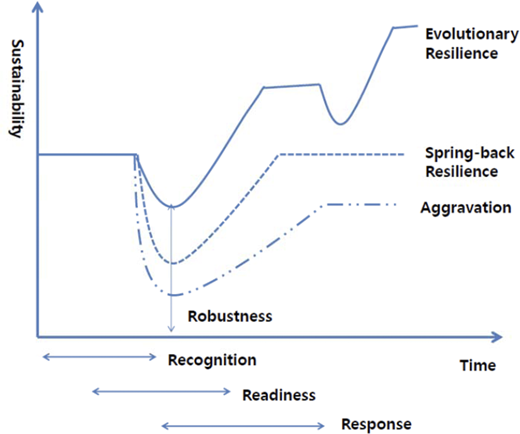
As noted in Figure 1, urban society and infrastructure uphold sustainability with some fluctuations. Gradual or sudden climate risks decrease the sustainability of an urban system. The degree of climatic impacts on an urban system and the rapidity of recovery rely on the level of robustness, recognition, readiness and response. Recognition, readiness and response are a consecutive process in that it is a challenge to respond to climate risks and vulnerability without prior readiness and recognition.
Depending on the level of these 3R steps and extant robustness, there could be different paths to urban sustainability. Without proper policies, the sustainability of an urban system could get worse, i.e. take an aggravation path. A return to normality or the status before the disturbances is a spring-back resilience path. By contrast, evolutionary resilience seeks to have the system evolve to better sustainability and quality. “Better” sustainability depends on locally specific physical, social and economic attributes. Furthermore, the aims and the direction of resilience policy for better sustainability should be discussed by encouraging the participation of local residents, NGOs, experts and policy makers in a form of urban governance. Key components of evolutionary climate resilience require that agents create or utilize institutions to make the system sustainable against climate risks.
3. Analytic framework of evolutionary climate resilience policy
Despite previous efforts to provide an urban resilience guideline (Brown et al., 2012; Tyler and Moench, 2012), a step-by-step process with check-list questions has rarely been suggested. Our analytic framework (Table I) is based on the sub-components of urban climate resilience procedure with specific questions. This can help practitioners and professionals to evaluate current climate-related policies and ordinances to check whether and to what extent they include some components of urban climate resilience concepts. The framework can also contribute to planning, implementing, monitoring and improving urban climate resilience policies.
Evolutionary climate resilience policy precedes 3R (recognition, readiness and response) steps. Recognition refers to the extent to which policy makers, the general public and legislation (as a policy output) identify the concept and significance of resilience and climate risks and vulnerability. The policy makers’ perception of climate risks affects the scope of urban climate adaptation agendas, which underscores the significance of recognition on the concepts and risks within a complex policy field (Lee and Hughes, 2014).
Readiness in an evolutionary climate resilience policy consists of robustness, resourcefulness and redundancy. First, robustness is the capacity of a complex system to absorb disturbances while maintaining function (McDaniels et al., 2008). Regarding climate resilience, an extant system is robust when it is able to reorganize to retain the same function, structure and feedback in response to fluctuating climate change impacts and climate extremes. Robustness can be evaluated by asking the question: Do infrastructure and policy reflect the threats of climate change in the process of design and implementation? Second, resourcefulness refers to the capacity to mobilize financial, organizational, informational and institutional resources (ISET, 2011). Given the competition over resources in a variety of socioeconomic and environmental issues, having responsible organizations with the knowledge and budget for a climate resilience policy is critical in fostering readiness and a response to climate risks. A key question, to analyze the resourcefulness of resilience, is, “To which extent do relevant policies or legislation utilize information, budgets, and organizational resources to cope with climate change and its impacts?”. Third, redundancy provides multiple options and alternatives to cope with contingent situations. Climate resilience redundancy prepares a backup system against climate extremes or slow changes when existing systems face a malfunction (ISET, 2011). Considering the potential conflicts between efficiency and redundancy, a key question to evaluate the level of climate change-related redundancy is: To what extent does a resilience policy provide redundant services and infrastructure? For instance, to deal with increasing flood risks because of climate change, resilience policies choose and prioritize multiple options, including flood defense, storm water storage and/or water butts.
The response stage entails a timely response and recovery. A timely response is important for both urgent climate extremes in natural disasters and slow changes. For urgent risks, it is necessary to have an early warning system and a well-practiced manual. Setting up an implementation scheme allows municipal governments and local communities to respond to climate risks effectively. In the absence of an implementation scheme, policy actions and plans may not be applicable and reasonable. Furthermore, a governance structure facilitates a deliberative response to climate risks, as well as ensuring participation of local residents and national, local and community-level governments. This participatory process is required in the recovery stage to assess the causes and ramifications of climate risks, as well as to make a recovery plan. Thus, learning from the 3R process is meant to prevent similar climate risks and to make a transition to better sustainability (Reed et al., 2013). Table I summarizes 3R categories, sub-categories and key questions to assess urban resilience policies.
4. Case study: comprehensive efforts to achieve climate resilience by the SMG
This paper aims to show how cities can improve the components of urban climate resilience in their policies and legislation through a case study of SMG. Seoul was chosen for this case study because this megacity with a population of approximately 10 million has tried to be a leading city in addressing climate change issues. Seoul has developed various climate change-related policies and ordinances. The SMG’s Ordinance on Tackling Climate Change was enacted on September 30, 2008, even before the national government enacted that kind of law (Lim and Suh, 2012). The Ordinance set a goal of a 25 per cent reduction of the total emission volume of greenhouse gases by 2020, compared to 1990. It includes climate adaptation in Article 26, which mandates adaptation measures responding to climate change; in Article 27, which requires the establishment of a mechanism to research the impacts because of climate change; and in Article 28, which prescribes a climate change impact and vulnerability evaluation test. Later, in 2009, the SMG promulgated a Master Plan for Low Carbon Green Growth, which includes “low carbon” as an essential part of its urban master plan and targets greenhouse gas reduction by 40 per cent (CAI-Asia and CDIA, 2012). Recently, the SMG’s energy policy (known as the “One Less Nuclear Power Plant” policy, which started from 2012) aimed to reduce CO2 emissions by 10,000,000 tons by 2020 (SMG, 2014b). If these policies and the Ordinance initiated substantive goals of greenhouse gas emissions reduction, then the following policies and ordinances have practically implemented those goals, as well as executing measures of climate change adaptation.
The representative policy tackling climate adaptation is the Detailed Plan for Climate Change Adaptation. It categorizes adaptation measures into disaster, health, water and ecosystem managements (SMG, 2012). After acknowledging the Detailed Plan for Climate Change Adaptation as the only salient policy relating to climate change adaptation, this study analyzes other policies or ordinances mainly under the category of climate change to examine whether they have some components of climate resilience. The SMG Basic Ordinance of Disaster and Safety does not specifically provide any particular description in relation to climate change. However, it is included in this study because it regulates a wide range of disaster-related issues, including disasters caused by climate change.
Additionally, the study analyzes the 2030 Seoul Plan, which is a comprehensive urban plan. Solecki et al. (2013, p. 202) clearly explained that responding to climate change involves coordination among many parts, including the legal and political systems, planning departments, zoning regulations, infrastructure and urban services, land markets and fiscal arrangements. Thus, it is essential to analyze the 2030 Seoul Plan because it is an indication of the future direction of the SMG’s policies in relation to climate resilience policy.
This study’s CF (Table I) is used to evaluate the aforementioned policies and ordinances to find out the extent to which they have included components of climate change resilience in which climate adaptation is implicitly included.
4.1 Recognition
4.1.1 Concept and significance of adaptation and resilience.
Question 1 of the CF (see Table I for the CF, supra) checks whether the concept of climate change adaptation is recognized. Yet, there is no recognition of this important concept by the 2030 Seoul Plan and the Basic Ordinance on Disaster and Safety. However, the Ordinance on Tackling Climate Change clearly articulates that concept. Article 26 of the Ordinance states:
[…]the Metropolitan Government shall formulate and execute measures to maintain sustainable development with minimal adverse effects, such as personal or physical damage to citizens from diverse environmental conditions in the future because of climate change.
The Detailed Plan for Climate Change Adaptation also recognizes the concept of adaptation, as it is a plan for climate change adaptation.
Question 2 of the CF examines whether the policy or ordinance explains the need to adapt to climate change. Whereas most policies and ordinances do not provide any mention of this important issue, the Ordinance on Tackling Climate Change (Art. 26) explains that the reason for adapting to climate change is to maintain sustainable development while minimizing the personal and physical damages to citizens caused by climate change. The Detailed Plan for Climate Change Adaptation also clearly states that it is essential to adapt to climate change because a safe city free from the risks of unusual climate patterns should be established to protect the lives and health of its citizens. Furthermore, it also declares that improving climate adaptability will improve the healthiness of an urban ecosystem (SMG, 2012, pp. 6-9).
Question 3 of the CF examines whether the concept of climate change resilience is recognized. Whereas other policies do not recognize the concept, the 2030 Seoul Plan describes the impact of climate change and the importance of responding to climate change at the city level. Although the 2030 Seoul Plan does not include the term “climate resilience” per se, it contains some attributes of the components of climate resilience (SMG, 2014a, p. 93), such as “prompt and early response against risks, prevention of climate disaster, and the improvement of environmental capacity, and set-up of a comprehensive city safety system in responding to unusual weather patterns” (in the section, “Making the City safe to allow all living beings to be vividly alive”; see also Brown et al., 2012; Folke, 2006; Surjan et al., 2011; Penney, 2008). The Detailed Plan for Climate Change Adaptation does not specifically mention climate change resilience. However, it does include “resilience” (in the section on forests and ecosystem) and “improving the capacity of resilience” by minimizing urban development that can have an impact on forests and creating urban forests (SMG, 2012, p. 9, pp. 56-57).
Whether a policy or piece of legislation takes into account the strengthening of climate change resilience and, if so, the reason for that are asked in Question 4 of the CF. This aspect is not considered by any of the previously analyzed policies and ordinances.
4.1.2 Climate risks and vulnerabilities.
The recognition of the impacts resulting from climate change is queried in Question 5 of the CF. The characteristics and time frames of the risks are identified in Question 6 of the CF. The Basic Ordinance of Disaster and Safety does not mention either of these. However, the 2030 Seoul Plan recognizes risks and vulnerabilities caused by climate change. The 2030 Seoul Plan states that Seoul increasingly has been experiencing water-related disasters and landslides caused by unusual climate patterns that resulted from climate change (SMG, 2014a, pp. 24, 93, 96, 110). The Detailed Plan for Climate Change Adaptation also recognizes risks and vulnerabilities caused by climate change (p. 3). It also notes that annual average temperature has increased from 11.6°C in the 1960s to 12.8°C in the 2000s, a 1.2°C increase during this period. Furthermore, climate change-related risks are identified in the fields of disaster, health, water and ecosystems; in increasing water-related disasters because of increased impermeability; in increased epidemic diseases and higher death rates of old people because of heat waves; in vulnerability to drought because of uneven distribution of rainfall between the rainy and dry seasons; and in damaged ecosystems because of an increase in extreme weather patterns. The Ordinance on Tackling Climate Change does not directly recognize risks and vulnerabilities caused by climate change, but rather defines them by stating, “the term ‘vulnerability to climate change’ means the degree that a specific system of a society is exposed to the adverse effects of climate change and fails to cope with them” (Art. 2.4). The Detailed Plan for Climate Change Adaptation does not specifically categorize risks as short-term or long-term risks caused by climate change (Question 6, CF). The other various aforementioned policies do not identify whether the risks are short- or long-term.
The recognition of areas or social groups vulnerable to the impacts of climate change is examined by Question 7 of the CF. Only the Detailed Plan for Climate Change Adaptation discusses specificities germane to Question 7. The Detailed Plan for Climate Change Adaptation specifically mentions the vulnerability of old people and people who live in areas prone to floods to the significant impacts of climate change, such as extreme heat waves and floods. It also articulates the great need to devise policies to address the problems of slope areas and areas prone to floods (SMG, 2012, pp. 7, 8, 10).
4.2 Readiness
4.2.1 Robustness.
Whether the threats of climate change are reflected in the design and construction of buildings and other infrastructure is examined in Question 8 of the CF. However, only the Detailed Plan for Climate Change Adaptation addresses this question to some extent. For example, it mentions that constructing new buildings requires facilitating water-saving devices in response to droughts (SMG, 2012, pp. 8, 13, 50) and basement construction in houses that are located in areas prone to floods should be regulated (SMG, 2012, pp. 11, 25).
4.2.2 Resourcefulness.
The existence of the publication of information and discussion of technology about climate change and its impacts are queried in Question 9 of the CF. The Ordinance on Tackling Climate Change (Art. 4.4) notes that the SMG has a responsibility to provide information to its citizens. The Detailed Plan for Climate Change Adaptation does not provide specific information on technology, although it has a bit of general information about climate change and its impacts. For example, it directs the SMG to disseminate climate and atmospheric environmental information (SMG, 2012, pp. 41, 42), operate a disease information monitoring network (SMG, 2012, p. 40) and provide monitoring information on vulnerable species subject to the impact of climate change (SMG, 2012, pp. 14, 60, 61).
The existence of organizations responding to climate change is examined in Question 10 of the CF. The Ordinance on Tackling Climate Change directs the SMG to establish a Committee Tackling Climate Change and states:
The Mayor shall establish the Committee Tackling Climate Change under his/her control to deliberate on the following matters, such as deliberation on matters concerning the formulation and modification of a master plan for tackling climate change and an annual execution plan, and reflection of the opinions of experts and citizens in the process of determination and execution, etc. of policies against climate change (Art. 12).
The Detailed Plan for Climate Change Adaptation stipulates that the SMG operates a disaster control tower (SMG, 2012, p. 17) and a heat wave shelter (SMG, 2012, p. 37). In the Basic Ordinance on Disaster and Safety, there are no specific organizations tackling climate risks. However, it mandates the establishment of the SMG disaster control tower (Articles 16 and 17), which can function as a control tower in case of climate-related disasters.
The inclusion of a budget for responding to the risks of climate change in an examined policy or ordinance is considered in Question 11 of the CF. The Ordinance on Tackling Climate Change requests that the Mayor allocate a budget to district governments to tackle climate change (Art. 33.2). The Detailed Plan for Climate Change Adaptation generally discusses a budget allocation for responding to climate change in the fields of disaster management (strengthening a disaster management scheme in case of heavy snows and rains and strengthening the capacity to respond to floods); water (strengthening the self-supply of water through adopting an efficient water circulation system and water reuse, and improving water quality, and the water ecosystem); health (increasing capacities to deal with heat waves, epidemic diseases, and air pollution); and ecosystems (preventing landslides, protecting biodiversity, improving urban green areas and activating urban agriculture) (SMG, 2012, pp. 66-70).
4.2.3 Redundancy.
The designation of a backup system to respond to climate change in certain sectors is examined in Question 12 of the CF. No aforementioned policy or ordinance mentioned a backup system. Allowing redundancy as a priority in a specifically designated sector is considered in Question 13 of the CF. None of the aforementioned policies or ordinances places a priority on redundancy.
4.3 Response
4.3.1 Timely response and governance.
Including a warning system so that citizens can be rapidly informed in case of a climate change-related event is examined in Question 14 of the CF. The Detailed Plan for Climate Change Adaptation establishes a smart disaster-safety information system (SMG, 2012, pp. 10, 17), a heat wave information system (SMG, 2012, pp. 12, 36) and an epidemic disease information-monitoring network (SMG, 2012, p. 40).
The existence of a manual for responding to climate-related short- and long-term risks is considered in Question 15 of the CF. The Detailed Plan for Climate Change Adaptation aims to distribute a health management manual in case of heat waves (SMG, 2012, pp. 12, 36), publish a manual for citizens on how to respond to landslides (SMG, 2012, p. 34) and promulgate a practical manual for responding to disasters such as heavy rain and snow (SMG, 2012, p. 40). The existence of implementation schemes for resilience policies in the aforementioned policies and ordinances is also considered in Question 15 of the CF. While other policies and ordinances do not articulate implementation schemes, the Ordinance on Tackling Climate Change and the Detailed Plan for Climate Change Adaptation deal with implementation schemes for realizing climate resilience strategies. The Ordinance on Tackling Climate Change mandates the SMG to formulate and execute the Master Plan for Tackling Climate Change including implementing climate adaptation measures (Art. 8). However, it does not specify measures to bring climate adaptation strategies into the Master Plans. On the contrary, the Detailed Plan for Climate Change Adaptation widely illustrates quite concrete implementation schemes with various projects falling within 29 categories. As climate adaptation strategies, all of these projects can be categorized as climate resilience policies, as climate resilience cannot be realized without climate adaptation, as Penney (2008) mentioned. They include revising existing disaster and safety-related ordinances, strengthening local participation, establishing a system for protecting disadvantaged groups prone to climate-related disasters, strengthening general disaster preventive system, building new infrastructure for preventing future climate-related disasters, facilitating alert systems and enhancing urban green areas to minimize climate-related disasters.
Permitting the local community’s participation in strengthening its responses to climate change is examined in Question 16 of the CF. The Detailed Plan for Climate Change Adaptation aims to foster citizen participation in the disaster management decision-making process. For example, it plans to form a disaster management committee that is composed of 21 persons, such as officers of the SMG, NGO workers and experts, as well as having other relevant organizations participate (SMG, 2012, p. 18).
The existence of the cooperation between diverse stakeholders in responding to climate change-related risks is inquired in Question 17 of the CF. The 2030 Seoul Plan stipulates the strengthening of a cooperative scheme among institutions, such as sharing information on climate change responses (SMG 2014a, p. 99). The Detailed Plan for Climate Change Adaptation directs the SMG and the 25 district governments of Seoul to cooperate in monitoring the safety of the steep slopes of urban forests and in continually reducing the risks associated with the landslides in urban forests (SMG, 2012, p.33). However, the Detailed Plan for Climate Change Adaptation does not include any content relating to cooperation among stakeholders, such as between the central and city government.
4.3.2 Recovery.
The inclusion of an evaluation system on a cause-and-effect relationship between climate change and risks is examined in Question 18 of the CF. The Ordinance on Tackling Climate Change mandates an assessment of the impacts of climate change, as well as vulnerability to it (Art. 28). The Detailed Plan for Climate Change Adaptation does not have an evaluation system. The existence of a system that allows stakeholders to participate in the process of evaluation is queried in Question 19 of the CF; none of the aforementioned policies and ordinances discusses this kind of system.
4.4 A summary of the results reflecting the conceptual framework
Table II succinctly summarizes the results reflecting answers questioned in the CF in Table I. The discussions in the table below will explain how the meaning of the aforementioned policies and ordinances can be evaluated from the perspective of evolutionary urban climate resilience.
Results reflecting answers from the conceptual framework
| Ordinance on Tackling Climate Change | Detailed Plan for Climate Change Adaptation | Basic Ordinance on Disaster and Safety | 2030 Seoul Plan | |
|---|---|---|---|---|
| Recognition | ||||
| (1) Adaptation concept | Considerably reflected | Considerably reflected | Not reflected | Not reflected |
| (2) Reasons for adaptation | Considerably reflected | Considerably reflected | Not reflected | Not reflected |
| (3) Resilience concept | Not reflected | Somewhat reflected | Not reflected | Somewhat reflected |
| (4) Reasons for resilience | Not reflected | Not reflected | Not reflected | Not reflected |
| (5) Climate impacts | Somewhat reflected | Considerably reflected | Not reflected | Considerably reflected |
| (6) Climate risks | Not reflected | Not reflected | Not reflected | Not reflected |
| (7) Vulnerability | Not reflected | Considerably reflected | Not reflected | Not reflected |
| Readiness | ||||
| (8) Robustness | Not reflected | Somewhat reflected | Not reflected | Not reflected |
| (9) Information | Somewhat reflected | Somewhat reflected | Not reflected | Not reflected |
| (10) Organization | Considerably reflected | Not reflected | Somewhat reflected | Not reflected |
| (11) Budget | Considerably reflected | Considerably reflected | Not reflected | Not reflected |
| (12) Backup system | Not reflected | Not reflected | Not reflected | Not reflected |
| (13) Redundancy | Not reflected | Not reflected | Not reflected | Not reflected |
| Response | ||||
| (14) Warning system | Not reflected | Considerably reflected | Not reflected | Not reflected |
| (15) Implementation/manual | Somewhat reflected | Considerably reflected | Not reflected | Not reflected |
| (16) Community participation | Not reflected | Considerably reflected | Not reflected | Not reflected |
| (17) Multilevel governance | Not reflected | Somewhat reflected | Not reflected | Somewhat reflected |
| (18) Assessment | Considerably reflected | Not reflected | Not reflected | Not reflected |
| (19) Evaluation participation | Not reflected | Not reflected | Not reflected | Not reflected |
5. Discussion
The analysis of this study shows that no particular policy or ordinance covers all components of evolutionary urban climate resilience. However, certain sections of a policy or an ordinance consider urban climate resilience components. Among 3R (Recognition, Readiness and Response) steps, climate change-related ordinances and policies mostly acknowledge the recognition step. The readiness step has also partially appeared in the ordinances and policies analyzed. In particular, ordinances and policies lack the components of redundancy. The response step is also partially discussed, without mentioning recovery components. The reason why readiness and response steps are not as fully addressed compared to the recognition step seems to be because of costs for obtaining resources and operating institutions for redundancy and recovery components. In addition, readiness and response steps appear to be much less recognized by practitioners and law makers.
The Ordinance on Tackling Climate Change and the Detailed Plan for Climate Change Adaptation recognize the concept of climate adaptation, while the 2030 Seoul Plan and the Detailed Plan for Climate Change Adaptation partially acknowledge the concept of climate resilience. The Detailed Plan for Climate Change Adaptation and the 2030 Seoul Plan recognize risks or vulnerabilities caused by climate change. Most of the discussed policies and ordinances discussed partially include components of recognition, as shown in the CF of evolutionary urban climate resilience.
In addition, the Detailed Plan for Climate Change Adaptation and the Ordinance on Tackling Climate Change also discuss robustness and resourcefulness to a significant extent (robustness, resourcefulness and redundancy are categorized as components of climate change readiness). The rain- or water-related disasters that Seoul has experienced in recent years might explain why the two components of readiness are significantly reflected in the policies and ordinances analyzed. From the analysis, it can now be stated that the SMG has achieved a certain level of development in the component of readiness for evolutionary urban climate resilience, thus learning from previous experiences. However, certain aspects of readiness such as obtaining a backup system and allowing redundancy are not fully acknowledged. Existing policies and ordinances need to be modified to include missing components of redundancy for implementing evolutionary urban climate resilience concepts.
Meanwhile, the Detailed Plan for Climate Change Adaptation includes providing alert systems to citizens, implementation schemes, a local community’s participation and cooperation among stakeholders. This means that timely response and governance as components of the CF of evolutionary urban climate resilience are well-represented in the Plan. In particular, the Plan provides the lists of concrete projects for realizing implementation schemes of climate resilience policy.
However, the Plan does not provide any evaluation scheme that is directly related to the component of recovery. None of the other policies and ordinances describes evaluation schemes to understand the relationship between climate change, disasters and risks. It also shows that they lack any guarantees for stakeholders to participate in an evaluation scheme. This lack of an evaluation scheme and well-structured governance mechanism for implementing an evaluation scheme implies that the existing SMG’s policies and ordinances lack components for recovery in strategizing evolutionary urban climate resilience. An evaluation scheme and the governance mechanism for implementing an evaluation scheme in these policies and ordinances need to be improved and adequately structured because they are crucial in a timely response to climate risks and disasters.
6. Conclusion and policy implications
The evolutionary urban climate resilience concept is quite new. Yet, applying this concept to respond to urban climate risks is significant and imperative. Our analysis and discussion support three applicable conclusions:
strengthen whole process of 3Rs;
coordinate interlinked policies and ordinances; and
establish a comprehensive climate change master plan.
First, the analysis of climate change-related ordinances and policies reveals which components need to be strengthened to achieve evolutionary urban climate resilience. To fully adopt evolutionary urban climate resilience concepts, city governments and councils need to further advance readiness and response steps. These two steps require substantial policy attention, resource allocation and institutional supports. Despite the need for considerable efforts, fulfilling all 3R steps of evolutionary resilience can allow city governments to achieve better sustainability under aggravated climate threats in the future.
Second, the findings of the paper suggest the coordination of mutually linked policies and ordinances. City governments need to incorporate the concept of evolutionary urban climate resilience to relevant policies and ordinances. For example, in the case of Seoul, evolutionary urban climate resilience concepts need to be connected with the Basic Ordinance on Disaster and Safety, as it regulates the disaster management control tower, which can play a significant role in the case of climate-related disasters.
Third, the study suggests establishing a comprehensive climate change master plan. In reality, it may not be possible for each individual ordinance or policy to be consistently revised to incorporate the components of evolutionary urban climate resilience. Thus, an alternative option can be to establish the Master Plan for Tackling Climate Change to widely and comprehensively cover mitigation, adaptation and resilience together. An individual policy and ordinance can be harmonized under this Plan for the purpose of a comprehensive response to climate change. Seoul’s case teaches that coordination among existing policies and ordinances is necessary to achieve an important policy goal – establishing and enhancing urban climate resilience strategies. The coordination needs to be directed toward recognizing risks and vulnerabilities, securing human and institutional resources, strengthening systematic robustness, preparing for redundancy in significantly vulnerable sectors, promptly responding and establishing and implementing measures to tackle climate resilience-related issues. The concept and analytic framework of evolutionary urban climate resilience is of a general nature, so that it can be applied to other cities that seek to build up or enhance sustainability through a resilience plan.
This research was funded by the Seoul Metropolitan Council. The authors thank the Seoul Metropolitan Council for their generous funding. This research was also funded from Yonsei University Challenge Research Grant 2015-22-0077 and the Basic Science Research Program through the National Research Foundation of Korea (NRF) funded by the Ministry of Education, Science and Technology (NRF-2013S1A3A2054969).

