


The purpose of this paper is to assess smallholder farmers’ vulnerability to climate change and variability based on the socioeconomic and biophysical characteristics of Chiredzi District, a region that is susceptible to the adverse effects of climate change and variability.
Vulnerability was assessed using the Vulnerability to Resilience and the Climate Vulnerability and Capacity frameworks.
The major indicators and drivers of vulnerability were identified as droughts, flash floods, poor soil fertility and out-migration leaving female- and child-headed households. From sensitivity analysis, it was shown that different areas within the district considered different biophysical and socioeconomic indicators to climate change and variability. They also considered different vulnerability indicators to influence the decisions for adaptation to climate change and variability.
The results of this study indicate that the area and cropping systems are greatly exposed and are sensitive to climatic change stimuli, as shown by the decline in main cereal grain yield. These results also showed that there is a need to define and map local area vulnerability as a basis to recommend coping and adaptation measures to counter climate change hazards.
1. Introduction
Understanding people’s vulnerability to climate change and variability is complex, as this depends on both biophysical and socioeconomic drivers of climate change impact that determine the capacity to cope and adapt (Berkes, 2007). The vulnerability of a society to climate disasters such as drought depends on several factors such as population, technology, policy, social behavior, land use patterns, water use, economic development and diversity of economic base and cultural composition (Wilhite et al., 2014). Prevalence of drought and decline in food availability should not necessarily lead to famines and loss of livelihoods. Whether food availability decline would lead to disaster will depend on capability failure, which in turn depends on market access and people’s social, economic and political entitlements (The World Bank and GFDRR, 2013). In sub-Saharan Africa, rainfed agriculture provides about 90 per cent of the region’s food and feed, and it is the principal source of livelihood for more than 70 per cent of the population (Bauer and Scholz, 2010). Because of heavy dependence on rainfed agriculture, about 60 per cent of sub-Saharan Africa is vulnerable to frequent and severe droughts (Viljoen, 2014).
As indicated, the level of vulnerability of a society exposed to climate change impacts is contextual, and depends on many factors. Therefore, vulnerability should be understood in the context of a systems approach to a hazard in a temporal reference (Joshua Ndiweni et al., 2014). Vulnerability to climate impacts is defined in many ways and has different meanings when used in different disciplines and contexts (Brooks, 2003; Gbetibouo et al., 2010; Gitz and Meybeck, 2012).
According to the IPCC (2007), climate change vulnerability is:
The degree to which a system is susceptible to, and unable to cope with, adverse effects of climate change, including climate variability and extremes. Vulnerability is a function of the character, magnitude, and rate of climate change and variation to which a system is exposed, its sensitivity, and its adaptive capacity.
Smallholder farmers’ vulnerability to climate change and variability can, therefore, be described in relation to exposure to increased temperatures, the sensitivity of crop yields to the increased temperature and the ability of the farmers to adapt to the effects of this exposure and sensitivity. This adaptation could be by planting more drought-tolerant crop varieties or diversification into new crops, for instance. The IPCC (2007) definition highlights three components of vulnerability: exposure, sensitivity and adaptive capacity. This means that a system exposed and sensitive to the impacts of climate change but with limited adaptive capacity is vulnerable. In contrast, a system is less vulnerable if it is less exposed, is less sensitive or has a strong adaptive capacity (Santiago, 2001; Smit and Wandel, 2006).
Adger (2006) points out that there are two climate change vulnerability concepts. These are outcome and contextual vulnerability, which differ depending on interpretation of vulnerability as being the end-point or the starting point of the analysis. The outcome vulnerability (“end-point” interpretation) concept considers vulnerability as the (potential) net impact of climate change on a specific exposure unit (which can be biophysical or social) after feasible adaptations are taken into account. Contextual vulnerability (“starting point” interpretation), on the other hand, considers vulnerability as the present inability of a system to cope with changing climate conditions, whereby vulnerability is seen to be influenced by changing biophysical conditions as well as dynamic social, economic, political, institutional and technological structures and processes. In the contextual approach, vulnerability is seen as a characteristic of ecological and social systems that is determined by multiple factors and processes (Adger and Kelly, 1999; Adger, 2006; Eriksen et al., 2011). Contextual vulnerability approaches focus more on the current socioeconomic determinants or drivers of vulnerability, such as social, economic and institutional conditions. Specific factors that can affect vulnerability include, for example, marginalization, inequity, food and resource entitlements, presence and strength of institutions, economics and politics (Kelly and Adger, 2000; Reed et al., 2005). Thus, contextual vulnerability explicitly recognizes that vulnerability to climate change is not only a result of biophysical events alone but also influenced by the contextual socioeconomic conditions in which climate change occurs. The contextual approach builds on the dual consideration of socioeconomic and biophysical aspects that make a system vulnerable (Turner Ii, 2010). The contextual approach emphasizes that the social and ecological context in which climate change occurs is likely to be as important as the climatic shock itself (Eriksen, 2000; Eriksen et al., 2011; Turner Ii, 2010).
This observation has been ascertained by quantitative agricultural research, such as quantitative work on the socioeconomic factors that make grain harvests in China sensitive to rainfall anomalies (Li et al., 2013). Different crop yields during drought periods in Mexico could not be solely explained by different precipitation patterns but were strongly influenced by different land tenure and the historical biases of farmers’ access to productive resources (Ericksen et al., 2009). In North America, Niggol Seo et al. (2008) find that about 39 per cent of the variations in average crop failure rates across the USA can be explained by variations in soils and climate, which basically implies that other factors such as management skills, socioeconomic, institutional and political conditions account for the remaining 61 per cent.
Therefore, from the contextual interpretation, vulnerability can be reduced by modifying the contextual conditions in which climate change occurs so that individuals and society are enabled to better adapt to changing climatic stimuli (Adger, 2006; Leary et al., 2006; Osman-Elasha et al., 2006). This study explores the biophysical and socioeconomic factors that make the smallholder farmers of Chiredzi District, Zimbabwe, vulnerable to climate change variability. It further explores the options that can be adopted to increase adaptive capacity and reduce vulnerability.
2. Methodology
2.1 Site description
The study was conducted in Chiredzi District which is located south east of Zimbabwe. Chiredzi District lies in Masvingo Province. The district is found in natural agroecological region V of Zimbabwe (Zimbabwe Meteorological Department, 2006). In Zimbabwe, natural region V is characterized by aridity and uncertain rainfall patterns. Chiredzi receives mean annual rainfall of 450-600 mm, with mean annual evaporation exceeding 1,800 mm. Historical data show that surface temperatures in the district have warmed by 0.6°C from 1966 to 2005, and are projected to rise to 1.5-3.5°C by about 2050 (Davis, 2011; Zimbabwe Meteorological Department, 2006). Despite the aridity of the district, the main source of livelihood for households in Chiredzi is agriculture.
2.2 Data collection for vulnerability assessment
This study used the Vulnerability to Resilience Framework developed by Practical Action (Pasteur, 2011) and the Climate Vulnerability and Capacity Analysis Handbook developed by Care (2009), to analyze local-level vulnerability. The tools generally recognize that individuals and communities are vulnerable in different ways. A summary of the tool is represented in Figure 1. However, the governance component was beyond the scope of this study. The tools used key informant interviews, household interviews, focus group discussions and secondary data. Four focus group discussions were held and 100 households were interviewed across four wards of the district (Ward 4 – Mupinga, 6 – Dzinzela, 8 – Chibwedziva and 25 – Muteo). Key informant interviews were done with local government officials, agricultural extension officials, community leaders and the elderly people in the communities.
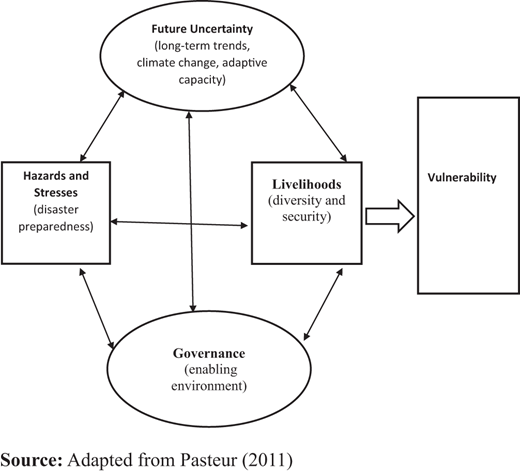
This assessment, based on the IPCC definition, attempted to quantify the three components by identifying appropriate indicators and combining them into indices for each. The components were then combined into an integrated index of vulnerability. The indicators used for the components included both biophysical (primarily for exposure and sensitivity) and socioeconomic (mainly for adaptive capacity) sources (Adger et al., 2004; Wheeler, 2011). The arithmetic model for assessment of the two sub-indices of exposure and sensitivity, minus the adaptive capacity, obtained the final value of the vulnerability [equation (1)]:
2.2.1 Assessment of exposure to climate change.
The exposure component of vulnerability evaluated characteristics of the local climate, described as changes and likely in key baseline climatic variables (temperature and rainfall). The assessment was based on the analysis of historical observations of temperature and precipitation in the 10-year baseline period (2000-2010). Because climatic threats are different for each season, there are no reasons to consider an exposure to their stressors in annual climatic variables.
2.2.2 Assessment of sensitivity.
Sensitivity assessment was done on biophysical and socioeconomic parameters. These parameters were defined by a set of indicators (Table I). Biophysical indicators were soil fertility, soil geomorphologic processes, droughts and flash floods. The socioeconomic indicators were local area population and character of household (female-headed, child-headed, migration).
Defining vulnerabilities by farmers in Chiredzi District
| Indicator of vulnerability | Description |
|---|---|
| History of disasters | Perpetual droughts (1 good season in 10 years) Increase in flash floods |
| Other events or trends (temperature/rainfall) | More prolonged droughts More young people and men migrating to urban areas and other countries |
| Food insecurity | Perpetual food insecurity |
| Poverty | Women- and child-headed households considered poorest Households with many young children considered poor |
2.2.3 Weighting of vulnerability.
The components of vulnerability (exposure, sensitivity and adaptive capacity) were weighted on the basis of vulnerability index (calculated using equation (1) above).
3. Results
3.1 Defining local vulnerabilities
The farmers (in focus group discussions) and key informants indicated that vulnerability to climate change is broad. However, the common indicators identified are shown in Table I. The increased frequency of droughts and other extreme events was noted as a major cause of increased vulnerability of individual households and the farmers. Increased food insecurity and poverty was identified as a key indicator to vulnerability to climate change and variability.
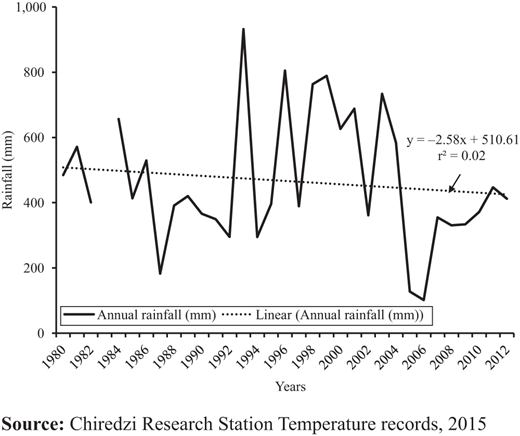
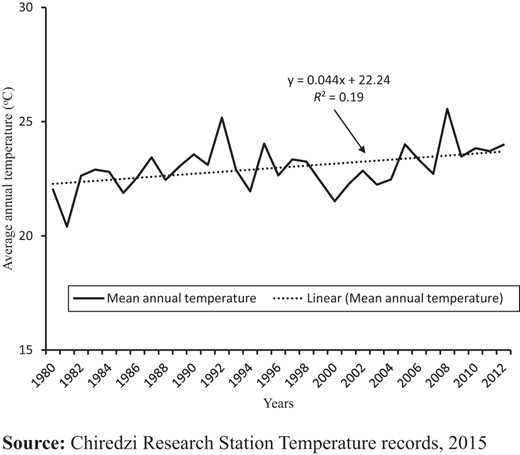
3.2 Assessment of exposure to climate change
The assessment was mainly focused on the trends (and therefore impacts) of ambient temperature and precipitation. Chiredzi District is located in a semiarid zone where rainfall is the main limiting factor for crops production, and any further aridization on its territory could substantially influence the productivity. The observed temporal variability of temperature and rainfall indicated certain widespread exposure to climatic conditions of the district (Figures 2 and 3). Over the 32-year period of 1980 to 2012, there was a decline in annual rainfall of 2.5 mm per year as shown in Figure 2. The temperature trend, however, shows an increase in annual mean temperature over the same period (by a factor of 0.04°C per year, Figure 3).
3.3 Assessment of sensitivity
The biophysical status of the agricultural land defines environmental sensitivity, mainly the anthropogenic load on the land. In these assessments, all indicators were treated as independent, and the ranking by a particular indicator implied equality of the rest. In addition to biophysical indicators, four socioeconomic indicators were ranked. The resulting sensitivity showed that female-headed households are considered to have more sensitivity to climatic threats (Table II).
Ranking of assessed wards in Chiredzi District in order of sensitivity
| Ward | Biophysical indicators | Socioeconomic indicators | |||||||||
|---|---|---|---|---|---|---|---|---|---|---|---|
| Indicators rank | Indicators rank | ||||||||||
| b1 | b2 | b3 | b4 | Biophysical indicators rank (b) | s1 | s2 | s3 | s4 | Socioeconomic indicators rank (s) | Final rank | |
| Dzinzela (Ward 6) | 7 | 13 | 4 | 6 | 3 | 11 | 12 | 3 | 7 | 4 | 1 |
| Chibweziva (Ward 8) | 2 | 11 | 3 | 4 | 1 | 1 | 6 | 1 | 15 | 1 | 2 |
| Mupinga (Ward 4) | 1 | 14 | 10 | 7 | 4 | 2 | 19 | 5 | 1 | 2 | 3 |
| Muteo (Ward 25) | 4 | 12 | 8 | 6 | 2 | 4 | 18 | 4 | 2 | 3 | 4 |
Notes:
Key: rank score – 1 least sensitive indicator and 20 the most sensitive indicator; b1 = flash floods; b2 = drought; b3 = soil fertility; b4 = geomorphologic processes; s1 = population; s2 = female-headed household; s3 = child-headed household; s4 = migration
3.4 Sensitivity of main crops to rainfall
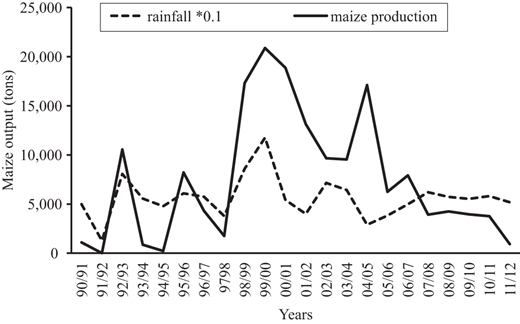
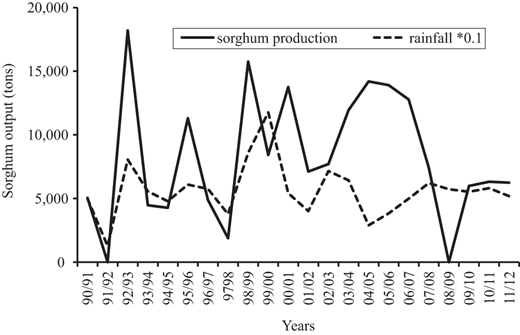
Correlation of rainfall variability and cereal grain output in Chiredzi District (1990-2012) is shown in Figure 4 (maize) and Figure 5 (sorghum). The maize correlation shows a trend of continued decline of maize output with continued decline in rainfall amounts. While sorghum is more drought-tolerant, the results also indicate a declining trend in sorghum output.
3.5 Assessment of adaptive capacity
Adaptive capacity was evaluated as the function of a set of general economic and agricultural indicators (Table III). The higher the levels of each of these indicators, the higher its adaptive capacity to climate change; the sum of indicators’ ranks determines its adaptive capacity relative to other areas. Table III shows that Ward 25 had more adaptive capacity than Ward 6, for instance.
Ranks of assessed wards in decreasing order of adaptive capacity
| Ward | Adaptation indicators rank | ||||
|---|---|---|---|---|---|
| a | b | c | d | Rank | |
| Dzinzela (Ward 6) | 9 | 9 | 1 | 1 | 1 |
| Chibweziva (Ward 8) | 12 | 5 | 2 | 3 | 2 |
| Mupinga (Ward 4) | 2 | 13 | 3 | 5 | 3 |
| Muteo (Ward 25) | 13 | 7 | 5 | 2 | 4 |
Notes:
Key: rank score – 1 most used adaptation measure and 20 least used adaptation measure; a = crop diversification; b = livestock diversification; c = market gardening; d = off-farm activities
3.6 Weighting of vulnerability
The field weighting of vulnerability had positive correlations with climate risk exposure (0.69) and sensitivity (0.74). The adaptive correlation was negative (−0.78). This implies that exposure and sensitivity are positively correlated with vulnerability, if either increases so does vulnerability (Figure 6). Increases in exposure and sensitivity tend to increase vulnerability. For instance, extreme events, environmental issues or climate alone would be sufficient to increase household or community vulnerability. Adaptive capacity should reduce vulnerability and explain why the correlations of variables are negative.
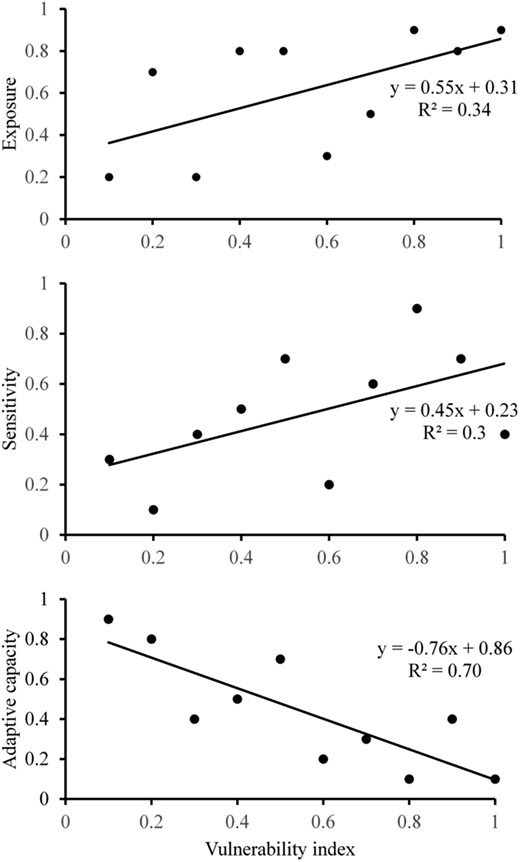
Exposure, sensitivity and adaptive capacity contribution to vulnerability index
Exposure, sensitivity and adaptive capacity contribution to vulnerability index
Among the exposure variables, the climatic variables best explained the variance, with a correlation of 0.68 (Table IV). Extreme events (0.61) and environmental problems (0.49) explained less of the variance. Sensitivity and adaptive capacity weightings are also shown in Table IV.
Correlation with vulnerability index by indicators of exposure, sensitivity and adaptive capacity
| Dimension | Indicator variables | Correlation with vulnerability |
|---|---|---|
| Exposure | Extreme events | 0.61 |
| Environmental problems | 0.49 | |
| Climate | 0.68 | |
| Index (exposure) | 0.73 | |
| Sensitivity | Population | 0.62 |
| Health issues | 0.41 | |
| Farming | 0.72 | |
| Index (sensitivity) | 0.71 | |
| Adaptive capacity | Labour | −0.63 |
| Social capital | −0.22 | |
| Access to credit | −0.53 | |
| Index (adaptive capacity) | −0.71 |
4. Discussion
Smallholder rainfed farming is highly exposed to climate change and vulnerability. These results show a decreasing trend in rainfall in Chiredzi District (Figure 1). According to literature, this trend is expected to continue as Southern Africa becomes more affected by climate change and variability impacts (Shiferaw et al., 2014; Ziervogel et al., 2014). This agrees with simulations of temperature and precipitation under climate change scenarios which indicate temperature increases from 1 to 2°C and rainfall reductions of 5 to 20 mm (10 per cent) in Southern Africa (Davis, 2011). The combination of changes in temperature and precipitation can lead to a more exposed agricultural sector. This would lead to a decline in crop yields and loss of livelihoods. In terms of vulnerability, smallholder farmers dependent on rainfall would need to adopt more drought-tolerant crops and shift to hardier livestock (Chambwera and Stage, 2010). On the other hand, average annual temperatures are increasing in Chiredzi District. Such warmer temperature would decrease the probability of cropping in the area (the opposite being true for increase in rainfall and decrease in temperature relative to the current conditions) (Lotsch, 2006). Thus, increase in temperature and decrease in rainfall reduce crop and livestock choices and diversification for the smallholder farmers, increasing their vulnerability to climate change and variability. After integrating the exposure and sensitivity variables, it is possible to develop more detailed profiles that may enable governments to target their climate adaptation policies.
These results also further indicate the increased sensitivity, due to droughts and flash floods, of smallholder farmers who depend on rainfall for farming. Prevalence of droughts in Chiredzi District appeared to mask the effects of poor soil fertility on crop production. While it is well established that inherently poor soils limit crop productivity in Africa (Rurinda et al., 2014; Shisanya, 2005; Whitbread et al., 2004), smallholder farmers tended to attributed poor crop yields to drought.
However, adaptation would not be cost-effective if the farmers do not understand their exposure and sensitivity (Nelson et al., 2010). It is supposed that areas where arable lands dominate are more subjected to climate risks and, thus, are more sensitive than, for example, lands under perennial pastures and forests. Also, the larger the built-up area (or the level of urbanization), the higher the physical sensitivity and vulnerability of the area. Soil degradation and geomorphologic processes (e.g. surface erosion) determine soil quality and ecological conditions (Shiferaw et al., 2014).
Sensitivity also increases with the increasing population (Table IV), particularly increasing share of female populations, which are among the most vulnerable categories (Lotsch, 2006). Growth of a demographic load, described as a ratio of incapacitated household members to the able-bodied household members, indirectly increases its vulnerability. The growth of female- and child-headed households is a direct impact of climate change, as households seek alternatives to climate-sensitive rainfed agriculture. Unfortunately, it is the able-bodied men and young people who migrate to urban areas in search of better livelihoods (Ogalleh et al., 2012). The socioeconomic impacts of such climate-induced migration need further exploration. However, the remaining female- and child-headed households bear the brunt of climatic shocks and risks.
The understanding of the farmers’ own vulnerability helps to develop adaptive capacity. While subsistence farmers would continue to use crop and livestock diversification to reduce exposure and sensitivity, there is an increasing trend to focus more on market gardening and off-farm activities (Table III; Coe and Stern, 2011; Li et al., 2013). However, produce from market gardens, despite increasing nutritional security, may be difficult to market when there is surplus (Nelson et al., 2009). Off-farm activities bring with them a lot of socioeconomic challenges as described by Angus and Hassani (2009) and Twerefou et al. (2014). The responsiveness of farmers to the impacts of climate change is determined, in principle, by their current adaptive capacity, but that capacity has limits that have already been demonstrated by the losses and damages associated with events such as droughts and floods, which cause economic and human losses (Shiferaw et al., 2014). Therefore, the results of this study may enable the shift of adaptation efforts to areas with greater exposure, increased sensitivity or lower adaptive capacity.
5. Conclusion
While perhaps most difficult to evaluate, subsistence farmers’ vulnerability in terms of climate change must be addressed to save livelihoods. It is the poorest members of these areas or those that could be made poor by climate change that are most at risk. The wide uncertainty with regard to local and regional climate change means it is difficult to rule out negative possibilities for any area. Thus, without even considering specific climate scenarios, we can assert that those who are currently poor, malnourished and dependent on local production for food are the most vulnerable in terms of hunger and malnutrition to climate change of the world’s populations. Similarly, severe economic vulnerability is also most likely where a large share of the population depends on agriculture, leaving little alternative employment opportunities. Such vulnerability, from the contextual interpretation, can only be reduced by minimizing and modifying the contextual conditions of exposure and sensitivity to climate risk and increasing indicators of adaptive capacity, so that individuals and communities are enabled to better adapt to changing climatic stimuli.
Funding: This study was funded by the National Research Foundation of South Africa through the Research Chair: Agronomy and Rural Development, University of KwaZulu-Natal, Pietermaritzburg, South Africa.

