
Response to Pearce and McCabe’s critiques
Article Type: Rejoinder From: International Journal of Culture, Tourism and Hospitality Research, Volume 8, Issue 2
Introduction
Honoured judge and jury, esteemed colleagues, Philip Pearce and Scott McCabe, greetings to you who are advising the prosecution, honoured students! It is with great trepidation that we seek to defend our academic work on the tourism behaviour theory and experience research in this academic court. We are grateful for the opportunity and applaud the editor’s initiative to establish this exchange platform.
This, what we might call an academic’s rapid-exchange platform, somewhat breaks up the straightjacketing of thoughts and ideas that come with the blind-reviewed blandness of the academic of world of publishing. Style requirements and word-limits create for ever tightropes of communication on which the academic has to balance his/her communication. The danger of falling into the void of misunderstandings is real, and we suspect these dangers will increase. We believe so because the Cartesian silos of scientific disciplines are not only beginning to merge reluctantly, as they manage less and less to explain the complexity of phenomena on their own, but also because academic thinking is changing more rapidly from a linear to a more complex and integrative mode of theorizing (#B2) as a consequence.
Being aware of these changes, it does not cease to amaze us how difficult human communication really is even when aware of its traps. The prosecution here confronts us with our own shortcomings. Yet, we are equally delighted as to how our flawed ability to communicate is clarified in our own minds through this discussion with these outstanding scholars the prosecution has been able to second. Likewise, we are honoured by the respect, grace and sensitivity by which these advisers manage to soften their intellectual blows meted out in their critique.
Philip Pearce is the Foundation Professor of Tourism at the Faculty of Law, Business and Creative Arts at the James Cook University and belongs to the pioneers of today’s tourism studies in Australia. Pearce is an important commentator on tourism development and marketing in Australia. Worldwide, he has established his particular fame with the introduction of the tourism career ladder (#B18) that continues Maslow’s footsteps. Being clear in his challenge, he asked us to appraise it together with other authors’ work so as to further reveal their relationship with and the relevance of the tourism experience model.
While highlighting the psychological aspects of tourism in his career ladder, Pearce’s work can be said to be that of a humanist, as he links his psychological interests in the maturation of the individual to an acute awareness of social psychology because when “articulating an experiential psychological definition of tourists […] [researchers should pursue this] without neglecting the fact that tourists are also defined by the local community” (#B18, p. 21). Then as now, such a view is going against the major current of interest in social psychology. As detailed elsewhere (#B6), social psychology “seeks to understand the nature and causes of individual behaviour in social situations” (#B39, p. 6); yet Pearce’s interest clearly lies with the individual and self-development first and the social environment second (#B22). This is where our interests happen to coincide.
Scott McCabe is the other outstanding tourism researcher providing the arguments for the prosecution and whose home is in England. He is Associate Professor at the University of Nottingham where he teaches in the areas of tourism marketing. A formidable contributor to the tourism research literature, his interest also lies with tourism behaviour. Yet, unlike Pearce, McCabe’s work reveals him as influenced by the Baconian school of empiricism, still a hallmark of Great Britain. Since 1996, many of his publications surround issues of participation and engagement in tourism. He subsequently built a strong profile with his work on social equity. McCabe’s numerous co-authored publications in tourism’s leading research journals reveal him as an effective communicator and teacher and make him an intellectual powerhouse in the discussion on tourism theory. One of the recurring themes in his work is his interest in how tourists’ behaviour is embedded and embodied in their everyday lives and social environment.
These two advisors to the prosecution have a number of serious criticisms. Pearce’s issues surround the authors’ style and clarity citing “obfuscating language”. A further issue is the neglect of important literature, while the last, the most critical, centres on the roots and specifications of the model. McCabe has overlapping concerns when expounding the view that “positioning tourist experience solely within a behavioural perspective […] [would not] embrace all the important psycho-social elements that influence behaviours”. He further questions whether the experience types in the model indeed cover all possible types, and he judges their authors’ emphasis of the “otherness” of holidays as an indication that they hinge experiencing on escape motivations. Finally, he critiques the authors for not sufficiently crediting the contributions of other social sciences like anthropology.
We wish to preamble our defence with the following explanation. Your Honour, valued jury, it is due to the vagaries of the academic publishing machine that influence our stream of publications, particularly when, as in our case, the providers of sustenance demand from us that we rely on blind-reviewed journals as the compulsory mode of publishing. Indeed, the somewhat unusual references in the paper on trial to a “not dated” and “unpublished” manuscript reveals the authors’ embarrassment that a broad and more comprehensive discussion of the tourism experience literature has yet to pass the scrutiny of our valued peers elsewhere.
As the prosecution kindly took on board, however, much of the previous tourism experience literature focuses on outcomes such as “the experience” (memorable or otherwise) or satisfaction, whereas the paper on trial seeks to focus on the process of experiencing. This distinction is particularly noteworthy, as few analytic definitions of “experience” exist. We define an experience as the “the conflux of, what is sensually perceived, how it is processed, and how it is retained in the resulting experience” (#B7 unpublished). The tourism experience model focuses on how stimuli are processed.
Positioning statement: a response to charge 3
Your Honour, valued Jury, before we enter into a direct response to the critique brought before you, we would like to sum up our view as brief and as practical. As Pearce’s charge that the phenomenological organisation of important streams of tourism literature “lacks roots’ appears as the gravest, we seek to work an answer into the following positioning. We also seek to address McCabe’s concern that we revive the old work–leisure dichotomy and the notion of escape.
Our defence of the TEM hinges on your appreciation of the analysis of how the processing of emotionally sensed stimuli received by the tourist can be presented systematically. Our suggested views on experiencingare:
a function of consciousness and activity;
which organises our way of grouping literature according to experiential modes. Owing to their functional characteristics, the resulting experiential outcomes are then; and
broadly typified as either, pleasure seeking, rediscovering, holism or knowledge seeking which we discuss in the paper on trial.
What distinguishes our approach from other systematic approaches is that we seek the future of tourist experience research to evolve together with the still emerging change in paradigm that body and mind exist in this world together and as one, including as part of the (social) environment. As #B16, p. 41) elaborates, “the body is both praxis as a physical space for exploration and a site for meaning where fantasies and desires play a role”. Drawing on #B5 and #B13, we also subscribe to the same views that “people experience themselves simultaneously in and as their bodies”. The otherness of holidays exists in the break from routine or the trip to a different place, yet the tourist remains the same individual, only transformed by way of his/her experiencing. Holidays redress the stresses and strains from a work-a-day life and (or) can help develop mind and body to its full potential (#B23; #B24). Yet, they may also have become a routine and the “otherness” of holidays may have nothing to do with work (#B25).
Our modes are ideal types. Experiencing may move across different modes in the flow of tourists’ holidays. However, with the TEM, we can find more consistent and grounded explanations for the ways hedonic and other outcomes are pursued. This is because we can better match the experience with relevant methodologies that have a claim in having studied its forms and structures. We can thereby create more efficient propositions for describing expectation, motivation, involvement, attitude and satisfaction formation. In addition, we hope this will enable us to ground perceptions of well-being and happiness in a tighter nomenclature and with cross-cultural validity.
#B20 observes in his analysis of consciousness as being-for-itself, that the past cannot be changed, while the future is open and uncertain. Consequently and universally, the contemporary present introduces moments of fundamental existential insecurity. Consciousness can choose to live in the present almost entirely as a product of a past. Life then is interpreted through a lens of acquired social norms, expectations and desired outcomes. The factual moments of such remembered behaviour then guide tourists in their choice of “what and how to latch onto” the present (a point McCabe reminds us of with his reference to #B26 eclectic tourism-as-role-play experience, but see also #B1, #B27 and particularly #B12). The tourist thereby tends to view the present through the past by looking backwards, as it were. It is not only granted but also important to note that the tourist can (and will) learn from such role-play, as he/she still has to deal with the dynamics of the present. Here, the discussion on autopoiesis is of importance. The TEM can elucidate the extent of transformation, what and how the tourist learns and how their relationship with their destination can be characterised.
Instead of living “through” the past, consciousness may also be directed towards what is present and in front of us (as tourists) in a manner that is far less self-reflective than the above. When moving away from copying roles and socially acquired patterns of consciousness, the individual turns to questioning what is present and tends towards interpreting it in its own right and complexity. The factual moments from the past that initially may drive and pattern tourists’ retro-visioning perception are thereby stripped of their context, are questioned, adapted and become but critically applied tools in the present perceptual process. The less self-reflexive, the more consciousness can overcome what keeps it from revealing the uniqueness of each moment that is present. Each leisure moment may therefore be both, existential and social (#B28), yet the TEM modes of experiencing can now suggest a more grounded path to analyse which of these existential or social ways of becoming conscious would dominate, how and why.
The TEM is a phenomenologically conceived, humanistic model of experiencing. Its sufficiency and totality in grasping all experiences is based on capturing, in each moment, how experiencing comes about and what the sources for its perceiving and meaning creation are. The TEM is thereby applicable cross-culturally as cultural influences become the very vehicle by which the role-defining characteristics of behaviour guide the mind’s perceiving. See, for example, #B21 reference to experiencing family holidays in which their private rituals re-establish the family’s authentic self. While embedded in, say, a Chinese cultural context, these rituals first transport the members to their own, private space, before opening up further opportunities for probing their authentic self with new practise. In these moments, culture becomes a mere tool and the uniqueness of their interaction in which they increasingly appreciate each other’s complexity reveals that particular family life as existentially authentic. Should mutual concern and honesty drive them to explore their relationship further, it will be less their “knowledge” of each other, but the holistic experience that drives this authenticity and family-fulfilment.
The cross-cultural applicability of the TEM is also consistent with #B8 research into a cultural contact scale for international tourists to New Zealand. The study uses #B9 scaling to test an involvement scale. This scale performs best when stratified along the parameters of not only how important tourists’ motive of experiencing Maori culture features in their minds but also by how much they are prepared to leave the security of their own cultural habitus. This is expressed by the degree to which they are willing to immerse themselves in the unknown Maori cultural practice, thus potentially, but increasingly, baring their existential self to their hosts’ view (most likely to their amusement).
The TEM is an abstracting model able to exploit all knowledge, interpretivist and (post-)positivist. We view all knowledge as interpretation, but are also conscious of the fact that only hermeneutics has a clear view on the knowledge dilemma: no matter whether we assume a priori knowledge as rationalists such as Descartes, but also Nobel Laureates such as Noam Chomsky or Roger W. Sperry do, or whether we rely on a posteriori knowledge from which Bacon and the British empirical school derive their laws. Both need to acknowledge the qualitative gap between how they achieve “understanding” and “laws”, respectively, vis-à-vis the empirical reality which they approach from different angles.
In the TEM, neither systems theory nor the theory of consciousness and its sources are new. What is new, however, is their deliberate fusion into one model of experiencing. It thereby achieves a level of penetrating the ways of experiencing hitherto rarely contemplated in tourism research. #B29 too fuses deterministic and cognitive processes into his model, alas, only as a list of issues that may impinge on satisfaction formation. In the first place, the fusion of interpretivism and positivism in the TEM juxtaposes the registers of (gestalt) psychology and of sociology. Second, it does that on the background of a simple explanation of how systems work. The third place is most likely the most radical: we use the thoughts and language of hermeneutics, that is of interpretative methods alongside and in conjunction with logical positivism and logical empiricism. If critics were to view the fusion of the rationalist and empiricist epistemologies into one model as heresy, it would mean reverting to the days of the Renaissance whence this division derives. We accept that both rationalism and empiricism require interpretation (#B10) and point out that both suffer from the same problem, the need to bridge the qualitative gap between a priori knowledge and empirical reality, on one hand, and between a posteriori facts and the laws derived from them, on the other.
First, with #B3, #B30 and #B17, the TEM begins its conceptualisation of experiencing even before the commonly accepted process of motivation formation takes place. It builds on Gnoth’s (1997) model of motivation and expectation formation. Motivation formation would normally lead us to using the familiar register surrounding perception (#B29, Chapter 3). Yet, the “twist” in Gnoth’s model is the starting point for how motives and situations become interwoven into motivations; it creates a fundamental addition to our understanding of what builds up to an organising force in motivation processes. In Ernst #B3 words, it is called “the urge”. An urge denotes an unspecified energy. It gains direction by becoming a drive as it begins to organise, how the tourist’s needs combine with the given environment. The opportunities to satisfy that needs are contingent on learning. Furthermore, preferences, values and heuristics are thereby applied according to how the tourist’s mind experiences the urge. In doing this, the model combines an interpretative approach to motivation together with empiricism in that it relies on our analysis of how and what tourists have been learning, both socially and existentially.
Consequently, the push resulting from the urge and the pull derived from how the tourist interprets the environment both form part of the tourist’s activities. Apart from the tourist’s “consciousness”, “activities” create the second dimension in the panarchy of systems that impinges on experiencing. The tourist’s environment is the third; it is the environment within which tourists discern their destinations. As systems, they themselves are subject to influences from other systems. Because neither a resort, which may be part of a tourist’s “destination”, nor the tourist can imagine or control the environment is invariably the source of any calamity or chaos (#B31). This justifies the TEM as a panarchic system and not just a 2x2 matrix. Changes in either of these dimensions or systems create changes in the other and impact experiencing (
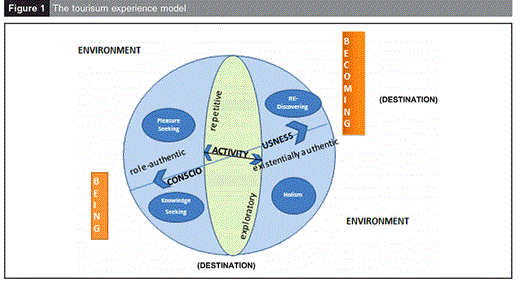
These resources relate to what the tourist “knows” (the association of objects, events, ideas and thoughts into meaning). Such knowledge has two sources, the socially acquired knowledge (as reference systems) of how the world is constructed and what is in it. Furthermore, it comprises existential knowledge, the thoughts and feelings about his/her individual self, including how these relate to objects and the social world as a whole. The first authenticates situational parameters by their appropriate names and categories (roles), the second – the tourist’s own lived experience, relates to the existential knowledge the tourist has about his own self, his/her capabilities and willingness to be and/or to become (grow). While the first type of knowledge can be acquired by (mindless) stimulus–response patterns, the second requires abstract thought, reflection and understanding. This may suggest that only educated tourists are capable of such understanding, however, #B21(forthcoming) discuss that existential authenticity also requires a sort of Socratic humility, i.e. an acceptance that all knowledge is conditional and that wisdom is not the prerogative of (academically) learned people.
Second, existentially authentic experiencing relies on the convergence of feelings and situations (#B32). This form of insight is a convergence of emotional stimuli, the awareness of their factual existence (haecceity), and their meaning into one unit of understanding (sometimes felt, for example, as Eureka! moments). Such an insight differs fundamentally from socially conditioned experiencing. That form is based on the processes of distinguishing and contrasting, resulting in the experience of difference. While the convergence is the experience itself, the experience of “difference” is a secondary reaction to the result of socially constructed meaning creation here identified as role-authentic.
The prosecution is asked to appreciate that this fusion demands of the reader not only to combine the findings and jargon of hitherto differentiated disciplines and schools of thought. The prosecution also needs to appreciate that mapping tourist’s lived experience requires both interpretivism and positivism. Importantly, it requires the reader of our text to appreciate that the traditionally retrospective language of science (#B33) can only partly be used to deal with a prospective analysis and description of experiencing. The resulting melee of registers has been observed elsewhere (#B10) and may be traced to the confusion that comes with a change of paradigms (#B15). As #B10 notes, it is due to the qualitative gap between theory and practice that befalls all sciences, positivist and interpretivist. This gap then can be seen to also create diversionary discussions on the “truth” of tourism. These are, at times, reminiscent of allegorical mock-battles as revealed by #B34. While we declare our position here and reveal it via the TEM, we concede that the real discussion on the ontology of knowledge in tourism has yet to be held (Holishead’s and Jamal’s great work notwithstanding). Tribe’s force-field describes some of the mechanics of knowledge creation, but does not fully cover the content and the qualities of the knowledge it deals with. “An experience” exists only as a construct by which we seek to distinguish and organise what is complex. The fusion of the diverse resources of knowledge the mind achieves in an experience is an issue of epistemology and the theory of learning and for its student to appreciate. Yet, it requires perseverance, openness to new thoughts and the acquaintance with different registers.
McCabe further remarks that our text is not forceful enough in creating a cross-disciplinary platform in the TEM. We notice that he himself accuses sociology of treating individuals as irrational (#B35, p. 70). He subscribes to ethnomethodology and the study of everyday practice, less in its content, but so as to understand how social life is achieved (#B35, p. 66). Like McCabe, we do not only appreciate that individuals may pursue mindless activities by following socially induced patterns of fashionable behaviour so as to create social identities. Indeed, we emphasise that individuals can create existential identities over and above these outwardly visible, symbolic interactions. (Although we accede that “shallowness” may be the totality of some tourists’ existence as suggested by many [irrational?] sociologists, we strongly believe in their increased chance of learning to reflect on their existence through tourism. While this may conjure up ideas about the tedious repetition and recurrence of “lessons learnt” throughout history, each may be “a first” for the maligned tourist and hence worth it. Such moments of self-discovery sociology does not include in its aims [Parsons, 1951; #B31] may occur late in some tourists’ lives, but better than never, adding to the individual’s self-fulfilment).
Ethnomethodology can thereby enrich our understanding of how individuals experience by using sociology, empirical psychology and even cognitive anthropology (D’Andrade, 1996) to structure our analysis. Yet, the fundamental difference between an ethnomethodological enquiry and the hermeneutic phenomenological enquiry into experiencing is that ethnomethodology, like its mother discipline of sociology, relies on distinguishing, contrasting and opposing. Its fundamental principle and concern is the detection of “difference” (#B36; #B31) and how that affects society, not the individual. If the individual tourist’s frame of reference and target of behaviour is the social environment, it is driven by role-authentic norms and expectations. When authentically experiencing, the individual seeks convergence, not difference. This is the viewpoint the TEM likes to add and elaborate on so that tourism research may help promote the experience of convergence which we see as essential for well-being and happiness.
Charge 1
Pearce’s first charge relates to the article’s language as an impediment to the communication of meaning. McCabe seconds this by critiquing how the model can be cross-disciplinary if it uses a “behavioural” (meaning behaviouristic) approach.
The authors apologise for the unconventional use of the term “behavioural tourism research” in the given context without a clearer explanation. With this description, we sought to include all research that makes observations on and seeks to understand behaviour, but exclude that type of literature that merely responds to such explanations and understandings of behaviour, such as the managerial literature or design studies, when drawing conclusions from behavioural research. In particular, we do specifically include both behaviouristic and cognitive schools of thought, including psychology, sociology and anthropology, but also cultural studies, the gestalt, existentialist and schools of thought that now fashion a “post-” in front of them such as the post-positivism. In fact, the TEM is based on an evolutionary discovery, rather than revolutionary ontology of experiencing and combines these streams of thought. We believe they can all add to our understanding of how experiencing occurs, especially in determining the contiguous sources of consciousness. All of the academic disciplines/silos have been seeking to understand existence and our experience; yet, by way of the already firmly established Cartesian paradigm in 19th century Europe (including the USA), their emergence as social sciences was a fait-accompli and easy for Auguste Comte (1856) to base his fame on. Experiencing is here seen as more complex than either one of these disciplines is capable of explaining, while other commentators (e.g. Deleuze, but also Cohen) are still being processed by academics for their positioning and their impact. We do not deny these schools at all; rather, we embrace them, but only in as far as we focus on the individual (who is embedded in the social person who, in turn, is embedded in his/her socio-cultural environment).
Indeed, the authors feel aggrieved, your Honour and Jury, by the accusations of obfuscation and verbosity. Being aware of the fact that we are standing on the shoulders of giants to whom we owe our insights, we tried our best to bridge the gap between the different registers that exist within the disciplinary schools we utilise and reference, as much as we sought to address the fact that not all readers may be familiar with the thoughts and concepts we seek to combine from the above varied disciplines or schools. The prosecution is correct in that a variety of audiences may struggle at their first reading of this text, but we kindly ask to “stay with us” and persevere.
It is verily true that the authors engage in an exercise of theoretical boundary crossing, as Pearce seems to disapproves of. It is therefore understandable that a reader, steeped in or familiar with only one theory, paradigm or register would get confused when confronted with the codes and vocabulary from another theory’s register. Yet such “transgressions” have become necessary to overcome the knowledge silos of modernism to which phenomenology, existentialism and hermeneutics seek a way out of and to which authors like Deleuze, Bourdieu or Foucault seek alternatives, too, inventing their own “new” language. Indeed, the authors seek to engage in what #B2 calls “integrative theorizing” (p. 312), that is overcome the silo effects created by Cartesian disciplines. We try to fuse knowledge from different schools into a more robust, analytic and holistic understanding, capable of turning tourism experience research into an analysis of how it unfolds and why experiencing in certain modes promotes some forms of relationships with the destination, but not others. Again, our phenomenological organisation of some prominent theories and literature in tourism research in the study on trial sought to provide evidence for the effectiveness of such theorising. Here, we seek to further clarify it in front of this court.
#B4 documentary “Manufacturing Consent” (1992/2002) is an analysis of how public opinion is conditioned. It can serve us to understand how knowledge production amongst academics is conditioned not only via their silos but also via the pressures of publishing in journals. The language and thinking of academics like Chomsky’s general public, become resistant to change when conditioned by the “sound bites” that are produced by many journals: they fix expectations of not only style, format and register but also of the scope of ideas. As #B10 observes the confusion that occurs during times of paradigm shifts is often the result of the use of different registers old and new at the same time, while scientists seek to drag their colleagues across to a new way of thinking.
Rather than succumbing to the pressures of the academic publishing machine forcing us to slice ideas like salami to increase output, the article on trial dares to stand on its own and reflect the complexity of experiencing while paying its dues to those who contributed and stimulated it – trying to mention them all will fail to do justice. The resulting organisation of research literatures relating to tourist behaviour, however, is offered as a test that the model has validity and warrants further discussion. At the same time, the word-limit we face in journals will always make such an inclusive approach a major struggle.
Charge 2
The neglect of important parallel literature
McCabe contends that we do not sufficiently address our stipulated cross-disciplinarity. While we sought to address this under the previous two points with reference to many other disciplines and their role in the TEM, we here extend that response by implicating psychophysics. Pearce further points towards our limited inclusion of prominent works on the tourism experience. He asks us to position ourselves in the face of Krippendorf’s, Ryan’s and his own work more succinctly. However, he himself locates our interest as being primarily in the process of experiencing. Yet, we agree that this inclusion will further elucidate the TEM, for example, the how and why of memorable experiences, how they can be modelled to come about and how they influence current and future behaviour.
Indeed, as Russel and Levy (2013) show, experiences can be re-experienced through re-consumption and lead to very similar sensations as those when the experience was first made. Likewise, we assume that when a memory is thought, it activates an entire neural network that causes the nerve system to produce some similar or even the same kinds of sensations experienced at the time; hence, we define an experience as a form of “being in becoming” when activated. Tourists are also able to uncover aspects in their experience that had not been noticed previously, but which, on reflection, retrieve as yet unprocessed sensations. These existing yet unprocessed memories can then even lead to a re-evaluation of the experience such as when, on reflection, the tourist discovers that what he perceived as inauthentic turns out to be authentic or vice versa (e.g. a culturally distinct kindness that was misinterpreted, an artefact that turns out inauthentic). Likewise, holiday memories can generate positive feelings long after they took place and new insights assisting not only in ongoing recreation but also learning. This discussion could be extended to include how tourists experience time within their experiences, an aspect we have only mentioned indirectly, but has been rightfully mentioned by MacCabe. While experiencing involves the transformation of emotionally experienced sensations into meanings and memories, the knowledge involved to configure that meaning, that is past learning, can equally create emotions in response. Accumulated experiences thereby impinge on current experiences; the time it has taken to make them can come to bear and cause one’s current emotional state. Stress and low self-esteem through overwork and underachievement can lead to working people to take time out and holiday away from home. The emotional state creates a need for recuperation and recreation (#B7). This is one of the forms of experiencing covered by the TEM which has also been covered by #B14.
#B14 explores tourists’ motivations of experiencing foreign lands mainly via the work–leisure contrast. Especially mass tourism is portrayed as a shallow escape from the mundanities of everyday life in which stressed tourists are poised to experience pleasurable rest, relaxation and recreation to excess. He has a strongly critical view on the tourism experience and uses empirical observations to induce some insights as to what tourists may feel as they go about their holidays. At the heart of #B14’s book “The Holiday Makers” (1989) is the message that tourists are not dumb nor merely emulating the activities of others or playing the roles of “pilgrims”, “pirates” or ignorant invaders of foreign cultures (#B1; #B27), but that they can become welcomed “guests” or genuine “friends” of locals, who contribute and learn to appreciate other ways of life, cultures and communities. His main concern lies with the development of “soft tourism” as an activity. Citing #B19, p. 10), Krippendorf discusses ways of sustainable tourism development in which tourists:
[…] experience more freedom, have more contact with nature and with other people and generally have a more interesting time than usual […] Indeed, it is not “the experience of a lifetime” […] but the little things […] that produce the feelings of satisfaction […] (#B14, p. 65).
Even the mundane rituals of every-day life can thereby become memorable holiday experiences – a point picked up by Wang and Gnoth (forthcoming).
This author thereby contrasts the horrors of exploitative mass tourism – which he gained from observation, with the actual possibilities the individual can obtain for recreation, growth and self-development – which Krippendorf obtained through introspection. Very much like the younger #B18, Krippendorf, too, sees such growth and self-development as a career ladder whereby he is “convinced that the progressive development of tourist needs is based on this inner organization” (#B14, p. 73) which Maslow’s hierarchy suggests. Yet #B14 does not pursue this idea further. Instead, he develops practical marketing and experience-design ideas that foreground the hierarchy: better experiences can be achieved by less materialism and more idealism and genuine involvement.
Such a mechanistic application of Maslow’s hierarchy to a tourism career has been critiqued by #B29. Taking a more cautionary approach, then, #B22 have reframed Pearce’s (1988) earlier research agenda by beginning to look at the patterns of tourists’ careers first to better determine what sorts of need dimensions prevail in tourism experiences and which ones are likely to be turned into practice and goals in subsequent holidays. Of importance here, they find some weak evidence that more experienced travellers are more interested in host-environments, in other words, in exploratory behaviour marked by a desire for learning and lack of self-interest, but interest “in the other”. Ryan’s critique of Pearce’s (1988) career ladder states that experiencing always involves a number of motivations and that “there exists a dynamic dialectical process […] that tourists will switch roles […] [and that] different needs will arise” (#B29, p. 51). Ryan may be pointing to the phenomenon of the emergence of motives over time and in the flow of life. This, too, indicates a development if only situational and need factors could be controlled for. Both Pearce and Ryan are therefore aware of the dynamics of experiencing, but address the issue differently. In his older work, focusing on the laddering idea, Pearce sought for the growing prominence of hierarchical motives in subsequent travels which Ryan suggests are different circumstances and present different motivational fields.
In contrast, the TEM suggests a different, systematic way for studying the underlying conditions of these motivational fields. It implies that, during one and the same holiday, the same or different experience modes may become prominent. If the experiential mode were to remain the same (e.g. the pursuit of “fishing out on the lake” day after day), study conditions may be less variable. If modes change, particularly when experiencing becomes exploratory, the hierarchy and the need-content may well require re-interpretation, as the context has changed. The self-actualisation of an avid fisherman who bonds with a place while continuously improving his cast – thus seeking self-development through a routine, would certainly be different from the self-actualisation through physical or cultural adventure activities marked by exploration of the unknown. The first could produce sustained flow while the other would most likely be characterised by moments of peak-experiences.
This would suggest, then, that Pearce should continue with his pursuit by considering situationally more comparable holidays, for example, compare “adventure holidays” only, or “recreational holidays” or “city holidays”, possibly in longitudinal studies. The different modes of experiencing in the TEM and the phenomenological organisation of the literature on trial suggest there to be distinct clusters of emotions to occur. It also suggests that different environments are more prone to generate some emotions more than others, reflecting varying potentials for the satisfaction of different needs. Therefore, controlling for situations, modes and the contextual interpretation of needs may help in understanding how the accumulation of practice (experience) leads to maturation.
Although #B29 is aware of learning and self-extension and learning as potential outcomes of tourism, he has not developed a theory of experiencing that looks for ways of actually progressing tourists’ experiencing. Rather, he has assembled a generic list of factors and attributes that may impinge on the tourism experience as an outcome. Whereas Pearce seeks to be analytic, his “model is, at best, only a partial concept” (#B29, p. 73) conceived to parameter satisfaction formation, but not, for example, maturation, happiness or recreation. Although Ryan uses many experience episodes as examples (of experiencing), they become indistinguishable in an unwieldy model. Importantly, his model mentions motivations, but does not consider how a tourist’s being as a function of a tourist’s emotional state may influence experiencing.
#B7 seek to show, however, that tourists’ emotional state may well critically impact the perception and evaluation of destination attributes, activities and services, as much as their physical involvement. In line with the TEM, service quality attributes are shown to be judged either as instrumental or as expressive elements or ends in themselves, depending on tourists’ emotional states. #B29 contribution to experience research therefore lies with its wide-ranging critical review. Regarding how needs may develop over time, he defaults on the suggestion that the emergence of needs is open-ended and hence unpredictable. The possible perturbations (#B31) of how environmental factors may influence holiday outcomes are therefore potentially endless. While this is true no doubt, issues related to the dynamics and progression of need-development remain topical. #B8, for example, found that tourists from all over the world travelling to Pukhet, Thailand, and in another large sample, to Hanoi, Vietnam, tended to show, on one hand, often significantly different value structures as measured by #B11’s scale to those of their respective national samples. This makes us believe that motivational structures are influenced by a number of parameters yet to be discovered and conceptualised.
We are sorry not to be able to comment on Pine and Gilmore’s work, other than a brief note. #B37 in their review of experience research give #B38 model appropriate credit – none. Tongue in cheek, they seem to locate it close to a marketing gimmick. In any case, their model has a number of serious shortcomings: the 2 × 2 matrix of experiences has two axes (active vs passive and absorption vs immersion). Nowhere in their book can we find a definition of experience nor an explanation of how these dimensions are derived, other than “common sense” perhaps which falls short in this case. We fail to see how these dimensions could be orthogonal nor when a customer can be considered as active and when as passive. For example, when a customer thinks about an action, is he/she not becoming active? If “going through the motions” means to be active, what is being passive? Or, why can I not be absorbed and immersed at the same time – their example from the race course does not convince. It is therefore sad that many colleagues have begun to test this model empirically failing to discuss its theoretical underpinnings. They are therefore prone to create a “reality of experience parameters” in their surveys which does not correspond to how customers really experience. These researchers just end up measuring correlations between a bunch of constructs in consumers’ minds that may be reliably measured, but invalid as a reflection of the experience.
Conclusion
Honoured Judge and Jury, students of tourism studies, we hope to have alleviated at least some of your fears that our indicative study on how the tourism literature may be organised by way of a phenomenological approach is not entirely to be dismissed. Rather, we hope that we have raised your interest and conviction to assist us further in our endeavour. We also hope that we have addressed the critiques sufficiently, if not point by point, then at least in spirit and by indication. Finally, we have provided a visually more indicative figure of the TEM together with a more extensive explanation of the panarchy of systems in which the trajectories or careers of holiday experiencing evolve. To convince you further, by your leave, we seek permission to continue our research and show amongst the other propositions listed in the paper on trial that the modes of experiencing generate distinct sets of outcomes in the form of the emotions they result in and are products of either distinction and contrast or of convergence.
Juergen Gnoth .
Professor at the Department of Marketing, University of Otago, Dundedin, New Zealand
Xavier Matteucci
Research Associate at the Modul University Vienna, Vienna, Austria
References
Adler, J. (1989), “Travel as performed art”, American Journal of Sociology, Vol. 94 No. 6, pp. 1366-1391.
Bagozzi, R.P. (1997), “Goal-directed behaviors in marketing: the role of emotion, volition and motivation”, Psychology and Marketing (1986-1998), Vol. 14 No. 6, pp. 539-579.
>Baron, Byrne and Suls (1989), Exploring Social Psychology, Allyn and Bacon.
Bloch, E. (1985), The Principle of Hope, MIT Press, Cambridge MA.
Brier, S. (2011), “Cybersemiotics: a new foundation for transdisciplinary theory of information, cognition, meaning, communication and consciousness”, Signs, Vol. 5, pp. 75-120.
Carù, A. and Cova, B. (2003), “Revisiting consumption experience: a more humble but complete view of the concept”, Marketing Theory, Vol. 3, p. 267.
Herman, E. and Chomsky, N. (2002), Manufacturing Consent: The Political Economy of the Mass Media, Pantheon Books, New York.
Csordas, T. (Ed) (1994), Embodiment and Experience: The Existential Ground of Culture and Self, Cambridge University Press, Cambridge.
Dumazedier, J. (1967), Toward a Society of Leisure, Free Press, New York.
Gnoth, J. (1997), “Motivation and expectation formation”, Annals of Tourism Research, Vol. 24 No. 2, pp. 283-304.
Gnoth, J. (2014), in Woodside, A. and Kozak, M. (Eds), The Role of Social Psychology in the Tourism Experience Model (TEM): A Response to Comments on the TEM during the CPTHL, Istanbul, 2013, (in print).
Gnoth, J. and Martin, B.S. (2014), “Do recreational needs impact expectations and experiences of service performance?”, Tourism Analysis, (in print).
Gnoth, J. and Zins, A.H. (2010), “Cultural dimensions and the international tourist role scale: validation in Asian destinations”, Asia Pacific Journal of Tourism Research, Vol. 15 No. 2, pp. 111-127.
Guignon, C.B. (1984), “Heidegger’s ‘authenticity’ revisited”, The Review of Metaphysics, Vol. 38 No. 2, pp. 321-339.
Guttman, L.(1950), “The basis for scalogram analysis”, in Stouffer, S.A., Guttman, L., Suchman, E.A., Lazarsfield, P.F., Star, S.A. and Clausen, J.A. (Eds), Measurement and Prediction, The American Soldier, Wiley, New York, NY, pp. 60-90.
Heelan, P. (1997), “After post-modernism: the scope of hermeneutics in natural science”, available at: www.focusing.org/apm_papers/heelan.html (accessed 21 December 2013)
Heidegger, M. (1927/1962) Sein und Zeit, translated by Macquarrie, J. and Robinson, E., 1962, Being and Time, New York: Harper and Row.
Hofstede, G. (1980), Culture Consequences: International Differences in Work-Related Values, Sage, Beverly Hills.
Inglis, F. (2000), The Delicious History of the Holiday, Routledge, London.
Joy, A. and Sherry, J.F. Jr. (2003), “Speaking of art as embodied imagination: a multisensory approach to understanding aesthetic experience”, Journal of Consumer Research, Vol. 30 No. 2, pp. 259-282.
Kelly, J.R. (1983), Leisure Identities and Interactions, London: George Allen and Unwin.
Krippendorf, J. (1989), The Holiday Makers, Heinemann, Oxford.
Kuhn, T.S. (1970), The Structure of Scientific Revolutions, 2nd ed., Chicago University Press, Chicago.
Luhmann, N. (1995), “Social systems,” Stanford University Press, Stanford, CA.
McCabe, S. (2002), “The tourist experience and everyday life”, in Dann, G.M.S., (Ed) The Tourist as a Metaphor of the Social World, Cabi International, pp. 61-75.
Matteucci, X. (2014), “Forms of body usage in tourists’ experiences of flamenco”, Annals of Tourism Research, Vol. 46, pp. 29-43.
Merleau-Ponty, M. (1962), Phenomenology of Perception, Routledge and Kegan Paul, London.
Parsons, T. (1951), The Social System, Routledge & Kegan Paul, London.
Parker, S. (1983), Leisure and Work, in Leisure and Recreational Studies, Vol. 2, London, Allen and Unwin.
Pearce, P. (1982), The Social Psychology of Tourism, Pergamon, Frankfurt.
Pearce, P.L. and Lee, Uk-II (2005), “Developing the travel career approach to tourist motivation”, Journal of Travel Research, Vol. 43 No. 3, pp. 226-237.
ine, B.J. and Gilmore, J.H. (1999), The Experience Economy: Work is Theatre and Every Business a Stage, Harvard Business School Press, Boston, MA.
Rieger, P. (1983), Glueck im Urlaub, unpublished, Munich.
Ryan, C. (2002), “The tourist experience”, 2nd ed., Continuum, London.
Sartre, J.P. (2003), Being and Nothingness, Routledge Classics, London & New York.
Seaton, A.V. (2002), “Tourism as metempsychosis and metensomatosis: the personae of eternal recurrence”, in Dann, G.M.S. (Ed) The Tourist as a Metaphor of the Social World, CABI, Wallingford, Oxon, pp. 135-168.
Tribe, J. (2006), “The truth about tourism”, Annals of Tourism Research, Vol. 33 No. 2 pp. 360-381.
Wang, N. and Gnoth, J. (1999), “Authenticity”, in Jafari, J. and Xiao, H., (Eds) Tourism Encyclopaedia, 2nd ed, Springer Verlag.
Yannakis, A. and Gibson, H. (1992), “Roles tourists play”, Annals of Tourism Research, Vol. 19 No. 2 pp. 287-303.
Note
The editor invites scholars to follow up the initial article published in Vol. 8 (1) and/or the commentaries and rejoinder. Contact Andreas Zins (andreas.zins@modul.ac.at)


