This paper explores perceptions of entrepreneurship among educators from several disciplines, to understand the circumstances for embedded entrepreneurship education across the university.
This qualitative study is based on eight online focus-group interviews with 44 university educators from different departments. Their experience with entrepreneurship ranged from being unfamiliar with entrepreneurship to being experienced entrepreneurs and entrepreneurship educators. We used social identity theory to analyse the data by theoretical thematic analysis.
The results show that educators may take the positions of “entrepreneurial outsiders” or “entrepreneurial insiders”, depending on their perceptions of entrepreneurship, as well as their ability to articulate and teach entrepreneurship. This study finds that educators often see themselves as “entrepreneurial outsiders”, lacking the competence to teach entrepreneurship. The findings highlight the importance of inclusive entrepreneurship discourse and innovation culture for educators to experience and acknowledge their “entrepreneurial insiderness”; the importance of contextual adaptation when teaching entrepreneurship in different disciplines and the importance of educators being contextualisation-bearers in entrepreneurship education for their students, bridging disciplines and showing that multiple social identities may co-exist.
This paper bridges a gap in the literature by looking at the educators’ perspective on entrepreneurship. The development of the two concepts of “entrepreneurial outsiderness” and “entrepreneurial insiderness” serves as an original contribution to social identity theory and the conversation of entrepreneurial identity, expanding our understanding of the complexity of enablers and barriers to embedded entrepreneurship education.
Introduction
Entrepreneurship is a complex social process of change, emergence and creation that unfolds in the interaction between individuals (Bruyat and Julien, 2001; Dimov, 2020; McMullen and Dimov, 2013). For this paper, we understand entrepreneurship broadly, as explorative creation of financial, social and/or cultural value in the form of an innovation or a new organisation. This potentially powerful, creative process is recognised as promoting solutions to the grand challenges of our time (Markman et al., 2019) – for instance, entrepreneurial competencies and skills are seen as crucial in creating economic sustainability and welfare (Seikkula-Leino et al., 2021). Consequently, there has been an increased focus on entrepreneurship in higher education (Donnellon et al., 2014; Forliano et al., 2021; Gabrielsson et al., 2023; Landström et al., 2022). This is visible in the growing number of entrepreneurship courses, specialisations and degrees around the globe (Hägg and Kurczewska, 2021), and the fact that entrepreneurship education has become relevant in disciplines that are not primarily about entrepreneurship (Huang-Saad et al., 2020; Gabrielsson et al., 2023). This phenomenon has been labelled “embedded entrepreneurship education” and is defined as “the inclusion of entrepreneurship education pedagogies or course sequences in existing non-business courses to enhance students’ entrepreneurship competencies” (Crișan et al., 2023, p. 2). Examples of non-business courses could include music and arts (Toscher, 2019; Toscher and Morris Bjørnø, 2019), science and engineering (Handscombe et al., 2008; Kleine et al., 2019) and public health (Martin et al., 2016). However, this shift brings about new educational challenges. One is the alignment of course objectives with the context and students (Mwasalwiba, 2010). Another regards terminology, as “entrepreneurship” holds different meanings in various educational contexts. There is a need for clarity in terminology to improve educational outputs (Pittaway and Cope, 2007). Entrepreneurship education should be tailored to specific educational contexts and the needs of individual students (Blenker et al., 2012), allowing the student to use their interests, knowledge, experiences and social networks (Harmeling, 2011). To adjust entrepreneurship education to a broadened audience, there is a need for more knowledge about the educational development required for various disciplines (Forliano et al., 2021). Further, there has been a call for more research regarding the legitimacy of entrepreneurship educators and the support they receive to conduct their work (Foliard et al., 2018). We argue that there is a need to continue this conversation, emphasising the role of entrepreneurship educators from different disciplines as they execute embedded entrepreneurship education. This study responds to this need by exploring university educators’ perceptions of entrepreneurship and how these might influence their teaching. The research question of the study is: How is entrepreneurship perceived by university educators across disciplines at a large university?
By university educators, we mean employees with teaching responsibilities at a university, including, but not limited to, professors, associate professors and lecturers (assistant professors), and PhD candidates and other researchers with teaching responsibilities. Wraae et al. (2022) argue that these educators work in a context where expectations differ based on positions, personal perceptions and values, as well as their experiences with entrepreneurship. This may influence their entrepreneurship teaching (Wraae et al., 2022). Educators’ perceptions of entrepreneurship constitute an important research topic, as they can play an important role in students’ learning. Lahikainen et al. (2022) found that the educators’ attitude towards entrepreneurship had a great influence on students’ perceptions of the entrepreneurial culture on campus. In fact, the effect of educators’ encouragement was stronger than the positive attitudes of peers (Lahikainen et al., 2022).
Although there is a growing number of studies that focus on embedded entrepreneurship education (Crișan et al., 2023), the emphasis has largely been on integrating entrepreneurship into specific fields, particularly focussing on the student perspective (e.g. Kusio and Fiore, 2020). Studies reveal that barriers to developing an entrepreneurial identity exist because this conflicts with disciplinary identities within fields such as culture, music and arts (Toscher, 2019; Werthes et al., 2018), agriculture (Fitz-Koch, 2020), information and communications technology (Mills and Pawson, 2012), or nursing and healthcare (Neergård et al., 2022; Nadin, 2007). Other studies have investigated embedded entrepreneurship in specific educational institutions or countries (e.g. Antal et al., 2014; Hoppe, 2016; Leffler and Falk-Lundqvist, 2014) and the use of specific teaching practices and pedagogical models (e.g. Bosman et al., 2019; Costello, 2017). Some studies have explored students’ perceptions of entrepreneurship (e.g. Belwal et al., 2015; Neergård et al., 2022; Peterman and Kennedy, 2003), although, to our knowledge, no studies have grasped a comprehensive understanding of educators’ perceptions of entrepreneurship across disciplines in the university context.
The paper continues by exploring the concept of perception through social identity theory. Thereafter comes a description of the methodology of the study, the findings and the discussion, followed by a conclusion including reflections on the contribution of the study, and its limitations and implications.
Theoretical framework
By studying perceptions, we intend to grasp people’s thoughts, ideas, reflections and experiences regarding a particular concept – in this case, entrepreneurship. For this paper, we make use of identity theory to understand perceptions, as this can further extend the conceptualisation of entrepreneurship from venture creation to value creation (including, for instance, intrapreneurship and social entrepreneurship), where the entrepreneurial process aims to advance “the life of others in the social space” (Gruber and MacMillan, 2017, p. 275).
Social identity theory
Identity is a complex, social construction with a wide range of conceptual meanings. It is explained as distinctiveness and as likeness to others, it allows us to interpret social situations, and it can influence our emotions, thoughts and behaviours (Anderson and Warren, 2011; Leitch and Harrison, 2016). Identity influences, and is influenced by, personal preferences and institutional and structural barriers, which allows for dynamic development. Thus, approaching identity in entrepreneurship research can challenge underlying static and decontextualised assumptions (Madsen et al., 2008). Social identity theory allows us to explore the need for distinctiveness and belonging for entrepreneurs (Shepherd and Haynie, 2009) and the concept of entrepreneurial identity – for example, in education (Falck et al., 2012), in various disciplines (e.g. Nadin, 2007) and among female entrepreneurs (Madsen et al., 2008). Social identity is also a relevant lens for researching stereotypical perceptions in large organisations (Ashforth and Mael, 1989), such as a university.
Social identity theory builds on the work of Tajfel and Turner, as formalised in the 1970s. It includes various aspects of the social being: social categorisation, social comparison, social identity and social change (Hogg et al., 1995). Identity theory is a closely related theory; whilst identity theory explains how we see others as individuals, and concerns the individual’s influence over their identity, social identity theory regards the social influence of people’s identities (Brown, 2000; Stets and Burke, 2000). Everyone belongs to different social categories (e.g. family position, nationality, religious belief, political affiliation and occupation) (Ashforth and Mael, 1989); thus, we all have multiple identities. Some of these are diverse personal identities (e.g. as a friend or a family member), and others are contextual group identities (e.g. as a sports fan or a member of an occupational group) (Spears, 2021). This paper focuses on contextual group identities – hereafter, referred to as social identities.
Multiple identities
The various social identities have different defining characteristics that influence our understanding of ourselves. Some social identities work well together but others conflict, and in the latter case, it can be painful to identify as members of specific groups (Ashforth and Mael, 1989). Rae (2005) focused on the tension between present and future identities, such as struggling with conflicting perceptions of values and practices. Being involved in an entrepreneurial process may satisfy a need for distinctiveness – however, it can happen at the expense of current social identities, causing frustration and potentially weakened psychological well-being (Shepherd and Haynie, 2009).
Research on academics’ development as educators has shown an increased interest in academics’ self-concept (Kreber, 2010; Nevgi and Löfström, 2014; Skelton, 2012). In many communities, the researcher’s identity is more valued than the educator’s identity, and the latter identity thus remains underdeveloped (Hannon, 2018). This can be linked to the concept of “double professionalism” (Peel, 2005). Although university educators need to develop in-depth knowledge about their subject discipline, they are, at the same time, required to contribute to high-quality education, thus being professionals both within their discipline subjects and within higher education pedagogy (Peel, 2005). Educators in higher education therefore hold at least two different professional identities (academics and educators), while perhaps also acting as scientists, counsellors or managers. They might have moved away from their primary professional identity (engineer, medical doctor, physiotherapist, etc.) to new ones, living in a stressful, “complex between-space, in which [they] are frequently pulled in a number of directions” (Browne, 2019, p. 8). Entrepreneurship adds to the list of new directions in which educators are pulled – for instance, a recent development in medical education asks educators to teach innovation and entrepreneurship to their students who aim to become medical doctors (Niccum et al., 2017).
Insiders and outsiders
The myriad of social identities among educators may also lead to a perception of group membership, where some are “insiders” and others “outsiders”. When feeling like an insider, individuals will be engaged in, and derive satisfaction from, activities that go well with their social identity (Ashforth and Mael, 1989). For this study, we consider an insider to be someone who can articulate explanations about the concept at hand (Groen, 2017; McCall et al., 2021) – in this case, an educator who can articulate explanations about entrepreneurship. We consider an outsider to be an individual who solely receives disciplinary information (Groen, 2017; McCall et al., 2021), so they are unfamiliar with the concept at hand (e.g. entrepreneurship) and struggle to teach it to others. It is possible to shift between these states. For instance, Groen (2017) and McCall et al. (2021) found that as student engineers gained more knowledge about their discipline, they employed multiple identity negotiations. This led to more knowledge about their potential careers as engineers, and they advanced from being outsiders to insiders. Further, when an insider faces a gap in their knowledge or experience, the in-group membership serves as a reference, assuming other in-group members share their social reality. In this way, social influence is partly self-influence (Spears, 2021).
Discourses and stereotypes
Insiderness leads to group behaviour that becomes stereotypical in the eyes of others, and group members perceive others as stereotypical (Hogg et al., 1995). This is tied to discourses. A discourse is defined as “a group of claims, ideas and terminologies that are historically and socially specific and that create truth effects” (Alvesson and Due Billing, 1999, p. 49, our translation). Discourse can also imply metaphors, images and stories (Burr, 1995, p. 48). Foucault (1969, p. 54) holds that discourses are “practices that systematically form the objects of which they speak.” This implies that discourses generate norms of behaviour regarding what is considered acceptable, desirable and normal (or not) (Ahl, 2008, p. 154). In specific contexts, patterns emerge as to which actions, ideas and expressions are preferred, and these patterns govern – that is, they shape – people’s actions, meaning-creation and ways of talking (Aarsand, 2011). However, these patterns do not exist outside or independent of the individuals who are governed by them, but rather they are also established and maintained by the individuals themselves (Schnoor and Haslebo, 2007). Thus, discourses are tied to social identity and the development and maintenance of stereotypes. According to Raible and Williams-Middleton (2021, p. 293), “stereotypes plague the social cognitive concept of ‘the entrepreneur’, shaping assumptions of what entrepreneurship is while being far from representative of possible entrepreneurial identities”. The entrepreneur is often stereotyped as a male with masculine characteristics (Gupta et al., 2009; Meyer et al., 2017), and is frequently caricatured as a hero, villain or clown (Atherton, 2004). The stereotype contributes to and is reinforced by certain discourses (Atherton, 2004; Anderson and Warren, 2011). Awareness of stereotypes is important in education, as stereotypes influence entrepreneurial intentions (Gupta et al., 2009). As stated by Meyer et al. (2017, p. 333): “Even those participants who do not believe to be bound to stereotypes are strongly influenced by them and describe a male image of the entrepreneur.” Thus, addressing stereotypical perceptions and discourses about entrepreneurship is important for educators who meet potential future entrepreneurs and entrepreneurial individuals (Raible and Williams-Middleton, 2021).
Methodology
To grasp perceptions of entrepreneurship across disciplines at a university, we collected data through focus-group interviews. Focus-group methodology is characterised by its capacity to stimulate interpersonal dynamics among the participants (Kvale and Brinkmann, 2010; Morgan, 1996) and is an adequate way of exploring a theme of which the participants have different knowledge, background and experience.
Research context
The Norwegian University of Science and Technology (NTNU) is Norway’s largest university, with a total of 43,422 students, 8,051 employees and 398 study programmes in three cities: Trondheim, Ålesund and Gjøvik (NTNU, 2024). It has a technological main profile, yet encompasses a wide range of disciplines. It is composed of nine faculties (of which eight involve educational programmes) and 54 departments (NTNU, 2024). NTNU is contracted to transform knowledge from a variety of research activities to innovative and sustainable solutions for the good of society and work-life, and to increase innovative activity and its contribution to sustainable innovation (Norwegian Ministry of Education and Research, 2024). In the guidelines for the design of study programmes, it is made explicit that one should describe “in what way innovation and entrepreneurship are integrated into the study programme” (NTNU, 2021, p. 11, our translation). A recent report, however, shows that, of the 7,577 courses at NTNU, only 5% of course descriptions contained the word “entrepreneur”, and 11% contained the word “innovation” (Aadland and Neergård, 2022).
Sampling
The participants in this study were educators from the eight faculties with educational programmes at NTNU, and they were interviewed in focus-groups, faculty by faculty [1]. The sample is thus purposive (Patton, 2005; Robinson, 2014). The participants were chosen because of their role, background and experience regarding the theme that is being investigated. An overview of the sample is shown in Table 1. It consisted of a total of 44 educators: five professors, six lecturers (Norwegian title: “universitetslektor”), 11 PhD candidates, 20 associate professors (Norwegian title: “førsteamanuensis”) and two researchers. Each faculty was represented by a focus-group interview. The sample was divided exactly between men (22) and women (22). The codes show a combination of their role/position, their number in the group in relation to this role, and the faculty they belong to. P means professor, L means lecturer, A means associate professor, R means researcher and Ph means PhD candidate. The two last letters in the code represent the Norwegian abbreviation for the faculty, which is also shown in column 1. For instance, the code P1SU means the first professor from the Faculty of Social and Educational Sciences. The codes were created to be able to follow the results section below in a transparent manner, enabling the reader to distinguish between faculties/educational contexts and educational roles while reading the selected quotes.
One of the authors conducted personal recruitment conversations by video call using Microsoft Teams, calling approximately 200 potential participants before the interviews. She stressed that we would be interested in any perspective, whether positive or negative, hesitant or engaged, to communicate an accepting attitude (Rogers, 1961) which might, again, contribute to creating an interview setting where any perspective or utterance is welcomed. All participants received information about the project by email and gave their consent to participate in the study orally at the beginning of the interviews. The Norwegian Research Ethics Committee (Sikt) has approved the methodology of the study.
Focus-group interviews
In focus-group interviews, participants can share their opinions and thoughts and discuss their perspectives on a given theme (Morgan, 1996). A focus-group interview provides the researcher with qualitatively different data than an individual interview, due to the interpersonal dynamic that stimulates different statements, and thereby generates different results (Kvale and Brinkmann, 2010; Morgan, 1996). A prerequisite for this interpersonal dynamic is the active participation of the members of the group and their willingness to share (Morgan, 1996). This study was carried out online, using Microsoft Teams, to interview the participants department-wise, across five campuses and in three different cities in Norway. We experienced that the online option made it easier for people to accept the invitation and participate, due to the time efficiency of not having to travel before and after the interview (Daniels et al., 2019; Forrestal et al., 2015; Willemsen et al., 2023). Both authors participated in the interviews, and we tried to create optimal conditions for online focus-group interviews through several means. For instance, as digital meetings tend to be more exhausting than physical meetings (Queiroz et al., 2023), we scheduled each interview to last no longer than 1.5 h, with a five-minute break halfway through (Willemsen et al., 2023). We were cognisant of the importance of creating a trusting atmosphere (Morgan, 1996) characterised by psychological safety (Edmondson, 2019). Thus, we started each interview by facilitating a short presentation of each participant, to enable everyone’s voice to be heard in the “common space” (Howlett, 2022) that was established in the interview. We did this to contribute to each participant’s feeling of having a “place” in the group, which can also create a feeling of acceptance (Rogers, 1961), thereby contributing to psychological safety.
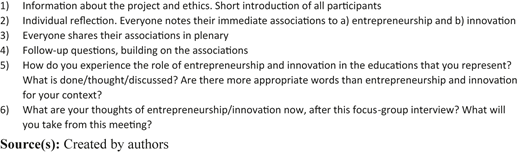
Although the quality of focus-group interviews lies primarily in its ability to generate discussion among group members (Morgan, 1996), this also involves the risk of group polarisation: the tendency of individuals to adopt more extreme positions than they would have shown in, for instance, individual interviews (Abrams et al., 1990). It was of particular interest for us to obtain an idea of what impressions, associations and experiences the participants brought with them to the interview, before they started to share and thereby influence each other, as we wanted to obtain as broad a picture as possible of people’s associations and thoughts regarding entrepreneurship and innovation. We therefore facilitated a few minutes of individual reflection, where everyone was asked to share their initial thoughts on the subject, one by one. From there, we allowed them to build on each other’s statements in the continuation of the focus-group interviews.
The interview guide for a focus-group interview should be open enough to facilitate discussion among the participants (Morgan, 1996), and the guide in this study was formed to discuss associations with entrepreneurship and innovation (Figure 1). We encouraged the participants to start with their immediate associations, trying to keep the conversation on a personal level and showing that any thoughts were equally relevant and interesting. We experienced a personal and relational engagement in the interviews– for instance, the participants referred to each other by their given names. This can be easier online than in a physical room, as the participants’ names are visible on the screen. Howlett (2022) argues that online interviews make it possible to create an egalitarian and personal atmosphere, as the participants can “enter” each other’s workspaces through the screen. As everyone has logged in from different places, the locations became a natural topic of the chit-chat before the formal part of the interview started, which enabled a friendly, informal tone despite the formal power differences. The interviews were video-recorded and automatically transcribed using Microsoft Teams, and the transcript was refined to a verbatim transcript in Norwegian by a research assistant who signed a confidentiality contract.
Analysis
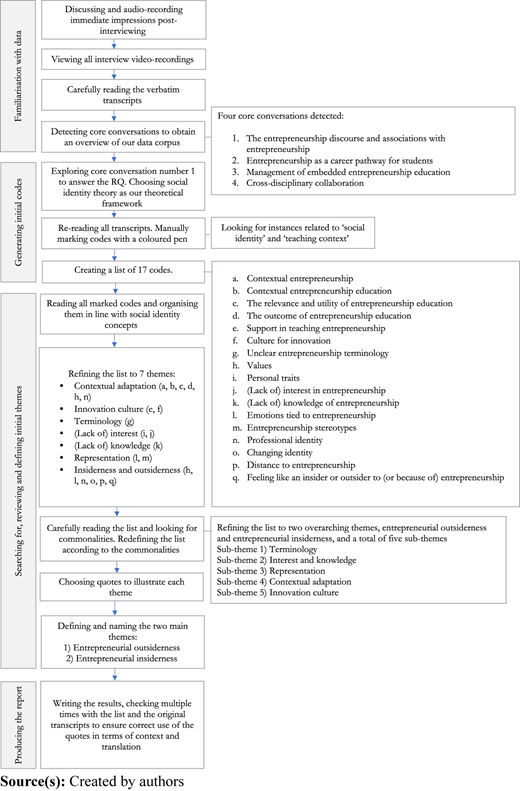
We performed a theoretic thematic analysis in line with Braun and Clarke (2006), detecting themes in the interviews. For a schematic overview, see Figure 2. With the philosophical stance of social constructivism, we have aimed for a theorisation of sociocultural contexts and structural conditions (Braun and Clarke, 2006) that influence the individuals who teach at a large university. To start the process of familiarisation with the data, one author took notes during the interviews while the other served as the main moderator. We identified core conversational topics, facial expressions and gesticulations. We met, in-person, to discuss immediate impressions and thoughts directly after each interview, and these conversations were audio-recorded. Next, both authors read the transcripts. We detected core conversations across all interviews to grasp the complexity of our data corpus (Braun and Clarke, 2006). Through this inductive process, we detected four conversations: (1) the entrepreneurship discourse and associations with entrepreneurship, (2) entrepreneurship as a career pathway for students, (3) management of embedded entrepreneurship education and (4) cross-disciplinary collaboration. Elements from all four conversations were mentioned in a report on innovation and entrepreneurship in education at NTNU (Roald and Neergård, 2022). When looking more closely at the first conversation (entrepreneurship discourse and associations with entrepreneurship), we revealed multiple accounts of social categorisation, social comparison and social identity. In order to answer the research question (how entrepreneurship is perceived by university educators across disciplines at a large university), we decided to explore this conversation through the lens of social identity theory, which constitutes a useful framework for looking at, for instance, perceptions of group membership, social identities and stereotypes. As a first step of generating initial codes, we limited our data set to instances across the entire data corpus that had some relevance to the social identity of the participants, as well as their teaching context. We used a coloured marker pen to highlight passages in the text that, in some way or another, could relate to social identity. In line with Braun and Clarke (2006), we then re-read all the marked text segments and categorised them using one or two keywords referring to social identity concepts. This resulted in a list of 17 codes. The initial codes were refined again and again, resulting in the identification of two main themes: “entrepreneurial outsiderness” and “entrepreneurial insiderness”. We re-read the coloured text segments in the transcripts, selected quotes that illustrated the different themes, assessed the themes while writing the results section, and named the themes and sub-themes.
Findings
Through the theoretic thematic analysis, we aimed to explore perceptions of entrepreneurship among educators from different disciplines to better understand the circumstances for embedded entrepreneurship education across disciplines at a large university. The analysis revealed two main themes: “entrepreneurial outsiderness” and “entrepreneurial insiderness”. Both themes are linked to the following five sub-themes: (1) terminology, (2) interest and knowledge (3) representation, (4) conceptual adaptation and (5) innovation culture. Each theme will be presented in the following section. This will include quotes from several interviews within each theme, showing that the tendencies are expressed across faculties. The participant codes following each quote are explained in Table 1.
Main themes: entrepreneurial outsiderness and entrepreneurial insiderness
Participants across all faculties described an experienced distance to entrepreneurship. They either found the terminology unclear and unfamiliar (sub-theme 1), did not understand the concept or meaning of entrepreneurship, did not find it interesting (sub-theme 2) or struggled to relate themselves to entrepreneurs or entrepreneurship (sub-theme 3). The term entrepreneurial outsiderness indicates that university educators might know what entrepreneurship is, although they struggle to articulate and teach it. Entrepreneurial outsiderness could also be linked to a distance to entrepreneurship in the educators’ professional contexts (sub-theme 4) or a lack of innovation culture (sub-theme 5).
A few statements in the interviews indicated that the educators were familiar with the terms innovation and entrepreneurship (sub-theme 1), had a passion for entrepreneurship, were knowledgeable about the topic (sub-theme 2) and/or identified with entrepreneurs (sub-theme 3). By employing the term entrepreneurial insiderness, we indicate that these university educators can teach their students about entrepreneurship, perhaps act entrepreneurially themselves, and like or even love to embed entrepreneurial activities in their teaching. The entrepreneurial insiderness was linked to an adaptation of entrepreneurship to the educators’ disciplines and professional contexts (sub-theme 4), as well as the innovation culture of disciplines and faculties (sub-theme 5). Although some participants saw themselves as insiders in the world of entrepreneurship, most participants seemed to experience an outsider position.
Sub-theme 1): terminology
The perceived distance to entrepreneurship is linked to terminology. Some participants described entrepreneurship as an empty term: “So, the first time I came across entrepreneurship […] I was a student in the early 90s, and well […]. There were a lot of students who thought: [swearing] this is nothing but talk” (P1ØK). It was clear from the interviews that this statement was not only a relic from the past; rather, the perception of entrepreneurship as a “woolly” and unclear term was still prevalent among educators. Entrepreneurship was perceived as a vague and “fuzzy” term. It can represent “everything or nothing at all”, and several participants struggled to assign meaning to it. This caused a distance: “I notice, when thinking about innovation and entrepreneurship, that it is bodily distant; it’s “up there” [raising her hands]” (L2SU). Other participants perceived entrepreneurship as too “fancy schmancy”–as a “buzzword” that did not resonate well with their background (e.g. E3HF). The experience of entrepreneurship terminology as being foreign seemed to hinder the articulation and teaching of entrepreneurship in various disciplines. Several participants explained that they seldom used the words innovation and entrepreneurship in their daily lives, although some did relate to the content, using different words: “I don’t have a conscious relationship to these terms. […] I have a conscious relationship to professional development and problem-solving” (Ph1MH). This is a scenario shared by several participants, relating entrepreneurship to other existing professional terms, or actively establishing new terms to present entrepreneurship familiarly (see also sub-theme 4): Contextual adaptation).
Sub-theme 2): interest and knowledge
The experience of entrepreneurship as being an unclear and unfamiliar topic is linked to a lack of interest in the phenomenon. The research revealed a perceived distance between basic sciences and theoretical knowledge on the one hand, and entrepreneurship on the other hand. Many educators participating in the study did not find entrepreneurship interesting:
I have to say, I don’t think that [entrepreneurship education] is something that everyone needs, that everyone needs to go through. ’Cause when it comes to me, and many others like me, we don’t have the interests, or the abilities, to be an entrepreneur. (Ph1IV)
As an example, the entrepreneurial process (associated with commercial interests) was deemed too distant in time among participants working on “deep tech” and “space tech”. The results of their work were situated far into the future, and they did not envision how their technology would be used: “We want to create stuff, we are interested in technology and in the environment, driven to improve things – but the product is […], what can I say, two generations ahead of us” (R1IE). Here we see a lack of interest in entrepreneurship because of an experienced tension between looking for immediate, new solutions and working longitudinally with basic science where they might not even live to see the result of their research.
The analysis reveals that there is a lack of knowledge about entrepreneurship among university educators. This influences the education provided to students, potentially leaving innovation and entrepreneurship out of the classroom. Participant A5NV described the issue as follows:
I understand that there is a set of tools and things to do in an innovation process, but I don’t know anything about it. This makes it hard for me to incorporate it into my teaching. […] We know that all study programmes should have learning outcomes tied to innovation, but ours don’t. We hope that [someone else] takes care of it. Because I would say, we don’t have enough knowledge to know how to include it in our subjects. (A5NV)
From this statement, we see that there was a wish for “someone else” to provide their students with entrepreneurship knowledge and skills, as several educators did not feel competent to do so. However, several of the participants in this study portrayed themselves as outsiders, even though they acted as insiders, teaching entrepreneurship to their students.
Sub-theme 3): representation
Outsiderness is also visible in terms of representation. Most participants described a distance between them and the concept of entrepreneurship, placing themselves far from “the entrepreneur”. As one participant, A1NV, stated: “The knowledge must reach the students, that’s important, even though we’re not entrepreneurs–yet.” In their presentation of themselves as non-entrepreneurs, the participants drew on both positive and negative associations. Whilst some talked about entrepreneurs with admiration and awe, others experienced a frustrating glorification of entrepreneurship: “It’s like everything we do in [the public sector] is boring, grey, dry. […] Is it about our personalities, or is it about the sector?” (L3SU). From this statement, we can read a tension between sectors, and between the new and the old. The accounts of outsiderness can also be linked to stereotypical representations of entrepreneurs, vividly described across faculties, such as in this account from participant P2SU:
I think about an individual. A male, to be honest. Steve Jobs or Elon Musk. Those are the entrepreneurs. […] Those who believe in themselves and can see things that we, mere mortals, can’t see. […] I do not picture a female.
From this statement, we read that their mind drew a blank when trying to think of a female entrepreneur. Several of the participants associated entrepreneurship with work far removed from their own discipline and academic context, because they associated the entrepreneur with the construction industry: “In my head, entrepreneurship equals building contractors” (Ph2MH). Others thought about engineering: “The first thing that comes to mind when thinking about entrepreneurship is engineers. That’s what they do” (Ph1MH). These interpretations of entrepreneurship can help us understand why entrepreneurship is absent from several study programmes. As expressed by A1HF: “With regards to [the discipline of] philosophy […] Well, it’s a thousand years since I had my education, but I’ve never heard about entrepreneurship in this study programme. Ever.”
The analysis revealed several accounts of entrepreneurial educators worrying that they were not competent enough to be seen as an entrepreneurial insider, teaching entrepreneurship. They explained that they did not fit the stereotypical behaviour of an entrepreneur. Even though some might want to be an insider, they felt like an outsider, for instance:
I can see myself as an entrepreneur, being innovative, but then this massive feeling arises […] that if I don’t have the right way of speaking, if I don’t have [this and that], then no-one would bother listening to me anyway. […] I have so many ideas that could improve our society, but no-one would listen to me. (L2SU)
Participant L2SU shed light on an important aspect: educators at the university might think and act entrepreneurially, while still feeling that they are not competent enough to be recognised as entrepreneurial. Their image of entrepreneurs and entrepreneurship leads to outsiderness.
Sub-theme 4): contextual adaptation
The analysis reveals that there was a lack of interest and knowledge about entrepreneurship among educators (sub-theme 2). Participants argued that these challenges could be tackled by emphasising the contextualisation of entrepreneurship and the applied relevance and practical usefulness of entrepreneurship post-graduation. This was emphasised by participant L1HF: “The secret, and perhaps the key to applying this in teaching, […] is to fill it with a purpose that is experienced as relevant or currently important, or as part of a future that students – and teachers, for that matter–can imagine.” Further reflection around the theme pointed to the need to educate students to know what to do when they get a good idea, regardless of discipline. One educator (A1HF), coming from a theoretical discipline, argued that students need to learn more than to “gaze at the stars”, and that entrepreneurship could help them to manage in the real-world, post-graduation. The participants highlighted that students should learn to think entrepreneurially, not accept the status quo, and learn to innovate and invent new things (e.g. R1IV). Entrepreneurship education was also mentioned as a way of highlighting the diversity of practices within each discipline, as, throughout history, disciplines have been developed by entrepreneurial individuals (L3SU). As the terminology may be challenging (sub-theme 1), several participants actively adjusted entrepreneurship terminology to fit their educational context. As an example, participant Ph1AD used the term “artistic entrepreneurship”, aiming to connect entrepreneurship to the discipline of her students. Participants also emphasised the role of educators in “showing the way” for students with good ideas – for instance, by introducing students of all disciplines to the university innovation ecosystem.
Sub-theme 5): innovation culture
The culture for (or against) innovation in different disciplines and at different faculties seems to influence the perceptions of entrepreneurship among educators. Whilst some participants expressed entrepreneurial insiderness with pride and engagement (e.g. educators from creative disciplines), others were hesitant in their expressions. As stated by participant P1SU: “Yeah. I must admit that I use those terms [innovation and entrepreneurship] in both teaching and research.” The fact that he uses entrepreneurship in his teaching is an expression of insiderness. Interestingly, from his “confession” (using the words, “I must admit”), we can assume that he felt like an outsider to the prevailing discourse in the interview, where most participants presented a distant relationship to entrepreneurship. Another account of sensing the challenges of insiderness can be seen in a quote from A2ØK, who teaches entrepreneurship and innovation to business students. She could easily detect resistance to entrepreneurship from other groups at the university: “From my perspective, and I am in the middle of this, and I’m very passionate about it, I know that this is a topic that can annoy people. There is a lot of fuss about it in the university, about innovation: Now what is that?” These statements show us that the university innovation culture could emphasise outsiderness, making even insiders portray themselves as outsiders.
Furthermore, entrepreneurial insiderness could be linked to professional sacrifice, due to a lack of innovation culture or due to conflicting discourses within disciplines. One participant from the field of philosophy explained how acting entrepreneurially could be deemed as a negative, second-rate execution of their discipline:
It’s a bit frowned upon by others, because it’s kind of not real philosophy. It’s more like pseudo-philosophical issues they work with, it’s not […] the real deal. So, that’s a recurring attitude. It makes it hard to orient yourself as a philosopher in a non-philosophic context. (A1HF)
Here we see how feeling like an insider in entrepreneurship can entail feelings of outsiderness concerning one’s discipline. The importance of innovation culture also concerns management, according to participants A1ØK and P1ØK. These participants experienced a lack of trust “top-down” regarding the various disciplines’ inclusion of innovation and entrepreneurship in education. Such experiences of distrust or micromanagement could cause resistance to the concept of entrepreneurship in education.
Discussion
This study explores the perception of entrepreneurship among educators at a large Norwegian university, aiming to understand how perceptions might influence the delivery of entrepreneurship education – and to explain the potential lack of it. The results show that unclear terminology, lack of interest, lack of knowledge and the stereotypical misrepresentation of entrepreneurs negatively influenced the perceptions of entrepreneurship among university educators, leading them to identify as “entrepreneurial outsiders” – i.e. as educators across disciplines who struggle to teach entrepreneurship to their students. However, some educators identified as “entrepreneurial insiders”, embracing entrepreneurship and adapting it to their professional and educational context, teaching the potential relevance and utility of entrepreneurship for their students. However, entrepreneurial insiderness can come with a cost. Some educators experienced a lack of proper recognition and trust from colleagues and managers in their mission to teach entrepreneurship to their students. This is related to various innovation cultures in different faculties and disciplines. This section will proceed with a discussion on entrepreneurship discourse, followed by a discussion on entrepreneurial identities in academia, a model portraying the maintenance of entrepreneurial outsiderness, as well as the contribution, implications and limitations of this study.
Entrepreneurship discourse
To answer the question of how entrepreneurship is perceived by university educators, we need to talk about entrepreneurship discourse (Alvesson and Due Billing, 1999; Burr, 1995; Foucault, 1969). The findings highlight a challenging terminology that is perceived as being empty of meaning and bodily distant, and merely serving as buzzwords. When educators are hindered in the teaching of entrepreneurship due to its foreign terminology, discourses cause outsiderness. Entrepreneurial insiders often adapted the terminology of entrepreneurship to their own context (e.g. artistic entrepreneurship, sub-theme 4). The use of alternative words can be a way of showing the relevance of entrepreneurship in specific disciplines. However, a more noticeable approach could be to work on “opening up” people’s ideas about what entrepreneurship could mean, by “including the diversity of entrepreneurial situations, processes and behaviours”, as stated by Klofsten et al. (2019, p. 152). Defining entrepreneurship broadly, as the creation of new value (Bruyat and Julien, 2001), could help academics to adapt entrepreneurship to their context, and to articulate it to their audiences, becoming entrepreneurial insiders.
Discourses also include the images and stories of entrepreneurs. Considering social identity theory (Hogg et al., 1995), one can say that when the image of the entrepreneur is difficult to identify with, this creates a feeling of being an outsider to what one perceives as an in-group: the community of entrepreneurs. The participants in this study presented the stereotypical image of the white, wealthy, male entrepreneur with masculine characteristics, in line with previous research (e.g. Atherton, 2004; Gupta et al., 2009; Meyer et al., 2017; Raible and Williams-Middleton, 2021). They also associated entrepreneurship with the private sector, experiencing this as a strong contrast to their work in the public sector. Such images of entrepreneurship and the entrepreneur made it difficult for the educators in this study to identify with the concept, and to teach entrepreneurship to their students. In this study, we also find stereotypical perceptions of entrepreneurship related to building contractors and people from the engineering disciplines. Such a stereotypical perception could be limited to users of the Norwegian language, as the Norwegian term “entreprenør” (entrepreneur) is used synonymously with terms for building contractors. The Norwegian online encyclopaedia states that “an entrepreneur is a person or a company that performs work for others, usually large-scale construction work” (snl.no, 2023, our translation). This could create a linguistic barrier to the broad understandings of entrepreneurship, and this needs to be addressed if students from various disciplines are to develop a social identity (Hogg et al., 1995) that does not exclude entrepreneurship post-graduation.
The emerging critical perspective on entrepreneurship emphasises how entrepreneurship discourses might have an excluding effect, and thereby reproduce existing differences in society (Verduyn et al., 2017). The finding that stereotypes still heavily influence the perceptions of entrepreneurship among educators across disciplines is interesting, after decades of broadening and contextualising the entrepreneurship discourse. It is still necessary to challenge stereotypical perceptions and discourses in the university context (Raible and Williams-Middleton, 2021), and there remains a need for clarity regarding entrepreneurship terminology to improve educational outcomes (Pittaway and Cope, 2007). Talking about entrepreneurship education in different disciplines requires a certain “wrapping”, to promote understanding, interest and the perceived relevance of learning entrepreneurship. If stereotypical ideas are not challenged, one risks maintaining discourses (Foucault, 1969) that exclude certain professions, disciplines and types of people from seeing themselves as existing or potential entrepreneurs, or as being able to think and act entrepreneurially. The findings of this study indicate that such discourses can create a feeling of outsiderness among educators that seems to hinder the processes of teaching entrepreneurship across disciplines.
Entrepreneurial identities in academia
Whilst almost all of the participants in this study were able to see a relevant link between entrepreneurship and their field of expertise, most participants hesitated to teach it themselves. Several stated that they wanted someone else to take responsibility for merging entrepreneurship with the teaching of their discipline. The educators in this sample expressed a lack of interest and knowledge in entrepreneurship, they did not see themselves as capable of teaching entrepreneurship, and they experienced that entrepreneurship education was prioritised at the expense of important matters within their disciplines. With such findings, it seems important to increase people’s understanding of why entrepreneurship is relevant and useful in various contexts, and how it can contribute to fruitful societal development. After all, entrepreneurship education should be tailored to specific teaching contexts, and allow students to engage with opportunities that they perceive as relevant, exciting and doable (Blenker et al., 2012; Harmeling, 2011).
Entrepreneurship scholars who teach entrepreneurship in dedicated entrepreneurship programmes fall within the concept of double professionalism (Peel, 2005). However, one might speak of a “triple professionalism” when requiring educators from various disciplines to also teach entrepreneurship. This study adds to previous research stating that contextualisation is important to make entrepreneurship education relevant in various disciplines (e.g. Blenker et al., 2012). We would suggest that educators – already holding professional identities within their domains – serve important roles as contextualisation-bearers in entrepreneurship education for non-business students. These educators also convey triple professionalism, showing that multiple identities may co-exist. Thus, educators of various disciplines should be involved in entrepreneurship education for their students.
The feeling of distance that is described in our findings can be related to opposing social identities. Ashforth and Mael (1989) point out that it can be troublesome or even painful to identify as members, insiders, of specific groups. This is visible from the findings, as we see that entrepreneurialism can be seen as a second-rate execution of a discipline (sub-theme 5). Experiencing a clash of values between entrepreneurship and other disciplines is well-known from research (e.g. Nadin, 2007; Neergård et al., 2022; Werthes et al., 2018) and seems to be just as relevant in the educational context. Related to this, Rae (2005) has shown how tensions can occur in the liminality between present and future identities. In this perspective, identifying closely with a specific profession or discipline can get in the way of developing an entrepreneurial identity. This is visible in the findings, as participants continued to describe themselves as entrepreneurial outsiders, even though they performed “insider work”, such as teaching entrepreneurship to their students. To improve the conditions for embedded entrepreneurship education, it seems necessary to address innovation cultures and entrepreneurship discourses across faculties and disciplines.
The maintenance of entrepreneurial outsiderness
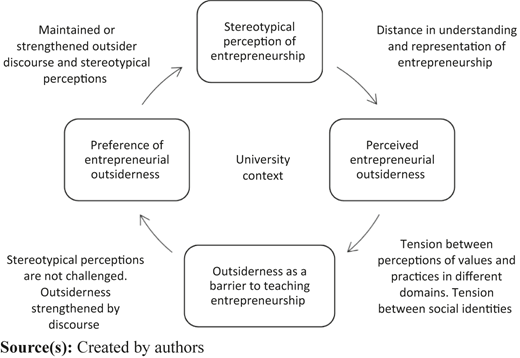
Figure 3 illustrates some of the main findings of this paper, including that educators at the university perceived entrepreneurship as a stereotyped concept. They found it hard to understand, and perceived entrepreneurship as being uninteresting and unfamiliar. Further, educators from all levels and faculties expressed a lack of entrepreneurship knowledge. This may have led educators to perceive themselves as outsiders to the concept of entrepreneurship, experiencing a tension between the perceptions and values of entrepreneurship and their contextual domain. Educators might also have experienced a tension between a perceived entrepreneurial identity and their current identities – for instance, domain-specific professional identities, educator- or researcher-identity, identities tied to specific industries or sectors, or identities tied to their private or personal life. In addition, entrepreneurial outsiderness served as a barrier to teaching entrepreneurship, and thus, the stereotypical perceptions were left unchallenged. This left entrepreneurial outsiderness as a preferred state for many educators, resulting in a maintained or strengthened outsider discourse and stereotypical perceptions of entrepreneurship.
Contribution and implications
The results of this study make a significant contribution to the conversation of embedded entrepreneurship education (Crișan et al., 2023), as it bridges a gap in the literature by looking at the educators’ perspective on entrepreneurship. If entrepreneurship competence is to be developed by students across disciplines (Gibb et al., 2013), we need to understand potential enablers and barriers among educators, because they can be seen as “gatekeepers” in terms of being key actors in higher education development. This paper has developed the concepts of entrepreneurial insiderness and entrepreneurial outsiderness to help understand the complexity of such enablers and barriers. The development of the two concepts serves as an original contribution to social identity theory and to the conversation of entrepreneurial identity. This study further contributes to the field of entrepreneurship education by showing how perceptions and discourses can influence the development of social identities that enable embedded entrepreneurship education. If entrepreneurship is to be disseminated across disciplines, it seems necessary to challenge stereotypes and discourses, and to encourage a broad understanding of entrepreneurship.
Challenging the spiral of stereotypical perceptions of entrepreneurship in the university context can be done in several ways. One important starting point is to provide educators from all disciplines with knowledge about entrepreneurship, thus enabling them to share a contextualised understanding of entrepreneurship with their students. Highlighting the relevance of entrepreneurship in various disciplines could spur a new interest in the teaching of entrepreneurship. This could be achieved through educational initiatives (e.g. train-the-trainer courses) and by further research on contextualised entrepreneurship and embedded entrepreneurship education. Further, the universities can actively build their innovation culture by portraying the broad set of values and practices that apply to entrepreneurship, aiming to reduce tension between identities and to challenge stereotypical discourses and perceptions. This could help educators to embrace entrepreneurial identities, perceiving themselves as entrepreneurial insiders. Further research is needed to find out what approaches are successful in helping educators to experience entrepreneurial insiderness. Also, performing the same research at other universities, in other countries, would provide information to determine whether the findings of this paper could be influenced by culture, locally or nationally. We can assume a variety of university cultures and university approaches to entrepreneurship education across countries and continents.
Limitations
The data material underpinning this paper does not make use of everything that was said in the interviews, as we removed nine students’ voices from the sample to specifically focus on the educators’ perceptions of entrepreneurship. There is, for instance, a possibility that educators’ ideas may have been influenced by students in the focus-group interviews. However, in our pre-analysis including all actors, there seemed to be no major differences between the students and educators in terms of their perceptions of entrepreneurship. A more homogeneous sampling would have generated different conversations, where we could have lost important perceptions of entrepreneurship across disciplines. Our sample provided a comprehensive picture of potential perceptions in different educational contexts. After having conducted eight focus-group interviews, we reached saturation, in terms of recognising recurrent themes (Hennink and Kaiser, 2022). The sample is not representative, which means that the educators’ perceptions are not necessarily representative of the general perceptions of entrepreneurship among educators in their respective departments. Whilst this study provides an in-depth understanding of how educators see themselves and their educational field in relation to entrepreneurship, quantitative studies could give a more comprehensive insight into the representativeness of the findings in different educational contexts. The results of this study indicate that there is still a long way to go in terms of entrepreneurship education at the university in question. Given that this university is the largest in Norway, located in three different cities, it is reasonable to believe that the situation would be similar in other Norwegian and perhaps also Nordic universities. Through “naturalistic generalization” (Tracy, 2010, p. 845), it may be probable that the findings of this study would also apply at similar universities, both in Norway and in other countries.
Conclusion
This study has used social identity theory to develop two new concepts describing entrepreneurial identity: “entrepreneurial outsiderness” and “entrepreneurial insiderness”. The study reveals that university educators experience entrepreneurial outsiderness due to unclear entrepreneurship terminology, lack of interest and knowledge in entrepreneurship, and a misrepresentation of entrepreneurs and of entrepreneurship. These elements cause distance in educators’ perceptions of what entrepreneurship might mean in their educational context, which negatively influences their delivery of embedded entrepreneurship education.
The study suggests that university educators should acquire an interest in, and knowledge about, entrepreneurship in order to articulate and teach it to their students as entrepreneurial insiders. Adaptation of the concept of entrepreneurship to the specific educational context can highlight the relevance and utility of entrepreneurship, and promote entrepreneurial insiderness. It seems to be important that the educators from various faculties and disciplines themselves execute embedded entrepreneurship education. Through such teaching, educators serve as examples of triple professionalism, combining multiple social identities and bridging disciplines. Innovation cultures across faculties and disciplines must be aware of entrepreneurship discourses and stereotypes, as these influence educators’ experiences of entrepreneurial insiderness or outsiderness, as well as their execution of embedded entrepreneurship education.
Notes
As part of a larger research project, we recruited a mix of students, PhD candidates and educators to consider perceptions from different levels of the educational system–at least one from each of the 54 departments–with a total of 54 participants, but only 50 of the 54 departments were represented, due to sickness on the day of the interview. However, for this paper, which aims to explore the perceptions of educators in particular, we have chosen to omit the students from the sample.