


The paradigm “think entrepreneur–think male” continues to prevail in entrepreneurship education (EE). Aiming to explore how EE educators and EE students engage with this paradigm, this paper examines how students’ beliefs about entrepreneurship are shaped within the classroom.
This study is based on a single case comprising 32 interviews with EE students and educators from a variety of higher education institutions in the Netherlands. Observations were conducted in a learning environment where undergraduate students from a range of EE minors (general, social and tech entrepreneurship) collaborated on projects under the guidance of entrepreneurship educators.
Our findings reveal that gendered constructs are deeply embedded in EE, shaping perceptions of entrepreneurship. However, these constructs are changing and challenging the “think entrepreneur–think male”.
This study contributes to gender and entrepreneurship literature by challenging the existence of the prevailing paradigm “think entrepreneur–think male” in EE. We emphasise the importance of acknowledging individual entrepreneurial motivations while recognising gendered constructs in entrepreneurial support and resource access.
1. Introduction
One of the purposes of entrepreneurship education (EE) in higher education institutions (HEIs) is to influence students’ attitudes towards entrepreneurship: teaching aspiring entrepreneurs how to recognise opportunities, strengthening their intentions to become entrepreneurs, and prompting entrepreneurial behaviour (Nabi et al., 2017). Yet, despite collective efforts to make EE gender inclusive, research shows that male students continue to form the majority of participants in EE programmes (Westhead and Solesvik, 2016). Studies indicate that, in enhancing their entrepreneurial self-efficacy, motivation, and pursuit of entrepreneurial careers, men derive particularly significant advantages from EE (Brüne and Lutz, 2020; Westhead and Solesvik, 2016). In turn, female students encounter difficulties in forming meaningful connections with the archetypical entrepreneur concept (Hentschel et al., 2018). Some scholars suggest that an inclusive entrepreneurship avenue accessible to all students on the basis of merit might be a myth (Kubberød et al., 2021; Jones and Warhuus, 2018; Jones and Underwood, 2017; Jones, 2015).
Indeed, a growing body of research indicates that the portrayal of entrepreneurs in EE often oversimplifies diversity, fostering an illusion of uniformity in individual characteristics and a standardised “entrepreneurial mindset” (Jones, 2014). Such a portrayal perpetuates the notion of a single “correct” approach to entrepreneurship endeavours that is historically aligned with Western white males and their manifestations of masculine attributes and competencies (Jones, 2014). This “think entrepreneur–think male” paradigm suggests that when people consider entrepreneurs, they typically envision men rather than women (Jones, 2014, 2015). This gendered stereotype can influence the perceptions, opportunities, and support available to individuals based on their gender when it comes to entrepreneurship (Jones, 2014, 2015). Consequently, this image of entrepreneurship, which elevates men as the ideal entrepreneurs, significantly influences the career trajectories of people of all genders.
It is imperative to acknowledge that female students are not passive subjects confined by gender-specific obstacles; rather, they possess agency in shaping their trajectories (Madsen et al., 2008). To empower female students, entrepreneurship educators must confront the divergency so that all aspirational entrepreneurs are conventionally perceived, approached, and treated within the entrepreneurial ecosystem—an aspect that frequently evades attention within pedagogical settings (Swail and Marlow, 2018). Neglecting these nuanced gender-based challenges leaves female students inadequately equipped to embark on entrepreneurial careers, thereby underscoring the uneven distribution of the benefits of entrepreneurship education among students (Westhead and Solesvik, 2016).
From previous literature, we know that the beliefs that define the constructs of entrepreneurship are strong (Meyer et al., 2017; Raible and Williams-Middleton, 2021). Research has shown that the contemporary popular notion of who, and what, is an entrepreneur stems from an image of a “hero male” who creates innovative new ventures that generate wealth and employment (McAdam, 2013; Swail et al., 2014). However, due to the scarcity of research on the specific role of educators in addressing gender aspects within EE, our knowledge is limited by the actions taken within the classroom to either reinforce or reduce the gendered nature of entrepreneurship, as well as the strategies they employ to support entrepreneurial learning among male and female learners, despite the insights provided by Jones (2015).
Sarasvathy (2004) notes that individuals can become entrepreneurs when provided with a supportive context. Consequently, we follow her suggestion that rather than focusing on entrepreneurial motivations and incentives, researchers need to examine barriers to entry entrepreneurship. We concentrate on examining how students’ beliefs about entrepreneurship are shaped within the classroom, specifically addressing the existence of the “think entrepreneur–think male” perspective.
Context plays an integral role in shaping entrepreneurial processes, decisions, and outcomes, thereby influencing the entrepreneurial journey (Welter, 2020). The Netherlands exemplifies such a context through its significant and deliberate commitment to advancing entrepreneurship education (EE) within its higher education landscape (Baggen et al., 2021). Consequently, the selected HEI in this case study is particularly suitable for this research, as it operates within this entrepreneurship-focused educational context. This paper intends to advance research on gender and entrepreneurship in several ways. First, we explore how entrepreneurship education (EE) educators and students address the paradigm “think entrepreneur–think male”. Second, we show that EE students have different requirements from their education, including knowledge about gendered obstacles in the entrepreneurial journey. The paper continues with a theoretical background that investigates prior research on the underlying mechanisms that perpetuate gender disparities in EE, and we detail our research design and data collection processes in the methodology section. The findings section reveals that gendered constructs are deeply embedded in EE and significantly shape perceptions of entrepreneurship. However, we also demonstrate that these constructs are evolving and increasingly challenge the “think entrepreneur – think male” paradigm. We conclude with a discussion of our findings, their contributions to the field, and suggestions for future research.
2. Theoretical framework
2.1 Entrepreneurial roles and gender roles
Burke and Reitzes (1981) suggest that roles derive meaning from their relation to other identities and responsibilities. Generally, roles represent a set of socially held behavioural expectations that are externally attached to an individual (Gecas, 1982). This means that entrepreneurial roles encompass behavioural expectations regarding what entrepreneurship is or should be (beliefs) and who an entrepreneur is, as well as what they can or should do (attitude). Meanings ascribed to specific roles are constructed and upheld in relation to other duties, serving as pivotal reference points. Women are typically described as caring, supportive, kind, or expressive, while men are most commonly seen as independent, courageous, aggressive, and/or autonomous (Gupta et al., 2009). Frequently, a role’s essence and significance are determined through its connection with an essential counter role. From a heteronormative perspective, for example, the “wife” role gains meaning through its interactions with the “husband” counter role. Similarly, in entrepreneurship, the roles of “venture capitalist” and “firm manager” may be pertinent counter roles that contribute to our comprehension of the entrepreneurial role (Burke and Reitzes, 1981). Roles cannot be effectively developed without considering pertinent counter roles, as Burke and Reitzes (1981) argued. In this view, entrepreneurship is associated with the masculine stereotype, including agentic traits such as competitiveness and the need for achievement or risk-taking, as demonstrated by Gupta et al. (2009), Marlow and McAdam (2013), and Marlow and Swail (2014), among others. Moreover, entrepreneurship has been linked to ambition and self-confidence, which are also connected to the masculine stereotype, as indicated by Laguía et al. (2019).
Gender has significant influence on the entrepreneurial legitimation process (Swail and Marlow, 2018), and adopting a gendered perspective is essential for comprehending the obstacles that nascent women entrepreneurs encounter concerning their identities and legitimacy (Swail and Marlow, 2018; Hentschel et al., 2018). Gender roles encompass the societal expectations and norms associated with being male or female (Swail and Marlow, 2018). Because the ideal entrepreneur is typically viewed as male and associated with masculine traits, women entrepreneurs face challenges when forming their identities. For example, feminine societal roles related to motherhood and physical appearance create tensions for women in an entrepreneurial role (Swail and Marlow, 2018). Additionally, women are inclined to conform to societal expectations (Thébaud, 2010). To realign these divergent roles, women are compelled to undertake forms of gender identity work aimed at exemplifying traits that challenge their conventional feminine personas. Women with a masculine or androgynous gender role orientation, for example, are more likely to develop entrepreneurial careers (Liñán et al., 2022). In short, gender role expectations make entrepreneurial success and growth more difficult for women than for men, leading to several gender disparities (Gupta et al., 2019).
2.2 The context of entrepreneurship education
Context is considered key to understanding how, when, and why entrepreneurship occurs, highlighting a spectrum of factors that include situational conditions and the influence of stakeholder groups (Welter, 2011). In addition, Welter (2020) suggests that the gender-context debate is moving from “contextualising gender” to focusing on the “gendering of contexts”. This shift indicates the need for a deeper examination of how gender influences not only individual experiences within specific contexts, but also how gendered constructs become embedded in the very fabric of the entrepreneurial environment. While previous discussions might have centred on women’s participation within certain industries, current attention involves an understanding of how gendered norms subtly influence investment decisions and startup dynamics in those industries. In this study, we highlight the context of EE in HEIs to examine what occurs within the EE classroom that narrates the students’ definition of an entrepreneur.
Despite the positioning of entrepreneurship as a meritocratic and inclusive career path in educational contexts (Jones, 2015), a “think entrepreneur–think male” gender norm is perpetuated in EE (Jones and Warhuus, 2018). This norm subtly reinforces the belief that masculine traits outperform feminine characteristics in entrepreneurial success (Ahl and Marlow, 2012), despite the absence of objective criteria supporting such beliefs (Thébaud, 2010). Indeed, research insights have demonstrated that EE in HEIs affords lower levels of learning outcomes for female students (Ferreras-Garcia et al., 2021), lower entrepreneurial intentions (Wilson et al., 2007), and decreased likelihood of starting their own ventures after graduation (Dabic et al., 2012; Johansen, 2015).
Gender norms are apparent in recruitment materials, which predominantly depict fictive male students (Jones, 2015; Korhonen et al., 2012), unless programmes specifically target women-only groups (Jones and Warhuus, 2018), thus contributing to the underrepresentation of women’s enrolment in EE (Hägg et al., 2022). This imbalance results in a homophily effect that hinders female students’ opportunities to build network connections. Moreover, the “think entrepreneur–think male” gender norm is also portrayed in educational texts (Fältholm et al., 2010), indirectly suggesting that female students do not measure up, fail to understand entrepreneurial opportunities, or lack confidence and knowledge compared to their male counterparts (Jones, 2015). Such messages negatively interfere with the positive drivers of entrepreneurial intention and activity, such as entrepreneurial self-efficacy and early entrepreneurial exposure (Barnir, 2020; Gupta et al., 2009). It also perpetuates hidden barriers, such as biased evaluation of female students’ competence by educators (Thébaud, 2010).
One way to increase interest in entrepreneurship (education) is by depicting diverse role models (Bettinger and Long, 2005; Laguía et al., 2022) in promotional and educational texts and creating learning contexts that feature representative group of educators, guest lecturers, and professionals from diverse sectors. Women-only EE classes taught by women entrepreneurs, practitioners, and guest speakers can empower female students (Gupta et al., 2009), but they may not fully address systemic disparities and can inadvertently marginalise those who attend. Though, Laird (2011) stressed that women educators, especially those of colour, tend to include diversity in course materials to a greater extent than their male colleagues, which is relevant considering that women students express less interest when masculine language forms or (sketched) images are used (Laird, 2011). It is what Henry calls the role of the educator as unique aggregator of content, where entrepreneurship educators shape the content of EE programs based on their own experiences, perspectives, and influences (2020).
For a more inclusive and gender-sensitive learning environment, it is crucial to include female students in entrepreneurship programmes from the outset (while at university) and to consider norms and potential barriers related to gender in these programmes (Hentschel et al., 2018). It is equally important to ensure that entrepreneurship education does not contain too much content, an abundance of which can lead to superficial coverage, assessment issues, and challenges in measuring impact (Henry, 2020).
2.3 The entrepreneurship educator’s perspective
The role of the entrepreneurship educator remains a critical, yet underexplored, dimension within the elements that contribute to the effectiveness of EE. Although scholars such as Hannon (2005), Bell (2021) have noted the importance of an educator’s insight into how educational philosophies and theories inform the different pedagogies in achieving a range of EE learning goals, focus has predominantly been on students’ experiences and outcomes (Neck and Corbett, 2018). This oversight is particularly evident in discussions about the gendered nature of entrepreneurship education. For instance, while Bell (2021) provides valuable insights into how EE classrooms facilitate learning through the lens of contextual factors such as learners’ age, education level, and how critical thinking skills influence the effectiveness of different approaches, the specific influence of gender remains unaddressed in their analysis.
Jones (2015), who explored the role of educators’ attitudes about gender and entrepreneurship as well as the (female) students’ responses to them, remains an exception when addressing gender aspects. As summarised by Tegtmeier and Mitra (2015), Jones’s study “unveils an ‘invisible’ level of interpretation and decision-making by educators. They translate traditionally masculinised assumptions into ideas about entrepreneurship that they present to students in the classroom, thus revealing its symbolic repercussions” (p. 266). This study sheds light on how educators’ gendered assumptions can permeate classroom discussions and learning experiences, thereby underscoring a critical area for further inquiry (Bell, 2021).
Despite Jones’s insights, the scarcity of research that specifically addresses the role of educators in gender aspects within EE leaves us with limited knowledge about what entrepreneurship educators do in the classroom to reinforce or, alternatively, reduce the gendered nature of entrepreneurship. Additionally, it is unclear what strategies the educators employ in their instruction to support entrepreneurial learning. This omission necessitates turning our attention to indirect indicators of potential pedagogical biases such as educational materials. Course manuals, produced by educators, serve as a tangible reflection of the implicit curriculum and offer insights into how entrepreneurship is framed, revealing the extent to which gendered narratives are reinforced or challenged within EE. Jones and Warhuus (2018) examined 86 entrepreneurship course manuals from 21 countries and found that course descriptions predominantly, albeit not exclusively, use masculine language. Dominant examples include declarations such as: “entrepreneurs are involved in activities that are ‘risky and very hard work’, and they need to be resourceful, with ‘innovative, pro-active and risk-seeking behaviour’” (p. 11). Feminine descriptions describing entrepreneurship as “an inherently social, collaborative process” were less common (Jones and Warhuus, 2018). Course manuals are generally produced by educators who are directly involved in teaching; hence, the materials are a reflection of the instructors’ views and biases. The utilisation of such masculine language implies that many educators possess implicit biases regarding female students. Moreover, this could inadvertently convey an environment that is less inclusive or welcoming for women in their courses. However, the challenge of fostering inclusivity in EE cannot be solely attributed to individual educators. Instead, we view this problem as intricately tied to complex contextual factors encompassing the possibility of layered biases (whether explicit or implicit) and frequently unacknowledged conflicts arising from the emphasis on promoting equality, diversity, and inclusivity. Through our study, we explore how the “think entrepreneur–think male” paradigm influences gendered perceptions of entrepreneurship within the classroom, focusing on the role of entrepreneurship education (EE) educators and students in either reinforcing or challenging these perceptions.
3. Methodology
3.1 Research design
To explore how entrepreneurship education (EE) educators and students address the paradigm “think entrepreneur–think male”, we conducted a single case study within Dutch higher education institutions (HEIs), using an inductive approach that guided the generation of novel theoretical insights. This study involved 32 interviews with students (21) and educators (10), supplemented by observations to deeply investigate the factors influencing students’ beliefs about entrepreneurship.
Our case study design was intended to explore a contemporary phenomenon within its real-world context, especially in situations where the distinction between the phenomenon and its context is not clearly defined (Yin, 2011, 2018). Specifically, we used semi-structured interviews and observations and a flexible coding process to unpack how gender beliefs are narrated and interpreted among students and educators in their everyday practices. This inductive approach provides rich insights into the multifaceted nature of the actors’ perceptions and the mechanisms through which gendered beliefs may be reinforced or challenged within an educational setting.
3.2 Data collection
The final set of study participants included 21 students and ten educators from various undergraduate EE programmes in the Netherlands, spanning disciplines such as business and economics, technology, and the creative industries (Table 1). We conducted the interviews during spring 2021, recording them with verbal and written consent in a face-to-face online setting. The interviews took place within the same academic year or, at most, one academic year after the EE students had formally completed their courses.
Summary of the EE student and EE educator respondents
| Respondent type | Total number of respondents | Average age | Gender | Number of respondents |
|---|---|---|---|---|
| Student | 21 | 21 | Female | 10 |
| Male | 11 | |||
| Educators | 10 | Female | 5 | |
| Male | 5 |
Source(s): Authors’ own creation
The interview protocol, developed as part of a larger study on gender and entrepreneurship education in Europe, included semi-structured questions on social safety, role models, and networking, thereby facilitating cross-interview comparisons. Following the interviews, the authors selected respondents for analysis based on the quality of the interviews and the representativeness of the respondents.
3.3 Triangulation of data and perspectives
To enhance the robustness of our findings, we employed triangulation by integrating multiple data sources and perspectives. Specifically, we (1) conducted interviews with students and educators to gather diverse viewpoints; (2) used classroom observations to capture real-time interactions and validate the insights from interviews; and (3) analysed the data to identify how student and educator perspectives complement and reinforce one another, rather than merely comparing them. This approach allowed us to capture the natural emergence of themes and perspectives, reflecting the authentic experiences and viewpoints of participants. By allowing topics to arise organically during interviews and observations, we were able to gain a contextually rich understanding of the dynamics within the EE classroom. Some topics were more extensively discussed with educators, while others received more attention during the student interviews. This method ensured that our findings were grounded in the lived realities of both groups, providing a more nuanced and comprehensive analysis.
By triangulating these data sources, we ensure a comprehensive understanding of how gendered beliefs are both reinforced and challenged within the educational setting, providing a well-rounded analysis that acknowledges the contributions of students and educators.
The average age of the student respondents (n = 21) was 21.19 years, with an age range between 19 and 26 years (Table 1, Table 2). Female students (n = 10) and male students (n = 11) were interviewed; most students live outside the Amsterdam Metropolitan Area (AMA), while a minority live within the AMA. The educator respondents (n = 10) work either as EE educators or as EE programme coordinators combined with a teaching component (Table 1, Table 3) in undergraduate programmes at one HEI. All of the educators work within different elective curricular courses, some in the form of a three-year track, some in minors, and some in extracurricular programmes, all focused on narrow entrepreneurship (Lackéus, 2015). Generally, the pedagogy emphasises personal development and entrepreneurship experience rather than the knowledge transfer for running a business.


EE students
| Pseudonym | Gender | EE-field | Level and type of EE in HEI | Target group | Age |
|---|---|---|---|---|---|
| RS01 | M | Small Business and Commerce Entrepreneurship | Bachelor (track) | Student | 21 |
| RS02 | M | Small Business and Commerce Entrepreneurship | Bachelor (track) | Student | 19 |
| RS03 | M | Small Business and Commerce Entrepreneurship | Bachelor (track) | Student | 23 |
| RS04 | M | Small Business and Commerce Entrepreneurship | Bachelor (track) | Student | 23 |
| RS05 | F | Small Business and Commerce Entrepreneurship | Bachelor (track) | Student | 23 |
| RS06 | F | Small Business and Commerce Entrepreneurship | Bachelor (track) | Student | 22 |
| RS07 | M | Small Business and Commerce Entrepreneurship | Bachelor (track) | Student | 24 |
| RS08 | M | Small Business and Commerce Entrepreneurship | Bachelor (track) | Student | 20 |
| RS09 | M | Small Business and Commerce Entrepreneurship | Bachelor (track) | Student | 21 |
| RS10 | F | Small Business and Commerce Entrepreneurship | Bachelor (track) | Student | 23 |
| RS11 | M | Small Business and Commerce Entrepreneurship | Bachelor (track) | Student | 18 |
| RS12 | F | Small Business and Commerce Entrepreneurship | Bachelor (track) | Student | 19 |
| RS13 | F | Media Entrepreneurship | Bachelor (minor) | Student | 20 |
| RS14 | F | Small Business and Commerce Entrepreneurship | Bachelor (minor) | Student | 20 |
| RS15 | M | Small Business and Commerce Entrepreneurship | Bachelor (track) | Student | 22 |
| RS16 | M | Venture Creation | Bachelor (Extracurricular) | Student | 24 |
| RS17 | F | Venture Creation | Bachelor (Extracurricular) | Student | 21 |
| RS18 | F | Small Business and Commerce Entrepreneurship | Bachelor (Extra Curricular) | Student | 24 |
| RS19 | F | Venture Creation | Bachelor (Extracurricular) | Student | 26 |
| RS20 | M | Tech Entrepreneurship + Venture Creation | Bachelor (minor + Extracurricular) | Student | 21 |
| RS21 | F | Small Business and Commerce Entrepreneurship | Bachelor (minor) | Student | 21 |
Source(s): Authors’ own creation
After completing the interviews, a specific learning environment was selected using convenience sampling for the primary author to conduct the observations. Little is known about what entrepreneurship educators do in the classroom, how they teach, or what strategies they use in their instruction to support entrepreneurial learning (Neck and Corbett, 2018). Indeed, EE in HEIs can reflect different perspectives about what entrepreneurship is and how it should be taught or learned by students of all genders. Since teaching is done in the privacy of the classroom, and since this is the place where relationships with students are built as a learning community and where lesson plans are put into practice (Nabi et al., 2017), it appears to be the right context to situate our case study. Therefore, to understand this environment, we selected an on-campus place where undergraduate students from various EE-minors (general, social, and tech entrepreneurship) collaborate and work on projects under the guidance of EE educators. Limiting the study to one context enables a more thorough examination of the interactions, instructional strategies, and dynamics within that environment, ensuring consistency, depth, and feasibility in data collection and analysis. Before the observations were carried out, the authors obtained ethical approval for the research observations by consulting the university’s data steward, ensuring compliance with ethical guidelines and standards, and subsequently obtaining written consent from the various EE minor coordinators. Subsequently, the observations were carried out on a weekly basis, primarily during guest lectures and nine events were observed during the fall semester between September 2022 and January 2023 (t = 15 h) (Table 4). The observations focused on how student entrepreneurs, their peers, and the educators talked and socialised with each other in the learning environment.
Summary of guest lectures and events observed
| Guest lecture | Roles | Theme | Age (in decades) | Gender | # of students present | Gender ratio (m*f) |
|---|---|---|---|---|---|---|
| 1 | Entrepreneur | Innovative Thinking | 40–50 | Male | ±80 | 80%*20% |
| 2 | Entrepreneur | Networking | 50–60 | Male | ±60 | 75%*25% |
| 3 | Entrepreneur | Entrepreneurial Journey | 40–50 | Male | 40 | 80%*20% |
| 4 | Educators | Wisdom of the crowd | 40–50 | Male + Female | ±30 | 70%*30% |
| 30–40 | ||||||
| 5 | Entrepreneur | Entrepreneurial Journey | 30–40 | Male | ±35 | 50%*50% |
| 6 | Educators | Pitching | 50–60 | Female | ±60 | 70%*30% |
| 20–30 | Female | |||||
| 7 | Market | Christmas fair | 20–30 | All genders | ±60 | 70%*30% |
| 8 | Experts, Entrepreneurs, Educators | Mini workshops with different expert to develop your business idea | All ages | All genders | ±80 | 80%*20% |
| 9 | Entrepreneur | Video Marketing | 30–40 | Male | ±20 | 100% |
Source(s): Authors’ own creation
Notes were made during each session and more extensive observation reports were produced in critical reflexive journals (field notes and reflexive memos) directly after the observation sessions (Cunliffe, 2016). Additionally, the reflexive journals’ content was periodically discussed in debriefing sessions with the other authors. Each of the respondents is anonymised using pseudonyms in the field notes.
3.4 Data analysis
We employed Deterding and Waters's (2021) flexible coding process for data analysis, which includes three types of coding: attribute, index, and analytic codes. This method is well-suited for semi-structured interviews with a relatively large sample size (N > 30), combining both inductive and theory-based approaches. In the first step, we compiled all source materials and created a MAXQDA database to house them. This involved importing our cases, including interview transcripts, observations, and reflexive field notes. We then connected these documents to specific attributes to guide the research design, initially categorising them as female students, male students, female educators, and male educators.
The second step involved exploring and preparing the data. This included indexing all transcripts, anchoring content to the interview protocol, and producing cross-case memos. Early transcript reads were crucial for generating concepts and theories and identifying the main stories within the data Deterding and Waters, 2021, p. 725). We had a preliminary sense of emergent themes from conducting the interviews. For example, female educators’ awareness of the importance of diverse role models emerged early on. We began index coding all interview questions based on the interview protocol, with themes like social safety, role models, networking, self-efficacy, and attitude. These codes corresponded to substantial sections of text and we included a code for each interview question. This setup enabled more focused subsequent readings and more reliable analytic coding (Deterding and Waters, 2021). Using MAXQDA’s “compare cases by groups” feature, we ensured all index codes were captured completely. In one instance, an interview with a female respondent did not follow the topic list and missed several important themes, leading us to eliminate this respondent from the dataset. We then created a theoretically driven coding manual, developed collaboratively among the authors. This manual included a list of concepts and relationships that emerged across multiple cases, outlined in thematic memos. The manual incorporated topics from underlying theories and allowed for the identification of new concepts from the data. Themes such as social roles (including gender and entrepreneurial roles), pedagogy (including role models and perspectives on entrepreneurship), and entrepreneurial experience were part of this manual and were subsequently used as analytic codes in the following step.
In the third step, we employed index coding for data reduction and applied analytic codes to focused sections of the transcripts, emphasizing the reliability and validity of the coding process Deterding and Waters (2021). During this stage, we analysed how students and teachers narrated gender role perceptions related to entrepreneurship within the educational environment. We focused on the research question: how do students’ beliefs about who can become an entrepreneur arise from their experiences in entrepreneurship education (EE) classrooms? Following Deterding and Waters’s (2021) recommendations, respondent attributes were disregarded during the application of analytic codes. We displayed the index codes relevant to each transcript section and applied analytic codes one at a time. Each interview was coded with an analytic code for each case. For example, we used “gender roles” followed by “entrepreneurial roles” as analytic codes. This approach increased the reliability and validity of the coding process (Deterding and Waters, 2021). After applying all analytic codes, MAXQDA facilitated the examination of cross-case reliability in thematic coding. Reducing the data from full transcripts to indexed extracts and, finally, to grouped analytic codes allowed us to ensure uniform qualitative criteria across the sample, thereby enhancing reliability and construct validity (Deterding and Waters, 2021). We then analysed the themes between different attributes using MAXQDA’s “compare cases by groups” feature. If a single disconfirming case or cluster of exceptions emerged, it helped refine the working theory to account for these exceptions. In this context, the number of exceptions was less important than how they refined the theory. An overview of these analytical steps is provided in Table 5.
Entrepreneurship educators
| Pseudonym | Gender | Type of entrepreneurship education | Level of entrepreneurship education in HEI | Target group |
|---|---|---|---|---|
| RE01 | F | Media Entrepreneurship | Bachelor (minor) | Coordinator |
| RE02 | F | Small Business and Commerce Entrepreneurship | Bachelor (minor) | Educator |
| RE03 | F | Small Business and Commerce Entrepreneurship | Bachelor (minor) | Educator |
| RE04 | M | Small Business and Commerce Entrepreneurship | Bachelor (minor) | Coordinator |
| RE05 | M | Social Entrepreneurship | Bachelor (minor) | Educator |
| RE06 | M | Small Business and Commerce Entrepreneurship | Bachelor (track) | Educator |
| RE07 | M | Social Entrepreneurship | Bachelor (minor) | Educator |
| RE08 | F | Small Business and Commerce Entrepreneurship | Bachelor (minor) | Educator |
| RE09 | M | Small Business and Commerce Entrepreneurship | Bachelor (track) | Coordinator |
| RE10 | M | Small Business and Commerce Entrepreneurship | Bachelor (track) | Educator |
| RE11 | F | Tech Entrepreneurship | Bachelor (minor) | Coordinator |
Source(s): Authors’ own creation
3.5 The context of the entrepreneurship education classroom case
The majority of students reported that there is a noticeable gender imbalance in their EE classes, with an approximate breakdown of 30% female and 70% male students. However, there are some variations in this imbalance.
In addition, several respondents stated that they have individual experience in entrepreneurship, close family members or acquaintances who have experience in entrepreneurship, or both. Only a few student respondents were enrolled without any prior entrepreneurial experience. The individual experiences are mostly small in scale and range from writing a business plan in high school, setting up internet stores, and participating in business plan competitions to selling at flea markets and selling holiday cards at school. Some respondents referred to those examples as their first entrepreneurial experiences, while others indicated that they do not see this as entrepreneurship. However, some respondents indicated that they had envisioned pursuing entrepreneurship as a career path from a young age:
Since I was little, I already wanted to become a fashion designer and I was already dreaming of my own clothing store. RS15, Female Student.
It is noteworthy that there were no differences in the prior entrepreneurial experiences of male and female students. Besides the respondents’ personal history, some had been exposed to entrepreneurship and entrepreneurial role models from early childhood via their family members’ occupations. In most cases, references were made to fathers who are entrepreneurs, while in a few cases, both parents were mentioned together; only one respondent mentioned a female family member as their first encounter with entrepreneurship. Some respondents said they encountered entrepreneurship through the family, but they claim to have no experience in entrepreneurship personally. This means that exposure to entrepreneurship does not account for the diversity in the students’ interest in becoming entrepreneurs.
4. Findings
4.1 In class dynamics
Our findings reveal the nuanced dynamics within the EE classroom by capturing the voices of students and educators. While some topics were discussed more extensively with one group than the other, this approach provides a rich, contextually nuanced understanding of the gendered constructs in entrepreneurship education. Exploring the educators’ perspectives first, gave us valuable insights into the factors shaping students’ beliefs about entrepreneurship. For instance, there is a significant focus on the importance of teams and team development: ‘I am a strong advocate of multidisciplinary teams”, RE01, Female Educator. According to nearly all educators, focused attention on team diversity based on different students’ educational profiles and personality traits is present in the team development process of their EE programmes. Even though gender diversity is recognized by some of the educators as important to the mix as well, none of the educators stress that mixing teams based on the students’ gender is integrated into the design of the curriculum. Conversely, implicit gendered perceptions from the educators’ perspective do appear integrated in this process, which can both favour and disadvantage female students and may dissuade them from exploring entrepreneurship:
The most successful [student] teams are those where they are both [female and male] in it. Where the woman pulls the practical tasks, [sending] the emails out, the communication side. And the men doing the funding and having the bigger mouths. RE4, Female Educator
However, there are also instances where some of the educators favour female students. For example, one educator explained the “battle” each semester between educators about who can coach the female students who are recognised as having high potential in their classroom.
Yes, of course, I can tell if someone is a boy or a girl. But I still know a lot of women who have that oomph-factor [1]. Going all out. Putting the ball in their court. I’m very impressed… The good news is, I can already see people who are already the role models for later. So, I’m not worried. So, I’m shocked! And the good news is, I’m not worried because I see them already sitting in my classroom. RE10, Male Educator
We also observed implicit situations where gendered behaviour was apparent during EE programmes. For example, we witnessed the following interaction between a male student and a male guest speaker:
In the bustling atmosphere of an entrepreneurship guest lecture, the dynamics of implicit gender bias unfolded subtly yet unmistakably. As the speaker posed a question to the class, a male student promptly raised his hand, followed swiftly by another male counterpart. Amidst their confident assertions, a female student, though visibly engaged, found herself relegated to the side lines, her discomfort palpable as she shared a nervous laugh with her peers.
Undaunted, she kept her hand raised, her attention drifting to her cell phone in a gesture of resignation as her voice remained unheard. It wasn’t until the speaker’s belated recognition of her raised hand that she was finally afforded the opportunity to voice her perspective.
The exchange that followed, albeit brief, underscored the disparity in treatment. The male student onstage, perhaps recognizing the significance of her input, engaged her in discussion, acknowledging the novelty and relevance of her ideas. Yet, even in this moment of validation, the subtle commentary exchanged between female classmates betrayed a sense of frustration and resignation: ‘If only he listened straight away’.
The influence of implicit gender bias in the EE classroom is starkly illuminated in this vignette. Through nuanced interactions and silent affirmations, the unequal distribution of opportunity and recognition becomes apparent, shaping students’ perceptions of their own agency and worth. Still, respondents are not passive recipients of gender roles but active agents who subvert gendered contexts to their values and needs. In addition, even a small number of educators suggested that embracing and advocating for greater opportunities and agency should start in their EE classroom.
I find that to be the most important lesson for my students, I almost truly mean that, be independent! RE01, Female Educator
Despite a stated intention to address this issue, none of the educators reported that topics related to inequality in entrepreneurship (or broader contexts) are incorporated into the curricula. In addition, when all the educators were confronted during interviews with the difficulties women experience with respect to receiving venture capital, some were surprised by the obstacle and deemed it important to address it in future EE programmes. Others, meanwhile, did not recognise the issue and even questioned the idea that gender influences the success or failure of entrepreneurial endeavours. For example, one male educator emphasised the importance of not dwelling on gender disparities but rather focusing on the actions needed to succeed in entrepreneurship, suggesting that perseverance and determination are key skills in overcoming such obstacles.
But I live under the assumption that the moment you acknowledge its existence, you won’t solve it anymore. I feel like you should focus on what you need to do as an entrepreneur to push through it. Make sure you’re among that one percent. What do you need to do for that? Perhaps work a bit harder? RE10, Male Educator
Taken together, the educators seem to recognise the importance of team diversity, particularly in terms of educational profiles and personality traits, but do not systematically integrate gender diversity into the curriculum. Some educators implicitly express gendered perceptions, which can either favour or disadvantage female students. Indeed, we observed clear variation in awareness and acknowledgement of gender issues. While some educators recognise the need to address systemic gender disparities, others focus more on individual perseverance and entrepreneurial actions.
In terms of the students’ perspective, a slightly different situation emerges from the data. Students indicate that their in-class experiences may actually cause male students to feel compelled to assert their dominance or competence in a manner that is more masculine.
“Because boys are generally much pushier than the girls. Yes, I experience that myself too. I am less pushy than boys”, noted R8, Female Student, implying that there might be a culture of competition among (male) students in EE programmes. Additionally, none of the students’ address gender-specific challenges in their educational programmes.
The minor is focused on entrepreneurship and, um, transitioning towards entrepreneurship. People were encouraged to collaborate with each other and get to know each other better. R15, Female Student
These results suggest that there is generally little awareness among students about implicit gendered behaviours, with a tendency to attribute agency and success to individual attitudes rather than addressing systemic inequalities. Indeed, the findings seem to suggest that students perceive a culture where male students dominate discussions, often feeling the need to assert their dominance more than female students.
4.2 Entrepreneurial attitudes
To explore the question of what types of skills and attitudes are expected from EE students, it is necessary to identify the competencies and mindsets these programmes aim to cultivate. According to the educators: “It’s all about attitude!” noted RSE5, Male Educator.
In fact, the educators’ interviews indicate that students are expected to demonstrate entrepreneurial behaviour: consistency, teamwork, focus, and ambition. This suggests a need for determination, resilience, and a proactive approach to problem-solving. “The girls who come here [referring to the EE programmes] are often the most successful. Much more successful than most boys. Girls are more consistent. Harder workers. The girls have more ambition than the average boy who comes here, that’s really true”, RSE4, Female Educator.
As such, educators seem to recognise that having an entrepreneurial attitude does not only contribute to personal success but also plays a crucial role in navigating the entrepreneurial landscape. By focusing on these traits, educators aim to prepare students to face challenges with a robust and determined mindset.
In turn, students believe that pursuing entrepreneurship is a career trajectory that reflects a mix of excitement, ambition, and recognition of the challenges. Interestingly, many students perceive entrepreneurship as a complex and evolving field, requiring a blend of ambition, passion, and adaptability for success. From their viewpoint, key elements in entrepreneurial achievement include perseverance, determination, drive, and inner motivation. “Making money is very important, but it all starts with your own passion”, RS6, Female Student. Other indicators of future entrepreneurial success are, for instance, “being able to receive feedback” and practicing “self-reflection”.
One of the elements some students valued was the holistic nature of the EE programmes, stressing that this type of education not only equips them with valuable business skills, but also fosters personal growth and prepares them to face real-world challenges. Some students even expressed that EE is a transformative experience that goes beyond merely acquiring business knowledge:
So, there I learned that leadership can come in many forms, because everyone is unique, and everyone is different. And thus, everyone would be a different leader. RS18, Female Student
In general, vision and growth were important markets for entrepreneurship. In addition, numerous students felt that entrepreneurship transcends mere profit-making—it entails making a beneficial impact on society. They admire entrepreneurs who utilize their ventures to serve their communities and tackle social or environmental challenges.
They [inspirational entrepreneurs] want to convey more values than just raising money, so to speak. They don’t do it to earn, well, that’s certainly part of it, but I think they mainly focus on how they can make the world a better place. RS07, Male Student
Several students attributed entrepreneurship as a means to make a positive impact on society. What emerges from the results reported here is the students’ belief that successful entrepreneurs contribute to the well-being of their communities or address specific social or environmental issues.
In summary, whereas educators focus more on individual dimensions of entrepreneurial attitudes by stressing consistency, hard work, and ambition, students emphasise passion, adaptability, and seem to have a more collective approach that focuses on the importance of collaborative efforts and entrepreneurial activities’ broader impact on society.
4.3 In class images of entrepreneurs
In the following paragraph, we will investigate the question what types of images are presented in the EE classroom. Generally, most respondents (educators and students) stress that there is still a prevailing image of male and masculine entrepreneurs in society. ‘I think there is still a bit of a stigma that still prevails in business. You see women less often as, as bosses or as CEOs of companies”, RS07, Male Student.
In addition, many students still picture a middle-aged white man when asked what they think of when imaging an entrepreneur:
Well, I think entrepreneur tends quite quickly towards man for me, because there is a bit of the image people have of an entrepreneur, I think, however stupid that is, of course. Because yes, women can be entrepreneurs too. But anyway, [laughter] … eh … I think that’s how it’s created in society. RS12, Female Student.
I’ve learned that, um, I see leadership as also a part of entrepreneurship, and I've learned that leadership comes in many forms. Before, I had a stereotype image of what a leader is, very dominant and, um, knows what he wants, and isn’t afraid to assign that and maybe a bit, um, dictatorial, a sort of dictatorship, kind of. But I’ve learned that’s not the case. RS18, Female Student.
The quotations above also highlight evolving perceptions amongst several students, indicating a paradigm shift towards a more inclusive understanding of leadership roles.
Some educators are personally aware of these stigmas and therefore try different approaches to create EE classroom environments that are appealing for all students. For instance, some educators question what truly inspires or drives the students being addressed, realising that their personal network contacts and insights might not resonate with the students’ interests and needs. “Or is he going to bring up something about a successful friend who is a millionaire again? Screw it, all of it. Yeah, what gets your hormones going? [meaning what inspires you]”, RSE7, Male Educator. Even though some educators are actively challenging gender bias in their daily routines, or have integrated more female guest speakers and experts in the programme, implicit gendered behaviour persists during sessions as is evidenced in the following situation sketch.
Amidst the hustle and bustle of an entrepreneurship education class, a guest lecturer confidently strides into the room. The class, comprised of different kinds of undergraduates, eagerly anticipates the day's lesson on the topic [of] investment sales pitches. After an introduction, the guest lecturer asks the students attentively to watch a video of an entrepreneur that navigates her investment sales pitch. The guest lecturer pauses the video intermittently, offering critiques and initiating a discussion about the elements that could be improved.
‘This illustrates what to avoid’, she remarks, her tone both instructive and encouraging. ‘Notice the areas where her delivery lacks conviction and her body language appears hesitant. These are important aspects to consider in your own pitches’.
The students nod in agreement, taking notes as they absorb the insights. The guest lecturer then transitions to another video, this time showcasing a male entrepreneur delivering a pitch with confidence and finesse. As the video progresses, the contrast becomes apparent—the male entrepreneur exudes assurance, his gestures commanding attention, his voice projecting authority.
‘This’, the guest lecturer emphasizes, ‘demonstrates effective investment sales pitch techniques’. (observation guest lecture)
Surprisingly, when questioned, most students remember only the male guest speakers or experts that were introduced in the EE classroom. “Then there were guest speakers there who came … uh … to tell their stories about their business. And those were by definition men. So those were not … uh … women”, RS02, Male Student. This example illustrates the reinforced male-dominated representation in entrepreneurship, particularly evident in the choice of speakers and experts who share their experiences and insights about entrepreneurial careers.
Thus, while both groups acknowledge the prevailing male-dominated image of entrepreneurs, they also contribute to a growing recognition of diverse and inclusive entrepreneurial identities. Educators’ efforts to introduce varied role models and challenge biases, combined with students’ evolving perceptions and reflections, contribute to a growing recognition of diverse and inclusive entrepreneurial identities, helping create a more nuanced and comprehensive understanding of entrepreneurship. Figure 1 demonstrates how this process of evolving beliefs is reinforcing, challenging, and subverting gender the EE classroom at the same time.
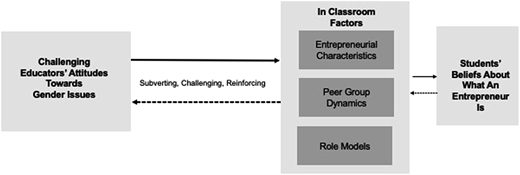
Visualization of the factors shaping the students’ beliefs of what an entrepreneur is
Visualization of the factors shaping the students’ beliefs of what an entrepreneur is
In summary, the triangulation of voices between educators and students reveals nuanced perspectives on gender dynamics in EE classrooms. Educators’ insights tend to focus on team composition and the implicit gendered perceptions that shape these dynamics, while students’ experiences highlight the pressures and biases they encounter. Despite these differences, educators and students acknowledge the importance of teamwork in EE programmes. Educators emphasize multidisciplinary and diverse teams, while students highlight collaboration and getting to know each other as part of their learning experience. Furthermore, both groups exhibit an awareness, to varying degrees, of gender biases and their impact on classroom dynamics and entrepreneurial activities. However, the depth of this recognition and the willingness to address it varies. Upon examining the findings in detail, we encountered a surprising result: while some educators continue to hold traditional views about gender, other educators and students are actively challenging and subverting these gender stereotypes through their evolving beliefs.
While we observed shared opinions in the importance of increasing students’ agency and providing greater opportunities, the approach differs. Educators talk about independence and pushing through challenges, while students see agency as tied to their attitudes and behaviours. By examining the EE classroom we identified that within every EE gendered constructs are embedded that shape beliefs about what it means to be an entrepreneur. And while these exert positive and negative influences on beliefs and expectations, they are challenged and reshaped by educators and students to create more inclusive and equitable alternatives.
5. Discussion
This paper makes three important contributions for future research. First, gender stereotypes are still reinforced in EE programmes. We confirm the results of other researchers who also found a stereotypical “think entrepreneur–think male” paradigm (Kubberød et al., 2021; Jones and Warhuus, 2018; Jones and Underwood, 2017; Jones, 2014, 2015). However, a closer analysis of the findings revealed that while some gender stereotypes persist, many educators and students are also beginning to question and overturn these stereotypes through their evolving beliefs. In general, these represent a set of socially held behavioural expectations attached to positions external to an individual (Gecas, 1982), meaning that entrepreneurial roles are behavioural expectations of what entrepreneurship is or should be (beliefs) and what they can do (attitude). From the perspectives of the educators and students, the divergent entrepreneurial and gender roles seem to be realigning towards a “think entrepreneur–think all genders” paradigm. This shift challenges the traditional grand narrative of entrepreneurship (Berglund and Wigren, 2012), which often highlights traits stereotypically associated with masculinity such as risk-taking and assertiveness, and which favours the individual “hero” as the “embodiment of entrepreneurial spirit” (Weiskopf and Steyaert, 2008). Our findings suggest that the image of an entrepreneur is becoming more inclusive, reflecting a wider range of skills, attributes, and identities. In addition, the respondents challenged the notion of a one-size-fits-all image of an entrepreneur. Suggesting, in contrast to other scholars who found that there is hardly any congruence between the image of women and that of entrepreneurs (Ahl, 2003, 2006), our results indicate that this connection does exist.
Second, Meyer et al. (2017) indicate that individuals who know self-employed persons show a lesser tendency towards stereotyping in entrepreneurship, concluding that people seem to have acquired a more realistic image of entrepreneurs through personal contact. Our findings also indicate that this is done via an abundance of guest lectures, for example. Our findings complement their insights by highlighting the impact of a diverse range of ventures on students’ aspirations; students are inspired to consider entrepreneurship because they connect with companies’ missions, values, and problem-solving approaches, rather than focusing solely on a founder’s gender or identity. This means that respondents believe that entrepreneurs contribute to the well-being of their community or address specific social or environmental needs. By emphasizing these aspects, we highlight the emergence of a more inclusive and realistic perception of entrepreneurship among educators and students, which further problematises the traditional male-dominated narrative.
Third, it is essential to promote a collective vision of entrepreneurship that is accepted among EE scholars and stakeholders. According to Welter et al. (2017), the EE challenge lies in striking the right balance to achieve an appropriate equilibrium. Our findings demonstrate that students are motivated by a variety of ventures that produce either a social, sustainable, or ecological impact, rather than just the gender of the individuals who establish these ventures. For example, students admire entrepreneurs who utilize their ventures to serve their communities and tackle social or environmental challenges. Yet, it is equally important to encourage individuals to recognise and embrace entrepreneurial possibilities that align with their personal goals and values, and these might vary across genders. Accordingly, it is necessary to acknowledge differences in students’ needs to create a meritocratic context for student entrepreneurs. This also means preparing them to overcome gendered obstacles in entrepreneurship during other stages of the entrepreneurial journey and acknowledging gendered differences in access to resources.
For a more inclusive and gender-sensitive learning environment, it is crucial to include female students in entrepreneurship programmes from the outset (while at university) and to consider norms and potential barriers related to gender in these programmes (Hentschel et al., 2018). Specifically, the results indicate the potential and desire to learn from the diversity of challenges that may occur during the entrepreneur’s journey, ranging from learning from and about failures and balancing their personal lives with entrepreneurial pursuits, to gender-specific constraints. Learning to cope with these challenging moments is considered an opportunity for growth and a valuable learning experience rather than a disincentive.
Teacher biases play a significant role in shaping the entrepreneurial mindset of students. Our study showed that some educators unknowingly perpetuate traditional gender roles by selecting predominantly male guest speakers and emphasizing traits traditionally associated with male entrepreneurs. Such practices reinforce the previously mentioned grand narrative and may limit students’ perceptions of what successful entrepreneurship can look like.
To mitigate these biases, educators should be trained to recognise and challenge their own biases through professional development programmes focused on diversity and inclusion in entrepreneurship. Additionally, incorporating a more diverse range of guest speakers and case studies can help present a broader spectrum of entrepreneurial success. Pedagogical interventions that can play a role in enhancing awareness of gender bias in entrepreneurship contexts are in-class experiments (Michaelis et al., 2022) that can be designed to enable conversations about bias in the domain of entrepreneurship (Michaelis et al., 2022). Such interventions provide students with an applied understanding of gender bias and the analytical skills to recognise it, thus fostering collective agency to address inequality mechanisms and systemic disparity in EE. Another example is the integration of pedagogical nudges in EE to transform participants’ perceptions of the masculine entrepreneurial ideal. According to Sundermeier and Steenblock (2024), these can successfully challenge traditional gender stereotypes associated with entrepreneurship.
6. Conclusion
The examination of beliefs within EE classrooms reveals a nuanced interplay of factors shaping perceptions and experiences for students and educators. Our findings into classroom dynamics expose a subtle yet significant presence of implicit gender biases, perpetuated through educator perspectives and classroom interactions. While some educators inadvertently reinforce traditional gender roles, others actively challenge such biases, underscoring the complexity of navigating gender dynamics within the educational environment. Moreover, our findings into entrepreneurial attitudes uncover a multifaceted understanding among students, wherein entrepreneurship is perceived not merely as a pursuit of profit but as a vehicle for societal impact and personal growth. This holistic view of entrepreneurship underscores a departure from traditional stereotypes and highlights a paradigm shift towards inclusive and socially conscious entrepreneurial endeavours. However, despite these evolving beliefs, images of entrepreneurs reveal persistent gendered representations, with prevailing societal stereotypes reinforcing a male-dominated narrative within the EE classroom. Efforts are made by some educators, however, to challenge these stereotypes through diverse guest speakers and inclusive pedagogical approaches.
In essence, our findings underscore the need for continued reflection and action within entrepreneurship education. Addressing implicit biases, promoting inclusivity, and fostering diverse representations are imperative steps towards creating an educational environment that empowers all students to thrive as entrepreneurs. By acknowledging and challenging entrenched stereotypes, EE programmes can cultivate environments that not only equip students with entrepreneurial skills but also nurture more equitable and inclusive entrepreneurial ecosystems.
7. Limitations and future research
As with all studies, ours has several limitations. First, many respondents in our sample come from business-related EE programmes and are assembled via snowball sampling. This approach yielded just three students from other educational fields, which may limit the generalisability of our findings to a broader student population. However, generalisability is not the aim of a single case study (Yin, 2018). In addition, the research focuses exclusively on a particular region of the Netherlands, namely, Amsterdam Metropolitan Area (AMA). This potentially constrains the generalisability of findings to other cultural or educational contexts, especially because the Amsterdam region seems to be at the forefront of many gender discussions. Consequently, the observed evolvement towards a more gender-neutral view of entrepreneurship might not have reached other parts of the country. In addition, it is also unclear to what extent the results can be transferred to other national cultures. With regard to the methodology, while employing a single case design allows for a nuanced exploration of EE, it serves the specific purpose of providing detailed insights into the case at hand rather than aiming for generalisability to broader contexts (Yin, 2011, 2018). Future research should explore which other factors, including unconscious ones, may potentially influence students’ beliefs. However, based on these findings there is an opportunity for future research to develop norm-critical education that questions the roles currently portrayed in EE as suggested by Markowska et al. (2023). This can be a stepping-stone towards changing discriminatory structures that are not serving all students enrolled in these programmes. Future research can develop what norm-critical education entails and test its effects on all students. This can include pedagogical nudges to transform participants’ perceptions of the masculine entrepreneurial ideal (Sundermeier and Steenblock, 2024). In addition, future research can examine the question of how diverse challenges empower students in their preparation for career paths in the entrepreneurship business environment, including examples of female founders who have built high-growth, high-impact ventures, and additionally demonstrate how those challenges create a sense of belonging for all students in EE. Exploring the diverse needs and their implications for pedagogy constitutes a crucial aspect for future research contributions in the field of pedagogy.
Part of the data collection was undertaken as part of an EU-funded project.
Notes
The “oomph-factor” is a colloquial term used to describe a characteristic that makes someone particularly impressive, compelling, or impactful from an entrepreneurial perspective. Essentially, it refers to that special spark or energy that sets someone apart and makes them stand out as potential successful entrepreneurs in a positive way.
References
Interview protocol
The interview protocol consisted of the following elements: an interviewee preparation protocol, the interview introduction, and informed consent forms. The latter were also digitally available. Please contact the lead author for a comprehensive list of interview questions for educators or students.
Topic list entrepreneurship educators and students
Introduction and role clarification
Notable entrepreneurial venture and course details.
Description of student demographics in their EE course.
Role models
Influential entrepreneurs (general and used in the EE course).
Traits that make these entrepreneurs inspiring.
Description of typical entrepreneurs.
Gender roles
Ideal audience for an EE course.
Essential characteristics for entrepreneurial success.
Example of a successful student.
Gender and ethnic background differences.
Adaptation of teaching methods.
Addressing underrepresented groups in educational material.
Self-efficacy
Identified obstacles in the entrepreneurship ecosystem.
Importance of preparing for obstacles.
)Confidence levels and development.
Attitude
Educators’ biases toward students.
Identified biases.
Personal biases toward students.
Social norms
Shared entrepreneurship norms.
Discussion of inequality.
Social safety
Student preparedness to collaborate with diverse peers.
Discussion of biases with colleagues/students.
Illustrative examples of bias discussions.
Gender ratio in the classroom.
Equitable representation and inclusion in the classroom.
Networks and access to institutional parties
Equity in access and support.
Inclusion of networking in the programme.
Discussion of networking aspects.

