


This paper aims to scrutinise postfeminist claims about gender progressiveness and entrepreneurial equality through exploring the lived realities of copreneurs on green care farms. Through applying a processual approach to gendering and entrepreneuring, we analyse how gendering is manifested, to what extent and how the ongoing gendering tinkers, tailors or transforms traditional gendering, as well as the discrepancies between post-feminist claims and lived realities.
Eight farms in rural Sweden, where different-sex couples engage in green care entrepreneurship, were studied through interviews and participant observations. The research employs an inductive approach, with data analysed using the Gioia methodology.
We find that postfeminist claims are far from the lived realities of rural copreneurs on farms and suggest that such claims have an urban and industrial bias. Furthermore, we find that in copreneuring on green care farms in Sweden, the gendering manifests in division of labour and economic power structures, where traditional gendering of tasks and economic power is ongoing. A few instances of tinkering and tailoring of this gendering were also found, but no examples of transformative change.
This paper offers a unique in-depth study of manifestations of gendering in rural copreneurship. This contributes firstly by empirically strengthening the critique of the postfeminist claims, revealing the urban bias and industrial limits to these claims. Secondly, the study contributes to the understudied area of gendering in copreneurship, shedding light on rural copreneurship as a significant form of business. The findings challenge the view that entrepreneurship can offer an escape from gendering processes. Thirdly, we contribute to a highly needed integration of a gendering perspective into copreneurship and family business studies.
Introduction
The past decades have not only brought entrepreneurialism and the valuation of individual career success (Larner, 2000) but also postfeminism – attributing gender inequality to the past or to other contexts (Gill et al., 2017). Postfeminism envisions gender equality as already achieved in the Western world (Gill and Scharff, 2013) and carries essentialist assumptions about differences between men and women (Ronen, 2018). It also accepts the current status quo in the organisational landscape (Gill et al., 2017), denying structural gendered constraints (Sullivan and Delaney, 2017). In addition, it positions women as the advantaged sex (Gill et al., 2017). Taken together, this implies that women entrepreneurs and leaders are treasured (Lewis, 2014; Lewis et al., 2017) and encouraged through government policies (Ahl and Marlow, 2021).
As phrased by De Simone and Priola (2022), an entrepreneur is seen as a super (wo)man able to reconcile both being seen as autonomous and empowered while dealing with traditional divisions of labour and other expectations of a woman's place. While the super-woman perception may favour some individual women, critics argue that denying gendered structural constraints implies that women are being blamed individually for the gendered obstacles they face (Ahl and Marlow, 2021). When gender differences are seen as essential and feminine traits are devalued, gender inequality is being reproduced (Ronen, 2018), it is claimed. In the postfeminist era, policy also “pays lip service to gender inequality” while, in fact, it neither problematises inequalities nor takes action, as illustrated through a discourse analysis of EU rural development policy (Pettersson et al., 2025).
In this paper, we investigate the validity of postfeminist claims of gender progressiveness and entrepreneurial equality through a qualitative empirical study of the lived realities in Sweden, a country often regarded as one of the most equal in the world (World Economic Forum, 2024). In the Swedish context, the early postfeminist period included endorsing women in female-dominated sectors of the economy (mainly public-sector care and health care). The women were encouraged to leave their employment and start businesses providing outsourced services to the public sector (Sundin and Tillmar, 2010). The goal was not only to increase the number of (women) entrepreneurs and entrepreneurship, but it was also presumed to increase gender equality. This proved to be a false promise. It is found that women's underrepresentation as entrepreneurs persisted, even in female-dominated sectors (Sköld and Tillmar, 2015).
Another example of public services being outsourced to private businesses is the provision of daily activities for individuals with functional impairments [1]. Private companies provide a quarter of the daily activities (The Association of Private Care Providers, 2021), including entrepreneurs on farms, since they can give particularly conducive environments for seeking to promote human mental and physical health, including working with animals, plants and forests – and therefore often defined as “green care” (Dessein and Bock, 2010). As it turns out, many of the green-care farms in Sweden are run by a male and a female spouse doing business together, i.e. different-sex copreneurs [2]. In this paper, we draw on a qualitative inquiry into eight cases of copreneurship on green care farms in rural Sweden. This paper aims to scrutinise postfeminist claims about gender progressiveness and entrepreneurial equality through exploring the lived realities of these copreneurs. Based on this empirical exploration, we seek to contribute to the debate around the spatial and industrial limits to postfeminist claims.
By studying copreneurs, we also shed light on an understudied sub-category of family businesses (Mahanti et al., 2025; Fletcher, 2010; Marshack, 1994; Deacon et al., 2014). Copreneurs merit more attention as they are vital for the economy (Randerson et al., 2015) and are becoming even more prevalent (Franco and Piceti, 2020). While gender perspectives over time have gained ground in family business studies (Al-Dajani and Marlow, 2014; Heinonen and Vainio-Korhonen, 2018; Jennings et al., 2013; Maseda et al., 2023; Sentuti et al., 2019; Hamilton, 2006), only a quarter of copreneurship studies discussed gendered power up until 2019 (El Shoubaki et al., 2022). Since then, very little has been done (Mahanti et al., 2025), and it is about time for an empirical inquiry like this one. To date, research results point in different directions regarding the gendering in copreneurship. Some argue that a traditional gendered division of labour (Bensemann and Hall, 2010) prevails, which we view as both a structural outcome of gendered processes and a basis for ongoing gendering. Other researchers, in line with postfeminist claims, contend that such results are outdated and lack empirical support, arguing that both men and women can hold leadership positions in copreneurial businesses (Deacon et al., 2014).
Scholars have made visible “invisible” women farmers (Riley, 2009), highlighted women's role in sustainable farming (Trauger, 2004) and employed feminist care ethics (Pettersson and Tillmar, 2022). Yet, others have shown that hegemonic masculinity is still being reinforced despite the increasing number of women in agriculture (Bock and Shortall, 2006; Pilgeram, 2007), affecting women's mental well-being (Nichols, 2024). Hence, gendering in family farm businesses requires further investigation. In exploring the lived realities of copreneurs on green care farms in Sweden, we ask the following research questions:
How is gendering manifested on Swedish rural farms run by copreneurs pursuing green care?
To what extent – and how – do the ongoing copreneuring tinker, tailor or transform traditional gendering?
What are the discrepancies between the postfeminist claims and the lived reality of rural copreneurs?
To explore these questions, we adopt a processual approach to gendering and entrepreneuring, as elaborated below. In short, gendering denotes the process by which what is perceived as masculine and feminine is socially constructed, which is a perspective with long tradition in gender studies (Oakley, 1972; Lorber, 1994). Entrepreneuring has become an approach to entrepreneurship that focuses on it being a creative and collective organising process (Johannisson, 2011; Steyaert, 2007). This approach broadens understanding beyond an individualistic focus and underscores the social dimensions of entrepreneurship, which are particularly useful for studying copreneurship.
The context of rural Sweden
In this paper, we shed light on the lived realities of copreneurs on green care farms in Sweden. The country has large rural areas but a relatively low rural population, indicating a high degree of urbanisation. There are regional variations in population density. The most densely populated area is the capital Stockholm with 235 residents per km2, while the northern parts of the country have only three inhabitants per km2 (Mattsson, 2006). The counties where the majority of the studied farms, featured in this paper, are situated have around 20 inhabitants per km [2] (Statistics Sweden). Agriculture has historically been a key economic activity in rural areas, but its importance has declined due to mechanisation and structural economic changes (Smutka et al., 2014). Overall, the agricultural structure in rural Sweden is characterised by small-scale, mixed farming, often labour-intensive and subsidy-dependent (Dubois and Carson, 2019). The decline in agriculture has led to a reduction in rural populations as people have moved to urban areas for better opportunities. Forestry remains a significant sector, although it is highly gender-segregated and dominated by traditional masculine values (Ville et al., 2023). Rural entrepreneurship faces challenges due to lower levels of formal education, ageing populations and limited market potential compared to urban areas (Dubois and Carson, 2019).
The international recognition Sweden has received for its gender equality has often been attributed to the well-established welfare state and the provision of public services “from the cradle to the grave” (Gunnarsson et al., 2023). This has enabled a high labour force participation among women (Barth et al., 2024) and among women entrepreneurs. Moreover, women entrepreneurs from Nordic welfare states consider household duties to be less of a constraint compared to their foreign counterparts (Pettersson and Heldt Cassel, 2014). At the same time, this organisation of welfare has created one of the most segregated labour markets in the world, with women doing care work in public employment and men working in industries (Nyberg, 2014). In rural areas, historical and cultural factors have shaped the gender division of labour, with persistent inequalities despite policies aimed at promoting gender equality (Osterud, 2014). New public management and neoliberal policies have challenged the welfare state in recent decades. The gender equality policies have shifted to individualised approaches rather than collective solutions (Hansen and Jansson, 2023), and services such as transportation, fire-departments, schools and elderly care have been reduced, particularly in rural areas (Macuchova and Brandt, 2025; Grip and Karlsson, 2025; Wimo et al., 2017; Isaksson, 2023; Olsson and Lindberg, 2024).
Previous research on gender and entrepreneurship
It has long been recognised that there is a male gendering of entrepreneurship (Bruni et al., 2004; Ahl, 2006). Early studies on women entrepreneurs (Sundin, 1988) and in family businesses (Hamilton, 2006) found that they were invisible to authorities, support systems and society. Research on gender and entrepreneurship, in its infancy, initially focused on adding women entrepreneurs and their perspectives to the existing body of knowledge (Brush et al., 2006). However, a seminal literature review found that research on women's entrepreneurship was often essentialist and positivist, failing to recognise the ongoing gendering and risking reproducing the male norm (Ahl, 2006). Hence, non-essentialist and constructivist approaches were called for and have increased dramatically since the adolescence of the research field (Rouse et al., 2013).
This research has found that gendered processes are so integral to entrepreneuring that they affect how male and female entrepreneurs identify and portray themselves (Calás et al., 2009; Mcadam and Marlow, 2012). Bruni et al. (2004) showed how women “established the boundaries of their entrepreneurial action of the basis of their womanhood” (p. 424) by, for example, refusing to define their work as entrepreneurial and letting others perceive them as secretaries. While numerous studies have shown that entrepreneurship is gendered in complex ways (Bruni et al., 2004; Ahl, 2006), more knowledge is needed on how gendering unfolds in copreneurial settings, where spouses pursue entrepreneurship together.
Gender in copreneurial settings
Existing research has established that spousal involvement and support is vital for entrepreneurial success – and that it is more common in male-owned than female-owned businesses (Matzek et al., 2010). Women in spousal relationships with entrepreneurial men are of critical importance, but often invisible (Lewis and Massey, 2011; Eriksson, 2021). Also in studies on copreneurship, it has been found that women provide vital business advice and encouragement (Dyer and Handler, 1994) as well as household and back-office work (Millman and Martin, 2007; Marshack, 1994), but risk not being recognised for their work and contributions (Barnett and Barnett, 1988; Marshack, 1994; Bensemann and Hall, 2010; Jurik et al., 2019). Women often carry out administrative work and become invisible and “muted”, and they are more likely to be underpaid, isolated and work extended hours, leading to dissatisfaction (Alessandrini and Winter, 2015).
The male gendering of entrepreneurship is reproduced in subtle ways – even when a woman is the leading entrepreneur in a spousal couple (Mcadam and Marlow, 2012), and when the business is pursued in a women-dominated sector (Millman and Martin, 2007). Additionally, among “mumpreneurs” who enact hybrid entrepreneurial femininities to manage conflicting requirements, the masculine gendering of entrepreneurship is still reproduced, according to an interview study in the UK (Lewis et al., 2022). In a similar vein, a study on rural copreneurship concluded that this form of business is not a tool for achieving gender equality, as spouses often run their businesses according to traditional gender roles (Bensemann and Hall, 2010). Decision-making is not equally shared between the copreneurs; instead, the majority of decisions are made by men (Bensemann and Hall, 2010; Jurik et al., 2019).
Still, research results are inconclusive, and some authors argue, in line with postfeminism, that for a woman, copreneuring with a male spouse may also have advantages, as it provides access to otherwise inaccessible male networks (Martin and Tiu Wright, 2005). Context, of course, also matters. Among copreneurs in the Czech Republic, men claimed ownership, whereas in the United States, women copreneurs received more credit (Jurik et al., 2019). In sum, while existing previous studies find that entrepreneuring is gendered, how gendering is manifested on Swedish rural farms run by copreneurs in rural Sweden is an empirical question.
Farming – a gendered affair
Farming has since long been associated with traditional gendering regardless of country context (Bock, 2006; Saugeres, 2002; Haandrikman et al., 2019). The concept of “farmer” is male-gendered (Saugeres, 2002), and studies have pointed towards a traditional rural division of labour where men are found to work outdoors, while women work indoors (Niskanen, 1998; Flygare and Isacson, 2003) [3]. Globally, women's rights to land ownership and the social acceptance of such ownership remain significant problems (Khodary, 2022). While postfeminism envisions gender equality as achieved (Gill and Scharff, 2013) in the global north, farm ownership has been characterised by a “patrilineal heritage” despite gender-neutral inheritance laws (Flygare, 1999; Javefors Grauers, 2003). Male ownership is more common than female in agricultural firms in Sweden (Sköld et al., 2018).
In line with the postfeminist treasuring of women entrepreneurs (Lewis, 2014; Lewis et al., 2017), scholars have made visible the indeed very active role played by “invisible” (women) farmers (Riley, 2009). It has been highlighted how women challenge the role of “farm wives” in sustainable farming, whereas spaces of empowerment for women farmers have been found (Trauger, 2004). Nevertheless, despite this progress, there is still a reproduction of hegemonic farming masculinity, occurring as women are forced to adopt masculine practices and identities to succeed (Pilgeram, 2007). Nichols (2024) recently showed how women in the United States, due to this masculinity in farming, experienced a liminality having to fulfil gendered norms of childbearing and (heterosexual) marriage at the same time as performing “masculine” coded labour. This negatively impacted their well-being. Hence, while research has shown progress, concluding that gender equality has been achieved seems premature.
Looking specifically at gendering in rural Sweden, the research results point in somewhat different directions. Stenbacka et al. (2018) found that women in rural Sweden are challenging traditional gender roles, and Haandrikman et al. (2019) highlight local variations. At the same time, women entrepreneurs in rural areas have lower disposable incomes than unmarried women entrepreneurs, while the opposite is true for men entrepreneurs (Tillmar et al., 2022). Hence, how gendering manifested on Swedish rural farms, to what extent and how copreneuring tinker, tailor or transform traditional gendering, and to what extent postfeminist claims hold in this context are questions that need responses.
Theory: a processual approach to gendering and entrepreneuring
To explore the validity of postfeminist claims to copreneuring on green care farms, this paper is informed by the process (Hjorth, 2017), practice (Thompson et al., 2020; Le Loarne–Lemaire et al., 2024) and linguistic turns (Branicki et al., 2023) in entrepreneurship studies. More precisely, the view taken here is that “the world is process, it is thus always potentially ripe for improvisational entry” (Hjorth, 2017, p. 51). Entrepreneurship is thus what emerges from the everyday process of entrepreneuring. We therefore adhere to the entrepreneuring approach, as it supports our exploration of how gendering is manifested on Swedish rural farms run by copreneurs. Specifically, we aim to understand the lived realities – what men and women copreneurs do in their day-to-day social and creative processes of pursuing green care. The focus on process and practice in entrepreneurship studies (Champenois et al., 2020; Johannisson, 2011) has fed into the studies of family entrepreneuring (Bettinelli et al., 2014; Breton-Miller and Miller, 2018; Short et al., 2016; Uhlaner et al., 2012).
Despite previous research, the discourse of entrepreneurship remains discriminatory to women's disadvantage and, in particular, the postfeminist turn again calls for greater attention to feminist theory (Marlow, 2020). Gendering denotes the ongoing social construction of what is regarded as masculine and feminine, i.e. the construction which people with male and female bodies then internalise. As phrased already by DeBeauvoir (1953, p. 301), “one is not born a woman, but, rather, becomes one.” Butler conceptualises gendering as the reiteration of social performance (Butler, 1990). This, in Ahl's (2006) terms, non-essentialist and constructionist approach to gender implies that through iterative acts, men and women often repeat social orders but can also act subversively (Davies, 1989; Butler, 1990). Agency, i.e. the capacity to make a difference, is “located within the possibility of a variation on that repetition” (Butler, 1990, p. 198).
Hence, gendering is inescapable, but more precisely, how gender is done differs over time and space (Butler, 1990). What is seemingly fixed as masculine or feminine traits and activities at a given time and place becomes manifested, for example, in the gendered division of labour in the household and on the labour market. What is regarded as masculine tends to become the norm, viewed as superior to what is regarded as feminine. This creates an invisible power structure that favours men and disadvantages women, i.e. the gender order (Hirdman, 1990). The undervaluation of women and the feminine is ingrained in the current economic and social system, giving men and the masculine an invisible symbolic power that perpetuates the gender order, which is the basis of the critique forwarded in feminist economic theory (Nelson, 2018; Agenjo-Calderón and Gálvez-Muñoz, 2019).
From a processual perspective, the gender order is understood as the result of iterative acts (Butler, 1990). Division of labour and economic power, for example, are seen as outcomes of the gendering process, serving simultaneously as the starting point for continued gendering. Gendering can be contested through subversive agency (Butler, 1990), which here means actions intended to overthrow and destabilise the system, by covert or overt means [4]. However, contesting traditional gendering, although possible, is challenging, particularly for the individual(s) doing so. Doing gender countering norms has many costs and may lead to a difficult life (Butler, 1990; Phillips and Knowles, 2012).
Over time, feminist scholarship has employed various terms to describe the contestation of gendering. A typology previously used in research (Lawless et al., 2022) and policy (Geber and Roughneen, 2011) is that of “tinkering, tailoring and transforming” (Rees, 2006). Tinkering implies moderate changes, such as the inclusion of women in male-dominated areas (Lawless et al., 2022), while tailoring goes further, allowing, for example, for the understanding that identities are gendered and shape opportunities for men and women. Transformation refers to the displacement of gender norms that create inequality (Lawless et al., 2022). In this paper, we are inspired by these concepts to explore the lived realities of copreneurs on farms and to what extent – and how – their copreneuring tinker, tailors or transforms traditional gendering. We are keen to capture nuances and minor changes in how gendering is manifested, when it is not completely overthrown or subverted.
Methodology
Approach and positionality
In this paper, we investigate the validity of postfeminist claims of gender progressiveness and entrepreneurial equality through a qualitative empirical study of the lived realities in Sweden. We conducted a multiple-case study, of eight copreneurial farms (see Appendix 1), using a qualitative approach that combined interviews and participant observation. The research process, from formulating research questions to generating and analysing data, has been informed by our backgrounds as feminist scholars, active in the fields of gender and rural entrepreneurship. We are critical scholars inspired by the process and practice turns in entrepreneurship studies. While gendering and entrepreneuring as concepts were with us from the outset, we have taken a primarily inductive approach in this research, viewing rich qualitative data on entrepreneuring as valuable (Teague et al., 2021), building phenomena (Alvesson and Sandberg, 2024) and theory from there (Gioia et al., 2013).
Sampling and data generation
To scrutinise the validity of postfeminist claims of gender equality as already achieved, studying a country perceived as one of the most gender equal in the world is particularly suitable. This paper is based on a larger research project in which the farms studied were identified through Internet searches and contact with support organisations. Twelve businesses in Sweden were identified in total, which was fewer than expected. Due to the openness of the entrepreneurs, we quickly reached data saturation in each case and opted for a multiple case study of all identified farms. The informants have been given fictive names, as have the farms, to protect them. The interview and observation guide is found in Appendix 2.
During the research process, we found that copreneuring was common in green care businesses on farms (eight out of twelve farms), and this dynamic proved particularly interesting. Hence, we delved into previous studies on copreneurship and, in parallel, selected data from the eight farms run by copreneuring spouses. This can be seen as a purposive sampling for this paper (Lincoln and Guba, 1985). Entrepreneuring and gendering on the farms are studied by observing what the entrepreneurs actually do, and how they narrate their doings by way of in-depth interviews. On these eight farms, we spent one whole day on each (both authors on three farms and one author on five) and conducted 16 interviews lasting 1–3 h each (see Table A1). We intended to interview the spouses both jointly and separately whenever possible. Due to the nature of the green care operations, this was not always possible. The interview guide enclosed ( Appendix 2) was our starting point, but it does not exhaust the topics discussed. Participant observations, as well as the interviews, were adjusted to the situation (Gobo, 2008; Kostera, 2007; Murchison, 2010). The participant observations were in line with what has been termed micro-ethnography (Wolcott, 1990) or rapid ethnography (Ranabahu, 2017). The participant observations enabled access to the “thickness of the mundane” (Steyaert, 2007). They facilitated uncovering processes that the researchers would not know to ask for in an interview, and interviewees would not always articulate. “Polished” narratives were thereby bypassed (Czarniawska, 2004; Gartner, 2010).
Appendix 1 illustrates which empirical material was gathered from which farm. The interviews were all recorded and transcribed. When a formal interview was not possible, informal dialogues were held during the participant observations. The themes of the researchers' questions were the same as in the interview guide, but the informants were given more room to elaborate on topics and ask questions. Informal dialogues were either transcribed or recorded as memos as soon as possible during the day. Field observations were recorded as memos directly after each day of participant observations.
As researchers, we learned about entrepreneuring and gendering while participating in the very same processes (Lave and Wenger, 1991; Nicolini, 2012), which made us observers-as-participants (Gold, 1958). The first part of the empirical section below provides the reader with an insight into the understanding and experiences gained from the participants' observations. The embodied experiences we gained also assisted us in the analytical process.
The ethical standards of this research follow the recommendations of the Swedish Ethical Review Authority. The research does not involve any sensitive personal data. Still, we have adhered to the principle of informed consent, meaning that the research subjects were informed about the goals of the research process from the outset, as well as about how the data would be handled and documented. The clients of the green care copreneurs have not been interviewed for ethical reasons.
Analytical process
The analytical work has been an iterative process inspired by the Gioia methodology. As Gioia et al. (2013) note, it would be superficial to argue that qualitative data analysis is separate from data generation. Instead, the process of categorisation and detecting patterns in the empirical material has been gradual, starting in parallel with the interviews and observations. Following the Gioia methodology, we revisited extant literature on gendering, entrepreneuring and copreneurship after the data-gathering process. After deciding to delve deeper into copreneuring, the data from the eight copreneurial farms were also revisited. Fieldnotes and interview transcripts were carefully coded using NVivo software to identify the activities involved in copreneuring, how these activities were gendered, and in what other ways gendering and copreneuring were intertwined. The result of this analysis is presented as follows:
We first identified and categorised the activities which constitute the entrepreneuring (Supplementary file 1). Thereafter, we analysed the gendering of these activities (Supplementary file 2). The Supplementary files are available online. The first-order concepts presented in Figure 1 align with the Gioia methodology categorisations closest to the empirical material. These were derived from quotes and field note excerpts as shown in Supplementary file 1. Following the advice given by Gioia et al. (2013) to adapt the methodology to the circumstances, we structured the table presented in Supplementary file 2 after the categories of activities which was generated by the analysis presented in Supplementary file 1.
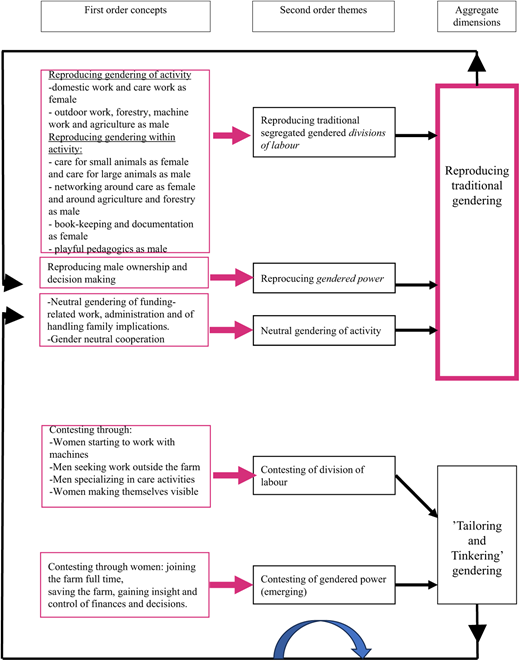
In this paper, the second-order themes, i.e. the generic theory-laden categories connected to the quotes and the aggregate dimensions that signal theoretically orientated conclusions to be drawn from the data, are presented in the data structure in Figure 1. The second-order themes are the dimensions along which gendering manifests on the studied farms, which concern the division of labour and economic power. The division of labour between men and women was captured by observing who did what and by how spouses described their tasks and responsibilities. Economic power was captured through interviews about the ownership structure, regulations and positions on the farm as well as through informal dialogues and observations. The aggregate dimensions show how much gendering reproduces traditional patterns and to what extent the copreneurs use their agency to tinker, tailor or transform those patterns.
The writing process
We present the quotes primarily in the Appendices to accommodate the rich empirical material within the article format. Hence, the reader is encouraged to read the text in conjunction with the Appendices. The empirical basis for the activities identified as part of entrepreneuring is outlined in detail in Supplementary file 1. The cases studied illustrate how gendering manifests through iterative doings across the activities involved, as presented in Supplementary file 2 using representative quotes from the interviews.
Only a few quotes are used in the Analysis and Findings section below. This is to convey the main messages to the reader in an engaging and integrated manner. What is presented is the result of an iterative process of writing, reanalysis and rewriting (Rockmann and Vough, 2024). Figure 1, summarising our Analysis, is presented at the beginning of the section below. To help the reader understand the context, we then set the scene through a brief narrative of how a field day typically begins.
Analysis and findings: reproducing, tinkering and tailoring gendering in copreneuring on farms
Through our analysis, we found that gendering primarily manifests in copreneuring through the division of labour and economic power (see the second-order themes in Figure 1). Consequently, this section is organised into two sub-sections addressing these dimensions. However, before proceeding, let us first set the scene.
Setting the scene
It is a sunny morning in June when we finally find the right dirt road winding through the forest and spot Dahlia Farm, with its red barn and the red cottage with white trim. We are in southeastern Sweden to visit rural copreneurs David and Dagmar, who founded a green care company a few years ago, enabling them to remain on the farm that has been in David's family for generations. The dairy farm had become too small to remain viable, and after a barn fire, repaying debt became a significant challenge. Meanwhile, Dagmar, a nurse by training, recognised the therapeutic benefits the farm environment could offer to individuals with neuropsychological or psychological health challenges. After a few challenging years, with the help of an extensive network, Dagmar successfully secured contracts with nearby municipalities to place participants in green care on the farm.
At the cottage, we spot the Dahlia Green Care sign and see David and Dagmar discussing how to match participants with activities and supervisors for the day. They explain their roles as we enjoy coffee in the sunshine before the participants arrive. They recount the struggles Dagmar faced in securing municipal contracts, how she had to give up her nursing job, and the identity crisis David experienced as he no longer identified as a “real” farmer. However, above all, David and Dagmar share the satisfaction they derive from working together to offer participants meaningful days and opportunities for personal growth, along with the sense of relief that comes from having preserved the family farm for future generations through this business venture. When the van from the municipality arrives, David and Dagmar immediately turn their attention to the participants. After landing on site and chatting and joking with David, some participants follow him to the barn to feed the horses and operate packaging machines. In contrast, others join Dagmar inside the cottage to cook and engage in handicrafts. For us, the participant observations continue (Field notes).
Division of labour
The analysis reveals that copreneuring on farms remains marked by the reproduction of traditional gendering. This is despite postfeminist claims of gender progress and entrepreneurial equality in contemporary society. This is done partly through a segregation between activities considered as masculine and activities considered as feminine, resulting in a division of labour between men and women (cf. Haandrikman et al., 2019). At the same time, the division of labour reiterates gender by reinforcing the notion of which activities are masculine and which are feminine.
Entrepreneuring in the green care business involves many more activities than care and farming. A broad spectrum of work was shared by the copreneurs, including networking, human resources, leadership, organisational tasks, pedagogical work and, not least, administration, including obtaining certifications, engaging with municipalities and funders, and bookkeeping. Childcare and elderly care were not frequently mentioned in the interviews, which may be explained by the fact that none of the copreneurs had any younger children at the time of the interview, as well as by the Swedish welfare context – characterised by state-funded childcare and elderly care.
Below, we provide a detailed analysis of categories of activities and the specific activities within them. We find that in some instances, the entire category of activities is gendered the same way; for example, forestry and agriculture are gendered as masculine. Regarding other categories, some activities were gendered as feminine, while others were gendered as masculine. Neutral gendering occurred across the entire funding-related work category and in some activities within the administration category.
Masculine gendering of forestry, agriculture and machine work
Some categories of activities, such as forestry, agriculture and machine work, were being entirely gendered, and in these activities, masculinisation was being reproduced.
When it comes to farmwork and things like that, [David] takes the responsibility, which means that he keeps an eye on the fences and enclosed pastureland and moves the animals and that kind of thing. When it comes to the cows and that side of things, I’m not – I don’t care much about that. (Dagmar, Dahlia Farm)
The gendering was manifested and reproduced in the division of labour. Agriculture and forestry work (when applicable) are continuously conducted by the men, on all but one farm, as illustrated by the quotes in Supplementary file 2. Carl on Ceder Farm, for example, says:
I work with the forestry; we have quite a considerable acreage […] When it comes to the farming, I do all the work with machines. […] I cut the silage and prepare for the sowing and things like that, bring in the bales and the artificial fertilizer, turn the hay and the straw swaths. I do those kinds of farming jobs. […] (Carl, Ceder Farm)
The masculine gendering of work in the fields was so strong in the copreneurship at Dahlia farm that even when David was ill, it was not considered that Dagmar could take it on. Instead, the son was called in to help.
Because I was not well at the beginning of the year and was on sick leave a lot of the time and at home quite a lot, we had a problem getting the animal fodder in – but [our son] went out and brought it in. (David, Dahlia Farm)
During our farm visits, we observed that especially the work involving the larger machines is continuously being reproduced as masculine. This was also expressed during other interviews with both men and women:
[She] doesn’t drive any of the machines or the tractors or anything like that, it’s just me that does that. (David, Dahlia farm)
He does the carpentry and builds things, makes sure the machines bring in the hay. I’m useless at that. I can’t drive the tractor. (Karin, Ko Farm)
Through this continuous gendered division of labour, masculine gendering of machine work, agriculture and forestry is being reproduced on the farms studied. Worth noting is, however, the two minor signs of tinkering with this gendering. Karin, who says that she cannot drive the tractor, is preparing to take a tractor driving course. And then there is Felicia at Furu farm, who was brought up on a farm, while her husband is originally a “city boy”. Felicia laughs at the prejudice that Folke is the farmer even though he has another full-time job. She says:
There was a knock on the door, and it was one of those companies selling red house paint. […] “Is your husband home?” he asked. […] “Okay”, I said, “But you can talk to me, it’s my barn out there too!” (Felicia, Furu Farm)
Furu Farm is the only case in our empirical material where the traditional gendering of farming is tinkered with.
Feminine and masculine gendering of activities within a category
In the categories logistics and premises, care, pedagogy, animal husbandry, networking and administration, gendering was done within each category of activity.
Green care entrepreneuring involves working with individuals with a diagnosis, where routines are essential. This necessitates the effective functioning of logistics and facilities, including safety, the availability of proper food and transportation. The division of labour within logistics and facilities reproduces a traditional gendering. Women take care of cooking, domestic work and grocery shopping on all farms, sometimes together with female clients.
[She] does the bookings and the food shopping, and she does the cooking. (Isak, Iris Farm)
Put differently, indoor work is reproduced as feminine and outdoor work is reproduced as masculine, which some interviewees also reflect upon.
So she spends more time inside here. (David, Dahlia Farm)
The traditional gendering aligns with Niskanen (1998), who argued that women predominantly work indoors and men outdoors.
Unfortunately, he’s often out, making sure that the boys … taking care of the outdoor work. (Helga, Hägg Farm)
Karin specifies more clearly what kind of outdoor work Karl does.
He does all that kind of work, like clearing the snow, cutting the grass and that sort of thing. (Karin, Ko Farm)
Overall, our findings therefore contrast with the postfeminist stance taken by Deacon et al. (2014), who contended that such a traditional division of labour no longer exists among copreneurs.
Care work and pedagogical work are not easy to distinguish in practice. By care work, we mean addressing participants' emotions, from joking and laughing with them to providing emotional support during difficult times. Pedagogical activities include supervising and teaching participants tasks, such as feeding animals, cooking, weeding and managing social situations. The spouse with primary responsibility for care and pedagogical work differed between the farms. On Ceder Farm, it was the woman.
But the way we share the work, it’s almost always me who goes down and has contact with [the participants and staff] (Cecilia, Ceder Farm)
At Allé Farm, on the other hand, this work has gradually come under Anders' responsibility.
The more this has grown, it [the care part] has become altogether his thing. (Anna, Allé Farm)
Also on Dahlia Farm, the care in the copreneurship has led David to engage more and more in care activities, which impresses his wife.
He’s really, really good and he’s really sociable and he’s really good with people in general … in fact, so -mm. He’s perfect for this. (Dagmar, Dahlia Farm)
The care work of Anders and David can be interpreted as examples of how traditional gender norms are tailored, given that care work is traditionally feminine and done by women. At the same time, gendering is reproduced within care and pedagogical work. One dimension which we observed during our field visits was that men typically attended to the participants during outdoor work with animals and in the fields, while the women engaged with them during indoor activities, such as cooking and weaving. Another aspect is that women guided the so-called reproductive work with participants.
I load and unload the dishwasher, and I’ve got the gang with me. (Dagmar, Dahlia Farm)
Joking and playing with participants were constructed as more masculine, and the men tended to spend more time on these activities, as in David's narration.
Like when someone comes up behind you and pours water down your back because they want a water fight, and … I’m up for it, no hesitation. If that’s what they want, we do it. (David, Dahlia Farm)
Hence, although some tailoring of traditional gendering is ongoing in care and pedagogical work, it is premature to argue that a transformation of the division of labour is ongoing.
Within animal husbandry, the care of small animals was typically carried out by women and framed as a responsibility for women.
Yes, and we have hens and goats and […] the way we share the work, I’m usually the one who looks after the small animals, and he takes the others. (Dagmar, Dahlia Farm).
In contrast, men handled larger animals, consistent with the findings of Flygare and Isacson (2003). Ceder Farm was also the only farm where we observed a woman caring for cattle.
Networking for business opportunities was a key component of entrepreneuring and an activity where women undertook most of the work. At Dahlia and Hägg Farms, this was solely a female responsibility. The green care was the larger part of the copreneuring, and Dagmar and Helga had valuable contacts with their respective municipalities. However, in the male-dominated forestry and agricultural sectors, networking was a male task, as narrated, for example, by Carl.
Our collaborators are local farmers and business people […], I mentioned one, and he drives my forest machine. (Carl, Ceder Farm)
We contend that the gendering of work tasks, as manifested in the division of labour, reproduced the traditional gendering of care as feminine and farming/forestry as masculine.
Neutral gendering of funding work and administration
Our analysis of the interviews revealed no particular gendering of administrative work as a whole, in contrast to Alessandrini and Winter (2015). The spouses' primary responsibilities varied across farms. On Furu Farm, Folke handled the finances.
But then I also take care of the finances. We bounce ideas around the kitchen table. I have a university education, and I’ve been a manager. (Folke, Furu Farm)
At Eke Farm, Eva handles all the administrative tasks.
I take care of all the administration here, and do the books and all of that. The pen-pusher. (Eva, Eke Farm)
Based on the interviews, we contend that bookkeeping was the only part of administrative work clearly gendered as feminine (see Appendices). Iris farm is one example of where this happened.
She takes care of the bookkeeping and the bookings. (Isak, Iris Farm)
The entrepreneuring also encompassed funding-related tasks, such as applying for agricultural support and reporting to funders. The gendering of these tasks also appeared neutral, with no observable division of labour.
In many copreneurships, one partner had additional income from work outside the farm. When transitioning to green care, David at Dahlia Farm became a part-time firefighter, while both Anna and Dagmar resigned from their previous jobs to work on the farm. Thus, diversification from farming into care has, on these farms, facilitated a shift in who works on the farm and who works outside it.
Tinkering, tailoring or transformation of the division of labour?
In sum, as illustrated in Figure 1, the gendered division of labour did broadly but not entirely reflect a reproduction of traditional gendering. There was some tinkering (Rees, 2006; Lawless et al., 2022), i.e. moderate changes, in the sense that women were included in previously male-dominated work (tractor driving) and vice versa (care and pedagogical work). Not all activities were gendered along a strict binary of masculine/feminine. Administration (excluding bookkeeping) and tasks such as applying for funding and reporting to funders were carried out by both men and women. Hence, we argue that the ongoing gendering was neutral in these activities. While we note that two women gave up their jobs to join and support the family business, we found that spousal support was provided by both men and women in both emotional and administrative forms, which contrasts with previous studies on copreneurship (Matzek et al., 2010).
At Allé and Dahlia Farms, the introduction of green care affected the division of labour, as Anders and David transitioned from doing farm work to caring work. The increase in men taking employment outside the farm may also be seen as a challenge to the traditional gendering (Lawless et al., 2022) in contrast to the conventional rural division of labour (Haandrikman et al., 2019). Nevertheless, while we observe some tinkering, a transformation in how gendering and entrepreneuring are intertwined was not enacted in the division of labour on the farms studied. Our results support Bensemann and Hall's (2010) assertion that copreneurship does not serve to escape gendering. Despite postfeminist claims and Sweden being seen as a relatively gender equal welfare state, traditional gendering into masculine and feminine work tasks is still present in the copreneuring. This way, the masculinisation of outdoor tasks and the feminisation of indoor household work is ongoing, despite women's agency in introducing green care and despite feminist care ethics being employed at the farms (Pettersson and Tillmar, 2022). Hence, we observe a paradox of gendering in farm copreneurship which needs further research.
Gendered economic power
On the farms studied, we find that the gendering of economic power is being iteratively reproduced in the copreneuring. In line with bringing the material circumstances into the analysis (Korsgaard et al., 2021), we note a gender difference in ownership patterns. On several farms, the man owned 100% of both the farm and the care business, even though both spouses were working on the farm and with the green care. There was no instance where the woman owned more than 50% of the farm and the business. This was the case even on the farms where the woman had initiated the care business, and on the farm where the woman was perceived as the farmer by both herself and her spouse. Not all copreneurs were eager to discuss these ownership arrangements, and some argued that it was an irrelevant issue for married couples.
This farm, where we’re sitting now, is actually only in [Erik’s] name. We own everything jointly because we’re married. (Eva, Eke Farm)
Although we did not hear of prenuptial agreements among the spouses interviewed, we know that such agreements are generally quite common among farm families in Sweden (Lantbrukarnas Risksförbund, 2025) and internationally (Halbach, 2023). Among the studied farms, there was one case in which the ownership was 50/50 from the start. This was Furu farm, where Felicia was the farmer in the family and the farm had been acquired jointly. In one case, the ownership was 60% (male) and 40% (female). This was the formally retired couple on Ceder Farm who had changed the ownership structure a few years before our study, thereby including Cecilia in the ownership. For 30 years, they had lived on farms with a traditional division of labour, combining farm work with employment. Cecilia had taken care of indoor work with children and the home in parallel with working as a kindergarten teacher. Carl had been employed as a manager and simultaneously handled the private forestry and agriculture. When asked about farm ownership in the couple interview, the following conversation occurred:
Carl: “We own this together”
Interviewer: “50/50 all of it?”
Cecilia: “Not quite …”
Carl: “But 60/40, and it does not matter. We own it together since a few years back …”
In several cases, the farm had been inherited from the husband's parents, but never from the wife's parents [5]. Hence, the differences in ownership still seem to be linked to the previously observed patrilineal inheritance of farms (Flygare, 1999). This is somewhat surprising, given the relative equality of Swedish society and its welfare state and illustrates a discrepancy in relation to postfeminist claims that gender equality has been achieved.
The material circumstances of ownership affected the power dynamics between the spouses and hence the copreneuring processes. This was explicitly expressed in the cases of Anna and Dagmar, who both quit their jobs to work with diversification on the farms. In Anna's case, it was Anders's decision on a large investment that did not pay off that forced her to come up with business ideas to save the farm. She explained the decision process in the following way:
It’s not what I wanted, but [I said to Anders]– “You grew up on this farm, you make the decisions, do what you want!” So he decided to go for it, and then everything just collapsed (Anna, Allé Farm)
For other women, it was a struggle to become involved in farm decision-making of the husband's family farm. Decisions were, in some cases, made in dialogue with the older generation rather than with the wife. Dagmar was not comfortable with her situation and realised that a change would require her to be more present on the farm.
We’ve argued […] and fallen out over things […]. I felt I had no choice but to take that step and work together with him more. […]at the same time there was […] the financial aspect. (Dagmar, Dahlia farm).
We found that the gender order in society and the material circumstances around the inheritance and ownership reinforced each other. This led to a situation in which decisions were made by the male spouse, either without consulting the female spouse or despite her disagreement. Hence, while the competencies and experience of both spouses were necessary, as noted by Deacon et al. (2014), ownership was primarily male, leading to gender-biased decision-making, in line with the findings of Jurik et al. (2016). It is our contention that being the one who inherited the farm conferred symbolic power in the relationship (Hermann, 2025), leading to a stronger position in decision-making processes. In this ongoing gendering process, the vertical segregation between masculine ownership and feminine supportive roles is being reinforced.
Even on some of the farms that were acquired together by the spouses, leadership and decision-making power were traditionally gendered. This is illustrated below by an excerpt from field notes after the day at Hägg farm.
Henrik, who is evidently the manager, has a coffee mug that says “Boss” on it, that he has been given as a gift. It is obvious that he is the one in charge and who makes the decisions. For example, when a person had reached out and asked to do work training with them, Henrik had said yes immediately without consulting his spouse. Henrik is also the one handling the contacts with the municipality. (Excerpt from field notes, Hägg farm)
With the women giving up their jobs to join the farm fulltime in the cases of Allé and Dahlia farms, the traditional gendering of power in the farm decision-making was somewhat tinkered with. In these cases, the women copreneurs exercised vital agency (Cush et al., 2018; De Rosa et al., 2019; Stenbacka et al., 2018), making it possible to keep the farm in the family and maintain a rural lifestyle. They were both present at the farm full time. In one case, this resulted in the wife owning 50%, while in the other, it led to the woman becoming more involved in the financial side and gave her a stronger position.
We sit down together [now] and enter the invoices and – So I know as much about the financial side of things as [David] does now, I didn’t before. (Dagmar, Dahlia Farm)
Contrary to previous findings (Bruni et al., 2004; Hamilton, 2006), these women were not invisible as entrepreneurs in their families or local communities. The gendered economic power was tinkered with, most recently through diversification into green care and women joining the farms full-time.
The tinkering of gendering, however, came at a cost for both Anna and Dagmar. Anna agonised over having to give up her job and misses being a musician.
I worked in my profession for 25 years. I’m a qualified church musician […]. So I gave up my job with some agony because I really enjoyed it. (Anna, Allé Farm).
Dagmar, on her side, misses her professional role and contacts.
I had my role as a nurse … I have had different roles … I’ve been a politician. I’ve had relations with others … And now some time has passed and it [the green care business] has become a part of ordinary everyday life and I have lost my identity as a nurse. It’s gone. (Dagmar, Dahlia Farm)
We contend that these situations are in line with the argument that subverting the gendering can lead to a life difficult to live (Butler, 1990; Phillips and Knowles, 2012). In summary, our study reveals some changes in the gendering of economic power on the farm. However, these primarily manifest in increased inclusion of women in decision-making rather than a fundamental alteration of the gendered power structure. That is, the change involves tinkering, rather than tailoring or transforming the gendering through subversion.
Conclusions and contributions: the urban bias of postfeminist claims
Reproduction and some tinkering
In this section, we discuss what our results mean in relation to the postfeminist claims that gender equality has been achieved in our north-western part of the globe. We start by addressing each research question in turn.
How gendering is manifested on Swedish rural farms pursuing green care
Overall, we find that in copreneuring on green care farms in Sweden, the gendering manifests in a traditional division of labour and economic power structures. This study did not observe any transformative change in gendering. Instead, traditional gendering was reproduced, with only a few instances of tinkering and tailoring (cf. Rees, 2006). This is illustrated in Figure 1. Given that Sweden is seen as one of the most gender-equal countries in the world (World Economic Forum, 2024), and that previous studies have shown signs of change (Stenbacka et al., 2018), this is somewhat surprising.
Despite postfeminist claims, even in one of the most progressive countries in the world, a traditional division of labour and division of economic power emerge as gendering and entrepreneuring unfold in copreneurship on rural farms.
The extent and how the copreneuring tinker, tailor or transform traditional gendering
Starting with the division of labour, our results show minimal tinkering with the gendering in entrepreneuring. The cases in which women gave up their external jobs to save the farm and in which men, not women, worked outside the farm are of particular interest. However, it is too early to tell who will gain economic power in the long run and how the intertwined gendering and entrepreneuring will be affected.
We observe some tinkering and even tailoring of the gendering in terms of economic power. Women have gained access to financial information, become included in decision-making and increased their share in the business, in terms of ownership, after quitting their jobs and joining the for full-time work. However, this came at the cost of their professional life and networks, which aligns with earlier arguments that seeking to subvert gender norms often leads to a difficult life (Butler, 1990). Hence, we empirically demonstrate that the tinkering and tailoring of gendering is not as smooth a process as its reproduction. The costs individuals incur from tinkering and tailoring disrupt the change process. This is symbolised in Figure 1 by the backwards-pointing arrow at the bottom.
Furthermore, we conclude from the analysis that most instances of tinkering and tailoring of the traditional gendering we observed had emerged after the diversification into green care (indicated as “emerging” in Figure 1).
What are the discrepancies between the postfeminist claims and the lived reality of rural copreneurs?
Based on our empirical study, we argue that the postfeminist claims of gender equality being achieved are distant from the lived realities of rural copreneurs on farms in Sweden. Our cases do not reveal any transformation, but instead ongoing traditional gendering of work and economic power among the farm copreneurs. Previously, it has been argued that postfeminism is based on a white, heterosexual, middle-class perspective (Butler, 2013). Our empirical findings suggest that postfeminist claims also have spatial limitations, specifically an urban bias, which is largely detached from rural practices.
It may well be that the limits to postfeminist claims are also related to industry. This study has focused on farming, which is often regarded as a heavily gendered family affair. However, that is also the case for many other industries (Essers et al., 2025). While it is essential to recognise progress in equality, we argue that it is equally vital to identify ongoing traditional gendering (Essers et al., 2025). For almost a decade, feminism has faced strong resistance from postfeminism (Lewis and Pullen, 2018). Moreover, presently there is increasing conservatism and profound setbacks for all Diversity, Equality and Inclusion (DEI) policies and research (Aguinis et al., 2025). Findings showing ongoing traditional gendering in a supposedly gender-progressive country like Sweden of course have theoretical implications. Given the discrepancy between postfeminist claims and lived realities among rural copreneurs in Sweden, we argue a need to strengthen what could be called a post-postfeminist approach and continue to problematise the gendering of entrepreneuring, and its' subcategory copreneuring especially in rural areas. Rather than postfeminism, it is hence our contention that we need feminist economics and feminist perspectives on entrepreneuring.
This paper demonstrates that gender remains a strong organising principle in copreneurship, and the traditional gendering of tasks and economic power is ongoing. Not only are there preexisting “old” and traditional gender orders, but the ongoing gendering is continuously reproducing them, even in one of the supposedly most progressive countries in the world. Given previous studies on women's agency on farms (Stenbacka et al., 2018), our analysis adds nuance to the debate. It suggests a paradox in farm gendering that merits further study.
Practical implications: awareness of gendering
Our research results indicate that a traditional gendered division of labour and economic power is a strong organising principle on rural farms, even in a country such as Sweden. For politics and policymaking, understanding the limits to postfeminist claims is vital for decision-making on entrepreneurship support, rural development plans and, not least, the approach to DEI policy. Suppose politicians and policymakers continue to focus on individualism and business-oriented entrepreneurship without considering the ongoing traditional gendering and the resulting structural inequality. In that case, there will likely be negative consequences for equality. In the long run, this may even lead to reduced entrepreneurial activity and workforce participation among women (on rural farms). Our finding of ongoing traditional gendering in Sweden is essential knowledge for copreneurs, potential copreneurs and support organisations for farmers and entrepreneurs. It highlights the great need for awareness and dialogue around gender issues on all levels, from policy makers designing rural development strategies, to support mechanisms for copreneurs and farmers. Knowledge of gender structures and increased awareness of taken for granted gendered practices are vital components of training programs as well as coaching and other advisory services. Apart from the ethical and democratic dimensions of gender equality, the efficiency arguments should be stressed to policymakers, advisors, consultants and copreneurs. When divisions of labour is based on traditional gendering, tasks may not be conducted by the person with the potential to develop the best skills, or work-efforts, in the longer run. When decisions are made by one person rather than through discussion between two people, they may not be the best. Not the least, awareness and discussion about gender issues among copreneurs are likely to benefit clients and potential copreneurial spouses, and the long-term viability and prosperity of the partnerships and entrepreneurial endeavours. As studies have shown before, just supporting entrepreneurship in an non-reflective way is insufficient to address gender inequality.
Theoretical contributions
This paper has made several contributions to the fields of entrepreneurship and gender studies.
First, we have empirically strengthened the critique of the postfeminist claims that gender equality has been achieved and that entrepreneurship is equal. Whether the claims are valid may depend on spatial context (urban, rural, country and region) – as well as industry. We suggest that postfeminist claims have spatial and industrial limits, as they were not reflected, in copreneuring on rural farms in Sweden. We have presented arguments for the urban bias of postfeminism and advocated for a post-postfeminism movement in entrepreneurship and gender research. We have shown how the gendering of entrepreneuring primarily reproduces traditional gender roles, even within the context of a supposedly gender-equal country. We reveal how seemingly emancipated copreneurs, without reflection, continue to reproduce traditional gendering.
Second, this study contributes to the ongoing debate on gendering in copreneurship. It sheds light on rural copreneurship as a significant form of family business, which has previously been understudied. In line with Bensemann and Hall (2010) and in contrast to Deacon et al. (2014), we conclude that traditional gendering remains a prominent aspect of copreneurship. We hence challenge the view that entrepreneurship is the solution to inequality. Entrepreneurship does not offer an escape from gendering processes. Rather, entrepreneuring and gendering are deeply intertwined.
Third, by analysing how copreneuring is gendered in practice within a rural farming context, this paper contributes to integrating a gendering perspective into copreneurship, family business and entrepreneurship studies. The extensive empirical accounts provided are crucial to this integration and also contribute to the practice turn in entrepreneurship studies. Uncovering the details of the intertwined processes of gendering and entrepreneuring is essential for organisations aiming to support entrepreneurship, gender equality and rural development, as well as for researchers seeking to understand entrepreneuring.
Fourth, this study contextualises the processes of entrepreneuring and gendering in a rural setting. The paper illuminates how the material context of the farm – through forestry and agriculture – affects gendering, particularly in terms of division of labour and gendered economic power. In this way, we contribute to reducing the urban bias in entrepreneurship studies.
Further studies
In this paper, we identify spatial and industrial constraints on postfeminist claims regarding entrepreneurship. Further empirical studies on gendering and entrepreneuring in various contexts are needed to scientifically scrutinise the postfeminist claims of gender progressiveness and entrepreneurial equality.
In rural settings, specifically, further studies on how relational (Champenois et al., 2020) and material (Korsgaard et al., 2021) contexts influence gendering and entrepreneuring would be valuable, especially in light of the material turn in the social sciences and entrepreneurship. While previous studies have indicated progress in women's agency in farming, this study found primarily traditional gendering, thereby surfacing a paradox in rural farm gendering that merits further study. Comparative studies in both rural and urban contexts would provide an interesting contrast in such an endeavour. Additionally, examining entrepreneurship in different welfare contexts – where the state does not provide elderly care and childcare – could further enrich our understanding of these dynamics. The same applies to studies of other industries than farming.
The copreneurs studied in this paper were primarily “lifestyle” copreneurs. Investigating how the intertwined processes of gendering and entrepreneuring unfold in more career-oriented copreneurships would offer an intriguing comparison. Such studies could also focus on how spousal relationships affect, and are in turn affected by, copreneurship. Moreover, while this paper concentrates on copreneurship among heterosexual couples, further research is needed to explore the dynamics of gender and entrepreneurship in LGBTQ + couples. Intergenerational and succession issues also play a significant role in the interplay of entrepreneuring and gendering. Diversification into green care as a means of transferring the farm to the next generation, as mentioned by some interviewees, warrants further investigation.
The authors wish to thank the green-care copreneurs who participated in the study as well as the editors and anonymous reviewers of this journal.
Appendix 1
Overview of empirical material
| Site, fictive name | Couple, fictive names husband/Wife | Activities and sources of income on the farm in addition to green care | Participant observation | Interview with husband | Interview with wife | Interview with couple | Number of formal interviews |
|---|---|---|---|---|---|---|---|
| Allé Farm | Anders/Anna | Forestry; another line of farm diversification; leased out farmland | Full day, both authors | Formal | Formal | Informal | 2 |
| Ceder Farm | Carl/Cecilia | Large areas for farmland and forestry; retirement pension | Full day, one author | Informal | Informal | Formal | 1 |
| Dahlia Farm | David/Dagmar | Small areas for farmland and forestry; part-time external employment | Full day, both authors | Formal | Formal | Formal | 3 |
| Eke Farm | Erik/Eva | Small area of farmland; medium-sized area for forestry | Full day, one author | Formal | Formal (2) | Formal | 4 |
| Furu Farm | Folke/Felicia | Small area of farmland and forestry; additional employment | Full day, both authors | Formal | Formal | Not possible | 2 |
| Hägg Farm | Henrik/Helga | Very small farmland | Full day, one author | Formal | Formal | Informal | 2 |
| Iris Farm | Isak/Ida | Very small farmland; another line of farm diversification | Full day, one author | Formal | Not possible | Not possible | 1 |
| Ko Farm | Kurt/Karin | Very small farmland; external employment | Full day, one author | Not possible | Formal | Not possible | 1 |
Appendix 2
Research questions guiding observations and interviews
Why and how do people on farms engage in green care activities?
How are the resources of farms and rural areas utilised?
How does their entrepreneurship contribute to the development of welfare services (care), agriculture and rural areas?
How is gender constructed on farms that provide green care?
In what ways are gender systems challenged or reproduced – gendered divisions (or not),
Symbols
Identities (coming to the farm, professional identification, gender identity, body language, hair, makeup, language, parenthood – mother/father),
Interactions (who speaks and who does not?)
Ownership – through the initiation and operation of such activities?
- –
Business form? Ownership structures?
- –
Proportion of income/profit from each activity (e.g. meat production, forestry, grain, green care)
How is work organised on the farm and how does it change with the introduction of green care?
- –
How did you work before/who did what and how is it now?
- –
In what ways does entrepreneurship in green care enable:
- –
The survival of the farm,
- –
The family's livelihood,
- –
Women's economic independence,
- –
Better care and
- –
The development of rural areas?
- –
What challenges does green care entrepreneurship face, such as:
- –
Ownership structures,
- –
Legislation, regulations,
- –
Difficult working conditions,
- –
Heavy workload,
- –
Low incomes and
- –
Insufficient future pensions, etc.?
- –
Relationships with and views on “clients”, nature, and animals?
Relationships with municipalities and county councils?
Other partners? Other companies? Non-profit organisations?
- –
How is the cooperation organised? What type of contracts do you have? For how long? Procurement. Contact persons at the municipality?
- –
The farm: support systems? EU support, etc.?
Projects? Further education?
Questions asked to both parties:
Were you born on the farm?
When did s/he come to the farm? How was it?
What did you do before? Are you employed on the farm now?
Is there any regulation if something happens to the spouse, or if the relationship changes?
How has the introduction of green care affected your different positions and relationships on the farm?
Why was green care started here?
Notes
There were no same-sex couples in our data. For insight into LHBTQ spouses, we refer to Pfammatter, P. and Jongerden, J. (2023). Beyond Farming Women: Queering Gender, Work and Family Farms. Agriculture and Human Values, 40,4, 1639–1651.
Men work in the fields, with forestry, larger animals and the farming machinery. Women take care of the children, household chores and smaller animals. Women do participate in outdoor jobs, and sometimes drive the tractor, yet this work is perceived as male (Flygare and Isacson, 2003).
Cf. Oxford English Dictionary.
The one woman who identified as a farmer had acquired the farm with her husband, as her brother had inherited the farm where she grew up.
The supplementary material for this article can be found online.

