The purpose of this study is to explore how critical aspects can be defined in a learning study on welding without conducting any pre-tests.
In this study, the authors focus on empirical examples from a learning study on welding conducted in six iterative cycles, with conversation analysis and variation theory approach (CAVTA) as a theoretical basis. The welding lessons have been video-recorded, and in the study, the authors analyze examples where the teachers try to identify critical aspects of a vocational practical object of learning in interaction. CAVTA permeates the complete process, where the analysis has been part of the iterative cycles and further developed when the six cycles were completed.
The results show how critical aspects can be made visible in the interaction between teacher(s) and student(s) in the enacted learning situation. In the process, the authors work with the three concepts expected critical aspects, displayed critical aspects and targeted critical features in relation to a vocational practical object of learning where conducting a pre-test to define critical aspects is not educationally possible.
Teaching vocational practical objects of learning could be seen as something different from teaching other kinds of objects of learning and the use of the traditional pre-tests in learning studies may be problematic. From that follows, that other ways of finding the critical aspects for the students regarding a vocational practical object of learning might be needed. In this study, such a way is presented.
Introduction
When deciding what to teach, a teacher need not only the knowledge of the contents to be taught and the educational objectives, but also what aspects of the learning contents could cause difficulties for the group of students to be taught. Based on previous experiences or previous studies on subject didactics, teachers can be familiar with such possible aspects (Lo, 2012; Marton, 2015). However, studies dealing with vocational objects of learning in education are scarce (e.g. Asplund and Kilbrink, 2020; Kilbrink, 2018; Kilbrink and Asplund, 2020a; von Schantz Lundgren et al., 2013), and teachers are left to their own experiences when trying to decide what to focus on in vocational subject specific didactics. On the other hand, according to Marton (2015), the most important resource regarding what aspects of the object of learning that are critical is the students. One important aspect of conducting a learning study is to define critical aspects of a specific group of students in relation to a chosen object of learning (Marton and Runesson, 2015; Lo, 2015).
A common way of identifying critical aspects, when conducting a learning study, is to construct and carry out a pre-test, where the goal is to find out the students' experiences of the object of learning (e.g. Wood, 2015). The aim of the pre-test is to define critical aspects, and the results from the test are analyzed to draw conclusions about what the students have to learn in order to progress in their learning process of a specific object of learning. However, concerning vocational practical objects of learning, conducting a relevant pre-test can be both complex and time consuming. Objects of learning handled in vocational education are often taught and learned in interaction between teacher and student(s) and can be considered as practical (Kilbrink and Asplund, 2020a). Practical objects of learning are, as we define it, objects of learning including an act of doing and relating to practical knowledge traditions and practical knowing (e.g. Ahlstrand, 2014; Björkholm, 2018; Carlgren et al., 2015; Kilbrink et al., 2014; Kilbrink and Asplund, 2020b; Nyberg, 2018). Furthermore, some aspects of the learning process and the learning contents in relation to practical objects of learning are not (yet?) articulated, which is often referred to as tacit knowledge (Ahlstrand, 2014; Asplund and Kilbrink, 2020; Carlgren et al., 2015; Lundgren and von Schantz Lundgren, 2012; Schaap et al., 2009; von Schantz Lundgren et al., 2013).
In relation to vocational workshop teaching, a pre-test can be difficult to carry out due to pedagogical organization, safety issues and/or material resources. Innumerous practical objects of learning regarding vocational education could be listed, but this might function as a clarifying example: Concerning the object of learning lathing, the teacher cannot begin the education by letting the students carry out a practical pre-test. Most probably, there are not as many lathes as there are students, and above all, it is far too dangerous to let the students display their (lack of) knowledge that way. Moreover, in relation to tacit knowing, Carlgren et al. (2015) argue that teachers:
also have to pay attention to non-linguistic expressions and actions. We therefore need an approach that includes analytical tools which can deal with tacit and implicit aspects of the knowing, in addition to what is spelled out in linguistic form. (p. 147)
Hence, other ways of reaching the learners' understanding of the object of learning and identifying critical aspects than conducting pre-tests and just focusing on linguistic aspects are desirable. Variation theory and conversation analysis (CA) might contribute with tools to identify critical aspects of vocational practical objects of learning directly in the teaching situation. These assumptions made us combine the two theoretical perspectives CA and variation theory into conversation analysis and variation theory approach (CAVTA) in a learning study on welding, with the supposition that the approach could support teachers to define critical aspects of vocational practical objects of learning in the actual learning situation.
The purpose of this study is, therefore, to explore how critical aspects can be defined in a learning study on welding without conducting any pre-tests and to investigate how teachers can make room for students to display their knowledge concerning vocational practical objects of learning in interaction in the enacted welding teaching.
Critical aspects
Critical aspect is a central concept in phenomenography, variation theory and the learning study tradition. As a backdrop of how we have worked with critical aspects in CAVTA, we will present a literature review of how critical aspect, as a concept, has been used in variation theory and learning study research. Variation theory emphasizes the act of learning as the process of seeing something in a new way. From that follows, that there must be something to be seen – an object of learning (e.g. Marton, 2015). Hence, teachers' ambitions ought to be to organize that content and create structure in the teaching and learning situation to maximize the learner's possibility of discerning necessary aspects of the object of learning. In short, an ideal teaching and learning process might be formulated as follows: the intended object of learning of the planning stage will become an enacted object of learning in the learning situation, and finally, the learner will experience a lived object of learning, which is close to the intended object of learning. However, Lo (2012) stresses that the learning situation often is complex and that the teacher needs to be open to the dynamics of the learning situation, realizing that the students may not understand the object of learning in the way the teacher intended.
One condition in order to accomplish an effective teaching and learning process is that the teacher has clarified what aspects of the object of learning are necessary to discern and at what points they are critical in order for the learner to progress in the learning process (e.g. Lo, 2012; Marton, 2015). If discernment of a specific aspect is critical in order to reach a more complete understanding of an object of learning, the aspect is defined as a critical aspect (Marton, 2015). To discern the critical aspect, the learner might be guided by a display of variation of that specific aspect while other aspects of the phenomenon are kept invariant. A dimension of variation is opened up for the learner. Thus, the learner is helped to discern a critical dimension of variation – in order words, a critical aspect – of the phenomenon (e.g. Lo, 2012; Marton, 2015).
The concept critical aspect is not as easy to define as the description mentioned so far. In the phenomenographic tradition, variation theory and learning studies, the concept is frequently problematized (e.g. Booth, 1997; Pang and Ki, 2016). Pang and Ki (2016) distinguish two strands in the way the concept is used. The first strand is where it is used as “analysis of naturalistic situations” (p. 323), which is closely linked to its origin within phenomenography. The other strand is the use related to the learning study approach, where the use is linked to dimensions of variation in designing teaching and learning situations and “to design experiment or action research” (Pang and Ki, 2016). In this article, we do not enter the wider discourse, but limit the discussion to the use according to the latter of the strands.
The use of the concept critical aspect differs even within variation theory and the learning study discourse. Often, a further clarifying word has been added to describe the small differences of the contents of the concept. For example, Booth (1997) addresses the use of the concept critical aspect somewhat differently when used in teaching – and she adds another word, altering it to educationally critical aspect. She advocates that the teacher should use his disciplinary knowledge combined with the experience of how a specific object of learning is taught and learned, adding the specific way a learner experiences an object of learning, when identifying the critical aspects. Thus, including the teacher's professional expectation of the way the learner experiences the object of learning and how the object of learning is actually learned, Booth (1997) changes the term to educationally critical aspect. This stance encompasses not only disciplinary knowledge, but also an analytic procedure of how a learning content is taught and learned and the specific context of a specific learner, so that the teacher simply does not take stages in the learning process for granted. The teacher needs to identify the educationally critical aspects at the intersection of disciplinary knowledge, didactic knowledge and the learner's way of seeing the object of learning.
Moreover, Olteanu and Olteanu (2010) have added the terms potential critical aspects and real critical aspects, where the teacher's assumptions about which aspects might be critical for the learner to progress are called potential critical aspects. The link to the learner's way of seeing the object of learning is kept intact by the use of the term real critical aspects. Apart from anticipating critical aspects, the teacher needs to identify the learner's actual critical aspects. It is possible to see this stance as a development of Booth's educationally critical aspects, only that it has been divided into two – depending on the stages of the teaching and learning process. Marton and Runesson (2015) also use the term potential critical aspect in a similar way, asserting that teachers might gather a generalizing stock of potential critical aspects in connection to a specific object of learning. In line with Olteanu and Olteanu (2010), they add that critical aspects must be identified in each learning situation since they are relative to specific learners – with the only difference that Marton and Runesson (2015) call the critical aspects identified in the specific learning context as actual critical aspects.
Additional versions of the critical aspects concept are assumed critical aspects and tentative critical aspects (e.g. Gunnarsson et al., 2019). The use of these versions are similar to the use of potential critical aspects and real critical aspects, stressing the analytic process of identifying critical aspects in advance, but altering and adjusting the critical aspects further on in the specified learning process.
Contributing with yet other alternatives in the discourse of critical aspects may seem unnecessary. But in relation to a vocational practical object of learning, where pre-tests need to be left out based on the arguments presented in the introduction above, we argue that there is a need for other alternating concepts. Those concepts are expected critical aspects and displayed critical aspects, which are related to the work with making room for students to display their knowledge concerning vocational practical objects of learning in interaction in the enacted welding teaching. In this presentation of our study, we will clarify the use of the new concepts, which does not contradict Pang's and Ki's (2016) argumentation, that it is the learner's way of experiencing a phenomenon, his way of discerning an aspect or not, which ought to guide the use of the original concept critical aspect.
Yet another concept, our version of critical feature – targeted critical feature – will be part of our clarification. Pang and Ki (2016) view critical features as the target values of critical aspects or dimensions of variation. Lo (2012) states that it is crucial for the teacher to identify the critical features of the object of learning, giving two important reasons: to extend the teachers' own understanding of the object of learning and to support teachers when dealing with students' individual differences. She also stresses the importance of visualizing critical features of practical objects of learning, which is so often regarded as tacit knowledge, and gives an example of how a person more quickly can learn to ride a bike if the one teaching him helps him to “discern the critical features of riding a bicycle” (p. 67) instead of just leaving the learner to practice on his own. The speed of the bike could be seen as an expected critical aspect, and in order to help a person learning to ride a bike, the teacher also needs to identify the value of that dimension of variation. Defining the expected critical aspect is not enough – the speed can vary. A minimum speed is required to keep the balance and the learning progression can be supported by the teacher helping the learner to find that critical feature. If the teacher specifies the value, he will extend his own understanding of the object of learning and be better prepared to support the student's learning process. This specification of a desirable value of the dimension of variation is something we use in our CAVTA approach. We have chosen to call the specific value of the critical aspect, what the teacher aims for in his teaching, i.e. the targeted critical feature (Kilbrink and Asplund, 2020b). In order for the teacher to know if the student has discerned the expected critical aspect or not, the teacher also needs to give the student opportunity to display his knowledge and understanding in the interaction – the displayed critical aspects and to adapt the teaching in relation to the student's pre-knowledge.
Research methodology
In this study, we conduct a learning study, based on the theoretical framework CAVTA (see Asplund and Kilbrink, 2020; Kilbrink and Asplund, 2020b). Conducting the learning study, we have chosen to use tools of CAVTA throughout the complete learning process, including the part of identifying the critical aspects. The traditional pre-tests used in learning studies (e.g. Wood, 2015) have been left out. CA, with its interest in describing the practices and methods participants use when publicly displaying understanding of their own and each other's conduct in the interaction (Schegloff, 2007), contributes with analytic tools when examining the teaching and learning processes that takes place in the enacted teaching. CA is used to identify how the teacher and students establish a shared understanding of the topic of the conversation through the use of verbal and embodied conduct. Hence, in the analysis, we use a multi-modal approach based on the works of Goodwin (2000, 2006), which entails a focus on how participants coordinate verbal and non-verbal communicative resources as constitutive of, and integral to, the ongoing interaction. When approaching data like these, the video-recordings are transcribed in great detail according to specific CA conventions (e.g. Hutchby and Wooffitt, 2008).
Variation theory contributes with analytical tools mainly concerning the learning contents. The interaction, in relation to the object of learning in the actual learning situation, is the key component in this process (Kilbrink and Asplund, 2020b; Asplund and Kilbrink, 2020). The study is part of an ongoing research project, Learning to weld in vocational education, launched in Sweden, in 2018 and funded by the Swedish Institute for Educational Research (ref no 2017-00056). One reason for using CAVTA as the theoretical basis for a learning study is that the tools of CAVTA might help the teachers conclude what aspects of the object of learning are critical to the students being taught; the tools of CAVTA enable the definition of the critical aspects of the object of learning – in interaction. The strive toward a shared understanding of the enacted object of learning and thus drawing the intended object of learning closer to the students' lived object of learning is the overarching ambition.
Implementation
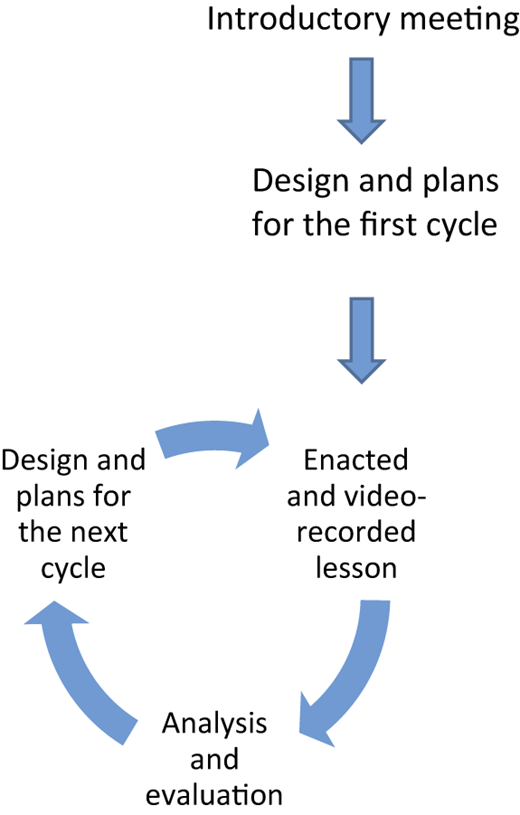
The learning study is conducted in collaboration between two researchers and three welding teachers at the vocational industrial program at an upper secondary school in Sweden. During the first two years, the object of learning chosen for the study was the specific welding method, Tungsten Inert Gas (TIG) welding, although narrowed down to more detailed, adequate objects of learning for a welding lesson, such as the ability to TIG-weld in a specific position. In cooperation with the researchers, the vocational teachers have designed, enacted and evaluated welding education based on ideas from CAVTA. Gradually, the implementation of the didactic approach CAVTA has increased. The work process has run in iterative cycles (Figure 1).
Six cycles of TIG-welding lessons, taught by two different teachers, were documented. The video-recorded material consists of the six lessons the vocational teachers enacted along with their students. In the first year, three cycles were conducted by one teacher and the lessons lasted 122 min, 73 min and 75 min. In the second year of the project, the next three lessons were conducted by another teacher in the same teacher team and the lessons lasted 52 min, 56 min and 44 min – making a total time of 422-min video-recorded film. The lessons were enacted in a secluded part of the workshop. Three students, who had not been taught in TIG-welding before, were deliberately selected for each cycle – apart from cycle five, where four students participated. Hence, new focus students participated in each new cycle (for an ethical discussion of the learning study, see Asplund et al., 2021).
Based on the teachers' previous experiences of teaching and subject specific learning resources, such as textbooks and teaching aids, aspects that the teachers expected could cause problems for the students in the group to be taught were chosen as a starting point for planning the teaching in relation to the object of learning to be taught. In this work, a dialog between the colleagues has been of importance for the lesson plans – the didactic discussion has been extensive within the team of welding teachers when planning the teaching together in the learning study. In CAVTA, we have chosen to call the aspects that the teachers expected could cause problems for the students who expected critical aspects. A kind of list of expected critical aspects, which needs to be ticked off as the student progresses in the learning process, has been discussed. The teaching was planned in a way that gave the students opportunities to display their knowledge and understanding in the interaction, so the teacher could decide if the displayed critical aspects were the same as the expected critical aspects in the teaching progression and proceed the teaching in relation to the displayed critical aspects.
The general ideas were realized in a lesson plan. The object of learning was specified as TIG-welding in a specific welding position in low-alloy construction steel. The teachers chose to focus on a few aspects of the object of learning – the aspects we term as expected critical aspects. Furthermore, the teachers planned how to focus on these aspects based on the patterns of variation separation and contrast deriving from variation theory (compare Marton, 2015) in order to help the students discern the aspects in the welding teaching. CA was applied by the stimulation of interaction – thus giving the students opportunity to display their knowledge and the teacher the possibility to identify the displayed critical aspects in order to decide how to proceed the teaching. In the planning stage, expected critical aspects and targeted critical features have been reflected upon and formulated. The teachers have been introduced to the learning study method and the tools of CAVTA. Results of previous studies (Asplund and Kilbrink, 2018; Kilbrink and Asplund, 2020a) have served as a background.
Analysis and results
Both teachers and researchers have had the possibility to first watch the video-recordings of the welding lessons and reflect on their own, and thereafter, we have had documented meetings between the teachers and the researchers and within the teacher team. When analyzing the video-recorded material, we have focused on what happens when the teacher enacts the lesson plan. In this work, we have studied how the expected critical aspects are oriented to and made visible in the interaction and how different dimensions of variation have been used as means to establish a shared understanding of the targeted critical feature. Sequences from the videos have served as visualizing examples and spurred to further discussions, probing deeper into the object of learning, its parts and entity and how the students discern and display their understanding of the expected critical aspects.
The analytic phase was followed by the teacher forming a new lesson plan for the next cycle. The development of ways to support the students discern the expected critical aspects, has been the focus of this work. In the implementation of the CAVTA approach, issues such as separation of the expected critical aspects, the use of contrast to display different values in that dimension of variation and the communication of the targeted critical features have been highlighted.
To deepen the knowledge of how critical aspects can be defined in interaction, we present a close and detailed analysis of two empirical examples from our learning study where pre-tests have been left out in favor of the approach where the students display their knowledge and understanding in the interaction of the enacted teaching (for transcript notations, see Appendix).
Example one. The expected critical aspect is made visible
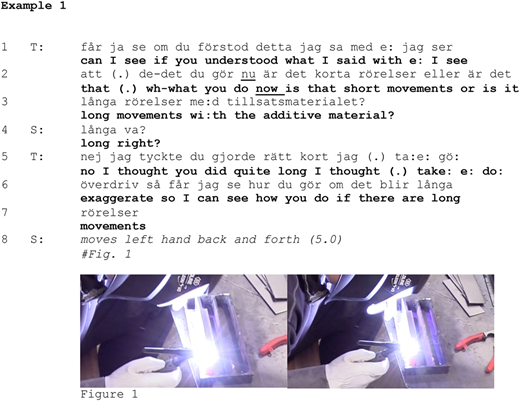
The first example (Example 1) shows how the expected critical aspect is made visible and how a shared understanding between the teacher and the student about the targeted critical feature is negotiated. The student displays how he discerns the expected critical aspect and makes his understanding of the targeted critical feature visible in the interaction. The expected critical aspect in this selected sequence is the movement of the additive material. In a previous phase of the welding lesson, the teacher had separated the expected critical aspect in a demonstration and displayed the movements when the additive material is added to the pool of melted metal. He used the pattern of variation called contrast (compare Marton, 2015) by showing too long movements, contrasting these with the desirable short movements – the targeted critical feature. In the students' individual welding, they are to show that they can discern the expected critical aspect and can master the targeted critical feature in their welding.
The expected critical aspect is made visible
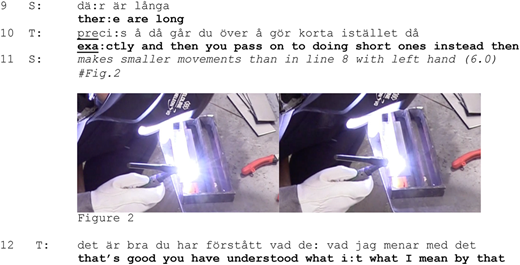
In the first three lines, the teacher makes a longitudinal link to the previous phase of the lesson, where he demonstrated the movements with the additive material. Then, the student seeks the teacher's confirmation that he has discerned what long movements of the additive material are like in line 4. The teacher opens up for a correction, encouraging the student to exaggerate the long movements in lines 5, 6 and 7. In lines 8 and 9, the student alters the movements and verbalizes the change. In line 10, the teacher confirms the student's displayed knowledge and immediately instructs the student to contrast these movements by displaying that he masters the targeted critical feature – the short movements of the additive material. In this work, contrasting as a pattern of variation is used to make the targeted critical feature visible, when contrasting the length of the movements of the additive material in order to find the desired length as the targeted critical feature. In line 11, the student orients toward the shared understanding by acting upon the teacher's instruction. The teacher, in line 12, expresses that he in the interaction has concluded that the student has discerned and defined the expected critical aspect and has made his understanding of the targeted critical feature visible.
This first example displays how an expected critical aspect is oriented to and also defined as a displayed critical aspect in the interaction and the teaching could focus on finding the right value – the targeted critical feature.
Example two. The expected critical aspect needs to be reconsidered
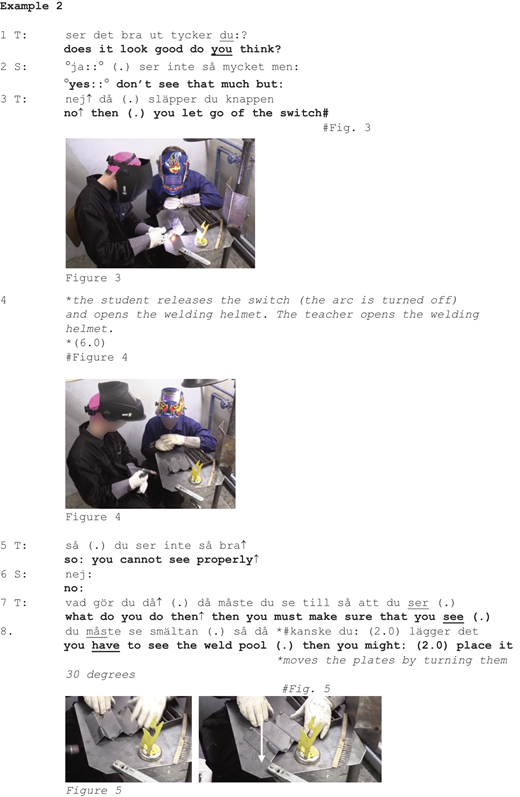
The second example (Example 2) is instead an example of where the expected critical aspect could not be focused, due to the student's displayed knowledge and understanding in the teaching situation, and had to be reconsidered by the teacher in the immediate interaction with the student. When analyzing the empirical material, we found situations where the teacher in the teaching sequence had to reconsider the focus on an expected critical aspect depending on how the student made his understanding of the object of learning visible in the interaction. Hence, in some cases, the displayed critical aspect differed from the expected critical aspect. In some examples, the student already knew how to handle the targeted critical feature; thus, the expected critical aspect was not critical. Then, the teacher moved on to another expected critical aspect in the learning progression. There were also a few examples in the empirical material, where the expected critical aspect was not possible to teach due to a lack of knowledge of more basic aspects of the object of learning. This is the case in the second empirical example from the fifth cycle of the learning study.
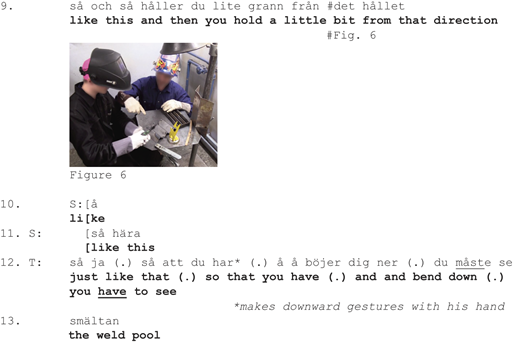
The second example displays how the teacher guides the student one step back in the learning process. In order to support the student in his learning progression, the teacher needs to reconsider and alters the exercise with the planned expected critical aspects. Instead, he helps the student discern another critical aspect before moving on to the expected critical aspects and their targeted critical features. The expected critical aspects of this example are the length of the arc and the travel speed and in a previous phase of the lesson; the teacher had prepared the students by demonstrating these expected critical aspects. The critical aspect the teacher turns back to is the discernment of the weld pool.
The expected critical aspect needs to be reconsidered
In the first line, the teacher encourages the student to express what he sees. When the student in line 2 utters he cannot see much, the teacher in line 3 instructs the student to interrupt the welding. In lines 5, 6 and 7 the teacher and the student address the student's statement that he cannot see much. In line 8, the teacher expands this experience to include the weld pool; thus, another displayed critical aspect becomes foregrounded in the interaction – the discernment of the weld pool. In lines 9 to 13, the teacher and the student orient toward a shared understanding of what has to be done in order to discern the weld pool, using different semiotic resources (speech, artefacts and body movements) simultaneously; the teacher concludes the example, in lines 12 and 13, by stating that the critical aspect to focus is the discernment of the weld pool.
This example illustrates how the teacher changes the lesson plan since it is made visible that the student is not ready for the expected critical aspects of the lesson plan, since another aspect of the object of learning became the displayed critical aspect. Immediately, he reconsiders the expected critical aspects and directs the student to a more basic critical aspect, which has to be mastered before the planned expected critical aspects can be focused.
Discussion
The ambition of the enactment of the lessons in this learning study has been that the teacher in interaction would try to give the student opportunity to display his knowledge and understanding in the interaction in order to establish a shared understanding of the object of learning. In the individual welding, the student's discernment and possible mastering of the targeted critical feature is focused. A plausible consequence in this learning process is that the intended object of learning, the enacted object of learning and the student's lived object of learning draws closer in the actual teaching situation. A substantial difference in a comparison with traditional learning studies, though, is that the pre-tests were excluded in this learning study in favor of focusing on the establishment of a shared understanding of the expected critical aspects and targeted critical features of the object of learning. Nevertheless, the requirement of identifying the students' real difficulties is kept intact by the enactment of a teaching situation, working with the displayed critical aspects where the students are encouraged to express and show their understanding (compare Asplund and Kilbrink, 2020). The teacher needs to use his disciplinary knowledge and his pedagogical content knowledge – the line of reasoning is indeed associated with the works of Booth (1997) and Shulman (1986). In the CAVTA approach, the teacher not only plans how and when to introduce the expected critical aspects and how and when to display/visualize the targeted critical features, but also prepares how to handle the displayed critical aspects in the welding teaching. This can be achieved in interaction by the use of different patterns of variation (compare Marton, 2015).
The use of CAVTA in the way described in this article is a way of meeting the demand of dealing with the “tacit and implicit aspects of knowing”, requested by Carlgren et al. (2015, p. 147) in relation to practical objects of learning. In the results presented above, we can see how the teachers and the students can orient toward a shared understanding using different semiotic resources, such as body, speech and equipment. Thereby, the teacher gets the possibility to define and identify what aspects of the practical object of learning are critical for the learner – the displayed critical aspects. This way of working with the vocational practical object of learning, the ability to TIG-weld in a specific position, has been fruitful. Our use of the concepts, namely expected critical aspects, displayed critical aspects and targeted critical features seems appropriate in this context. More studies are needed, though, to evaluate if this is a possible way of conducting learning studies with other practical objects of learning as well.
We can also see that the teaching needs to be dynamic and follow the student's learning process in relation to what is critical for the individual student. In the first example, the teacher's preparation and plans work out well. The demonstration of expected critical aspects in an introductory phase of the lesson is followed up in the individual welding by the student. Although the student in the interaction seems somewhat hesitant, the teacher uses the displayed critical aspect to conclude that the student is close to discerning the targeted critical feature and that they can reach a shared understanding of the learning content – the aim of the enacted lesson. By the use of the pattern of variation contrast (compare Marton, 2015), the teacher supports the student to discern the expected critical aspect and master the targeted critical feature.
In the second example, however, it is evident that the student needs to take one step back in the learning process, when the displayed critical aspect prevents the student to discern the expected critical aspect. The interaction facilitates for the teacher to experience the student's difficulties and the teacher's disciplinary knowledge, and/or his pedagogical content knowledge, enables him to alter his original plans, stepping back in the teaching process to support the student's discernment of another critical aspect. This is a necessary step before progressing to the expected critical aspects the teacher initially had prepared for.
In relation to the literature review of critical aspects and how critical aspects can be defined in relation to vocational practical objects of learning in a learning study based on CAVTA, we see the need of using the targeted critical feature, expected critical aspect and displayed critical aspect concepts as part of planning and enacting teaching. Although similar concepts are already in use, they are linked to the common use of pre-tests in learning studies. By the use of these new concepts, we can avoid misconceptions since the CAVTA approach of this learning study encompasses the identification and definition of critical aspects directly in interaction, without the use of the traditional pre-tests.
In a learning study about a vocational practical object of learning, where a pre-test is difficult to conduct, the teacher needs to find other ways of identifying the critical aspects for the students to be taught. The CAVTA approach of this article presents a solution very much in line with Marton's (2015) thoughts:
But the best resource is the group of learners being taught. They reveal critical aspects by what they say and what they do. This process is, of course, facilitated by the teachers’ questions and the tasks the teacher invites the students to engage in. (p. 261)
The teacher's disciplinary knowledge, as well as his pedagogical content knowledge, is essential in the CAVTA approach, but the necessary condition of learning – to identify and define the critical aspect – is at the core of the approach. The general idea of using CAVTA in this context includes the stance that vocational practical learning to a large extent is doing learning in interaction. Hence, the teacher must be prepared for the communication, have strategies to identify and define the expected, as well as the displayed critical aspects, and know how to visualize the targeted critical features. In the enacted lesson, the teacher invites the student to engage in the interaction, aiming for the orientation toward the ultimate goal – a shared understanding of the object of learning.
Based on these results, we argue that working with expected and displayed critical aspects in order to reach the targeted critical feature and a shared understanding between teacher and student(s) of the object of learning in interaction was a fruitful way of conducting a learning study in the area of vocational education. However, future studies could investigate if this way of working with making room for students to display their knowledge concerning objects of learning in interaction in the enacted teaching could be applied to other subject areas as well. One limitation of the study, though, is the small group of students participating in every teaching cycle. Hence, a challenge to be addressed in future studies could be how to find strategies for working with reaching students displayed knowledge in larger groups of students.
Conclusion
This study explores how critical aspects of vocational practical objects of learning can be identified and defined in interaction and gives empirical examples from actual teaching experiences deriving from a learning study based on CAVTA. The combination of the two theories into CAVTA opens up for a new way of conducting learning studies without pre-tests, without losing the essential component of the students' initial experience of the object of learning. In this work, the teachers were not only reflecting on the critical aspects of the object of learning for the students being taught, but also discussed in the teacher team how to work with the progression of critical aspects regarding the specific object of learning, as well as how to give students opportunities to display their knowledge and understanding in the teaching and learning interaction.
To enhance conditions for accurate planning of expected critical aspects, displayed critical aspects and targeted critical features, more studies regarding different vocational practical objects of learning are needed. Teachers' awareness of critical aspects in relation to the intended objects of learning and how teachers can create conditions for how to display students' understanding or proficiency in interaction ought to be focused. The implications for insights in this field are that teachers may be helped by strategies of how to identify and define the critical aspects for each individual student and thereby adapt the teaching situations.
Further knowledge regarding how to visualize dimensions of variation for the respective critical aspects is also needed. Since learning studies regarding practical objects of learning, not least in a vocational context, are scarce, there is a demand for further studies. Although learning studies sometimes are criticized for being far too narrow and trivial (e.g. Pang and Runesson, 2019), findings may well be of interest outside the context of the specific learning study and also in relation to a wider range of subject areas.
The research was funded by The Swedish Institute for Educational Research (no: 2017-00056).