Recently, disruptive technologies (DTs) have proposed several innovative applications in managing logistics and promise to transform the entire logistics sector drastically. Often, this transformation is not successful due to the existence of adoption barriers to DTs. This study aims to identify the significant barriers that impede the successful adoption of DTs in the logistics sector and examine the interrelationships amongst them.
Initially, 12 critical barriers were identified through an extensive literature review on disruptive logistics management, and the barriers were screened to ten relevant barriers with the help of Fuzzy Delphi Method (FDM). Further, an Interpretive Structural Modelling (ISM) approach was built with the inputs from logistics experts working in the various departments of warehouses, inventory control, transportation, freight management and customer service management. ISM approach was then used to generate and examine the interrelationships amongst the critical barriers. Matrics d’Impacts Croises-Multiplication Applique a Classement (MICMAC) analysed the barriers based on the barriers' driving and dependence power.
Results from the ISM-based technique reveal that the lack of top management support (B6) was a critical barrier that can influence the adoption of DTs. Other significant barriers, such as legal and regulatory frameworks (B1), infrastructure (B3) and resistance to change (B2), were identified as the driving barriers, and industries need to pay more attention to them for the successful adoption of DTs in logistics. The MICMAC analysis shows that the legal and regulatory framework and lack of top management support have the highest driving powers. In contrast, lack of trust, reliability and privacy/security emerge as barriers with high dependence powers.
The authors' study has several implications in the light of DT substitution. First, this study successfully analyses the seven DTs using Adner and Kapoor's framework (2016a, b) and the Theory of Disruptive Innovation (Christensen, 1997; Christensen et al., 2011) based on the two parameters as follows: emergence challenge of new technology and extension opportunity of old technology. Second, this study categorises these seven DTs into four quadrants from the framework. Third, this study proposes the recommended paths that DTs might want to follow to be adopted quickly.
The authors' study has several managerial implications in light of the adoption of DTs. First, the authors' study identified no autonomous barriers to adopting DTs. Second, other barriers belonging to any lower level of the ISM model can influence the dependent barriers. Third, the linkage barriers are unstable, and any preventive action involving linkage barriers would subsequently affect linkage barriers and other barriers. Fourth, the independent barriers have high influencing powers over other barriers.
The contributions of this study are four-fold. First, the study identifies the different DTs in the logistics sector. Second, the study applies the theory of disruptive innovations and the ecosystems framework to rationalise the choice of these seven DTs. Third, the study identifies and critically assesses the barriers to the successful adoption of these DTs through a strategic evaluation procedure with the help of a framework built with inputs from logistics experts. Fourth, the study recognises DTs adoption barriers in logistics management and provides a foundation for future research to eliminate those barriers.
1. Introduction and motivation
Disruptive innovation has influenced the logistics industry, with most firms attempting to adapt to a rapidly changing environment. Many organisations are transforming their logistics networks to remain competitive and sustainable in the continuously evolving technological environment (Winkelhaus and Groose, 2020). For instance, Kouvolo Innovation, a Finnish company, has collaborated with International Business Machines (IBM) to build a blockchain-based system for shipping containers (Del Castillo, 2017). Recently, major European operators have joined Tradelens to enable information-sharing across diverse supply chains (SCs), increase industry innovation, reduce trade friction and endorse more global trade [1]. Although experts expect that blockchains will deliver significant benefits (Hughes et al., 2019), freight logistics firms prefer to operate with simpler technologies rather than adopt more advanced ones (Janjevic et al., 2019).
With more focus on the Internet of Things (IoT), logistics firms and SCs immensely benefit from IoT adoption. IoTs are expected to generate US$1.9 trillion in economic value globally across the SCs and logistics sectors [2]. Further, according to DHL, IoTs help track shipments, manage warehouse inventory and optimise vehicle fleets. Recently, Saia LTL Freight [2] incorporated Intel's IoT on its truck fleets to track maintenance schedules, the health and safety of the drivers and the frequency of refuelling. However, IoT adoption in the logistics sector is not without challenges. A critical challenge is maintaining the consistency between the centralised information technology (IT) records and data feeds from the installed IoT sensors (Tu, 2018). Further, a big challenge with IoT adoption is the highly uncertain financial returns on technology investment [3]. Finally, realising the full potential of IoTs may require significant managerial attention for handling issues such as analytics challenges and cybersecurity [4].
As firms focus more on improving the operational efficiency of their SCs and logistics, they are opting for automation technologies more frequently, such as drone-based delivery. For instance, Swiss Post and Matternet are conducting trial drone-based deliveries [5]. Recently, Aha has been delivering food items and small consumer goods with the help of drones within a limited radius of 2.5 miles [6]. However, there are obstacles (such as poor weather, other flying objects and drone loudness) that current market players such as Amazon face whilst serving drone-based deliveries [7]. Further, drone-based deliveries in densely populated urban areas are too risky [8]. Whilst many research projects have proven the success of drone-based deliveries, in reality, infrastructural support and regulatory factors can determine its commercial viability [9, 10].
Global logistics firms are also expected to increase their digital technologies, such as artificial intelligence (AI) to meet the growing e-commerce demand [11]. Traditional logistics and transportation firms still depend heavily on human labour for logistical processes [12], which can improve with the adoption of AI. Many logistics firms use robots and AI-based mechanical arms to reduce human intervention in logistical operations. For instance, XPO Logistics, Rakuten and JD.com are using AI-based robots for delivering the goods ordered by customers [13, 14]. However, these firms face problems due to the enormous range of items these robots need to lift and carry in the warehouses [13]. In another instance, KNAPP AG, the Austrian logistics firm, reported that AI-based robots could successfully handle only about 15% of all items [15]. Further, most of these robots could not grip soft objects properly, leading to inefficient usage of AI-based technologies [16].
The current competitive environment in the logistics industry leads to a huge increase in business data. Big Data Analytics can be a solution to handle these challenges and provide a competitive advantage to logistics firms. For instance, service delivery time can be optimised through advanced predictive techniques. DHL Smart Trucks operate on real-time geographical, traffic and weather data to plan the delivery routes dynamically. Big Data Analytics can also provide a versatile platform to create valuable customer insights and recommendations built from existing data, customer feedback and demographics to improve delivery [17]. However, the implementation of Big Data projects is not without its challenges. First, a strong alignment between business units and the IT departments must be maintained (Bean and Davenport, 2019; Wamba et al., 2018). Second, organisational data must be accessible to all stakeholders [17]. Third, organisations need to hire data scientists to manage these projects efficiently [18].
Many logistics firms and organisations plan to adopt autonomous vehicles (AVs) to ease transportation hurdles. For instance, TuSimple [19] collaborates with major Third-party logistics (3PL) operators to improve freight delivery with AVs [20]. Next, Amazon plans to adopt AVs to overcome logistical challenges [21]. However, opting for AVs is costlier for logistics firms, and they need regular maintenance [22]. AVs have inadequate scope in the trucking industry due to their obvious disadvantage whilst long-distance driving on highways [23]. Besides, the global adoption of AVs in the logistics sector has safety concerns. For instance, Uber's autonomous car was involved in a fatal accident [24], whilst the image-processing algorithms of AVs could not identify objects as accurately as predicted [25].
Next, there is growing hype and excitement about 3D printing (or additive manufacturing) technologies that can potentially revolutionise the logistics sectors. For instance, Amazon has designed delivery trucks fitted with 3D printers to manufacture products on the way to a customer destination. Therefore, it can drastically reduce the lead time of customised delivery [26]. However, many challenges prevent the successful adoption of 3D printing in the logistics sector. For instance, Ford Motors is adopting 3D printers to mass produce spare parts. However, the production speed of these 3D printers is much lower than the traditional machines, leading to a higher lead time. Again, 3D printing is a fast-developing technology, and organisations fear that their initial investments will be obsolete within the next few years. Thus, the feasibility of 3D printing remains a significant challenge.
Therefore, firms must identify various barriers before considering the implementation of disruptive technologies (DTs) (Christensen, 2013; Rogers et al., 2016; Zhong et al., 2016; Hofmann and Rüsch, 2017; Kim et al., 2017; Hopkins and Hawking, 2018; McDonald, 2019; Sah et al., 2021). Thus, in this study, (1) we list the barriers, (2) select the relevant barriers with the Fuzzy Delphi Method (FDM) and (3) analyse their interrelationship using an Interpretive Structural Modelling (ISM)-based structural model. Further, we analyse their driving and dependence powers using Matrics d’Impacts Croises-Multiplication Applique a Classement (MICMAC) analysis. For this study, we consider the following seven DTs (see Table 1) in the logistics sector: Unmanned aerial vehicle (UAV)/Drone technologies, Driverless car/AVs, Big Data, blockchains, AI, IoT and 3D printing (Hopkins and Hawking, 2018; McDonald, 2019; Hughes et al., 2019). These seven DTs are applied extensively in the logistics sector, and these are viable for large scale adoption (Rogers et al., 2016; Zhong et al., 2016; Hofmann and Rüsch, 2017; Kim et al., 2017; Kellermann et al., 2020). In this exploratory study, we also apply the classical theory of disruptive innovations by Christensen (Christensen, 1997; Christensen and Raynor, 2013; Christensen et al., 2015) and ecosystems framework (Adner and Kapoor, 2016a, b) to corroborate our choice of these seven DTs for the logistics industry. Therefore, we address these research gaps in the form of the research questions as follows:
What are the different DTs in the logistics sector?
How does the Theory of Disruptive Innovation and Ecosystems Framework map the logistics industry's business models (i.e. seven DTs)?
What are the relevant barriers to the successful adoption of these DTs?
What are the hierarchical relationships and interaction(s) amongst those barriers?
The rest of the study proceeds as follows. Section 2 provides detailed background literature on DTs for the logistics sector, followed by relevant theoretical frameworks. Section 3 presents the proposed research methodology. Section 4 presents the application of the proposed methodology, followed by the results. Section 5 presents the discussion and findings of this study, followed by their managerial and research implications in Section 6. The study concludes with a future research direction and limitations in Section 7.
2. Literature review and theoretical foundation
In this section, we review the relevant literature on the seven DTs in the logistics sector and the barriers that inhibit their adoption, as presented in Table A1. Later, we present and discuss the theoretical frameworks to examine the feasibility of these seven DTs.
2.1 Barriers to the adoption of disruptive technologies: identification
2.1.1 Legal and regulatory frameworks (B1)
The federal and state governments play an essential role in evaluating unforeseen economic, health and safety issues whilst implementing and using 3D printing (US GAO, 2015). Similarly, blockchain-based platforms have no dependency on regulatory frameworks due to their decentralised nature (Biswas and Gupta, 2019). In the context of a driverless car, regulatory actions are necessary to address several issues, such as vehicle licensing and liability requirements (Fagnant and Kockelman, 2015). Therefore, developing robust regulatory and legal frameworks is mandatory to enable faster adoption of DTs (Hughes et al., 2019).
2.1.2 Resistance to change (B2)
Adopting DTs across logistics firms can also arise from various factors such as resistance to change, associated social scepticism, stakeholders' attitude and perceptions (Kostoff et al., 2004). Fear is often an attitudinal factor that creates resistance to the successful adoption of commercial drones in logistics (Kwon et al., 2017). Similarly, the perception of security risks, technology anxiety and perceived complexity cause resistance to IoT adoption (Mani and Chouk, 2018). Factors such as changing jobs, tasks and work practices resist the successful adoption of 3D printing (Mellor et al., 2014). Finally, inadequate administrative support for IT and related practices creates resistance to adopting Big Data amongst organisations (Bean and Davenport, 2019).
2.1.3 Infrastructure (B3)
The successful adoption of DTs requires a preliminary investment for associated hardware and software to analyse the data. But most organisations are not ready to upgrade their existing IT systems to meet the requirement of Big Data (Alharthi et al., 2017). Similarly, IoT implementation in an organisation requires high infrastructure readiness and support to manage the interconnected devices efficiently (Luthra et al., 2018). Likewise, infrastructure issues may hinder the adoption of AVs (Zhang et al., 2018). In the context of 3D printing, a lack of technical infrastructure may impede its adoption (Dwivedi et al., 2017). Improper security infrastructure and connectivity are considered critical barriers to adopting DTs (Kaur and Rampersad, 2018).
2.1.4 Data management (B4)
The data centres are not ready to deal with the massive amount of data due to their heterogeneous nature (Gartner, 2014; Chen and Zhang, 2014). The drones used for last-mile deliveries generate real-time data from multiple sources (Alwateer et al., 2019). In such circumstances, an effective data management framework needs to be implemented to resolve issues arising from the data centres (Finn and Wright, 2016; Alwateer et al., 2019). Similarly, additive manufacturing generates enormous data in different formats and from diverse sources that lead to adoption challenges (Liu et al., 2020).
2.1.5 Lack of trust (B5)
The lack of trust can be a big challenge to the adoption of DTs (Hsiao, 2003). Trust is an important issue in the adoption of IoT and blockchains (Heiskanen, 2017). Similarly, trust issues in organisations, such as inefficient transactions, frauds and pilferage, are highlighted in many studies (Hsiao, 2003). Similarly, the lack of trust leads to safety issues that may threaten the commercial use of DTs (Finn and Donovan, 2016).
2.1.6 Lack of top management support (B6)
Poor organisational policies did not support blockchains, leading to problems with resource allocation in organisations (Mendling et al., 2018). The lack of budgeting and financial support from top management hindered the adoption of Big Data (LaValle et al., 2011). A lack of top management support may discourage the adoption of additive manufacturing (Dwivedi et al., 2017).
2.1.7 Lack of adequate resources (B7)
Availability of resources such as IT skills, access to finances and the latest software can lead to the successful implementation of DTs in the logistics sector and provide a competitive advantage (Danneels, 2004). For instance, adopting blockchain-based platforms requires investment in new information collection and processing software. This adoption is expensive for organisations and their network partners (Mougayar, 2016). In another instance, challenges such as unskilled employees, insufficient computing resources and low data storage can cause problems to handle Big Data and hinder its adoption (LaValle et al., 2011). Similarly, Janssen et al. (2019) found that the lack of resources posed a significant challenge in developing an efficient IoT-based platform.
2.1.8 Lack of reliability (B8)
The reliability of a logistics system refers to the effective facilitation of materials and the flow of information throughout the entire SC (Saberi et al., 2019). In additive manufacturing, a lack of reliability can cause issues in quality, consistency and repeatability (Kim et al., 2014). If blockchains cannot maintain the promised reliability, then complications may arise related to the traceability of the process (Biswas and Gupta, 2019). In the context of drones, Colefax et al. (2019) addressed the reliability of components that cause hindrance in the detection, monitoring and surveillance.
2.1.9 Privacy and security (B9)
Privacy concerns the right of a user to evaluate when, how and to what level the associated information is to be shared with others. Similarly, security refers to protecting data against intentional and accidental breaches. IoTs collect confidential information and can cause a privacy and security breach by third parties (Janssen et al., 2019). In the context of Big Data, several challenges may hinder its adoption, such as poor data protection, lack of data storage and data privacy threats (Chen and Zhang, 2014). Biswas and Gupta (2019) identified data privacy and security issues in blockchain platforms that can hinder their adoption. The US Federal Aviation Administration reported that data privacy and security issues could delay the operation of civil drones (Finn and Wright, 2016). Similarly, privacy is a primary concern in adopting additive manufacturing (Niaki and Nonino, 2017; Dwivedi et al., 2017).
2.1.10 Technical issues (B10)
The technical barrier refers to restricted access to useful, meaningful, relevant and appropriate hardware and software. Sah et al. (2021) reported major technical issues such as limited payload carrying capacity, poor range and bad weather conditions that could increase delivery risks in the context of drones. In the context of IoTs, Janssen et al. (2019) identified technical challenges such as networking issues, sensing issues, poor standardisation and lack of interoperability that impede their successful adoption. In additive manufacturing adoption, Mellor et al. (2014) reported barriers such as poor technical standards, low performance and low consistency issues.
2.2 Theoretical frameworks to examine disruptive technologies in the logistics industry
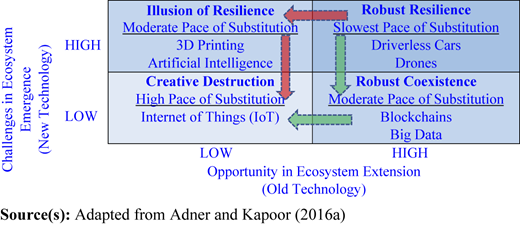
In this exploratory study, we examine the seven DTs (Table 1) using the Theory of Disruptive Innovation (Christensen, 1997; Christensen et al., 2011; Christensen and Raynor, 2013) and the Ecosystems Framework (Adner and Kapoor, 2016a, b). Next, we validate the seven DTs using the 2 × 2 matrix (Figure 1) proposed by Adner and Kapoor (2016a). The matrix consists of four types of substitution of DTs. It helps us gauge the relationship between the seven chosen DTs and evaluate how rapidly a transformation may happen in the logistics sector. Typically, the best position for a DT within the matrix is the “creative destruction” quadrant with the fastest substitution speed. In contrast, the riskiest position for a DT is the “robust resilience” quadrant with the slowest substitution speed. A typical DT which is currently in the “robust resilience” quadrant and aspires to be adopted quickly (i.e. to become creative destruction) must follow a route either through the “illusion of resilience” or the “robust coexistence” (shown as the green or red arrows in the matrix).
2.2.1 Creative destruction
This form of DT faces weak challenges in the emergence of the ecosystem (i.e. new technologies) whilst also demonstrating inadequate opportunities for extension (i.e. old technologies) (Adner and Kapoor, 2016a, b). Based on our matrix, this type of DT has the highest substitution speed within the entire logistics sector. A good example of “creative destruction” is the adoption of IoTs within the global logistics sector. For instance, when a worker scans a shipment fitted with IoTs, it helps to collect real-time data, increasing coordination amongst the other agents in the delivery process and reducing information asymmetry. Whilst an IoT component is simply a “plug-and-play” feature, it possesses the ability to replace many labour-intensive practices within the old logistics ecosystems. Firms can install IoT ecosystems quickly and without many technological challenges. Additionally, the coronavirus disease 2019 (COVID-19) pandemic has forced businesses to adopt IoT-based logistics ecosystems [27]. As a result, the adoption of IoT can swiftly “disrupt” the old technology or, in other words, lead to a “destructive” replacement.
2.2.2 Illusion of resilience
This form of DT faces strong challenges in emerging ecosystem (i.e. new technologies) whilst demonstrating weak extension opportunities (i.e. old technologies). Based on our matrix (see Figure 1), this DT has a moderate pace of substitution within the logistics sector. Examples of this type are 3D printers and AI, which still face strong challenges whilst adopting these technologies. For instance, successful adoption of 3D printing in the mainstream logistics sector is delayed due to many reasons such as escalated production costs of machine parts, unavailability of cost-effective 3D printing plastics and low speed of fabrication [28]. Next, in adopting AI-based practices, businesses face many challenges, such as the sceptical behaviour of managers and a prevalent belief that AI will replace human jobs (De Cremer and Kasparov, 2021). Therefore, a weak opportunity to extend old technologies signifies that the incumbent ecosystem players cannot advance as fast as expected. This phenomenon leads to an imaginary scenario where these incumbent players, still dependent on old technology, do not sense an immediate threat and remain in a “state of inertia,” only to be replaced swiftly in the future.
2.2.3 Robust coexistence
This form of DT faces weak challenges in the emergence of an ecosystem (i.e. new technologies) but indicates abundant opportunities for extension (i.e. old technologies). Based on our matrix, this type of DT has a moderate pace of substitution within the logistics sector, for example, blockchains and Big Data technologies. It is now evident that the widespread adoption of blockchains across logistics firms will be much slower (Biswas and Gupta, 2019; Hughes et al., 2019; Yadav et al., 2020) than the initially predicted hype (Mougayar, 2016; Heiskanen, 2017; Saberi et al., 2019). It will lead to a gradual readjustment or coexistence of new processes that migrate to blockchains, whilst the traditional ones still follow the same old technologies. Also, many logistics firms choose to work with simple software platforms instead of adopting a more complex and advanced blockchain-based platform (Janjevic et al., 2019). This reluctance was also reflected in the mild success of Tradelens, signifying that the competitors and subcontractors would have to join the platform and share data (Lacity and Van Hoek, 2021). Similar is the case with low responses of businesses towards adopting the Big Data technologies. Although much was proposed about their miraculous capabilities, improvement of financial performance and efficient business processes (McAfee et al., 2012; Alharthi et al., 2017), firms should be cautious whilst implementing Big Data functionalities to reduce the overall risks of adoption (Bean and Davenport, 2019; Wamba et al., 2018). These DTs have yet to attain their full potential, leaving ample time for their competitors to upgrade. In other words, blockchain and Big Data must function as complementary opportunities in established ecosystems and “coexist”.
2.2.4 Robust resilience
This form of DT faces strong challenges in the emergence of an ecosystem (i.e. new technologies) and shares many opportunities for extension (i.e. old technologies). Based on our matrix, this type of DT has a very slow pace of substitution within the logistics sector, for example, driverless cars and drones. Although logistics firms are progressively using more AVs and drones for parcel deliveries, they have not fully replaced their “traditional” delivery systems. For instance, the global adoption of AVs and drones has safety concerns, the inability to operate in bad weather conditions and regulatory challenges. That is why they cannot compete with the traditional delivery systems. Although these DTs are making significant developments, they are still in their early stages and require developing a fully validated ecosystem that can be adopted universally.
2.3 Background work on multi-criteria decision-making (MCDM) techniques
Multi-criteria decision-making (MCDM) techniques are tools for decision-makers (DMs) to solve complex problems where DMs may have different knowledge, characteristics and experience (Aoun et al., 2021). Before applying any MCDM technique, it is important to identify the barriers from the previous literature. Once researchers identify the barriers from literature, it is important to filter the relevant barriers based on their importance and appropriateness. Researchers often use qualitative techniques such as in-depth interviews and Delphi methods to collect expert opinions. However, these techniques consume more time and have high chances of generating exploratory findings (Phellas et al., 2011). In contrast, FDM addresses the vagueness and ambiguity of experts' judgements with the help of fuzzy set theory (Gupta et al., 2022). In this manner, it addresses the situations in which humans cannot precisely conclude (Rathore, 2021; Rathore and Gupta, 2021).
Similarly, other MCDM techniques, such as Decision making trial and evaluation laboratory (DEMATEL) and ISM, are available in the previous literature to identify the barriers' interrelations (Dwivedi et al., 2017; Biswas and Gupta, 2019). Using ISM has the advantage over DEMATEL by transforming poorly articulated models into a hierarchy of systematic barriers and well-defined models (Singh and Bhanot, 2020). Many recent studies have applied ISM to analyse the barriers to the successful adoption of technologies (Yadav et al., 2020; Rana et al., 2019). Table 2 presents a brief literature review on the ISM technique.
3. Proposed research methodology
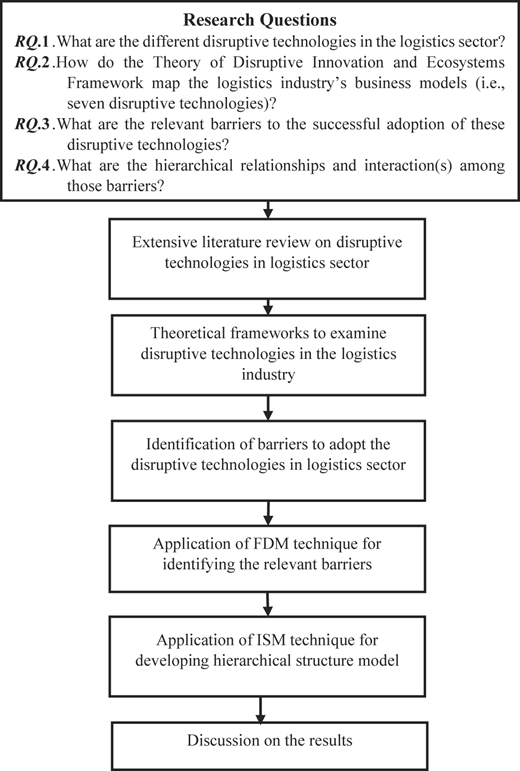
We prepared an FDM questionnaire (refer to Table A2 in Appendix) to collect experts' opinions to identify the relevant barriers. Then, we sent the questionnaires to 15 experts in India. Each expert had over ten years of work experience in logistics management, such as managing warehouses, handling inventory, exports and imports, transportation and procurement of raw materials. Many previous studies have collected inputs from 15 experts to apply MCDM-based techniques (Nassereddine and Eskandari, 2017; Singh and Sarkar, 2020). Therefore, the sample size of experts in our study is well within the prescribed limit. We present the demographic details of the experts in Table 3. We asked the experts to determine the importance of each adoption barrier using a linguistic scale (refer to Table A3 in Appendix). After finalising the relevant barriers, we analysed them to develop a robust structured hierarchical model using ISM. This technique can collectively examine all barriers and identify their interdependencies (Kamble et al., 2018). Then, we included the relevant barriers in the ISM questionnaire (refer to Table A4 in Appendix) and sent it to those 15 experts to determine their contextual relationships. The experts were requested to fill the questionnaire with the help of V, A, X and O symbols. Figure 2 presents the proposed methodology for this study.
3.1 Fuzzy Delphi Method
The following are the steps involved in FDM (adapted from Ishikawa et al., 1993) and are given below:
Identify the barriers from literature;
Prepare a questionnaire with all barriers and ask experts () to rate the importance of barriers () related to the study with the help of the fuzzy linguistic scale (Table A3 in Appendix) and
Convert all expert opinions into fuzzy numbers and use the geometric mean model to evaluate the aggregate experts' opinions.
Let us assume is the fuzzy number corresponding to the th barrier by the th expert is present as given below:
where represents the number of experts and represents the number of barriers.
Calculate the fuzzy weights of barriers as follows:
The centre of gravity method is used to estimate the defuzzification value as follows:
Compare the weights of all barriers by setting the desired threshold value (). If , then the barrier is accepted; if then the barrier is rejected.
3.2 ISM analysis
ISM is an interactive learning technique that directly integrates the barriers into a systematic and structured model. It is an efficient modelling methodology to evaluate the effect of one barrier on another. Warfield (1974) reported that the ISM technique is powerful for identifying the relationships within the specific elements in an interdependent system. It also helps analysts identify and recognise relationships between specific items that may lead to an issue or an ensuing problem.
Ravi and Shankar (2017) examined the reverse-logistics barriers and their relationships in the automotive sector with the ISM technique. Raj et al. (2008) applied ISM to identify the mutual relationships amongst enablers that assisted the implementation of flexible manufacturing systems and then classified them based on individual drives and dependency powers. We enlist the critical features of the ISM technique, as adapted from Raj et al. (2008):
Interpretive, as the decision recommended by experts, can decide the relationships amongst the individual barriers;
Helps build a hierarchy map based on a complex set of barriers;
Leads to a diagraph representing the fundamental interactions amongst the barriers and their overall structure and
Allows the imposition of a ranking and the direction on the complexities within the relationships amongst those barriers.
Next, we enlist the steps of the ISM methodology adapted from Kannan et al. (2009):
List the identified barriers to the adoption of DTs in logistics sectors.
Establish a contextual relationship between the identified barriers.
Prepare a structural self-interaction matrix (SSIM) comprised of the barriers.
Develop the reachability matrix from the SSIM matrix and check for transitivity. (Transitivity is a preliminary assumption in the ISM technique. This relationship says that if a barrier X is linked to Y; and Y to Z, then X must be linked to Z.)
Partition the final reachability matrix (FRM) (derived from Step 4) into various stages.
Draw a diagraph based on the relationships represented in the FRM. The transitive connections are omitted from the diagraph.
By replacing vector nodes with statements, convert the diagraph into an ISM-based model.
Recheck the ISM-based model for conceptual inconsistency and take necessary actions.
3.3 MICMAC analysis
We performed the MICMAC analysis to identify indirect relationships amongst the barriers with the help of the driving and dependence power of each barrier (Ravi and Shankar, 2017). The sum of each row barrier and column barrier becomes the coordinates of each individual barrier, and they are positioned in the two-dimensional graph based on these coordinates. Then, the barriers were classified into four quadrants (Rana et al., 2019) as follows:
Autonomous (Quadrant I) – Barriers under this quadrant have low driving and dependence powers. Therefore, they do not yield much influence.
Dependent (Quadrant II) – Barriers in this quadrant have weak driving power but strong dependence power. Other barriers usually influence these barriers in the lower level of the ISM model.
Linkage (Quadrant III) – Barriers that come under this quadrant have strong driving power and strong dependence power. They are unstable, and any action involving these barriers would result in a subsequent reaction that affects them and other barriers.
Independent or driver (Quadrant IV) – Barriers under this quadrant are considered the most important ones with strong driving powers but weak dependence. It means that they can highly influence other barriers. Therefore, they require immediate attention because other barriers that depend on them might be affected.
4. Results from our study
4.1 Results from the Fuzzy Delphi Method
After an extensive literature review on DTs in the logistics sector, we identified 12 barriers that hinder their adoption. Then, we examined these 12 barriers with the help of experts' opinions using FDM steps. According to the FDM steps described in Section 3.1, we performed defuzzification for barriers utilising the centre of gravity method. Then, we compared the values obtained after the defuzzification of all barriers with the desired threshold value (α). This threshold is considered a benchmark for accepting or rejecting any barrier (Kannan et al., 2009). Finally, we identified ten relevant barriers to applying this method. The FDM results are shown in Table 4.
4.2 Results from ISM and MICMAC
After successfully identifying ten relevant barriers, we developed a robust structured hierarchical model and examined the interrelationship amongst those barriers using the ISM technique. We prepared a SSIM matrix using ISM steps to depict these interrelationships, as described in Section 3.2. Then, we constructed an SSIM (Table 5) with the help of experts' opinions which we collected through questionnaires. Next, we developed the initial reachability matrix (IRM), as shown in Table 6. Then, we checked the IRM for transitivity to create the FRM, as presented in Table 7.
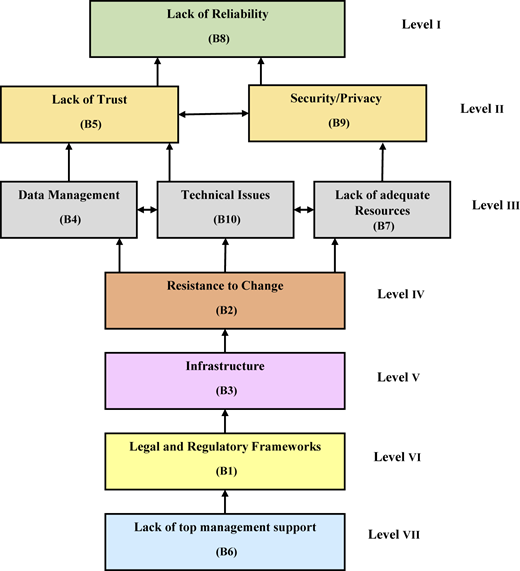
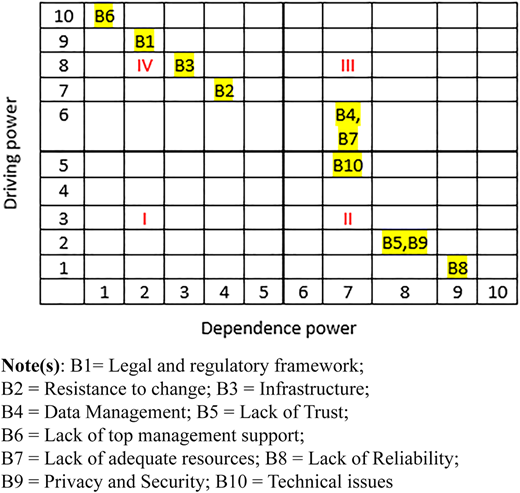
Then, we obtained the reachability and antecedent sets for each critical barrier from the FRM. The reachability set consisted of the barrier itself and other barriers affected by it. The antecedent set consisted of the barrier itself and other barriers that may have affected it. Then, we generated the intersection of these two sets for all other critical barriers. A barrier with the same reachability and intersection sets secures the top level in the ISM hierarchy. These barriers have high dependence power, so the remaining barriers drive them. After finding the top barriers, they were removed from the other barriers. Finally, these top level barriers helped us in developing the ISM hierarchy. We completed the detailed analysis of the level partition of these ten critical barriers within seven iterations (see Table A5 from Appendix). We developed the ISM hierarchical structural model (see Figure 3) with the help of FRM. Finally, we performed MICMAC analysis to examine the barriers based on their driving and dependence powers, which were calculated from the FRM. The summation of each row and column score for each barrier becomes the coordinates in which the barrier is positioned on the diagram (Figure 4). Then, we categorised the ten barriers into these four quadrants as follows: Autonomous barriers, Dependent barriers, Linkage barriers and Independent barriers.
5. Discussion
The key research questions for this study were: RQ1. What are the different DTs in the logistics sector? RQ2. How does the Theory of Disruptive Innovation and Ecosystems Framework map the logistics industry's business models (i.e. seven DTs)? RQ3. What are the relevant barriers to the successful adoption of these DTs? RQ4. What are the hierarchical relationships and interaction(s) amongst those barriers?
To answer RQ1, first, we identified the seven DTs with the help of an extensive literature review. Further, we explained each DT with the help of unique use cases (Table 1).
To answer RQ2, we analysed the seven DTs using Adner and Kapoor's framework and the Theory of Disruptive Innovation. Then, we categorised these seven DTs into four groups, namely creative destruction, robust coexistence, illusion of resilience and robust resilience. We also recommended how each of these DTs could be adopted quickly.
To answer RQ3 and RQ4, we identified significant barriers with the help of inputs from logistic experts and an in-depth examination of background literature. We then analysed the interrelationships between the barriers and developed a hierarchical framework using the ISM technique. The structured hierarchy model was developed in seven levels, as shown in Figure 3. It helped to portray the interrelations amongst the barriers that could increase the efficacy of DTs adoption in the logistics sector.
From our analysis, the lack of top management support (B6) at Level VII emerges as a potentially critical barrier to building a foundation and might act as the single driving force behind Level VI. This barrier is related to legal and regulatory frameworks (B1) in the ISM model. Therefore, the risks associated with the adoption of DTs will impact other associated barriers. For instance, the exploratory findings from our study indicate that the top management might not be supportive of the adoption of DTs. Other barriers could appear stronger because logistics managers might try to prevent the associated risks from those barriers. Previous literature has addressed the lack of top management support from an adoption perspective only (LaValle et al., 2011; Dwivedi et al., 2017). However, Govindan and Hasanagic (2018) suggested that managers should not consider top management support as a singular barrier because it might encapsulate many other barriers. This finding supports our result, indicating that lack of top management support potentially serves as a key barrier that has a greater influence on other connecting barriers in the ISM model.
The lack of top management support (B6) is directly related to the legal and regulatory frameworks (B1) barrier at Level VI (Figure 3). Barrier B1 possess a high driving power and low dependence power, and so it is placed in Quadrant IV (Figure 4). Therefore, the lack of suitable adoption frameworks and policies might cause difficulties in adopting DTs in logistics firms. Biswas and Gupta (2019) found that blockchains lacked adherence to legal procedures and regulations due to their decentralised structure. Similarly, obsolete regulatory policies can potentially restrict the adoption of DTs in logistics. Therefore, top management in the logistics industry needs to intervene and create a flexible environment with regulations that can scale, adapt and enable disruptive innovations.
The infrastructure (B3) barrier at Level V is an outcome of the previous Level VI (Figure 3). Exploratory findings from our study indicate that barrier B3 possesses a high driving power but low dependency power and is positioned in Quadrant IV (Figure 4). Therefore, it can possibly influence other barriers from higher levels but, in turn, is controlled by the barriers from its lower level. Previous studies have found that organisations lacking upgraded IT systems and low infrastructure readiness may be affected by quick adoption decisions of DTs in the logistics sector (Kaur and Rampersad, 2018). These infrastructure issues might be prevailing due to the lack of top management support (B6) and legal and regulatory frameworks (B1). Therefore, they could possibly be an extended concern because of their strong driving power on infrastructure (B3).
Next, the barrier resistance to change (B2) exists at Level IV (Figure 3). Its driving power is relatively low as compared to the lack of top management support (B6), legal and regulatory frameworks (B1) or infrastructure (B3). Still, it acts as an independent barrier and is positioned in Quadrant IV (Figure 4). From the exploratory findings, barrier B2 is influenced directly by B3 and might create other barriers such as technical issues, data management and inadequate resources. Mellor et al. (2014) found that changing jobs, tasks and work practices were often responsible for increasing resistance amongst logistics workers during the adoption of novel DTs. After years of traditional manufacturing processes, firms were often uncomfortable acquiring new technology in maintaining logistics operations. This could possibly lead to the resistance to change (B2) that emerged as a critical barrier to adopting DTs.
Next, the group of barriers at Level III (Figure 3) are generated from the linkage and dependent category. Whilst technical issue (B10) is a dependent barrier and is placed in Quadrant II (Figure 4), data management (B4) and lack of adequate resources (B7) belong to the linkage category. They are positioned in Quadrant III (Figure 4). Although they are placed in different quadrants, they are closely related due to their driving and dependence power. Therefore, findings from our exploratory study indicate that technical issues (B10) such as limited payload-carrying capacity and low range could increase the associated risks of a logistics firm that operates drones for parcel delivery (Sah et al., 2021).
Similarly, Janssen et al. (2019) identified some technical challenges, such as networking issues, sensing issues, standardisation and interoperability, impeding the successful deployment of IoTs. These issues also raised privacy and security concerns amongst logistics users, leading to distrust within the organisation. This exploratory finding revealed that an organisation might often pay lesser attention to such barriers and that they needed to be possibly reinvented and restructured, especially for gaining trust and addressing existing users' security and privacy concerns.
Level II (Figure 3) contains two barriers, lack of trust (B5) and security and privacy (B9). Whilst their driving powers are very low, their dependency powers are extremely high, positioning them in Quadrant II (Figure 4). These barriers could be influenced by other barriers from the lower levels in the ISM model. Extant studies suggested that greater attention must be paid to privacy and security issues to gain customer trust (Dwivedi et al., 2017). Therefore, based on the exploratory findings from our study, a secure information-sharing and data protection framework might be needed for logistics firms.
Level I (Figure 3) of the ISM model consists of a single barrier, i.e. lack of reliability (B8). It possesses a high dependence power and is placed in Quadrant II (Figure 4). In the ISM model, other barriers from lower levels can affect the lack of reliability (B8). Therefore, B8 is possibly an outcome of the lower-level obstacles (i.e. Level II), and there might be a direct link between these two levels. This direct connection could also suggest that reliability issues can reduce system performance during the adoption of DTs if the logistic managers cannot provide a reliable system.
6. Research and managerial implications
6.1 Research implications
Our study has several research implications in light of the adoption of DTs. First, this study successfully analyses the seven DTs using Adner and Kapoor's framework and the Theory of Disruptive Innovation based on the two parameters as follows: emergence challenge of new technology and extension opportunity of old technology. Second, this study categorises the seven DTs into four quadrants (see Figure 1), namely creative destruction, robust coexistence, illusion of resilience and robust resilience. In particular, (1) IoT belongs to the “creative destruction” quadrant, (2) blockchains and Big Data belong to the “robust coexistence” quadrant, (3) 3D printing and AI belong to the “illusion of resilience” and (4) driverless cars and drones belong to “robust resilience”. Third, this study proposes the recommended paths for DTs in the “robust resilience” quadrant, which aspires to be adopted quickly by firms. It needs to follow either of the two approaches: (1) reduce the opportunity in old technology extension from high to low and then reduce the challenges in new technology emergence from high to low; (2) reduce the challenges in new technology emergence from high to low and then reduce the challenges in old technology extension from high to low.
6.2 Managerial implications
Our study has several managerial implications in light of the adoption of DTs. First, our study identified no autonomous barriers to adopting DTs (Figure 4). This finding implies that all the barriers in our study have significant driving and dependence powers for the successful adoption of DTs. Second, other barriers belonging to any lower level of the ISM model can influence the dependent barriers. Therefore, logistic managers should focus on these barriers to achieve less resistance to DTs adoption. Third, the linkage barriers are unstable, and any preventive action involving them would subsequently affect themselves and other barriers. However, if they are appropriately implemented, that could result in a positive environment for the successful adoption of DTs. Therefore, managers should take care of these linkage barriers. Fourth, the independent barriers have high influencing powers over other barriers. Due to this reason, they are considered key barriers to the successful adoption of DTs. Hence, logistics managers should pay attention to these critical barriers whilst implementing DTs.
7. Conclusion and future directions of research
Our research presented potential DTs with use cases from the logistics sector and the significant barriers that may have prevented their adoption. We validated and categorised these DTs into possible four groups according to the Theory of Disruptive Innovation. Next, we examined and evaluated these significant barriers in terms of their contextual relationships using the ISM technique. Although we do not claim to be fully inclusive in our analysis, the proposed framework helps us identify a potential set of barriers that may have affected the adoption of DTs in the logistics sector. Finally, we described the interrelationships amongst these barriers to develop a structural hierarchy model.
Our exploratory findings reveal that the ten barriers are the legal and regulatory framework, resistance to change, privacy/security, infrastructure, data management, lack of trust, lack of top management support, lack of adequate resources, reliability and technical issues. Amongst them, lack of top management support, legal and regulatory framework and infrastructure are vital and might need immediate attention of managers to adopt DTs successfully. However, lack of trust, reliability and privacy/security issues demonstrate a very high dependence power than other barriers. Therefore, managers might not be much concerned about their influence on adoption.
The main contributions of this exploratory study are fourfold. First, it identifies the seven DTs in the logistics sector. Second, it applies the theory of disruptive innovations and the framework of the ecosystems to rationalise the choice of these seven DTs and categorise them into four possible groups. Third, it identifies and critically assesses the barriers to the successful adoption of these DTs through the ISM method. Fourth, it builds the interrelationships amongst the identified barriers.
Despite these contributions, this study has a few limitations. First, our analysis was exploratory in nature, owing to the application of the Delphi Approach. Future studies could adopt questionnaire-based surveys and collect responses from logistics managers to examine the possible barriers of DTs and their interrelationships. Second, our analysis was limited to a specific selection of ten barriers. Future research in logistics management could extend our study by reviewing other innovative technologies. Third, future studies can adopt empirical analysis to offer additional evidence on the applicability of our research and thus build a generalised framework to identify the adoption barriers in the logistics sector.
The authors gratefully acknowledge the reviewers for the constructive comments that led to the significant improvements to this manuscript. Shubhi Gupta acknowledges the infrastructural support received from FORE School of Management, New Delhi in completing this paper.
Notes
Tradelens Ecosystem: https://www.tradelens.com/ecosystem
Internet of Things reaches into the trucking business: https://www.wsj.com/articles/internet-of-things-reaches-into-the-trucking-business-1430342965
TuSimple is the world's largest and most advanced self-driving truck company.
Global industry accelerates IoT adoption in response to COVID: https://www.computerweekly.com/news/252507082/Global-industry-accelerates-IoT-adoption-in-response-to-Covid
References
References
Appendix
Please answer the questions by filling the appropriate response.
After scrutinising the significant barriers of DTs adoption, the contextual relationships amongst the barriers are developed. To depict these contextual relationships, a SSIM matrix is prepared. The following symbols are used to interpret the direction of relationships between the two significant barriers to the adoption of DTs in logistic sector.
V: Barrier i will influence barrier j;
A: Barrier j will influence barrier i;
X: Barrier i and j will influence each other and
O: Barriers i and j are unrelated.
Let us assume barrier = 1, i.e. “Legal and regulatory framework”, will influence = 2, i.e. “Resistance to change”, then fill the symbol “V”. Similarly, if = 2 will influence = 1, then fill symbol “A”. If both barriers = 1 and = 2 will influence each other, then insert the symbol “X”, and if both barriers = 1 and = 2 are unrelated to each other, then insert the symbols “O”
Please follow the same procedure for all the cells (barriers) shown in the below table: