


1. Introduction
The coronavirus disease 2019 (COVID-19) pandemic is one of the most impact events in recent decades that has caused severe global economic disruptions (Ivanov, 2020a, b; Dubey et al., 2022). Pandemics of this magnitude are rare as only 1918 (H1N1 virus), 1957–1958 (H2N2 virus), and 1968 (H3N2 virus) caused severe disruptions. However, rapid changes in climate and rapid rise in the population raise further possibilities of pandemics in the near future. Hence, the lessons learnt from the recent COVID-19 pandemic can be useful for the entire humanity on several fronts. Supply chain managers have a lot of opportunities to relook at their existing supply chain designs and identify the weakest links that have caused unprecedented disruptions in lead times and order quantities, fragilities in network structures and severe demand fluctuations (Ivanov, 2020a; Ivanov and Dolgui, 2020). The outbreak of the COVID-19 virus and its global effects have shed light on the scope and scale of the cascading impacts on global supply chains (Choi, 2020). Gao and Ren (2020) argue that organizations need to adapt their supply chain design amid the COVID-19 pandemic and in light of future trade challenges. In totality, the COVID-19 virus has exposed several missing links in the global supply chains and the degree of preparation these organizations have made in response to such pandemics. Recently, some scholars have attempted to deepen our understanding related to the effects of the pandemic resulting from COVID-19 on global supply chains and their designs (Ivanov, 2020b; Currie et al., 2020; Choi, 2020; Govindan et al., 2020), yet most of these literature studies offer anecdotal evidence and lack theory grounded research.
2. Need for the special issue
There is an urgent need to understand the cascading effects of pandemics on global supply chain designs and new logistics and supply chain management skill sets to deal with a pandemic. Ketchen and Hult (2007) argue that organizational theories help differentiate traditional supply chains from best value chains. Following Ketchen and Hult (2007), operations and supply chain management scholars have shown an increasing trend toward using organizational theory to explain complex phenomena (see, Halldórsson et al., 2015; Tang, 2016; Gunasekaran et al., 2018). However, the COVID-19 pandemic has further raised new questions that need new approaches to explain (Craighead et al., 2020). Hence, in response to the need to address some of these new research questions that the COVID-19 pandemic has raised in front of the supply chain managers, we organized a special issue (SI) to develop theoretical debates to broaden our understanding of supply chain management during the pandemic and how in future supply managers can tackle some of these challenges that the entire humanity faced following the COVID-19 crisis due to lack of adequate understanding of the nature of the problem and how to design supply chain for such unprecedented crisis resulting from the COVID-19. Topics for this SI could include (but were not limited to):
Importance of agility, adaptability and alignment in global supply chains in the context of a pandemic.
Influence of supply chain skills gap for global supply chains management in the context of a pandemic.
Application of artificial intelligence and big data analytics capability in building collaboration among supply chain partners.
Resilience in global supply chains.
Applying cutting-edge tools and technologies such as artificial intelligence, drones, big data, and blockchain to improve visibility in global supply chains and build trust among global partners during a pandemic.
Capacity building and management in the context of a pandemic.
Behavioural supply chains.
Performance measures and metrics in use for supply chains during a pandemic situation.
Logistics in humanitarian operations and otherwise.
Information sharing and emerging technology adoption in global supply chains during the pandemic situation.
Total quality management in the global supply chain and logistics during a pandemic.
Costing in logistics and supply chains during a pandemic.
3. The submission of the articles
We were open to submission without any restrictions. We invited submissions that focused on advancing the theoretical debates concerning operations and the supply chain management field in the context of the pandemic. The contributors were encouraged to submit articles focussing on theory-driven research relying on empirical studies grounded in positivism or interpretivism philosophy (Gammelgaard, 2017). However, we have particularly motivated the authors to adopt a multi-methods approach to tackle the research questions (Boyer and Swink, 2008; Carter et al., 2008).
We received encouraging responses from operations and supply chain management scholars across the globe. The articles which do not meet the International Journal of Logistics Management (IJLM) criteria were desk rejected by the guest editor-in-chief. The articles that met the requirements of IJLM were sent to more than two referees with rich expertise in their field. After multiple rounds of extensive reviews, we finally accepted 25 articles. The SI is split into two volumes. This volume presents a literature review, a conceptual paper as well as contributions based on an interpretive and positivist foundation respectively. The next part that will appear in IJLM vol 34, no. 2, further presents a conceptual paper, analytical papers as well as papers based on a pragmatist research philosophy. In the following, we provide the synthesis of all twenty-five articles accepted in our S.I.
4. Summary of contributions
Out of the accepted 25 articles (see Figure 1), there are 22 research articles. The 22 articles are further classified into 4 different categories. Based on the positivism philosophy, we have accepted four articles. The four articles are grounded in theory and the research hypotheses were tested using data (see, Behl et al., 2021; Ajmal et al., 2021; Wagner et al., 2021; Kumar and Chakraborty, 2022). Based on the interpretivism philosophy, we have accepted nine articles. The authors have used qualitative interviews to derive their research propositions (see, Shareef et al., 2021; Modgil et al., 2021; Ashraf et al., 2021; Castka et al., 2021; Klymenko and Halse, 2021; Hohenstein, 2022; Wagner et al., 2022; Kohl et al., 2022; Song et al., 2022). Two articles based on pragmatism philosophy were accepted (see, Nayal et al., 2021; Kumari et al., 2021). Nayal et al. (2021) adopted interpretive logic to develop a theoretical model and further validated the model using the ANP technique. In the second article, based on the pragmatism philosophy, Kumari et al. (2021) used qualitative interviews to develop the theoretical model and further tested it using cross-sectional data. Finally, we understand that the analytical-based articles have significantly contributed to advancing operations and the supply chain management field (Boyer and Swink, 2008) by solving problems. We accepted some relevant articles that may be useful for the practitioners based on analytical methods (see, Zhang et al., 2021; Paul et al., 2021; Dohale et al., 2021; Abdolazimi et al., 2021; Mariappan et al., 2022; Banik et al., 2022; Yassine, 2022).
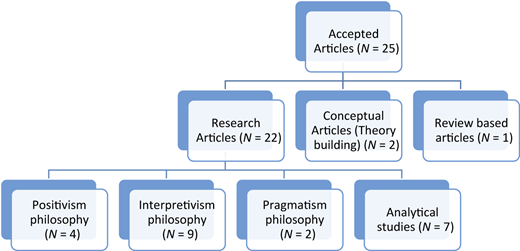
We recognize the need for theory-driven conceptual articles in advancing operations and supply chain management. We accepted two articles that help advance the theoretical boundaries of supply chain disruption and the ways to mitigate the risk (see, Ivanov, 2021; Altay and Pal, 2022). Ivanov (2021) provides food for thought for operations and supply chain management professionals to understand how A, U, R, A framework can help advance the theoretical understanding of supply chain resilience during the pandemic crisis. Furthermore, using coping theory, Altay and Pal (2022) provide a theoretical framework to understand the supply chain disruption and the ways to minimize the risk.
Finally, the importance of review-based articles cannot be ignored as we know that the literature review helps identify the potential research gaps and provide future research agenda that motivates scholars to shape their research strategies. Furthermore, the literature review also provides practitioners and policymakers with an overview of the field. We accepted one review article (see, Mavi et al., 2022) that provides in-depth insight into innovation in transportation in response to the COVID-19 crisis.
5. Future research agenda
We based our discussions on 25 accepted articles. The objective of the SI was to attract papers that help broaden the understanding of supply chain management theories in the context of the pandemic. We all know how the COVID-19 crisis has changed business models, and technology has gained significant momentum during the pandemic. Moreover, in the past, operations and supply chain management scholars have heavily relied on a few popular organizational theories such as resource-based theory (see, Hitt et al., 2016), institutional theory (Kauppi, 2013), relational view (Dyer and Singh, 1998; Chen and Paulraj, 2004; Chen et al., 2013; Moshtari, 2016), resource dependence theory (Handfield, 1993; Singh et al., 2011; Jajja et al., 2016) and information processing theory (Srinivasan and Swink, 2018; Dubey et al., 2021). However, we note that the COVID-19 crisis has presented a different level of challenges that have not only contained the mobility of human beings to avoid the spread of the virus, but it has also created huge resource constraints, especially in developing and developed economies. The post-COVID era is far more difficult, and the supply chain design must help alleviate poverty, reduce social inequality and create more employment opportunities for jobless people. Hence, competitive advantage theories such as a resource-based view or dynamic capability view, or transaction cost economics theory alone do not help explain the realities. Thus, future research must help address the following questions:
What are the enablers and barriers of the frugal supply chain? (see, Dubey et al., 2022)
What are the enablers and barriers of visibility in healthcare supply chains? (Govindan et al., 2020)
How do national and organizational cultures shape supply chain designs to tackle unprecedented crises? (Gupta and Gupta, 2019; Gupta et al., 2021)
How can AI-driven technology help tackle social inequalities and corruption in societies? (Fosso Wamba et al., 2021a, b; Galetsi et al., 2022)
How can AI and firm resilience help improve supply chain disruptions issues and enhance firm performance? (Sullivan and Fosso Wamba, 2022)
How can emerging technologies tackle governance issues in the global supply chains? (Sodhi and Tang, 2021)
Besides some of these questions, it is also recommended that future organizational scholars can develop their own theories relevant to the operations and supply chain management field (Bromiley and Rau, 2016; Fosso Wamba et al., 2021a, b; Dubey et al., 2022). Furthermore, how organizations can assimilate emerging technologies (see, Fosso Wamba, 2022) to tackle complex issues resulting from crises or disasters (Queiroz et al., 2020). We hope that our SI opens new avenues for research that may help advance the operations and supply chain management field to the next level.

