Organizations as catalysts of sustainable development: greening the workforce for responsible management in the 21st century
1. Introduction
In recent times, organizations around the globe have been put under pressure to become more sustainable, in order to reduce their environmental impacts, enhance the social benefits of their business and to promote economic development in terms beyond the traditional profit-related measures (Bastas and Liyanage, 2019), a reality that modern organizational leaders must accept (Ortiz-de-Mandojana et al., 2019). In this context, organizations face tensions (Hahn et al., 2018; Pinkse et al., 2019) and should begin to transition towards a more sustainable management style, which will create sustainable value (Figge and Hahn, 2004). However, nations and organizations tend to have different responses to the challenge of sustainability (Khan and Ulucak, 2020).
In this work, organizational sustainable value is defined as the organizational adoption of contemporary management principles, practices and attitudes which are capable of optimizing firms' environmental, social and economic performance, with the aim of moving towards sustainable development (Hart and Milstein, 2003). The creation of sustainable value can help firms to improve their performance even in contexts of economic recession (Seles et al., 2019).
In order to generate sustainable value, both new green technologies and behavioural changes in the workforce are necessary (Jabbour, 2013; Norton et al., 2015; Graves et al., 2019). The development of green technologies has been experiencing an upward trend (Khan and Ulucak, 2020); however, when it comes to the “human side” of the greening of organizations, a number of firms around the world have struggled with greening their workforce (Ren and Jackson, 2019). This aspect of management is also popularly known as “the soft side of organizations” (McGregor, 1966). For example, the role of the workforce in promoting organizational transformation was an imperative discussion during the total quality management movement (Fotopoulos and Psomas, 2009) and was consequently called the “soft side of TQM” (Dubey and Gunasekaran, 2015).
In principle, it is well accepted that human resource management (HRM) should be adapted to contemporary changes in society (Aust et al., 2019), which includes a necessary degree of adjustment to address the current environmental crisis in face of issues such as loss of biodiversity and climate change. Indeed, only when HRM is fully aligned with organizations' strategic objectives, will firms be able to achieve their goals (Boudreau et al., 2003; Schuler and Jackson, 1987; Huselid, 1995; Jiang et al., 2012; Daily and Huang, 2001; Chaudhary, 2019). For example, organizational responses to climate change require action from HRM (Hoffman, 2005), and it is important that organizations have a talented workforce with the necessary skills to deal with the complex tensions and paradoxes, which are at the epicenter of managing organizational sustainability (Hahn et al., 2018). In this context, there are calls for more research on the essential role of HRM in promoting more sustainable organizations (Roscoe et al., 2019)
The concept of “green human resource management” (GHRM) (Renwick et al., 2013; Renwick, 2018; Renwick et al., 2016) has emerged to deal with the ongoing debate concerning the possibilities, constraints and impacts of the greening of the workforce to create more sustainable organizations and has evolved since it was first coined (Pham et al., 2019a, b, c). The topic of GHRM has had an impact not only on the HRM field but also on other fields of management research through an interdisciplinary perspective. For example, research has been conducted on how GHRM can affect operations management (Daily et al., 2012); the adoption of environmental management systems (Jabbour and Santos, 2008) and the potential role of HRM in promoting contemporary trends in environmental sustainability, such as the circular economy (Jabbour et al., 2019). Finally, the insertion of “green” concerns into the traditional HRM field can be considered one of the trending topics in the future of human resources (Jackson et al., 2011). The global reach of GHRM has been developed through the growing number of research projects on the topic conducted in both mature and emerging markets, including representatives of the BRICS countries (Ahmad et al., 2019; Srivastava, 2019; Ndubisi, 2019; Moktadir et al., 2019; Haddock-Millar et al., 2016).
This article offers an overview on the fundamentals of GHRM, selected recent research results and a research agenda on emerging topics in the area. Specifically, this article:
Provides a review of key definitions and sub-systems of organizational GHRM;
Offers an overview of recent research results from GHRM studies around the globe;
Concludes by systematizing an original research agenda for future studies.
2. How to promote GHRM in organizations?
This work is mainly focused on the alignment of HRM with the “environmental dimension” of sustainable organizations, also known as the greening of organizations (Green et al., 2000). In this context, a sustainable organization can be defined as an organization which contributes to sustainable development by simultaneously delivering economic, social and environmental performance, frequently referred to as the “triple bottom line” (people, planet and profit) of firms (Hart and Milstein, 2003). While it is now widely accepted that organizations should be more sustainable, a close look at the “people” dimension of firms' sustainable transformation is imperative, and research in this field has evolved considerably since the 1990s (Wehrmeyer, 1996).
Under the broad understanding that HRM should make a contribution to sustainable organizations (Jabbour and Santos, 2008), we adopt Renwick's definition of green human resources (Renwick et al., 2013; Renwick, 2018), which suggests that GHRM concerns the full alignment of human resources practices, systems and strategic initiatives, such as organizational objectives.
GHRM can be achieved through a number of human resources-related practices, such as: (1) a recruitment process which considers how “green” candidates are, and how aligned they are with the firm's environmental objectives (Adjei-Bamfo et al., 2019); (2) unlocking the full potential of the workforce and the organization's top management team in order to achieve a more environmentally sustainable organization (Ramus and Steger, 2000; Daily et al., 2012; Pham and Kim, 2019); (3) training for green purposes, such as the development of green products (Govindarajulu and Daily, 2004; Jabbour et al., 2013); (4) individual and group assessment and performance appraisal of the workforce based on green criteria (Milliman and Clair, 2017; Naeem, 2019) and (5) green capacity building beyond the company's walls, which means the promotion of capacity building for green purposes across supply chains (Nejati et al., 2017; Jabbour and de Sousa Jabbour, 2016; Longoni et al., 2018), including certifications and labels (Ahmad et al., 2019).
GHRM has been explored both in manufacturing (Bag and Gupta, 2019; Ndubisi, 2019) and service provision contexts (Fawehinmi et al., 2020), including, for example, health care services (Mousa and Othman, 2020), higher education provision (Srivastava, 2019; Yusoff et al., 2019) and hospitality/tourism management (Siyambalapitiya et al., 2018; Pham et al., 2019a, b, c; Kim et al., 2019). GHRM is influenced by a number of organizational factors and context and can be found in different levels of maturity in organizations (Nejati, 2019; Yuriev, 2019; Moktadir et al., 2019). GHRM can be deployed not only in large-scale firms but also in SMEs and family businesses (Alwadani and Ndubisi, 2019).
It is believed that GHRM can enhance employees' green behaviour towards corporate environmental management (Naaem et al., 2019). It has been recently highlighted that positive impacts have emerged from two types of employee perception of corporate green policy (perceived ease of use and perceived usefulness), affecting employees' attitudes towards corporate green policy (Yang et al., 2019). Thus, GHRM practices can help to enhance employee's green behaviour and thus improve the firm's overall environmental performance (Yurev et al., 2019). If properly developed and implemented, a wide range of GHRM initiatives can be effectively used to create more responsible organizations (Luthra et al., 2019). Of course, effective GHRM needs well managed incentives and antecedents, such as top management commitment (Nejati, 2019; Yadav et al., 2019).
The recruitment process can be broadly defined as the act of attracting the most suitable candidates for a specific job position (Jabbour and Santos, 2008). During the selection process, the number of candidates is reduced progressively, until the candidate with the most suitable profile is identified. In organizations which adopt GHRM, the recruitment and selection process is adapted to consider the environmental objectives of the firm (Wehrmeyer, 1996). These objectives tend to be aligned with a number of green initiatives led by the organization, which is driven by its greener organizational mission. Real life examples of how companies can attract talented candidates through environmental initiatives have been led by German companies such as Siemens, BASF and Bayer, which use their institutional image in order to attract competent staff who are committed to the environment (Wehrmeyer, 1996). The latest research has suggested specific frameworks and guidelines for effective environmentally friendly recruitment processes by considering the organization's environmental management policies and practices, as well as its green values during the decision-making process related to employee selection (Adjei-Bamfo et al., 2019).
Training is an organizational process through which the systematic provision of knowledge and opportunities is delivered to employees, so they can be equipped with appropriate knowledge and a set of skills which will unlock their full potential in the workplace (Jabbour, 2013). In this context, environment-related training concerns the inclusion of environmental issues in either general training or specific training for green management purposes. For example, green content can be made part of general training sessions to address the firm's sustainability mission; on the other hand, specific environmental training can be used to develop specific organizational areas – such as R&D – in order to further understand how environmental issues will affect departmental trends. Such training will unlock the green talent which is present within organizations (Song and Xie, 2019).
Performance appraisal, which is linked to employee rewards, is an aspect of HR systems considered essential to analyse employees' performance based on their responsibilities and how well they carry these out (Jabbour and Santos, 2008). Green performance appraisal and rewards can, thus, be achieved through the insertion of green metrics into frameworks for assessing the performance of employees and teams. Rewards associated with green performance can be implemented, either through monetary or symbolic gains that employees can be awarded with, due their contribution to the reduction of the environmental impact of firms (Milliman and Clair, 2017).
These GHRM practices can be applied to support a wide range of contemporary green management initiatives in organizations which are committed to responsible management in the 21st century, including:
Eco-design, which refers to the inclusion of green aspects in new product development (Boks, 2006), including life cycle assessment (Konstantas et al., 2020)
Eco-innovation, through building up talent which will discover path breaking new green technologies (Singh et al., 2020; Subramanian et al., 2017)
Development and implementation of green marketing strategies (Han et al., 2019)
Supporting the development of green (Koberg and Longoni, 2019) and sustainable supply chain strategies and practices (Li et al., 2019), including enhanced cooperation (Yu et al., 2020) and closed-loop chains (Govindan et al., 2015)
Articulating the necessary knowledge and skills to develop a more circular economy based on green objectives (Koberg and Longoni, 2019)
Equipping top management and the upper echelons of organizations with the skills required to understand the potential benefits and constraints imposed by environmental issues on organizational strategies (Henry et al., 2019)
Design and implementation of world class sustainable manufacturing, as defined by Dubey et al. (2015), including green procurement (Liu et al., 2020)
Promoting social sustainability practices (Amrutha and Geetha, 2019)
Understand latest ideas towards a more sustainable society, such as the circular economy (Jabbour et al., 2019)
Promoting a general organizational culture towards sustainability, safety and technology advancement (Gobbo Junior et al., 2018)
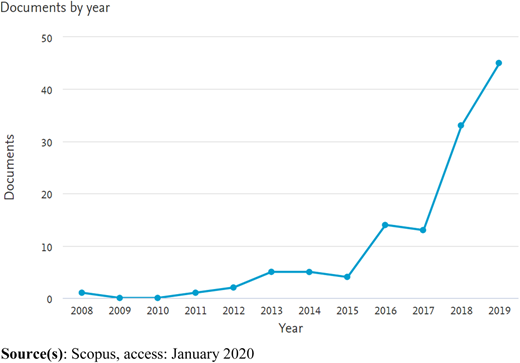
According to the Scopus database, by the end of 2019, 123 academic works including the term “green human resource management” in the titles, abstracts and keywords of articles had been published. As can be seen in Figure 1, the field of GHRM has witnessed rapid growth in terms of research output.
Table 1 presents a summary of the 10 most cited works in the GHRM research field according to the Scopus database. Citations of these works are growing, which shows that interest in GHRM is on the rise, according to the aforementioned search conducted in the Scopus database.
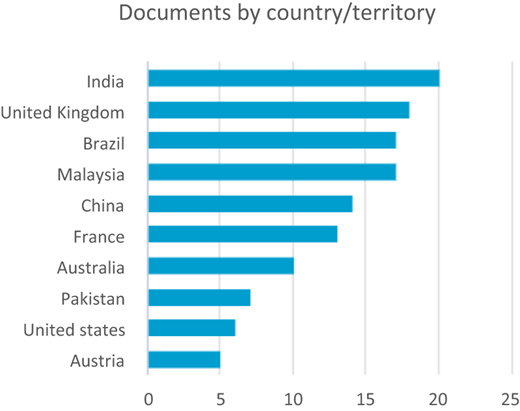
Figure 2 reveals that India, the UK and Brazil are the top three countries worldwide in terms of the main authorship of academic works on GHRM indexed in the Scopus database.
The next section systematizes a number of research questions which may be useful for researchers aiming to further develop the GHRM research field.
3. Final remarks and research agenda
3.1 Contribution of this special issue on greening of workforce
The special issue organized by the International Journal of Manpower contributes to the advancement of the debate of GHRM in a number of ways.
The special issue starts with an overview on future developments in GHRM, as the article “Green human resource management: A comprehensive review and future research agenda” (Pham et al., 2019a, b, c) explores the future of the topic in the context of the most pressing issues facing contemporary society, such as the circular economy.
The article “Assessing the green behaviour of academics: The role of green human resource management and environmental knowledge” (Fawehinmi et al., 2020) addresses the role of GHRM in promoting green behaviour of academics, through assessment of green performance of scholars in an academic environment. In the same line of research, the manuscript “Authentic leadership towards sustainability in higher education- an integrated green model” (Srivastava, 2019) adds to the literature of GHRM that top management leadership plays a fundamental role in the process of greening the workforce. However, GHRM proved to be a relevant topic for other industrial sectors as well, such as the automotive sector, according to the article “Analysing green human resource management indicators of automotive service sector” (Luthra et al., 2019)
The special issue also adds to the debate on how to deploy GHRM in different organizational contexts, from multinational corporations to small and medium enterprises. In this context, “Sustainable Family Business: The Role of Stakeholder Involvement, Mindful Organizing, and Contingent Human Factors” (Alwadani and Ndubisi, 2019) highlights new factors that can enable GHRM, such as mindfulness. GHRM can also be useful for the green transformation of multinational companies in traditional industries, such as the gas and oil industry, as explored by in the article “Greening Multinational Enterprises in the Oil, Gas and Petrochemicals: Environmental Sustainability and the moderation role of environmental sensitivity” (Ndubisi, 2019). Labels and certifications can affect the implementation of GHRM, as detailed in “Organizational and human factors related challenges to ISO 20000: Implications for environmental sustainability and circular economy” (Ahmad et al., 2019).
The effects of GHRM on employees' green behaviour was a concern of the authors of this special issue. In this context, the factors affecting green proactive behaviour were explored by “Evaluating determinants of employees” pro-environmental behavioural intentions (Yuriev, 2019). With a focus on organizations' policy for the environment, the article “An empirical examination of individual green policy perception and green behaviors” (Yang et al., 2019) sheds light on the relation of institutions and green behaviour.
One of the main concerns of the GHRM arena is the effects of GHRM on organizations' performance. In this context, three articles: “Green Human Resource Management: A Two-Study Investigation of Antecedents and Outcomes” (Nejati, 2019), “Do green HRM practices influence employees' environmental performance?” (Naeem, 2019) and “Green Human Resource Management: A Two-Study Investigation of Antecedents and Outcomes” (Nejati, 2019) suggest that GHRM can promote better organizational performance. This tends to occur when companies hire more green candidates, as revealed by “Green candidate selection for organisational environmental management” (Adjei-Bamfo et al., 2019). Finally, Song et al. (2019) in “How Does Green Talent Influence China's Economic Growth?” suggested that GHRM can be addressed at the national level, as countries should develop further the green talent of the current and future generations.
3.2 A research agenda on GHRM
While research on GHRM is still evolving, with considerable growth over the past several years, there still are a number of research questions which should be developed further. Examples of these questions and knowledge gaps in the GHRM field are:
How has the GHRM arena evolved?
How is GHRM related to the idea of “common good HRM”?
Have HRM-related professional bodies incorporated the concept of GHRM?
Are HRM professionals within organizations being put in charge of sustainability initiatives?
How can GHRM be linked to circular economy emerging business models (Geng et al., 2013; Jabbour et al., 2019)?
How can the adoption of GHRM in organizations be sustained over time?
What are the main tensions and paradoxes affecting the adoption of GHRM?
What are the best places to work in terms of the adoption of GHRM?
Are companies really adopting a wide range of GHRM practices?
What are the most adopted practices of GHRM?
Are there differences between patterns of adoption of GHRM practices in companies operating in mature economies compared to companies in emerging markets?
What is the role of HR in addressing pressing issues, such as organizations' contributions to the mitigation of climate change?
Are the best performing companies in terms of HRM also the best ones in dealing with GHRM?
How can GHRM practices be spread across networks of firms and entire supply chains?
Are millennials more supportive of GHRM (Zhao and Xu, 2019)?
What is the role of green HRM in motivating employees to achieve environmental excellence?
What is the role of GHRM in promoting green teams and organizational culture for a better world?
What is the role of GHRM in promoting initiatives of business ethics (Han et al., 2019)
Which particular factors best motivate top managers to embrace GHRM (Henry et al., 2019)?
What is the role of stakeholders in promoting GHRM?
What are the mediators of implementing GHRM in firms?
Do GHRM practices gain momentum through the development of movements in favour of climate activism?
Do GHRM practices reduce their relevance in organizations facing economic difficulties (Seles et al., 2019)?
Are GHRM practices equally popular in organizations from different economic sectors, for example manufacturing, services and agriculture?
How can universities and business schools effectively teach GHRM?
How to promote consistent GHRM across different units of multinational corporations (Budhwar et al., 2017)?
How has the number of green jobs evolved?
The role of CEO's time perspective in the development of GHRM initiatives (Ortiz-de-Mandojana et al., 2019)
How to methodologically advance the debate on GHRM, such as the development of new measurement scales (such as Tang et al., 2018; Shah, 2019)
The research agenda proposed above may be explored through a myriad of methodological approaches, including: literature reviews, conceptual pieces, theoretical development papers, action research, staff interviews, designing new survey measurement instruments, case studies, survey questionnaires and others.