This study investigates how platform-based online freelancers navigate algorithmically mediated stressors through distributed coping and extends the Transactional Model of Stress and Coping (TMSC) under algorithmic HRM.
Drawing on 41 semi-structured interviews with Sri Lankan freelancers delivering creative and professional services via global platforms, this study employs an abductive, Gioia-guided analysis within a theory-elaboration approach. TMSC is treated as a sensitising framework, while the analysis remains open to emergent dynamics that extend beyond its original scope.
The findings identify four key extensions to the TMSC: (1) Primary appraisal is reconceptualised as socially distributed rather than individual, emerging through collective sensemaking under conditions of algorithmic opacity; (2) Secondary appraisal is shown to be structurally delimited by platform governance in the absence of institutional resource pathways; (3) Coping generates paradoxical outcomes, sustaining short-term functioning while reinforcing conditions of chronic precarity; and (4) Coping resources are assembled through a distributed ecology spanning platform affordances/induced behaviours, peer networks, clients, families, and AI tools.
Platforms should enhance algorithmic transparency and provide structured worker support. Policymakers should invest in digital infrastructure and portable social protections. Worker collectives and educational institutions can formalise distributed support mechanisms and build algorithmic literacy.
This study advances TMSC by identifying four theoretically grounded extensions that reposition the model to explain how workers appraise and cope with algorithmic HRM stressors in the Global South, highlighting the collective and paradoxical nature of coping in algorithmically governed labour markets.
1. Introduction
Algorithmic human resource management (HRM) has fundamentally transformed the organisation of platform work. On global freelancing platforms such as Fiverr and Upwork, algorithms perform core HRM functions. These include matching workers to tasks, monitoring performance through ratings, regulating visibility through ranking systems, and enforcing compliance through automated sanctions (Duggan et al., 2020; Keegan and Meijerink, 2025). These mechanisms create working arrangements characterised by opacity, volatility, and power asymmetries (Lippert et al., 2026). Consequently, workers must navigate automated systems with limited recourse and restricted opportunities for clarification or redress (Kellogg et al., 2020). Understanding how workers sustain participation under these conditions is therefore theoretically and practically important.
At the individual level, the ability to cope with algorithmically mediated stressors directly affects income stability, psychological wellbeing, and career continuity (Duggan et al., 2023; Jabagi et al., 2025; Mansour, 2026). Platform-based freelancers lack the employment protections, grievance mechanisms, and institutional safety nets available in conventional workplaces. This absence leaves responsibility for managing risks largely with individuals (Sharma et al., 2025; Weber et al., 2025). At the structural level, coping practices also shape how algorithmic governance functions. Workers’ adaptive strategies may support continued participation, but they can also reproduce the very conditions that generate stress (Dasgupta et al., 2026; Kellogg et al., 2020). Existing studies have advanced understanding of how platforms control labour. In comparison, limited attention has been paid to how workers cope under algorithmic control mechanisms. This gap has important implications at both individual and structural levels. For individual workers, coping capacity determines whether they can sustain income, protect their reputation, and remain viable in competitive markets. At a theoretical level, examining how workers respond to algorithmic control exposes the limits of stress and coping frameworks developed for more transparent and institutionally supported work settings.
The Transactional Model of Stress and Coping (TMSC) (Lazarus and Folkman, 1984) offers a useful framework for analysing these dynamics. The model centres on two sequential appraisal processes. Primary appraisal concerns whether a situation is interpreted as threat, harm or loss, or challenge. Secondary appraisal involves evaluating available coping resources and response options. Recent research demonstrates the TMSC’s relevance in technologically mediated work contexts (Chi et al., 2025; Weber et al., 2025). Existing applications of TMSC in platform work have focused almost exclusively on location-based gig workers such as food delivery and rideshare (Caparas, 2026; Chi et al., 2025; Lu et al., 2025; Weber et al., 2025). These workers typically encounter stressors that are spatially anchored and resolved within relatively short timeframes.
Platform-based online freelancers, defined here following Cieslik et al. (2022) as fully virtual, high-skilled workers (hereafter referred to as online freelancers), provide creative and professional services through cross-border, reputation-dependent markets. They operate under fundamentally different structural conditions. Stressors accumulate over longer time horizons and are mediated by algorithmic opacity, which limits freelancers’ ability to attribute causes or anticipate consequences (Rahman, 2021). Stressors also unfold within markets where visibility and client relationships constitute critical and difficult-to-recover assets. These differences are not only empirical but also theoretically important, as they expose tensions within the individualised assumptions of TMSC. Coping resources in this context are not anchored in formal institutions. Instead, they are assembled across distributed social and technological arrangements (Aroonsri and Crocco, 2024; Wood et al., 2018). This suggests that coping in this context is inherently relational and distributed, a dimension that existing formulations of the model do not fully capture.
These tensions are intensified in the Global South, where infrastructural fragility, regulatory gaps, and economic precarity amplify the contradictions of platform capitalism (Sharma et al., 2025). Institutional resources assumed in traditional formulations of secondary appraisal are often limited or absent (Heeks et al., 2021). Studying platform-based online freelancers in this context therefore provides both empirical grounding and theoretical leverage for revisiting core assumptions within TMSC. Accordingly, this study addresses the following research questions:
How do platform-based online freelancers appraise and respond to algorithmically mediated stressors through different coping mechanisms?
What implications does this hold for extending the Transactional Model of Stress and Coping?
Drawing on 41 in-depth interviews with platform-based online freelancers in Sri Lanka, this study highlights how workers navigate algorithmically mediated stressors through distributed coping mechanisms. Sri Lanka provides a theoretically productive setting for this analysis. It has emerged as a key digital labour hub in South Asia (Perampalam and Senanayake, 2016). However, it also exhibits structural conditions that intensify precarity, including unreliable electricity and internet access, and weak institutional recognition (Galpaya et al., 2017, 2018; Liyanage et al., 2025). This study makes four key contributions to TMSC by reconceptualising primary appraisal as socially distributed, secondary appraisal as structurally delimited, coping outcomes as potentially paradoxical, and coping resources as part of a distributed ecology assembled beyond formal institutional provision.
2. Literature review
2.1 From location-based platform work to online freelancing
Research on algorithmic management in platform work has predominantly focused on location-based on-demand services such as ridesharing and food delivery, where tasks tend to be short, standardised, and geographically bounded (Duggan et al., 2023; Lu et al., 2025; Weber et al., 2025). Platform-based online freelancers, by contrast, typically provide knowledge-intensive and creative services through global digital marketplaces such as Upwork and Fiverr. They compete across national boundaries for project-based contracts without geographic constraints (Blyth et al., 2024; Fiers, 2024; Wood et al., 2018). Structural features may therefore differentiate this form of work from location-based platform work, with consequences for how stressors are experienced and managed.
Whereas location-based tasks are often discrete and resolved within a single transactional exchange, online freelancing frequently involves extended project cycles that require iterative communication, negotiation, and revision. As a result, stressors may accumulate rather than dissipate at task completion. Market access in location-based work tends to depend on proximity and real-time availability. In online freelancing, by contrast, access is more likely to be shaped by self-presentation through proposals, portfolios, and credential signalling. This creates cumulative reputational vulnerabilities that may not have direct equivalents in location-based platform work (Blyth et al., 2024; Fiers, 2024).
Performance evaluation in online freelancing often aggregates across projects into compound reputation metrics such as Job Success Scores. In these systems, a single adverse outcome can reduce a freelancer’s future visibility more sharply than in location-based work (Seifried et al., 2024). Cross-border competition may also generate temporal stressors that are less pronounced in location-based work. Maintaining client visibility often requires responsiveness beyond conventional working hours (Alvarez De La Vega et al., 2023). Because stressors in online freelancing tend to accumulate across reputation, time, and market access, the coping demands they impose are likely to differ in both duration and consequence from those documented in location-based platform work.
Despite this, existing studies on online freelancing often frame coping as an individual psychological process. However, there is limited attention to how algorithmic stressors interact with distributed and relational support systems. Where the phenomenon has been examined, research has addressed work-life boundaries (Alvarez De La Vega et al., 2023) or digital skills as resilience factors (Blyth et al., 2024; Fiers, 2024), rather than fully theorising coping as a multi-layered process embedded within platform governance structures. Emerging research on gig work shows that coping strategies can carry structural costs. These include technostress produced by proactive income-optimising strategies (Mansour, 2026), workers’ adaptive responses feeding into platform recalibration (Dasgupta et al., 2026), and the progressive transfer of operational burdens onto workers as platforms consolidate market power (Maffie and Hurtado, 2026). This study extends existing literature by examining how these dynamics operate in the underexplored context of platform-based online freelancing.
2.2 Algorithmic HRM stressors through the lens of Transactional Model of Stress and Coping
The TMSC is organised around a relational view of stress, a central role for cognitive appraisal, and coping as an ongoing regulatory process (Lazarus and Folkman, 1984). Stress is conceptualised as transactional rather than residing solely in the individual or the environment. Instead, it emerges from a perceived imbalance between situational demands and available coping resources. This relationship is mediated by cognitive appraisal, which unfolds in two distinct phases. Primary appraisal involves evaluating whether an encounter is irrelevant, benign-positive, or stressful. If the encounter is appraised as stressful, it may be interpreted as harm or loss, threat, or challenge. Secondary appraisal concerns what can be done, as individuals assess coping options in relation to perceived personal and contextual resources. Coping refers to the cognitive and behavioural efforts mobilised in response to these appraisals. These efforts are conventionally distinguished between problem-focused strategies and emotion-focused strategies. The former are directed at altering the stressor, while the latter are aimed at regulating affective responses. These processes are dynamic and iterative, unfolding through continuous reappraisal as circumstances change.
Implicit in TMSC are several assumptions that may be difficult to sustain under the governance architecture of online freelancing platforms. Algorithmic HRM reshapes the person–environment transaction by relocating managerial authority from human discretion to data-driven systems. Four interrelated functions are commonly identified as generating distinctive stressors: matching, monitoring, ranking, and discipline (Duggan et al., 2020; Kellogg et al., 2020; Lippert et al., 2026). Applying TMSC to these functions helps illustrate how algorithmic mechanisms can generate stress. It also highlights where key assumptions of the model may not fully hold.
Matching algorithms determine freelancer visibility and task access while obscuring allocation criteria. They commonly elicit threat appraisals related to income continuity. Challenge appraisals may emerge where freelancers believe outcomes can be influenced through bid timing or portfolio adjustment (Alvarez De La Vega et al., 2023; Fiers, 2024). Because matching logic is often opaque, workers may rely on collective sensemaking within peer communities to interpret platform signals (Waldkirch et al., 2021). As a result, appraisal in this context can become socially constituted rather than solely individually determined. This potentially challenges the model’s assumption of independent, information-sufficient primary appraisal.
Digital surveillance through activity tracking and communication monitoring tends to reduce perceived autonomy and intensify effort demands. This often elicits threat or harm appraisals. Anticipation of automated sanctions may further constrain secondary appraisal, as certain responses could themselves trigger penalties (Rahman, 2021; Wood et al., 2018). How workers cognitively orient toward algorithmic systems further shape these responses. Sherman et al. (2025) show that gig workers frequently anthropomorphise algorithms, attributing intentionality and agency to non-human managerial entities. This process can foster positive emotions and underpin psychological contract formation with platform systems. Freelancers may respond with work-process adjustments and exposure-limiting practices, drawing on both problem-focused strategies to address resource threats and emotion-focused strategies such as psychological detachment and peer support (Aroonsri and Crocco, 2024; Wood et al., 2018). Mansour (2026) captures this duality through the concepts of gig crafting, which refers to a proactive income-optimising response to algorithmic demands, and playful work design, a secondary mechanism through which workers redesign their work experience to sustain engagement. These concepts suggest that secondary appraisal may be shaped not only by personal judgement but also by system design. In this context, conventional resources such as compensation and work-life balance may offer limited relief. When delivered through autonomy-thwarting algorithmic systems, they can even intensify psychological strain (Duggan et al., 2026). As a result, the coping space available to workers is shaped as much by platform architecture as by individual perception.
Reputational ranking aggregates performance into cumulative indicators such as Job Success Scores, where a single adverse engagement may durably reduce market access (Seifried et al., 2024). Freelancers may appraise ranking simultaneously as both threat and opportunity. While this dynamic has been documented mainly in location-based gig work, evidence shows that algorithmic transparency influences whether perceived control is experienced as motivating or constraining (Zhang et al., 2026). This insight is also relevant in online freelancing contexts, where workers rely on opaque systems to interpret performance signals. In response, freelancers may adopt reputation management strategies alongside emotional reinterpretations of feedback. These responses can sustain short-term functioning while potentially reinforcing dependence on the systems generating precarity. This highlights a limitation of TMSC, which tends to evaluate coping outcomes in terms of improved person-environment fit rather than structurally reproduced vulnerability. From the platform perspective, workers’ adaptive responses feed into ongoing algorithmic recalibration, meaning that coping strategies can inadvertently strengthen the control structures they seek to navigate (Dasgupta et al., 2026).
Disciplinary mechanisms, including automated warnings and account deactivations triggered when performance metrics fall below required thresholds (Kellogg et al., 2020), are often appraised as harm or loss. In the absence of formal dispute resolution, secondary appraisal may be constrained, prompting reliance on client diversification and informal peer and family support (Waldkirch et al., 2021). This highlights a further limitation of TMSC, which presumes access to organisational supports that may be largely absent in platform labour.
These limitations are likely to be amplified in Global South contexts, where institutional fragility can intensify their effects. Automated deactivation may constitute major income disruption under weak regulatory frameworks (Sharma et al., 2025). At the same time, persistent availability pressures can compound work–family conflict, particularly for women workers (Liyanage et al., 2025). Although challenge and hindrance appraisals in location-based gig work have received increasing attention (Chi et al., 2025; Weber et al., 2025), how platform-based online freelancers navigate algorithmically mediated stressors under conditions of opacity, institutional fragility, and cumulative reputational dependency remains substantially underexamined.
3. Methodology
3.1 Research design and theoretical stance
This study adopted an interpretive qualitative design to elaborate the TMSC for platform-based online freelancing. Following Fisher and Aguinis (2017), theory elaboration begins with established concepts and develops them by confronting empirical observations that reveal where existing theory is incomplete. This stance supports the aim of our study to move beyond prior applications of TMSC in gig work (Lu et al., 2025; Caparas, 2026) and specify how algorithmic HRM stressors reshape appraisal, coping, and outcomes in online freelancing. Our study design follows an abductive approach, where TMSC functions as a sensitising framework while remaining open to emergent mechanisms that extend beyond the model’s assumptions.
3.2 Research context
Sri Lanka was selected as a theoretically productive field site because its structural conditions expose the limitations of TMSC that become most consequential in the context of platform-based online freelancing under algorithmic HRM (Lazarus and Folkman, 1984), with each contextual feature rendering a specific assumption of the model empirically untenable.
Infrastructure unreliability, characterised by intermittent electricity supply and unstable internet connectivity (Galpaya et al., 2017), means that algorithmic performance metrics accumulate during disruptions regardless of worker intent, making individual anticipation of stressor consequences impossible in isolation. Freelancers instead share real-time connectivity information and interpret platform signals collectively, distributing primary appraisal across peer networks in ways the TMSC’s individualised formulation does not accommodate.
A regulatory vacuum and the absence of social protection (Perera et al., 2024) further delimit secondary appraisal structurally. Without national regulation of algorithmic management or accessible dispute-resolution mechanisms, the range of coping options workers can meaningfully assess is determined by institutional absence rather than individual capacity.
Sri Lanka’s peripheral position within global platform labour markets generates coping outcomes that are simultaneously adaptive at the individual level and self-defeating collectively, a duality TMSC was not designed to accommodate (Galpaya et al., 2017). Facing pronounced power asymmetries and limited exit options, freelancers adopt strategies that mitigate immediate algorithmic risks while reinforcing the opacity and control producing them.
Economic precarity and dependence on foreign-currency earnings (Dilmith et al., 2025; Liyanage et al., 2025) compound these dynamics by challenging the assumption that coping resources are individually held and stable prior to the coping act. Chronic income volatility and constrained credit access prevent freelancers from drawing on pre-existing personal reserves. Instead, resources are constituted through collective practices such as rotating credit arrangements, equipment sharing, and reciprocal income-smoothing. These resources are produced through coping itself rather than preceding it.
3.3 Sampling and participants
We used purposive and snowball sampling to recruit 41 freelancers across creative/design (n = 25) and professional knowledge services (n = 16) (see Table 1). Invitations were disseminated via Facebook, LinkedIn networks, and professional referrals. Gender representation reflects documented under-participation of women in Sri Lankan freelancing (Liyanage et al., 2025). Ethical approval was obtained from the authors’ institution. Participants received information sheets and consent forms. All data were anonymised (P1–P41), with identifying details removed.
3.4 Data collection
Semi-structured interviews invited participants to describe stressors encountered under algorithmic HRM and the coping responses they mobilised. Interviews also explored appraisal processes and outcomes of coping efforts. Interviews were conducted via Zoom and lasted between 31 and 133 minutes. Ten interviews were conducted in Sinhala; others combined English with occasional Sinhala expressions. The first author (bilingual) transcribed and translated interviews, treating translation as an interpretive process rather than a mechanical step. Audio/video recording occurred with consent from all participants.
3.5 Data analysis
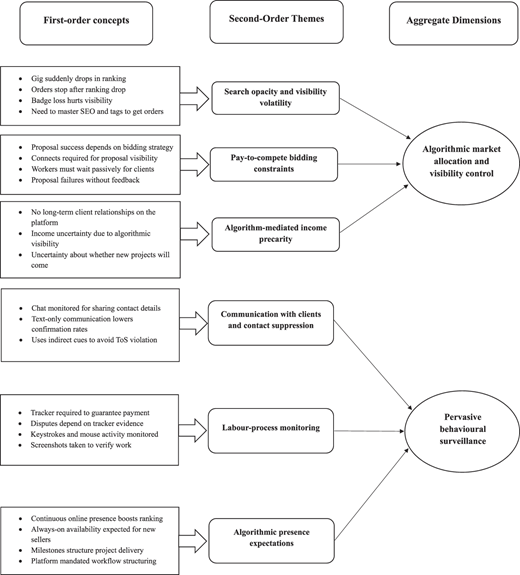
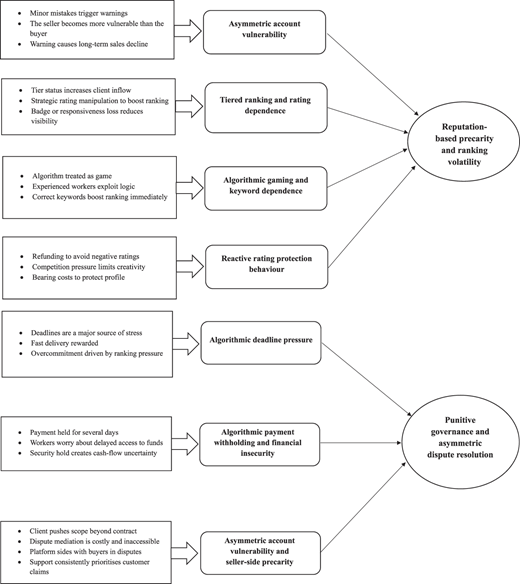
The data analysis followed Gioia’s methodology (Gioia et al., 2013) and was organised around two interrelated analytical layers: the algorithmic HRM stressors freelancers encountered in their platform work, and the coping strategies they mobilised in response. This two-layer structure reflects the theoretical architecture of the TMSC (Lazarus and Folkman, 1984), which distinguishes between stressors, appraisal, and coping responses. Consistent with the abductive approach, TMSC functioned as a sensitising framework, while the analysis remained open to emergent patterns that extended or challenged its assumptions.
The analysis proceeded through three iterative coding stages. In the first stage, the first author, who conducted all interviews and was closely familiar with the dataset, generated informant-centric first-order codes grounded directly in participants’ accounts. These codes retained participants’ language and sensemaking expressions wherever possible. Coding was organised across both analytical layers to maintain analytical clarity between stressors and coping responses. For the stressor layer, the analysis focused on identifying specific algorithmic HRM stressors described by participants. For the coping layer, codes captured the strategies, social arrangements, and resources through which participants responded to the stressors.
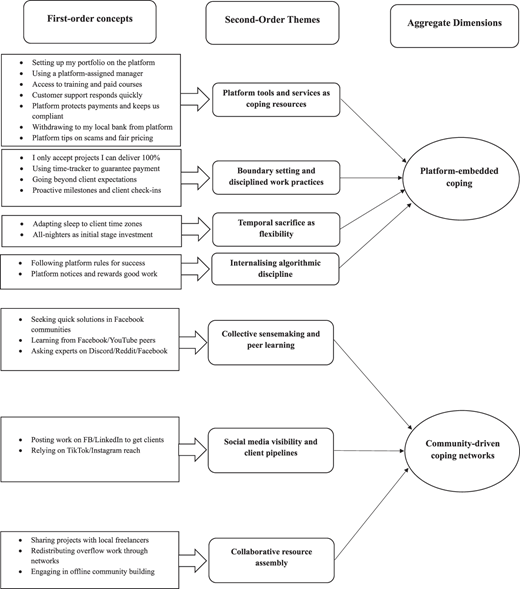
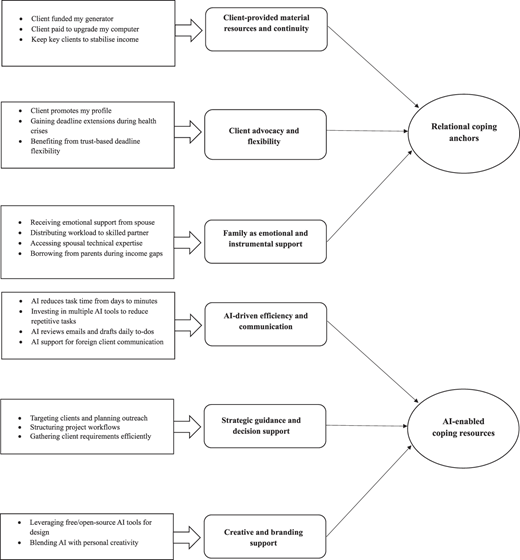
In the second stage, first-order codes were iteratively grouped into second-order themes through multiple rounds of constant comparison within each analytical layer. Because participants rarely articulated appraisal as a discrete cognitive step, appraisal processes were inferred through recurring patterns in their narratives. Specifically, instances in which freelancers sought guidance from peers or platform communities to interpret opaque rules were examined. These instances were treated as indicators of appraisal when they were closely linked to subsequent behavioural adjustments. Such adjustments included refusing off-platform contact, modifying availability windows, and restructuring project milestones. Through successive rounds of comparison, second-order themes for the stressor layer included “Search opacity and visibility volatility”, “Labour-process monitoring”, and “Asymmetric account vulnerability and seller-side precarity”. For the coping layer, themes such as “Collective sensemaking and peer learning” and “Client advocacy and flexibility” were developed, while maintaining analytical separation between experienced stressors and coping responses.
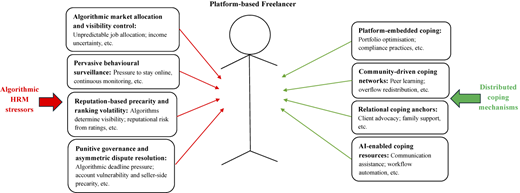
In the third stage, second-order themes were synthesised into four aggregate dimensions within each analytical layer. For the stressor layer, these comprised algorithmic market allocation and visibility control, pervasive behavioural surveillance, reputation-based precarity and ranking volatility, and punitive governance and asymmetric dispute resolution (Figure 1). For the coping layer, the aggregate dimensions were platform-embedded coping, community-driven coping networks, relational coping anchors, and AI-enabled coping resources (Figure 2). Full data structures, including illustrative first-order concepts and representative participant quotations, are provided in Appendix A.
Coder involvement followed a structured and iterative process across all three stages. After completing primary coding of each batch of transcripts, the first author shared the coding with the co-authors. They independently coded a stratified subset of transcripts selected to capture variation in platform type, participant experience, and service category. Coding comparisons were then discussed in team meetings. Areas of convergence and divergence were examined and resolved through collective discussion. These exchanges informed subsequent coding decisions and contributed to the refinement of first-order concepts, second-order themes, and their synthesis into aggregate dimensions across the dataset. Analytical memos maintained by the first author documented coding decisions, interpretive shifts, and emerging theoretical insights throughout the process.
Data saturation was assessed at the level of first-order concepts. During coding, the first author monitored whether successive interview transcripts generated novel conceptual categories beyond those already captured. Saturation was considered to have been reached when additional interviews did not produce substantively new first-order concepts across consecutive transcripts. This assessment was conducted across the two principal service categories in the sample (creative and professional services). The judgement was subsequently reviewed and confirmed through team discussion after the analysis of all 41 interviews.
Across both analytical layers, appraisal emerged as a collective and embedded process rather than a discrete antecedent step. Sensemaking and coping frequently unfolded together, as freelancers jointly interpreted algorithmic signals and acted upon them. This pattern was documented through analytic memos and verified across the dataset. It is treated as a substantive finding, as it challenges TMSC’s assumption that appraisal precedes coping in a linear, sequential process.
3.6 Trustworthiness and ethics
Credibility was strengthened through bilingual data collection and careful translation. Dependability was supported by maintaining a transparent audit trail (e.g., memos, codebooks), and confirmability was ensured through multi-author coding and documented decision paths. Ethical procedures included secure data storage, anonymisation, and the removal of identifying details from quotes.
3.7 Researcher positionality and reflexivity
The first author occupied an insider–outsider position that facilitated cultural and linguistic rapport while requiring vigilance against over-familiarity; translation from Sinhala to English was treated as an interpretive act, with bilingual validation of key excerpts to preserve cultural nuance. A research journal documented contextual factors, subjective reactions, and coding decisions throughout. Regular team debriefings, drawing on complementary expertise in HRM and qualitative methods, enabled critical interrogation of assumptions and mitigated individual bias.
4. Findings
The findings are organised around two analytical layers: the algorithmic HRM stressors participants encountered in their platform work, and the distributed coping strategies they developed in response (Figure 3). The four coping dimensions identified demonstrate how each is linked to specific algorithmic stressors and to how freelancers appraised those stressors as threats, challenges, resource losses, or uncertainty.
Across the four coping dimensions, participants drew on problem-focused, emotion-focused, and meaning-focused coping strategies, often in combination. Distinguishing between these modes matters because coping under algorithmic HRM involves sustained emotional and cognitive labour that largely remains invisible to platform governance. Illustrative participant quotations corresponding to first-order concepts underpinning the identification of algorithmic HRM stressors are provided in Appendix A; the analysis below focuses on interpreting how these stressors are appraised and managed through distributed coping.
4.1 Algorithmic HRM stressors and platform-embedded coping
Platform-embedded coping emerged primarily in response to stressors generated by algorithmic market allocation, pervasive behavioural surveillance, and reputation-based ranking systems. Freelancers appraised these mechanisms as persistent sources of uncertainty about visibility, income continuity, and account security, all perceived as contingent on opaque and continuously shifting algorithmic criteria. Coping was consequently oriented not towards eliminating stressors but towards aligning work practices with platform logic.
Platform-embedded coping encompasses two related but analytically distinct forms. The first involves platform affordances, where freelancers mobilise tools and services explicitly provided by the platform. The second reflects platform-induced behaviours, where freelancers adjust their conduct, time use, and discipline in response to algorithmic surveillance and evaluation. The distinction matters because the two forms reflect different appraisal processes and reveal different dimensions of how algorithmic governance shapes coping.
Platform affordances including portfolio optimisation tools, training programmes, payment dispute mechanisms, and banking infrastructure enabling local withdrawal of earnings were mobilised as problem-focused coping resources, targeting the operational consequences of algorithmic market allocation even where underlying mechanisms remained opaque. Participants described following platform guidance because compliance produced algorithmic rewards: “If you really follow the terms and conditions, give 100% to the gig, and always keep the client updated, then the algorithm pushes your account up …” (P32); “… If we follow those instructions properly, we can succeed” (P13). These tools were not experienced as neutral efficiency aids but as means of rendering algorithmic expectations more legible, with freelancers growing increasingly dependent on prescribed resources to maintain visibility (P3, P5, P13, P16, P25).
Platform-induced behaviours reflect the internalisation of algorithmic discipline through structurally constrained adjustments to conduct. Freelancers reported selectively accepting projects, structuring delivery around platform-mandated milestones, and using time-tracking systems to generate disputable evidence. These practices were driven by threat appraisals of algorithmic surveillance, prompting workers to calibrate behaviour closely to monitored performance indicators. One freelancer described the platform tracker as “the only safe option” because disputes without algorithmic evidence were rarely resolved in workers’ favour (P15). This illustrates how coping took the form of compliance-oriented adaptation that reproduced the very mechanisms generating stress.
A further pattern concerned platform-induced temporal sacrifice in response to algorithmic presence expectations. Among newer entrants, maintaining continuous availability and adapting sleep patterns to client time zones were appraised as challenging but unavoidable short-term investments in ranking improvement. As one participant explained, remaining online throughout the night was essential “at the beginning” because visibility “whenever the client needs” increased account performance (P39). These accounts illustrate how platform flexibility becomes reconfigured as personal responsibility. In doing so, it shifts temporal strain onto the worker. Over time, algorithmic signals governing visibility and responsiveness are naturalised as indicators of individual merit rather than as artefacts of platform governance.
4.2 Algorithmic HRM stressors and community-driven coping networks
Community-driven coping networks emerged most clearly in response to stressors associated with visibility control, reputation-based precarity, and punitive governance, under which freelancers experienced limited feedback, unpredictable visibility shifts, and minimal institutional recourse. These conditions were typically appraised as uncertainty rather than discrete threats, prompting workers to seek interpretive guidance and practical support beyond the platform itself.
Community-driven coping operates through collective sensemaking, whereby freelancers draw on peer networks to interpret platform signals, assess risks, and develop responses to algorithmic rules. Participants described using social media communities on Facebook, YouTube, Discord, and Reddit to obtain advice about account warnings, ranking changes, bidding strategies, and client disputes. These networks were valued not merely as sources of information but as spaces in which individual appraisals of algorithmic events could be validated and recalibrated through shared experience. As one freelancer explained, “If there’s anything doubtful with the platform or with a client, I just put a post in the [a Facebook group for freelancers] Facebook page. That group is run by well-established and experienced freelancers in Sri Lanka. They quickly help” (P16). Through such interactions, collective engagement does not function as a downstream response to individual appraisal. Rather, it becomes the mechanism through which appraisal is produced under conditions of algorithmic opacity.
A critical analytical distinction concerns whether peer networks are emergent or formalised, as each reflects a different coping logic. Emergent networks, such as Facebook groups, comment threads, and peer messaging arose organically and facilitated rapid problem-solving and experiential learning, particularly for newer freelancers encountering opaque mechanisms for the first time. Formalised networks, including nationally organised freelancer groups, platform-affiliated community events, and workshops led by highly ranked practitioners, offered more systematic knowledge transfer and legitimacy, though they remained external to contractual employment relations and conferred no institutional protections. Their coexistence illustrates how community-based coping fills governance gaps without replacing the underlying asymmetries that create them.
Both network types also functioned as income diversification mechanisms, with freelancers cultivating client visibility across LinkedIn, Instagram, and TikTok to buffer against ranking volatility (P1, P4, P7, P21, P28, P34). Established freelancers redistributed overflow orders to trusted peers and collaborated across complementary specialisations (P1, P17). Community-driven coping therefore spanned two TMSC modes simultaneously; problem-focused coping through formalised networks developing platform-legible skills, and emotion-focused coping through emergent networks regulating the anxiety produced by algorithmic HRM. That both modes coexist within a single coping dimension reflects the stressor’s dual nature as simultaneously an informational problem and an emotional burden.
4.3 Algorithmic HRM stressors and relational coping anchors
Relational coping anchors emerged clearly in response to stressors associated with punitive governance, income volatility, and asymmetric account vulnerability, where freelancers appraised algorithmic risks as potentially catastrophic. Without organisational protections such as guaranteed income, sick leave, or enforceable dispute resolution, relational ties functioned as stabilising resources that buffered against income loss and account sanctions, substituting for the contractual protections platform governance withholds.
Freelancers primarily appraised the relational consequences of algorithmic management as resource loss: the erosion of client relationships, professional reputation, and income continuity that would be contractually protected under conventional employment. In TMSC terms, this reflects harm already experienced rather than merely anticipated, as years of accumulated reputation could be undermined by algorithmic warnings (P5, P16, P41). Those who had cultivated durable client relationships simultaneously held a challenge appraisal, reflecting sustained relational investment conducted outside the platform’s matching architecture. As one participant noted, “Around 70% of my platform sales are coming from my key clients” (P33). Such challenge appraisal was not assumed but earned. It distinguishes this coping dimension analytically, as the relational bond itself becomes the coping resource rather than any specific strategy mobilised within it.
At the client interface, freelancers engaged in relational forms of coping, seeking to stabilise work by cultivating continuity, advocacy, and flexibility within relationships that are otherwise structured as transactional by the platform. Trusted clients occasionally provided material support during periods of local disruption, “There were continuous electricity outages during the day, and I was unable to deliver their gigs on time … I told them one solution was to have a generator. Then the client provided the cost for purchasing a generator” (P32). This account is interpretively significant because the client relationship substituted for infrastructure that the platform failed to provide. Appraisal here was relationally mediated, with feasible coping options determined not by individual assessment of personal resources but by anticipated client responses, marking a qualitative departure from platform-embedded coping where stress relief is achieved through rule compliance rather than interpersonal trust. In some cases, client advocacy increased freelancers’ visibility beyond the platform’s matching architecture, as clients’ personal recommendations generated regular new enquiries (P39).
Beyond client relationships, family networks provided emotional reassurance during ranking drops (P5), shared workloads (P6), technical assistance (P36), and short-term financial buffering during income gaps (P30). These supports were particularly salient when stressors were appraised as uncontrollable, generating emotion-focused coping aimed at maintaining psychological endurance. Family members assumed roles as emotional regulators, financial backstops, and informal co-workers that organised welfare systems would conventionally provide, demonstrating how algorithmic management restructures not only work practices but also the distribution of risk and care within intimate relationships.
4.4 Algorithmic HRM stressors and AI-enabled coping resources
AI-enabled coping emerged in response to stressors associated with algorithmic deadline pressure, and visibility competition, which freelancers appraised as persistent and time-intensive rather than episodic. Under these conditions, AI systems were not experienced as optional enhancements but as situational means of sustaining participation within increasingly compressed performance expectations.
A critical interpretive distinction concerns whether AI operates as a coping resource or as a coping tool within the TMSC. The findings reveal that AI does not function as a stable resource available prior to appraisal. Instead, it is activated through appraisal as a contingent coping tool, drawn upon in response to perceived algorithmic pressure. In this sense, AI temporarily enables coping by expanding informational, temporal, or cognitive capacity, but its availability remains contingent on freelancers’ economic means, learning effort, and continued platform participation.
Where stressors were appraised as tractable but overwhelming, AI supported problem-focused coping through efficiency gains. Freelancers described using generative AI to draft proposals, structure project workflows (P11), summarise client requirements, and automate repetitive tasks (P22), completing work that previously required days “in five minutes” (P28). AI also reduced the communication burden associated with linguistic inequality in global markets, combining problem-focused coping through improved accuracy with emotion-focused coping through reduced anxiety in client interaction (P16). Where stressors were ambiguous, AI supported meaning-focused coping by helping freelancers structure decision-making and restore a sense of interpretive control over their work (P11, P19).
Importantly, AI-enabled coping did not reduce exposure to algorithmic stressors or loosen dependence on platform governance. By expanding freelancers’ capacity to absorb work demands, AI tools intensified expectations of speed, availability, and output (P22). Freelancers therefore appraised AI as empowering in the short term, while its adoption normalised accelerated performance standards subsequently encoded into platform requirements. AI thus functions as a compensatory coping tool that temporarily operates as a coping resource. In doing so, it enables compliance with algorithmic demands rather than resistance to them.
5. Discussion
The findings show that platform-based online freelancers encounter distinct algorithmic HRM stressors, including visibility control, behavioural surveillance, ranking volatility, and punitive governance. These stressors are appraised as threats, challenges, resource losses, and conditions of uncertainty, and are managed through distributed coping strategies spanning platform-embedded practices, peer networks, relational ties, and AI-enabled tools. Together, these patterns indicate that coping under algorithmic HRM is not solely an individual process. Instead, it is distributed across interconnected socio-technical arrangements.
Building on these findings, this study advances theorisation of coping under algorithmic HRM by demonstrating that appraisal and coping in this context are not exclusively individually enacted nor institutionally supported, but are instead distributed across peer networks, client relationships, family support, and AI-enabled tools. These patterns expose specific limitations in the TMSC (Lazarus and Folkman, 1984) and provide an empirical basis for extending the model beyond its individually centred and institutionally embedded assumptions.
In contrast to prior applications of TMSC in organisational or location-based platform contexts, where these assumptions are less visibly strained (Caparas, 2026; Chi et al., 2025; Lu et al., 2025; Weber et al., 2025), the Sri Lankan online freelancing context functions as a boundary condition that makes these assumptions increasingly difficult to sustain empirically. By foregrounding the socio-structural organisation of coping, this study extends research on algorithmic HRM and gig work that has focused primarily on individual adaptation and resilience (Alvarez De La Vega et al., 2023; Duggan et al., 2023; Fiers, 2024; Jabagi et al., 2025; Weber et al., 2025).
Consistent with arguments that algorithmic systems function as work designers (Parent-Rocheleau and Parker, 2022), the distributed coping practices identified here can be understood as attempts to reconstruct job resources eroded by algorithmic management. Rather than restoring security or control, however, these practices reconfigure coping itself as a collective, relational, and technologically mediated process shaped by platform governance. Together, these dynamics produce a coping landscape that the existing TMSC apparatus is poorly equipped to explain.
5.1 Theoretical contributions
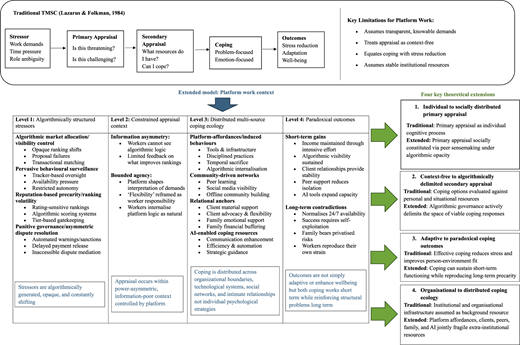
Although highly influential, the TMSC (Lazarus and Folkman, 1984) was developed with implicit assumptions of informational transparency, institutional support, and individual agency that may not fully transfer to algorithmically governed work contexts. Building on the tensions identified in platform-based online freelancing, this study advances TMSC through four analytically distinct extensions. These extensions reposition appraisal, coping, and coping outcomes within broader socio-structural conditions shaped by algorithmic HRM.
5.1.1 Extension 1: primary appraisal reconceptualised as socially distributed
TMSC conceptualises primary appraisal as an individual cognitive process, presupposing sufficient informational access for independent evaluation of stressors (Lazarus and Folkman, 1984). Under algorithmic management, this assumption becomes more difficult to sustain. Ranking systems, matching algorithms, and disciplinary thresholds generate consequential outcomes without disclosing their underlying logic, limiting workers’ ability to interpret stressors independently (Kellogg et al., 2020; Lippert et al., 2026).
The findings suggest that freelancers may respond to this opacity by engaging in collective sensemaking through peer networks. In such contexts, appraisal can extend beyond individual cognition and become embedded in social interactions where platform signals are interpreted collaboratively. Social engagement therefore appears to play a constitutive, rather than purely subsequent, role in appraisal processes (Aroonsri and Crocco, 2024). Collective sensemaking also has broader consequences, as platforms recalibrate their systems in response to workers’ interpretive practices (Dasgupta et al., 2026). In turn, these recalibrations shape the governance conditions under which future appraisals occur.
This extension suggests that primary appraisal may be better understood as a socially embedded process under conditions of algorithmic opacity. In doing so, it highlights a dimension of appraisal that remains relatively under theorised in applications of TMSC to digitally mediated work.
5.1.2 Extension 2: secondary appraisal reconceptualised as structurally delimited
Within TMSC, secondary appraisal is typically conceptualised as an individual evaluation of available coping options and resources (Lazarus and Folkman, 1984). Structural conditions are considered relevant but are generally mediated through subjective perception rather than theorised as direct constraints. The findings of this study suggest that this assumption may require reconsideration in the context of algorithmic HRM.
In platform-based online freelancing, coping options are often shaped by platform architecture. Surveillance systems, performance metrics, and disciplinary mechanisms can render certain responses risky or sanctionable, thereby limiting the range of feasible actions available to workers. As a result, some possible coping strategies may be excluded before appraisal is fully formed. Conventional resources (e.g. work-life balance and compensation) may offer limited relief in this context, as platform architecture can transform them into sources of strain rather than support (Duggan et al., 2026). This evidence suggest that secondary appraisal is shaped not only by what workers perceive as available, but also by the ways in which platform design conditions the resources they draw upon.
In this context, secondary appraisal may be less open-ended than typically assumed. It may instead be shaped by the constraints imposed by platform architecture. This extension highlights the importance of considering structural constraints as active determinants of coping feasibility, rather than treating them solely as background conditions within the appraisal process.
5.1.3 Extension 3: coping outcomes reconceptualised as potentially paradoxical
TMSC evaluates coping effectiveness primarily in terms of reduced stress and improved person–environment fit, and it often treats outcomes as individually resolvable (Lazarus and Folkman, 1984). The findings of this study, however, suggest a more complex pattern in algorithmically governed work contexts.
Across the identified coping dimensions, strategies that alleviate immediate strain, including platform compliance, peer-guided sensemaking, and AI-supported efficiency, may also contribute to longer-term dependence on the systems that generate stress. These patterns indicate that coping can support short-term stability while simultaneously reinforcing underlying conditions of precarity, a dynamic that recent evidence identifies at both individual and structural levels (Dasgupta et al., 2026; Maffie and Hurtado, 2026; Mansour, 2026).
Such outcomes are therefore not necessarily anomalous but may reflect structural features of labour markets characterised by limited exit options (Beerepoot, 2026). This extension broadens TMSC by suggesting that coping effectiveness should be considered at both individual and structural levels. Specifically, strategies that are beneficial in the short term may also reproduce the conditions that generate stress over time.
5.1.4 Extension 4: coping resources reconceptualised as a distributed ecology
TMSC generally assumes access to organisational and institutional resources that support appraisal and coping (Lazarus and Folkman, 1984). In platform-based online freelancing, such resources may be fragmented or absent. Instead, the findings indicate that freelancers assemble coping resources across a range of distributed sources.
These include platform affordances, peer and mentor networks, client relationships, family support, and AI-enabled tools. This constellation of resources does not function as a direct substitute for organisational provision. Instead, it represents a qualitatively different configuration. Resources are often informal, interdependent, contingent, and in some cases emerge through coping practices themselves rather than preceding them. The stability of this distributed ecology is not uniform. It depends on how platform design shapes the conditions under which resources are accessed and experienced. Workers’ trust in platform systems is strengthened when evaluation criteria are transparent and scheduling is predictable, but it is undermined when compensation practices are opaque, regardless of earnings (Mustafa and Mansour, 2026). Workers’ cognitive orientation toward algorithmic systems further shapes these dynamics. When workers attribute intentionality and agency to non-human managerial systems, this influences the psychological contracts they form with platforms and their willingness to continue engaging (Sherman et al., 2025).
This study conceptualises this arrangement as a distributed coping ecology. It suggests that coping under algorithmic HRM is sustained through multi-actor configurations whose stability may vary across contexts. This perspective extends TMSC by foregrounding the relational and distributed nature of coping resources in platform-based work.
Taken together, these four extensions suggest a repositioning of TMSC as a more explicitly socio-structural framework for understanding stress and coping under algorithmic HRM. Figure 4 synthesises the extensions by illustrating how appraisal processes, coping resources, and coping outcomes are reconfigured within algorithmically governed platform work.
5.2 Practical and policy implications
The findings highlight actionable priorities for multiple stakeholders, with implications that are particularly acute in Global South contexts where structural constraints intensify (Galpaya et al., 2018).
Platform operators possess the most immediate capacity to reduce the burdens generated by algorithmic HRM. Transparency in ranking criteria, task allocation, and performance metrics would reduce the interpretive labour currently shouldered by peer networks (Waldkirch et al., 2021; Kellogg et al., 2020). Accessible dispute-resolution mechanisms and structured mentoring would similarly redistribute functions that, in conventional employment, are managed through organisational HR systems (Duggan et al., 2020). Platforms could prioritise explainable performance metrics and flexibility-preserving scheduling over monetary incentives as the primary mechanisms for sustaining worker engagement. Transparent evaluation and predictable scheduling strongly support worker trust and continuance intention, whereas compensation opacity undermines trust even when earnings are adequate (Mustafa and Mansour, 2026). Evidence suggests that consistently applied algorithmic systems can also enhance worker trust and platform performance (Lu et al., 2025).
However, it would be misleading to assume platforms are strongly incentivised to pursue such reforms voluntarily. Algorithmic opacity frequently functions as a strategic design feature. In bid-based systems, it intensifies worker effort, while surveillance mechanisms shift quality-assurance responsibilities onto workers, reducing operational costs and limiting platform accountability (Blyth et al., 2024; Fiers, 2024). Informal coping infrastructures, such as peer support and family assistance, further absorb welfare functions that platforms would otherwise be expected to provide. As platforms consolidate market position, workers absorb escalating operational burdens through adaptive responses that sustain participation without resolving underlying precarity (Maffie and Hurtado, 2026). This dynamic is reinforced by evidence that platforms actively recalibrate their algorithmic mechanisms in response to workers’ adaptive acts, making workers inadvertent contributors to their own tightening control (Dasgupta et al., 2026). These short-term efficiencies carry longer-term risks. Service quality on global digital labour platforms increasingly depends on a small core of experienced providers (Beerepoot, 2026). In turn, intensified algorithmic governance may accelerate exit among the very workers whose skills and reputation underpin platform credibility.
Governments and policymakers play a critical complementary role. Freelancers contribute significantly to foreign-exchange earnings (Galpaya et al., 2017; World Bank, 2023) yet operate without reliable infrastructure. Investment in stable electricity and affordable high-speed internet, alongside regulatory frameworks providing portable benefits, collective bargaining rights, and algorithmic accountability requirements, would strengthen competitiveness and address the structural conditions that amplify stress (Keegan and Meijerink, 2025; Perera et al., 2024). Regulatory frameworks could extend beyond contractual protections to address the cognitive demands workers face when navigating algorithmically governed labour markets, where proactive coping strategies may simultaneously sustain engagement and generate new psychological costs (Mansour, 2026; Zhang et al., 2026).
Informal worker collectives occupy a vital but fragile position. Formalising peer networks through cooperatives could stabilise knowledge-sharing, enable resource pooling, and strengthen platform advocacy, including collective negotiation over commission rates and transparency standards (Aroonsri and Crocco, 2024). Educational institutions should also integrate digital labour ethics, algorithmic literacy, and client relationship management into curricula alongside technical skills, equipping both workers and future managers to engage critically with the governance architecture of algorithmically mediated work (Roper et al., 2022; Fiers, 2024).
6. Conclusion and direction for future research
This study advances understanding of coping under algorithmic HRM by identifying four theoretical extensions to TMSC in the context of platform-based online freelancing. The Global South setting provides important theoretical leverage. It reveals how infrastructural fragility, regulatory absence, and reliance on informal support systems shape distributed coping processes. Sri Lanka’s specific economic conditions and culturally embedded family arrangements may generate patterns that differ from other developing-economy contexts. Cross-country comparative studies spanning different levels of platform penetration and regulatory protection would therefore provide a useful test of the generalisability of these findings.
Longitudinal research tracking freelancers over time would illuminate how coping strategies evolve and how relationships with platforms, clients, and peer networks change across career trajectories. Multi-method designs combining interview data with analysis of online community interactions and platform-level data would offer richer insight into distributed coping dynamics. Further theoretical development may also draw on socio-technical systems theory and social support theory to explain how informal coping infrastructures stabilise or deteriorate under algorithmic governance.
Ethics approval
This study received approval from the University of Tasmania Human Research Ethics Committee (approval number: H0032312).
The authors thank the Guest Editors of the Special Issue on “Decoding Algorithmic HRM in the Gig Economy: Workers’ Interpretations, Reactions, and Strategies,” as well as the two anonymous reviewers, for their constructive feedback, which significantly strengthened the manuscript. The authors also acknowledge the contribution of publicly accessible online practitioner communities, which informed reflexive journalling and analytical memo writing during data collection and analysis. An initial version of this work was presented at the Annual HDR Conference of the Tasmanian School of Business and Economics (TSBE), followed by a more developed version discussed at the ANZAM Doctoral Workshop (2025), and the authors are grateful for the valuable feedback received at both stages.
The supplementary material for this article can be found online.