This paper proposes a model for understanding the key features of coaching and the mechanisms of change that lead to professional learning and development in an educational context.
The model was developed through an interactive process of conceptualisation and testing, drawing on a synthesis of findings from two case studies of coaching for early childhood educators. The case studies were analysed through four theoretical lenses and influenced by a critical realist perspective.
The synthesis of findings from case study data suggests that critical reflection is the key mechanism that drives learning and change in coaching. The findings further suggest that the focus should be meaningful and relevant to educators and their contexts (“coherent”), yet different enough from educators' pre-existing beliefs, practices, or assumptions to trigger critical reflection (“challenging”). The findings also indicate the processes and conditions of coaching that may be important to enable critical reflection on the issue in focus. The proposed model presents the focus, processes, conditions, and key mechanisms of coaching as interlinked components.
What happens during coaching and how and why it “works” is not well understood. The proposed model provides a framework for further exploring the features of coaching, its impact on learning and practice and the mechanisms of change that underpin these impacts. It could provide guidance for continued innovation and evaluation of coaching practice in early childhood education more broadly.
Introduction
Innovative forms of professional learning and development (PLD) such as coaching have been gaining popularity, including in early childhood education and care (ECEC) (Borko, 2004; Desimone and Pak, 2017; Kraft et al., 2018; Organisation for Economic Co-operation and Development [OECD], 2022; Schachter et al., 2023). However, what underlies the success of coaching is not well understood. As Timperley et al. (2007) and others (e.g. Powell and Diamond, 2013) have noted, the processes by which coaching and other forms of PLD lead to change in a range of educational contexts can be considered a “black box”, worthy of unpacking.
Unpacking this “box” first requires identifying what happens during coaching and which features of coaching are most important. In a previous literature review, we identified several common features of coaching in ECEC (Elek and Page, 2019). Features that appeared to be critical included that it is (1) ongoing, (2) individualised and (3) in situ. These features enable coaches to respond to educators' characteristics and contexts and provide opportunities to practise new skills. Literature on PLD more broadly suggests there is a consensus that “core” features of PLD are active learning, coherence, a focus on content, ongoing duration, and collective participation (Darling-Hammond et al., 2017; Desimone, 2009; Timperley et al., 2007). Except for collective participation, these features are often seen in coaching (Cirkony et al., 2021; Desimone and Pak, 2017). However, this consensus has been called into question. Empirical evidence suggests that not all these features may be necessary for success or that it may be the number or combination of features that drives success (Asterhan and Lefstein, 2023; Kennedy, 2016; Kraft et al., 2018; Sims and Fletcher-Wood, 2021; Sims et al., 2025). This indicates that a focus on features alone is insufficient to understand how and why coaching leads to learning and practice change.
To address this, many have suggested that an alternative way of understanding coaching is required (Boylan et al., 2018; Kennedy, 2014; Schachter, 2015; Spence and Oades, 2011; Yang et al., 2022). Similarly, there have been repeated calls for an improved theoretical understanding of PLD to support the selection, design, and evaluation of PLD and coaching programs (Sheridan et al., 2009; Sims et al., 2025; Snyder et al., 2012; van der Linden et al., 2021).
To fill this gap, a wide range of models, theories, or frameworks of PLD have been applied to understand the effects of coaching (Elek et al., 2024), some of which are specific to coaching (de Haan et al., 2013; Kraft et al., 2018; Lofthouse and Leat, 2013). However, these models are often contradictory (Elek et al., 2024). Further, many are lacking in empirical evidence or arguably undertheorise the change processes that take place (Boylan et al., 2018; Elek et al., 2024). Further research is needed to consider how and why the features of PLD interact with one another to influence learning or practice, and the mechanisms by which these processes occur (Cirkony et al., 2021; Goldsmith et al., 2014; Kennedy, 2016; Sims et al., 2025).
In this article, we draw on a synthesis of findings from our analysis of case study research undertaken with two coach-educator pairs working in ECEC in Australia to elicit, propose and test a model for understanding the key features and mechanisms in coaching. Drawing on several definitions of coaching in the literature (e.g. McLeod et al., 2019; National Association for the Education of Young Children [NAEYC] and National Association of Child Care Resource and Referral Agencies [NACCRRA], 2011; van Nieuwerburgh, 2012), we define coaching as the provision of individualised, collaborative and ongoing PLD for an educator that facilitates their growth or learning of job-related skills and practices in order to support children's learning and development. Early childhood education and care refers to the provision of services that support the learning and development of children aged from birth to school age. In Australia, this generally entails services for children from birth to five years (Australian Government Department of Education [AGDE], 2022).
The research questions we address are:
How can coaching and its features be conceptualised to support planning, understanding and evaluating coaching programs?
Which features of coaching influence learning and change for early childhood educators?
Methods
We answer the first question by proposing a model for understanding coaching, arrived at through an iterative process of conceptualisation through application to our empirical data. We then elaborate and test the model to demonstrate how it could be used and identify what may be the key features and mechanisms of coaching for early childhood educators, thereby indicating what our empirical data indicates regarding the second research question.
To achieve this, we drew on a synthesis of findings from two case studies of coach-educator pairs engaged in monthly coaching in one ECEC service in Australia. The service was located in an outer metropolitan area of Melbourne, Victoria, and had received the highest rating of “excellent” according to the quality standards for ECEC in Australia. All staff received coaching from more senior colleagues, and coaches were trained to use the GROW model of coaching, which emphasises personal growth and progress towards goals set by the coachee (Whitmore, 1992). The study was approved by The University of Melbourne Human Research Ethics Committee and the Victorian Department of Education. All participants had either a bachelor's degree in education or a diploma in early childhood education.
Data was collected via video recordings, interviews, questionnaires and administrative documents. Over a period of five months, four coaching sessions for each case were video recorded, and each participant was interviewed six times separately: one before the first coaching session, one soon after each session, and one 18 months later. Further, participants completed brief study-designed questionnaires following each session, and contextual information was gathered via administrative documents. The data thus included video and audio files and transcripts, administrative documents and field notes. Further detail about the participants and methods can be found in previously published articles (Elek et al., 2022, 2025).
This article focuses on a model we developed using an iterative process of conceptualisation and testing through application to the findings of our previous analyses. Analysing case study research allows for such conceptualisation because the aim of case study research in complex, real-world settings is to identify the mechanisms that operate within the given context by identifying patterns and regularities in the case studies (Opfer and Pedder, 2011). Case study research is not designed to be generalisable. However, in line with a critical realist perspective, case study research can lead to rich, contextual understandings and enable “analytic generalisations” or inferences to be made that are worthy of further exploration. This can include inferences about how the mechanisms might influence outcomes in other contexts (Merriam, 1988; Wynn and Williams, 2012; Yin, 2018).
To enable such inferences, we first analysed our findings through four theoretical lenses, models, or frameworks to identify the features and mechanisms at play during coaching and to determine the most plausible explanation for the phenomena. These four lenses were:
The interconnected model of professional growth (IMPG; Clarke and Hollingsworth, 2002);
Desimone's (2009) core conceptual framework;
Self-determination theory (SDT; Deci and Ryan, 1985); and
Transformative learning theory (TLT; Mezirow, 1978).
We used a mix of qualitative and quantitative analytic methods appropriate to the respective theoretical lenses, including the use of template analysis for coding qualitative data (King and Brooks, 2018; Ritchie and Spencer, 1994) and analysis of “input” and “directiveness” in coaching interactions (Elek et al., 2022; Hennissen et al., 2008).
Then, we synthesised the findings to explore how coaching influences learning and change for educators. Drawing also from the wider body of literature, we developed the proposed model, which we then further elaborated and refined through application to the case study data. Matrix analysis (Miles et al., 2014; Nadin and Cassell, 2004) was the primary method we used to synthesise and interpret findings across cases in the context of the extant literature and arrive at the model. Through this iterative process, we also delineated what the case study data suggested might be the key features of coaching, as understood through the lens of the proposed model.
Results and discussion
In this section, we first give a brief overview of the case study findings as context for the subsequent discussion. Detailed results are reported elsewhere (Elek et al., 2022, 2025). Then, we present our proposed model, followed by a discussion of what the findings of our case study research suggest regarding the features and mechanisms of coaching, viewed through the lens of our proposed model.
Overview of the case studies
Coaching in our case studies entailed many of the practices and conditions commonly seen in coaching in ECEC, including those often considered important for the success of PLD. These included active learning strategies such as feedback and reflection, an ongoing duration, and a supportive context (Elek and Page, 2019). However, the coaching differed from common practice in several ways. Most notably, the coaches were not external “experts” and the coaching did not focus on subject matter, a feature often considered key to effective coaching. Instead, the coaches were more senior colleagues at the same service, and the coaching was flexible and adapted to each educator, their priorities, and their contexts (Elek et al., 2025).
The coaching led to several changes in practice, knowledge, attitudes, and beliefs for both educators, and it was valued by participants and viewed by educators as an opportunity to be understood and supported (Elek et al., 2022). The order in which changes occurred varied. For instance, changes in practice occurred both before and after changes in knowledge, attitudes, and beliefs (Elek et al., 2025). Together, the findings illustrate that how coaching unfolds is influenced by a complex interplay of factors such as context, content, processes, and individual characteristics.
A model for the features of coaching
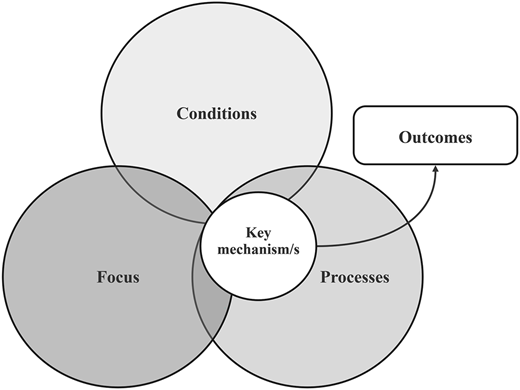
To commence the iterative process of conceptualisation and testing, we delineated the features of coaching observed using a three-part framework informed by literature on the features of professional development (Buysse et al., 2009; Powell and Diamond, 2013; Schachter, 2015; Sheridan et al., 2009). This three-part framework consists of focus, process, and conditions. Focus refers to the subject matter or content of the coaching, or the outcomes that are the target of the coaching. Processes refer to how the coaching happens, including the strategies coaches use. Conditions include the structure of coaching as well as the context in which it takes place and the coaching relationship. Then, influenced by the theoretical lenses we used to analyse case study findings and our critical realist conceptual framework, we identified a fourth element, mechanisms. Mechanisms can be defined as processes that must take place for a particular outcome to occur as a result of an event or input in a particular context or social structure (Maxwell and Mittapalli, 2010; Pawson and Tilley, 2004). In coaching, mechanisms can be seen to differ from the processes of coaching because they relate less to what the coach does and more to how the educator responds to the coaching in a particular context (Pawson and Tilley, 2004). In our model, mechanisms are seen to connect all other features to the outcomes of coaching. A representation of this model can be found in Figure 1. We propose this model as a framework for understanding, planning, or evaluating coaching. In the next section, we elaborate the model by using it to describe the features of coaching that influenced learning and change in the case studies.
What influenced learning and change?
We elaborated, refined, and tested the model through application to the case study data. The synthesis of findings using our model indicates what might be the key mechanisms and features of coaching for early childhood educators. The findings can be grouped into four themes:
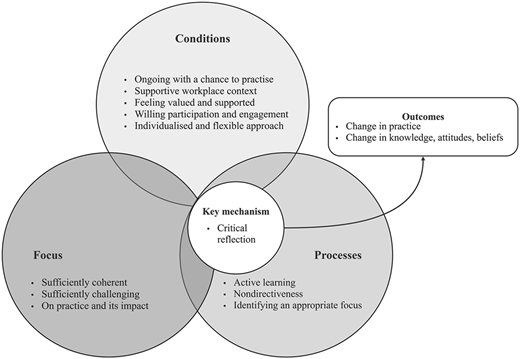
Critical reflection as the key mechanism of coaching;
Striking the right balance in the focus of coaching: coherence and challenge;
Processes to enable critical reflection;
Conditions to enable critical reflection.
The application of our model to the findings from the case study is represented in Figure 2.
Critical reflection as the key mechanism of coaching
The findings of this research suggest that reflection is the key mechanism of coaching that supports change for early childhood educators. This finding was arrived at primarily through analysing case study data using the IMPG and TLT, which identified that critical reflection occurred in the vast majority of changes to educators' knowledge. This claim echoes the commonly held view that reflection is central to the success of coaching (Cirkony et al., 2021; Domitrovich et al., 2009; Jayaraman et al., 2015; Landry et al., 2011; Rush and Shelden, 2011).
However, reflection has come to mean a wide range of processes, including in ECEC (Brownlee et al., 2021; Marbina et al., 2011). The type of reflection identified in this research can be described as critical reflection. We draw from TLT to define critical reflection as reflection involving deliberation on a dilemma, self-examination, or exploration of new or revised meaning perspectives and how these might be applied to practice. According to TLT, it is the reflection on “meaning perspectives” that distinguishes critical reflection from reflection. Meaning perspectives include points of view, frames of reference, habits of mind, and assumptions that underpin one's understandings or practices (Taylor, 2000).
The subsequent themes explore what foci, processes, and conditions were found to support critical reflection as the key mechanism driving change in these cases.
Striking the right balance in the focus of coaching: coherence and challenge
It is often suggested that the focus of coaching is a key driver of its success (Aikens and Akers, 2011; Kraft et al., 2018). The findings from our case studies support this view, indicating that the focus or topic of coaching may have had a greater influence than the context or individual characteristics on the changes that occurred during coaching, and the order in which they occurred. In these cases, similar content led to similar sequences of change, even within the same coach-educator pairs (Elek et al., 2025). For instance, when processes of documenting children's learning were discussed, both educators responded to the discussion during coaching by first changing their practice, followed by their knowledge, attitudes, and beliefs.
However, what the focus of coaching should be is less clear in the literature. The focus in the coaching observed in our research was not predetermined but negotiated between the coach and educator in each session. In our cases, the focus of coaching included changes in sleep and settling practices, documentation processes, or social roles such as confidence and leadership. They did not focus on subject matter content, which is often seen to be critical to the success of PLD, including coaching (Aikens and Akers, 2011; Desimone, 2009, 2023; Desimone and Pak, 2017; Ingvarson et al., 2005; Kraft et al., 2018; Timperley et al., 2007) and has been found to be common in coaching for ECEC educators (Elek and Page, 2019; Schachter et al., 2023; Yang et al., 2022). Since the coaching in these cases successfully led to change, our research supports the less commonly held suggestion that a focus on other issues can also be effective in coaching or PLD, including educators' attitudes, beliefs, self-confidence, planning skills, and relationships with other providers (Boyle et al., 2021; Opfer and Pedder, 2011; van der Linden et al., 2021).
Given that coaching with a range of foci can be effective, it could be that it is not the issue itself but the nature of the issue and how it relates to the educator and their context that is important. Our findings suggest that for coaching to lead to learning and practice change, the issues in focus during coaching should strike a balance between coherence and challenge.
Coherence can be defined as consistency with educators' prior knowledge or beliefs or the context, such as current policies, programs, and curriculum (Desimone, 2009). It is often suggested that PLD should respond to the needs of educators by identifying topics or goals that are relevant to and aligned with their contexts, beliefs, and practices (Boyle et al., 2021; Labone and Long, 2016; Landry et al., 2011; LoCasale-Crouch et al., 2016). This is in line with broader principles of adult learning, in which responding to and building on learners' experiences, interests, and needs is advised (Darling-Hammond et al., 2017; Knowles et al., 2015). Similarly, SDT suggests that aligning the focus of coaching with educators' values and interests promotes a sense of autonomy and contributes to motivation to continue to learn and improve practice (Deci and Ryan, 1985; Ryan and Deci, 2018; Schiemann et al., 2018).
The findings of this study suggest two key factors that may support coherence in coaching: an individualised and flexible approach, and a focus on practice and its impact. That coaching is generally an individualised form of PLD means that coaching is well-placed to support coherence, enabling coaches the flexibility to take into account the characteristics of individuals, their prior beliefs, and their contexts while maintaining fidelity to the coaching approach (Domitrovich et al., 2009; Hubers, 2020; Opfer and Pedder, 2011; LoCasale-Crouch et al., 2016; Shannon et al., 2021). In our case studies, there was no predetermined content for the coaching, so the coaching could be tailored entirely to the individual educators. This arguably supported coherence and therefore the impact of the coaching identified in these cases.
Like other studies of PLD and coaching (Diezmann et al., 2007; Tillema, 2000; Zwart et al., 2007), our research suggests that critically reflecting on practice and/or its impact is associated with consolidating change. This finding provides support for the model of teacher change proposed by Guskey (1986, 2002), which suggests that changes in beliefs are consolidated when educators appreciate the impact of new practices. It also aligns with the foundational work of Schön (1983) and suggests a symbiotic relationship between reflection and action in professional practice. The relationship we found between reflection and practice also aligns with the view that reflection for early childhood educators is not critical unless it involves enacting changes to practice (Brownlee et al., 2021). Further, this alignment indicates a close connection between the two mechanisms of change proposed within the IMPG: reflection and enactment, as well as its emphasis on reflecting on the outcomes that educators perceive to be salient (Clarke and Hollingsworth, 2002; Elek et al., 2025). Taken together, the literature and the findings of our research suggest that focusing on issues of practice and its impact can not only support reflection and change but also support coherence by keeping the focus of coaching relevant to educators' daily work.
In contrast to an emphasis on coherence, however, some argue that learning is most likely to take place when there is sufficient challenge or dissonance between the focus or goals of coaching and educators' pre-existing beliefs, practices, or assumptions (Fisher-Yoshida, 2009; Marbina et al., 2011; Nolan and Molla, 2018; Opfer and Pedder, 2011). According to this view, the focus or goal of coaching should be different enough from the educator's current practice, assumptions, values, or beliefs to induce a degree of discomfort (Opfer and Pedder, 2011). Similarly, in TLT, a degree of “disorientation” has been seen as important to spur critical reflection and therefore important for learning and change (Mezirow, 1990). This kind of discomfort is arguably beneficial as long as it is within a supportive and comfortable environment (Fisher-Yoshida, 2009; Mälkki, 2010; McLeod, 2015; Mezirow, 1990; Nolan and Molla, 2018; Opfer and Pedder, 2011). The findings of our research provide some support for this view, as coaches sought to challenge educators to critically reflect on issues that they were somewhat uncomfortable with. One coach believed that doing so challenged the educator she was coaching to think more deeply.
Coherence and challenge can coexist in the focus of coaching. Indeed, coaching could be most effective when it strikes the right balance between the two. Our research suggests that this balance can be achieved when the focus of coaching is sufficiently relevant to be “coherent”, thereby promoting a sense of autonomy and engaging the educator in the process, yet challenging enough to provoke critical reflection and change. For instance, in one case, the coaching focused on an educator's ability to articulate her practice well, an issue relevant to her daily practice but which she found challenging. The individual and flexible nature of coaching and a supportive coaching relationship could be key to enabling the identification of a focus that strikes this balance.
Processes to enable critical reflection
Our research suggests that who does the “thinking” during coaching may be key to its success. By thinking, we mean actively and autonomously engaging in the coaching through critical reflection, and we propose that this is essential for coaching to lead to learning or practice change. This can be contrasted with coaching in which the coach dominates the conversation by sharing feedback or giving advice, for example. Our research highlights several processes that can help achieve this, including taking a nondirective approach to the coaching conversation and other strategies to support active learning.
Active learning strategies are seen by many as key to the success of effective PLD (Darling-Hammond et al., 2017; Desimone, 2009; Ingvarson et al., 2005; Knowles et al., 2015; Kolb et al., 2001; Opfer and Pedder, 2011; Timperley et al., 2007). Examples of active learning strategies in coaching include observation, reflection, goal-setting, planning, practising, collaboration, and discussion (Elek and Page, 2019). According to TLT, active learning strategies such as these are important because they create moments of discomfort or disorientation that, in turn, create opportunities for educators to critically reflect on their meaning perspectives (Fisher-Yoshida, 2009; Holdo, 2023; Nolan and Molla, 2018).
SDT suggests that most important among the active learning strategies are those that promote an educator's sense of autonomy, as these support engagement in the coaching process, critical reflection, and motivation to learn or change practice (LeeKeenan, 2020; Ryan and Deci, 2018). Supporting educators to identify topics for discussion and reflection, or to choose from among a selection of topics, is one way to support autonomy (Elek et al., 2025; Hollingsworth and Clarke, 2017). Another is to support the educator to “lead” the conversation and the reflection after a topic is introduced, such as through open-ended questioning (Schiemann et al., 2018; Spence and Oades, 2011). Coaches who do so could be described as using “nondirective” skills (Hennissen et al., 2008). In our case studies, coaches found themselves being more directive than they had planned to be (Elek et al., 2022), which is not unusual for coaches (LeeKeenan, 2020; Nugent et al., 2023). However, coaches still used many nondirective strategies to support critical reflection, learning, and change, and this was associated with critical reflection and the changes in practice and views.
Conditions to enable critical reflection
Enacting processes to support critical reflection requires supportive conditions. Arguably, reflection, particularly reflection that is sufficiently critical, is unlikely to happen without the appropriate support and conditions (Holdo, 2023; Knight, 2011; Mälkki, 2010; Moon, 1999).
Commonly seen as crucial are structural conditions, such as a workplace context that supports ongoing and individualised coaching embedded in an organisation and provides opportunities to practise (Borko, 2004; Darling-Hammond et al., 2017; Joyce and Showers, 2002; Kraft et al., 2018; Labone and Long, 2016; Opfer and Pedder, 2011; Thompson et al., 2021; Timperley et al., 2007). The findings of our research corroborate this view. However, our research findings pertain most to the importance of relational conditions between the coach and educator.
As Moon (1999) noted, a person cannot be forced to reflect. However, a coach can facilitate critical reflection by creating the appropriate conditions. Because change can be difficult, it is argued that it is important to create a “safe” space for this to occur, including a safe coaching relationship (de Haan et al., 2013; Gessnitzer and Kauffeld, 2015; Knight, 2011; Nugent et al., 2023; O'Broin and Palmer, 2010). To achieve this, the literature highlights that mutual respect, reciprocity, collaboration, trust, security, openness, and a sense of “partnership” are important for educators to feel comfortable discussing concerns, goals, and plans or trying out new ideas or skills (Knight, 2011; Reeve and Jang, 2006; Robertson et al., 2020; Schiemann et al., 2018; Spence and Oades, 2011; Thompson et al., 2021). However, our research signals that some aspects of this relationship may be more important than others. While the two participants in our cases valued conditions conducive to a “safe” and collaborative relationship, they placed more emphasis than the coaches on feeling listened to and unconditionally supported. They placed less emphasis than coaches on openness and trust. This indicates that openness in a coach might not be as essential as is often supposed, a finding that has been echoed in the work of others such as Pretorius (2015) and Costache et al. (2019). Openness may be less important than other relational conditions, such as mutual respect, and the use of interpersonal skills, such as humour (Nugent et al., 2023). Together, this research thus suggests there may be a set of minimum relational conditions that are sufficient to support coaching and that these might not include the degree of trust or openness sometimes suggested as necessary. Our research suggests that willingness to engage and motivation to change may be best supported by a coaching relationship in which the educator feels valued, “heard”, and supported and feels a sense of autonomy or control in the coaching.
This aligns with a body of literature indicating that individual characteristics are important conditions for the success of coaching. Such characteristics include educators' willingness to engage, alongside their expectations, orientation towards coaching, and the skills to participate in critical reflection (Aikens and Akers, 2011; Domitrovich et al., 2009; Fisher-Yoshida, 2009; Kennedy, 2016; Kraft et al., 2018; Opfer and Pedder, 2011; Robertson et al., 2020). It has been suggested that, among these characteristics, an educator's willingness to engage in coaching and openness to change and to other points of view are key to critical reflection and motivation, and therefore key to the success of coaching (Mälkki, 2010; McLeod, 2015; Mezirow, 1990; Moon, 1999; Nolan and Molla, 2018; Sheridan et al., 2009). In support of this, in our cases, educators generally demonstrated positive expectations about the coaching and a willingness to openly share their thoughts and feelings. They were willing to make themselves vulnerable and hoped to be listened to and supported as a result. This was evident despite limits to their positive perceptions of the relationship.
However, willingness can be seen as more than just a precondition for success. Instead, it has been suggested that willingness and engagement are related to, and arguably require, a sense of autonomy, which should be fostered throughout the coaching process (Spence and Oades, 2011). Thus, the coaching process should not just require willingness and autonomous engagement but also support it. In this way, individual characteristics, coaching processes, and relational conditions are interwoven.
Implications for practice and further research
By confirming that coaching can achieve learning and change for educators, this research validates the current interest in coaching, including within ECEC in Australia. Moreover, through synthesising the data viewed through a range of theoretical lenses with the literature, we were able to conceptualise a proposed model of coaching (Figure 1). The elaboration of the model through further application to the data demonstrates its potential for understanding what influences learning and change as a result of coaching, in this case for early childhood educators.
Our data, when viewed through the lens of this proposed model (Figure 2), suggests that, for early childhood educators, critical reflection is the key mechanism of change that drives the outcomes of coaching. This is because it was evident in most changes to knowledge and practices that occurred. Critical reflection was influenced and supported by the interconnected focus, process, and conditions. Importantly, in our cases, the focus of coaching was tailored to each educator. However, our findings suggest that the focus should strike a balance between being coherent, meaningful, and relevant to educators and their contexts, and being challenging enough to lead to critical reflection by being sufficiently different from educators' prior assumptions, beliefs, or practices. This balance was present in the content of coaching that led to changes in our cases. For the same reasons, our findings suggest that a focus on practice is effective. In addition, the findings suggest that certain processes and conditions may be important to support critical reflection, as they were evident in this coaching when changes took place. These include supportive structural conditions that enable ongoing, individualised coaching and a coaching relationship in which the educator feels valued, “heard”, and supported. Finally, active learning and the use of nondirective coaching strategies may support an educator's sense of autonomy, engagement, and motivation, thereby also supporting critical reflection, learning, and change, as suggested by both the literature and the instances of effective coaching in our cases.
For coaches of early childhood educators, these findings indicate the important role coaches play in fostering a supportive coaching relationship, identifying an appropriate focus together, and using coaching strategies to promote critical reflection on practice and its impact. This research suggests that coaches should be supported to develop and hone the skills they need to do this, doing so may require a thorough understanding of the educator and their context, and the ability to use nondirective active learning strategies within a supportive coaching relationship.
This research contributes to filling a gap in the literature in understanding the features and mechanisms of coaching that influence learning and practice change. It does so by proposing a theoretical model informed by empirical evidence. However, the research has several limitations. It is based on the synthesis of findings from only two case studies in one setting and primarily through using just four theoretical lenses. Case studies have inherent limitations to generalisability, as noted previously. However, a critical realist perspective emphasises the value of inferences made about how the mechanisms might influence outcomes in other contexts on the basis of case study findings, and the benefit of “thought trials”, involving a dialogue between theory and data (Wynn and Williams, 2012). Nonetheless, our proposed model and the suggested key features of coaching within it would benefit from further testing through application to additional empirical data. As with any proposed model, scrutinising it through additional theoretical lenses would also be fruitful. The model should be considered as intended: as a proposal for further exploration and testing. There is still much we do not know about coaching, and much theoretical work to be done.
First, there is ample scope to test, elaborate, or adapt the model based on its application to additional empirical data on coaching and a wider range of educational contexts, within or beyond ECEC, including the examination of programs using technology to provide coaching support. This could include additional case studies that collect data from a range of perspectives as well as studies of coaching on a larger scale that investigate associations between the features of coaching and the outcomes for both educators and children.
There also remains room to expand on the contribution this research makes to improve a theoretical understanding of coaching by considering whether the model can encompass or align with a wider range of theories and perspectives than those that informed its development. Continuing to draw from a range of theories would support a better understanding of how coaching can influence learning and change.
Conclusion
This paper responds to a call for a better theoretical understanding of how and why coaching leads to learning and change for educators by drawing from the literature and synthesising data from case study research among early childhood educators in Australia. Through an iterative process of conceptualisation and refinement, in this paper we propose a model for understanding coaching that is intended to support an improved understanding of the features and mechanisms of coaching, support planning and evaluation, and spur further research and testing.
Coaches and educators who participated in the study and service management for granting them time to participate; The Victorian Department of Education for support to conduct the research.