Review introduction
The book, and chapters co-authored by the editors and other experts in this field (Drouin et al., 2021a) is a remarkable, engaging and valuable contribution not only to the project management (PM) field but also to other disciplines interested in megaprojects in the construction infrastructure sectors. Whereas the literature on leadership in general is extensive, there are few lived-experience stories about how project leaders' career trajectories prepared them for megaproject delivery. This book admirably rectifies that literature gap. Apart from providing a rigorous account of the requisite knowledge, skills, attributes and experience of the leaders in the 14 biographical life story chapters, this book provides a fascinating human-level personable read. I can well imagine many readers of these chapters enjoying the stories and understanding how these remarkable people became leaders that demonstrate resilience in coping with and thriving on a daunting, frightening challenge.
The book provides not only highly useful lessons for students and academic staff but also for practitioners. It forms an excellent mentoring and coaching resource. One thing that struck me was the sense of humility of these leaders and their awareness of the importance of developing a supportive, collaborative and humane team to deliver these projects. Each case study chapter uses relevant theoretical lenses to reflect on that leader's style, for example, how they considered the political, economic, cultural context, how they engaged with stakeholders and how they managed their person interactions with their team colleagues. These are not leaders-as-heroes style people but authentic leaders who critically think their plans and actions through bravely and diligently. Their attitudes and approaches demonstrate how complex projects should be led. These leaders also intuitively, or through strategic intent, learnt how to engage with the political (as in policy as well as what is expedient) complexity inherent with megaprojects and large-scale infrastructure projects. This book, therefore, provides an excellent guide on how to move beyond a focus on “stakeholder management” leading to authentic stakeholder engagement. I suggest that readers would find each chapter a gem.
Section I - Introduction
This section contains two chapters that introduce the book's aims and research approach.
Chapter 1 – “what is done through the lens of megaproject leaders” life stories' (Drouin et al., 2021b)
The book begins with an introductory chapter that explains why society needs megaprojects and the value of insights gained from the biography of India's most famous megaproject manager, Mr Sreedharan (Ashokan, 2015). It states its objectives on page 5 as: “(1) to investigate the managing of megaprojects from a human perspective; (2) to identify new trends in the managing of megaprojects; and (3) to identify lessons learned from personal views of leaders”. The chapters reflect the global nature and challenge of megaproject delivery with South America and Africa as the only continents (except Antarctica which has not experienced any megaprojects yet) to be represented by a chapter case study leader. This achieves the stated objectives well, and I have already recommended the book to numerous colleagues and students.
Chapter 2 – A biographical research approach (van Marrewijk et al., 2021)
This chapter has Alfons van Marrewijk as the lead author, he is a recognised leading academic with research expertise in the cultural and ethnographic research approaches on projects and PM. His contribution to the book is significant drawing upon his wealth of global PM ethnographic studies. If readers need to follow up on the Latin American perspective, they could refer to his research into the Panama Canal expansion project (van Marrewijk and Smits, 2016; van Marrewijk et al., 2016).
This chapter explains and justifies the biographical perspective and provides a strong source for readers interested in this ethnographic perspective and how the leader's stories are brought to life to add rich contextual data to the biographical studies. They state that “Biographical research produces rich data, sketches an historical perspective, and obtains access to one's life world”. The book treats each chapter about the selected leaders as cases for multiple case study analysis in which they compare and contrast characteristics of leadership and how the leader's life story shaped their career and actions. The research question rationale (p. 14) is “In the guidelines, the central question of the book was emphasized: what can we learn from the personal views of megaproject leaders in managing successfully their own projects?” This question was divided into three relevant sub-questions: (1) what are the personal views of project managers; (2) how has this view influenced their leadership and (3) what do project managers perceive as successful lessons learnt?
It occurred to me when reading this chapter that this approach may work well for students undertaking a minor thesis dissertation. However, the person conducting interviews for such research interviews would need to gain the confidence of, and be empathic towards, the interviewee to grasp the nuances of what interviewees are telling them. Understanding timelines, significant career milestones and other influencing events are shown as rich and highly relevant contextual data to make sense of the interviewee's story.
The chapter section on how interview data were analysed and made sense of was very instructive. The sensemaking approach involved each of the analysis chapter's authors drawing together themes, relating these abductively to relevant literature and then discussing in a workshop how to use the cross-case data to explain the book's main research question. It provides a useful template for others to follow.
Section II - The Biographical Life Stories
Chapters 3–16 develop an analysis of case study megaprojects and their project leader through interviewees with these leaders and using the research approach outlined in Chapter 2. Each chapter may be read in any order. The case study projects, and interviewed leaders, provide an interesting and enlightening insight into how these people coped with the enormous demands and expectations associated with highly complex projects that acutely impact the lives of real people (that is, us!). I found these chapters make recreational as well as deeply informative reading and I enjoyed reading them. I wish that a book like this had been around 50 years ago! We can all learn from these accounts and take some comfort that leaders such as these, are not born to rule and that their human and humane approach is generally triggered by their resilience in dealing with challenges. These are special people who arose from ordinary circumstances, and in many cases, faced with difficult circumstances. Their stories are inspiring.
For each of the case study chapters I provide the chapter title, author(s), interviewee name and country. I then briefly describe the case study context and then summarise the chapter content.
Chapter 3
Title: “3 instead of 24 – complete closure of the A40 motorway”, (Schoper, 2021); Interviewee; Annegret Schaber; and Country – Germany.
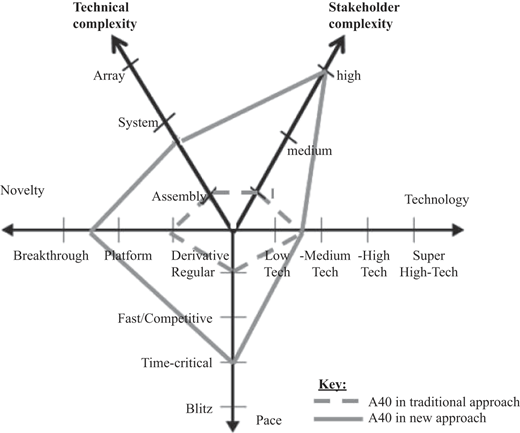
Context: The A40 motorway project plan was changed from a 24-months lane closure disruptive plan to a three-months complete road shutdown. The work comprised renovation of three bridges, the re-build of another bridge, the renovation of one tunnel, repair of 5 km of roads and the application of whispering asphalt plus the new noise protection measures. This raised huge technical and stakeholder complexities.
Chapter content and comments: Schoper uses the Shenhar and Dvir (2007) Diamond Model to illustrate the context of the project and its complexity.
The original plan was for two years of disruption to keep the A40 open but Schaber devised a plan to close down the road completely and undertake three months of intensive 24/7 work with all the extensive logistical and stakeholder planning and action that entailed.
This was a brave and ambitious plan as local and national media and the public expected chaos and political disaster yet that did not happen. One of Schaber's strategies was to fully engage with the media, she appointed a press spokesperson and a technical contact person for public relations to keep everyone informed. This was done honestly and authentically rather than engaging in “spin” and this approach proved successful from a stakeholder perspective as well as a means to perform the works most effectively with less disruption than would be the case for the original two-year plan. They clearly explained to the media progress and plans so that their audience could understand the level of complexity. Schaber's honest approach and ability to discuss technical details simply and clearly generated confidence.
The chapter describes Schaber's upbringing in Herne, a coal mining area of Germany, as a middle sibling from a working-class and family that supported and highly valued education. Schoper notes that the miners tend to work in well-co-ordinated teams with high trust levels of co-workers and these values pervaded Schaber's cultural setting. She loved maths and science and completed her civil engineering studies and worked for the Road Construction Authority in Ostwestfalen-Lippe.
She is described in Schoper's chapter as has having high levels of emotional intelligence and is self-aware, confident, resilient and empathic. The case study demonstrates that Annegret Schaber's project manager job entailed entrepreneurial as well as social personality traits being needed, with a balance of technical, intellectual but particularly emotional competences.
One aspect of this chapter I find fascinating is that Schaber had conceived the idea that a three-month shut down was more feasible that 24 months of disruption and thought through a business case to complete the project based on three months. She approached the Transportation Minister of North Rhine-Westphalia at a football tournament and told him about the project. His curiosity was awakened, so he gave her an appointment for the next week in his ministry where she could present the project to him. He asked her if she believed that they could succeed within the three months, and she answered “Of course. This is my job” (p. 30). This demonstrates, despite Schaber being somewhat shy (p. 35) she had the courage, sense of confidence and initiative to press her case.
This chapter's analysis concludes that Annegret Schaber shows that project management is a profession where the classic job theories of person–environment (PE) fit theory and particularly person–job (PJ) fit theory (Malach-Pines et al., 2009), but also job crafting theory (Tims et al., 2016; Akkermans et al., 2020) and voice behaviour theory (Bashshur and Oc, 2015), can be applied for a better and deeper understanding. Schaber's expert stakeholder engagement was a deciding factor for the change of plan that proved less disruptive and satisfied a broad range of stakeholders.
Chapter 4
Title: “Storytelling from the authentic leader of High Speed 2 (HS2) Ltd. infrastructure megaproject in the United Kingdom” (Sergeeva and Davies, 2021); Interviewee: Mark Thurston and Country – UK.
Context: HS2 is a high-speed railway £Multi-billion project to deliver a railway from London to Birmingham, the East Midlands, Leeds and Manchester in the United Kingdom. It is scheduled to open in phases between 2026 and 2033.
Chapter content and comments: The chapter comprehensively describes the project context and methodological rationale for the study. It then describes the interviewee's life story. Mark Thurston, the CEO of this massive enterprise, grew up in a happy working-class family background that values academic achievement. He was also the captain of his soccer team in his 20s and learnt about leading a team and how teams interact from his sport experiences. He chose not go to university but instead completed an electrical technician apprenticeship at Transport for London. During this four-year apprenticeship, Thurston did an HNC in Electrical and Electronic Engineering and his practical, hands-on skill experiences shaped his systematic way of his organisational and the project management thinking. He was strongly influenced by supportive mentoring colleagues and he worked his way up the career ladder to working in a design office and transitioning into project management. He progressed through hard work, diligence and ability. He left London but later returned with promotions and an expanded outlook having worked in various places including Railtrack, Metronet, The Nichols Group, London Olympics, Crossrail and CH2M Hill before becoming the CEO of HS2.
Sergeeva and Davies use an authentic leadership theory lens (Avolio and Gardner, 2005) to analyse Thurston's career development and note that it is commonly understood that authentic leaders are “original”, “real” and “true to themselves”. The authors use words like trustworthy, authentic, confident and empathic to describe Thurston. The chapter makes its academic contribution by emphasising Thurston constructing self-identity and organisational identity, and the alignment between them as well as the importance of maintaining work–life balance.
Chapter 5
Title: “Transformation2: leading a megaproject turnaround”, (Naughton and Maylor, 2021); Interviewee: Neil Couling and Country – UK.
Context: A £Multi-billion digitisation and streamlining transformation of the UK's income-related benefits payment system. A highly sensitive stakeholder engagement, technical and politically sensitive project.
Chapter content and comments: Neil Couling is the Senior Responsible Officer for this project. The authors provide context details and comprehensive background of the project and Couling's career path. Couling was brought up in a working-class London area and his family valued education, he is also passionate about soccer. He went to university but did not blossom until his final year. One of his first jobs was working for the UK Government social security office; a job which he enjoyed, and which would provide a good grounding and experience for what was to come. He never stood out from his colleagues and took life as it comes until getting married which changed is plans for his career and boosted his ambition. It is interesting to see examples of “late developers” as leaders of such complex megaprojects. After a stumbling start, he got a place on the management fast track scheme and later undertook a master's degree mid-career which he enjoyed and learnt much from. Sports and family experiences seem to have shaped Couling's values about learning and fitting into a group and influencing others in non-braggard ways. He is hard working and likes taking underperforming situations and transforming them into successful ones. The chapter's focus on a stigmatised view of the case study (see Hampel and Tracey, 2017) and Couling's role in legitimising this project is interesting and thought provoking. The authors use a complexity theory (Maylor and Turner, 2017) and resilience theory (Turner, 2011) perspective to analyse Couling's leadership qualities. The way that he manoeuvred and steered the team, being resilient and adaptive while maintaining the programmes' vision and purpose, is instructive. His final quote is worth reproducing. “Stopping being a white knight leader … And the advantages of a much more kind of collaborative, less power, less driven approach, let solutions happen, power of not knowing, things like that I had to learn and they came in from my early forties where my heroic leadership style crashed into the buffers, and having the space to be able to do that and then emerge as a different kind of person out of it. I still have elements of heroism about me, because it's part of what drives me, but I know now that isn't gonna get me to success” (p. 73).
Chapter 6
Title: “Developing a partnership in the Schiphol–Amsterdam–Almere megaproject”, (van Marrewijk, 2021); Interviewee: Hans Ruijter and Country – The Netherlands.
Context: The €4.5bn 2004–2026 road construction megaproject between Schiphol, Amsterdam and Almere (SAA). It comprises a 3 KM tunnel, aqueduct, (65 M wide and 620 M in length), a 12-lane wide motorway and adjustment to approximately 100 bridges and viaducts.
Chapter content and comments: van Marrewijk provides a historical context for the project beginning with a crisis in 2002 about systematic major contractor collusion and price fixing practices in The Netherlands being revealed that led to a need for transformation of the client–contractor relationship and practices. Hans Ruijter's is programme director of the case study megaproject. The chapter outlines his life story to explain his career trajectory. He was born and raised in Rotterdam by his father in the navy and mother both stressing the importance of education. At 12, they moved to a small town/suburb and Ruijter studied at the gymnasium and in 1979, Civil Engineering at Delft Technical University. A three-months internship at the iconic Eastern Scheldt storm-surge barrier project proved a career defining event. He lived and worked on the construction site with constant workforce interaction that shaped his passion, interest in large-scale meaningful infrastructure projects and understanding people. The project had technical and political challenges that Ruijter learnt from. van Marrewijk adeptly tells Ruijter's story and analyses how this project leader's philosophy on life and work evolved along with Dutch attitudes to megaproject delivery and this ethnographic research approach reveals fascinating discoveries of key events that shaped this leader's attitudes and how that occurred. Ruijter also completed his PhD in 2019 reflecting on the programme of projects.
Chapter 7
Title: “The Gotthard base Tunnel: the work of a century”, (Drouin and Müller, 2021); Interviewees: Renzo Simoni, and Dieter Schwank; and Country – Switzerland.
Context: The Gotthard Base Tunnel (GBT) is a 57.09 km railway tunnel through the Swiss Alps. The project was technically, financially, environmentally and politically immensely challenging with every conceivable form of complexity one could imagine. Renzo Simoni, was the CEO of the AlpTransit Gotthard Ltd (ATG), who led the project from April 2007 to June 2017 and Dieter Schwank took over the role in July 2017.
Chapter content and comments: The chapter traces the historical context of the project from the Gotthard Railway Tunnel (1882), the Gotthard Road Tunnel (1980) and the GBT (2016). The authors explain some of the technical, political and stakeholder aspects of the project and then they provide background context of the two interviewees. They outline Renzo Simoni's formative years, his physical and religious and educational development that became factors impacting his developing world view. They draw upon authentic leadership theory (Avolio and Gardner, 2005) to highlighted Simoni's leadership approach. Other observations point to Simoni's highly evidence-based structured way of working and how his education maintained that regime. They then profile Dieter Schwank who was born in Basel near the German and French borders that was liberal and predisposed him to be open minded favouring diversity. Schwank studied law at university and later joined a technology corporation, engaged in many global projects and was exposed to a range of project organising and delivery aspects. He later headed the legal department of a contracting company. Drouin and Müller cited emotional intelligence theory (Müller and Turner, 2010) to support Dieter Schwank's emotional intelligence traits/attributes that led him to willingly listen to new ideas, be culturally sensitive in understanding people's mental models and to actively reflect on, the reactions and inputs from others. Other attributes the authors observed was that Dieter Schwank's family values being respectful of others' perspective, even if he did not agree, and his legal training made him very meticulous about details, the importance of clarity of meaning in communication and a duty for responsibility and accountability. He was also described as curious and resourceful. The authors also focus on case study lessons learnt from a governance perspective and how leadership style was shaped by the project's context and political-cultural environment.
Chapter 8
Title: “The project owner and the project manager: the M4 motorway connecting Sydney from the west to the east”, (Freeder et al., 2021b); Interviewees: Nick Greiner and Grahame Campbell; and Country – Australia.
Context: The project case study is an historic one the first BOOT toll road project in Sydney. It was completed at nine months ahead of schedule, at half of the time and cost projections, and traffic projections exceeded initial estimates by over 20%. The project sponsor was Nick Greiner and Grahame Campbell was the project manager. The authors argue that even at 2008 AU$45m, it meets megaproject criteria characteristics.
Chapter content and comments: This chapter is interesting because it explores the project and its sponsor Nick Greiner, as well as it project delivery leader, Grahame Campbell. The chapter details the historical context of the project as a first BOOT infrastructure project in the state championed and sponsored by Nick Greiner who was the New South Wales State Premier at the time. The chapter explains Griener's background as an immigrant at an early age, his education and career in the private sector before entering politics and his values that help explain his sponsorship and leadership in supporting the project. Greiner was considered a very bright and intelligent politician and with his educational achievements, his background of resilience by moving from Hungary to adapt to Australia and his strong work ethic was enough to overcome any political qualms about exiting politics. He had confidence in his abilities and vision, and an effective communicator able to enthuse and energise others. The chapter also profiles Grahame Campbell's working-class background and his early entrepreneurial spirit. He has excellent stakeholder engagement skills and a keen sense of identifying purpose and motive and shaping solutions around these. The chapter describes Campbell's early influence as being a part-time musician and how that experience and the lessons it taught him contributed to his emotional intelligence. The chapter also discusses contextual aspects around Campbell's Alice Springs to Darwin 1,600-km gas pipeline project experiences and what he learnt from that project and others.
Chapter 9
Title: “The Museum of New Zealand Te Papa Tongarewa: a labour of love and learning”, (Freeder et al., 2021a); Interviewee: Sean Sweeney and Country – New Zealand.
Context: The Museum of New Zealand, is a landmark and highly adventurous and innovative project, faced by extraordinary challenges including design to cope with Its location on an earthquake fault-line zone and the museum exhibit digital presentation characteristics.
Chapter content and comments: The chapter weaves the project into a broader narrative of influences in Sean Sweeney's leadership development. The chapter outlines his early life in a working-class family being the middle child with a father from England and a mother from Ireland. His values were shaped by a Catholic background and being an immigrant from the UK living in a highly multi-cultural suburb with strong Maori presence. This influenced his world view and helped him understand the importance of cultural empathy, a sense of fairness, justice, acceptance of diversity and the legitimacy of people holding different world-view perspectives to his own. His educational journey was mixed. He changed direction from an initial stint at teachers' college to one of working for two years fixing cash registers in a very rough part of town. After deciding to prepare for his future he first undertook engineering studies at technical college while working part-time as a draftsman then gaining advanced standing to study, ending up attaining Honours at Auckland University. The key turning point was his seven years working on the case study project where he rose through the career ranks to lead a highly motivated team. This primed him for a career move to Australia as Executive Director the Major Projects Unit for the Victorian Government and further leadership roles in Melbourne and now back in NZ leading a major rail infrastructure project. His story is engaging and insightful.
Chapter 10
Title: “Childhood experiences and personality meet opportunity: the formative development of a megaproject innovator”, (Steen, 2021), Interviewee: John Parker and Country – Australia.
Context: The $Billion Queensland Clean Fuels Project (QCFP) is an alliance project, the first hydrocracker in Australia where hydrogen was used to convert heavy oil into fuel and separates sulphur from the oil to allow it to be used for other industrial purposes. Jon Parker was the controls manager, a vital leadership role in delivering the project.
Chapter content and comments: BP, Queensland State Government, Brisbane Council and the delivery contractors formed an alliance to deliver the QCFP with Flour and other delivery contractors. Challenges included complex stakeholder engagement and technology innovation to cope with transforming low grade oil into high grade fuel and other valuable by-products such as sulphur for industry feedstock and co-generated electricity from natural gas and refinery waste gas within stringent environmental requirements. BP had experience from decades ago on its Andrew Oilfield alliance project in the North Sea. It realised that it needed a project leadership team that could think outside the box and be committed to a best-for-project delivery.
John Parker undertook a vital senior role that his career had uniquely prepared him for. Brought up in the UK during the Second World War and bombed out of home at the age of 11 months, the family moved to Rugby. He later attended Rugby Grammar School. He was independent, self-reliant, gifted at art, sound academically and at sport as a youngster and editor of the school magazine. At the age of 13 years, he and his friends holidayed by cycling around Belgium and Germany and later he hitchhiked around Europe. After school he worked for English Electric on a five-year engineering apprenticeship, obtaining a Higher National Certificate in mechanical engineering. Following his apprenticeship, he joined the construction department with projects for the UK Central Electricity Generating Board (CEGB). His early experiences traced the advances in PM techniques such as the use of PERT and computer technology. The chapter details a fascinating journey through Parker's career of how PM techniques evolved as well as Parker's career setting up control communication networks and working on the Andrew Oilfield Alliance. Interestingly, he got his QCFP role because he had alliancing experience and could effectively work within required alliancing collaborative behaviours (see for example Walker and Lloyd-Walker, 2020) and encourage innovative approaches to the project. The chapter highlights Parker's background, adaptive abilities, hardworking ethic, ability to master detail and fundamentals and his artistic traits and free spirit combined to prepare him for his role in the case study.
Chapter 11
Title: “Incheon Bridge, South Korea: the actualization of a landmark envisioned a century ago”, (Brunet, 2021), Interviewee: Dr Soohong Kim and Country – South Korea.
Context: The Incheon Bridge at 21.38 km, connects Songdo City (about 64 km from Seoul) on the mainland with Yeongjong Island, where Incheon Airport is located. The project's total cost was US$2.38bn, and it consisted of two sections: one, a build–transfer–operate agreement worth US$1.52bn, and a government-financed section to connect the bridge to existing roads under a US$862m turnkey contract.
Chapter content and comments: This chapter helps us understand how a project dream may be realised. The chapter introduction explains the author's impressions of the bridge and introduces us to the project leader Dr Soojong Kim, CEO of the Incheon Bridge Company, that build the bridge. Section 2 provides background historical context and detail about the project, explaining the project initiation, construction and to the maintenance and operation phase. Section 3 then focusses on Kim, his family roots and background and how that was wrapped up in the project. His grandfather was a successful businessman and local leaders and his father was an architect, but the family wealth crashed, and Kim was brought up in a poor but happy environment. At school, Kim was always a leader of his cohort. His vision to connect the island to the mainland was inspired by his grandfather's and father's dreams. The chapter then focusses on Kim's ability to turn a dream into a megaproject reality. The story is told mainly in his own words. I found the case study an interesting example of a person who had managed the initiation phase of securing funding, building the business case and proceeding through design to delivery. Kim forged many relationships with teams and individuals along that journey and appears to be successful at building these coalitions and allowing them space to use their expertise to define, design and deliver a successful result. Kim also seems to have firmly set the project in context with regional and national development but also with a strong focus on environmental harmony.
Chapter 12
Title: “The Hong Kong–Zhuhai–Macao Bridge and its project leader”, (Shi and Xiao, 2021), Interviewee: Zhu Yongling and Country – China.
Context: The Hong Kong–Zhuhai–Macau Bridge (HZMB) connects Hong Kong to Zhuhai in Guangdong and Macao. The total length of the HZMB is 55 km, and the Main Bridge section is 29.6 km. The link is a dual three-lane expressway and it cost about $18.4bn. It is a significant regional development project of major political importance.
Chapter content and comments: The authors begin their chapter with a description of the project in its geographical–political context as not just a construction megaproject but as a Guangdong–Hong Kong–Macau Greater Bay Area (GBA) regional nation building development project. They then explain their research approach to position their research on the HZMB and its project leader. Section 3 outlines Zhu Yongling's background, born in the Xiangtan County of Hunan Province, a small town with a 1,500-years history. This area, a central place in the 1949 revolution that swept the Chinese Communist Party into power, permeated and created Mr Zhu's character and the trajectory of his life. “His pursuit in life is not to leave anything for himself as an individual, but to pursue the spirit of the country and nation, and the pride of this era, such as the HZMB project” (p. 186). This case study provides insights into a project leader with radically different political–cultural views to others in this book and helps us understand the leader's perceived role from this perspective. It describes Zhu as growing up in a family with parents as teachers and he was a diligent and avid student and learner. In 1969, at six years old, he lived in the countryside as with his brother in a production team for nine years. He studied hard and, after passing the college entry exam, he became a university student in 1978 at Tongji University. He is highly motivated to use his Civil Engineering education to help drive his commitment to his sense of national pride and the development of China. The chapter also describes examples of how Zhu managed delicate local stakeholder issues as it involved co-operation, co-ordination and negotiation drawing upon emotional intelligence and characteristics of leaders of megaprojects complex managing stakeholder complexity citing (Floris and Cuganesan, 2019). I found this chapter interesting as one seen through the eyes of Chinese culture.
Chapter 13
Title: “Attention and mindfulness: a tale of two megaprojects”, (Wang and Zhu, 2021); Interviewee: Ma Zonghao; Country – China.
Context: This chapter focusses on a young megaproject leader who after seven years moved on from being responsible for the tunnelling works on the (HZMB) from Chapter 12 to lead another tunnelling megaproject, the US$2.3bn Dalian Bay Subsea Tunnel project.
Chapter content and comments: Ma Zonghao was born in 1983 and raised in Yantai, Shandong. His father is a chauffeur and very strict, his mother is a traditional Chinese housewife and his older sister a nurse. He developed strong friendships with several schoolmates in his village and highly valued those relationships. His parents encouraged Ma and his sister to pursue and achieve big dreams. Ma left his village to study and lived independently at boarding school when he was 13 years old this help him develop critical thinking abilities. Later, he enrolled at the Dalian University of Technology, majoring in tunnelling and underground space technology where he excelled as one of the top students. After completing a master's degree in hydromechanics, he was hired on the HZMB as a technician for the immersed tube tunnel part of that project. His project leader was Zhu Yongling (Ch12) who mentored and impressed on Ma the value of mindfulness, resilience and being a reflective practitioner. The chapter authors explain the mindfulness concept (Ocasio, 2011) meaning “attentiveness to context and the capacity to respond to unanticipated cues or signal defines mindful information processing or mindfulness and … promotes the quality of attention, promoting vigilance or stability in organizational attention over a period of time” The authors explain the role of leader, individual and collective mindfulness and its importance on project outcomes. It was interesting to see this chapter's discussion from a mindfulness perspective and how that translates to the Chinese context. Ma's story is summarised as follows: The growing experience and working experience in the Bridge project contributed to Ma's success. A sense of critical thinking and non-conceptual processing since his childhood, enabled him to carry out tasks independently. The authors also explain the role of leader, individual and collective mindfulness of the project context and how that shapes how complexity is managed.
Chapter 14
Title: “Megaproject leadership in the developing world: an Indian Perspective”, (Mahalingam, 2021); Interviewee: Dr. Brijesh Dixit and Country – India.
Context: The Nagpur Metro Rail Corporation Limited (NMRCL) was started in February 2015. As part of this first phase, the project was expected to consist of 41.7 km of above-ground metro rail split across two routes passing through the heart of Nagpur, with 40 stations and two depots.
Chapter content and comments: The chapter begins with useful context information about India and its rail transport system and Urban Rail with an anticipated spend of hundreds of billions of dollars. The project he focusses on is “The Nagpur Metro Rail Corporation Limited (NMRCL)”.
Dr Brijesh Dixit spent a happy early childhood in a district-level town in the state of Madhya Pradesh in central India. He grew up in a joint family, one of seven children, with his businessman father, homemaker mother amongst a variety of uncles, aunts and cousins. He spent fun-filled time in the forests near his house interacting with the tribal population that lived there. Dixit moved to Bhopal to study civil engineering and engaged in the debating society and was head of the student union. This was followed by over 32 years with the Indian Railways overseeing construction, operations, working on civil engineering, mechanical, electrical and IT-related projects. Most were over time and cost budgets, so his reflections on experience gave him insights into why, proving useful when he joined NMRCL. His curiosity about the non-technical reasons for project performance led him to carry out further studies while working on projects and he gained a PhD in Economics at Bombay University. Dixit's also championing digital technology initiatives including BIM. The virtue of having a multi-disciplinary (across a range of engineering fields) perspective on the project was a key trait. His economics, philosophy and engineering knowledge came into play along with his social and personal attributes to make him open-minded and curious and allowing him to facilitate the various project teams to harmonise and align their knowledge and perspectives on issues as they arose.
The final section in the chapter discusses whether leaders are born or made and concludes that “Dr. Dixit's long and fruitful professional career with the Indian Railways where he had personally experienced project management challenges and failures also equipped him with the requisite knowledge and experience that he needed to manage the NMRCL project”. Also, his debating background from his university days helped shape his approach to framing and reframing issues based on evidence and expert opinion and his family-based sociable disposition was helpful in his getting on with people and gaining their respect, confidence and trust. He valued and supported a sensible and productive work–life balance and an amenable workplace atmosphere. He had known and constantly remembered his happiness as a child and kept that value for the workplace alive and a key objective of his.
Chapter 15
Title: “How to lead an urban megaproject: lessons from the Canada Line”, (Drouin, 2021a); Interviewee: Jean-Marc Arbaud and Country – Canada.
Context: The Canada Line project is situated in Vancouver and its suburbs, a CAN$2bn project, constructed in preparation for the 2010 Winter Olympics. It comprised 17 stations along 19.2 km of track linking downtown Vancouver to Richmond with a branch line to the Vancouver International Airport and opened three months ahead of schedule, months before the 2010 Winter Olympics.
Chapter content and comments: The first chapter section sets the project context as a long-neglected metro rail extension that was triggered by the need to prepare for the 2010 Winter Olympics and a link from downtown to the airport. Arbaud is Deputy Managing Director of CDPQ Infra, a subsidiary of the Caisse de dépôt et placement du Québec, which manages funds for public and parapublic organisations, mainly pension and insurance plans. In this role, Arbaud is responsible for developing and overseeing infrastructure projects. He has 30 years of experience developing, planning, financing, executing and operating public and industrial infrastructure projects on all continents. He held various positions in one of Canada's largest construction companies, SNC-Lavalin from 1997 to 2005. From 2005 to 2011, he was President and Chief Executive Officer of InTransit BC, the concession holder for the Canada Line and from 2011 to 2012, he was Vice-President of Operations of its global operations and Vice-President and Managing Director of its Brazilian division. Arbaud started his career in Reims, France and undertook an engineering degree and a specialist diploma in applied mathematics and computer science.
Drouin explains that Arbaud's character was formed by numerous events. Following his parents' separation, he barely saw his father and dropped out of school at the age of 14 or 15 years to become an antique dealer despite being a bright student. Realising that he did not want to do that work for the rest of his life he returned to school with the support of his maths teacher and ended up with his diploma in engineering. Drouin states that “He spent several years at a firm in France, working on projects to optimize industrial production lines. His specialization as an engineer is mathematics and computer science applied to programming” (p. 236). His good listening skills strengthened his developing project design capabilities. At the age of 26 or 27 years, he became director of engineering for 200 people. He had excellent listening skills to engage in dialogue with clients to discover what they really wanted or needed and while he had a healthy disinclination to respect hierarchies, he highly respects intelligence and so he seeks out advice and expertise and engages in thinking to fully understand issues. In one quote, he refers to the project not having cell phone usage within tunnels and no integration of artwork into the project – he saw those two features as being critical to be present for users to be satisfied with their train journey experience. It was not so much about a specific “customer experience” rather about a response to changing societal norms and practices that demand changes in what is offered, hence the need to be flexible and adaptive to respond and be prepared to respond. He used analogies of the leader being a ship's captain that relies on the crew's skills working in unison to ensure safe passage. While the captain is in charge, the expertise of each crew member is vital.
Chapter 16
Title: “Hydro-Québec megaprojects: learnings from a leader”, (Drouin, 2021b); Interviewee: Réal Laporte and Country – Canada.
Context: Hydro-Québec is one of the Canada's iconic organisations and the case study focus is on the various large-scale projects that Laporte was involved in, initially as a junior engineer but moving up the ranks to be president of Hydro-Québec Innovation, Équipement et services partagés, which is the company's construction segment. The projects described in this chapter are of a nation-building scale including the Eastmain La Grande Complex (1971–1996) was built in two phases. The project (programme of projects really) was truly monumental in scale, scope and of nation-building consequence situated at James Bay. The dam construction project with an area of 350,000 km2 borders Québec and Ontario provinces and serves customers in the Northers states of the USA.
Chapter content and comments: The chapter introduction stresses the importance of this flagship organisation as having a heavy influence on the commercial, social and intellectual development of the province of Québec. The chapter section discusses the history and evolution of Hydro-Québec before focussing on two megaprojects that helped shape Laporte's career and influenced his leadership approach.
Section 16.3 discusses Laporte's leadership skills development through his involvement with two megaprojects (the Eastmain projects and the Romaine project). The Eastmain La Grande Complex (1971–1996) was built in two phases. The project (programme of projects really) was truly monumental in scale, scope and of nation-building consequence situated at James Bay. Phase 2 starting in 1987 consisted of five power stations built on the La Grande River and Eastmain with a total capacity of 3,516 MW. The second project helped shape Réal Laporte's career is the Romaine project (2009–2021).
Laporte was born in the Centre-sud, a French-speaking district of Montreal. He lived and went to school there for his first 18 years with his three siblings in what could be described as a village atmosphere within a cosmopolitan city of villages and he loved nature and summers at his parent's cottage north of Montreal exploring forests and lakes in the Laurentian Mountains. This link to nature was important later in sharing common bonds with First Nation people, he would be negotiating with as influential affected project stakeholders. Laporte came from a loving home with strong family values. He hitchhiked on several continents and considered that it helped him become adaptable. Graduating in 1981 with a college diploma in civil engineering, he continued his studies while working for various contractors. He took art history courses in the evening because he was interested in culture and in 1988, joined Hydro-Québec's generating refurbishment team and enrolled on a master's degree in project management at Université du Québec à Trois-Rivières, completed at UQAM. He graduated from the École de technologie supérieure (ETS) in civil engineering, he has a master's degree in project management from Université du Québec à Montréal (UQAM) and completed the Directors Education Program at McGill University. The master's degree helped him enjoy and develop learning PM soft skills that advanced his career. Prominent amongst Laporte's insights into leadership are as follows: communicating a project vision, not only what the end result should look like but to also provide the team with sufficient information, knowledge-support and other means for them to confidently act to deliver that vision; protect and be a stabilisation agent to his team when turbulence and environmental changes creates uncertainty so they can focus on their responsibilities; to make decisions and take action that is in congruence with your values and remain true to them even if that means quitting; communication about the vision, choices and possible directions in a way that the team (and other stakeholders) can understand and respond to; be able to read between the lines (be politically astute) to understand the context of what is implied and not articulated; being intuitive but also vigilant about blind spots; and being close to people, empathy, the ability to listen.
Section III - Insights and Conclusions
This section comprises two chapters to wrap up the book and discuss results and insights from their cross-case study analysis of their interview findings and analysis.
Chapter 17 – Insights from personal perspectives (Müller et al., 2021)
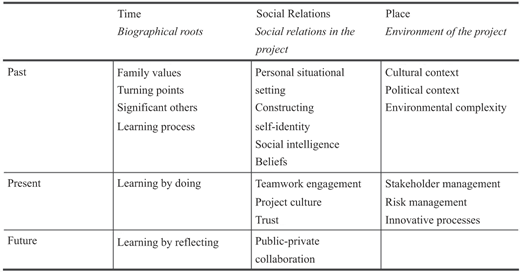
The authors, following the biographical research approach explained in Chapter 2, analysed the interview data based on a framework of three clusters of Time, Social Relations and Place. Time related to the biographical roots of the interviewee and contains topics such as social class, family values, turning points, learning process and transition to future roles. Social Relations refers to the relations between actors in the project of study, including topics that covered teamwork, institutions, personal traits and project culture. Place includes the environment of the project containing topics of political and cultural context, stakeholders and risk management. The chapter case studies were then analysed combining the clusters with three temporal categories: Past, Present and Future. They developed an analytical framework as illustrated in their Figure 17.1 reproduced.
This guided their analysis of each case study for each cluster – Past, Present and Future.
For example, in the Time Past analysis each case study was reviewed for themes around family values, turning points, significant others and learning processes that form pieces in the puzzle about how these factors shaped the leaders of the case study megaprojects. The authors point to an example of the family values influence “The strongest example of this is the biography of Soohong Kim (Chapter 11) who mentioned that building the bridge connection was a “dream of three generations”; his grandfather, who was a local leader, his father, who was a famous architect, and himself” (p. 271). Turning points were also noted by the authors such as death of a father, school experiences, hitchhiking around the world, internships and working away from the home environment/culture. The authors also talk about the influence seen from significant others such as parents/relatives, mentors and teachers etc. Learning processes were seen in both formal terms such as university and extra-mural activities as well as through a specific culture such as being part of a sporting team.
In this way, and for each of the guide matrix cells, a picture of influences and potential causation to form patterns and pictures of what led these people to become exemplar leaders of such complex megaproject enterprises. This chapter, authors made sense of the cases and interviewee transcripts, analysing these through various theoretical lenses, to form an enlightening view of understanding what shaped these individuals into leaders.
Chapter 18 – Conclusions and reflections: what have we learnt about megaproject leaders? (Sankaran et al., 2021)
This chapter reflects on the interviews, projects and Chapter 17 analysis. The authors identify four trends in research into leadership of megaprojects. The book's research question was “What can we learn from the personal views of megaproject leaders in managing their projects?”
It appears that we can learn a lot. The authors have all written much about leadership and culture in past books, but this book is different. It is an excellent book for students of PM leadership and draws upon a solid body of literature on leadership and culture in general but also on how that is applied in the management of megaprojects. Each of Section II chapters discuss case study data using a wide range of theoretical lenses that many researchers and students will find useful, they certainly prompted me to follow up some interesting looking cited references and so I thank the authors for acting in this way as my research assistants in finding such enlightening references! I trust that other readers will benefit from this aspect of the book.
This book, and its methodological approach, offers a significant contribution to PM theory development. It focusses much attention on the life and workplace experiences that shaped interviewees' attitudes, values, experience and learning that in turn shaped their career paths. Therefore, this book, and its methodological approach, offers a significant contribution to PM theory development.
The authors also observe four evolving trends in megaproject leadership, governance and management that I summarise below.
First, they note increasing attention on human capital and socio-environmental dimensions of megaprojects by their leaders. The human and social capital perspective of performance has been an area of growing interest, particularly during this century. Inkpen (2005) drew our attention to social capital, networks and learning. Nahapiet and Ghoshal (1998) discuss the nature and creation of social capital and its organisational competitive advantage value. The relationship-based project delivery literature also speaks to the value of generated social value as an important output and outcome, for example, Aaltonen and Turkulainen (2018). The megaproject leaders interviewed in this book have recognised through their reflection on their career path the value of their human capital support systems. Family, friends, mentors and exemplars have made a significant contribution to these people's leadership development.
Second, the ability of these leaders to reflect upon their leadership style to nurture and develop it. Throughout the chapter interviews we see examples of reflective practitioners. Some took up further study to better understand their practice. Sweeney in Chapter 9 for example studied for his PhD while holding down a crucial role with the Major Projects Unit in the Victorian Government. Others undertook additional formal studies, and all were avid readers and enjoyed learning new things and being exposed to stimulating ideas. As the authors observe (p. 290) “Reflection helped leaders to take on roles that others viewed as a “poisoned chalice” and to deal with complexity in projects”. They also learn from reflection-on-action as well as reflection-in-action. Thus, complexity can be seen as a perception (Mikkelsen, 2021) and leaders who appear to take risks may not be doing so in their eyes because these “risks” in their view, are surmountable, they have either coped with it (or something similar) before or they have developed intuition to find a solution and/or know who can help develop a solution.
Third, experiences are used to inform new or innovative strategies. This is what Carlsen and Pitsis (2020) refer to as use of narrative capital. Narrative capital describes the power of stories, how significant turning-points in a persons' life are understood and used later to help develop schemas and action plans. The story is more than a lesson-learnt summary or bullet point but a whole experience captured including context and reflection on its impact. The interviewee's stories relate significant wisdom gained from their narrative capital. Interviewees use reflections on the past to help guide the present and future. These experiences shape their identity. Project kick-off meetings and inspirational project leaders and members can co-create a specific project narrative and hence identity that informs project workplace values and culture. The concept of narrative capital is (to me at any rate) a fascinating idea that helps explain motivation and learning whether it is about a monstrously “bad” project and how that played out or a “dream” project that was a joy to work on.
Fourth, is the growing awareness of leaders of the issues of project culture and cultural differences in megaprojects. Clegg in (Clegg et al., 2002; Pitsis et al., 2003) describe how an inspirational team vision for what a project should deliver and how it can be delivered collaboratively points to trends in understanding project culture as does Smits and van Marrewijk (2012) in their paper on the Panama Canal Expansion Program. Walker and Lloyd-Walker (2014) focus on workplace culture in discussing the ambience felt when engaging with team members on an Australian alliance project. This literature and insights from this book's interviewees illustrate a trend in thinking about how to design and shape a positive workplace culture and the role of the project leadership team, consciously or intuitively, to do this.
This chapter outlines some of the special attributes above and beyond expected technical and PM knowledge and skills that have been demonstrated by the megaproject leaders. An ability to cope with ambiguity and uncertainty, for example, stakeholder engagement and conflict resolution is achieved through listening and dialogue more that exercise of authority and overt power. Advanced understanding of complexity in all its forms (structural, legislative, social, etc.) is evident or at least a level of understanding the go-to people and resources required when encountering complex problems.
Comparison of the traditional and the new project
Comparison of the traditional and the new project