


The objective of this research is to explore integration and transition activities in large industrial projects. The purpose is to (a) obtain a better understanding of the integration and transition activities between the project front-end (FE) and project initiation phases (PIPs), (b) explore what, how and when these integrations and transitions occur, and (c) explore what the integration and transition activities mean to project practitioners.
A qualitative research design methodology is followed, based on interviews using open-ended questions. An expert panel is used to provide responses to questions pertaining to the integration and transition between the project FE and PIP. The research is focused on managing large projects in the South African electrical engineering industrial projects industry. A literature review combined with empirical analysis reflects the importance of integrating and transitioning in project business.
The findings provide guidance to researchers and practitioners on integration and transition mechanisms, how and when these occur. It highlights the benefits of integration and transition activities. Important lessons for researchers and practitioners are provided together with areas for future research.
This is an interpretative analysis of expert opinion. Expert panel members are experienced at senior decision-making level, and their expertise was accessed based on experience, education and knowledge. This extensive experience is shared in this paper providing insights into their opinions, experiences, success and failures. These inputs together with the literature review provide interesting implications for both a theoretical foundation as well as practical implications for practitioners.
1. Introduction
Project management (PM) consists of at least two phases, the sales and marketing front end (FE), also known as the (acquisition) phase and the project execution (PE) phase (Blanchard and Fabrycky, 2006). The project FE is where the initial analyses of problems, needs, and customer and stakeholder requirements are conducted, which leads to the initial solution alternatives and choices (Samset and Volden, 2016; Williams et al., 2019). FE is where the business case, target benefits and their realization are set out (Siriram, 2022). It includes the activities which are performed before the start of the project (Cooper and Budd, 2007; Nobelius and Trygg, 2002). The FE includes the entire business case inclusive of the project concept phase, all the various organizations, and the various mechanisms and arrangements involved in the inter-organizational relationships (Miller and Hobbs, 2009).
Figure 1 gives a graphical representation of these two phases. The project initiation phase (PIP) is the “start of the project from an execution perspective; it is the first phase of the project life cycle (PLC). The PIP is when the project manager and project team take over accountability and responsibility from the sales and business development team” (Siriram, 2022). The PLC commences at the start of the PIP and extends until project closure (Siriram, 2022). The FE is not seen to be within the domain of the PLC phases, i.e. the PE phases is also outside the domain of the project manager and the PE team (Cova and Salle, 2005; Momeni and Martinsuo, 2019; Samset and Volden, 2016). The FE phase occurs before the PLC phases. Samset and Volden (2016) cited Morris (2016) where it is emphasized that by only focussing on the PLC, the critical FE part of the project is missed, and both these phases need to be integrated for successful project outcomes (Cooper and Budd, 2007). Integration means that not only are the FE and PE teams jointly involved in the FE phases of the project, but the sales FE team is also involved in the PE phases as well, with gradual reduction in sales effort as the project progress through the PLC (Nobelius and Trygg, 2002; Storbacka, 2011; Turkulainen et al., 2013).
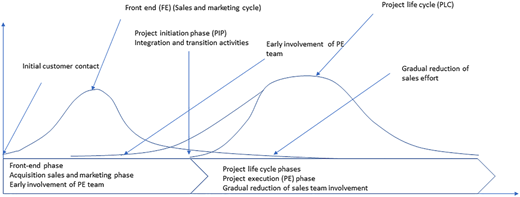
The interface between the acquisition and execution phases in project management
The interface between the acquisition and execution phases in project management
The project manager is responsible for the successful delivery of the project (Cova and Salle, 2005), which only includes the PE phase. Momeni and Martinsuo (2019) argue that this view is not fully acknowledging the importance of the sales and marketing activities, which are crucial for successful delivery but have not been the focus historically. The FE is where the project sponsors, owners and champions are identified, and where the responsibilities of the project owner and project manager are initially laid out. These roles are central to the project (Bryde, 2008; Pinto and Patanakul, 2015; Samset and Volden, 2016; Suprapto et al., 2015). Therefore, neglecting the FE is taking a narrow view of PM. The traditional approach to PM focuses on vertical issues like standardization of processes and management procedures to ensure detail planning in the PE phase (Morris et al., 2006); this may be viewed as more systematic. Turkulainen et al. (2013) argued that while these issues are essential, they are inadequate to fully manage the integration. The focus should be in the wider view, incorporating the project scope, schedule and resources throughout the system life cycle (Levitt, 2011) because these activities are already committed in the FE (Cooper and Budd, 2007; Nobelius and Trygg, 2002), and a more systemic view is required (Asif et al., 2010).
Integration refers to the coordination of activities (Demirkesen and Ozorhon, 2017), and transition refers to how well the handover between the two phases takes place (Siriram, 2022). Transition refers to change before and after an event or the change among project participants (Lundin and Söderholm, 1995). In this paper, transition refers to the change from the FE sales and marketing phase to the PE phase. Transition is a signal that indicates actionable steps needed to be taken when there is a shift from one phase to the next (Jacobsson et al., 2013). The transition also focuses attention on how to move from the present state to the next state (Lundin and Söderholm, 1995). These actionable steps in the context of this paper mean a shift or transformation from the sales and marketing FE to PE.
PM is not restricted to a single functional unit, thus successful project completion requires proper management of the integration (Cooper and Budd, 2007; Turkulainen et al., 2013) coordination (Demirkesen and Ozorhon, 2017) and transitioning (Van de Ende and Van Marrewijk, 2014) activities. The interface between the project FE (which is mainly seen as a sales and marketing initiative) and PE is the most critical interface for project success and therefore requires special managerial attention (Cooper and Budd, 2007; Williams et al., 2019; Turkulainen et al. (2013). Williams et al. (2019) highlighted that the FE phase is not well understood even though it has been shown to be critical to the strategic success of the project. “I (i)n spite of acknowledging the importance of the FE phase of projects there is little empirical studies exploring how the FE management of projects can be improved” (Momeni and Martinsuo (2019, p. 956). The FE is hurdled with many challenges, and efforts should be made to overcome these (Flyvbjerg, 2017; Saukko et al., 2020; Cova and Salle, 2005).
Researchers have highlighted that the transition between the FE and PE is understudied (Larsen et al., 2021; Van den Ende and Van Marrewijk, 2014; Willumsen et al., 2019). Zwikael and Meredith (2019) emphasized the importance of effective organizational practises in the FE due to its strategic nature, shorter timeline and smaller teams, because this is where the FE project participants play a significant role in engaging with stakeholders to obtain support for the project (Flyvbjerg et al., 2018; Gil and Pinto, 2018).
Turkulainen et al. (2013) highlighted that future research should be directed to empirically assessing the use of integration mechanisms in projects and whether the integration mechanisms are really implemented. Bergmann and Karwowski (2018) positioned that empirical research combined with a theoretical foundation challenges current PM practises, and Geraldi and Soderlund (2018) called for practised oriented research. Therefore, this research will address this gap by providing further empirical research into the integration and transition in the PIP between the FE and PE phases.
Given the limited attention in PM literature to the FE and the link to the PE (Cova and Salle, 2005; Larsen et al., 2021; Momeni and Martinsuo, 2019; Samset and Volden, 2016; Van de Ende and Van Marrewijk, 2014; Willumsen et al., 2019), this research focuses on the integration and transition in the PIP between the FE and PE phases. This enables the organization to develop offerings that create customer value (Shapiro, 1977; Turkulainen et al., 2013).
The following research questions are posed: (a) What integration and transition mechanisms can be discerned in the PIP between the FE and PE phases (b) How and (c) when are they practiced and (d) What do they mean for project participants?
The objectives of this research are as follows:
To obtain a better understanding of the integration and transition activities in the PIP between the FE and PE phases.
To understand the challenges associated with integration and transition as well to understand the opportunities from integration and transition.
The paper makes a contribution by providing empirical evidence through interpretative analysis of interviews with a panel of experts emphasizing the importance of the PIP, moreover the importance of integrating and transitioning between the project FE and PE phases. The rest of the paper is structured as follows: first, a theoretical foundation is established through a literature review, next follows the research methodology, followed by the research results, discussion of results, and finally the conclusions, limitations and further research areas are provided.
2. Theoretical foundation of the FE phase, the integration and transition to the PIP
2.1 The concept of the front end: the sales and marketing phase
Kirsilä et al. (2007) observed that integration involves two dimensions, namely (a) technical integration and (b) social integration. Technical integration focuses on the technical requirements; social integration focuses on the complex relationships between different stakeholders. Social integration is inclusive of the customer and suppliers, which has managerial implications for the different stakeholders. Davies et al. (2003) emphasized the importance of the customer and sales team relationship as a starting point for integration across the PLC. The FE is where the design principles of the technical solution and the customer needs are analysed, and solutions are provided, which make commitments in terms of cost, schedule and price (Artto et al., 2016). Kirsilä et al. (2007), who pointed out that integration is not limited to certain parts of the project but applies across the PLC. While the importance of integrating across the PLC is well researched in PM literature, the integration of the FE with the PLC seems to have been neglected (Cooper and Budd, 2007; Cova et al., 1996; Larsen et al., 2021; Morgan, 1987; Nobelius and Trygg, 2002; Momeni and Martinsuo, 2019; Samset and Volden, 2016; Turkulainen et al., 2013; Van den Ende and Van Marrewijk, 2014; Williams et al., 2019).
Both units must participate in the FE and PE phases, defining the project scope, schedule and contract terms (Turkulainen et al., 2013). Otherwise, things get “thrown over the wall”: the final contract is handed over to the project team for execution with little mutual discussion or actual face-to-face contact, and such an approach is detrimental to the project and the success thereof (Goold and Campbell, 2002; Turkulainen et al., 2013).
2.2 A review of concepts: integration and transition
Kirsilä et al. (2007, p. 715) see integration as the “bringing or joining together several distinct things so that they move, operate and function as a harmonious, optimal unit”. Project integration ensures the project's various phases are well coordinated (Demirkesen and Ozorhon, 2017). Asif et al. (2010) view integration as a systemic approach to developing a governance structure for managing key stakeholders. Eisner et al. (1993) define integration as a major element of systems engineering, incorporating the main elements of scheduling, budgeting and costing. Therefore, integration is about linking activities systematically (Asif et al., 2010) and systematically (Morris et al., 2006).
The importance of transitions was reinforced by Van den Ende and Van Marrewijk (2014), where they presented evidence of transitions being celebrated in PLC through transition rituals. Van den Ende and Van Marrewijk (2014) see transition rituals as social and symbolic events celebrating a transition from one project phase to the next. While there is some literature evidence supporting transition rituals (Cova and Salle, 2000; Eskerod and Blichfeldt, 2005; Löfgren, 2007), it has not received wide attention in PM research. Turner (1969) defined transition as a ceremonial event that marks the passage from one phase to another, as when a milestone has been reached. Ritual transitions, therefore, mark important transitions and milestones in the PLC (Bennet, 2003; Van den Ende and Van Marrewijk, 2014). While transitions are emphasized through rituals, there is no guarantee that information flow and knowledge transfer occur between different phases (Van der Ende and Van Marrewijk, 2014). Rituals are mechanisms to celebrate success, however, one must safeguard against “throwing it over the wall”, for example, when sales and marketing teams handover to the project teams with no proper mechanism to ensure the necessary continuity (Goold and Campbell, 2002; Turkulainen et al., 2013).
Information flow and knowledge transfer are necessary for a successful transition (Ståhle et al., 2019). Knowledge can only be generated and understood by people who live or work in similar settings (Hatch and Cunliffe, 2006). This view of knowledge generation and transfer has also been emphasized in the field of organizational learning (Lane and Lubatkin, 1998). This is especially important because the settings and objectives of the FE and PE teams are different, and they also have different tasks and responsibilities (Turkulainen et al., 2013). The FE and PE teams operate in different functional areas, organizational barriers often exist between such areas, and these barriers hinder integration and collaboration (Artto et al., 2015; Ståhle et al., 2019). The organizational objectives at a strategic level are the same: delivering customer value (Davies, 2004), through longer-term considerations like sustainability, relevance and effectiveness through the system life cycle from conception to disposal (Samset and Volden, 2016). This requires a shift in thinking from short-term to longer-term challenges, which require PM to not only focus on time, budget and quality but also on broader systemic issues like social, environmental and economic impact (Sabini et al., 2019; Siriram, 2017). This will contribute to the long-term performance of the organization (Zwikael et al., 2018) and a wider strategic view incorporating the delivery of innovative and unique solutions (Brady et al., 2005; Davies, 2004; Hobday, 2000).
Given that the most critical decisions are made in the FE (Haji-Kazemi et al., 2013; Williams et al., 2019), and limited amounts of integration and coordination take place between the FE and PE phases (Momeni and Martinsuo, 2019; Samset and Volden, 2016; Turkulainen et al., 2013), it is prudent that more effective PM practises are implemented. This includes sequencing, prioritization and proper staffing to govern the integration and transition between the FE and the PE and such planning is the responsibility of the FE team (Nobelius and Trygg, 2002). The FE team, however, need to be a cross-functional team and could, for example, include the forthcoming project manager, financial managers, key engineers, sales and marketing, as well as other functions such as product development, operations and finance, which may all be necessary to ensure a proper transition (Nobelius and Trygg, 2002; Storbacka (2011).
Integration and collaboration can offer several advantages such as frequency of communication and resource flexibility (Galbraith et al., 2001), well-coordinated activities (Barki and Pinsonneault, 2005), increased customer value (Davies, 2004), competitive advantage (Barki and Pinsonneault, 2005) and improved performance (Barki and Pinsonneault, 2005; Turkulainen and Ketokivi, 2012). However, potential disadvantages can include organizational uncertainty, conflicts and increased costs (Enberg et al., 2010; Engwall, 2003; Galbraith et al., 2001). Such disadvantages are because of the challenges of integration and transition, which include, for example, differences in personalities, backgrounds, locations and responsibilities, lack of support and proper organizational structures (Griffin and Hauser, 1996; Song et al., 1996). Such dynamics should be appropriately managed and could lead to further conflict if not handled well (Artto et al., 2015). It could also seriously hamper the development of customer relationships (Artto et al., 2015).
Organizational boundaries divide the entity into different functional areas, each with their own responsibilities and tasks, resulting in the need to link these functional areas though integration (Artto et al., 2015; Cooper and Budd, 2007; Dietrich, 2006; Ståhle et al., 2019). Transition activities are required to ensure that project participants adhere to defined integration processes (Larsen et al., 2021; Van den Ende and Van Marrewijk, 2014; Willumsen et al., 2019). The FE should also focus more on building trust and mutual understanding (Imam and Zaheer, 2021; Merschbrock et al., 2018), this is just as important as complex structural dimensions (Winch and Cha, 2020), and a higher level of trust increases collaboration, reduces uncertainty and ultimately increases project success (Bond-Barnard et al., 2018; Stephens and Carmeli, 2016).
Integration may be categorized into two groups: vertical (integration within a single unit through centralization, standardization, formation and vertical information systems) and lateral (integration across units, through cross-functional units and job rotation) (Turkulainen et al., 2013). When the level of uncertainty is high, the use of cross-functional integration is preferred (Gemser and Leenders, 2011), and in such cases, organizations use more informal and interpersonal options (Adler, 1995). Informal interactions have the potential to bring different stakeholders closer and may facilitate communication, which is crucial in complex environments (Kokkonen and Vaagaasar, 2018).
Having completed the literature review, it is prudent to reinforce the central research questions and to provide some linkage to the literature discussion. For the first research question, (a) What integration and transition mechanisms can be discerned between the FE and PE? Integration is the coordination of activities (Demirkesen and Ozorhon, 2017), and transition refers to change before and after an event or the change among project participants (Lundin and Söderholm, 1995). Integration is about linking activities in a systemic (Asif et al., 2010) and systematic manner (Morris et al., 2006). Transition refers to the change in accountability and responsibility from the sales FE to PE (Jacobsson et al., 2013). Transitions are seen as symbolic events celebrating a transition from one phase to the next (Turner, 1969; Van den Ende and Van Marrewijk, 2014). Van den Ende and Van Marrewijk (2014) also recognize transition activities as including the signing of contracts, project kick-offs and project milestones. For the second research question, (b) How are these integration and transition activities performed? Some of the mechanisms indicating how these activities are performed involve quality control mechanisms through stage-gate processes as well as cross-functional team involvement (Samset and Volden, 2016). For the third research question, (c) When are integration and transition activities performed? A project network diagram or stage-gate process can also be used to indicate when activities take place (Samset and Volden, 2016). There is also support for triggering transition activities specific to time, duration and structuring (Furst et al., 2004; Lundin and Steinthórsson, 2003; Winch, 2014). For the fourth research question, (d) What do they mean for project participants: integration and transition activities can help reduce friction between the sales FE and PE teams. This will ensure a smoother and seamless transition (Artto et al., 2015). Integrating the FE phases also means that resources are not over-committed, and promises made at the sales and marketing FE are achievable (Cooper and Budd, 2007). It also ensures that the organization can develop offerings that create customer value (Shapiro, 1977; Turkulainen et al., 2013).
3. Research methodology
3.1 Research design
This research follows a qualitative research design methodology, based on interviews using open-ended questions. An expert panel is used to provide responses to questions related to the integration and transition between the FE and PIP in the South African Electrical Engineering Industrial projects industry. Focused interviews were used, the expert panel participants were interviewed and interviews ranged from 1.15 h to 1.65 h (Table 1 in section 3.1 indicates the duration per interview). The interviews were open-ended and of a conversational nature (Yin, 2003). An interview guideline was used; the main purpose of the interviews was to seek the respondents' opinions and insights based on their experiences (Yin, 2003). The interview guideline was derived from the literature review and structured toward obtaining the respondents' inputs regarding the integration and transition between the FE and PIP. Other researchers have also used interviews to obtain data (Mason, 2018; Willumsen et al., 2019; Zerjav et al., 2021).
Profile of interview participants
| Participant # | Role and expertise | Date and duration of interview |
|---|---|---|
| 1 | Project's director, worked in an international electrical engineering heavy industrial environment, more than 35 years' experience, financial background | 25 August 2021 1.55 h |
| 2 | General manager projects, worked in an international electrical engineering heavy industrial environment, more than 35 years' experience, engineering background | 26 August 2021 1.21 h |
| 3 | Senior sales manager projects, worked in an international electrical engineering heavy industrial environment, more than 35 years' experience, engineering background | 27 August 2021 1.35 h |
| 4 | Senior business development manager projects, worked in an international electrical engineering heavy industrial environment, more than 20 years' experience, engineering background | 28 August 2021 1.25 h |
| 5 | Senior business development manager projects, worked in an international electrical engineering heavy industrial environment, more than 20 years' experience, engineering background | 28 August 2021 1.15 h |
| 6 | General manager project sales, worked in an international electrical engineering heavy industrial environment, more than 30 years' experience, engineering background | 29 August 2021 1.35 h |
| 7 | Director tendering and estimating, worked in an international electrical engineering heavy industrial environment, more than 35 years' experience, engineering background | 30 August 2021 1.65 h |
| 8 | General manager projects, worked in an international electrical engineering heavy industrial environment, more than 35 years' experience, engineering background | 31 August 2021 1.45 h |
| 9 | Projects director, worked in an international electrical engineering heavy industrial environment, more than 35 years' experience, engineering background | 1 September 2021 1.25 h |
| 10 | General manager projects, worked in an international electrical engineering heavy industrial environment, more than 35 years' experience, engineering background | 1 September 2021 1.35 h |
The expert panel participants were selected based on four criteria. Three criteria are selected from Momeni and Martinsuo (2019). First, the participants had to be experts in industrial projects based on experience, education and knowledge. Second, they had to be involved or have extensive experience in either the project FE and/or extensive experience in PE. Third, they were willing to participate in the research and allow the researcher to conduct in-depth interviews, and they were willing to share their opinions, experiences, successes and failures regarding the integration and transition between the FE and the PE phases. The fourth criterion was chosen from Zerjav et al. (2021): participants were required to have senior decision-making experience in industrial-type projects. This approach was also used by Siriram (2018, 2019). In this paper, we follow the multiple projects approach like Zerjav et al. (2021), where the researchers followed a phenomenon-based research approach using interviews in transportation infrastructure. This paper investigates the heavy electrical engineering industrial project environment in South Africa. This is because electrical power generation and distribution in South Africa is a major constraint and subject to many challenges (Baker and Phillips, 2019). Therefore, any further insight into how to better manage these types of projects will have much economic benefit.
3.2 Data collection and analysis
The research approach is an interpretive analysis (Sandberg, 2005) consisting of interviews with participants of the expert panel (Aguinis and Solarino, 2019; Mikecz, 2012; Harvey, 2011; Siriram, 2018, 2019). Taking this approach, the expert panel participants bring together experience across a diverse range of industrial projects over at least the past three decades (Zerjav et al., 2021). The expert panel participants were chosen specifically for their experiences in both the FE and PE phases of industrial projects. They were chosen from different organizational settings and have experience in the private sector. The profile of the participants is shown in Table 1. The interviews are conducted from a project delivery perspective.
The participants were chosen from the private sector because, in the private sector, the goal is to improve profitability through improvements in the organization's competitiveness (Samset and Volden, 2016). PM is a core resource in the private sector, specifically in project-based firms; therefore, improvements in PM link directly to the organization's success, and the private sector is where the researcher's interest lies. Like Zerjav et al. (2021), as the interviews progressed and data were collected, this information led to further questions that helped develop further insights. A purposive sampling approach was adopted to select the expert panel participants. In total, 10 expert participants were interviewed.
In terms of validity, the approach of Zerjav et al. (2021) was followed for communicative, pragmatic and transgressive validity. For communicative validity, the interviews were documented and then returned to the relevant participant to ensure that the documented interview was a true reflection of the face-to-face interview (Momeni and Martinsuo, 2019). Similarly, pragmatic validity was ensured by asking follow-up questions where the responses from the participants were more generic. Finally, transgressive validity was achieved by seeking contradictions and tensions during the interview process. Like Zerjav et al. (2021), after the interview, the notes between different interviews were compared to assess the comprehensiveness of the findings. However, the aim was not to achieve convergence but to identify emerging trends and disparities that follow-up interviews could clarify. Further, to ensure credibility, close collaboration with the expert panel participants was maintained throughout the research, and the previous experiences of the researcher in conducting similar research in these industries also reinforced the credibility of the data (Momeni and Martinsuo, 2019).
To ensure dependability, interview transcripts and data logs were stored systematically, and the confidentiality of the participants was protected (Momeni and Martinsuo, 2019; Zerjav et al., 2021). To ensure confirmability, the interview transcript was shared with the expert panel participant to ensure it was an accurate representation of the interview (Momeni and Martinsuo, 2019).
Affinity diagrams were used to identify first-order codes, second-order themes and aggregated dimensions (Gioia et al., 2013; Willumsen et al., 2019). Similarly, like Zerjav et al. (2021), the approach by Gioia et al. (2013) is followed; the intention is not to follow a formal grounded theory approach but to use the method as an analytical device for data coding for the interpretive study. Figure 2 provides an example of the first-order codes, second-order themes and aggregated dimensions. Note that the questions are used as the aggregated dimension.
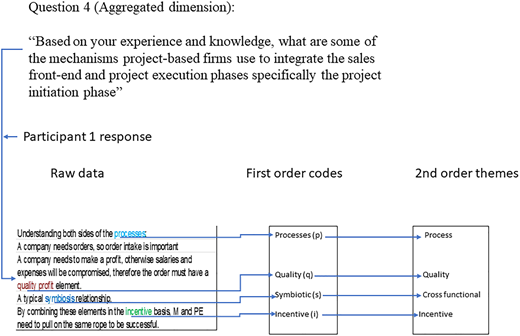
Keywords were identified and coded ( Appendix Table A1), and the codes were then grouped into second-order themes. Figure 2 and Appendix (Tables A1 and A2) provide an example of the coding and theme structure using participant 1 and question 4: “Based on your experience and knowledge, what are some of the mechanisms project-based firms use to integrate the sales front-end and project execution phases specifically the project initiation phase”? As an example, consider the response to this question reflected in Figure 2 and Appendix (Table A2), provided here for convenience. The first response in row one is “Understanding both sides of the processes. A company needs orders to make a profit, otherwise, salaries and expenses will be compromised; therefore, the order must have an adequate quality profit element”. From this response keywords for, e.g. “process” were coded as “p”, and “quality profit” as “q”. These first-order codes were then grouped into the second-order theme. These themes are “process’” and “quality”, and a “1” is recorded in Appendix (Table A2) under the themes “process” and “quality”, indicating these keywords appeared once.
Codes
| Keywords | Code |
|---|---|
| Incentive | i |
| Symbiosis | s |
| Margin quality | q |
| Risk | r |
| Process | p |
| Common workshops, meetings | c |
| Cross-functional joint involvement | v |
| Project manager | m |
| Technology and tools | t |
| Customer/client | u |
| Post-mortem | m |
Codes and theme categorization
| # | Q4 Responses | Themes | |||||||||||
|---|---|---|---|---|---|---|---|---|---|---|---|---|---|
| Codes | Incentive | Quality | Risk | Process | Technology And tools | Project manager | Meetings | customer | post-mortem | cross | Cross functional involvement | ||
1. | Understanding both sides of the processes : A company needs orders, so order intake is important A company needs to make a profit, otherwise salaries and expenses will be compromised, therefore the order must have a quality profit element. A typical symbiosis relationship. By combining these elements in the incentive basis, M and PE need to pull on the same rope to be successful. | p q s i | 1 | 1 | 1 | 1 | |||||||
2. | Inclusion of the project manager from the outset, but on long lead time projects this may not be possible. Careful risk management and timeous actions Common workshops to generate lists of risks and possible early actions. | m r c | 1 | 1 | 1 | ||||||||
3. | A formal CRM package A formal handover from Sales to the Project team. | t p | 1 | 1 | |||||||||
4. | Best practice firms have a clear process and handover procedures | p,p | 2 | ||||||||||
5. | CRM platforms Gannt charts or excel based project management forms Project review meetings | t t c | 1 1 | 1 | |||||||||
6. | Execution team must be involved in the costing process and signing of on the project cost estimates. Proper project handover process Sales teams involved in project execution as an oversight function, also attending ad-hoc project meetings and visiting site Customer needs are taken into consideration. IT systems like CRM platforms Celebrations/rituals not part of the handover process. | f,p p f c u t,t | 1 1 | 2 | 1 | 1 | 1 1 | ||||||
7. | Joint involvement both sales and PE in estimating, in face discussions with the client in the front-end. A post-mortem should be done at the end of the front-end phase, before commencement of the PLC phases, this is at the initiation phase, so that what is missed can be highlighted and proper risk management can be put in place and furthermore these mistakes do not occur again in the future. One consolidated document needs to be part of the handover process . Pricing finalization needs to be a joint effort between sales and PE. While the project manager and PE teams are risk adverse, they need to be realistic and simply including mechanisms to eliminate all or reduce risk will over price and over constrain the solution, resulting in the solution being rejected by the customer . Leading to order failure. | v,c u o r p f m,r r u | 1 1 1 | 1 | 1 | 1 | 1 1 | 1 | 1 1 | ||||
8. | Involvement of the project manager in the solution sign off process will ensure that the PE team is jointly accountable together with the sales team for the project deliverables. A proper handover process inclusive of a fully consolidated and comprehensive documentation pack that is handed over to the PE team An incentive scheme that has a weighting system holding both the sales and PE teams jointly accountable for the solution sales as well as the project deliverables | v,m p,v p i v | 1 | 1 1 | 1 | 1 1 1 | |||||||
9. | Joint sign off by the project manager and the sales lead at the sales stage ensures both sales and PE are held jointly accountable for project deliverables An risk list with risk mitigation factors needs to be compiled early on in the sales process and the risk list is continually updated throughout the project life cycle A defined handover process which is regularly audited to ensure adherence to the process . Having a process that is not adhered to adds no value, project participants must adhere to process. | v,m v r,r p,r p p,p p | 2 1 | 1 P 2 1 | 1 | 1 1 | |||||||
10. | An incentive scheme that has a weighting system holding both the sales and PE teams jointly accountable for the project deliverables will ensure the project is subjected to lower risk and this will go a long way in ensuring that the project has a greater chance of meeting the project deliverables. A proper process that is followed by the project participants, in larger organizations a project management office (PMO) can perform an auditing function ensuring adherence to process . A formally defined project handover meeting between the sales and PE team will ensure that there is continuity from the sales team to the PE team. A formal lesson's learnt workshop ensuring that learnings are carried forward and mistakes are not repeated. | l v r p p c c | 1 | 1 | 1 1 | 1 1 | 1 | |||||
Column total | 3 | 1 | 8 | 15 | 5 | 4 | 6 | 1 | 1 | 11 | ||
Percentage | 5% | 2% | 14% | 26% | 9% | 7% | 11% | 5% | 2% | 19% | ||
Total | 57 | |||||||||||
Similarly, for the second point to question 4: “A typical symbiosis relationship”. From this response, the keyword “symbiosis’” was coded as “s” and then aggregated to the second-order theme “cross functional” teams, Appendix (Table A2).
The third point to question 4: “By combining these elements in the incentive basis, M and PE need to pull on the same rope to be successful”. From this response, the keyword “incentive” is coded as “i” and then aggregated to the second-order theme “incentive”, Appendix (Table A2). Furthermore, the frequency of second-order themes is summated, and the total percentage for each second-order theme is calculated for all participants. The calculated percentage is the frequency of occurrence of the second-order theme and additionally indicating its ranking.
Atlas.ti was used to find linkages between the different second-order themes and the research questions. This was done by transferring the interview transcripts into Atlas.ti. The interview transcripts were coded (first-order), and themes (second-order) were generated in Atlas.ti. The research questions were used as the aggregated dimension.
4. Research results
Through the analysis of the interview data, distinct themes were found; the findings are presented through answering key questions relating to integration and transition and are discussed in Sections 4.1 to 4.4. The results are reported anonymously to maintain confidentiality. The comments received verbatim from the participants are provided in quotation marks. In section 4.1, Table 2 is used to show how the illustrative quotes link to the first-order codes and second-order themes. In Section 4.2 to 4.4, a narrative approach is used instead of a table format; this enhances the readability of the document and gives a logical flow to the discussion process.
Illustrative quotes and discussions linked to themes
| Question 4 (aggregated dimension): What mechanisms can be used to improve the integration and transition between the project front-end and project initiation phase? | |||
|---|---|---|---|
| # | Theme contribution | Theme | Illustrative quote and discussion |
| 1 | 27% obtained from Appendix | Processes | Participant 3 “A formal handover from Sales to the Project team”; Participant 4 “Best practice firms have a clear process and handover procedures”; participant 1 highlighted the importance of the understanding of process from both the sales and PE teams; Participant 8 “A proper handover process inclusive of a fully consolidated and comprehensive documentation pack that is handed over to the PE team”; Participant 9 “A defined handover process which is regularly audited to ensure adherence to the process. Having a process that is not adhered to adds no value; project participants must adhere to process” |
| 2 | 19% obtained from Appendix | Cross-functional collaboration | Participant 1 called for a “symbiotic relationship”; Participant 7 “Joint involvement of both sales and PE in estimating, in face-to-face discussions with the client in the front-end”; Participant 8 “Joint sign off by the project manager and the sales lead at the sales stage ensures both sales and PE are held jointly accountable for project deliverables” |
| 3 | 14% obtained from Appendix | Risk | While incentives did not appear as a significant theme, it did appear in terms of joint accountability as iterated by participant 10 who also linked joint accountable to the third theme: risk “An incentive scheme that has a weighting system holding both the sales and PE teams jointly accountable for the project deliverables will ensure the project is subjected to lower risk and this will go a long way in ensuring that the project has a greater chance of meeting the project deliverables”. Incentives as a mechanism for joint accountability was also supported by participant 8 “An incentive scheme that has a weighting system holding both the sales and PE teams jointly accountable for the solution sales as well as the project deliverables”. Further support for risk management was provided by participant 9 “A risk list with risk mitigation factors needs to be compiled early on in the sales process and the risk list is continually updated throughout the project life cycle” |
| 4 | 11% obtained from Appendix | Meetings and workshops | Collaborative involvement in the FE was also supported by participant 4 who linked joint involvement to the fourth theme: face-to-face meetings: “Joint involvement of both sales and PE in estimating, in face-to-face discussions with the client in the front-end”; Participant 7 also further linked cross functional involvement to the third theme: risk: “Pricing finalization needs to be a joint effort between sales and PE. While the project manager and PE teams are risk adverse, they need to be realistic and simply including mechanisms to eliminate all or reduce risk will over price and over constrain the solution, resulting in the solution being rejected by the customer, leading to order failure”. Participant 10 referred to a formal project handover meeting as a mechanism to ensure continuity: “A formally defined project handover meeting between the sales and PE team will ensure that there is continuity from the sales team to the PE team” |
4.1 What mechanisms can be used to improve the integration and transition between the project front-end and project initiation phase?
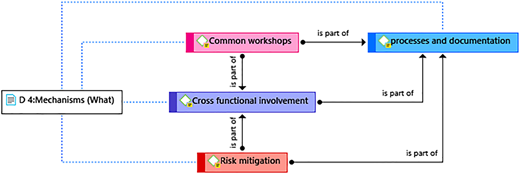
Fifty-seven in vivo comments were grouped into 14 first-order codes and then categorized into 10 second-order themes; the top four themes constitute 70% of the in vivo comments. Processes and documentation was the dominant theme at 26%, Cross-functional involvement at 19%, risk at 14%, and Common workshops (meetings) at 11%.
Figure 3 depicts the perpendicular relationships between the second-order themes (referred to as code groups in Atlas.ti). D4 refers to mechanisms (i.e. What mechanisms can be used to improve the integration and transition between the project FE and PE?). Table 2 shows the links between the illustrative quotes and discussions, second-order themes and aggregated dimensions. Figure 3 reflects that mechanisms can be used to improve the integration between the sales FE and PE phases are linked. The foundational requirement is one of processes and documentation (i.e. processes and documentation guides cross-functional involvement). Cross-functional involvement is, therefore, a part of process. Similarly, common workshops are a part of cross-functional workshops (i.e. cross-functional involvement sets the basis for conducting common workshops). Finally, risk mitigation is a part of cross-functional involvement (i.e. risk can be mitigated through cross-functional involvement, and risk can also be mitigated through knowledge sharing, which can be achieved through cross-functional involvement). Risk mitigation is also a part of processes and documentation, and therefore, process and documentation will guide risk mitigation processes.
4.2 How are the transitions between the FE and PIP performed?
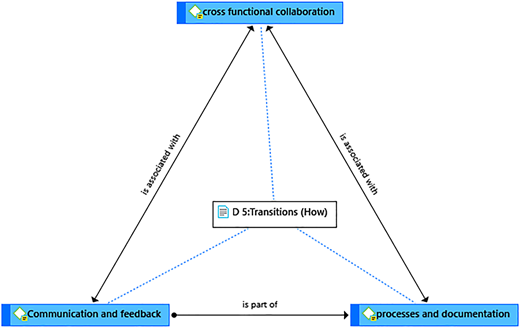
Regarding how the transitions are performed, 43 in vivo comments were grouped into 13 first-order codes, which were then categorized into 7 second-order themes. The top three themes constituted 82% of the in vivo comments. Processes and documentation were at 40%, cross-functional collaboration and teamwork at 23% and communication and feedback at 19%. Figure 4 depicts the graphical representation from Atlas.ti between the different themes indicating how transitions are performed between the FE and PE phases. D5 refers to transitions (i.e. how are transitions between the FE and PIP performed). The basis for transitions is processes and documentation (i.e. processes and documentation is the basis for how transitions are performed). Cross-functional collaboration stems from processes and documentation. Therefore, cross-functional collaboration is associated with processes and documentation. This implies that cross-functional collaboration is guided through processes and documentation. Communication and feedback are a part of processes and documentation because processes must include feedback and processes will guide communication and feedback. Communication and feedback are also associated with cross-functional collaboration because processes and documentation will indicate how communication and feedback should occur.
Some of the comments from the expert panel include the following:
Participant 3 “A formal handover from Sales to the Project team is required”; Participant 1 also emphasized the interpretation of the process “Leave nothing to interpretation”. The handover process, however, is intricately linked to the second-order theme: cross-functional collaboration and teamwork, which ensures two-way communication (second-order theme three) as articulated by participant 8 “a formal project handover meeting between sales and the PE teams. This must be a two-way communication mechanism where the sales and PE teams engage in active discussions to ensure that there is good continuity between the sales and PE teams. This session is a collaborative effort to ensure that the PE team is fully briefed on the project deliverables and commitments made to the customer”. Moreover, the importance of collaboration was highlighted: the idea of linking the process, documentation and cross-functional collaboration was further reinforced by participant 9 “A formal project handover meeting which is inclusive of a full set of comprehensive project documentation which is formally handed over to the PE team. The documentation is to compliment to an already defined set of process and documentation standards. Any missing information must be documented so that this information can be provided to the PE team. The handover process must be a collaborative session to ensure that the PE team is brought up to speed, so there are no surprises in the later phases of the project”. Participant 10 also highlighted that if the FE is integrated at the outset, then the transition is easier “Transition stems from the integration and collaboration at the FE; when there is evidence of good integration and cross-functional collaboration in the FE between sales and PE teams, transition becomes a formality. Beyond process and documentation, transition requires communication, trust, and teamwork. Notwithstanding the importance of process and documentation, trust, rapport, and teamwork is critical for the transition between sales and the PE team”.
4.3 When do the project transitions between the FE and PIP take place?
Regarding when the transitions should occur, 27 in vivo comments were grouped into 8 first-order codes, which were then categorized into 5 second-order themes. The top three themes constituted 89% of the in vivo comments, contract award at 48%, process at 22% and informal means at 19%. Figure 5 gives a graphical representation from Atlas.ti of the linkages between the different second-order themes. D6 refers to when transitions between the FE and PE take place.
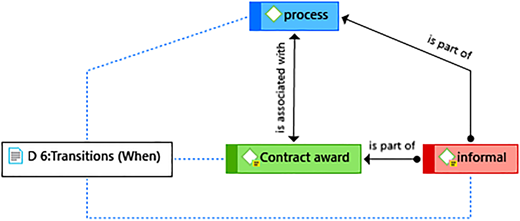
Contract award is the basis of when to perform transitions. Contract award dictates when transitions should occur. Due process is thereafter followed as process is associated with the contract award. Informal means are also used. Informal means is a part of process because process can allow for informal means of communication. Informal means are also a part of contract award. Informal mechanisms are used when there is a high probability of contract award. PE teams should start getting involved in transition activities, and these are informal discussions to get an early start.
Some of the comments from the expert panel include the following:
Contract award was the dominant one; when to trigger transition activities, participant 3 articulated “On the award of the contract by the customer, with the following having been performed; the contract, including the scope, the price, the T&C's, having been signed by the client and the contract”. Other participants indicated that in some instances, a notification to proceed might also indicate when the transitions should occur, namely, participant 8 stated, “In some instances the customer may issue a notification to proceed while the terms and conditions are being negotiated. In such cases the notification to proceed is used to trigger the transition between the sales and PE teams”. Processes also indicate when transitions should occur, participant 10 stated, “A formally defined process (stage-gate) will indicate when the transition process should commence; normally this is on contract award or on notification to proceed. The organizational process should clearly indicate when the transition should occur and any process deviation must be communicated and agreed to by the organization's executive management’, especially in large complex projects”. Other participants also indicated that on some occasions, informal mechanisms could be used to trigger transitions. Participant 7 stated, “Before the order is received, but at that phase where it is known that there is a high probability of success, PE should start getting involved, asking early questions to get more clarity. These are more informal discussions to get early alignment; this will help the planning process. This will enable PE to get an early start”. This view was also echoed by participant 9 “Informally, initiatives to accelerate the transition may occur between the sales and PE teams when there is a high probability that the project will be awarded. Both the sales teams and PE teams may engage informally to get an early start on the transition because in large complex projects, the transition process can consume a lot of time and any time saving will be beneficial”.
4.4 What do the transitions between the FE and PIP mean for project practitioners?
Fifty-eight in vivo comments were grouped into 15 first-order codes, which were then categorized into 9 second-order themes. The top four themes constitute 78% of the in vivo comments. Milestones measurements and project deliverables at 28%, knowledge sharing at 19%, teams and team responsibilities at 17% and risk 14%. Figure 6 gives a graphical representation of the linkages from Atlas.ti between the different second-order themes. D7 refers to transitions (i.e. What do the transitions between the FE and PE mean for project practitioners?). From Figure 6, milestones measurements and project deliverables trigger transition activities. Knowledge sharing is a part of milestones measurements and project deliverables because milestones measurements and project deliverables rest on knowledge sharing. Teams and team responsibilities are a part of milestones measurements and project deliverables, because milestone measurements and project deliverables trigger teams and team responsibilities as these are resources required to deliver the project. Teams and team responsibilities are also associated with knowledge sharing because teams can only function effectively through knowledge sharing. Risk is a function of milestone measurements and project deliverables because non-adherence to project milestones measurements and project deliverables can lead to risk. Risk is associated with teams and team responsibilities. Risk is a function of knowledge sharing because poor knowledge sharing practices increase risk, and good knowledge sharing practices reduce risk.
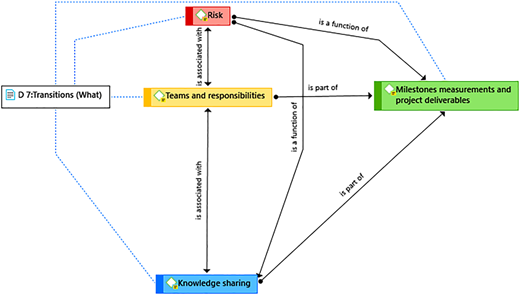
Transitional linkages indicating what transitions mean for project practitioners
Transitional linkages indicating what transitions mean for project practitioners
Some of the comments from the expert panel members include the following:
Transitions imply benefits in project deliverables as articulated by participant 1 “A well-integrated and transitioned project results in higher margin quality as well as lower risk in PE. This also improves team morale as generally; staff work better on a project knowing there is upstream potential to improve on the project deliverables. This is a lot better than trying to recover a project with high risk which is often the case in projects that are not well integrated and transitioned”. There are also implications for teamwork as pointed out by participant 3 “Both the sales and the project teams are on the same page which results in reduced risk and less conflict in the later stages of the project. The responsibilities have also changed from sales to PE”. Transition also implies that the project has also officially commenced as per the contract conditions, which was eloquently stated by participant 4 “The clock has started ticking from a project schedule perspective, the milestones and measurements now need to be regularly tracked to ensure adherence to the project budget, schedule and specifications which have been committed during the sales phase”; this view was also supported by participant 8 “The responsibilities have shifted from the sales team to the PE team. The project has now commenced in terms of the project start date and the milestones and measurements need to be tracked and measured against the project baseline which was submitted and committed to the customer”.
Transitions also imply “knowledge sharing and continuity”, as pointed out by participant 2; however, participant 10 highlighted the importance of tacit knowledge transfer: “Knowledge has been shared between the sales and PE teams. However, one must caution against ensuring that tacit knowledge which has not been documented be transferred across to the PE team. This is possible through the gradual reduction of the sales team involvement which will ensure knowledge transfer and continuity”. In line with continuity and knowledge transfer, participant 7 highlighted the importance thereof: “As the project evolves, sales team involvement is reduced, however it is not a hard stop from sales, the transition is a process of knowledge sharing and continuity and gradual reduction in sales involvement”. From a project risk perspective, it is important to ensure that the project scope and limitations are properly understood and managed: Participant 9 “It is important that the scope is correctly managed by the PE team and any deviations need to follow due process otherwise the project will be hampered by scope creep which could lead to cost, schedule and specification deviations which will be detrimental to the project”. Participant 10 also highlighted the implications from a risk perspective: “The project scope and limitations must be understood and adhered to as per the contractual documentation and the risk management needs to be a continuous process throughout the project life cycle”.
5. Discussion of results
For the “What” question, what integration and transition mechanisms can be linked to project success? It is important to understand that projects are undertaken by organizations to create value (Davies, 2004; Shapiro, 1977; Turkulainen et al., 2013), and deliver benefits to both the organization and the client. The findings from this research revealed that processes and documentation, cross-functional involvement, risk management, common workshops (meetings) are the essential mechanisms to ensure integration and transition (Section 4.1). Processes and documentation between the FE team and the PE teams need to be in place, a process that is followed and respected; not just a physical set of documents which people do not adhere to. This view was also supported by Samset and Volden (2016). The handover process needs to include a fully comprehensive document encompassing all relevant information pertaining to the FE phase. Research also supports the flow of customer information from the FE to the PE phase (Ståhle et al., 2019). This was also supported by the expert panel, where it was found that continuity between the FE and PE team is a critical factor for project success. This aligns with the findings from Willumsen et al. (2019) where standardization is seen as a way to facilitate communication within the project team and enable collaboration. There was support for a proper stage-gate process which is a requirement for the project to move from one gate onto the next, where certain criteria need to be met; this concept is also supported by literature evidence (Samset and Volden, 2016).
From a cross-functional involvement perspective, close alignment between the FE and the PE team is paramount, and this is the most critical aspect of managing a project (Samset and Volden, 2016). It is also important to build a trust relationship between the FE team and the PE; this is one of the foundational requirements for integration and transition. Only through this trust relationship can alignment be achieved (Imam and Zaheer, 2021). Joint initiatives between FE and PE teams are required to create alignment and trust; these should include joint face-to-face meetings with the customers, representing a single front with the customer's interests at heart. A closer relationship between the two teams is needed, with a more symbiotic relationship facilitating a collaborative approach to the integration and transition in line with literature evidence (Imam and Zaheer, 2021). This can be facilitated through common workshops and meetings. There was also support for FE team involvement in PE execution as an oversight function, where FE teams also attend project meetings and perform site visits to ensure that the promises that have been made are adhered to; this point was related to tacit knowledge transfer and continuity (Nobelius and Trygg, 2002; Storbacka, 2011; Turkulainen et al., 2013). Risk management with timeous actions is seen as an area that is to be addressed early in the FE and common workshops can be the vehicle to generate risks and identify early actions to mitigate risk. Risk management as an activity is well published and researched (Willumsen et al., 2019).
For the “How” part of the central question, how are the integration and transition mechanisms practised? Process and documentation, cross-functional collaboration and teamwork, and communication and feedback were the top three dominant second-order themes (Section 4.2). Process and a documented handover process between the FE and PE team are key, with a strong focus on careful interface management and documentation, with involvement of quality control to ensure adherence to process. The handover process must include a full documentation pack of all the relevant FE documentation used. Research evidence also supports the involvement of quality control mechanisms through stage-gate processes (Samset and Volden, 2016). Cross-functional involvement and teamwork to improve the quality of the FE work is the area where there is more uncertainty (Samset and Volden, 2016). Research evidence pointed out that the FE is under-resourced, and far too few resources are spent on the FE (Samset and Volden, 2016). Indications of resources which should be spent in the FE range from 15% up to 35% (Miller and Lessard, 2009) as cited by Samset and Volden (2016). Communication was recognized as an element for effective integration and transition. However, the focus needs to be on continuous integrated communication throughout the FE phase and communicating throughout the PLC (Galbraith et al., 2001). The more information that is shared, the more transparent the process will be. While there is recognition for more involvement in the FE, there is also a requirement for FE involvement in the execution phases to ensure continuity and transparency. This also includes feedback from the PE team to be well documented to avoid mistakes in future projects: this is a key factor in ensuring lessons learnt. This also includes a post-mortem on completed projects, which will provide another opportunity for lessons learnt. Cognisant with literature research, ex-post evaluation is an essential element in any project governance scheme (Samset and Volden, 2016).
Regarding the “When” question, when are integration and transition activities practiced? The findings from this research revealed that the top three focus areas are contract award, processes and informal means (Section 4.3). There was strong support for transition activities to be trigged on contract award or in some instances when the customer issues a notification to proceed. A well-documented process will indicate when integration activities are to take place. Transition takes place on contract award when a signed contract between the customer and the service provider is concluded. A project network diagram or stage-gate process (Samset and Volden, 2016) can also be used to indicate when certain activities should take place, as well as indicating who is responsible and what resources are required, however, the project network diagram must be regularly updated to reflect reality. Research evidence also supports processes that can be used to trigger transition activities that are specific to time, duration and structuring (Furst et al., 2004; Lundin and Steinthórsson, 2003; Winch, 2014). There is also evidence that an early informal engagement between the FE and PE teams should occur. This is before the contract is awarded, when there is a high probability of the award, as this will give the PE team an early start in terms of project alignment. These informal means can be used to facilitate information flow and knowledge transfer for successful transition (Ståhle et al., 2019). This is important because the settings of the FE and PE teams are different, they have different tasks and responsibilities (Turkulainen et al., 2013), and organizational barriers exist between them which hinder integration and collaboration (Artto et al., 215; Ståhle et al., 2019), and informal means may provide the opportunity to improve information flow and knowledge transfer.
For the “What” question, what does the integration and transition mean for project practitioners? The findings from this research revealed that there was strong support for milestones, measurements and project deliverables, knowledge sharing, teams and team responsibilities, and risk management (Section 4.4). The expert panel indicated that integration and transition activities show that the project has officially commenced, and the clock has started ticking regarding measurements, milestones and project deliverables. Integration refers to the coordination of activities (Demirkesen and Ozorhon, 2017), whereas, transition refers to a change before and after an event or among participants (Lundin and Söderholm, 1995). There is a change in accountability from the sales FE to PE (Jacobson et al., 2013). Transition activities include the signing of contracts, project kick-offs and project milestones (Van den Ende and Van Marrewijk, 2014). From literature evidence, there is also a requirement for milestones measurements and project deliverables specific to time, duration and structuring (Furst et al., 2004; Lundin and Steinthórsson, 2003; Winch, 2014). This can be achieved through a proper stage-gate process (Samset and Volden, 2016).
Better integration and transition can also help reduce tensions between the two teams and the two phases; this will ensure a smoother and seamless transition (Artto et al., 2015). This will enable better assignment of teams and team responsibilities. Integrating the two phases also means resources are not over-committed, and promises made during the sales and marketing phases are achievable (Cooper and Budd, 2007). This will enable better knowledge transfer from both an explicit and tacit knowledge perspective, thus developing a better understanding of the project scope and limitations and a mutual understanding of the expectations. This is important because organizational barriers exist between the sales FE and PE phases resulting in the need to link these two functional areas through integration (Artto et al., 2015; Cooper and Budd, 2007; Dietrich, 2006; Ståhle et al., 2019). However, a transition is an evolving process: it is not a one-shot or a hard stop. As the project evolves, the FE team's involvement is reduced, and integration and transition should be well planned and coordinated as per defined processes to ensure the project's future success and not merely throw it over the wall from the FE to PE. A well-integrated and transitioned project also implies higher profit margins, higher quality and lower risk. Reduced risk also leads to lower conflict in the later stages of the project. Conflict within the PE phases can lead to risk, which can affect the project's success. Such conflict, if not handled well (Artto et al., 2015), can also seriously hamper the development of customer relationships (Artto et al., 2015). A well-integrated and transitioned project can also allow for better risk sharing between the FE sales and marketing phases and the PE phases.
6. Conclusions, limitations and areas for further research
The work here contributes to empirical research done in the project FE and PE phases. It enhances our knowledge about effective integration and transition between these project phases. Current literature highlights that the FE is not seen as within the domain of PM, and therefore the need exists for better integration and transition between the FE and PE phases for project success, and it consequently requires managerial attention. Current literature also highlights that the FE is not fully understood even though it is critical for project success. It also emphasises that the FE is hurdled with many challenges; hence, more research in this area is required. This research contributes to the debate on the integration and transition mechanisms required to improve project outcomes.
This paper reports on an in-depth interpretative analysis based on interviews with an expert panel in the empirical setting of South African electrical engineering industrial projects. The findings present an argument about the importance of integration and transition between the FE and PE phases. From this, the following has been identified:
(a) In terms of what mechanisms are important. Findings revealed processes as being the dominant second-order theme followed by cross-functional involvement, risk management and meetings and workshops as important mechanisms to improve integration and transition (Section 4.1).
(b) In terms of how integration and transition mechanisms should be performed, the three areas that require focus include processes and documentation, cross-functional collaboration and teamwork and communication and feedback (Section 4.2).
(c) In terms of when should transitions occur, the three triggers to effect transitions include contract award, proper process indicating when transitions should occur and other informal means like collaborative discussions outside formal process, which is built through relationship and trust (Section 4.3).
(d) In terms of what do transitions mean, the findings reveal that once the project has transitioned from the FE to the PE team, the project is now in the execution phase, and milestones and project deliverables are confirmed, it also requires knowledge sharing and teamwork as responsibility has shifted from the FE sales team to the PE teams and finally risk must be closely monitored as risks impact project deliverables (Section 4.4).
These findings enable a better understanding of the integration and transition activities in the PIP between the FE and PE phases. This research has implications for researchers and practitioners. From a research perspective, this research further identifies the need for more research on the integration and transition between the project FE and PE phases. In terms of project practitioners, it emphasises that more attention be devoted to integration and transition between the FE and PE phases. It also identifies several areas that practitioners should focus upon to improve project outcomes; these areas are highlighted in points (a) to (d).
This research highlights that a better understanding and implementation of integration and transition activities lead to better project outcomes and improves customer value. It also emphasises that well-integrated and transitioned projects are fundamental to the future success of the business. Moreover, this research further reinforces the need for more empirical research as empirical research recognizes the importance of obtaining more detailed insights from real life practitioners on their views, experiences and opinions thereby providing insights to guide further research and at the same time proving real life practical examples to guide practitioners in better integrating and transitioning between the project FE and PE phases. The findings also indicate that a more strategic focus be employed in PM initiatives. Practitioners should take a more strategic focus on PM and in doing so, embrace the FE of PM due to the fact that most of the critical decisions are made in the FE phase. Similarly, the FE team should also pay more attention to PE phases, this is critical to ensure promises made in the FE are realized. Naturally, this falls within the scope of the agreed contractual scope and deliverables.
Regarding limitations, the expert panel participants were a South African group of elite individuals, so certain cultural and geographical demographics may be unique to the South African group; hence, the findings of this group cannot be generalized across other geographic locations. A second limitation is that the qualitative study had a limited group of participants, interviewing 10 experts across one industrial sector: heavy electrical engineering industrial projects. This is mitigated by the narrow geographical location of projects in the one province, Gauteng, and across a single industry.
A further mitigating factor is the data quality which is because of the elite quality of expert panel participants whose in depth knowledge and experience across the project FE and PE and their insights provided confidence in the results. A further confidence factor was the results from the interviews specifically quoted in this paper, reflecting the expert panel's views, opinions and insights, based on a tremendous body of experience. The cumulative experience of the participants was more than 315 years, with an average of 30 years.
Future research areas should focus on different industry sectors and other categories of projects, as in this research, the focus is on heavy electrical engineering industrial projects. Moreover, this research was qualitative in nature and limited in terms of the expert panel participants, future research could also focus more on quantitative studies to explore the linkages between the project FE, PE, and the linkages to overall project performance.
Future studies can also address the dynamics associated with the different behavioural characteristics of the FE and PE teams and how these dynamics affect the integration and transition.
The author recognizes the contribution made by Chantelle Du Plessis for reading the initial drafts of this chapter and providing valuable comments on editing, which helped improve the content and quality of this work. The author is grateful for the valuable contribution.
This research did not receive any specific grant from funding agencies in the public, commercial, or not-for-profit sectors.

