This paper aims to develop a process theory of capability evolution that explains how organisational capabilities persist, erode and renew over time. It addresses limitations in capability lifecycle theory by reconceptualising capability evolution as a recursive process driven by capability–environment alignment and misalignment.
The paper develops a conceptual, mechanism-based process theory by synthesising dynamic capabilities theory, capability lifecycle theory and complementary perspectives on organisational learning, process theory and organisational microfoundations. The framework identifies capability persistence, managerial recognition and capability reconfiguration as interconnected mechanisms underlying recurring capability evolution.
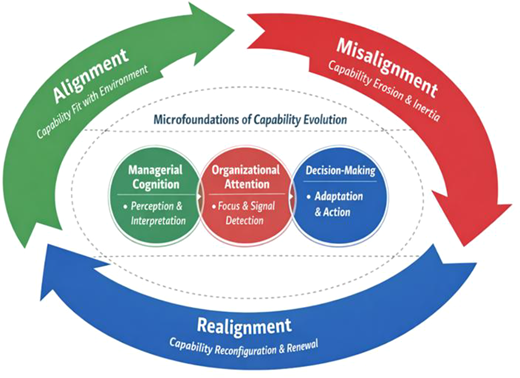
The framework conceptualises capability evolution as a continuous, relational and recursive process. Capability–environment alignment supports persistence, while environmental change can generate misalignment and erosion. Managerial recognition of misalignment and subsequent capability reconfiguration enable renewed alignment. Each cycle reshapes the conditions for subsequent organisational adaptation.
The paper is conceptual and does not empirically test the proposed framework. Future research should examine the model through longitudinal and process-oriented studies, develop measures of its core mechanisms, and investigate its applicability across different organisational and institutional contexts.
The framework suggests that managers should treat capability renewal as a continuous process. Regular assessment of capability–environment alignment, environmental scanning, organisational learning and capability reviews can help organisations recognise emerging capability gaps and support timely capability reconfiguration.
The framework highlights how organisational learning and capability renewal can support responsiveness to technological, institutional and stakeholder changes. It provides a basis for future research examining how capability evolution influences organisational adaptation and broader societal outcomes.
The paper extends capability lifecycle theory from a stage-based description towards a mechanism-based process explanation. It identifies capability–environment alignment and misalignment as the generative mechanism linking persistence, erosion and renewal, while integrating managerial cognition, organisational attention and strategic decision-making into a recursive model of capability evolution.
1. Introduction
In an era characterised by persistent environmental turbulence, technological disruption and shifting competitive landscapes, firms are under increasing pressure to continually renew their capabilities to sustain competitive performance. The dynamic capabilities perspective has become the dominant framework for explaining organisational adaptation, emphasising the processes of sensing, seizing and reconfiguring that enable strategic renewal (Teece et al., 1997; Teece, 2007). Over the past two decades, this perspective has generated substantial research on capability heterogeneity, organisational learning, microfoundations and the performance implications of dynamic capabilities across diverse contexts.
Despite these advances, an important question remains comparatively underexplored:
How do organisational capabilities evolve over time as a recurring process?
Existing research has significantly advanced understanding of how firms adapt through learning, path dependence and capability development (Zollo and Winter, 2002; Winter, 2003), while the capability lifecycle framework (Helfat and Peteraf, 2003) introduced an important temporal perspective by conceptualising capabilities as evolving through stages of founding, development, maturity and branching into alternative trajectories. Related research has further examined exploration and exploitation (March, 1991), organisational inertia and core rigidities (Leonard-Barton, 1992; Tripsas and Gavetti, 2000) and, more recently, the dynamic relationship between organisational capabilities and their external environment (Cristofaro et al., 2025).
However, these contributions differ in the aspects of capability evolution they emphasise, and their insights have not always been integrated into a coherent explanation of capability evolution as a recurring organisational process. Although existing theories provide important explanations of capability development, learning and adaptation, they provide comparatively less explicit explanation of how organisational capabilities repeatedly transition between effectiveness, erosion and renewal over time. In particular, capability lifecycle theory provides an important temporal foundation, while subsequent research has expanded understanding of the organisational, behavioural and environmental dimensions of capability development.
This paper addresses this theoretical opportunity by reconceptualising capability evolution as a cyclical and recursive process driven by capability–environment alignment and misalignment. Rather than viewing capability development solely as a progression through stages, the framework proposes that capabilities evolve through recurring cycles in which periods of alignment may be progressively disrupted by environmental change, leading to capability erosion and subsequent renewal through capability reconfiguration. The framework further explains these transitions through the microfoundational processes of managerial cognition, organisational attention and strategic decision-making, thereby linking macro-level capability dynamics with behavioural mechanisms of organisational adaptation.
To clarify the theoretical distinction between the existing capability lifecycle perspective and the process framework proposed in this study, Table 1 summarises the principal areas in which the present framework extends existing capability lifecycle thinking.
Building on these insights, this paper reconceptualises capability evolution as a cyclical and recursive process driven by the dynamic alignment and misalignment between organisational capabilities and their external environment. Rather than progressing through discrete lifecycle stages, capabilities evolve through recurring cycles in which periods of alignment gradually give way to misalignment as environmental conditions change, resulting in capability erosion and subsequent renewal through capability reconfiguration.
This reconceptualisation makes three interrelated contributions to the dynamic capabilities literature. First, it advances a process-based understanding of capability evolution that replaces predominantly stage-based interpretations with a recursive model of organisational adaptation. Second, it identifies capability–environment alignment and misalignment as the generative mechanism that explains how capabilities transition between effectiveness, erosion and renewal over time. Third, it integrates organisational learning, inertia, environmental adaptation and managerial microfoundations into a unified, multi-level process theory that links macro-level capability evolution with the behavioural processes of managerial cognition, attention and strategic decision-making.
2. Capability evolution in dynamic capabilities research: revisiting capability lifecycle theory through adjacent theoretical perspectives
Understanding how organisational capabilities evolve has become one of the central concerns of strategic management and organisation theory. While the dynamic capabilities perspective provides the dominant theoretical explanation for organisational adaptation under conditions of environmental change, a growing body of scholarship has examined capability evolution from multiple complementary perspectives, including organisational learning, evolutionary economics, organisational resilience, ambidexterity, co-evolution, complexity theory and institutional adaptation. Collectively, these perspectives recognise that capabilities are dynamic organisational phenomena whose development is shaped by learning, environmental interaction and organisational change. However, they differ in the mechanisms they emphasise and remain only partially integrated into a coherent explanation of how organisational capabilities repeatedly evolve over time.
Within this broader intellectual landscape, the capability lifecycle framework proposed by Helfat and Peteraf (2003) represents the first systematic attempt to conceptualise capability evolution as a temporal process. Since its publication, however, research has expanded considerably, with neighbouring theoretical traditions explaining different dimensions of organisational adaptation without necessarily extending lifecycle theory itself. Consequently, understanding capability evolution now requires revisiting capability lifecycle theory within the wider context of these adjacent perspectives. This section therefore reviews the evolution of capability research, examines the continuing contribution of lifecycle theory, and synthesises insights from complementary organisational theories to identify the remaining theoretical gaps addressed by the present study.
2.1 Dynamic capabilities and the origins of capability evolution
The dynamic capabilities perspective emerged in response to the limitations of the Resource-Based View, which explained sustained competitive advantage primarily in terms of valuable, rare, inimitable and non-substitutable resources but provided comparatively limited insight into how firms continually renew these resources under conditions of environmental change. Teece et al. (1997) addressed this limitation by introducing dynamic capabilities as the organisational capacity to purposefully integrate, build and reconfigure internal and external competences in response to rapidly changing environments. This perspective shifted attention from resource possession to the organisational processes through which firms adapt, innovate and sustain competitive advantage.
Subsequent developments significantly expanded the dynamic capabilities perspective. Teece (2007) articulated the foundational processes of sensing, seizing and reconfiguring, while later scholarship increasingly examined the microfoundations underpinning these processes, emphasising managerial cognition, organisational routines, resource orchestration and strategic decision-making (Felin et al., 2012; Helfat and Martin, 2015; Teece, 2023). More recent work has further highlighted the reciprocal relationship between organisations and their environments, demonstrating that firms not only adapt to environmental change but may also shape the environments within which they compete (Cristofaro et al., 2025).
Although dynamic capabilities theory provides a powerful explanation of organisational adaptation, early research focused primarily on explaining how firms renew competitive advantage rather than how organisational capabilities themselves evolve over time. Questions concerning the origins, development, maturation, transformation and eventual renewal of capabilities remained comparatively underdeveloped. Addressing these questions required a more explicit temporal perspective on capability development, providing the intellectual context for the emergence of capability lifecycle theory.
2.2 Capability lifecycle theory: contributions and continuing influence
The capability lifecycle framework developed by Helfat and Peteraf (2003) represents the first comprehensive attempt to conceptualise capability evolution within the dynamic capabilities tradition. Building on the broader logic of organisational adaptation, the framework introduced a temporal perspective by proposing that organisational capabilities evolve through the stages of founding, development and maturity before potentially branching into alternative trajectories such as replication, renewal, recombination, redeployment or retirement. By conceptualising capabilities as evolving organisational phenomena rather than static strategic assets, the framework established an important theoretical bridge between the Resource-Based View and dynamic capabilities theory.
The principal contribution of the capability lifecycle framework lies in its recognition that capability development is historically contingent and path dependent. Rather than assuming that capabilities remain stable once established, Helfat and Peteraf (2003) argued that their development is shaped by accumulated organisational learning, experience and changing environmental conditions. This insight provided scholars with a coherent temporal vocabulary for examining capability emergence, growth and transformation and subsequently informed a wide range of research on organisational learning, strategic renewal and capability heterogeneity.
The enduring influence of capability lifecycle theory extends beyond dynamic capabilities research. Its emphasis on cumulative development and historical trajectories resonates strongly with evolutionary economics, where organisational change is understood as a process of variation, selection and retention shaped by organisational routines and accumulated experience (Nelson and Winter, 1982; Dosi, 1982). Similarly, its temporal orientation aligns with process theories of organisational change, which conceptualise organisations as continuously evolving systems rather than collections of static structures (Tsoukas and Chia, 2002; Hernes, 2014). These complementary perspectives reinforce the importance of understanding capability evolution as an ongoing organisational process rather than as isolated episodes of strategic change.
Despite its continuing influence, subsequent developments within dynamic capabilities research have progressively expanded beyond the original lifecycle formulation. Research has increasingly focused on managerial cognition, organisational routines, environmental adaptation and resource orchestration as critical determinants of capability development (Schilke et al., 2018; Teece, 2023; Cristofaro et al., 2025). While these developments have enriched understanding of organisational adaptation, they have also highlighted the need to revisit capability lifecycle theory in light of broader theoretical advances concerning organisational learning, recursive adaptation and capability renewal. The following section therefore examines how adjacent theoretical perspectives have expanded contemporary understanding of capability evolution and identifies the opportunities for extending lifecycle theory through a more integrative process perspective.
The question of how organisational capabilities evolve over time remains central to dynamic capabilities research. Since the seminal work of Teece et al. (1997), the dynamic capabilities perspective has shifted attention from the possession of valuable resources to the organisational processes through which firms purposefully renew, reconfigure and orchestrate resources in response to environmental change. Subsequent scholarship has refined this perspective by elaborating the microfoundations of dynamic capabilities, the role of managerial orchestration and the conditions under which capabilities generate sustained competitive advantage (Teece, 2023; Cristofaro et al., 2025). Within this broader intellectual tradition, the capability lifecycle framework proposed by Helfat and Peteraf (2003) represents the first systematic attempt to explain how organisational capabilities develop and change over time. Rather than viewing capabilities as static organisational assets, the framework introduced a temporal perspective that recognised capability development as an evolutionary phenomenon shaped by organisational learning, experience accumulation and environmental interaction.
2.3 Broadening capability evolution through adjacent theoretical perspectives
Although dynamic capabilities theory provides the principal theoretical foundation for understanding organisational adaptation, a broader body of scholarship has examined how organisations develop, adapt and renew over time. These adjacent theoretical traditions offer complementary insights into different dimensions of capability evolution, including learning, resilience, exploration, environmental adaptation and systemic change. Collectively, they demonstrate that capability evolution is a multidimensional phenomenon shaped by behavioural, organisational and environmental processes. Nevertheless, these perspectives have largely developed independently, with each emphasising particular aspects of adaptation while providing only a partial explanation of how organisational capabilities repeatedly transition between effectiveness, erosion and renewal.
One of the earliest complementary perspectives is evolutionary economics, which conceptualises organisational development as a cumulative process of variation, selection and retention (Nelson and Winter, 1982; Dosi, 1982; Metcalfe, 1998). From this perspective, organisational routines function as repositories of accumulated knowledge that evolve through experimentation, competitive selection and organisational learning. Evolutionary economics therefore explains why organisational capabilities exhibit path dependence and why historical investments constrain future strategic choices. However, while this tradition explains the evolutionary logic of organisational development, it provides comparatively limited insight into the organisational mechanisms through which capabilities are repeatedly reconfigured in response to changing environmental conditions.
Closely related, the organisational learning literature emphasises that capabilities emerge and evolve through continuous processes of knowledge acquisition, experimentation and experience accumulation (March, 1991; Zollo and Winter, 2002; Howard-Grenville, 2021). This perspective highlights the dynamic tension between exploration and exploitation, demonstrating that organisations must continually balance capability refinement with innovation. While organisational learning provides an important explanation of capability accumulation and adaptation, it offers comparatively less attention to the recursive organisational processes through which established capabilities progressively lose environmental relevance and subsequently undergo renewal.
Building on these ideas, research on organisational ambidexterity has advanced understanding of how organisations sustain competitiveness by simultaneously exploiting existing competencies while exploring new opportunities (Raisch and Birkinshaw, 2008; O'Reilly and Tushman, 2013). Ambidexterity explains how firms manage competing strategic demands and avoid becoming trapped in excessive exploitation or exploration. However, its principal concern lies in balancing strategic orientations rather than explaining the recurring organisational mechanisms through which capability–environment misalignment develops and stimulates capability renewal.
Another important contribution comes from organisational resilience, which examines how organisations anticipate, absorb, recover from and adapt to disruption (Lengnick-Hall et al., 2011; Duchek, 2020). Resilience research demonstrates that organisational recovery depends upon preparedness, adaptive capacity and organisational learning. This perspective substantially enriches understanding of renewal following adverse events, yet it primarily focuses on recovery from disruption rather than on the continuous cycles of capability erosion and renewal that characterise long-term organisational evolution.
Research on co-evolution has further expanded understanding of organisational adaptation by demonstrating that organisations and their environments evolve through reciprocal interaction rather than one-directional environmental selection (Lewin and Volberda, 1999; Volberda and Lewin, 2003). More recent dynamic capabilities research similarly recognises that organisations both respond to and actively shape their competitive environments (Cristofaro et al., 2025). These perspectives reinforce the importance of capability–environment alignment as a dynamic and continuously evolving relationship. Nevertheless, they devote comparatively less attention to the internal organisational processes through which changing environmental conditions generate capability erosion and subsequent renewal.
Additional insight is provided by complexity theory and adaptive systems theory, which conceptualise organisations as complex adaptive systems characterised by nonlinear interactions, emergence and recursive feedback (Anderson, 1999; Sterman, 2000; Meadows, 2008; Uhl-Bien and Marion, 2008). From this perspective, organisational adaptation cannot be understood through simple linear relationships because feedback processes continually reshape organisational behaviour over time. These ideas closely align with recent developments in process theory, which conceptualise organisational change as an ongoing process of becoming rather than a sequence of discrete events (Tsoukas and Chia, 2002; Langley et al., 2013; Hernes, 2014). Together, these perspectives provide a strong theoretical basis for understanding capability evolution as recursive, dynamic and continuously unfolding.
Finally, institutional adaptation extends understanding of capability evolution by recognising that organisations respond not only to competitive pressures but also to changing regulatory, normative and socio-cultural environments (Scott, 2014; Greenwood et al., 2017). Institutional theory highlights how organisational legitimacy shapes strategic adaptation and capability development, demonstrating that capability evolution is embedded within broader institutional contexts. However, like many adjacent perspectives, institutional theory places greater emphasis on external pressures than on the internal organisational mechanisms that repeatedly transform capabilities over time.
Collectively, these theoretical traditions substantially enrich understanding of organisational adaptation by explaining learning, resilience, environmental interaction, strategic balance, recursive change and institutional influence. Yet their contributions remain fragmented. None provides an integrated explanation of how organisational capabilities repeatedly transition between effectiveness, erosion and renewal through identifiable organisational mechanisms operating across multiple cycles of adaptation. Consequently, while capability lifecycle theory remains the principal temporal framework within dynamic capabilities research, extending it requires integrating insights from these complementary perspectives into a coherent process theory of capability evolution. Such an integrative perspective forms the foundation for the theoretical framework developed in this study.
2.4 Synthesising adjacent perspectives: why capability lifecycle theory requires extension
The preceding review demonstrates that scholarship on capability evolution has advanced substantially since the introduction of the capability lifecycle framework. dynamic capabilities research has deepened understanding of strategic renewal and resource orchestration, organisational learning has explained how capabilities emerge through experience and knowledge accumulation, evolutionary economics has highlighted the cumulative and path-dependent nature of organisational development, and organisational resilience, ambidexterity, co-evolution, complexity theory and institutional adaptation have each illuminated important dimensions of organisational adaptation. Collectively, these perspectives have broadened understanding of how organisations respond to environmental change and sustain competitive advantage.
Despite these advances, the literature remains theoretically fragmented. Each perspective explains a particular dimension of organisational adaptation while adopting different assumptions regarding the drivers, processes and outcomes of capability evolution. dynamic capabilities theory focuses primarily on strategic renewal and resource reconfiguration; organisational learning explains capability accumulation through knowledge creation and experience; ambidexterity examines the balance between exploration and exploitation; resilience emphasises recovery from disruption; evolutionary economics highlights variation, selection and retention; complexity theory explains recursive feedback and emergence; and institutional theory examines adaptation to changing legitimacy requirements. Although these perspectives are complementary, they have developed largely in parallel and have not been integrated into a coherent explanation of how organisational capabilities repeatedly evolve over time.
Capability lifecycle theory remains the closest approximation of such an integrative perspective because it explicitly recognises that capabilities evolve throughout their organisational lives. However, its original formulation primarily provides a temporal description of capability development rather than a process explanation of capability evolution. While the framework identifies alternative developmental trajectories, it offers comparatively limited insight into the organisational mechanisms through which capabilities repeatedly transition between effectiveness, erosion and renewal. Similarly, although the lifecycle perspective acknowledges environmental influences and organisational learning, it does not fully explain how changing environmental conditions, managerial interpretation and organisational responses interact recursively to reshape capabilities across successive cycles of adaptation.
These observations suggest that extending capability lifecycle theory requires more than refining its developmental stages. Instead, it requires integrating complementary insights from adjacent theoretical traditions into a mechanism-based explanation of capability evolution. Such an explanation must recognise that capability development is simultaneously behavioural, organisational and environmental; that capability renewal emerges through recursive interactions between organisations and their changing environments; and that these interactions are mediated by organisational learning, managerial cognition, resource reconfiguration and feedback processes operating across multiple levels of analysis. Rather than viewing capability evolution as a progression through sequential stages, this perspective conceptualises it as a continuously unfolding process in which capability persistence, erosion and renewal constitute recurring organisational phenomena.
Building on this synthesis, the present study develops a process theory of capability evolution centred on the dynamic relationship between organisational capabilities and their external environment. Specifically, the proposed framework explains how capability–environment alignment and misalignment generate recurring cycles of capability persistence, erosion and renewal, while identifying the behavioural and organisational mechanisms through which these transitions occur. By integrating insights from dynamic capabilities theory with adjacent perspectives on organisational adaptation, the framework advances a more comprehensive explanation of capability evolution than has previously been available in the literature.
3. A process theory of capability evolution
The preceding review demonstrates that capability evolution has been examined from multiple theoretical perspectives, each contributing important insights into organisational adaptation. Dynamic capabilities theory explains purposeful resource renewal and reconfiguration, organisational learning highlights knowledge accumulation through experience, evolutionary economics emphasises variation and path dependence, while resilience, ambidexterity, co-evolution, complexity theory and institutional adaptation illuminate complementary dimensions of organisational change. Collectively, these perspectives have advanced understanding of organisational adaptation but remain fragmented in explaining how organisational capabilities repeatedly transition between effectiveness, erosion and renewal through identifiable organisational mechanisms.
Building on these complementary perspectives, this paper develops a process theory of capability evolution that conceptualises organisational capabilities as continuously evolving through recursive cycles of persistence, erosion and renewal. Rather than viewing capability development as progression through predefined lifecycle stages, the proposed framework conceptualises capability evolution as an ongoing organisational process driven by the dynamic interaction between organisational capabilities and their external environment. Central to this perspective is the concept of capability–environment alignment, which explains how organisations sustain capability effectiveness while adapting to changing environmental conditions.
The proposed theory advances capability lifecycle theory by shifting attention from descriptive developmental trajectories to the organisational mechanisms that generate capability evolution. Specifically, the framework explains capability evolution through three interrelated mechanisms capability persistence, managerial recognition and capability reconfiguration that collectively explain how organisations repeatedly transition between periods of capability effectiveness, erosion and renewal. Given that every episode of renewal reshapes routines, managerial cognition, resource configurations and adaptive capacity, capability evolution is conceptualised as an inherently recursive organisational process rather than a linear sequence of stages.
The following sections develop the theoretical foundations of the proposed process theory, elaborate capability–environment alignment as its generative mechanism, explain the mechanisms through which capability evolution unfolds and demonstrate how recursive adaptation underpins continuing organisational renewal. Figure 1 presents the overall framework developed in this study.
3.1 Philosophical foundations of the process perspective
The proposed process theory is informed by a process-oriented view of organisational reality, in which organisational phenomena are understood as continuously unfolding rather than as fixed or static entities. This perspective is particularly appropriate for examining capability evolution because capabilities are not treated as stable organisational properties but as phenomena that emerge, persist and change through ongoing interactions among organisational actors, routines and changing environmental conditions (Tsoukas and Chia, 2002; Langley et al., 2013; Hernes, 2014). Accordingly, capability evolution is conceptualised as a temporal and relational process rather than as a predetermined sequence of developmental stages.
This process perspective also assumes that capability effectiveness is relational: capabilities derive their effectiveness from their relationship with changing environmental conditions rather than from their intrinsic characteristics alone. The framework therefore focuses on the processes through which alignment, misalignment and renewed alignment emerge over time. At the same time, the analysis adopts a mechanism-oriented view of theoretical explanation, seeking to explain how managerial cognition, organisational learning, resource reconfiguration and environmental change interact to generate recurring patterns of capability persistence, erosion and renewal. These philosophical assumptions provide the foundation for the theoretical premises developed below.
3.2 Theoretical foundations of the process theory
The proposed process theory is underpinned by four interrelated theoretical premises that collectively redefine capability evolution as a continuous, recursive and environmentally embedded organisational process. Rather than treating capabilities as organisational assets that progress through predetermined developmental stages, the framework conceptualises capability evolution as an emergent phenomenon arising from the ongoing interaction between organisational actors, organisational routines and changing environmental conditions.
The first premise is that capability evolution is continuous rather than episodic. Organisations exist within environments characterised by persistent technological innovation, competitive rivalry, institutional change and evolving stakeholder expectations. Consequently, organisational adaptation cannot be understood as a series of isolated strategic events but rather as a continuous process through which organisations repeatedly modify and renew their capabilities (Tsoukas and Chia, 2002; Langley et al., 2013; Hernes, 2014). This perspective aligns with dynamic capabilities theory, which views sustained competitive advantage as dependent upon the continuous renewal of organisational resources and competencies (Teece, 2023). Capability evolution therefore represents an enduring organisational process rather than an occasional strategic intervention.
The second premise is that capability evolution is relational. The strategic value of organisational capabilities is not determined solely by their internal characteristics but by the extent to which they remain aligned with environmental conditions. Capabilities derive their effectiveness from their ability to address prevailing technological, competitive, regulatory and market demands. Consequently, capability evolution reflects the dynamic relationship between organisational capabilities and their external environment rather than changes occurring within the organisation alone. This relational perspective shifts analytical attention from capabilities as static organisational resources towards capability–environment alignment as the central determinant of sustained organisational effectiveness.
The third premise is that capability evolution is recursive. Every episode of organisational adaptation reshapes subsequent adaptive capacity by modifying organisational routines, accumulated knowledge, managerial cognition and resource configurations. Organisational learning therefore generates feedback processes that influence future responses to environmental change, producing cumulative and path-dependent patterns of organisational development. This recursive understanding is consistent with evolutionary economics, systems thinking and complexity theory, which conceptualise organisational change as a self-reinforcing process characterised by feedback, emergence and continual adaptation (Nelson and Winter, 1982; Sterman, 2000; Meadows, 2008).
The fourth premise is that capability evolution is behaviourally enacted. Capabilities do not evolve autonomously but through the interpretations, decisions and actions of organisational actors. Managers continuously scan the external environment, interpret emerging opportunities and threats, evaluate existing capability configurations and initiate strategic responses through resource orchestration and organisational reconfiguration (Felin et al., 2012; Helfat and Martin, 2015). Consequently, capability evolution depends upon managerial cognition, organisational learning and collective decision-making that translate environmental change into purposeful organisational adaptation.
Taken together, these four premises establish capability evolution as a process that is continuous, relational, recursive and behaviourally enacted. These premises provide the conceptual foundations upon which the proposed process theory is developed.
3.3 Capability–environment alignment as the generative mechanism
Building upon these theoretical foundations, the proposed framework identifies capability–environment alignment as the generative mechanism underpinning capability evolution. Unlike traditional notions of strategic fit, which often imply a relatively stable correspondence between organisational resources and environmental conditions, capability–environment alignment is conceptualised as a dynamic and continuously evolving relationship. Alignment reflects the extent to which organisational capabilities remain appropriate for prevailing environmental demands and therefore enable effective strategic action.
Periods of alignment are characterised by the effective deployment of organisational capabilities to achieve strategic objectives. During these periods, successful routines become reinforced through repeated application, organisational learning consolidates existing knowledge and established resource configurations become increasingly institutionalised. Persistence is therefore a natural consequence of sustained alignment because organisations tend to continue investing in capabilities that consistently generate favourable performance outcomes.
However, organisational environments are inherently dynamic. Technological disruption, competitive restructuring, institutional reform, regulatory change and evolving stakeholder expectations continually reshape the conditions within which organisations compete. As these changes accumulate, previously effective capabilities may become progressively less appropriate for emerging environmental demands. Capability erosion therefore arises not because capabilities deteriorate intrinsically but because the external environment changes more rapidly than existing organisational capabilities.
The transition from alignment to misalignment creates strategic tension that necessitates organisational adaptation. Managers must interpret environmental signals, evaluate the adequacy of existing capabilities and determine whether capability reconfiguration is required. Successful adaptation restores capability–environment alignment, while delayed or ineffective responses may intensify capability erosion and reduce organisational performance. Capability evolution is therefore generated through the continuous movement between alignment, misalignment and renewed alignment rather than progression through fixed developmental stages.
Conceptualising capability–environment alignment as the generative mechanism provides an important extension to capability lifecycle theory. Whereas lifecycle theory primarily describes capability trajectories, the present framework explains why capabilities evolve by locating the source of organisational adaptation in the dynamic interaction between organisational capabilities and changing environmental conditions.
3.4 Generative mechanisms of capability evolution
The process theory proposes that capability evolution unfolds through the interaction of three interdependent organisational mechanisms: capability persistence, managerial recognition and capability reconfiguration. Together, these mechanisms explain how organisations repeatedly transition between periods of capability effectiveness, erosion and renewal.
The capability persistence mechanism reflects the stabilising influence of organisational routines, accumulated experience and path dependence. Organisational routines promote reliability, coordination and operational efficiency by embedding knowledge within recurrent patterns of organisational behaviour (Nelson and Winter, 1982; Feldman and Pentland, 2003). As organisations repeatedly deploy successful routines, these become increasingly institutionalised, reinforcing existing capability configurations and encouraging continued exploitation of established competencies. While persistence enhances organisational stability, it also increases the possibility that capabilities become progressively less responsive to changing environmental conditions.
The managerial recognition mechanism explains how organisations identify capability–environment misalignment. Environmental change alone does not automatically trigger adaptation; organisational actors must first recognise that existing capabilities no longer adequately address emerging environmental demands. Drawing upon managerial cognition, the attention-based view and organisational sensemaking, this mechanism emphasises that strategic renewal begins with the interpretation of environmental signals rather than with environmental change itself (Ocasio, 1997; Weick et al., 2005; Helfat and Martin, 2015). Differences in managerial attention, experience and interpretation therefore influence both the timing and effectiveness of organisational adaptation.
The capability reconfiguration mechanism captures the deliberate organisational actions undertaken to restore capability–environment alignment. Building upon dynamic capabilities theory, reconfiguration involves modifying, recombining, redeploying or replacing organisational capabilities through strategic resource orchestration, organisational learning and structural adjustment (Teece, 2007, 2023). Successful reconfiguration enables organisations to respond effectively to environmental change while simultaneously generating new knowledge and adaptive capacity that influence subsequent capability evolution.
These mechanisms should not be interpreted as sequential stages but as mutually reinforcing processes operating throughout organisational adaptation. Capability persistence provides organisational stability, managerial recognition identifies emerging strategic challenges, and capability reconfiguration enables purposeful organisational renewal. Their interaction constitutes the generative architecture through which capability evolution unfolds.
Taken together, this literature provides a substantial foundation for understanding capability development, adaptation and change. The dynamic capabilities perspective highlights organisational renewal and reconfiguration; evolutionary approaches emphasise learning, routines and path dependence; and capability lifecycle theory provides an important temporal account of capability development. These perspectives offer complementary insights, but their implications for the recurring movement of capabilities between effectiveness, erosion and renewal remain comparatively under-integrated. This study builds upon these established perspectives by bringing their temporal, behavioural and environmental insights together within a process-based account of capability evolution.
3.5 Recursive dynamics of capability evolution
A defining characteristic of the proposed framework is its conceptualisation of capability evolution as an inherently recursive organisational process. Unlike lifecycle models that assume progression through successive developmental stages, the present theory argues that every episode of capability renewal transforms the organisational conditions from which future adaptation emerges. Organisational adaptation therefore exhibits recursive dynamics in which the outcomes of one evolutionary cycle become the inputs for the next.
Following each episode of capability reconfiguration, organisations do not simply return to their previous state of equilibrium. Instead, renewed capabilities reshape organisational routines, alter managerial cognition, reconfigure resource portfolios and modify adaptive capacity. These organisational changes influence how future environmental signals are interpreted, how strategic opportunities are recognised and how subsequent capability reconfiguration unfolds. Capability evolution is therefore characterised by cumulative learning, organisational memory and path dependence that generate distinctive evolutionary trajectories across organisations.
The recursive perspective also explains why organisations facing similar environmental conditions frequently experience markedly different adaptive outcomes. Differences in organisational learning, managerial interpretation, resource endowments and institutional contexts influence how organisations recognise capability–environment misalignment and implement capability reconfiguration. These differences accumulate over successive cycles of adaptation, producing increasingly divergent patterns of capability evolution despite comparable external conditions. Capability evolution should therefore be understood as an emergent organisational phenomenon arising from the interaction of behavioural, organisational and environmental processes rather than from deterministic lifecycle progression.
The recursive dynamics proposed in this framework extend capability lifecycle theory by replacing linear developmental trajectories with continuous cycles of adaptation generated through feedback and organisational learning. In doing so, the theory aligns capability evolution with broader process perspectives that conceptualise organisations as continuously becoming through ongoing interactions between organisational actors and their environments (Van de Ven, 1992; Tsoukas and Chia, 2002; Langley et al., 2013; Hernes, 2014). Figure 1 integrates these dynamics into a unified process model, illustrating how capability–environment alignment, capability persistence, managerial recognition and capability reconfiguration interact recursively to explain organisational capability evolution over time.
4. Discussion
This study sought to address a longstanding but insufficiently theorised question within the dynamic capabilities literature: how do organisational capabilities evolve over time? While existing scholarship has substantially advanced understanding of how organisations adapt through sensing, seizing and reconfiguring resources (Teece et al., 1997; Teece, 2007, 2023), considerably less attention has been devoted to explaining the organisational processes through which capabilities themselves repeatedly emerge, persist, erode and renew. Although capability lifecycle theory (Helfat and Peteraf, 2003) introduced an important temporal perspective by conceptualising capabilities as evolving across developmental stages, subsequent research has increasingly highlighted the importance of recursive adaptation, managerial cognition, organisational learning and environmental interaction in shaping organisational capability development (Schilke et al., 2018; Cristofaro et al., 2025).
Against this backdrop, the present study advances a process theory of capability evolution that reconceptualises capability development as a recursive organisational phenomenon generated through the dynamic interaction between organisational capabilities and their external environment. By positioning capability–environment alignment as the generative mechanism underpinning capability persistence, erosion and renewal, the proposed framework moves beyond descriptive accounts of capability development to explain the causal processes through which organisational capabilities repeatedly evolve over time. In doing so, the framework extends capability lifecycle theory while integrating insights from dynamic capabilities theory, organisational learning, evolutionary economics, resilience, process theory and organisational microfoundations into a unified explanation of organisational adaptation.
Rather than introducing entirely new constructs, the principal contribution of this study lies in integrating previously fragmented theoretical insights into a coherent mechanism-based explanation of capability evolution. Existing research has independently examined organisational learning (Zollo and Winter, 2002), managerial cognition (Helfat and Martin, 2015), organisational inertia (Tripsas and Gavetti, 2000), capability renewal (Teece, 2023) and the capability–environment nexus (Cristofaro et al., 2025). However, these perspectives have generally evolved in parallel, providing limited explanation of how their underlying processes interact recursively to generate continuing capability evolution. The present framework therefore contributes by explaining why capability evolution is continuous, how successive episodes of adaptation become causally connected, and why organisational renewal represents an enduring organisational process rather than an episodic strategic response.
The following discussion considers these contributions in relation to contemporary developments in dynamic capabilities research, capability lifecycle theory and the broader organisational adaptation literature. Particular attention is given to recent empirical evidence demonstrating the recursive, behavioural and environmentally embedded nature of capability evolution.
4.1 Reframing capability lifecycle theory
The first contribution of this study is the reconceptualisation of capability lifecycle theory from a predominantly descriptive temporal framework into a mechanism-based process theory of capability evolution. Helfat and Peteraf’s (2003) lifecycle framework fundamentally transformed dynamic capabilities research by recognising that organisational capabilities evolve rather than remain static. Their conceptualisation of founding, development, maturity and branching established the first coherent vocabulary for examining capability development over time and has subsequently informed extensive research on strategic renewal, organisational learning and capability heterogeneity.
However, developments within the dynamic capabilities literature over the past two decades suggest that capability evolution is considerably more dynamic than implied by sequential lifecycle progression. Contemporary empirical studies increasingly demonstrate that organisational capabilities are repeatedly reshaped by digital transformation, environmental turbulence, organisational learning and managerial intervention rather than progressing through relatively discrete developmental trajectories (Warner and Wäger, 2019; Teece, 2023; Cristofaro et al., 2025). Organisations continuously modify capability configurations as technologies evolve, stakeholder expectations change and competitive conditions become increasingly uncertain.
The proposed process theory responds to these developments by positioning capability–environment alignment as the central generative mechanism underpinning capability evolution. Rather than interpreting capability decline as an exceptional event or capability renewal as a contingent organisational response, the framework conceptualises persistence, erosion and renewal as recurring organisational phenomena generated through continuous interaction between organisational capabilities and changing environmental conditions. Capability evolution therefore becomes a recursive process in which every episode of renewal simultaneously restores organisational effectiveness while establishing the conditions from which future misalignment will emerge.
This reconceptualisation also provides a richer explanation of recent empirical observations that organisations rarely follow uniform evolutionary trajectories. Longitudinal studies of organisational adaptation increasingly report iterative cycles of experimentation, adjustment and reconfiguration rather than orderly stage progression, particularly within digitally transforming organisations and highly dynamic industries. These findings are more readily accommodated by a recursive process perspective than by linear lifecycle assumptions, suggesting that capability evolution is characterised by continual recalibration rather than sequential progression.
4.2 Advancing dynamic capabilities theory
The proposed process theory extends dynamic capabilities theory by shifting analytical attention from the functional deployment of dynamic capabilities towards the temporal processes through which capabilities themselves repeatedly evolve. Since the seminal work of Teece et al. (1997), dynamic capabilities theory has explained how organisations sense opportunities, seize them through strategic action and reconfigure resources to sustain competitive advantage. Subsequent developments have further elaborated the microfoundations of these capabilities by highlighting the importance of managerial cognition, resource orchestration and entrepreneurial judgement (Helfat and Martin, 2015; Teece, 2023). While these developments have substantially enriched understanding of organisational adaptation, they have primarily focused on explaining how organisations adapt, rather than why capability renewal repeatedly becomes necessary over time.
The present framework addresses this limitation by conceptualising capability evolution as an endogenous organisational process generated through the dynamic interaction between organisational capabilities and changing environmental conditions. Rather than viewing sensing, seizing and reconfiguring as discrete managerial functions, the proposed theory positions them within recurring cycles of capability persistence, erosion and renewal driven by capability–environment alignment and misalignment. This perspective provides a temporal explanation for why organisations must continually reconfigure capabilities despite previous episodes of successful adaptation.
Recent empirical research increasingly supports this recursive interpretation of dynamic capabilities. For example, Warner and Wäger (2019) demonstrated that digital transformation is characterised by repeated cycles of sensing, experimentation, implementation and organisational renewal rather than one-off episodes of strategic change. Similarly, Teece (2023) argues that dynamic capabilities should be understood as continuously evolving organisational capacities that require ongoing managerial orchestration in response to rapidly changing competitive environments. These developments suggest that adaptation is not an isolated strategic response but an enduring organisational process, consistent with the recursive logic proposed in the present study.
Contemporary empirical evidence further demonstrates that capability development is shaped by the interaction between organisational learning and environmental dynamism. Wilhelm et al. (2022) showed that firms develop different configurations of dynamic capabilities depending on their learning orientation, resource allocation patterns and environmental context. Rather than identifying a single optimal capability configuration, their findings indicate that organisations continually adjust capability portfolios in response to changing strategic conditions. This configurational perspective aligns closely with the proposed process theory, which argues that capability effectiveness depends upon maintaining capability–environment alignment rather than achieving a static state of strategic fit.
Recent scholarship has also reinforced the importance of managerial cognition in shaping organisational adaptation. Drawing on a meta-analysis of more than 100 empirical studies, Durán and Aguado (2022) found that managerial cognitive capabilities—including opportunity recognition, strategic attention and environmental interpretation—are consistently associated with stronger dynamic capabilities across organisational contexts. These findings provide empirical support for the managerial recognition mechanism proposed in this study, suggesting that capability evolution depends not only on environmental change but also on how organisational actors perceive, interpret and respond to changing conditions.
The growing literature on digital transformation provides additional support for the recursive nature of capability evolution. Organisations implementing digital technologies rarely complete transformation through a single episode of change; instead, they engage in continuous experimentation, capability recombination and organisational learning as technologies and competitive conditions evolve (Warner and Wäger, 2019; Verhoef et al., 2021). These repeated cycles of adaptation closely resemble the capability persistence, recognition and reconfiguration mechanisms advanced in the present framework. Rather than viewing digital transformation as a discrete organisational project, the proposed theory explains it as one manifestation of an ongoing process of capability evolution driven by recurring capability–environment misalignment.
Similarly, recent research on organisational resilience demonstrates that adaptation extends beyond recovery from disruption to encompass the continual renewal of organisational capabilities. Duchek (2020) conceptualises resilience as a dynamic capability involving anticipation, coping and adaptation, while subsequent empirical studies have shown that resilient organisations repeatedly modify routines, knowledge structures and resource configurations in response to successive disruptions. These findings reinforce the argument that organisational renewal should be understood as a recurring organisational capability rather than an episodic response to crisis.
Taken together, these developments suggest that dynamic capabilities theory is increasingly moving towards a more process-oriented understanding of organisational adaptation. However, existing research continues to focus primarily on the components of dynamic capabilities rather than on the mechanisms through which capabilities themselves repeatedly evolve. By positioning capability–environment alignment and misalignment as the generative mechanism connecting persistence, erosion and renewal, the present study complements dynamic capabilities theory with a temporal and mechanism-based explanation of capability evolution. In doing so, it extends the explanatory scope of the dynamic capabilities perspective from explaining how organisations adapt to explaining why capability adaptation constitutes a continuous and recursive feature of organisational life.
4.3 Theoretical contributions
The proposed process theory advances the dynamic capabilities literature in several important respects. While dynamic capabilities theory has become the dominant explanation for organisational adaptation under conditions of environmental change (Teece et al., 1997; Eisenhardt and Martin, 2000; Teece, 2007, 2023), its primary analytical focus has been on explaining how organisations sense opportunities, seize them through strategic action and reconfigure resources to sustain competitive advantage. Comparatively less attention has been devoted to explaining how organisational capabilities themselves repeatedly evolve through cycles of emergence, persistence, erosion and renewal (Schilke et al., 2018; Cristofaro et al., 2025). The present study addresses this theoretical gap by repositioning capability evolution as the primary phenomenon requiring explanation.
The first contribution is the development of a mechanism-based explanation of capability evolution. Capability lifecycle theory (Helfat and Peteraf, 2003) introduced an important temporal perspective by recognising that capabilities evolve throughout their organisational lives. However, the framework primarily describes developmental trajectories rather than explaining the organisational mechanisms responsible for transitions between different states of capability development. Although subsequent dynamic capabilities research has substantially expanded understanding of sensing, seizing, reconfiguration and managerial microfoundations (Helfat and Martin, 2015; Teece, 2023), these developments have not fully explained why capabilities repeatedly transition between effectiveness, erosion and renewal. The present framework advances this literature by identifying capability–environment alignment and misalignment as the generative mechanism linking environmental change, capability persistence, managerial recognition and capability reconfiguration into a coherent causal process.
The second contribution is the reconceptualisation of capability evolution as a recursive organisational process rather than a linear developmental trajectory. Existing capability research has largely examined capability development through stages, episodes of renewal or discrete adaptive events (Helfat and Peteraf, 2003; Winter, 2003). By contrast, the proposed framework argues that capability renewal simultaneously restores organisational effectiveness while creating the conditions from which future capability erosion subsequently emerges. Consequently, organisational adaptation is conceptualised as a continuous cycle rather than a sequence with a definable endpoint. This recursive perspective aligns with recent calls to incorporate temporality and process into dynamic capabilities research (Langley et al., 2013; Hernes, 2014; Teece, 2023), while providing a more explicit explanation of how successive episodes of organisational adaptation become historically connected.
The third contribution is the integration of macro-level capability dynamics with micro-level behavioural mechanisms. Although the microfoundations literature has demonstrated that managerial cognition, organisational attention and strategic decision-making influence organisational adaptation (Felin et al., 2015; Helfat and Martin, 2015), these behavioural processes have generally been examined independently from broader models of capability evolution. The proposed framework explicitly links managerial cognition, organisational attention and strategic decision-making to the recognition of capability–environment misalignment and the initiation of capability reconfiguration. In doing so, the theory provides a multi-level explanation connecting behavioural processes operating at the individual level with recurring patterns of capability evolution observed at the organisational level.
The fourth contribution is the introduction of capability–environment alignment as the organising principle of capability evolution. Recent scholarship has increasingly recognised the reciprocal relationship between organisations and their environments (Cristofaro et al., 2025). However, environmental alignment has largely remained a contextual consideration rather than the central explanatory mechanism underpinning capability development. The present framework advances this emerging perspective by proposing that capability effectiveness is inherently relational and that capability evolution is generated through recurring shifts between alignment and misalignment as organisational and environmental conditions co-evolve. This moves beyond static notions of strategic fit by conceptualising alignment as a dynamic condition that continuously generates organisational adaptation.
Collectively, these contributions reposition capability evolution from a descriptive organisational phenomenon to a theoretically specified process governed by identifiable organisational mechanisms. Rather than replacing dynamic capabilities theory or capability lifecycle theory, the proposed framework extends both by providing a process explanation of how organisational capabilities repeatedly emerge, stabilise, erode and renew through recursive interactions between organisational capabilities, managerial cognition and changing environmental conditions. In doing so, the study contributes to the growing movement within strategic management towards mechanism-based explanations of organisational phenomena (Felin et al., 2015; Schilke et al., 2018; Teece, 2023).
While dynamic capabilities theory provides the primary foundation for explaining organisational adaptation, adjacent theoretical perspectives—including organisational learning (March, 1991; Zollo and Winter, 2002), organisational resilience (Duchek, 2020), organisational ambidexterity (O'Reilly and Tushman, 2013), evolutionary economics (Nelson and Winter, 1982), process theory (Langley et al., 2013; Hernes, 2014), and complexity theory (Uhl-Bien and Marion, 2009) have each contributed valuable but partial explanations of organisational change. These perspectives have largely developed in parallel, emphasising different mechanisms such as learning, adaptation, exploration–exploitation, variation and selection or emergence, without providing an integrated explanation of how organisational capabilities repeatedly evolve over time.
The proposed process theory does not seek to replace these perspectives; rather, it synthesises their complementary insights within a unified mechanism-based framework. By positioning capability–environment alignment as the organising principle of capability evolution, the framework demonstrates how learning, managerial cognition, resilience, resource reconfiguration and environmental interaction collectively shape recurring cycles of capability persistence, erosion and renewal. In doing so, the study contributes to ongoing calls for greater theoretical integration within strategic management and organisation theory (Schilke et al., 2018; Teece, 2023; Cristofaro et al., 2025) by bringing these complementary perspectives together within a process-based explanation of capability evolution.
4.4 Practical implications
The proposed process theory has important implications for managers operating in increasingly volatile, uncertain and technologically dynamic environments. Contemporary organisations often approach capability development as a periodic strategic initiative undertaken in response to major environmental disruptions. The present framework suggests an alternative perspective by arguing that capability evolution is a continuous organisational process requiring ongoing managerial attention rather than episodic intervention. Managers should therefore view capability renewal as an integral component of organisational strategy rather than an exceptional response to declining performance (Teece, 2023).
A key implication of the proposed framework is the importance of continuously monitoring capability–environment alignment. Rather than assessing organisational capabilities solely through internal performance metrics, managers should evaluate whether existing capabilities remain aligned with evolving technological, competitive, regulatory and stakeholder conditions. Misalignment may emerge gradually through incremental environmental changes before becoming evident in declining organisational performance. Early recognition of these shifts enables organisations to initiate capability renewal proactively, reducing the likelihood of capability erosion and strategic inertia (Helfat and Martin, 2015).
The framework also highlights the central role of managerial cognition in capability evolution. Because capability renewal depends upon recognising changing environmental conditions, organisations should invest in managerial processes that strengthen environmental scanning, strategic sensemaking and organisational learning. Mechanisms such as cross-functional collaboration, knowledge-sharing systems, scenario planning and regular strategic reviews can enhance managers’ ability to identify emerging capability gaps before they undermine organisational effectiveness. These practices reinforce the behavioural microfoundations that underpin sustained capability renewal (Felin et al., 2015; Teece, 2023).
Furthermore, the recursive nature of capability evolution suggests that organisations should institutionalise capability renewal rather than treating it as an ad hoc activity. Continuous experimentation, reflective learning and periodic capability reviews can help organisations develop routines that support ongoing adaptation. Such routines enable firms to respond more effectively to repeated technological disruption, changing customer expectations and evolving competitive landscapes while reducing the risk of organisational rigidity (Schilke et al., 2018).
Finally, the framework has implications for organisational governance and strategic planning. Boards and senior leadership teams should incorporate capability evolution into long-term strategic oversight by regularly assessing whether existing capabilities remain fit for purpose under changing environmental conditions. Viewing capability development as a recurring organisational process encourages organisations to balance the exploitation of established capabilities with investments in emerging competencies, thereby supporting sustained organisational resilience and long-term competitiveness.
Overall, the proposed process theory encourages managers to shift from managing capabilities as static strategic assets to managing them as continuously evolving organisational processes. This perspective offers a process-based foundation for considering organisational renewal and strategic adaptation in environments characterised by persistent change.
4.5 Future research directions
The proposed process theory provides several opportunities for advancing future research on organisational capability evolution. By conceptualising capability evolution as a recursive process generated through capability–environment alignment, the framework shifts attention from static explanations of organisational adaptation towards the mechanisms through which capabilities emerge, persist, erode and renew over time. Future research should therefore prioritise explaining the dynamics of capability evolution rather than simply examining the presence or absence of dynamic capabilities.
A first priority is the empirical validation of the proposed process model. While this study develops a conceptual explanation of recursive capability evolution, longitudinal and process-oriented research designs are needed to examine how organisations transition through successive cycles of capability persistence, erosion and renewal. Such studies would enable researchers to identify the temporal sequences and contextual conditions under which capability–environment misalignment triggers managerial recognition and capability reconfiguration. Process tracing, qualitative longitudinal studies and mixed-method designs may be particularly well suited to capturing these evolving organisational dynamics (Langley et al., 2013; Hernes, 2014).
A second avenue concerns the operationalisation and measurement of the framework’s core constructs. Future studies should develop reliable measures of capability–environment alignment, managerial recognition and capability persistence to facilitate empirical testing across organisational settings. Establishing robust measurement scales would enable researchers to examine the relationships among these mechanisms and assess their influence on organisational adaptability, innovation and long-term performance.
Third, the framework creates opportunities for multi-level research linking managerial cognition with organisational capability evolution. Although the microfoundations literature has highlighted the importance of managerial judgement and decision-making (Felin et al., 2015; Helfat and Martin, 2015), further research is needed to explain how individual and team-level cognitive processes accumulate into organisation-wide capability renewal. Multi-level designs that integrate behavioural, organisational and environmental data would provide valuable insights into the mechanisms through which capability evolution unfolds across levels of analysis.
The proposed theory also invites comparative research across organisational and institutional contexts. Capability evolution may differ between family and non-family firms, public and private organisations, entrepreneurial ventures and established corporations or organisations operating in developed and emerging economies. Examining these contextual differences would help refine the boundary conditions of the proposed framework and improve understanding of how institutional environments influence recursive capability evolution.
Finally, rapid technological advances present important opportunities to extend the proposed framework. Digital transformation, artificial intelligence and platform-based business models are continuously reshaping organisational capabilities and accelerating environmental change. Future research should examine how these developments influence capability–environment alignment and whether emerging technologies alter the frequency, speed or nature of capability renewal cycles. Such work would enhance understanding of capability evolution under conditions of increasing technological complexity and uncertainty.
Collectively, these research directions position capability evolution as a promising area for future scholarship. By moving beyond descriptive accounts of capability change towards empirical examination of the mechanisms underlying recursive organisational adaptation, future studies can further develop and refine the process theory advanced in this paper, contributing to a more dynamic and temporally informed understanding of organisational capability development.
5. Conclusion
Understanding how organisational capabilities evolve remains one of the most important yet insufficiently resolved questions in strategic management and organisation theory. Although capability lifecycle theory (Helfat and Peteraf, 2003) established a valuable temporal perspective by recognising that capabilities develop and change over time, the literature has provided comparatively limited explanation of the organisational mechanisms through which capabilities repeatedly emerge, persist, erode and renew. As organisations increasingly operate in environments characterised by technological disruption, institutional complexity and persistent uncertainty, explaining the dynamics of capability evolution has become both a theoretical and practical imperative.
This study addressed this gap by developing a process theory of capability evolution that reconceptualises capability development as a recursive organisational process generated through the interaction between organisational capabilities and their external environment. Rather than viewing capability evolution as a sequence of developmental stages or isolated episodes of strategic renewal, the proposed framework explains capability evolution as a continuous cycle in which capability persistence, environmental change, managerial recognition and capability reconfiguration are causally connected through recurring processes of capability–environment alignment and misalignment. By identifying these mechanisms, the framework provides a more explicit explanation of how organisational capabilities evolve over time.
The study makes several theoretical contributions to the dynamic capabilities literature. First, it advances a mechanism-based explanation of capability evolution by identifying capability–environment alignment as the generative mechanism linking persistence, erosion and renewal. Second, it reconceptualises capability evolution as a recursive process rather than a linear developmental trajectory, thereby extending capability lifecycle theory beyond descriptive lifecycle stages. Third, it integrates behavioural microfoundations with organisation-level capability dynamics, demonstrating how managerial cognition and strategic decision-making shape organisational adaptation. Finally, it synthesises insights from dynamic capabilities theory and adjacent organisational perspectives—including organisational learning, resilience, ambidexterity, evolutionary economics, process theory and complexity theory—into a coherent explanation of capability evolution. Collectively, these contributions bring together temporal, behavioural and environmental dimensions of capability evolution within an integrated process-based account of organisational adaptation.
Beyond its theoretical contributions, the proposed framework offers a different way of thinking about organisational capability development. Rather than treating capabilities as relatively stable organisational assets that are occasionally renewed, the framework positions capability evolution as an ongoing organisational phenomenon requiring continuous managerial attention. This perspective has important implications for how organisations monitor environmental change, recognise emerging capability gaps and institutionalise processes of learning and renewal in increasingly dynamic competitive environments.
The process theory proposed in this paper should be viewed as a foundation for future research rather than a definitive explanation of capability evolution. Empirical testing across organisational contexts, industries and institutional environments will be essential to evaluate, refine and extend the proposed framework. Longitudinal, process-oriented and multi-level studies will be particularly valuable in examining how the mechanisms identified in this study operate over time and under different environmental conditions.
In conclusion, this study contributes to the continuing evolution of dynamic capabilities scholarship by extending attention from how organisations adapt to how organisational capabilities themselves evolve over time. By developing a recursive, mechanism-based process theory centred on capability–environment alignment, the paper offers a process-based lens for understanding organisational adaptation and provides a platform for future theoretical and empirical research on capability evolution. As organisations confront increasingly complex and rapidly changing environments, understanding capability evolution as a continuous, recursive and environmentally embedded process offers a promising direction for both strategic management theory and organisational practice.
The author would like to acknowledge IMPACT Project from the office of DVC Research and Innovation from the University of the Western Cape, Capetown, South Africa.