This study aimed to examine how the organizational socialization process affects newcomers’ work engagement and well-being. It employed relational cohesion theory and social exchange theory to argue that relational factors, specifically perceived organizational support and on-the-job embeddedness, would act as mechanisms linking the organizational socialization process to key affective outcomes
A two-wave study in the chemical industry was conducted. Data was collected during and after the onboarding process with 72 newcomers who joined the organization between January and April of 2023 and completed the organizational onboarding program.
The results demonstrated that both perceived organizational support and on-the-job-embeddedness mediated the indirect relationship between socialization tactics used in the onboarding program and work engagement. Further, the findings also demonstrated that work engagement was a mediator in the relationship between perceived organizational support and on-the-job-embeddedness and newcomers’ well-being. Lastly, socialization tactics influenced newcomers’ well-being through a serial effect of perceived organizational support and work engagement and on-the-job embeddedness and work engagement.
This research highlights the critical role of carefully selected socialization tactics in organizations. By choosing the right approaches, organizations can not only meet their objectives but also gain from the active participation and commitment of their new employees. This, in turn, leads to a significant increase in overall employee well-being.
Introduction
The socialization process, also known as onboarding, aims to integrate employees into their new roles under these evolving conditions. Socialization is a vital HRM process due to its profound impact on employee satisfaction, well-being, organizational adjustment and ultimately, retention (Bowers et al., 2023). This process involves learning tactics that facilitate new hires’ swift and smooth adjustment to the social and performance aspects of their positions (Bauer, 2010, p. 2).
During the socialization phase, new employees embark on the journey to become effective insiders within the organization (Krugiełka et al., 2023; Perrot et al., 2014). Different socialization tactics vary in terms of the information they convey (content), the modes through which this information is delivered (context) and the appropriate responses to various job situations (social) (Burböck et al., 2016; Eyal et al., 2023). Research has demonstrated that diverse socialization tactics can significantly influence newcomers, leading to a range of outcomes encompassing relational, affective and behavioral dimensions (Allen and Shanock, 2013).
For example, socialization tactics can shape newcomers’ perceptions of organizational support (the employees’ general perception of the extent to which their organization values their contributions and prioritizes their well-being; Eisenberger et al., 2020) and their sense of embeddedness (the degree to which an employee feels “stuck” or integrated within a broader social framework; William Lee et al., 2014) within their new roles (Zhou et al., 2022). By fostering a shared belief that the organization values their adaptation process, these tactics enhance both perceived organizational support (POS) and on-the-job embeddedness (Song et al., 2015).
This is particularly relevant for organizations focused on talent retention, as both POS and on-the-job embeddedness significantly influence work engagement – a positive affective and motivational state characterized by high levels of dedication, task absorption and vigor (Bakker et al., 2014) – as well as overall well-being, which reflects individuals’ subjective evaluations of their quality of life (Diener et al., 2020; Xu et al., 2019).
Relational cohesion theory (Yoon and Lawler, 2006) and social exchange theory (Blau, 1968) provide a strong framework for understanding how organizational socialization impacts both relational dynamics (e.g. POS and on-the-job embeddedness) and affective outcomes (e.g. work engagement and well-being). Social exchange theory emphasizes reciprocal exchanges, where employees engage in behaviors expecting recognition and rewards from the organization, with socialization reinforcing organizational connections. Relational cohesion theory highlights how these exchanges foster a sense of belonging, strengthening both POS and embeddedness.
When organizations promote relational cohesion, employees receive positive feedback and resources, enhancing their support and embeddedness. This creates a more interconnected work environment, improving well-being and reinforcing engagement. Employees who feel valued are more likely to demonstrate higher motivation and job satisfaction (Liao et al., 2020). Additionally, relational cohesion enhances POS, reinforcing the social exchange dynamic, where employees reciprocate with increased engagement and commitment (Cook and Hahn, 2021; Ahmad et al., 2023).
On-the-job embeddedness reflects this mutually beneficial exchange, where social ties formed through socialization deepen employees’ integration within the organization. This embeddedness, driven by relational cohesion, strengthens engagement and well-being, ultimately demonstrating how effective socialization fosters positive relational exchanges, support, and a sense of belonging – key drivers of engagement and well-being.
Despite the recognized importance of organizational socialization in shaping newcomer experiences, research has predominantly overlooked the underlying mechanisms through which socialization tactics influence newcomer well-being, particularly in the context of post-pandemic work environments. Existing studies have largely concentrated on contextual factors, such as working conditions, while failing to address individual-level factors that mediate how newcomers experience and internalize socialization processes (Allen and Shanock, 2013; Perrot et al., 2014). This gap highlights the need for a more targeted approach that examines individual perceptions and experiences, which could inform the development of more effective onboarding strategies and enhance both newcomer integration and organizational outcomes.
This study addresses this research gap by investigating the impact of three key socialization tactics – content, social, and contextual – on both relational outcomes (POS and on-the-job embeddedness) and affective outcomes (work engagement and well-being). Grounded in relational cohesion and social exchange theories, it posits that socialization tactics shape how newcomers perceive their relationship with the organization, fostering a supportive, reciprocal, and socially enriching bond. These tactics also influence the development of embeddedness within organizational roles (Allen and Shanock, 2013). POS and embeddedness, in turn, act as critical mediators linking socialization to enhanced engagement and well-being.
This study makes three key contributions to theory and practice, particularly in light of the post-pandemic work environment. First, it extends relational cohesion theory by illustrating how socialization tactics – content, social, and contextual – impact both relational (POS and embeddedness) and affective (engagement and well-being) outcomes, thus offering a deeper and more nuanced understanding of the theory within organizational contexts. The study also provides empirical evidence that POS and embeddedness mediate the relationship between socialization tactics and affective outcomes, highlighting mechanisms that have been previously underexplored in the post-pandemic landscape (Adil et al., 2023).
Second, in contrast to previous research that primarily focused on contextual factors (Simosi, 2010), this study shifts the focus to individual-level perceptions, particularly how newcomers perceive and experience socialization. This shift is crucial in the post-pandemic context, where hybrid and remote work arrangements have redefined the socialization process. By examining the individual’s experience, the study offers a more comprehensive understanding of how newcomers navigate organizational integration in an era marked by digital communication and reduced in-person interactions.
Finally, this research provides practical implications for organizations in the post-pandemic era. This study underscores the importance of designing onboarding programs that thoroughly address the content, context, and social dimensions of socialization (Simosi, 2010). As remote and hybrid work models continue to shape organizational dynamics, understanding how socialization tactics influence newcomers’ relational and affective outcomes can guide the development of more effective onboarding and integration strategies. By focusing on individual perceptions of organizational support and embeddedness, organizations can foster a more engaged and resilient workforce, enhancing well-being and retention in increasingly flexible work environments.
Theoretical framework
Organizational socialization
Organizational socialization is the process of learning (Chao et al., 1994; Liao et al., 2020) through which newcomers move from being outsiders to becoming effective insiders (Saks et al., 1997; Wanberg, 2012). Thus, it is the process through which an organization integrates a new member into its way of thinking and acting, after the process of recruitment and selection (Perrot et al., 2014). It is an important period of adaptation between the newcomer and the organization in which each one tries to fit the other, by compromising in a process designated by the psychological contract that is based on trust and a process of social exchange (Bauer and Erdogan, 2011, 2012).
During the socialization process, different socialization tactics can be combined (Chong et al., 2021). Socialization tactics are the ways the experiences of transitioning to a new role are planned for a newcomer (Bauer et al., 2007; Cai et al., 2023). According to Van Maanen and Schein (1979), they can be separated into six groups, categorized respectively into social, context and content. The context refers to the way the information is presented to the newcomer (Allen and Shanock, 2013). It can be formal in which an official procedure of welcome is prepared and promotes organizational values. It can also be informal when a newcomer is immediately placed in the workplace and integrated by colleagues. Moreover, it can also be applied to individuals on a one-to-one basis that helps preserve each person’s differences and perspectives, or collectively to a group, where employees can share experiences and network (Godinho et al., 2023; Van Maanen and Schein, 1979).
The content of the information provided to newcomers can be sequential versus random or fixed versus variable. It can be sequential when incorporating different stages of the employee journey until being able to tackle the work. The content can also be random when the strategies do not follow any specific pattern. It can also be fixed if the socialization process has a calendar to be followed, or variable if instead of following a pre-defined schedule it is adaptable to the employees’ learning capability (Godinho et al., 2023; Van Maanen and Schein ,1979).
The social aspect of the tactics refers to the mechanism that connects the newcomers (Chong et al., 2021). It can be serial if a new employee is coached by a mentor or a buddy on how to behave in the company. It can also be disjunctive if an individual is allowed or encouraged to have this learning alone. At last, it can be by investiture when previously gained knowledge and traits are valued, or by divestment when the previous knowledge is not encouraged, and the aim is to “reset” the new employee to better adjust him/her to the new position and organization (Godinho et al., 2023; Van Maanen and Schein, 1979).
At the individual level, and consistent with social exchange theory (Blau, 1968), the socialization process enables employees to form perceptions of the organization that significantly influence their expectations (Bauer and Erdogan, 2012). When these expectations are unmet, it can adversely affect the success of the socialization process, leading to short- and long-term repercussions for both the organization and its employees (Bauer et al., 2024). Potential consequences include decreased job satisfaction, diminished work engagement, and reduced productivity, all of which can increase operational costs for the organization (Bauer, 2010). Ultimately, the effectiveness of the socialization process can determine a new employee’s decision to remain with or leave the organization, as it impacts the person-organization fit (Liu et al., 2024). Conversely, a successful socialization process can foster positive outcomes by enhancing employees’ POS and on-the-job embeddedness (Huang et al., 2024), thereby strengthening the reciprocal relationship between employees and the organization, as emphasized by the reciprocity norm in social exchange theory (Cropanzano et al., 2017).
The relationship between organizational socialization and relational mechanisms
The socialization process facilitates newcomers’ understanding of the organization and their specific work roles, thereby promoting a better alignment between individuals and the organization (Adkins, 1995; Ellis et al., 2017). During this process, newcomers establish connections with colleagues and the organization, fostering a sense of belonging and embeddedness within the organizational culture (Allen and Shanock, 2013; Yoon and Lawler, 2006). Consequently, socialization not only enhances positive exchanges between newcomers and the organization but, in alignment with the social exchange framework, also contributes to newcomers’ perceptions of organizational support and their sense of on-the-job embeddedness (Qadeer et al., 2020; Liao et al., 2020).
POS can be defined as employees’ belief that an organization values their performance and is concerned about their well-being (Eisenberger et al., 2020), and is construed through different processes, including the socialization one (Eisenberger et al., 1986). On-the-job embeddedness is defined as the connection individuals have with their organization and/or specific role, encompassing both organizational and community components (Allen, 2006). Job embeddedness theory emphasizes three types of ties: links, fit and sacrifices associated with leaving the organization.
First, links refer to the formal or informal bonds formed between employees and their colleagues, managers and broader communities. Second, fit pertains to the degree of alignment between the employee and their job, the employee and the organization, or the employee and the surrounding community. In this context, fit occurs when an employee perceives that their values and goals align with those of the organization. Finally, sacrifices involve the material or psychological costs that employees would incur if they were to leave the organization, including the loss of benefits or relationships (Mitchell et al., 2001).
Relational cohesion theory (Yoon and Lawler, 2006) and social exchange theory (Blau, 1968) provide strong theoretical frameworks for understanding how socialization experiences shape newcomers’ POS and on-the-job embeddedness. Both theories highlight the processes through which individuals develop meaningful bonds with their organizations, influencing their commitment and retention.
According to social exchange theory, newcomers perceive the support and resources provided by the organization as part of a reciprocal exchange. When organizations invest in effective socialization practices, newcomers develop a sense of obligation to reciprocate by demonstrating greater engagement, loyalty and long-term commitment (Ahmad et al., 2023). This reciprocity strengthens their on-the-job embeddedness, as they recognize that departing from the organization would mean forfeiting both social connections and material benefits, further reinforcing their integration within the workplace (Cropazano et al., 2017). Additionally, beyond fostering positive social exchanges, socialization tactics simultaneously promote relational cohesion (Leo et al., 2020), which plays a critical role in strengthening workplace relationships (Revell et al., 2024).
Relational cohesion theory complements this perspective by suggesting that when organizations cultivate relational cohesion, they create a more harmonious and interconnected work environment. Social interactions within the workplace foster emotional bonds between employees and the organization, leading to a stronger sense of belonging and organizational identification (Yoon and Lawler, 2006). Through participation in socialization activities, newcomers develop these bonds, which in turn enhance their perception of organizational support and deepen their embeddedness within the organization. Positive social interactions signal to employees that the organization values their contributions, further strengthening POS (Zheng, 2020).
The three dimensions of socialization tactics – content, social and context – play a crucial role in fostering positive exchanges that enhance POS and a sense of belonging (Bauer et al., 2024). Content tactics demonstrate that the organization has a structured plan for adaptation, signaling investment in newcomers’ long-term success (Kim et al., 2005). Social tactics, such as mentorship and peer support, facilitate positive interactions with experienced organizational members, reinforcing the perception that the organization genuinely cares about newcomers’ integration and well-being (Shore et al., 2009). Context tactics, including shared learning experiences and cultural orientation programs, provide newcomers with essential organizational knowledge, helping them navigate workplace norms and expectations (Gruman and Saks, 2011).
These tactics collectively foster a positive social exchange relationship with the organization, reassuring newcomers that their success and adjustment are valued. As a result, socialization tactics not only enhance POS by facilitating meaningful workplace relationships but also alleviate uncertainty and anxiety – common challenges in new work environments (Woo et al., 2023). By reducing these uncertainties, organizations build trust-based relationships with newcomers (Martin et al., 2023), further embedding them within their roles and strengthening their long-term organizational commitment (Eisenberger et al., 2020; Nasr et al., 2019).
Socialization tactics further promote on-the-job embeddedness by fostering relationships with key stakeholders, such as colleagues and managers, while also enhancing the newcomer’s sense of belonging within the organization. This, in turn, positively influences the three key dimensions of job embeddedness: links, fit and sacrifice (Allen, 2006). The stronger the interpersonal connections (links), the better the alignment between personal and organizational values (fit), and the greater the perceived sacrifices associated with leaving, the more deeply embedded an employee becomes within the organization.
Research by Fang et al. (2011) highlighted that it is primarily through interactions and communication during the socialization process that newcomers develop social capital, reinforcing their embeddedness. Similarly, Allen and Shanock (2013) demonstrated that socialization tactics facilitate these interactions, which in turn influence all three dimensions of on-the-job embeddedness.
In summary, socialization tactics play a critical role in shaping both POS and on-the-job embeddedness by providing newcomers with a supportive network and signaling the organization’s investment in their development and adjustment (Martin et al., 2023). Through these mechanisms, employees are more likely to feel integrated, supported, and committed to the organization.
The mediating role of perceived organizational support
The relational cohesion theory and the social exchange framework suggest that through ongoing exchanges, such as when newcomers are enrolled in the socialization process, they develop perceptions of organizational support and a sense of harmony with it; these relational mechanisms (i.e. POS and on-the-job embeddedness) lead to work engagement (Woo et al., 2023).
According to Schaufeli et al. (2017), work engagement can be defined as a psychological state that relates to work in a fulfilling and positive way, and is divided into three dimensions: (1) vigor refers to high levels of energy and resilience and the ability to persevere in difficult situations; (2) dedication is characterized by a sense of belonging, meaning and pride as well as enthusiasm and (3) absorption which can be described as being completely focused and immersed when performing the tasks, to the point where there may be some difficulties detaching from work (Bakker et al., 2014).
Organizational socialization plays a pivotal role in fostering work engagement by providing new employees with essential training, helping them adjust to their roles, and cultivating a sense of belonging within the organization. This process not only aids in professional development but also promotes positive attitudes toward challenges, significantly enhancing employee well-being (Xu et al., 2019). Research has demonstrated that key elements of socialization tactics – such as coworker support, performance feedback, autonomy, and learning opportunities – are positively related to work engagement (Bakker et al., 2008).
Work engagement has also been linked to POS and on-the-job embeddedness, particularly as these relational factors foster trust in both colleagues and the organization as a whole (Tabak and Hendy, 2016). According to Mazzei et al. (2023), POS is positively associated with both job satisfaction and work engagement, as it creates a social exchange relationship in which employees reciprocate organizational support with effort and dedication (Shore et al., 2009). This perception of support reinforces employees’ initial positive expectations, motivating them to align with organizational goals, increasing their engagement, and enhancing their overall happiness (Hellman, 2009).
Thus, based on the above-mentioned literature, the following was hypothesized:
POS mediates the relationship between (a) the content, (b) social and (c) context dimensions of socialization tactics and work engagement.
The mediating role of on-the-job embeddedness
We propose that on-the-job embeddedness mediates the relationship between the three socialization tactics and work engagement. This proposition is grounded in both relational cohesion theory and social exchange theory, which suggest that positive social exchanges foster favorable attitudes by creating a sense of positive relationships and organizational harmony (Yoon and Lawler, 2006). Specifically, job embeddedness theory (Allen, 2006) posits that employees become integrated into a network of relationships, which generates a “web” of forces that strengthens their attachment to the organization, thereby increasing work engagement (Mitchell et al., 2001).
We argue that socialization tactics enhance work engagement by facilitating the development of meaningful relationships between newcomers and their colleagues, supervisors, or mentors, promoting a sense of connection and belonging. These relationships hold intrinsic value for newcomers, as they contribute to their sense of fit within the organization and would represent a significant loss if severed upon departure. Consequently, these factors increase newcomers’ perception of being embedded within the organization, making them more engaged with their work (Allen and Shanock, 2013).
Given that, the following hypothesis was proposed:
On-the-job embeddedness mediates the relationship between (a) the content, (b) social and (c) context dimensions of socialization tactics and work engagement.
The mediating role of work engagement
Work engagement can also be related to emotions such as focus, intensity and enthusiasm and can lead to higher well-being (Macey et al., 2009). Well-being is a concept that has been debated in literature due to its subjective nature and broadness. According to Kjell and Diener (2021), well-being can be measured by analyzing life satisfaction. Life satisfaction comprises an evaluation of an individual’s life quality according to each person’s criteria and can be related to terms such as happiness, contentment, fulfillment and gratification (Diener et al., 2020).
Socialization can have a profound impact on employees’ well-being, particularly when socialization tactics are poorly designed, creating a gap between employees’ expectations and the organization’s reality (Cai et al., 2021). Inadequate socialization processes can lead to heightened distress and diminished POS (Cooper-Thomas et al., 2014). Further, support is a key job resource that promote work engagement (Byrne et al., 2016).
This is aligned with social exchange theory. Accordingly, employees who perceive high organizational support are more likely to demonstrate resilience, dedication, and well-being, as they feel a reciprocal obligation to contribute to the organization’s success (Cropanzano et al., 2017). POS fosters enthusiasm, energy, attentiveness and a sense of fulfillment in employees, reinforcing their commitment to work roles (Lan et al., 2020). Therefore, employees who feel strongly supported by their organization are typically more satisfied and experience higher levels of well-being (Zhou et al., 2022), a finding supported by empirical research (Mosquera and Soares, 2025).
For instance, Imran et al. (2020) found a direct positive association between POS and work engagement, while a study conducted in private and nonprofit organizations in the USA reported similar findings (Khodakarami and Dirani, 2020). Moreover, POS is especially crucial for enhancing work engagement and well-being among newcomers, as their transition into a new organization often involves uncertainty and anxiety (Cesário and Chambel, 2019; Weilage, 2025). High levels of POS can alleviate these challenges, fostering a supportive environment that promotes overall well-being (Cai et al., 2023), a pattern also observed in virtual onboarding (Sani et al., 2023).
Thus, relying on the literature the following hypothesis was proposed:
Work engagement mediates the positive relationship between POS and well-being.
Theory and empirical research consistently indicate that individuals with higher levels of on-the-job embeddedness are more engaged in their work and experience greater well-being (Mitchell et al., 2001). Relational cohesion theory and social exchange theory suggest that positive workplace relationships enhance well-being (Cropanzano et al., 2017), as employees perceive a reciprocal relationship with their organization (Huang et al., 2024). This perceived reciprocity fosters a sense of obligation, motivating employees to invest greater effort and commitment, particularly when they experience positive exchanges with the organization (Yoon and Lawler, 2006).
Embedded employees tend to be more psychologically and emotionally invested in their work, a key characteristic of work engagement (Ramaite et al., 2022). Additionally, their strong sense of belonging reinforces motivation, as they recognize that leaving the organization would entail the loss of valuable social and professional resources, further strengthening their dedication (Allen and Shanock, 2013).
Empirical evidence supports this relationship. A meta-analysis by Zhang et al. (2021) found a positive correlation between job embeddedness and work engagement, highlighting the psychological investment of embedded employees. Ng and Feldman (2011) demonstrated that greater embeddedness leads to higher work engagement due to stronger psychological attachment to work roles. Similarly, Ramesh and Gelfand (2010) found that employees in multinational corporations exhibited greater engagement and proactivity when embedded, as they perceived higher career stability and social integration. Furthermore, Halbesleben and Wheeler (2008) conducted a longitudinal study showing that employees with higher embeddedness reported increased work engagement over time, as they were less likely to experience turnover intentions and more likely to invest in their roles.
This dynamic is particularly relevant for newcomers, who initially have few established relationships within the organization (Sani et al., 2023). The socialization process fosters connections that enhance employees’ sense of fit, making the potential loss of these relationships a significant sacrifice, given their contribution to life satisfaction (Diener et al., 2020). Originally conceptualized as an affect-driven model of well-being (Mitchell et al., 2001), on-the-job embeddedness has been shown to be directly associated with workplace happiness, independently of other affective mechanisms such as work engagement (Ramaite et al., 2022).
Therefore, based on the relational cohesion and the social exchange theory, the following hypothesis was proposed:
Work engagement mediates the positive relationship between on-the-job embeddedness and well-being.
The serial mediating model
It is further proposed that POS and on-the-job embeddedness will be positively related to well-being, with work engagement serving as a mediator in this relationship. Previous studies have demonstrated that work engagement is a key predictor of well-being and mediates the connection between various job resources or demands and well-being outcomes (Cesário and Chambel, 2019; Mosquera and Soares, 2025). Within the framework of newcomer integration, socialization tactics promote positive exchanges and cultivate human, social, and cultural capital (Allen and Shanock, 2013; Weilage, 2025).
Specifically, socialization tactics, by offering relevant information and fostering social interactions with supervisors and peers, have been shown to alleviate uncertainty and anxiety, thereby enhancing newcomers’ well-being (Cai et al., 2021). Social interactions, in particular, play a crucial role in promoting workplace well-being (Berdicchia et al., 2023). Empirical studies have demonstrated a positive link between socialization tactics and well-being, both in general onboarding programs (Chotigavanich, 2020; De Jong, 2023) and specific practices such as mentoring (Cai et al., 2021). Thus, by linking relational cohesion theory with well-being, we posit that POS and on-the-job embeddedness function as relational mechanisms that mediate the effects of the three socialization tactics on work engagement and, ultimately, well-being.
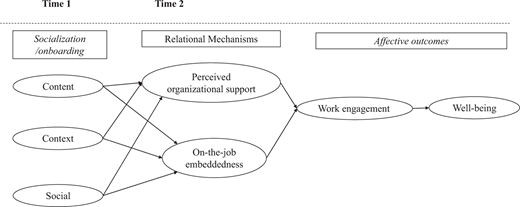
Building on social exchange theory and relational cohesion theory, we propose that socialization fosters stronger connections between employees and the organization, ultimately enhancing POS and on-the-job embeddedness, which in turn positively influence work engagement and, consequently, employee well-being (Figure 1):
(a) The content, (b) social and (c) context dimensions of socialization tactics are positively related to well-being through the serial mediating effect of POS and, as a result, work engagement.
(a) The content, (b) social and (c) context dimensions of socialization tactics are positively related to well-being through the serial mediating effect of on-the-job embeddedness and, as a result, work engagement.
Method
Participants and procedure
The study was conducted during the onboarding process of a chemical organization and involved a two-wave data collection with a three-month time lag between them. The two-phased survey was chosen to reduce the potential common method bias that could occur with one-time data collection (Podsakoff et al., 2003).
The sample size was calculated using GPower statistical power analysis software (GPower 3.1.9.7; Kiel University, Germany) for a linear multiple regression model with three predictors (i.e. the three socialization tactics). The input parameters were as follows: statistical test = t-tests: linear multiple regression; effect size f2 = 0.15; α error probability = 0.05; power (1 – β error probability) = 0.80; and number of predictors = 3. Based on these parameters, the required sample size was determined to be 43 participants. Therefore, the sample of 72 was considered sufficient for testing the model.
Overall, 72 full-time new employees were invited to fulfill two online surveys. After the onboarding program started, participants were informed about the purpose of the study and that the surveys were strictly confidential, and anonymous. They were also told that their participation was completely voluntary and that they could withdraw at any moment.
The first survey was sent when the onboarding program started and was conducted between January and April of 2023. This survey assessed participants’ demographic information, (e.g. gender, age and occupational area), as well as their socialization tactics, and well-being. The second survey was sent three months after the onboarding ended and was conducted between April and July of 2023, allowing a 3-month time lag between the surveys (Morrison, 1993). The second survey assessed relational mechanisms – POS and on-the-job embeddedness – work engagement, and well-being.
Overall, 72 participants answered the first survey. On the second wave, three months later, only 71 employees answered the survey (response rate: 98.6%). Overall, 41.1% of the participants were male and their mean age was 32.53 years (SD = 9.44). The sample worked in the following occupational areas: finance (20.8%), human resources (13.9%), industrial (2.8%), IT (11.1%), legal and compliance (1.4%), procurement (34.7%), research and information (4.2%), supply chain (4.2%), support and customer service (6.9%).
Instruments
Socialization tactics (T1).
To measure the three dimensions of socialization, we used 14 items from the Socialization Tactics Scale (Jones, 1986). It measured the content (five items; α = 0.73; e.g. “I have been through a set of training experiences which are specifically designed to give newcomers a thorough knowledge of standard procedures of local and company rules and guidelines”), context (five items; α = 0.73; e.g. “This organization puts all new hires through the same set of learning experiences”) and social aspects of the socialization process (four items; α = 0.53; e.g. “Experienced organizational members see advising or training newcomers as one of their main job responsibilities in this organization”) on a 5-point Likert scale (1 = strongly disagree; 5 = strongly agree).
Well-being (T1).
To measure well-being, three items from the abbreviated version of the Satisfaction with Life Scale (Kjell and Diener, 2021) were used. An item example is: “Overall, I feel like my life is close to my ideals.” Participants answered on a 5-point Likert scale that varied from 1 – strongly disagree to 5 – strongly agree. The internal consistency of the scale was 0.77.
Perceived organizational support (T2).
To measure POS, six items were used (Eisenberger et al., 1986). An item example is: “This organization really cares about my well-being.” Participants answered on a 5-point Likert scale (1 – strongly disagree; 5 – strongly agree) (α = 0.89).
On-the-job embeddedness (T2).
To measure on-the-job embeddedness, we used 18 items developed by Mitchell and colleagues (2001). An item example is “My job utilizes my skills and talents well.” or “I feel that people at work respect me a great deal.” Following Lee et al. (2004), the three organization-focused composites were aggregated to form an on-the-job embeddedness construct (α = 0.92).
Well-being (T2).
We used the same measure (Kjell and Diener, 2021) used on time 1 (α = 0.83).
Work engagement (T2).
To measure work engagement, we used the ultra-short measure for work engagement (Schaufeli et al., 2017). It is composed of three items (e.g. “I feel energized at work”). Participants answered on a 5-point Likert scale that ranged from 1 – never to 5 – always. The internal consistency was 0.92.
Control variables.
We used participants’ sex and age as controls. We used sex as a control because some studies have shown that women tend to be more sensitive and as such might influence their perceived support from the organization and well-being (Mascarenhas et al., 2022); hence, sex differences could influence both mediators and the criterion variables. Furthermore, age could also account for influences on well-being, as there have been identified differences in the way older and younger feel about their life as a whole (Dello Russo et al., 2020; Junça-Silva and Caetano, 2024).
Data analysis
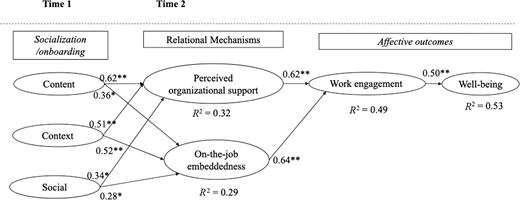
In the proposed serial mediating model (see Figure 2), there were three types of variables: (1) predictors (socialization tactics); (2) criterion variable (well-being); and (3) three mediators (POS, on-the-job embeddedness and work engagement). SPSS 29.0 and the software JASP (version 0.14.1) were used to test the proposed research model. First, descriptive analysis was conducted to calculate the mean and standard deviation for each variable. Second, correlational analyses were performed to examine whether the three socialization tactics were associated with the mediators and the criterion variables. Third, the measurement model’s goodness of fit was evaluated. In this regard, the Root Mean Square Error of Approximation (RMSEA) < 0.08, Standardized Root Mean Squared Residual (SRMR) < 0.08, Comparative Fit Index (CFI) > 0.90 and Tucker-Lewis Index (TLI) > 0.90 evidence a good fit (Kline, 2015).
Subsequently, to test H1–H3, Model 4 of the PROCESS macro in SPSS was used (Hayes, 2018). Further, to examine whether POS and on-the-job embeddedness contributed to work engagement and, together, mediated the relationship between socialization and well-being, serial mediation analyses were conducted using Model 6 of the PROCESS macro (Hayes, 2018). A bias-corrected bootstrapping method with 5,000 resamples and a 95% confidence interval (CI) was applied to assess the significance of the indirect effects.
Results
Common method bias and multicollinearity issues
Although we have followed some recommended procedures to reduce the potential common method bias – i.e. using closed-ended questions mixed in the survey (e.g. “I like cold weather”) and resorting to previously validated surveys to assess the variables under study – it cannot be completely avoided (Podsakoff et al., 2003). Hence, to understand its presence in the study we followed some recommendations (Podsakoff et al., 2003).
First, we performed Harman’s single factor test to check for common method bias. The findings showed that the first factor only accounted for 38.04% of the total explained variance (below the threshold of 40% proposed by Podsakoff and colleagues (2003); hence, the common method bias was not a serious issue.
Second, as Kock suggested (Kock, 2015), we also performed a full collinearity evaluation test to check for the potential common method bias. The results demonstrated that all the variance inflation factor (VIF) values ranged from 1.19–2.75; because the values were less than the cutoff point of 3.33, multicollinearity concern was not a severe issue in this study.
At last, we performed four confirmatory factor analyses (CFA) to confirm the independence of the variables under study. To assess the adequacy of the model and compare it with other reasonable alternative models, diverse fit indices were analyzed (Hair et al., 2014), namely CFI, TLI, SRMR, and RMSEA. Model 1 was the hypothesized seven-factor model comprising separate scales for socialization tactics – content, context and social – POS, on-the-job embeddedness, work engagement and well-being. Model 2 was a five-factor model where all three socialization tactics were combined into a unique factor. Model 3 was a three-factor model in which the three socialization tactics were combined into a unique factor and the three mediators (POS, on-the-job embeddedness, and work engagement) were also combined into a single factor. Model 4 was a one-factor solution in which all items were loaded onto a single factor. Table 1 shows that the seven-factor model (Model 1) provided the best fit for the data (CFI = 0.94, TLI = 0.93, SRMR = 0.05, and RMSEA = 0.05), and all other alternative models evidenced a poorer fit. These results together with the Cronbach’s alpha reliability scores across all the measurement scales evidenced the discriminant and convergent validity of the study; hence, we proceeded with the hypotheses testing.
Descriptive statistics
Table 2 presents the descriptive statistics, together with the correlations and internal consistency indices of the variables under study.
Hypotheses testing
H1 expected that the relationship between socialization tactics and work engagement would be mediated by POS. First, regarding the socialization context, the indirect effect was significant (Indirect effect = 0.52, 95%CI [0.25; 0.86]). In terms of socialization content, the indirect effect was also significant (Indirect effect = 0.43, 95%CI [0.17; 0.79]). Finally, regarding social aspects, the indirect effect (Indirect effect = 0.29, 95%CI [0.09; 0.53]) was also significant. Given that, H1 was supported by data.
H2 predicted that the relationship between socialization tactics and work engagement would be mediated by on-the-job embeddedness. First, regarding the socialization context, the indirect effect was significant (Indirect effect = 0.53, 95%CI [0.24; 0.88]). In terms of socialization content, the indirect effect was also significant (Indirect effect = 0.35, 95%CI [0.11; 0.71]). Regarding the social aspects, the indirect effect was also significant (Indirect effect = 0.30, 95%CI [0.06; 0.55]) are significant. Hence, H2 was supported by the data.
H3 predicted that work engagement would mediate the relationship between POS and well-being. The results revealed a significant indirect effect (Indirect effect = 0.29, 95%CI [0.16; 0.45]), which supported H3.
H4 predicted that work engagement would mediate the positive relationship between on-the-job embeddedness and well-being. The results revealed a significant indirect effect (Indirect effect = 0.45, 95%CI [0.27; 0.67]), supporting H4.
H5 predicted that the three dimensions of socialization tactics would be positively related to well-being through the serial mediating effect of POS and work engagement. The serial indirect effect of the socialization context on well-being through POS and work engagement was significant (Indirect effect = 0.20, 95%CI [0.08; 0.38]). The indirect effect of the socialization content on well-being via POS and work engagement was also significant (Indirect effect = 0.16, 95%CI [0.04; 0.32]). Finally, the indirect effect of the socialization social aspects on well-being via POS and work engagement was also significant (Indirect effect = 0.11, 95%CI [0.03; 0.22]). Thus, H5 received support.
H6 expected that the dimensions of socialization tactics would be positively related to well-being through the serial mediating effect of on-the-job embeddedness and work engagement. First, the indirect effect of the socialization context on well-being through on-the-job embeddedness and work engagement was significant (Indirect effect = 0.26, 95%CI [0.11; 0.49]). The indirect effect of the socialization content on well-being via on-the-job embeddedness and work engagement was also significant (Indirect effect = 0.16, 95%CI [0.04; 0.35]). Finally, the indirect effect of the socialization social aspects on well-being through on-the-job embeddedness and work engagement was significant as well (Indirect effect = 0.14, 95%CI [0.03; 0.30]). Thus, H6 received support.
Additional analysis
To complement the findings, we performed additional comparisons on newcomers’ well-being between times 1 and 2. Results from the t-test showed significant differences [t(1,71) = 52.950, p < 0.01], in which newcomers reported higher well-being at time 2 (M = 4.03, SD = 0.55) when compared to time 1 (M = 3.96, SD = 0.63).
Discussion
This study examines the impact of socialization tactics – specifically, content, context and social dimensions – on newcomers’ well-being. To conceptualize this relationship, we drew upon relational cohesion theory (Yoon and Lawler, 2006) and the social exchange theory (Blau, 1968) to propose a model in which relational and affective mechanisms mediate the effects of socialization on well-being. In this framework, POS and on-the-job embeddedness serve as key relational mechanisms, while work engagement functions as the primary affective mediator. The study explores whether the relationship between socialization tactics and newcomers’ well-being is mediated through a serial pathway involving both POS and work engagement, as well as through on-the-job embeddedness and work engagement.
This study advances the existing literature by demonstrating that socialization tactics (content, context, and social dimensions) influence well-being through a sequential process involving POS, job embeddedness, and work engagement. While prior research has explored the effects of socialization on newcomer adjustment (e.g. De Jong, 2023), this study is the first to empirically validate this serial mediation pathway, offering a more nuanced understanding of how socialization fosters long-term positive outcomes.
Additionally, although previous studies have separately linked POS and job embeddedness to work engagement and well-being (e.g. Khodakarami and Dirani, 2020), our findings establish work engagement as a crucial affective mechanism that integrates these constructs. This highlights the dynamic interplay of socialization processes in shaping employee experiences. Furthermore, in light of the increasing prevalence of hybrid and remote work (Taşkan et al., 2024), our research underscores the enduring relevance of structured socialization programs in cultivating support, engagement, and well-being, even in nontraditional work settings. This perspective, which has been largely overlooked in the literature, reinforces the need for organizations to implement intentional onboarding strategies that enhance relational and affective resources in the workplace.
Theoretical implications
This study has some implications for research on the effects of socialization on newcomers’ well-being. By integrating relational cohesion theory (Yoon and Lawler, 2006) and social exchange theory (Blau, 1968), the study offers a nuanced understanding of how socialization tactics influence newcomers’ well-being. The results show that POS mediates the positive relationship between the three socialization tactics and work engagement. This means that when the socialization process is well applied and planned in terms of content, context, and social aspects, the perception of support and value felt by employees tends to increase, and it leads them to become engaged with their work. In other words, well-planned socialization creates engaged employees because they perceive that their organization is there to support and care about them (Zhou et al., 2022). Other studies have shown that POS explains how socialization impacts affective outcomes, such as work engagement (Sani et al., 2023; Tabak and Hendy, 2016). For instance, Allen and Shanock (2013) found evidence for the mediating role of POS on the relationship between socialization and affective commitment. Thus, socialization not only creates engaged employees but also improves their perception of organizational support.
Moreover, on-the-job embeddedness also mediates the positive relationship between the three socialization tactics and work engagement. That is, socialization makes employees create links and positive bonds within the organization that may be a sacrifice to quit if employees decide to leave the organization. In turn, they experience a sense of positive exchange between them and the organization that makes them energetic to do their work, dedicated to it, and absorbed while working (Bakker et al., 2014). The literature is in line with this finding (Chong et al., 2021); the relationships created by new employees, and the fit of their values/skills/knowledge to the organization make them perceive that leaving the company would be a sacrifice, thus contributing to a feeling of trust and engagement to their work (Sani et al., 2023; Tabak and Hendy, 2016). Therefore, on-the-job embeddedness plays a mediating role between socialization and work engagement. Hence, the findings highlight the role of relational mechanisms like POS and on-the-job embeddedness, and affective mechanisms like work engagement, advancing these theoretical frameworks by demonstrating their interconnected effects.
Second, this study advances socialization research by empirically demonstrating the impact of socialization tactics (content, context, and social dimensions) on well-being within a real-world organizational setting (Cesário and Chambel, 2019). Unlike traditional studies that primarily focus on adjustment and job satisfaction (De Jong, 2023), this research highlights the broader affective outcomes of socialization, such as work engagement and overall well-being (Chotigavanich, 2020). Moreover, in a post-pandemic context where virtual interactions have become more prevalent and face-to-face socialization has diminished (Junça-Silva and Martins, 2023; Taşkan et al., 2024), these findings underscore the enduring importance of fostering interpersonal connections (Junça-Silva, 2023). The study reveals how feeling valued, supported, and embedded within an organization enhances not only employees’ work-related attitudes but also their overall well-being, reinforcing the role of socialization in shaping positive organizational experiences (Liu et al., 2024).
Third, this study advances the literature on work engagement by establishing it as a key affective mediator linking socialization, POS, on-the-job embeddedness, and well-being. Specifically, work engagement mediates the relationship between POS and well-being, as well as between on-the-job embeddedness and well-being, highlighting its pivotal role in shaping employees’ affective experiences. When employees perceive strong organizational support, they develop a sense of obligation to reciprocate (Huang et al., 2024), which enhances their vigor, sense of belonging, and absorption in their work (William Lee et al., 2014). This aligns with the reciprocity norm of social exchange theory (Blau, 1968), wherein employees respond to organizational support by investing greater effort and commitment to their work (Cropanzano et al., 2017).
Furthermore, employees who experience a strong sense of fit within the organization (Allen and Shanock, 2013) are more likely to reciprocate by demonstrating higher engagement, which, in turn, fosters greater well-being (Chong et al., 2021; Eisenberger et al., 2020). Thus, work engagement functions as a critical mechanism through which relational constructs (Lan et al., 2020)—such as POS and on-the-job embeddedness – translate into enhanced well-being (Khodakarami and Dirani, 2020). These findings reinforce the theoretical link between socialization tactics and engagement (Song et al., 2015), positioning work engagement as a central explanatory variable in understanding the affective benefits of effective socialization processes (Simosi, 2010).
Finally, the proposed serial mediation model advances theoretical understanding by elucidating how relational and affective mechanisms operate in sequence. The findings reveal a serial mediation effect, whereby socialization tactics (content, context, and social dimensions) enhance well-being through the sequential influence of POS and work engagement. Notably, the socialization context exerts the strongest impact (Cai et al., 2021); newcomers are more likely to perceive organizational support when integrated through structured onboarding programs that provide formal training, clarify organizational expectations, and foster a welcoming environment (Berdicchia et al., 2023). This structured approach facilitates a more positive perception of work, enhancing newcomers’ overall well-being (Mosquera and Soares, 2025).
These results align with relational cohesion theory, which posits that POS predicts affective outcomes – such as work engagement and well-being – as a consequence of effective socialization tactics (Cai et al., 2021). The theory further suggests that the sense of belonging, and purpose cultivated during socialization strengthens the relational bond between newcomers and the organization (Allen and Shanock, 2013; Revell et al., 2024). Employees, in turn, respond by engaging more deeply with their work as a means of reciprocating the support provided by the organization, ultimately enhancing their well-being (Cesário and Chambel, 2019; Junça-Silva et al., 2024; Weilage, 2025). Thus, socialization not only mitigates uncertainties but also fosters positive perceptions of organizational support (Liu et al., 2024), reinforcing engagement and well-being (Song et al., 2015).
The findings also extend previous research on on-the-job embeddedness, demonstrating that all three socialization tactics significantly contribute to embeddedness (Huang et al., 2024), which subsequently enhances work engagement and promotes well-being (Cai et al., 2021). Among these dimensions, socialization context plays a particularly critical role. Specifically, newcomers participating in structured onboarding programs develop connections with their peers as they navigate shared experiences of organizational integration (Liu et al., 2024). As these relationships strengthen and employees gain a clearer understanding of organizational benefits, the perceived cost of leaving the organization (i.e. sacrifice) increases, reinforcing their commitment (Simosi, 2010; Wanberg, 2012).
Consistent with relational cohesion theory, the results suggest that on-the-job embeddedness, as an affective outcome, emerges from positive socialization experiences (Huang et al., 2024). A well-designed socialization program fosters a sense of collective belonging (Adil et al., 2023), strengthens social bonds (Song et al., 2015) and enhances newcomers’ perceived fit within the organization (Mosquera and Soares, 2025). This heightened embeddedness, in turn, amplifies work engagement, leading to improved well-being (De Jong, 2023; Liao et al., 2020).
Overall, the serial mediation model highlights the sequential interplay between relational and affective processes in shaping employee well-being (Allen and Shanock, 2013). POS acts as a motivational catalyst (Lan et al., 2020), fostering a sense of belonging and psychological safety (Imran et al., 2020), which strengthens employees’ commitment and investment in their work (Cai et al., 2021). Moreover, as individuals become more embedded within the organization, they experience greater stability and perceived career continuity, further reinforcing their motivation to engage with their roles (Ramaite et al., 2022). Work engagement then serves as the final link in this process, translating these relational and structural supports into higher energy, dedication, and absorption in daily tasks (Junça-Silva and Pinto, 2024; Schaufeli, 2017). Ultimately, this cumulative effect enhances overall well-being, demonstrating that workplace experiences that foster support (Song et al., 2015), stability, and engagement play a critical role in promoting positive affective outcomes (Liu et al., 2024).
Practical implications
This study highlights the critical role of socialization tactics, including relevant content, an integrative context, and social mechanisms that support newcomers’ adaptation within the organization. These tactics influence POS and on-the-job embeddedness, which, in turn, enhance work engagement and overall well-being.
A key focus of this study is the content of the onboarding program, emphasizing its role in structuring the socialization process and ensuring that newcomers comprehend organizational procedures, guidelines, and training. Managers can derive several important insights from this. First, the onboarding program should align with the employee’s hire date, ensuring that new hires feel welcomed while simultaneously completing the formal institutional onboarding process. Additionally, onboarding sessions should comprehensively address topics such as HR policies, organizational rules and other essential information. Regular assessments should be conducted to evaluate whether newcomers have effectively understood and applied the key messages from the onboarding process.
The social dimension of socialization focuses on fostering connections between new employees and experienced staff members. For example, assigning a “Buddy” to support and facilitate the newcomer’s integration can be an effective strategy. Other approaches may include organizing informal networking opportunities, such as team lunches on training days, to strengthen relationships with facilitators and enhance both POS and on-the-job embeddedness.
The context in which socialization occurs also plays a fundamental role in fostering a sense of belonging within the organization. Shared learning experiences among newcomers create a collective sense of connection, reinforcing their attachment to both colleagues and the organization as a whole. Implementing these socialization techniques is essential, as they lay the foundation for fostering engaged and satisfied employees (Junça-Silva and Dias, 2022). Moreover, structuring the onboarding program around in-person sessions can further enhance on-the-job embeddedness and, consequently, work engagement by facilitating direct interpersonal connections and shared experiences among employees.
Limitations and future directions
In terms of limitations, several factors could affect the generalizability of the findings. The relatively small sample size and limited representativeness of the sample group constrain the extent to which these results can be applied to broader populations. Additionally, the use of self-reported measures introduces potential biases, such as social desirability or response consistency, that may influence the accuracy of the data. Nevertheless, the findings indicate that common method bias does not pose a significant threat to the validity of the study.
Finally, another limitation of this study is the notably low reliability coefficient for the social aspect of socialization, which may impact the consistency and validity of the findings related to this dimension. Future research should address this issue by improving the measurement of the social aspects of socialization, potentially by refining the scale or exploring alternative methods to capture this construct more reliably.
For future research, expanding the sample size and including a wider variety of organizations would enhance the external validity of the model, allowing for more robust conclusions. Furthermore, future research should consider cross-industry samples. Moreover, an interesting avenue for future exploration would be the comparison between online and in-person socialization tactics, particularly in understanding how these different approaches influence newcomers’ work engagement and well-being. Given the rise of hybrid work environments, this distinction has become increasingly relevant.
Furthermore, future studies should consider incorporating job satisfaction as an additional affective variable to provide a more comprehensive understanding of overall well-being. Investigating the turnover rates following the onboarding process could also offer valuable insights into how socialization tactics affect longer-term outcomes like retention. Since POS and on-the-job embeddedness are linked to work engagement and well-being, studying turnover could further elucidate the cascading effects of effective socialization.
Conclusion
This study illustrates the relationships between socialization tactics, POS, on-the-job embeddedness, work engagement, and well-being. Specifically, the model demonstrates how socialization tactics, through their impact on POS and on-the-job embeddedness, indirectly influence work engagement and, subsequently, well-being. The findings provide empirical support for the strength and direction of these relationships, indicating that socialization tactics positively contribute to relational mechanisms, which, in turn, enhance both work engagement and well-being. This framework reinforces the mediating role of work engagement in linking organizational practices with employee well-being. This research fills a gap in existing literature and supports relational cohesion theory by highlighting the crucial role of the perceived bond between new employees and their organization in fostering work engagement, which in turn enhances well-being. This outcome is achieved through socialization strategies that help new employees feel integrated, reducing their stress and uncertainty.
Funding: This work was supported by Fundação para a Ciência e a Tecnologia, grant UIDB/00315/2020.
Conflict of interest statement: The authors declare that they have no conflicts of interest.
Compliance of ethical standard statement: All procedures performed in studies involving human participants were in accordance with the ethical standards of the institutional and/or national research committee and with the 1964 Helsinki Declaration and its later amendments or comparable ethical standards.
Informed consent: Informed consent was obtained from all individual participants involved in the study.
Data availability: The data is available only upon reasonable request to the authors.