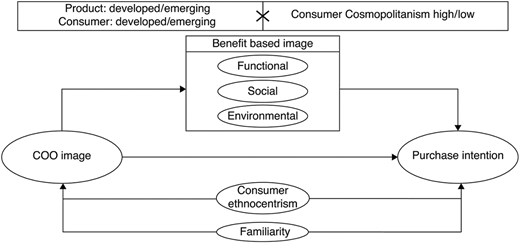
This study investigates the impact of country-of-origin image on purchase intention across developed and emerging markets and explores the mediating role of functional, social, and environmental brand image. Additionally, it assesses the moderating effect of consumer cosmopolitanism on these relationships among consumers in developed and emerging markets.
This study utilised a cross-country comparative design with 2,514 respondents from developed markets (the United States and Japan) and emerging markets (China and India). A multi-group mediated moderation analysis examined the influence of country-of-origin on purchase intention through brand image and the moderating role of consumer cosmopolitanism.
The effect of country-of-origin image on purchase intention is generally mediated by brand image. Moreover, higher consumer cosmopolitanism moderates the mediating effect from COO to PI through social and environmental images, with cosmopolitan consumers in developed markets viewing the country-of-origin images of emerging markets favourably, thus boosting purchase intention. Thus, contrary to previous assumptions, even the country-of-origin images of emerging markets can positively affect purchase intentions.
Until now, no research has examined the moderating effect of cosmopolitanism in an integrated manner across four distinct scenarios: products from developed versus emerging markets × consumers in developed versus emerging countries. The moderating effect of cosmopolitanism is explored in this manuscript through a detailed analysis of the psychological mechanisms by which these scenarios influence decision-making. This is the first manuscript that investigates the mediating roles of three brand images in the relationship between country-of-origin image and consumer behaviour, addressing a significant gap in the literature. Despite the growing appreciation for cultural diversity among consumers, the moderating role of cosmopolitanism on country-of-origin image—particularly in developed nations—remains underexplored.
Introduction
Consumers in emerging markets typically prefer products from developed countries to those from emerging markets, owing to their perceived quality and status (Abdul-Latif et al., 2024). With the spread of information communication technology and the emergence of entrepreneurs in developing nations, products from emerging markets have become a significant force (He and Zhang, 2018). Consequently, companies from emerging countries in the automobile industry are increasingly threatening established market players. The Indian automobile industry is the fourth largest in the world, growing at a compound annual growth rate of 9.5% (Kumar et al., 2021). China surpasses Japan and the U.S. in automobile production despite export difficulties (Imran et al., 2018).
Despite the prevalence of Chinese and Indian products in developed countries, consumers may hesitate to purchase foreign products, particularly from emerging markets that lack strong branding (Islam and Hussain, 2022). This favourable or unfavourable view of a country is known as the country-of-origin (COO) image (Berns et al., 2021). Chinese and Indian brands have recently experienced global expansion. For example, the Chinese company BYD has significantly influenced Kyoto, Japan, with many buses featuring its brand (BYD website, n.d.). Furthermore, Geely and Tata sought to mitigate negative COO perceptions by acquiring Volvo and Jaguar Land Rover, respectively (Zhejiang Geely Holding Group, n.d. and Tata Motors, n.d.). Meanwhile, the rise of online media has expanded opportunities for individuals to engage with global communities, fostering acculturation beyond their local environments (Dey et al., 2020). Consumers who are open-minded and receptive to different cultures are more likely to purchase and utilise products and services from foreign countries (Riefler et al., 2012). Thus, with the rise of emerging countries and more open-minded consumers, research on COO images must align with global trends.
Previous studies have highlighted the significance of COO image in global marketing and in identifying and targeting cross-country segments (Sharma, 2011). COO image research has revealed a heightened negative impact when production moves to emerging countries and its association with ethnocentrism (CET) and animosity (Magnusson et al., 2019), influence on brand image, evaluation, attitude, and purchase intention (PI) (De Nisco and Oduro, 2022), and effect on consumers in developed and emerging countries (Alonso-Dos-Santos et al., 2020; Sharma, 2011). Consumers are increasingly exposed to more information annually, and because of cognitive limitations, they do not accurately perceive information about a brand’s COO (Cakici and Shukla, 2017). Beyond the COO label, the country association of a brand name shapes consumer perceptions (Samiee and Chabowski, 2021). Diamantopoulos et al. (2011) suggested that the COO image impacts brand image and consequently consumer behaviour.
Given that brand image mediates the relationship between COO image and consumer behaviour, it is imperative to conduct a comprehensive study on brand image. Previous research has predominantly focused on specific brand images, such as environmental images (Thøgersen and Pedersen, 2021). Additionally, by investigating the aforementioned mediating relationships, we examine the moderating effect of consumer cosmopolitanism (hereafter, cosmopolitanism) (Riefler et al., 2012). Except for Han et al. (2023), extant research examining the relationship between COO image and cosmopolitanism has neither explored the mediating effects of brand image nor investigated consumers in developed markets. Against this backdrop, this study examines the influence of COO image on brand image and PI and investigates the moderating role of cosmopolitanism (high vs. low) across various country contexts (products from developed versus emerging markets × consumers in developed versus emerging countries) for cross-cultural validation of the research model. This research model, which comprises eight patterns, allows for a comprehensive examination of the impact of brand image on PI. Therefore, this study has practical implications for specific targeting and positioning strategies for global companies entering foreign markets.
Focusing on PI for automobiles as the dependent variable, this study highlights it as a key consumer motivation for purchasing, aligning with previous COO image research (De Nisco and Oduro, 2022). The COO literature indicates that quantifying purchase intention for automobiles is ideal for elucidating the COO phenomenon (Bartikowski et al., 2019). To conclude, this study examines the following questions to enhance our understanding of the role of COO image in consumer decision-making.
What are the situations in which the direct and indirect effect of COO image on PI are triggered in developed and emerging countries?
What are the key elements of brand image that mediate the relationship between COO and PI?
Does cosmopolitanism moderate the relationship between COO image and PI?
How do cosmopolitan consumers perceive products from developed and emerging countries?
Does COO image impact PI differently for consumers in developed and emerging countries, as indicated in (1)–(4)?
To investigate these research questions, we estimated the direct and indirect effects of COO image on PI through brand image and the moderating effect of cosmopolitanism. Consequently, this study reveals that cosmopolitanism mitigates negative COO in emerging economies and enhances purchase intentions. Additionally, it elucidates the influential segment of COO image by assessing its effects in various contexts, considering the market’s economic development and cosmopolitanism.
Theoretical background
Orthogonality or irradiation perspective of country-of-origin
COO image is especially valuable when product attribute information is scarce (Magnusson et al., 2022) and can influence consumer decision-making predictions (Oduro et al., 2024). However, COO image could hinder firms, particularly from emerging countries, in terms of global expansion (Kim et al., 2022). This challenge stems from the persistence of COO stereotypes, as consumers’ long-term and stable brand perceptions create substantial barriers for brands trying to enter foreign markets (Wang et al., 2022). Since the 2010s, researchers have employed mediation models to examine the psychological mechanisms that connect COO image with consumer responses, thus addressing the complexities inherent in this area of study (Thøgersen and Pedersen, 2021).
Diamantopoulos et al. (2011) investigated these mediating relationships through two models. First, the orthogonality perspective asserts that COO and brand image are independent and directly affect PI. The second perspective, irradiation, posits that brand image mediates the relationship between COO image and PI through subjective perceptual evaluation. Their analysis showed that the irradiation perspective explained more than the orthogonality perspective. The irradiation perspective has traditionally aligned with the research trend of COO image as a halo, originating from Han’s (1989) halo model. Brand image pertains to consumer perceptions generated by a brand’s benefits (Diamantopoulos et al., 2011). Each element of brand image, including quality, price, and environmental friendliness, is derived from a brand’s benefits. Therefore, this study terms brand image a benefit-based image (BBI). While a halo frequently elucidates COO influences on consumer behaviour (Samiee and Chabowski, 2021), validating the intricate interrelations among COO and various BBIs necessitates the application of schema theory, a form of analytical inference predicated on a mental schema that explicates the subjective linkage of perceptual evaluation from an irradiation perspective (Allman et al., 2016).
Consumers evaluate market offerings based on the origin image associated with the specific schema category they relate to (Thøgersen and Pedersen, 2021). Empirical evidence indicates that BBI serves as an intermediary between COO image and PI, lending credence to the validity of the schema-based irradiation perspective. Kim et al. (2017) found that the COO image from a fashion brand’s collection enhances PI by increasing its perceived value. In a survey of Japanese and Filipino students, COO image was found to influence PI only through product quality (Bautista et al., 2020). Finally, the meta-analysis conducted by Oduro et al. (2024) consistently demonstrates the robustness of an irradiation perspective. Hence, this study employs an irradiation perspective to examine the relationship between COO and brand image in the automotive sector, the applicability of which remains uncertain. Additionally, it investigates whether this perspective is valid for both developed and emerging COOs, as consumer orientations may vary by economic development stage according to Maslow’s hierarchy of needs (Maslow, 1968). Thus, this study assesses the effectiveness of the irradiation perspective in automobiles across these two conditions.
Country-of-origin image and benefit-based image
Topaloglu and Gokalp (2018) classify BBI into intrinsic and extrinsic categories. Consumers typically use BBIs, such as quality and functionality, to reduce anxiety. These elements form a product’s functional image, which is an intrinsically oriented image encompassing quality, specifications, functionality, durability, and price. In contrast, some images stem from a product’s association with others, such as gaining approval or symbolising status, thus forming the product’s social image. This encompasses the status derived from luxury, rarity, and fashion, which many consumers endorse, and is thus classified as an extrinsic-oriented image. Intrinsic-functional and extrinsic-social BBIs are fundamental to BBIs, with the COO image impacting both functional and social BBIs of products.
Research on the use of COO images in offshore operations of multinational corporations (MNCs) involves extending overseas production (Li et al., 2023). An international production base can also generate an adverse BBI. Consumers in developing nations often have negative perceptions of their COO (He and Zhang, 2018). Consumers perceive products or parts from emerging countries as low quality with poor functionality, whereas those from developed countries are viewed positively in terms of functionality (He and Zhang, 2018).
Additionally, COO image can positively or negatively influence consumers’ environmental perceptions. Trivedi et al. (2015) recommend that firms cultivate eco-friendly brand images to improve consumer attitudes and willingness to pay. An environmental image can address social issues, such as environmental problems. Recently, MNCs have been increasingly expected to adopt greater environmental responsibility, with a brand’s environmental image impacting consumer attitudes and purchase intentions (Lee and Lim, 2020). Despite varying environmental standards and attitudes across countries, a strong link between COO and environmental image has been identified (Thøgersen and Pedersen, 2021).
This study investigates how functional, social, and environmental images, which are pivotal components of BBI, relate to COO image and PI. Traditional COO image studies have focused on developed markets; however, emerging countries are now being examined (De Nisco and Oduro, 2022; Han et al., 2023). Developed nations usually possess a favourable COO image, sophistication, and innovation (Eng et al., 2016), which boosts PI (De Nisco and Oduro, 2022). A favourable COO image in developed countries enhances consumers’ views of the functional, social, and environmental aspects of brands and products originating there. In such countries, COO image is correlated with quality, functionality, and social prestige (Allman et al., 2016). Diamantopoulos et al. (2011) suggest that there is no direct relationship between COO image and PI and that COO image affects PI indirectly via BBI for products in developed markets. However, this mediating relationship has not been tested for products from emerging markets.
Products from emerging markets tend to have a less strong positive COO image than those from developed countries, despite offering cost-performance benefits that reflect a functional image (Samiee and Chabowski, 2021), whereas consumers in emerging countries aim to safeguard their economies and purchase products from these markets to gain social approval and mutual support (Sharma, 2015). Thus, the functional and social images of products from emerging markets could mediate the relationship between COO image and PI. The COO image of emerging countries will enhance PI by mediating the BBI of emerging market consumers, albeit differently than in developed countries.
The positive effect of (a) developed and (b) emerging COO image on PI is mediated by BBI.
Consumer cosmopolitanism as a moderator
Cosmopolitanism and CET significantly influence COO image across varying levels of economic development (Han and Won, 2018). Moreover, Le et al. (2025) posit that investigating the role of cosmopolitanism as a determinant of PI across diverse national contexts has the potential to yield profound contributions to the literature in international marketing. Previous studies have verified that cosmopolitanism has a non-negligible propensity for foreign brand consumption in emerging countries (Han et al., 2020, 2023). This is because modernisation and globalisation have increased consumers’ favourable impressions of foreign countries. Given this background, we assume that cosmopolitanism moderates the mediation model in which COO image leads to PI via BBI in both developed and emerging countries. Emerging market products and consumers in developed countries, previously unaddressed in H1, are examined within the framework of cosmopolitanism.
Recently, society has seen the emergence of cosmopolitan consumers, a new market segment resulting from accelerated globalisation (Makrides et al., 2022). Shifts in the media landscape and heightened global exposure have led to the emergence of cosmopolitanism, defined as an open-minded disposition towards foreign cultures and appreciation for diversity in products, people, and cultural experiences (Makrides et al., 2022). Bartsch et al. (2016) attributed the conceptual foundation of cosmopolitanism to identity theory, which elucidates human behaviour through the interplay between societal structure and the self (Stets et al., 2020). Thus, cosmopolitanism reflects the evolving self, particularly amid the recent modernisation and individualisation in emerging Asia. Previous studies have investigated the influence of cosmopolitanism on various consumer groups—Chinese (Han et al., 2020), Indian (Srivastava and Balaji, 2018; Srivastava et al., 2023), Southeast Asian (Han et al., 2023), Indonesian (Jin et al., 2024), and Malaysian (Abdul-Latif et al., 2024). These studies highlight how these groups respond to a diverse range of brands, including Japanese, global (developed and local), emerging Asian, South Korean, and Chinese brands. However, similar surveys have not yet been conducted with consumers in developed countries. Furthermore, while studies dealing with cosmopolitanism may include mediating variables that are close to BBI (e.g. brand trust in Han et al., 2023), they have not investigated how cosmopolitanism moderates BBI. How does the modernisation and individualisation of society affect BBI, and how does cosmopolitanism moderate BBI not only for emerging market consumers but also for consumers in developed countries? These two questions need to be answered to obtain a more precise picture of the impact of COO image on PI. Here, we apply the irradiation perspective to examine the moderating role of cosmopolitanism through surveys conducted in developed and emerging countries.
Given that the Chinese consumers in this study have experienced modernisation and globalisation (Han et al., 2020), we stratified the participants based on their levels of cosmopolitanism and analysed each stratified model separately. This study evaluates consumers’ cosmopolitan tendencies toward foreign products and examines the moderating effect of cosmopolitanism.
The theory of planned behaviour (TPB) explains this phenomenon, positing that actual behaviour is influenced by prior attitudes, perceived social norms, and behavioural controls (Ajzen, 1991). Given that COO and BBI evaluations encompass prior attitudes towards the product, its sociocultural significance, and the propensity for purchase (Diamantopoulos et al., 2019), the influence of these antecedent evaluations on PI aligns with TPB. Enhanced consumer ideologies, like cosmopolitanism, significantly strengthen behavioural, normative, and control beliefs, making them reliable indicators of TPB variables (Lin et al., 2025). Kim et al. (2022), employing TPB, demonstrated that affective factors such as country affinity moderated the link between consumers’ initial evaluations and subsequent purchasing behaviour.
Highly cosmopolitan consumers can broadly perceive information about foreign countries and gain a deeper understanding (Riefler et al., 2012). Despite an unfavourable COO image, such consumers may still show an interest in products as their cosmopolitanism increases (Han et al., 2023). COO image positively influences consumer behaviour for products from developed markets (Thøgersen and Pedersen, 2021). Because consumers in developed and emerging countries generally favour products from developed countries, cosmopolitanism is unlikely to moderate this effect.
COO image indirectly enhances PI via BBI for products from developed markets, positively affecting consumers in (a) developed countries with higher (vs lower) cosmopolitanism and (b) emerging countries, irrespective of the cosmopolitanism level.
Consumers in developed countries avoid products from emerging markets because of their negative COO image (Chen, 2020), whereas individuals with high cosmopolitanism, characterised by open-mindedness and respect for other countries, are likely to overlook negative associations with them (Riefler et al., 2012). Cosmopolitan consumers are inclined to support other countries (Grinstein and Riefler, 2015); thus, those in emerging markets with high cosmopolitanism will show interest in products from similar markets. Thus, we propose the following hypothesis:
The indirect effect of COO image on PI via BBI is positive for emerging market products, specifically among consumers with high (vs low) cosmopolitanism in both a) developed and b) emerging countries.
We have outlined the literature and positioned our study within this context in Table A of the supplementary files. Figure 1 illustrates the conceptual framework of the study. To enhance the model’s explanatory power, the constructs of CET, representing consumers’ preferences for domestic products, and familiarity, denoting their attachment to the product’s COO, were incorporated (Sharma, 2015). Research on COO suggests that CET and familiarity are crucial to the interplay between COO image, BBI, and PI (Roy et al., 2019). These factors notably influence the purchase of high-priced items, such as automobiles, more than low-priced items (Balabanis and Siamagka, 2017).
Methods
In Sharma’s (2011) representative study on developed and emerging COO images, respondents were asked about automobiles from other countries. Mediation analysis estimates the relationships between COO image; functional, social, and environmental image; and PI. Additionally, a multigroup mediated moderation analysis was conducted to assess the indirect effects between the constructs and the moderating effect of cosmopolitanism.
Target countries
This study asked respondents about other countries’ automobiles. China, the U.S., Japan, and India are the top four automobile-selling countries, according to the International Organisation of Motor Vehicle Manufacturers (2022). Samples of this study comprised respondents from four countries. The U.S. (51,629 USD) and Japan (41,092 USD) have a higher per capita GDP than China (7,655 USD) and India (1,671 USD) (World Bank Database, 2022). Meanwhile, more rapid annual growth in GDP over 2010–2019, on average, is confirmed in China (7.69%) and India (6.66%) than in the U.S. (2.27%), and Japan (1.28%) (World Bank Database, 2022). In addition, the existing literature on COO, focusing on the automotive industry, has highlighted China and India as emerging countries in comparison to the U.S., Japan, and Germany (Sharma, 2011). Therefore, this study considers the U.S. and Japan as developed countries and China and India as emerging countries.
Sampling and measurement items
This study employed online panel consumer data from the U.S., Japan, China, and India, collected through a research agency in December 2020. Data were collected across the regions of these four countries through online. To mitigate the impact of age and to ascertain and validate the interrelationships among the constructs, this study controlled the respondents’ ages using an equal allocation sampling method. We randomly collected samples from each country (e.g. different U.S. respondents were asked to answer assuming fictitious automobiles from Japan, China, and India). Hair et al. (2014) recommend an analysis involving a sample size of over 500 when dealing with variables comprising more than six factors. To adhere to this criterion and ensure an adequate number of valid responses in each country, this study conducted random sampling from the panel data until the number of subjects reached 3,200 (800 each from the U.S., Japan, China, and India).
The same respondent gave answers pertaining to independent, dependent, moderating, and mediating variables. Therefore, a procedure for avoiding and reducing common method bias (CMB) is required. Following Podsakoff et al. (2003), the respondents answered the questionnaires anonymously and randomly. In order to exclude from our sample subjects who responded inappropriately to our questionnaire, our questionnaires included an attention check item to determine whether they read and understand the text appropriately. A total of 2,514 samples were analysed (i.e. the valid response rate is 78.6%, U.S.: 659, Japan: 583, China: 743, and India: 529). Sample trends on gender, age, and family income are shown in Table B of the supplementary files. We controlled for these variables in our model.
This study measured constructs using existing scales related to consumers’ foreign product purchasing habits: country image (Chan et al., 2010), functional and social image (Sweeney and Soutar, 2001), environmental image (Balderjahn et al., 2013), PI (Dodds et al., 1991), cosmopolitanism (Cleveland et al., 2009), CET (Lundstrom et al., 1998), and familiarity (Kent and Allen, 1994). Table C in supplementary file presents the details of these items. These measures were modified to reflect the context of purchasing foreign products. The measurement scales were translated from English to Japanese and Chinese via back-translation (Usunier, 1998). Four professional translators and the authors reviewed and adjusted the items to ensure linguistic equivalence. Constructs were measured using translated items and a seven-point Likert scale.
Measurement validity
We assessed the measurement scales by confirming consistency; convergent, construct, and discriminant validity; non-response bias, and CMB. First, the study conducted an exploratory factor analysis with promax rotation and maximum-likelihood estimation using SPSS v.29.0.0.0 to test the measurement model. The two dimensions of country image—country belief and attitude towards people—converged. Chan et al. (2010) developed these two country image dimensions. This study considers both dimensions under “country image”. The remaining items converged into the assumed factors. However, two items from country image, three from functional image, and one from CET showed lower factor loadings. Hair et al. (2014) suggest that items showing lower factor loadings and cross loadings should be deleted from the analysis. Hence, these were deleted from our study. The Kaiser–Mayer–Olkin ranking indicating the sampling adequacy was 0.98 (p < 0.001). The cumulative percentage of eigenvalues for the eight factors was 77.17%.
Second, we conducted confirmatory factor analysis using the maximum-likelihood estimation method and Amos V.29.0.0, to assess the measurement model. The model showed a good fit to the data (χ2 = 3,065.26, df = 673, p < 0.001, CFI = 0.97, TLI = 0.97, SRMR = 0.03, and RMSEA = 0.038). Hair et al. (2014) suggested that threshold indexes showing model fit depend on sample size and the number of measurement items. This study included 2,514 respondents and 39 observed measurement items. Values of CFI > 0.90, TLI > 0.90, SRMR < 0.08, and RMSEA < 0.07 are recommended in this situation (Hair et al., 2014). Based on these criteria, our model shows a good fit. Convergent validity, internal consistency, and construct validity were assessed using factor loading, item-to-total correlations, average variance extracted (AVE), Cronbach’s alpha, and composite reliability (CR). All items and constructs showed adequate values and confirmed validity (see Table C of the supplementary files).
Third, discriminant validity was tested using the heterotrait–monotrait (HTMT) ratio of correlations. This study used the HTMT to assess validity, as suggested by Henseler et al. (2015). All HTMTs between the constructs were below 0.90, confirming discriminant validity (Henseler et al., 2015).
Fourth, the impact of non-response bias was estimated by comparing the early and late respondents in our sample. We tested whether a significant difference existed between the variables that we employed. If there was no significant difference, non-response bias was not serious. We confirmed that no significant difference exists between our model’s two groups of variables. Therefore, we do not consider non-response bias to be a problem in our sample.
Fifth, we tested whether CMB was a serious complication in our model. This study tested CMB by controlling for the effects of unobserved latent factors (Podsakoff et al., 2003). We confirmed the significance of all paths without the latent general common factor, and they remained significant (p < 0.05) when it was controlled. This process indicates that CMB is not a problem in our model.
Based on these five steps, we assessed the measurement scales. The relationships between country image, BBI, and PI were estimated using structural equation modelling. Gender, age, family income level, familiarity, and CET were controlled in our model. Regarding age and gender, an analysis of intergroup differences revealed no significant differences were observed for any other variables.
Results
Measurement invariance between the groups was assessed. As this study collected samples from the U.S., Japan, China, and India, we had to test the invariance among the groups. To assess this, we compared configural, metric, and scalar models across multiple groups (Steenkamp and Baumgartner, 1998). Changes in CFI, SRMR, and RMSEA were checked to estimate the differences between the models. Chen (2007) recommended the thresholds of ΔCFI ≤ 0.01, ΔSRMR ≤ 0.03, and ΔRMSEA ≤ 0.015 for model comparison. Using this criterion, we estimated the measurement invariance (see Table D of the supplementary files).
The configural model showed a good fit to the data (χ2 = 6996.65, df = 2,692, p < 0.001, CFI = 0.94, TLI = 0.94, SRMR = 0.04, and RMSEA = 0.025). Comparing the configural model to the metric model, we observed the following: ΔCFI = 0.00, ΔSRMR = 0.00, and ΔRMSEA = 0.000; thus, metric invariance was confirmed. However, the CFI difference between the metric and scalar models shows ΔCFI = 0.03, although ΔSRMR and ΔRMSEA cleared the criteria. Steenkamp and Baumgartner (1998) recommended a more relaxed assumption to assess measurement invariance. Following this suggestion, we calculated a partial scalar model, and the difference between the full metric and partial scalar models showed the following: ΔCFI = 0.01, ΔSRMR = 0.00, ΔRMSEA = 0.003. Thus, we confirmed the measurement invariance using these procedures.
We conducted a mediation analysis to examine the indirect effects of BBI. We used 2,000 bootstrapped replicates to estimate indirect effects. Table 1 shows the results for four groups: consumers in developed/emerging countries times products from developed/emerging markets. The fit indices of the multigroup mediation analysis showed satisfactory scores: χ2 = 5,605.110, df = 2,216, p < 0.001, CFI = 0.95, TLI = 0.95, SRMR = 0.043, and RMSEA = 0.025.
Against products from developed markets, there was no significant direct effect of COO image on PI, whereas an indirect effect of COO image on PI through BBI was significant for consumers in both developed (β = 0.61, p < 0.001) and emerging (β = 0.65, p < 0.001) countries, thereby supporting H1a. Especially for consumers in emerging countries, the mediating effects of functional (β = 0.42, p < 0.001) and environmental (β = 0.11, p < 0.05) images were significant, whereas that of social image was not significant (p > 0.4). For consumers in developed countries, a mediating effect of functional image was also found (β = 0.61, p < 0.001), whereas that of social and environmental images were not significant (ps > 0.3).
Subsequently, against products from emerging markets, the indirect effect of COO image on PI through BBI was significant for consumers in both developed (β = 0.44, p < 0.001) and emerging (β = 0.66, p < 0.001) countries, thereby supporting H1b. In this situation, for consumers in emerging countries, the mediating effect of social image (β = 0.64, p < 0.001) was significant, while that of functional and environmental images were not significant (ps > 0.05). For consumers in developed countries, the mediating effects of functional (β = 0.31, p < 0.01) and social image (β = 0.23, p < 0.05) were found, whereas that of environmental image was not significant (p > 0.6).
Finally, we estimated the moderation effect of cosmopolitanism to test H2 and H3. This study used the mean split procedure to divide participants into either high or low cosmopolitanism. The overall model shows satisfactory fit indices (χ2 = 10,985.575, df = 4,699, p < 0.001, CFI = 0.90, TLI = 0.89, SRMR = 0.078, and RMSEA = 0.024). Based on this procedure, we estimated the results (see Table E of the supplementary files).
First, against products from developed markets, the positive indirect effect of COO image on PI through BBI was found only for consumers in developed countries with high cosmopolitanism (β = 0.56, p < 0.001), but for those with low cosmopolitanism (p > 0.2), thereby supporting H2a. For further investigation, we examined the role of each BBI element in those with high cosmopolitanism. The result showed that the mediating effect of functional image (β = 0.82, p < 0.001) was significant, while that of neither social nor environmental image was significant (ps > 0.1).
Meanwhile, a positive indirect effect of COO image on PI through BBI was found for consumers in emerging countries with both high cosmopolitanism (β = 0.43, p = 0.09) and low cosmopolitanism (β = 0.33, p < 0.01), thereby supporting H2b. The role of each BBI element was examined for further investigation. For those with low cosmopolitanism, we confirmed mediation by functional image (β = 0.32, p < 0.01), whereas mediation by neither social nor environmental image was significant (ps > 0.6). In contrast, for those with high cosmopolitanism, the indirect effect through environmental image was significant (β = 0.15, p < 0.01), whereas neither functional nor social image was significant (ps > 0.2).
Subsequently, against products from emerging markets, the positive indirect effect of COO image on PI through BBI was found not only for consumers in developed countries with high cosmopolitanism (β = 0.43, p < 0.001) but also for those with low cosmopolitanism (β = 0.24, p < 0.01). However, the standardised coefficient of the indirect effect was greater when consumers had high (vs. low) cosmopolitanism. Although significant values were confirmed in this situation, whether cosmopolitanism was high or low, we could not find a significant difference between them (ps > 0.6). Therefore, H3a was not supported. For further investigation, we examined the role of each BBI element. For those with high cosmopolitanism, we confirmed mediation by social image (β = 0.41, p < 0.01), whereas that by neither functional nor environmental image were significant (ps > 0.05). Subsequently, for those with low cosmopolitanism, no significant indirect effect was found for all BBI elements (ps > 0.1).
Last, against products from emerging markets, the positive indirect effect of COO image on PI through BBI was also found for consumers in emerging countries with both high (β = 0.81, p < 0.001) and low cosmopolitanism (β = 0.43, p < 0.001). Given the presence of significant values for both high and low cosmopolitanism, a test for the difference in effect size indicated that the effect size was significantly stronger for high cosmopolitanism (p < 0.01). Thereby H3b was supported. The results imply that the positive indirect effect will become greater as their cosmopolitanism increases. For further investigation, we examined the role of each BBI element. The indirect effect mediated by social image was more pronounced among consumers with high cosmopolitanism (β = 0.88, p < 0.05) compared to those with low cosmopolitanism (β = 0.48, p < 0.001). However, we could not confirm any significant difference between them (ps > 0.3). An indirect effect through both functional and environmental images was not confirmed for less cosmopolitan consumers. For highly cosmopolitan consumers, the indirect effect of functional image was still insignificant. In contrast, a significant indirect effect of environmental image was revealed in highly cosmopolitan consumers (β = 0.09, p < 0.01).
Discussion and theoretical implications
This study investigates the impact of COO image on purchase intention across four scenarios (products from developed vs. emerging markets × consumers in developed vs. emerging countries) and examines the mediating role of BBI. Furthermore, it assesses the moderating effect of cosmopolitanism on these relationships. Overall, BBI mediates the effect of COO image on purchase intention. Higher levels of cosmopolitanism further moderate this impact through social and environmental images, with cosmopolitan consumers in developed countries perceiving COO images of emerging markets favourably, thereby enhancing PI. Thus, even COO image in emerging markets positively influences purchase intentions in this scenario. Here, we discuss the key theoretical implications of this study from the four scenarios.
First, for developed market products and emerging country consumers, COO image boosts their PI via BBI (total), as the literature suggests (De Nisco and Oduro, 2022). However, when analysed by each component of the BBI, functional and environmental images were significantly mediated, while social images were not. Consumers in developing countries prioritise the functional and social images of global brands more than those in developed countries (Liu et al., 2021). However, in the present study, only functional image exhibited a mediating effect. Here, we examine the moderating effect of cosmopolitanism. For less cosmopolitan consumers, COO image enhances PI only through functional image, serving as an informational cue for assessing quality and performance due to their low interest in foreign countries. In contrast, when cosmopolitanism was high, only the mediating effect of environmental image was significant, whereas the mediating effect of functional image disappeared. Highly cosmopolitan consumers often aspire to ameliorate global conditions (Gil et al., 2024), expecting firms from developed countries to demonstrate environmental conscientiousness (Grinstein and Riefler, 2015). Moreover, consumers in emerging economies view firms in developed countries as agents of positive global change (Liu et al., 2021). For highly cosmopolitan consumers, the COO image of developed countries can bolster their environmental image. Thus, the incorporation of the worldwide cosmopolitan trend (Han and Won, 2018) into the model elucidates a complex interrelationship between COO image, BBI, and PI, which more accurately reflects contemporary consumer decision-making processes.
Second, for emerging market products and consumers in emerging countries, we found a change in the key BBI element between low and high cosmopolitanism. Although this study did not examine consumers’ purchases of products from their home country, the mediating effect of social image was confirmed, and the effect was stronger for highly cosmopolitan consumers than for less cosmopolitan consumers. Our data suggest that consumers in emerging countries are aware of their aversion to products from developed nations, and they may achieve social acceptance by buying products from countries with comparable economic development. Han et al. (2023) examined Southeast Asian consumers’ responses to brands from developing countries and found that perceived brand localness promotes brand trust and active ownership irrespective of the degree of cosmopolitanism. Interestingly, this study found that cosmopolitanism had a positive impact on social image, which was not influenced by the intrinsic worth of the product (i.e. functional image).
Highly cosmopolitan consumers can support not only their home country, but also other countries with similar economic conditions. This suggests that the concept of cosmopolitanism can be divided into two categories: one that scopes the whole world and another that includes only countries with similar economic development. The collective efforts of consumers to safeguard their nations’ economies through reciprocal support align with the concept of CET. Conversely, CET differs from consumer-supporting countries with similar economic development, as it represents the efforts of people to protect their home country. The empirical examination revealed the limitations of existing theoretical paradigms in fully elucidating this phenomenon. The insights from this study offer the potential to enrich the theoretical framework of cosmopolitanism and CET. Moreover, mediation by environmental images has been confirmed among highly cosmopolitan consumers. This trend is similar to that of products from developed markets and consumers in emerging countries. These results suggest that cosmopolitan consumers in emerging countries view foreign products as environmentally friendly. This trend indicates that cosmopolitan consumers in emerging countries exhibit greater environmental consciousness than those in developed countries. This aligns with the findings of Trivedi et al. (2015), who studied Indian professionals’ responses to eco-friendly products. While the indirect effects of COO and PI via BBI have been documented, few studies have explored the impact of products from both developed and emerging markets on consumers in emerging countries. This study deepens our understanding of the role of cosmopolitanism in emerging countries.
Third, for products from developed markets and consumers in developed countries, we found different results for low- and high-cosmopolitan consumers. No significant relationship between COO image and PI was confirmed for less cosmopolitan consumers, indicating that they may purchase products from developed markets without substantially considering COO image. In this context, we confirm only the indirect effect of COO on PI through functional image for highly cosmopolitan consumers. The literature suggests that COO image serves as an indicator of consumer product quality (Sweeney and Soutar, 2001). Consumers perceive COO as a fundamental criterion for assessing functional image in this scenario. Furthermore, it is postulated that consumers’ perceptions of individual brands in developed countries are more pronounced than their overall COO image, making COO less likely to be linked to a product or brand’s social and environmental image.
Fourth, we investigated how consumers in developed countries perceive products from emerging markets. Products from emerging markets are generally considered inferior, yet limited research has examined the relationships among COO image, BBI, and PI in this context (He and Zhang, 2018). We find a positive COO image effect on PI through BBI (total) for less cosmopolitan consumers. However, our results could not identify whether BBI elements were specifically mediated. Considering that functional image was nearly significant at the 10% level, although not significant at the 5% level, this suggests that functional image marginally contributes to this mediating effect. For products from emerging markets, low prices can be a significant factor (Paul, 2020). This study incorporates price into functional image, indicating its relevance to this mediation. We found not only indirect effects through social image, but also a direct effect of COO image on PI only for highly cosmopolitan consumers. The observation of a positive COO image effect on PI presents an intriguing contrast to the well-documented negative COO perceptions of products from emerging markets. Highly cosmopolitan consumers respect, appreciate, and provide mutual aid (Grinstein and Riefler, 2015) to emerging countries, leading to a favourable reception of products from these markets.
Furthermore, cosmopolitan consumers in developed countries may express themselves as cosmopolitan by purchasing products from emerging markets. Thus, our study demonstrates that highly cosmopolitan consumers in developed countries accept products from emerging markets, suggesting that they use these products to establish their identity in social groups, aligning with identity theory (Bartsch et al., 2016).
Overall, our results suggest that the theoretical framework of the irradiation perspective serves as a robust model for elucidating the effect of COO images. Nonetheless, it was also confirmed that the framework needs to be customised for each element of the BBI and validated in different market contexts. Additionally, an examination of the mediating effects of BBI according to its elements showed that the pattern of mediation varied according to the degree of cosmopolitanism. Such validation of this study has led to a broadening of the application of the irradiation perspective, providing useful implications for more segmented image strategies and targeting, starting with COO imagery.
Conclusion
When products from emerging markets are consumed in developed countries, the impact of COO image in various scenarios must be considered (Bautista et al., 2020). However, there is limited research on this subject (De Nisco and Oduro, 2022). Further, the importance of cosmopolitanism has grown in terms of the purchase of foreign brands because of increased modernisation and globalisation (Han et al., 2020). Thus, this study examined the moderating role of cosmopolitanism considering four conditions: products from developed and emerging markets and consumers in developed and emerging countries. Further, functional, social, and environmental image, which are key elements of BBI that are closely related to COO image, were investigated as mediating variables in the relationship between COO image and PI. The study found that as cosmopolitanism increased, the influence of COO image on purchase intention was mediated by social and environmental images. Additionally, highly cosmopolitan consumers in the U.S. and Japan positively perceive the COO image of emerging markets (China and India), thereby boosting their PI. This study elucidates how cosmopolitanism effectively moderates the process by which COO constructs a positive BBI and ultimately influences purchase intention. It also reveals how these effects differ under the conditions of developed and emerging markets. These findings contribute to the existing COO literature by clarifying aspects of COO effects that have not been sufficiently addressed. Additionally, this study offers practical implications.
Managerial implications
Because COO image can affect PI, usually indirectly and situationally, global marketing managers must consider COO image when marketing their products. This study compared developed country and emerging market consumers and products. The moderating effect of cosmopolitanism was also examined. The importance of cosmopolitanism has grown as consumers have become more globalised and exposed to foreign cultures and values.
BBI (functional, social, and environmental image) mediates the effect of COO image on PI. However, the mediator’s effect depends on the situation. When consumers in emerging countries consider purchasing a foreign product from a developed market, the COO image increases PI through a functional image for less cosmopolitan consumers. As cosmopolitanism increases, the effect of COO image changes to mediate environmental image. When highly cosmopolitan consumers in developed countries buy foreign products, functional image mediates. In contrast, this study could not find any COO image effect for less cosmopolitan consumers. By understanding these dynamics of COO image, the PI of foreign consumers can be increased by generating a synergistic effect by matching brand appeal and boosting the image of each segment.
Firms from developed countries often conduct manufacturing and assembly in emerging countries. Meanwhile, firms from emerging countries are expanding their businesses overseas and in developed countries. Therefore, we must understand the effect of the COO image of emerging markets on consumers’ PI. The COO image of emerging countries such as China and India is likely to harm PI; however, this tendency has gradually dissipated in recent years (Bartikowski et al., 2019). This study confirmed that even the COO image of emerging markets can positively affect PI. Consumers in emerging countries perceive the COO image of other emerging countries and enhance the brands’ social image, which increases the PI for products from emerging markets. Further, this indirect effect of social image will be stronger for highly cosmopolitan consumers than for less cosmopolitan consumers. This result suggests a tendency for antipathy towards developed country products and for consumers to try and gain social approval by purchasing products from countries of a similar economic level. This implies that marketing that supports economic development is effective in emerging markets.
Less cosmopolitan consumers in developed countries prefer emerging market products because of their cost performance. Meanwhile, the COO image of emerging markets can indirectly increase the PI of cosmopolitan consumers. Highly cosmopolitan consumers in developed countries want to help less economically developed countries; therefore, they buy and own products from emerging markets. Even in developed countries, targeting cosmopolitan consumers can boost the COO image of emerging countries.
Limitations and future research
This study presents several theoretical and practical implications but leaves some limitations and challenges. First, as consumers gain experience with products manufactured in a particular country, the COO image can change dynamically (Jaffe and Nebenzahl, 2006). Among the emerging countries, China and India, considered in this study, are experiencing remarkable growth. China boasts the second-largest economy after the U.S. and has many products with excellent design and technology. India has many talented engineers, particularly in the information technology field, and features companies such as the Tata Group, which greatly influences the global economy. As a result, the COO images of these two emerging countries may change rapidly, and these trends must be considered.
Second, we consider the expected timeline of cosmopolitanism. Han et al. (2020) found that emerging Asian consumers are gaining individualistic values through modernisation. Cosmopolitanism may decline during a political or economic conflict with a foreign country; it is not a linear process (Cannon and Yaprak, 2012), and it may decline when consumers recognise the significance of their home nations and national identity (i.e. reaffirming national identity; Terasaki and Perkins, 2017). Future research should examine the dynamic aspects of cosmopolitanism. Third, since this study started during the pandemic, there may be trends specific to that time. Post-pandemic data should be analysed and compared to increase the generalisability of the study’s findings. We hope that this will clarify the differences between the situation during and after the pandemic and allow us to draw more comprehensive conclusions.
We sincerely appreciate the valuable time and effort of the Editor-in-Chief, the editorial board members and the anonymous reviewers. Their insightful comments and constructive feedback have significantly contributed to improving the quality of this manuscript.
Funding: This work was supported by JSPS KAKENHI (Grant Number: JP23K01657). In addition, this work was supported by Meiji University Open Access Fund, which covered the Article Processing Charge (APC). We also appreciate the financial support from Meiji University and Ritsumeikan University, which enabled this study.
References
The supplementary material for this article can be found online.