Purpose
The purpose of this paper is to elaborate the understanding of socialization in the context of temporary operations and organizational settings, using project alliance – the most contemporary approach to the management of large and complex projects – as an example. In particular, the paper also assesses how informal and formal socialization mechanisms are used to facilitate relational capital in such a setting.
Design/methodology/approach
Data were collected by two case studies of complex infrastructure projects in a Northern European city. The analysis focuses on how socialization is managed across organizational interfaces within the alliance organization during the project tendering and development phase to create relational capital.
Findings
The findings indicate that significant emphasis is put on socialization in project alliances. However, while in the tendering phase both informal and formal socialization mechanisms are used to create relational capital; in the development phase informal socialization mechanisms are associated with higher levels of relational capital and formal socialization mechanisms are used to maintain the level of relational capital.
Originality/value
While operations and supply chain management research argues that socialization is critical to manage organizational interfaces and to create relational capital in buyer-supplier relationships, research has mainly focused on ongoing operations. This study complements the prior research by developing further insight into socialization in the context of temporary operations and organizational settings; such settings create a unique empirical context, posing different managerial challenges as the results also indicate.
1. Introduction
Large project deliveries imply significant managerial challenges to ensure the development of common goals, values, and trust among the complex temporary network of participating organizations with diverse and complementary skills, backgrounds, and limited prior co-operation (Gann and Salter, 2000; Geraldi et al., 2011). Contrary to the traditional project set-ups where multiple dyadic contracts are established between the participants, “project alliances” are a unique multi-party contractual structure, involving the formation of a temporary project alliance organization (Walker and Lloyd-Walker, 2015). The alliance organization is formed on the basis of shared risks and rewards and in addition to the contractual structure, also incorporates various other practices such as early involvement of key parties, transparency (e.g. open book accounting), and joint decision-making (Jefferies et al., 2014; Lahdenperä, 2012; Walker and Lloyd-Walker, 2015)[1]. Recent evidence indicates that project alliances are the most efficient and effective way to manage large and complex projects (Stuart, 1997; Suprapto et al., 2016). In order to succeed, project alliances, however, require timely and fast development of trust, respect, and interaction among the organizational members that oftentimes have no shared history of co-operation and collaboration (Hietajärvi and Aaltonen, 2017; Walker and Lloyd-Walker, 2015).
In order to facilitate the development of mutual trust, common goals, and interaction among organizational members, operations and supply chain management (OSCM) research points to the importance of various socialization mechanisms (Cousins et al., 2006; Cousins and Menguc, 2006)[2]. Socialization – the interaction and communication between different organizations facilitates the building of personal familiarity, improved communication, and problem solving (Gupta and Govindarajan, 2000) – is one of the fundamental issues in the management of organizational relationships. Research on socialization in OSCM has developed the understanding of socialization in dyadic buyer-supplier relationships (BSR) in the ongoing manufacturing context (e.g. Cousins et al., 2006; Cousins and Menguc, 2006). While the development of trust and social interaction across organizational interfaces in the ongoing operations context is critical, we know very little about socialization in temporary operations and organizational settings, such as project alliances, characterized by lack of joint history of interaction and pre-existing joint working experience, pre-determined limited duration of the operations and of the entire relationship, as well as the inherent dynamism related to a project lifecycle (Bakker, 2010; Burke and Morley, 2016; Lundin and Söderholm, 1995). This is a significant gap as socialization has been found to depend on the “shadow of the past,” i.e. history of interaction (Lawson et al., 2008; van de Vijver et al., 2011). Furthermore, it cannot be assumed that a theory developed in one context (i.e. ongoing operations) holds in a fundamentally different context (i.e. temporary operations and organizational settings) but requires elaboration and testing (Boer et al., 2015).
In this study, we address the question:
How do socialization mechanisms facilitate the development of relational capital in temporary operations and organizational settings?
The empirical part focuses on project alliances as an example of temporary operations and organization. Project alliances form a particularly fruitful context to study socialization; in such a setting it is especially critical to quickly overcome all organizational boundaries, develop trust, respect, and joint values, be transparent about confidential information, and develop interaction across multiple organizations simultaneously (Clegg et al., 2002). Moreover, organizational relationships in project alliances are highly complex, requiring a greater managerial emphasis (Clegg et al., 2002; Walker and Lloyd-Walker, 2015).
In this study, we take a theory elaboration research approach (see, e.g. Maylor et al., 2015). First, we build on OSCM research on socialization. Second, we build on the assumption that socialization in project alliances may vary over time because the fundamental feature of projects is dynamism over their lifecycle (Morris, 1994) and because organizational relationships in general vary over time (e.g. Ambrose et al., 2008). To illustrate and elaborate socialization in project alliances, we collected data with a multiple case study design (Yin, 2009) on Railway Alliance and Tramline Alliance projects, focusing on their project tendering and development phases, because the development of relational capital is especially critical in the early phases of project lifecycle (Ericksen and Dyer, 2004).
Following the theme of the special issue “Old theories, new contexts: extending operations management theories to projects,” the study translates and elaborates the “old theory” of socialization in the novel context of projects. The study contributes to the OSCM research on socialization and also provides the further understanding of management of complex projects. For OSCM research on socialization, the study provides contextualized understanding of socialization in temporary operations and organizational settings (e.g. Cousins et al., 2006, 2008; Lawson et al., 2009); as the findings indicate, the use of informal and formal socialization mechanisms depend on the phase of project lifecycle. For the management of complex projects (e.g. Brady and Davies, 2014; Davies and Hobday, 2006; van Marrewijk et al., 2016), the study provides novel insights into the management of organizational relationships, especially socialization mechanisms in project alliances and their implications on relational capital. The study also contributes to research on project alliances, which has especially focused on exploring the contractual features of these arrangements (e.g. Ibrahim et al., 2013; Walker and Lloyd-Walker, 2015).
2. Literature review
2.1 Socialization in OSCM research
The concept of “socialization” was introduced to the OSCM research as a way to manage BSRs to the best of our knowledge by Cousins and colleagues (e.g. Cousins et al., 2006, 2008; Cousins and Menguc, 2006)[3]. Socialization refers to “the level of interaction between, and communication of, various actors within and between organizations, which leads to the building of personal familiarity, improved communication and problem solving” (Cousins and Menguc, 2006, p. 607). It facilitates building of inter-personal relationships, trust, interaction, and knowledge sharing (Cousins and Menguc, 2006; Lawson et al., 2009), leading to increased relational capital (i.e. personal relationships people have with each other through a history of interactions, which facilitates trust and reciprocity in the relationship (Cousins et al., 2006; Lawson et al., 2008)[4] and ultimately to better performance (Cousins et al., 2008; Cousins and Menguc, 2006). At the organizational level, it is a member’s social relationships within the group and with the broader social structure (Cousins et al., 2006; Oh et al., 2004).
Socialization can be facilitated with various mechanisms, including workshops, conferences, cross-functional teams, and matrix-style reporting structures (Cousins et al., 2008; Gupta and Govindarajan, 2000; Van Maanen and Schein, 1979). Socialization mechanisms can be divided into informal and formal mechanisms (Cousins et al., 2006; Lawson et al., 2008; van de Vijver et al., 2011); informal socialization mainly occurs outside of the workplace, increasing the level of trust and giving greater time, opportunity, and motivation to strengthen social relationships, whereas formal mechanisms are structures and processes designed to communicate expectations and behavioral guidelines as well as share useful information and knowledge between members (Cousins et al., 2006; Lawson et al., 2008).
Research on socialization in OSCM (see Table I) has mainly assessed dyadic BSRs in ongoing operations settings with large-scale surveys (e.g. Cousins and Menguc, 2006; Lawson et al., 2008). This research concludes that both historical ties (“shadow of the past”) and previous interaction have implications for socialization mechanisms and development of relational capital (Lawson et al., 2008; van de Vijver et al., 2011).
2.2 Socialization in temporary organizational settings
Organizing operations with temporary organizational forms – defined as organizations working on a complex task over a pre-defined, limited period of time (Lundin and Söderholm, 1995) – are typical, for example, in construction (e.g. Gann and Salter, 2000) and film industries (e.g. Manning and Sydow, 2011). Temporary organizations are characterized by a pre-defined limited timeframe and discontinuity (Bakker, 2010; Lundin and Söderholm, 1995), distinguishing them from enduring organizations and ongoing operations. In addition, projects as temporary organizations proceed through a set of predefined stages that each have distinctive features, posing different managerial requirements (Morris, 1994).
Research on temporary organizations and complex projects brings forth a variety of interorganizational collaborative practices and “socialization tactics” to facilitate collaboration and trust among the participating organizations, including workshops, relationship programs, co-locational collaborative spaces, use of facilitators, and joint training (e.g. Hietajärvi and Aaltonen, 2017; Suprapto et al., 2015).
2.3 Project alliances
Project alliance is a distinct multi-organization project form to deliver major capital assets, in which the owner and one or more providers are tied together with a multi-party contract (Lahdenperä, 2012). In contrast to traditional project delivery forms where the client, contractors, and designers work under separate dyadic contracts and manage their relationships separately, project alliances rely on early integration of key actors, joint organization, and a contractual framework to align goals and share risks and rewards (Department of Treasury and Finance, 2010; Walker and Lloyd-Walker, 2015). They feature a significant philosophical change from competition-based models and optimization of single actors’ performance to highly collaborative models, ensuring maximum value for all participants. Project alliances emerged in the early 1990s’ industrial North Sea oil projects in UK and have been developed further in the Australian infrastructure and construction sectors’ public projects (Walker and Lloyd-Walker, 2015). During the recent years, they have increasingly been used in public infrastructure projects in Europe. Currently, project alliances are considered as the optimal solution to manage complex projects, including adversarial attitudes and opportunism (Suprapto et al., 2016).
As an organizational entity, the alliance organization conceptualizes, develops, and executes the project innovatively together, requiring continuous management of organizational interfaces (Baiden et al., 2006; Ibrahim et al., 2013; Kumaraswamy et al., 2005). Therefore, significant emphasis is needed on building the relationships, collaborative culture, and trust between the participating organizations, which are considered as core elements of an effective project alliance (Lahdenperä, 2012). The alliance contract includes two parts (Lloyd-Walker et al., 2014): a contract, which ensures that the financial reward and penalty provisions drive motivation, and a behavioral agreement, which requires partners to work together in good faith, acting with integrity, and making decisions that are best for the project. Such collaborative identity, no-dispute culture, unanimous decision-making processes, sink-or-swim attitude, and mutual respect and trust have been found to be salient to project alliances (Clegg et al., 2002; Hietajärvi and Aaltonen, 2017). Achieving quickly behavioral unity, personal affinity, and collaborative culture in the project alliance organization has, however, proven to be challenging: conflicts with the traditional buyer and supplier roles and tensions between the alliance participants’ home organization values and values of the temporary project alliance organization can cause challenges as well as result in struggles with identity among the alliance participants (Clegg et al., 2002).
Project alliance starts with a client’s strategic procurement phase when the project delivery form is decided. This is followed by competitive tendering phase with the offering consortium. In the development phase, then, the client and the providers jointly develop the project concept under a development phase alliance agreement (Walker and Lloyd-Walker, 2015). The commercial model’s structure and key target areas are developed jointly during this phase and the project plan is produced. If in an agreement, the parties then proceed to the execution phase in which the actual product/services are produced. Finally, the project ends with a post-project phase typically including a guarantee period (Department of Treasury and Finance, 2010). In this study, we focus on the alliance tendering and development phases, which include preparing the tender within the consortium of providers as well as joint concept development and planning in the joint alliance organization, consisting of the client, and the tendering consortium.
3. Methodology
This research follows a “theory elaboration approach” (Ketokivi and Choi, 2014). Following the idea of theory elaboration (Ketokivi and Choi, 2014), the study builds on the research on organizational socialization in OSCM (e.g. Cousins et al., 2006, 2008; Cousins and Menguc, 2006; Lawson et al., 2008) to develop understanding of socialization in the context of temporary operations, such as project alliances. Empirical data are used to illustrate, elaborate, and develop contextualized understanding (Ketokivi and Choi, 2014; Voss et al., 2002).
We collected empirical data of the use of socialization mechanisms and relational capital in two alliance projects, following a multiple case study design (Yin, 2009). A case study approach was considered suitable for the following reasons. First, case studies are especially suitable for theory elaboration purposes (Ketokivi and Choi, 2014), supporting our aim of elaborating research on socialization in an unexplored – simultaneously fundamentally different – context of temporary operations and organizational settings. In-depth case studies are especially suitable for developing the understanding of the interaction of a phenomenon and its context (Meredith, 1998; Yin, 2009). Second, two in-depth case studies support the aim of providing rich analysis and understanding of complex organizational relationships. The selected cases also allow to make comparisons. Finally, this paper aims to develop understanding of how socialization is managed in the tendering and development phases, making the context highly suitable to be studied with the case study method (Yin, 2009).
3.1 Case selection and empirical context
The selected case projects are a railway renovation project (Case Railway) and a light rail construction project (Case Tramway), both located in a Northern European city and embedded in the same infrastructure industry context. Theoretical sampling logic was guiding the selection of the cases. Both multi-organizational projects are organized as alliance projects and are large and highly complex in terms of their technical content and organizational context, requiring particular emphasis on socialization mechanisms. Case Railway can be characterized as a vanguard project (Brady and Davies, 2004); it was the first project to be using the alliance model in the industry, introducing a significant change in the logic of managing complex projects. Case Tramway, in turn, is the largest project alliance in terms of its budget and scope in the country to date. The two project alliances were chosen as both projects were pioneering with regard to the use of the alliance method, were ongoing at the time of the data collection, and conducted approximately during the same time period in the same industry, which minimized the potential variance produced by cultural, temporal, or organizational orientations in terms of socialization. The cases were also selected so that the participating organizations and key individuals had only limited co-operation experience with each other in the previous projects to control for the potential effect of the “shadow of the past” (van de Vijver et al., 2011). Finally, we had a unique access to collect in-depth data in the early project phases, including interviews and attending lessons learnt sessions and project workshops. While the unit of observation in this study is the project, the unit of analysis is the organizational interfaces within the consortium/alliance organization. A detailed description of the cases is in Appendix 1.
3.2 Data collection
Data collection concerning socialization in the tendering phase primarily focused on activities within the tendering consortiums, while data collection in the development phase broadened the scope to the entire alliance organization. The collected data on both cases include semi-structured interviews as well as research and validation workshops and observations in the lessons learned sessions of the two project cases. The data were complemented with project documentation, including organizational charts of the project, process descriptions, behavioral guidelines, public value-for-money reports, and implementation plans developed in the development phase. The data collection addressed organizational issues, such as integration, socialization, and contractual issues. For this particular paper, we focus on analyzing the data from the perspective of socialization. Details of data and data collection are available in Table II. In Case Railway, the interviewees were selected by first contacting the assistant project manager, who knew all the key actors in the project and was able to identify the relevant interviewees; all interviewees represent the three organizations constituting the core alliance organization and had been actively involved in the tendering process and project development. In Case Tramway, the interviewees were selected by first contacting the key development persons from the participating organizations, who were able to select the most appropriate interviewees. The interviews were also scheduled and arranged by a project engineer and organized in the co-locational space of the project.
All the interviews were recorded and transcribed into text. In addition, notes were taken during the interviews. The interviews were conducted in the local language and the quotes were translated into English by the authors for the purposes of the paper. The semi-structured interviews covered general themes related to the project alliance (key events over the lifecycle, processes, people, tools, and techniques), and more focused questions related to organizational integration and socialization in the different phases of the project lifecycle (see the detailed research protocol in Appendix 2). To ensure the validity of the data, all interviewees were given an opportunity to check the transcripts and analysis. In addition, the results of the Case Tramway were also validated in workshops.
3.3 Data analysis
The data analysis started by building a brief case description of the cases from the beginning of the tendering phase until the end of the development phase. We then proceeded to more systematic coding of the data. One of the authors was primarily responsible for coding of the data, but the analysis was discussed and reflected among the authors as the analysis proceeded. The interview transcripts, other documentary data, and observation memos were coded with NVivo and Excel in several rounds.
First, we searched the text data for descriptions of the use of socialization mechanisms. This open coding resulted in identifying the variety of mechanisms in both cases such as informal workshops outside office, development of joint behavioral guidelines, use of liaison persons for socialization when using Last Planner, visualization methods, etc. In this round of coding, also any indication of timing or emphasis related to the use of socialization mechanism was coded. Furthermore, all data indicators concerning a change in their use were coded.
We then classified the first-order codes into more general socialization mechanism categories consisting of the following categories: informal socialization events, communication guidelines, co-locational space’s informal premises, organizing structures, workshops and meeting, co-locational space, visual management, formal evaluations of collaboration and guidelines and rules. These identified categories could then be classified under the categories of informal and formal socialization mechanism used in prior research (Cousins et al., 2006, 2008; Cousins and Menguc, 2006). The categories with illustrative quotes are presented in Tables AI and AII of Appendix 3.
Coding of relational capital followed the established definition (e.g. Cousins et al., 2006); we first coded all incidents related to the degree of mutual respect, trust, and close interaction within the alliance organization at multiple levels (project leadership team, project management team, and project team) in the interview transcripts, secondary data, and observations as well as any indication of timing. This procedure allowed us to get a more profound and in-depth portrayal of how the key individuals in the alliance projects experienced the atmosphere and collaboration in the daily project work during the tendering and development phases. Mutual respect, reciprocal trust, and personal interaction were also key themes discussed in the lessons learned sessions, allowing us to develop a deeper understanding of how they were developed. Second, we assessed how people at different hierarchical levels perceived the level of trust, respect, and interaction but significant differences across organizational levels were not observed; the interviewees have a rather similar assessment of relational capital in the project alliances. Finally, based on the coded indicators of relational capital, we then assessed the level and development of relational capital during the tendering and development phases. We used a qualitative classification scheme where the level of relational capital could vary between low, medium, high, and very high. Examples and illustrative quotes are presented in Tables AI and AII of Appendix 3.
Finally, we engaged in cross-case analysis to find the similarities and differences across the two cases concerning the use of formal and informal socialization mechanisms during the tendering and development phase and the development of relational capital.
3.4 Validity and reliability concerns
We paid special attention in establishing high validity and reliability (e.g. Voss et al., 2002; Yin, 2009). Means used in the context of this study are summarized in Table III.
4. Analysis and results
In this section, we present the analysis and key results regarding socialization and development of relational capital in the two cases. The results suggest that significant effort was put on socialization in both tendering and development phase to facilitate relational capital. However, the results suggest that the mechanisms differ depending on whether the project is in the tendering or development phase.
4.1 Socialization mechanisms in Case Railway
4.1.1 Tendering phase
The data concerning the tendering phase suggest that various informal and formal socialization mechanisms were used to facilitate the establishment of common ground, trust, and interaction. In particular, informal socialization mechanisms were used from the very beginning to build personal relationships and affinity. Informal socialization mechanisms focused especially on informal events and communication guidelines set to facilitate informal communication. For example, a joint reading club was established, where learnings on the principles of project alliancing were developed and shared collectively among the constructors and designers.
Formal socialization mechanisms, on the other hand, focused especially on guidelines and rules. Formal socialization events took place in the organizations’ own premises and oftentimes entailed facilitated training on the behavioral principles of project alliances and on how these differed from traditional projects (e.g. no blame principle, the requirement to always help others). The active role of the client in the collaborative procurement workshops was also evident in the data. Client’s representatives were actively leading, organizing, and participating in the formal socialization activities. During the first procurement workshop, the representatives of the client tended to adopt their traditional “buyer” roles, but they soon realized that a profound change in their attitude was needed in order for the co-operation and interaction to take place. Simulations on real project events were used in the workshops to see how the client’s representatives were co-operating and collaborating with the representatives of the tendering consortium. The client’s representatives expressed that the procurement workshops were the key events to facilitate the shared understanding between the buyer and the supplying consortium. Other formal socialization mechanisms included guidelines, such as staffing rules to select individuals with an alliance mindset and formal evaluation procedures to evaluate the group dynamics. What was notable regarding the socialization activities during the Case Railway’s tendering phase was the broad engagement of actors from multiple levels including senior management, managers, and project professionals in socialization and the fact that the leaders emphasized the importance of informal socialization mechanisms for the success of the project from the start. Table AI of Appendix 3 provides a summary of the identified socialization mechanisms from the data and provides illustrative quotes on their use.
4.1.2 Development phase
The data indicate that various informal and formal socialization mechanisms were systematically used throughout the Case Railway’s development phase. Particular emphasis was given on informal socialization mechanisms right from the beginning of the development phase. The interviewees considered it to be extremely important to start the conscious teaming process as soon as the development phase starts in order to integrate the client’s representatives to the tendering consortium and to start building a “true joint alliance team” without internal cliques and organizational boundaries. The leaders emphasized that instead of rushing into the given task at hand, it was critical to allocate time to getting to know each other personally, to form the team and its joint identity and for this, various informal workshops and kick-offs were organized. The interviewees emphasized the role of the physical space in these events; workshops were organized in overnight cruises and training sessions and values were discussed in the forest to build cohesion and establish trust. Informal routines such as weekly group hugs or joint behavioral rules were also used to facilitate collaboration.
Formal mechanisms were also used systematically throughout the development phase. Of these, the most important was the co-locational collaborative space of the Railway project, where the key persons worked and where, for example, visualizations were used to facilitate the interaction of the team. Specific alliance philosophy facilitators and psychologists were used to support the maintenance of the group spirit and collaborative working among the client, constructor, and designers. Instead of meetings, the focus was on the workshop type of group work and in empowering all professionals instead of the traditional passive meeting roles. Moreover, formalized rules of behavior, project logos, and symbols were used to support building of the community. What was notable was the central role of the client’s representatives and particularly their project manager in establishing and nurturing steam spirit with a supportive attitude. In addition, the members of the leadership team were also committed to their role as the champion for collaboration. Table AI of Appendix 3 provides a summary of the identified socialization mechanisms from the data and provides illustrative quotes on their use.
4.2 Socialization mechanisms in Case Tramway
4.2.1 Tendering phase
According to the data, various informal and formal socialization mechanisms were used during the tendering phase of the Case Tramway by the alliance consortium consisting of the designers and constructors. Of informal mechanisms, teaming events outside the office were used to establish trustful and richness in communication; external facilitators and psychologists were used to reduce the organizational boundaries and to build an atmosphere were ideas could be presented and developed in a collaborative manner between constructors and designers. Formal socialization mechanisms, such as tendering workshops engaged representatives from multiple levels in the organizations and personal evaluations done by psychologists were also utilized in order to identify each individual’s personal behavior style and to evaluate the applicability of the persons to work in an alliance project. The client organizations’ representatives were also committed to building “the best alliance team in the world” and considered the alliance mode of delivery to be a huge learning opportunity for all. Table AII of Appendix 3 provides a summary of the identified socialization mechanisms from the data and provides illustrative quotes on their use.
4.2.2 Development phase
During the development phase of Case Tramway, both informal and formal socialization mechanisms were used but clearly more emphasis was put on formal socialization mechanisms. Even though there are some indicators related to the use of informal socialization mechanisms, their role was less important and only occasional. Notable was also the rather low interest of project management of the development phase to organize and facilitate informal socialization events on a regular basis. In addition, representatives of the client organization did not consider that it is their responsibility to facilitate the use of such events.
According to the data socialization, mechanisms were not used systematically especially in the beginning of the development phase. Various interviewees explained that team development in informal settings was not systematically facilitated when they started to work in the co-locational space; people were eager to start working on the project. This led to a slow development of the team in the beginning and to the persistence of organizational boundaries in the alliance project particularly between the client’s representatives and the service providers. The use of the co-locational space was considered as the most important socialization mechanism and its use was planned but the strategy seemed to rely strongly on locating people into a joint working space without facilitating the teaming processes outside the co-locational space. To facilitate people getting to know each other, various changes were made in the use of socialization mechanisms during the development phase. Toward the end of the development phase, the emphasis was put on the role of liaison persons and visualization to build interaction. In addition, informal social events were organized and also the role of the leadership team in facilitating socialization through the use of a godfather system was implemented. Table AII of Appendix 3 provides a summary of the identified socialization mechanisms from the data and provides illustrative quotes on their use.
4.3 Level of relational capital during the tendering and development phases
In addition to the use of informal and formal socialization mechanisms, we analyzed the level of relational capital in the project tendering and development phases. Examples from data and illustrative quotes are presented in Table AIII.
4.3.1 Case Railway
During the tendering phase of Case Railway, the key actors in Constructor’s two units that were engaged in the alliance tendering process started to familiarize themselves with each other and with the project alliance philosophy, for example, through systematically organized weekly learning and tender preparation sessions. The key persons soon realized that the underlying principles of the project alliance approach emphasized heavily behavioral integration in the project team and therefore attention was directed to building team spirit and establishing trust and mutual respect among the members. A project manager of the tendering phase describes the focus on building the spirit of the project as follows: “We really needed to understand that this was all about us, about people. What was relevant was to understand our own behavior in this. And when we were jointly discussing and meeting we truly learned to know each other.” Many interviewees emphasized how quickly the level of trust, respect, and collaboration as well as team spirit were formed and were at a high level.
When the project entered the development phase and the client’s representatives were integrated to the project team, the interviewees indicated that there was immediate openness for sharing confidential information between the project partners, which was at first surprising. The openness soon led to a situation where it was easier for people to bond with each other, discuss, and build personal relationships as described in the comment by the client’s deputy project manager: “We really left all the arguing and conflicts that are so typical in traditional projects behind. And the focusing on solutions, talking about the difficult things and bringing the cat on the table without blaming others – it made us feel good and the alliance spirit really grew. We were not there to find persons to blame but felt that we really were on the same boat even though we came from different organizations. We did have so much more dialogues and conversations in the development phase than in normal projects.” Particularly visible was also the level of collaboration as illustrated in the following quote from the design manager: “The level of collaboration in this project has been really good and it just improved all the time during the development phase. The only bad thing is that this alliance is one day going to end.” Additional indicators of very high level of relational capital in the development phase were that organizational boundaries were considered invisible, people identified themselves to be working for the joint alliance organization and they also talked in the form of “we” and “us” instead of referring to their home base organizations. Moreover, the collaborative culture was so strong that when new individuals entered the project, they very soon changed their behavior and internalized the values and behavior style of the project; the spirit and strong sense of belonging together featured itself also in the joint humor, internal language and different kinds of joint “Railway routines” that the project had developed.
4.3.2 Case Tramway
In Case Tramway, relational capital during the tendering phase can be characterized as high. The tendering consortium was unofficially meeting regularly, and formation of the team and team spirit was even longed for during the tendering phase as illustrated in the following comment of the quotation manager: “I was very eager at the start. We had such a great group of people, the spirit was great and communication easy and open. Our co-operation was on a very good level and we were able to develop trustful relationships within the consortium […]” Knowing each other personally was also emphasized within the tendering consortium and interaction with the client was also characterized as easy and novel ideas were invented and openly shared.
The development of relational capital during the development phase can, however, be characterized as a relative slow process, where challenges were particularly experienced in terms of the integration of the client’s team to the project as illustrated in the following comment: “The commitment was not that clearly visible in the beginning [development phase] of the project and their dedication to following the co-operational rules of the alliance was not that clear. We had such a great spirit in the tendering phase. And then it all changed when new persons joined. We did not support the teaming anyhow, just rushed into the task. I would change that now if I could.” Various indicators in our data point to the slow process of team development and establishment of trust in the early project development phase of Case Tramway; the interviewees evaluated the team spirit to be satisfactory and indicated that more effort was needed to develop the atmosphere. In the beginning of the development phase, the teaming process was characterized as “taking place relatively slowly” and the individuals were seen to bond and socialize with the members of their own home organizations, indicating lower levels of interaction within the alliance team. Also the organizational boundaries were visible and conflicts, and blaming each other were also reported, which is highly atypical for project alliances. Different types of project management orientations were also present and the data indicate that this was also considered to contribute to the interaction challenges within the entire alliance team as illustrated in the following comment: “There has existed two contradictory types of project management culture and leadership orientation in the project, which has contributed to the general atmosphere. It has also affected our work at the level of the project”.
However, toward the end of the development phase, a positive shift in the level of relational capital in terms of, for example, collaboration and commitment toward the project was visible, which is demonstrated in the comment from the project manager of the development phase: “There has been some progression in the spirit and level of collaboration and we have found a new joint tone.” Project participants were also indicating that the interaction between the contractors and designers was increasing and becoming easier because of increased trust and respect on each other’s professional competences. In the “lessons learned session” of the development phase, individuals were observed to be proud of the development steps that had taken place during the later phase of the development phase as reflected in the following comment: “It has been an important lesson to learn that yes, we can develop the joint co-operation atmosphere and create that kind of co-operative environment. We have been able to change our way of operating for this goal. After the end of the year we have been able to unite our team.”
4.4 Synthesis of findings
In the following, we conclude the analysis about the use of socialization mechanisms as well as relational capital with summarizing observations based on the two cases.
First, the analysis indicates that significant emphasis was put on both informal and formal socialization mechanisms during the project tendering phase in both cases to facilitate the development of trust and cohesion within the tendering consortium. Especially the use of diverse informal socialization mechanisms was found to be crucial for the development of inter-personal relationships, team spirit, personal affinity, as well as collaboration and interaction in the tendering phase. The analysis also indicates that the level of relational capital was developed very fast and was high in both Case Railway and Case Tramway during the tendering phase. Hence, we conclude our findings:
Observation 1. In the context of project alliances, both informal and formal socialization mechanisms are important in creating relational capital.
Observation 2. In the context of project alliances, informal socialization mechanisms can be used in the tendering phase to build relational capital, especially in terms of developing personal relationships, trust, and interaction.
Second, clear differences in the use of socialization mechanisms were observed during the early stage of the project’s development phase across the cases: while formal socialization mechanisms were actively used in both cases, the use of informal socialization mechanisms was more intensive in Case Railway. The importance of informal socialization mechanisms in building the joint collaboration within the whole alliance project team was also valued and nurtured by the whole alliance organization across different hierarchical levels. In Case Tramway, on the other hand, especially the use of co-locational space and diverse workshops ensured that designers and constructors were collaborating on project-related tasks and also other formal mechanisms were in place. However, more investments in the facilitation of socialization within the team were called for by the participants. While the level of relational capital increased steadily in Case Railway in the development phase, being very high toward the end of the development phase, the early development phase of Case Tramway was characterized by a slow development of team spirit and visible boundaries between the alliance organizations indicating medium level of relational capital. Toward the end of the development phase, Case Tramway, however, indicates that more efforts were directed at, for example, visual management facilitating informal interaction in the co-locational space and team-building events outside the office. Toward the end of the development phase, the level of relational capital was assessed to have improved, and was considered at a high level. Hence, we conclude:
Observation 3. In the context of project alliances, informal socialization mechanisms can be used in the development phase to further enhance the level of relational capital, especially in terms of integrating the new alliance organization members.
Observation 4. In the context of project alliances, formal socialization mechanisms, such as co-locational space and project visualization can be used in the development phase especially to maintain relational capital.
5. Discussion
Building on the research on socialization in OSCM (Cousins et al., 2006, 2008; Cousins and Menguc, 2006; Lawson et al., 2009), this study illustrates how informal and formal socialization mechanisms are used in temporary operations to facilitate the development of relational capital. The empirical context for the study is project alliances. First, the findings indicate that significant emphasis is put on informal and formal socialization mechanisms throughout the project tendering and development phases. However, socialization mechanisms are adjusted, depending on whether the project is in the tendering or development phase; in the tendering phase of a project alliance, informal socialization mechanisms facilitate relational capital especially in terms of development of personal relationships and trust, while in the development phase, informal socialization mechanisms facilitate relational capital to integrate the new alliance members. Formal socialization mechanisms, on the other hand, are emphasized in the development phase to maintain the achieved level of relational capital. While the results give support to previous research on the relationship between socialization mechanisms and social capital (Cousins et al., 2006), the findings are more nuanced and somewhat contrary regarding the mutual relationship between informal and formal socialization mechanisms (cf. Cousins et al., 2006; Lawson et al., 2009).
5.1 Contribution and implications
The study provides the further understanding of management of complex projects and also contributes to the OSCM research on socialization. For the OSCM research on socialization, the study provides contextualized understanding of socialization (e.g. Cousins et al., 2006, 2008; Cousins and Menguc, 2006; Lawson et al., 2009); while prior research has focused on dyadic BSRs in ongoing operations, this study provides elaborated understanding of how socialization is managed in the context of temporary operations. As the findings indicate, both informal and formal socialization mechanisms are important to develop and maintain relational capital and their use depends on the project lifecycle phase. These findings complement prior large-scale surveys on socialization in ongoing operations and dyadic BSRs (Cousins et al., 2006, 2008; Cousins and Menguc, 2006; Lawson et al., 2009); socialization depends on the relationship history of the organizations (van de Vijver et al., 2011) and by providing in-depth understanding of socialization in a multi-party setting.
For the management of complex projects (e.g. Brady and Davies, 2014; Davies and Hobday, 2006), the study provides novel insights into the management of organizational relationships, especially during the tendering and development phases in complex projects, which are critical for project success (Samset and Volden, 2015). The findings increase the understanding on managing the relationships and development of relational capital with formal and informal socialization mechanisms, complementing prior research on temporary organizations and projects, which has assessed a variety of collaborative practices to manage organizational relationships in temporary settings (e.g. Bresnen, 2007; Ericksen and Dyer, 2004). Moreover, assessing how the use of socialization mechanisms varies across project lifecycle in a complex project provides more in-depth understanding on socialization in temporary settings; prior research has acknowledged that temporariness may have significant implications for socialization but has not addressed it explicitly (e.g. Bakker, 2010; Bresnen, 2007; DeFillippi and Sydow, 2016; Saunders and Ahuja, 2006). Particularly the findings of the criticality of the continuous and systematic use of informal socialization mechanisms in building relational capital in the tendering and development phase of project alliances are novel: prior research on project collaboration has tended to highlight the importance of formal socialization mechanisms in establishing trust, collaborative spirit, and co-operation in complex projects (Bresnen, 2007).
Our findings also show how the focus on formal mechanisms, such as the use of co-locational space among constructors and designers is not sufficient in ensuring high levels of relational capital in temporary organizational context, but that the use of informal socialization mechanisms is particularly critical also in the development phase when the alliance organization needs to facilitate mutual trust, commitment, and co-operation across organizational interfaces. In Case Railway the dominant focus during the early development phase was on building social relationships and cohesiveness within the alliance organization across multiple levels which supported the development of relational capital and facilitated inter-personal familiarity and joint problem solving, whereas in Case Tramway the alliance organization was at first very task-driven emphasizing primarily the use of formal socialization mechanisms resulting in lower levels of relational capital. Consequently, our results suggest that a highly task-driven focus instead of investing in informal social collaboration during the project development phase may potentially explain some of the faced relational challenges of complex projects. Therefore, our findings increase the understanding of how the task-driven focus of project work and limited understanding of the joint future may affect relationships (Saunders and Ahuja, 2006). The results of the study also reveal the critical role of the client in establishing and facilitating the use of informal socialization mechanisms and consequently relational capital in the context of project alliances, which has been largely unexposed in prior literature on project alliances.
By focusing on socialization mechanisms in the development of relational capital, the study also contributes to research on alliance projects, which has mainly focused on exploring the contractual and technical features of these arrangements (Ibrahim et al., 2013; Walker and Lloyd-Walker, 2015). This deeper understanding of how to facilitate relational capital in alliance projects may also help to explain why some alliance projects perform better than others (e.g. Jefferies et al., 2014). The findings of Case Tramway also reveal how project alliances, even though putting significant emphasis on formal collaboration and co-operative practices, may face relationship dynamics where collaboration and conflict exist simultaneously.
5.2 Managerial implications
The socialization mechanisms as well as pattern of use of informal and formal mechanisms identified in this study may serve as a basis for managerial decision making in the tendering and development phase of future project alliances. Understanding the variety and use of informal and formal socialization mechanisms as well as the relationship with relational capital may facilitate organizational improvements both in developing relational capital as well as in crafting more effective socialization mechanisms in organizations.
The findings of the study imply that managers and core members of alliance projects need to be aware of the changing nature of how socialization mechanisms facilitate relational capital in tendering and development phases and adjust their managerial approaches and organizing accordingly. While informal socialization mechanism are especially critical in the tendering phase to develop the personal relationships and mutual trust, informal socialization mechanisms are critical in the development phase to integrate the new organizational members. Moreover, formal socialization mechanisms are required in the development phase to maintain the achieved level of relational capital. The findings concerning the dynamics of socialization mechanisms emphasize importance of continuous reflection, adjustment, and adaptation of the used socialization mechanisms. Developers and promoters of complex projects need to also be aware of the critical role that the buying organization i.e. the client plays in the facilitation of the relational capital in alliance projects: According to our findings, the client’s driving and active role in establishing informal co-operation and commitment within the alliance organization seems crucial for facilitating high levels of relational capital.
5.3 Pedagogical implications
The study can be used for pedagogical purposes with different student audiences in various ways. As such the study is most suitable to be used as a pre-reading material based on which students can address different themes in the class discussions and learning essays.
The study offers ideas on the use of formal and informal socialization mechanisms in the context of temporary operations and can therefore be used to facilitate discussions on the enablers and challenges of team building and establishment of relational capital in projects with undergraduate students. With them, the study can also be utilized to address the key features of project alliances and how these characteristics facilitate the co-operation and collaboration in project contexts.
With graduate students, the study can be used to address in a more in-depth manner the use, timing and balancing processes of informal and formal socialization mechanisms in different lifecycle phases of projects. Graduate students could also be encouraged to discuss analytically the distinct role of project alliance set-up in enabling socialization in temporary operations and, to reflect, following contingency thinking, whether the identified socialization mechanisms could be used in other types of project delivery arrangements and operational contexts and to what extent. Here, the processes of establishing mutual trust, behavioral unity, and commitment quickly in temporary operations contexts brought up by the study could be reflected, e.g. against the ideas on swift trust in temporary teams (Meyerson et al., 1996). The potential dangers and implications of overinvesting in the development of relational capital in temporary operations contexts could also be addressed, e.g. in the light of the paradox of embeddedness (Uzzi, 1997). Furthermore, as the study generally adopts a rather favorable approach toward the use of project alliances, the paper could also be used to challenge the students to reflect on the use and suitability of project alliances in the management of complex projects from a more critical perspective (see, e.g. Merrow, 2011).
For executive audiences, the paper can be used in various ways. A practical starting point would be to use the classification templates of formal and informal socialization mechanisms and ask the managers to map and analyze the use of the different mechanisms in their projects. Then, based on these analyses, a discussion on the challenges and best practices of using socialization mechanisms in projects could be carried out. Furthermore, the findings of the study could be used to reflect on the socialization processes during the project tendering phase, which is a rather overlooked area in practice.
The study can also be used for research methods teaching. The methodology chapter could be used as a catalyst for a discussion on theory elaboration approach as a case research strategy (Ketokivi and Choi, 2014) and the appendices that entail detailed research protocol and analysis templates could be used as examples for facilitating discussions on the reporting of empirical evidence and data analysis.
5.4 Limitations and future research
The two rail infrastructure cases provide interesting findings about how socialization mechanisms facilitate the development of relational capital in project alliances. Future research could assess socialization in other types of project alliances, taking also into consideration the potential industry and cultural differences. This would also provide an avenue to further enhance the contingency approach to OSCM (Boer et al., 2015). Moreover, research could dig deeper into the organizational relationships in alliance projects, assessing, for example, the potential complementary effect that organizational integration (e.g. Flynn et al., 2010; Turkulainen and Ketokivi, 2012) has on achieving the benefits of socialization.
The project alliances under analysis are ongoing projects. While this is essential to allow us, for example, to observe managerial decision-making, it also poses limitations. The empirical analysis focused on the tendering and development phases. While socialization is particularly critical in these phases (Samset and Volden, 2015), future research could extend the analysis to the entire project lifecycle to develop understanding of socialization over the project lifecycle.
Appendix 1. Case descriptions
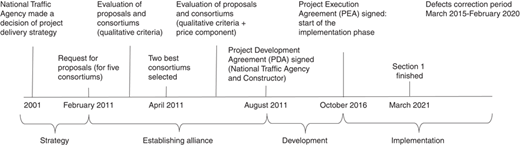
Case Railway is a railway renovation project to improve safety in a 90-km stretch, reduce maintenance costs by renewing and repairing structures, and reinforce surface and bench structures. The total budget of the project was 106.4 million Euros and it was initiated in 2010. The main goals of the project were to increase rail track usability, undisturbed railway traffic, traffic and occupational safety, cost efficiency, and planning and construction quality and to improve scheduling. The starting premises for the project were purposefully loose to enable flexibility, innovations, and search for appropriate technical solutions. The preliminary baseline information included the client’s goals for the project, initial cost estimates, and plans produced by the client before the actual alliance development phase. The timeline for the project is shown in Figure A1.
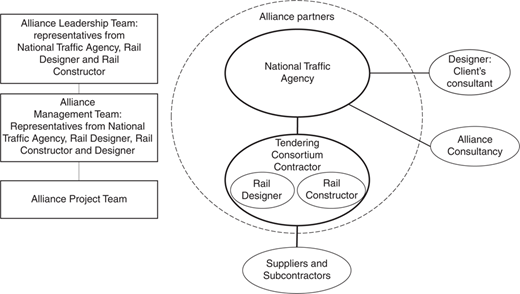
The project alliance organization in Case Railway consisted of the partners who had signed the development phase alliance contract: National Traffic Agency (client organization) and Contractor (who was the main contractor for both design (RailDesigner) and construction work (RailConstructor). In addition, a consultancy company Designer acted as the client’s consultant providing construction management services for the project. Together, these organizations formed a multi-organizational project network during the project’s development phase which included Alliance Leadership and Alliance Management Teams as well as other members of the alliance organization. Alliance Leadership Team was responsible for the high-level management of the project, setting up the key target areas, and, for example, for solving any possible disputes. It also aimed at unanimous decision making. Alliance Leadership Team selected the project manager for the project, who runs the Alliance Management Team, and was responsible for the operative work during the development phase. Other members of the alliance organization played also a key role in executing the practical project work and included experts on project alliance and designers. In addition, several cross-functional working groups on specific areas such as safety and cost-follow up served as coordination and development bodies during the development phase. In addition, Alliance Consultancy (consulting firm) provided alliance management facilitation services. Case Railway’s project network is presented in Figure A2.
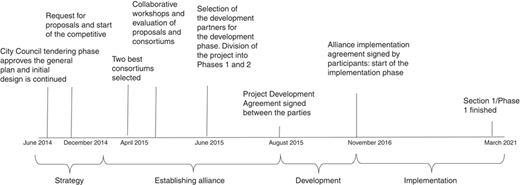
Case Tramway is a public transportation system project being built by the Tram Alliance in a Northern European City. The key goals of the tramline system include making the everyday life and transportation easier in the municipality, supporting the growth and development of the urban area, and increasing the city appeal. In June 2014 the general plan for the tramway was approved by the City Council and the quotation process was initiated in Spring 2015. The total cost estimate for the project that is binding all alliance parties and includes the client’s procurements, the client’s risk reserve, and the bonus pool is 238.8 million Euros. The implementation plan for part one covers 15 kilometers of a two-track line. The alliance contract also covers the power supply stations, the relocation of pipes and cables to make way for the tramway infrastructure, the construction of bridges and supporting walls, as well as the implementation of technical systems, such as the electricity supply for the rails and tram traffic monitoring and control. The construction of Section 1 is estimated to take about five years and the construction work in 2017 has been started on several sites.
The preliminary baseline information included client’s goals for the project, initial cost estimates, and plans produced by the client before the actual alliance development phase. The competitive tendering place took place during Spring 2015 and two best consortiums were selected in April 2015 and the final selection made in June 2015. The initial integration requirements at the start of the project were considered extremely high due to high task complexity and uncertainty inherent in the project. A great deal of uncertainty was related to the linings of the tramway, street plans, and old cables that needed to be moved away. The timeline for the project is shown in Figure A3.
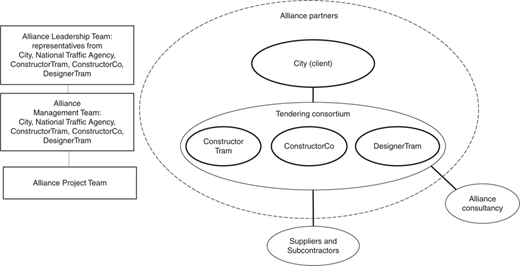
The Tram Alliance is composed of the City (the client) and the service providers ConstructorTram, ConstructorCo and DesignerTram. ConsctructorTram, and ConstructorCo are responsible for construction of tramline infrastructure and depot area and ConstructorTram and DesignerTram for the design. The project governance model for the development phase consisted of Alliance Leadership Team (responsible for the high-level management of the project, setting up the key targets, and solving any possible disputes) and of project management team (controlled the daily operative management and project reporting). In addition, different disciplines had their own leaders and cross-functional working groups were also formed. The Tramway alliance organization is presented in Figure A4.
Appendix 2. Interview protocol
Background
The research and interviews were focused on understanding how integration among the alliance organizations had been managed so far in the project in its different phases. More specifically, the purpose was to understand better how integration was planned to be achieved at the beginning of the project, what kinds of integration mechanisms have been used and how and why their use has changed. In addition, the study addressed the overall achievement of the project’s objectives, team-building activities, and the level of co-operation. The interview themes are presented in the following. The list of themes and more specific questions were modified depending on the interviewee.
Interview themes
Background of the interviewee and alliance background information
Background and previous experience: experience in this alliance and others; organizational experience in alliances; characteristics of this project and key events; alliance organization; key successes and challenges so far.
Organizational and contractual integration
Integration motivation, shared understanding and equality of alliance partners, governance model, roles and responsibilities; coordination practices; joint facilities and co-location; alliance contract
Behavioral- and relationship-based integration capabilities
Team-building activities; joint identity; leadership and alliance leadership team; trust-control balance; best for the project spirit; no blame culture and transparency
Technological and process integration
Integration of technical disciplines and tasks and practices for these; management of scope creep; visual guidance and management; big room practices; technologies facilitating collaboration; innovation processes; risk management; management of conflicts and consensus decision-making
Continuous management of integration
Learning and continuous reflection; reciprocal interdependence; flexibility competences; planned adjustments and changes in integration practices.
Appendix 3. Socialization mechanisms
Appendix 4
Notes
Project alliances can be considered as an extreme form of organizing to facilitate the management of organizational relationships and achievement of common goals in complex projects (Lahdenperä, 2012), aiming to provide “the best value” for all parties rather than, for example, the least expensive or quickest project outcome (Walker et al., 2002). They are fundamentally different from the management of dyadic relationships and dyadic contracts in projects, such as partnerships (Bresnen, 2007). Project alliances are also fundamentally temporary in nature and formed for the purpose of completing a single project only. Hence, they differ from long-term and loose strategic alliances, which have been intensively studied in the strategic management literature (e.g. Kale et al., 2000).
We thank the anonymous reviewer for pointing us toward this stream of literature.
Socialization has its roots in organizational behavior; at the very general level, it refers to the process by which individuals acquire social knowledge and skills necessary to assume an organizational role and it can vary from a relatively fast and self-guided process to one that requires extensive preparation, education, and training (Van Maanen and Schein, 1979).
Relational capital is one dimension of social capital (Nahapiet and Ghoshal, 1998). Research on socialization has addressed especially socialization as a facilitator of relational capital (e.g. Cousins et al., 2006) and, hence, this study also focuses on relational capital.