The purpose of this study had two aims: (1) to extend insight regarding the challenges of implementing standardised work, via care pathways, in a healthcare setting by considering interactions with other operational (i.e. resource sharing, portfolio alignment) and professional (i.e. autonomous expertise) dependencies and (2) to develop novel insights regarding a specific flow mechanism, the stroke nurse practitioner, a form of flow “pilo” or guide.
This was a longitudinal case study of implementing the acute stroke care pathway in a National Health Service hospital in England based on 185 hours of non-participant observations and 68 semi-structured interviews. Archival documents were also analysed.
The combined flow, operational and professional dependency lens extends operations management understanding of the challenge of implementing standardised work in healthcare. One observed practice, the process pilot role, may be particularly valuable in dealing with these dependencies but it requires specific design and continuous support, for which the authors provide some initial guidance.
The research was a single case study and was focussed on a single care pathway. The findings require replication and extension but offer a novel set of insights into the implications of standardised work in healthcare.
In addition to confirming that a multidependency lens adds conceptual and practical insight to the challenges of implementing standardised work in a healthcare setting, the findings and recommendations regarding flow “pilots” are novel. The authors' analysis of this role reveals new insights regarding the need for continued improvisation in standardised work.
1. Introduction
Attempts to implement standardised work are increasingly common in healthcare; something that is of great interest to operations management (OM) scholars and practitioners. Consider the idea of the “care pathway”, an evidence-based optimal timed sequence of interventions for a particular diagnosis, procedure or symptom (Campbell et al., 1998; Ben-Tovim et al., 2007). In addition to ensuring that patients are treated according to best available evidence, a pathway could also be seen as an attempt to create flow, something that is very familiar to all students of “lean healthcare”. Lean or flow approaches have reportedly freed up hospital capacity (Schonberger, 2018), reducing waiting times, lengths of stay and costs (Costa and Filho 2016). Other researchers observe that as a result of endemic operational dependencies, such as specialist resource sharing (e.g. computer tomography scanner) and portfolio alignment (e.g. integrating multiple care pathways, in a fixed space, equitably, etc.), lean interventions deliver inconsistent outcomes. They have also be shown to deliver predominantly negative impacts on worker satisfaction and to have no significant association with either health outcomes or patient satisfaction (Poksinska et al., 2017; Moraros et al., 2016; Mazzocato et al., 2012). In summary, fundamental questions and challenges for implementing standardised flow in healthcare remain to be explored (Smart et al., 1999, 2009).
In addition to these operational dependencies, patient flow relies on different professional, autonomous specialists (Lewis and Brown, 2012) interacting, creating another form of dependency. To date, the healthcare OM literature has considered these dependencies (i.e. flow, operational and professional) but as distinct phenomena. A broader question of interacting dependencies in the implementation of standardised flow remains under-explored. This leads to our first research question:
What happens when standardised flow interacts with other operational (i.e. resource sharing, alignment) and professional (i.e. co-ordinating autonomous expertise) dependencies?
To answer this question, we undertook a longitudinal case study describing the experiences of a UK National Health Service (NHS) general hospital as it implemented a care pathway for acute stroke care. This pathway was very suitable for our research as it combined a flow logic in its design, with specific time objectives (n.b. diagnostic and treatment speed have a significant impact on patient outcomes including mortality). Yet, because of the general hospital setting, still required physicians to compete for access to key shared resources, whilst co-ordinating with a range of adjacent medical specialities.
The implementation of the stroke pathway involved the introduction of a novel flow co-ordination mechanism, namely the role of the Stroke Nurse Practitioner (SNP), designed to act as a pilot to navigate the various system dependencies. This type of process pilot (guide, expediter, etc.) role has received almost no attention in the OM literature and led us to our second research question:
How does the process pilot role, intended to support standardised flow, deal with operational and professional dependencies?
The rest of this paper is structured as follows. In Section 2, we present the overall conceptual framework, used ex ante to structure our empirical work and, in Section 3 and four, the method and findings. In Section 5, we discuss the RQs and revise our initial framework, introducing some reflections on the role of improvisation in achieving standardised flow. In the final section, we discuss practical implications and make recommendations for further work.
2. Conceptual framework
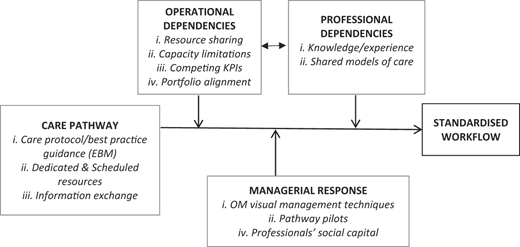
A care pathway is, on first inspection, a type of standardised flow that is very familiar to OM scholars and practitioners. In order to guide our investigation of the stroke care pathway, we created an initial conceptual model (Figure 1). We considered the pathway as a form of standardised flow based on: (1) guidance regarding the optimal sequence and timing of interlinked activities (Malone and Crowston, 1994; Malone et al., 1999); (2) management of resources to avoid bottlenecks (Yang et al., 2018) and (3) co-ordinating effective information exchange (van Leijen-Zeelenberg et al., 2015). Yet, as discussed in the introduction, any flow implementation interacts with other forms of operational dependency (e.g. resource sharing, alignment).
Moreover, professional medical work introduces additional dependencies such as co-ordinating autonomous expertise. As the process of care for a particular patient transitions between different locations (e.g. emergency department (ED), imaging room, etc.), potential information handoff problems follow (Gulliford et al., 2006; Boyer et al., 2012; Dobrzykowski and Tarafdar, 2015). Finally, in any implementation there are also various managerial actions that seek to moderate the interaction between the standardised flow “intent” and these other dependencies.
2.1 Operational dependencies
Care pathways typically share key resources such as computed tomography (CT) scanners or ED staff members. These shared resources are commonly expected to meet different types of demand and to perform multiple activities, with greater or lesser degree of multitasking. Thus, resource sharing can have a range of unintended and sometimes adverse consequences for flow performance. de Souza and Pidd (2011) for example, highlighted how reduced bed occupancy in a lean project for elderly care caused additional problems as the empty beds were filled via a hospital-wide Bed Management System with other patients on different, unrelated, care pathways. Tay et al. (2017) stated that if the focus of a system is on maximizing resource efficiency, without reflecting on how the specific resources interact with the other elements of the system, then, this will eradicate the resource efficiency outcome of the whole system. The authors refer to this phenomenon as the “efficiency paradox”.
Even the classic OM “bottleneck formula” can be inaccurate. Capacity is often smaller than the bottleneck in “networks”, like healthcare, where many tasks are processed by indivisible (human or otherwise) multitasking resources (Gurvich and Van Mieghem, 2015). Brown et al. (2003) found that hospital staff scheduling, a typical source of variation in the supply of healthcare services, often led to workloads which adversely affected individuals' ability to learn from (clinical) mistakes and resolve the underlying causes of problems (Tucker and Edmondson, 2003).
In addition to the challenging interaction with various forms of shared resource, specific pathway flows are part of a broader portfolio of activity. Of course, shared resources are themselves a key part of wider portfolio management. Busy multiuse settings, like an ED, are invariably an aggregate strategic priority – often with no real regard to specific care pathways, but multiple pathways mean multiple goals, and healthcare actors (health professionals in particular) have significant autonomy to act without regard for the wider portfolio (Feldman and Rafaeli, 2002; Gittell, 2011). Papadopoulos (2011) found that the full agenda of “decision makers” prevented them from being able to gather in weekly meetings, undermining the development of lean.
Moreover, resources sharing (especially in public-service models like the UK NHS) can have strongly p(P)olitical dimensions (Grove et al., 2010). Drupsteen et al. (2016) show that an over-arching emphasis on resource utilization can create conflict between “resource-providing” departments (such as radiology), focussed on meeting their own performance targets and the “resource-deploying” care pathways. Similarly, Elissen et al. (2011) found that scarce resources force practitioners to compete, which inhibits their ability to cooperate effectively, leading to suboptimal use of resources and variations in care. Professional “silos” fragment care (Mann, 2005) and increased pressure to improve specific aspects of in silo performance results in worse system level outcomes (Seung-Chul et al., 2000; de Souza and Pidd, 2011). Grove et al. (2010) also note that targets result in “gaming” and data manipulation to report good outcomes while hiding real performance.
2.2 Professional dependencies
As highlighted, standardised flow is often dependent on effective (in this case patient) handovers and yet the literature reports the challenging nature of co-ordinating medical professionals to engage with effective information sharing. Various explanations have been proposed. McDermott and Venditti (2015) found that professionals sometimes do not know what happens after they perform their tasks and how their tasks fit within the overall flow. van Leijen-Zeelenberg et al. (2015) ascribed communication failures in six acute care hospital pathways to limited shared understanding of the overall pathway. McKnight et al. (2002) found that physicians and nurses had different perceptions of what information was essential for effective communication.
In addition to differential expertise and experience at any specific point along the pathway (Pagell et al., 2015), standardised flow initiatives can actually seem to limit the time available for effective communication (Gerein et al., 2006; Green and Holmboe, 2010). Radaelli et al., 2015 note, with reference to the concept of “stickiness” (Tyre and Hippel, 1997), the high cost of sharing tacit information and further observe that physicians are reluctant to exchange information when they are confronted with practical problems in its transmission. Kc and Terwiesch (2009) found that reduced throughput time can be unsustainable and may come at the expense of increased medical errors. Similarly, Powell et al. (2012), found that high-workloads made physicians more likely to miss information on patients' complications, leading to miscoding issues. They explain that when multiple activities compete for the physicians' services and time, then they typically de-emphasize the communication aspects of the care process (Vargas et al., 2015).
2.3 Managerial response
What managerial mechanisms are effective in moderating the interaction between the intended standardised flow and these other dependencies? Drupsteen et al. (2016) note that inadequate knowledge regarding the interdependent nature of the process is associated with a lack of process visibility that may suggest a role for classic OM visual management techniques (McDermott and Venditti, 2015; Tezel et al., 2015; Beynon-Davies and Lederman, 2017). McDermott and Venditti, (2015) found that through the process and value stream mapping, healthcare professionals were able to understand the nature of the process and how their tasks fit together, thus work towards lean implementation. General administrative information and communication technology systems, such as bed management software, are often implemented to help manage shared resources and resource utilization (Proudlove et al., 2007) but struggle to accommodate flow dependency (Hellström et al., 2010).
Addressing what we labelled “professional dependencies”, Dobrzykowski and Tarafdar (2015) showed that informal social ties are a vital element in healthcare information exchange. Frequent interactions (Nicolini et al., 2012) underpin shared mental models of care and, when professionals are located close together, they have opportunities to synchronise behaviour (Sole and Edmondson, 2002). Edmondson et al. (2001, p. 705), in their study of cardiac surgery departments, emphasised how “group-level reflection” taking place “through formal meetings, informal conversation, and shared review of relevant data” contributed to better co-ordination of new practices in an operating room. Similarly, Greenhalgh (2008) showed that successful routines depended on collaborative interactions between staff members. They argue that friendship and reciprocity, developed over time, can enable individuals to cross routine professional and organisational boundaries over time. When professionals have shared knowledge, they tend to share the same goals and trust the work of each other they act in support of the goals of the whole process (Gittell, 2011; Dobrzykowski and Tarafdar, 2015). Mura et al. (2016) found that when individuals have stronger social ties, higher degrees of psychological safety allow them to exchange mistake and error related information, seek feedback and to ask questions. Moreover, in environments where boundaries are highly guarded, stronger social ties reduce individuals” opportunistic behaviours (Siemsen et al., 2009).
2.4 Pathway pilots
In addition to the various managerial responses described above, we highlight one particular approach to managing standardised flow implementation; the introduction of specialised employees whose job is to help manage flow (Hunt et al., 2016). These boundary spanning roles are, in theory, able to cross various institutional boundaries that can divide other colleagues (Nasir et al., 2013). Collins et al. (2014) found that process champions as subject matter experts promote knowledge amongst employees regarding the process with results in sustaining commitment to improvements. Interestingly and despite the potential of these “pilot” roles, there is limited research exploring their function in healthcare, particularly examining how boundary spanners perform (or should perform) to improve quality of care (Brostrøm et al., 2015).
3. Methods
In order to address our research questions, a single in-depth case study approach was most appropriate (Eisenhardt and Graebner, 2007; Yin, 2014) as it offered the opportunity for focus and intensive data gathering (Voss, 2010; Pellinen et al., 2016). Given the range of constructs under investigation, a key consideration was to control as far as possible for organisational and institutional context. Moreover, the focus over an extended timeframe (28 months) allowed the researchers to become familiar with the workings of the acute stroke pathway and the multiple professionals involved. The fieldwork lasted 28 months, from March 2015 to July 2017.
The selected site was a UK district general hospital, employing about 4,500 staff members and serving an area of approximately 500,000 people. Located in a small city but also serving surrounding towns and villages, the hospital had at the time of the study 732 beds and offers a range of acute services including medicine and surgery, services for women and children, emergency, diagnostic and clinical support services.
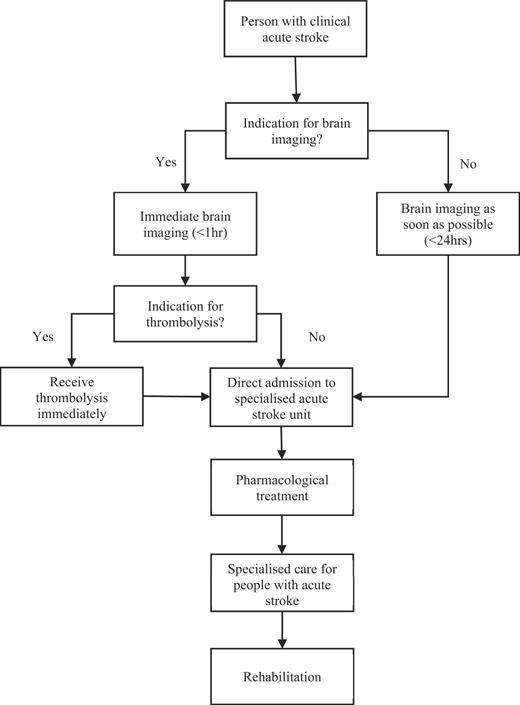
The unit of analysis was the acute stroke care pathway. This pathway integrates a wide range of activities that differ substantially in terms of function, space, time and organisational structure: the emergency department (ED), the medical assessment unit (MAU), the acute stroke care unit (ASU) and the radiology department (RD) with an explicit temporal component (i.e. faster is better for the patient). The standardised acute stroke care pathway, based on a national evidence-based assessment of best practice, was first introduced in 2011 (Campbell et al., 1998). Figure 2 summarises its key stages. Overall, 1,144 suspected stroke patients were admitted during the period of the study.
Table 1 summarises a number of key performance indicators (KPIs) as these are compiled by the Sentinel Stroke National Audit Programme (SSNAP), a national healthcare quality improvement programme that measures the quality and organisation of stroke care in the NHS.
The SNP role was introduced to the hospital of study in March 2015. SNPs are specialist stroke care practitioners responsible for co-ordinating and facilitating the pathway of patients from the time of their arrival in the ED until admission to the acute stroke unit.
Data collection comprised three phases and created four data sources – semi-structured interviews, non-participant observations, archival documents and secondary patient data. Phase one used a snowball sampling technique to build familiarity with the pathway, key resources and professional roles. One researcher conducted 41 interviews with relevant participants (see Table 2). The interviews lasted 30–45 min on average, following a topic guide that covered a range of topics including ideal stroke care pathway, sources of variation and pathway management and improvement. All interviews were recorded and transcribed.
Formal and informal process documents provided by hospital staff members were also collected and analysed. These included nine pathway guidelines, SNAP reports of the years 2014–2016, monthly evaluation reports of SNPs as well as formal documents describing the role of SNPs.
We also conducted 192.5 h of non-participant observation in the ED, the ASU, RD and MAU; “shadowing” the SNPs in particular as they cared for 52 patient instances in total. These observations offered a complement to the retrospective recall of events by interviewees and allowed the researcher to note important contextual information.
Phase two, began with validating a map of stroke care “flow in practice” with further observations and eight additional medical staff interviews. This map was then used as a prompt in an additional 19 semi-structured interviews where Sequential Incident Technique (SIT) was used to elucidate specific incidents that cause variation to the flow.
Phase three, comprised a staff workshop organised on hospital premises. Sixteen people attended, nine members of ASU (three consultants, three SNPs, two registered nurses and one occupational therapist) and seven members of the management team (head of general medicine, manager of ASU, three project managers and the business manager).
The final data set consisted of 26,979 words of observations, approximately 92,500 words of interviews and 198,654 words of archival documents, as well as 16 photos of the hospital environment and nine process maps. NVivo (2010) was used to manage the analysis of such a large data set. We followed an iterative process of open, selective and then theoretical coding. For example, an information exchange issue might be coded by “participants” (e.g. ED, stroke team, etc.), then by “staff availability” at a particular time, and then as “flow – shared resource dependency interaction”. The coding scheme was reviewed and developed regularly during data collection phase, with theory from the literature used to underpin the revisions.
4. Findings
The following tables summarise key insights from the interview and observation data, framed by contextual performance data. In Table 3, we present a sample of our coding table, providing a description of the factors that we coded as having an impact on pathway performance.
Tables 4 and 5 summarises the key findings and includes fragments of the qualitative data for illustration of our analysis methods. Table 4 presents the interacting dependencies using the structural elements of the conceptual model and Table 4 the managerial interventions intended to support flow, in part to mitigate the adverse impact of these interactions (purposely or not) . A particular focus in both tables is to highlight evidence relating to the SNP role. In Table 4, we see strong evidence of many anticipated issues, including conflicts centred on shared resources and competing portfolio priorities, differential medical expertise and communication difficulties. Given the pathway had been introduced four years prior to the study, there was a surprising lack of clarity over basic process logic together with an unhelpfully large selection of visual and textual representations of the pathway. We also observed the SNPs negotiating a mixture of operational and professional dependencies, from managing information and knowledge sharing amongst professionals to facilitating resource allocation and scheduling of resources.
In Table 5, we summarise observations on a range of managerial interventions which either helped the system cope with the interacting dependencies (i.e. coherent flow) or, sometimes, had a negative impact (i.e. incoherent flow). The emergent formal and informal distinction also helped add insight to these interventions and the nature of the SNP role – and its limitations – in particular.
5. Discussion
Overall, many of these observations confirmed our ex ante insights regarding the challenges associated with standardised flow implementations and echoed many of the (healthcare specific) evaluations of interprofessional collaboration. However, the interacting (flow, operational, professional) dependencies lens did offer additive insights (RQ1). Our interest in managerial mechanisms for supporting standardised flow, and the introduction of the flow “pilot” role (the SNP), specifically (RQ2), generated fascinating and novel findings. As intended, SNPs were repeatedly observed acting to span communication and knowledge boundaries among multiple professionals. We also observed frequent interventions – using the informal “authority” of the pathway – in local capacity planning and in the management of resources. More surprising was the limited direct evidence regarding the formal design and management of the role (cf. White et al., 2017). Consequently, individual pilots approached the task in (sometimes very) different ways, contingent on their own personalities, status, social capital, etc. Indeed, we found their work was often primarily characterised by its improvised nature, with variable consequences in terms of ultimate performance. In this chapter, we further elaborate on these observations and with reference to the H (O) M theoretical framing we try to answer our two research questions.
5.1 What happens when standardised flow interacts with other operational (i.e. resource sharing, alignment) and professional (i.e. co-ordinating autonomous expertise) dependencies?
The data reinforce and clarify many of the benefits and challenges of standardised flow identified in the HOM literature. For example, when flow meant that professionals were located close to each other, information and knowledge sharing was more efficient. Practitioners who had the opportunity to interact more frequently, and thus to develop better social capital, working and social relationships (e.g. SNPs within the ASU stroke team), were more motivated to voice and share any issues or concerns they had with their work. In addition, those improvement initiatives where practitioners engaged in formal and informal conversations were important for supporting knowledge sharing, and consequently increasing practitioner motivation to engage in further efforts for standard flow (McDermott and Venditti, 2015).
Conversely, although process mapping techniques can be effective in making the pathway more visible and clear (van Raak et al., 2008; Hellström et al., 2010; Hayes et al., 2011; McDermott and Venditti, 2015). Well-established challenges associated with mapping (i.e. graphical or text based, level of analysis, composition of the mapping teams, etc.) were even more acute in this professional environment. In a healthcare setting, process maps (and other artefacts (Pentland and Feldman, 2008) like textual descriptions can help span knowledge boundaries, improve visibility and clarity of the process (i.e. roles, sequence, etc.), increase shared understanding of the distinct value added by different professions and, hence, enhance intergroup communication (McDermott and Venditti, 2015). However, this only appears to hold when “artefacts” are developed and co-ordinated in a structured and integrated manner.
5.2 Flow interruptions/changeovers
There was evidence of the effect that compliance with best practice guidance had on reducing ad-hoc task interruptions. In line with experimental studies that show task interruptions can lead to longer processing times – Bo et al., (2019) estimate 20% of total processing time per patient is associated with changeovers – our interviews suggested the standard protocol helped with localised co-ordination efficiency. Medical professionals are typically categorised as specialists performing specialist tasks, but our observations confirm that they are also involved in a range of quite mundane and generalist tasks – including a great deal of basic simultaneous and asynchronous “changeovers”. The collaborative process of prioritising and switching between collaborative and individual tasks affect treatment times. This aligns with research that has investigated the impact of standardised handovers in surgery (Wayne et al., 2008) and other structured communication protocols such as checklists (Lingard et al., 2008) and structured interdisciplinary rounds. Even with the “guide rails” of standardised flow, medical staff members have considerable autonomy to use their individual judgement to decide when and how to engage and commit in various collaborative tasks. The stroke care pathway, built on the combined expertise of multiple professionals with varied knowledge and skills, provided fertile ground for the combined effect of autonomy and variations in knowledge, competency and engagement to influence the standard stroke care flow. Stroke flow is predicated on the effective and efficient administrative and medical information exchange between those professionals and although social capital could enhance communication, the high workload due to multiple activities, different location etc. frequently resulted in outcomes that are more dysfunctional.
5.3 Multifaceted dependencies
The fundamentally interactive character of the various operational dependencies comes through very strongly in the analysis of the data. Many of the factors that impact the outcome of one process dependency, appear to influence other process dependencies as well (see Tables 4 and 5). As the above discussion illustrates, standardised flow can have a positive impact on efficiency, but attempts to implement it whilst ignoring simultaneous resource sharing (including multitasking people and shared IT systems) dependencies can create additional “vicious cycle” challenges. In its most frequent manifestation, limited availability of key people repeatedly interrupted flow. When specific practitioners were unable to carry out their tasks, in order to proceed with the pathway, other “potentially eligible” staff members were interrupted; even when the effect of prioritising one flow was interruptions in others. Hospital portfolio and resource sharing led to an increased bottleneck “busy-ness” of professionals and subsequent high workload, with its concomitant adverse effects on the number of interruptions and changeovers, reinforcing additive workload and flow issues. Achieving standardised flow in one pathway in a (highly utilized) shared resource management system propagated sequence variation to other pathways and, via increased variability, may have actually diminished the effective capacity (and quality) of critical resources (c.f. Coeira et al., 2002; McDermott and Venditti, 2015). During one observation session, ASU nurses were moved elsewhere by the hospital staff manager during early and night shifts based on the (erroneous) assumption that the number of stroke patients arriving at the unit would be lower at those times. Equally, one SSNAP audit found approximately 20% of stroke beds in the case study hospital, were being used for non-stroke patients to avoid breaching other hospital priorities. These interacting priorities, with differentiated intermittent audit/enforcement cycles, only exacerbated the challenge of isolating dedicated capacity necessary to support standardised flow.
Similarly, we observed as much competition as collaboration (Collins et al., 2014). Hospital managers try to enhance pathway visibility by setting specific KPIs, aligned with best practice guidance. But, misalignment of the pathway targets with the other pre-existing portfolio targets and goals, induced more competition than collaboration. For example, despite the central role of specific shared resources in standardised flow, resource-holding departments involved in the care of multiple patient types, such as Radiology, continued to make portfolio decisions; where the use of the specific resource, rather than the stroke pathway objectives, was the foremost consideration.
5.4 Managerial response
Most of the pathway “ingredients” above are managerial in nature, but this section reflects on the specific responses to try and ensure coherent stroke care pathway “flow”. Outside the SNP/pilot role, discussed in greater depth in Section 5.2, what was most striking was the lack of evidence of properly designed support mechanisms. For example, although the need for the stroke care pathway to draw on shared resources is explicitly recognised in the formal guidance, in practice, the hospital responded to this challenge in a disconnected manner. We have shown the ad-hoc and highly varied attempts to increase flow visibility with the addition of specific (mandatory) KPIs to the hospitals' measurement portfolio, then subject to external audit and reporting (e.g. SNAAP). However, even with this external pressure, managerial response was limited. There were some improvement initiatives, such as inter/departmental meetings and some attempts at classic “continuous improvement work”, but these were rarely part of a coherent deployment of activities and communication.
An institutional lens may offer some explanation. The pathway implementation was responding to a range of external (to the pathway) institutional pressures. Although a logical evidence-based guide in its own right, the standardised flow for stroke care was officially adopted in response to a range of external pressures. It was also an explicit accounting mechanism with specific coercive consequences. This idea of “enforcing” best practice may have served to undermine key legitimation processes and, consequently, institutional change. Likewise, there was ample evidence regarding the role of agency (and resistance) in legitimate change. It was clear that for many professionals the pathway, far from being seen as a neutral scientific best practice, played into established managerial and professional boundary skirmishes (e.g. specialities, medical/surgical, doctor/nurse, medical/administrative, etc.). Healthcare professionals draw on a common body of regulated (in this case by nine UK statutory bodies and the General Medical Council) knowledge, values and standards, which influences and defines their knowledge, skills and expertise. If any “improvement” is seen as a vehicle for “empire building”, a way to broaden specific professional span of influence, then this exacerbates the negative aspects of the interacting dependencies; increasing resource competition, impinging on professional responsibilities and judgements and amplifying (dysfunctional) political dynamics (Drupsteen et al., 2016).
5.5 How does the process pilot role, intended to support standardised flow, deal with operational and professional dependencies?
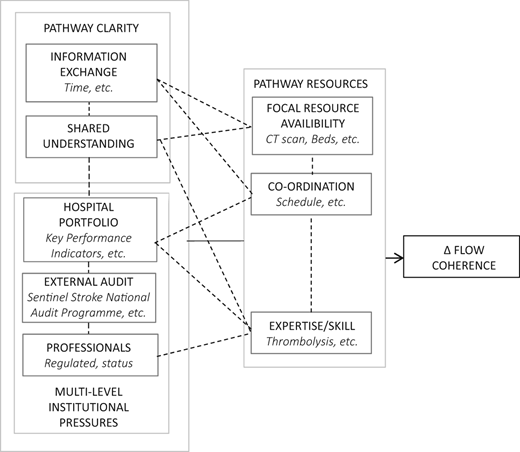
The process pilot role (SNP) was a particularly intriguing response and co-ordinating mechanism for aligning sharing and flow interactions and connecting care professionals. It justifies an extended discussion, as this type of role has received almost no attention in the OM literature. It is an interesting hybrid between formal and informal managerial response. The pilot worked in connecting the relevant aspects of the pathway flow model, to try to ensure coherent stroke care pathway “flow”. Particularly, the SNPs works in improving pathway clarity and managing the multilevel institutional pressures. From numerous points of view, this was an effective approach. As already noted above, there is a known exchange challenge (Radaelli et al., 2015; Mura et al., 2016) with professional knowledge (tacit, situational, etc.: Alvesson, 2001) that is resistant to the traditional OM recipe of explicit formalisation and standardisation. However, there is a positive relationship between professionals' relationships and subsequent willingness/motivation to exchange information and knowledge, which improved collaboration and effective process management (Gittell, 2011; Hayes et al., 2011; Tucker and Singer, 2015). This allows for timely adjustment to unexpected variation (Gittell, 2011; Dobrzykowski and Tarafdar, 2015; Mura et al., 2016). Clearly, the role is a critical integrator.
In many ways, without the pilot there is no meaningful pathway in any consistent sense. The SNPs tie together different professional groups, argue for adhering to or ignoring KPIs, manage external audit (such as SNAAP), using the informal “authority” of the pathway to facilitate pathway co-ordination through negotiation of resource allocation and scheduling, coach and help professionals to build shared understanding, the specific knowledge and needs of the pathway, etc. Yet despite the advantages of this informality, the other side of this was the frequent contestation and near permanent improvisation surrounding the role. From SNPs interrupting their work to undertake adjacent administrative and clinical work (cf. Sangster-Gormley et al., 2011), preventing them from facilitating the pathway of their patients, to the near daily and often heated, arguments around resource availability and prioritisation.
Here we are not talking about variable medical judgement but adaptations and improvisations to the pathway flow itself. This notion of improvisation (Weick, 1998) has been applied to a range of phenomena, from teamwork and creativity to product innovation (e.g. Moorman and Miner, 1998, 2001; Kamoche et al., 2003) and the hospital Emergency Room (Batista et al., 2016). However, despite its importance in co-ordinating healthcare processes, its role in the healthcare and operations management bodies of literature is under-explored. In Figure 3, the scope of the role and the extent of the observed improvisation is indicated by a series of dotted lines between all the relevant aspects of the pathway flow model.
Our findings reveal a strong element of SNPs' improvisation as either a spontaneous response or development of a routine, being a critical mechanism in managing the pathway flow (Batista et al., 2016). For example, in response to the challenge of obtaining precise admissions information (including stroke patients being wrongly admitted to the MAU), the SNPs created their own informal, temporary “walkabout” routines to facilitate flow. SNPs were going to ED every 1–2 h to ask informally about patient arrivals, reminding the ED staff members that they are there, and that they should be informed if any patient arrives with suspected stroke, etc. Similarly, when there was a delay of professionals reporting the medical diagnostic reports, SNPs would ring them more than once, or walk down to the relevant department (i.e. Radiology, laboratories, etc.) and demand professionals to provide the relevant information the soonest possible in order to facilitate flow.
Here too, adjacent dependencies shaped the extent and effectiveness of improvisation. Reduced stroke bed availability (at times due to non-stroke patients been admitted to the ASU), for example, frequently led SNPs to try to “sort this out”. Similarly, faced with CT scan delays, SNPs would go into the small room and “discuss” with the radiographer how to move things faster. These improvisations also impact professional dependencies. Negotiating ad-hoc bed arrangements “face-to-face” on the ward (sometimes marshalling the support of other stroke nurses) would often result in quite heated disputes with the hospital bed managers. Similarly, there were several instances when SNPs went directly to stroke doctors to facilitate a patient move without informing the ED staff who were officially in control. There was also improvised auditing, such as participants challenging the actions of others. A nurse challenging a doctors' stroke expertise and experience would typically be inappropriate, but the pathway principle is clear that it would be wrong to draw an inexperienced doctor into stroke care. Such improvisations, no matter how well justified/intentioned, could exacerbate interprofessional communication challenges.
6. Conclusions
Before reflecting on the key conclusions of the work, it is important to note that this study has several limitations. In particular, it was an exploratory study and although extant literature was used to frame the investigations, there was no formal hypothesis development or testing. The empirical setting offered the invaluable opportunity to investigate clinical care pathway implementation, but it was a case study of a single care pathway in a single organisation and this can lessen the external validity of the study and generalisability of the findings. Equally, although the research employed formal data collection protocols (triangulation, coding, etc.) derived from a conceptual framework itself informed by literature, interpersonal differences (i.e. native language, cultural assumptions, educational background, etc.) between the researchers and the participants can never be completely eliminated.
Noting these potential limitations, we believe that the whole paper is studying a clearly society important problem, contributing to the optimization of healthcare processes flow. Insights from this paper will contribute to the production of better patient outcomes for stroke patients, including survival and post-discharge quality of life. This paper draws conclusions and makes theoretical and practical implications in two key areas. First, the study clarifies and confirms that standardised flow implementation (RQ1) requires negotiation between flow, operational and, particularly in this healthcare setting, professional dependencies. In conceptual terms, this emphasizes the need for a multidimensional and multilevel model of “process” management; a perspective that exists in the (H)OM literature but is not widely deployed. Viewing implementation as a multidependency puzzle also provides a useful contingent framework for understanding (in research and practice) the networked capacity questions that characterise most healthcare systems composed of shared and/or multitasking resources. Gurvich and Van Mieghem (2015) highlight the need in such circumstances to match task priorities with the collaboration levels defined by the capacity network's collaboration architecture. Without such a collaboration centric logic, our findings confirm that even if a standard flow design is sometimes coherent, it can quickly become incoherent when implemented in a setting with multiple other care pathways and patient activity. Autonomy frequently led to minimally shared mental models of care, different perspectives on the best interests of the patient, and (often highly dysfunctional) competition between individuals and groups potentially causing a negative effect both on its effectiveness (i.e. accuracy in decision-making) and efficiency (i.e. changeovers, timeliness, use of resources, etc.). In practice, managing standardised work in a setting with professional autonomy requires multifaceted managerial interventions, which create the structural (e.g. knowledge interdependencies) and cognitive (e.g. shared goals) conditions to facilitate and motivate knowledge sharing (Radaelli et al., 2015).
Second, the process pilot (RQ2), although poorly designed and, like other boundary spanner roles, frequently contested, was observed to be an effective mechanism for aligning flow and other dependencies and connecting care professionals. Interestingly, and echoing the organisational routines literature (Feldman and Pentland 2003), significant levels of deviation persisted even in the midst of this attempt to create a highly formalised routine. Even with the “in principle” (ostensive) pathway acting as both a guide to implementation (e.g. role creation, training, diagnostic scripting, scheduling, etc.) and an accounting mechanism (i.e. reviewing the pathway, feeding into audits, etc.) we observed significant forms of adaptation and, especially around the SNP/pilot role, extensive improvisation (cf. Batista et al., 2016).
The novelty of this contribution derives from the fact that, the role of process “pilot”, which is under-explored in H(O)M, can constitute a bridge between the ostensive and performative (improvisational) aspects of healthcare processes, which provides a “realm” of operational performance, where coherence of flow can be achieved. In practice, the role of process pilots should be designed with a better realisation of the situated organisation and the multifaceted nature of the healthcare processes. This will enable better integration of their role at the workplace. Complete integration may improve the use of pilots' knowledge and skills, as well as enable them to build the required resources (i.e. relationships etc.) to manage the dynamic and complex nature of healthcare processes.
Finally, we would highlight further work aligned with our key conclusions. First, in this study we deliberately sampled a pathway where patients (and their carers, families, etc.) had a limited impact on the flow process. Would similar effects be observed in longer duration pathways where patients' characteristics matter significantly (e.g. psychiatry) or indeed in more complex care processes? Second, this was a preliminary exploration of the role of process pilot in a specific care pathway and hospital. We observed patterns of action and evidence of extensive improvisation, but it was not the focus of our theorizing. Future research could more fully conceptualise (expediter, chasers, negotiators, customer care, guides, etc.) and investigate these roles and the process of improvisation in so-called standardised work, in a range of other settings.
The authors would like to thank for their help and support all the staff of Royal United Hospital NHS Foundation Trust (RUH) who participated in this research. Special thanks to Dr Monica Baird, Prof Carol Peden and Prof Mark Tooley. This research was partially supported by RUH.