This research aims to examine the potential tensions and management strategies for adopting artificial intelligence (AI) within Sales and Operations Planning (S&OP) environments.
We conducted in-depth interviews with eight S&OP professionals from different manufacturing firms, supplemented by interviews with AI solutions experts and secondary document analysis of various S&OP processes, to scrutinize the paradoxes associated with AI adoption in S&OP.
We revealed 12 sub-paradoxes associated with AI adoption in S&OP, culminating in 5 overarching impact pathways: (1) balancing immediate actions with long-term AI-driven strategies, (2) navigating AI adoption via centralized systems, process redesign and data unification, (3) harmonizing AI-driven S&OP identities, collaboration and technology acceptance, (4) bridging traditional human skills with innovative AI competencies and (5) managing the interrelated paradoxes of AI adoption in S&OP.
The findings provide a roadmap for firms to proactively address the possible tensions associated with adopting AI in S&OP, balancing standardization with flexibility and traditional expertise with AI capabilities.
This research offers (1) a nuanced understanding of S&OP-specific paradoxes in AI adoption, contributing to the broader literature on AI within operations management and (2) an extension to Paradox Theory by uncovering distinct manifestations at the AI–S&OP intersection.
Background and purpose
Traditional Sales and Operations Planning (S&OP) practices have long relied on rigid frameworks designed to balance supply capacities with demand fluctuations. While effective in the past, these frameworks are becoming increasingly insufficient for handling the volatility of modern supply chains (Jonsson et al., 2021), especially in an era marked by rapid disruptions ranging from pandemic-induced shocks to geopolitical tensions (Harper, 2022). In parallel, fast-paced technological advancements in supply chains have prompted firms to upskill their workforce across digital, soft and technical competencies to maintain competitiveness (SDC, 2024). As a result, S&OP professionals find themselves at a critical juncture; they must adapt their practices and skillsets to navigate modern supply chain challenges while preserving structured decision-making frameworks traditionally regarded as hallmarks of effective planning (Goh and Eldridge, 2024).
Amid these shifting dynamics, S&OP professionals now operate in environments where firms increasingly leverage emerging technologies like Artificial Intelligence (AI)—defined as “the ability of a machine to learn from experience, adjust to new inputs and perform human-like tasks” (Duan et al., 2019, p. 63). This movement is driven by AI’s potential to enhance forecasting accuracy and decision-making speed (Zhu et al., 2021), promote supplier scouting competencies (Guida et al., 2023), reduce bias in human judgment (Brau et al., 2024), manage supply chain uncertainties (Belhadi et al., 2024) and boost supply chain resilience (Dai et al., 2024). AI is thus frequently hyped as one of the most transformative technologies to reshape the realities of S&OP professionals (Deloitte, 2023; Forbes, 2022), with promises to bridge the renowned gap between supply chain planning and execution (KPMG, 2024). According to Rockwell Automation (2024), 83% of manufacturers anticipate adopting AI in their operations before the end of 2024, reflecting the industry’s accelerated commitment toward the technology. However, this rapid push for AI adoption, often driven by consulting and IT firms’ agendas, could lead to conflicting tensions for S&OP professionals themselves—given the delicate interplay between established practices and disruptive technologies (Sengupta et al., 2024).
Although multiple studies have surfaced to elucidate AI adoption within operations management (OM), most address the topic from a broad, supply chain perspective—taking either a conceptual stance (e.g. Pournader et al., 2021; Sharma et al., 2022; Toorajipour et al., 2021) or, more recently, an empirical stance (e.g. Cannas et al., 2024; Gupta et al., 2023; Hasija and Esper, 2022; Helo and Hao, 2022; Wamba et al., 2022). A further wave of studies has begun exploring AI across different OM-related contexts such as procurement (Spreitzenbarth et al., 2024; van Hoek, 2024), retailing (Brau et al., 2024), lean manufacturing (Tortorella et al., 2024), production relocation (Kinkel et al., 2023) and healthcare (Guo et al., 2024). Yet, no empirical research can be found that examines the nascent conflicts accompanying AI adoption for S&OP professionals—separating the technology’s hype from its reality for this particular segment.
This impact pathway (IP) article aims to establish the first empirical foundation for this inquiry. Specifically, we examine the potential tensions and management strategies for adopting AI within S&OP environments. We utilized Paradox Theory as a lens for investigation, given its suitability for unraveling the tensions associated with embracing emergent technologies in OM (Kocabasoglu-Hillmer et al., 2023; Yang et al., 2023) and propensity to elucidate the simultaneous existence of conflicting dualities (Barbieri et al., 2023). Empirically, we conducted in-depth interviews with eight senior S&OP professionals at different manufacturing firms who have either implemented or are seriously considering implementing AI in their S&OP roles—supplemented by interviews with three AI solutions experts and secondary document analysis from various S&OP processes.
This research advances the literature on AI adoption in OM by offering nuanced insights into its implications for S&OP—a vital process that bridges strategic and operational decision-making tenets in organizations (Thomé et al., 2012). Unlike other OM functions that focus on specific operational aspects, S&OP uniquely integrates multiple planning horizons, stakeholder perspectives and business objectives into a cohesive, enterprise-wide framework (Jonsson and Holmström, 2016). Given this distinct orchestrating role, understanding AI’s impact on S&OP unlocks actionable insights that extend beyond isolated OM functions, providing a foundation for understanding technology adoption in processes spanning organizational boundaries and hierarchies.
Next, we briefly discuss Paradox Theory alongside the potential tensions that could impact AI adoption in S&OP, concluding with an analytical framework that serves as a foundation for our investigation. We then describe the methods, followed by presenting the results and their connection to the paradox types outlined in the framework. Finally, we propose five unique pathways for future research aimed at understanding and managing the revealed paradoxes of AI use for S&OP professionals as they enter the future—offering a roadmap for both scholars and practitioners to navigate the complexities of AI adoption in S&OP.
Paradox thinking for AI adoption in S&OP
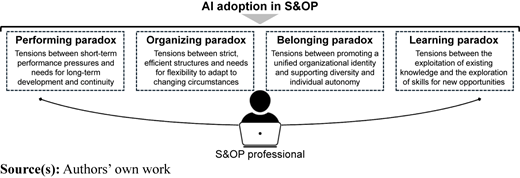
A paradox is defined as “contradictory yet interrelated elements—elements that seem logical in isolation but absurd and irrational when appearing simultaneously” (Lewis, 2000, p. 760). Rooted in the classical premise of the theory (Lewis, 2000; Smith and Lewis, 2011), these contradictions manifest in four primary types: (1) performing paradoxes, which arise from tensions between the immediate pressures of performance and the long-term needs for development and continuity; (2) organizing paradoxes, which arise from the conflict between the necessity for structured, efficient processes and the flexibility required to adapt to evolving circumstances; (3) belonging paradoxes, which highlight the challenges in fostering a unified organizational identity while also promoting diversity and individual autonomy; and (4) learning paradoxes, which encapsulate the struggle between exploiting existing knowledge and the pursuit of innovations essential for discovering new opportunities. These tensions, which highlight the intricate interplay between stability and change, are expected to become more pronounced in modern supply chains due to their increasing complexity and volatility (Kocabasoglu-Hillmer et al., 2023).
In the evolving landscape of S&OP, AI adoption introduces under-explored complexities for this particular segment. While we aim to bridge this gap by examining AI’s unique implications in S&OP, we first draw upon initial insights from related OM fields. For instance, performing paradoxes may stem from skepticism about AI’s long-term potential driven by a culture that prioritizes immediate results from technology investments (Cannas et al., 2024), especially if AI solutions have not matured enough to justify significant investments (Guida et al., 2023). This skepticism can be further amplified by a firm’s level of AI readiness; less prepared firms are likely to see minimal benefits from AI solutions when responding to unforeseen events (Lerch et al., 2024). Organizing paradoxes, in turn, might emerge as AI-driven automation optimizes current business processes (Helo and Hao, 2022) yet simultaneously demands greater flexibility to accommodate real-time data and unpredictable market changes (Wamba et al., 2022).
While feeding AI models with high-quality data is seen as a primary barrier to its adoption (Cannas et al., 2024), the intersection of data and AI seems to play a dual role in adoption success; AI can automate the processing of historical data to improve accuracy and reduce bias, yet it still depends on human input to interpret anomalies and sudden demand shifts (Brau et al., 2024). This highlights the challenge of balancing AI’s predictions with human contextual understanding (Spreitzenbarth et al., 2024). In turn, belonging paradoxes can arise, for example, when centralized AI integration blurs accountability in work environments and yields anxiety over who is responsible for AI-driven outcomes, especially in hierarchical organizations where clear decision-making structures are paramount (Hasija and Esper, 2022). Similarly, learning paradoxes may surface as AI integration drives a shift from traditional practices to holistic end-to-end platforms (Gupta et al., 2023), raising questions about whether AI will ultimately replace or enhance human decision-making (Brau et al., 2024; Guida et al., 2023). While some research highlights AI’s role in strengthening supply chain resilience through explorative learning (Dai et al., 2024), findings from healthcare suggest a more complex dynamic. After surveying 400 physicians, Guo et al. (2024) concluded that AI is “neither strictly substitutive nor solely assistive” (p. 28), highlighting the ambiguity of AI’s role in (re)shaping organizational roles.
These potential tensions, as mentioned, remain speculative for S&OP contexts due to the lack of empirical evidence for this segment—motivating a deeper exploration to elucidate the uncertainties surrounding AI adoption in this area. Figure 1 presents our analytical framework, which will serve as the foundation for the empirical investigation.
Methodology
This research adopts an abductive, theory elaboration approach that combines both deductive and inductive elements (Ketokivi and Choi, 2014). Deductively, we utilized Paradox Theory to structure our investigation and drew upon AI literature within OM to corroborate our findings, which were inductively derived from our empirical exploration of AI adoption in S&OP-specific contexts. To this end, we conducted in-depth interviews with eight experienced S&OP professionals, supplemented by interviews with three AI experts and secondary data analysis from different S&OP processes, as detailed in the following text and summarized in Table 1.
We applied Yin’s (2018) aggregate replication logic for case selection, with each S&OP informant representing a distinct case. This entailed combining literal replication to identify consistent patterns of AI adoption across S&OP setups and theoretical replication to uncover theory-driven patterns based on diverse informants’ contexts. As such, we approached nine S&OP informants from varied backgrounds, characterized by (1) employment in different manufacturing sectors (industrial machinery, N = 4; heavy machinery, N = 3; electrical components, N = 1); (2) plant locations across Europe and North America; and (3) varying levels of AI experience, ranging from consideration (N = 3) and testing (N = 3) to implementation (N = 2).
The interview questions focused on the informants’ familiarity with AI in their S&OP tasks alongside perceived potentials and tensions arising from AI adoption. The interviews were fully transcribed and electronically filed to establish a trail of evidence (Yin, 2018). The data underwent abductive thematic analysis (Braun and Clarke, 2006), employing theory-driven themes as initial coding lenses (i.e. performing, organizing, belonging and learning paradoxes) and data-driven themes as advanced coding lenses [i.e. emergent sub-paradoxes (SPs) under each paradox type]. The analysis was also informed by the Gioia approach (Gioia et al., 2013; Magnani and Gioia, 2023), where a systematic data structure was developed by starting with first-order informant codes then synthesizing them into second-order researcher-centric themes. This dual-layered coding, performed iteratively between theory and data, ensured a clear distinction between informants’ assertions and our theoretical interpretations, resulting in aggregate insights for context-specific SPs of AI adoption across S&OP cases.
We took two additional steps to complement the initial interviews and corroborate their findings. First, we interviewed three AI experts from a Dutch-based firm specializing in IT transformation projects, including tailored AI solutions for manufacturing and S&OP environments. Each expert was provided with a synthesized summary of the results (similar to Table 2 in “Results”) prior to their interview. During the interviews, we followed a paradox-by-paradox format to gain the experts’ technical views on (1) how realistic each SP is (see “reflections” in Table 2) and (2) possible strategies for managing the SP (see “suggestions” in Table 2). These insights enabled triangulating S&OP informants’ views by providing both technical validation and resolution strategies, thus grounding the revealed SPs in actual AI capabilities and limitations. This, in turn, enhanced the robustness and applicability of our results for S&OP environments.
Second, we collected a comprehensive set of secondary data from the participating firms (D1–D17; Table 1). These documents and tools, ranging from S&OP playbooks to software systems, were selected for their relevance to current S&OP practices and AI-driven developments. Accordingly, we used the secondary data to (1) triangulate interview findings and provide concrete examples of the revealed SPs and (2) infer AI adoption potentials across various S&OP contexts. For instance, comparing S&OP playbooks (D2) with strategic plans (D11) illuminated the performing paradox between short-term efficiency and long-term AI-driven optimization. S&OP flow swim lane diagrams (D12) and forecasts (D3) revealed organizing paradoxes between current processes and potential AI-driven redesigns. Documents like CI need reports (D9) and change board meeting outputs (D14) provided insights into organizational approaches to AI adoption. In turn, the S&OP playbook and training materials (D16) highlighted current AI learning platforms and possible areas for AI-enhanced training.
Results
Table 2 provides a detailed synthesis of the results—organized across the revealed SPs for AI adoption in S&OP under each paradox type from Figure 1. It includes descriptions of the contrasting poles of each SP, its meaning, and examples to enhance its understanding in typical S&OP scenarios. The table also features exemplary quotes from S&OP informants that facilitated the extraction of each SP, along with reflections and suggestions from AI experts together with secondary documents used for further validation. Accordingly, we identified three unique SPs under each paradox type specifically tied to AI adoption in S&OP—using them as backbones for our IPs.
Impact pathways (IPs)
IP1: balancing immediate S&OP actions with long-term AI-driven strategies
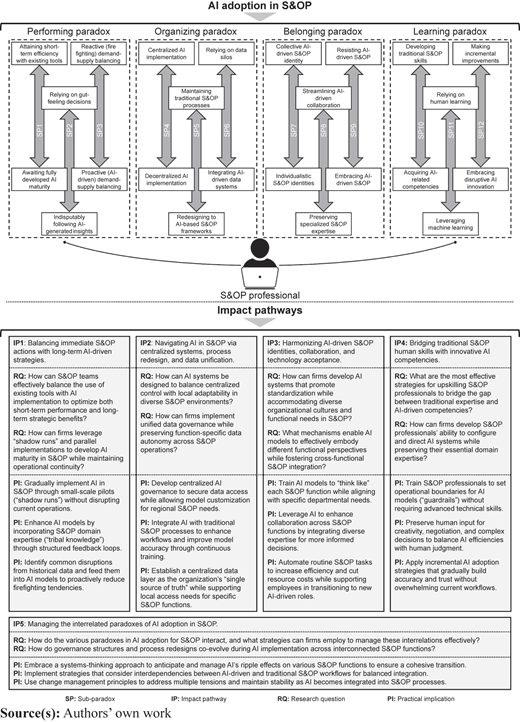
S&OP professionals expressed tensions between using existing tools (e.g. Excel for demand planning, ERP for inventory management) to achieve immediate results and awaiting the full maturation of AI technologies. Here, I3 highlighted the urgency of meeting sales targets with current methods, while I2 noted the lengthy time required for AI algorithms to generate accurate insights (SP1). While all AI experts acknowledged this tension, they stressed that AI’s maturity is not the primary issue; rather, successful AI adoption requires gradual integration through “shadow runs” (i.e. trial simulations) (E2), long-term planning horizons (E1) and small-scale implementation (E3)—with E2 noting that “AI doesn’t get better if you wait; it gets better by using it.” In turn, skepticism about AI’s current capabilities was expressed by I8, who doubted significant improvements over traditional methods unless AI integrates both internal and external data, such as market intelligence revealing trends in the automotive industry. E2, however, pointed to industries like semiconductors, where firms currently use market indicators to enhance forecasting decisions—suggesting that integrating external data into AI models is feasible in some cases. S&OP professionals’ skepticism also coincided with their reliance on gut feelings and intuitions rather than AI’s insights to make decisions (I3, I6, I8; SP2). AI experts recognized this tension, attributing it to the perception of AI as a “black box” (E1) and insufficient testing of AI models (E1, E2). As such, they proposed integrating S&OP professionals’ “tribal knowledge” into the AI model to fine-tune it based on their intuition (E1–E3) and validating AI predictions through “what-if” scenario testing before system launch (E1). S&OP professionals further expressed doubts about AI’s capacity to handle sudden market demands (I3; SP3), with I8 going further by portraying AI as risky for forecasting tasks due to its lack of human intuition. All AI experts reframed this as a process maturity issue rather than an AI limitation, with E2 and E3 suggesting that AI could shift S&OP from reactive “firefighting” to proactive planning by incorporating historical disruptions into AI models to mitigate similar future events.
Our findings on the performing paradoxes SP1–SP3 contribute to the AI adoption literature in OM by revealing S&OP-specific nuances. While Cannas et al. (2024) discuss general skepticism about AI’s long-term potential, we found that in S&OP contexts, the performing paradox (SP1) manifests as a tension between immediate decision-making pressures and extended timelines for AI implementation—with experts suggesting running trial simulations and engaging in proactive planning to address this issue. In turn, while Guida et al. (2023) noted that firms often hesitate to invest heavily in AI due to the immaturity of current solutions, we found that AI maturity does not develop on its own but rather benefits from incremental use—suggesting that gradual investments are better positioned to accommodate the technology (at least in S&OP contexts). Our findings also diverged from Lerch et al.’s (2024) emphasis on AI readiness for unforeseen events, as SP3 reveals that in S&OP, the challenge is not solely about AI capability but also process maturity. Here, co-development and maturation between process and technology are crucial, since a firefighting mentality contradicts both the essence of S&OP and the prerequisites for AI adoption.
These insights suggest a key IP for research: balancing immediate S&OP actions with long-term AI-driven strategies. Derived practical implications include (1) gradually implementing AI in S&OP through small-scale pilots (“shadow runs”) to avoid disrupting current operations, (2) enhancing AI models by incorporating S&OP domain expertise (“tribal knowledge”) through structured feedback loops and (3) proactively reducing firefighting tendencies by identifying common disruptions from historical data and feeding them into AI models.
IP2: navigating AI in S&OP via centralized systems, process redesign and data unification
S&OP professionals may encounter difficulties when implementing centralized AI systems across different departments and regions, as expressed by I3, who noted discrepancies in S&OP maturity between developed and developing countries, thus impeding company-wide AI adoption (SP4). Nonetheless, AI experts emphasized the necessity of centralized AI systems to uphold governance, cybersecurity and computational efficiency (E1), advocating for a balanced approach that combines centralized infrastructure with regional customization (E1–E3) and a phased implementation where global targets cascade into localized, AI-driven planning (E2, E3). Tensions between tradition and reform were also stressed in the cases; while I2 optimistically envisioned transitioning to continuous planning and real-time updates with AI, both I3 and I4 expressed concerns about the complexity of such holistic redesigns (SP5). Here, all AI experts collectively voiced that a fully AI-driven S&OP process remains largely theoretical, proposing instead a parallel approach where AI improves rather than replaces traditional S&OP processes, with E1 highlighting the importance of retaining existing S&OP processes for data collection and validation. Though, such perceived complexity was further manifested in relying on data silos vs. utilizing integrated AI-driven data systems (SP6); all S&OP informants unanimously highlighted the challenge of accurately selecting and feeding the right, function-specific data into AI systems from extensive datasets, with I1 particularly emphasizing the importance of maintaining data consistency across different systems to avoid receiving false or skewed signals. Grounded in the “single source of truth” principle, AI experts reframed the data silos paradox as an organizational challenge driven by internal politics rather than a technical limitation (E2, E3)—advocating for a unified, well-governed data layer and comprehensive integration across S&OP functions to avoid bias (E1) and prevent “garbage in, garbage out” scenarios (E3).
While Hasija and Esper (2022) discuss hierarchical challenges in AI adoption within supply chains, our analysis of SP4 reveals a more nuanced tension in S&OP between the need for centralized AI governance and variations in regional S&OP settings, with experts suggesting a hierarchical, context-specific AI implementation to bridge these gaps. In turn, Wamba et al.’s (2022) emphasis on real-time data adaptation attains new complexity in SP5, where experts view the shift to holistic live planning not as a technical hurdle but as a gradual process evolution that requires maintaining both traditional and AI-driven models. Similarly, while Cannas et al. (2024) identify securing high-quality data as a primary barrier to AI adoption, SP6 shows that in S&OP, the challenge specifically involves balancing functional data autonomy with integrated planning needs, supported by a “single source of truth” principle represented in unified data layers. Finally, Brau et al.’s (2024) note on AI’s dual role in data processing and human interpretation in retail contexts gains new depth in SP6, where in S&OP, this organizing paradox is heightened by the need for cross-functional alignment and data consistency—stressing the importance of well-governed data integration to enable accurate, localized AI planning.
These insights suggest a key IP for research: navigating AI in S&OP via centralized systems, process redesign and data unification. Derived practical implications include (1) developing centralized AI governance frameworks to secure data access while allowing for model customization to meet regional S&OP requirements, (2) establishing a centralized data layer as a “single source of truth” for the organization while enabling localized access needs across S&OP functions and (3) integrating AI with traditional S&OP processes to enhance workflows and improve model accuracy through continuous training.
IP3: harmonizing AI-driven S&OP identities, collaboration and technology acceptance
We expect S&OP professionals to experience tensions between establishing a collective, AI-driven S&OP identity and preserving diverse planning identities when adopting AI. Here, I3 expressed concerns about losing visibility of different responsibilities with fully integrated AI systems, while I7 mentioned attitudinal and organizational factors influencing data-entry practices that may impede identity unification efforts (SP7). AI experts recognized the challenge of capturing diverse functional identities in AI systems (E1) but reframed it as a matter of transparency, trust and goal alignment rather than identity preservation (E2). As such, they recommended training AI models to “think like” different S&OP functions (E1) and voiced the need for a transparent adoption process involving both end users and leadership to foster trust in AI outputs (E2, E3). Looking at different S&OP functions, I2 stressed resistance from sales and finance teams to unified forecasting schemes (SP8), while I8 expressed a likely bias of AI systems toward serving one function over another based on the data at hand. AI experts acknowledged this challenge but saw it as industry-dependent (E2), suggesting that AI could enhance cross-functional collaboration rather than compromise functional autonomy by providing accessible insights into product status, past releases and inter-functional needs (E1, E3). While perceived functional bias could yield resistance to accepting AI systems across all S&OP functions, I3 felt that it is mainly back-office employees who might lose their jobs to AI, as opposed to customer-facing sales who would rather embrace AI to enhance their productivity (SP9). On that front, AI experts validated AI’s threats to S&OP jobs but framed this situation as job transformation rather than outright elimination (E3). While E1 noted that AI might reduce hiring needs (and operational costs) by automating data-entry tasks, E2 asserted that resistance often stems from concerns over diminished responsibilities or status, even as some employees welcome AI’s potential to streamline their work.
While Guo et al. (2024) portray AI’s ambiguous role as “neither strictly substitutive nor solely assistive” in healthcare, our findings through SP7–SP9 reveal a more delicate understanding shaped by S&OP’s cross-functional nature. The challenge here manifests not only as role ambiguity but as a complex interplay between preserving distinct functional identities (such as I3’s concern about responsibility visibility) and achieving integrated planning through AI. Technology experts frame this as a transparency and trust barrier rather than a straightforward identity preservation issue, suggesting that AI can be trained to “think like” different S&OP functions. While Hasija and Esper (2022) note accountability challenges for AI adoption in hierarchical organizations, our findings under SP8 suggest that S&OP’s cross-functional dynamics could, in fact, foster collaboration—but only if AI models are transparent enough to align teams on shared goals. Similarly, where Gupta et al. (2023) discuss a general shift toward end-to-end platforms, SP9 reveals S&OP-specific tensions between back-office automation and customer-facing enhancement, with experts viewing these impacts as industry-dependent and reframing AI-driven job shifts as necessary transformations rather than undesirable replacements.
These insights suggest a critical IP for research: harmonizing AI-driven S&OP identities, collaboration and technology acceptance. Practical implications here include (1) training AI models to “think like” the corresponding S&OP functions, (2) leveraging AI to improve cross-functional collaboration by integrating diverse S&OP expertise for more informed decision-making and (3) automating routine S&OP tasks to increase efficiency and reduce resource costs while supporting employees in adapting to new AI-driven roles.
IP4: bridging traditional S&OP human skills with innovative AI competencies
S&OP professionals will likely face challenges in balancing traditional skills with new AI-related competencies. Here, I2 emphasized the need to become more data-driven and reduce reliance on potentially erroneous human interpretations, while I8, with more skepticism, noted that current AI models are not yet tailored to S&OP functions—suggesting that S&OP professionals may need to acquire IT-related skills (e.g. Python) to effectively leverage AI for their roles (SP10). While balancing traditional S&OP skills with tech-savviness was noted (E2, E3), all AI experts rejected the need for S&OP professionals to become technical AI/programming experts. Instead, they advised S&OP professionals to master the skill of “setting the guardrails” for AI models through effective prompts and configurations (E1), leaving technical tasks to IT specialists (E1–3). In turn, indispensable reliance on human judgment vs. fully shifting to AI systems (SP11) was perceived by S&OP informants and attributed to superior human creativity (I3), the need for human input of data (I5) and human-based interactions and negotiations (I8). AI experts affirmed the continued need for human judgment, pointing to AI’s limitations in handling missing data (E1) and its creativity being restricted to set boundaries (E2). They further emphasized the ongoing cycle of incorporating human expertise into AI models, noting that while AI can perform creative tasks, it cannot “think outside the rules” predefined by humans without additional input (E2, E3). Last, all S&OP informants favored a gradual AI adoption approach (SP12), which I3 linked to maintaining stable annual figures by avoiding radical investments. AI experts strongly endorsed this “baby steps” (E3) approach, emphasizing the importance of data accumulation to improve the AI model’s accuracy (E1) and recommending incremental automation starting with simpler tasks (E2). This method is posited to build trust in AI models, enhance accuracy gradually and lower risks as more complex tasks are automated over time (E1, E2).
Although Brau et al. (2024) highlight the dual role of AI in data processing and human interpretation, SP10 reveals a unique S&OP tension in skill requirements, where AI experts reject the need for technical mastery despite practitioners’ perceived pressure to acquire IT-related skills. In turn, Cannas et al.’s (2024) challenge of feeding the system with high-quality data gains new dimensions in SP11, as experts emphasize the cyclical nature of incorporating human expertise into AI systems, particularly for handling missing data and maintaining essential negotiation skills. Likewise, Guida et al. (2023) point to concerns about justifying AI investments, while SP12 reveals S&OP-specific tensions around gradual adoption, with both practitioners and experts advocating “baby steps” to maintain operational stability while building model accuracy.
These insights prompt a critical IP for research: bridging traditional S&OP human skills with innovative AI competencies. Practical implications include (1) training S&OP professionals to define operational boundaries for AI models (e.g. setting acceptable ranges for forecast adjustments) without requiring advanced technical/programming expertise, (2) preserving human input for creativity, negotiation and complex decision-making tasks and (3) adopting incremental AI adoption strategies that build accuracy and trust over time.
IP5: managing the interrelated paradoxes of AI adoption in S&OP
Our analysis reveals intricate interconnections between AI adoption (sub)paradoxes in S&OP that extend beyond the current understanding of AI adoption in other OM contexts. For instance, the tension between centralized and decentralized AI implementation (SP4) is intrinsically linked to the challenge of maintaining vs. redesigning S&OP processes (SP5), as the shift toward AI-driven frameworks requires addressing governance structures and process evolution at both central and local levels. Here, implementing centralized AI systems must accommodate varying regional S&OP maturity levels while supporting the transformation of traditional planning processes, thus creating a complex web of interdependent challenges. While Helo and Hao (2022) discuss AI-driven process optimization and Wamba et al. (2022) emphasize flexibility needs, our findings illustrate how these challenges in S&OP are inherently connected through their combined impact on organizational structure and process design. Similarly, the paradox between relying on data silos and integrated AI-driven systems (SP6) links to balancing traditional S&OP skills with AI-related competencies (SP10), extending Cannas et al.’s (2024) insights on data quality barriers to show how data integration shapes capability development. This complexity intensifies as the tension between collective and individualistic S&OP identities (SP7) intersects with balancing AI-driven collaboration and specialized expertise (SP8), expanding Hasija and Esper’s (2022) view on hierarchical accountability. Together, these interconnections deepen Gupta et al.’s (2023) note on end-to-end platforms by showing how S&OP contexts require addressing multiple paradoxes simultaneously across interconnected organizational dimensions, where changes in one area inevitably influence—and are influenced by—adaptations in others.
These insights highlight a key research pathway: managing the interrelated paradoxes of AI adoption in S&OP. Derived practical implications include (1) embracing a systems-thinking approach that anticipates how AI adoption in one area can influence other S&OP functions, (2) implementing integrated transformation strategies that consider interdependencies between AI-driven processes and traditional S&OP workflows and (3) using change management principles that address multiple tensions at once to maintain operational stability as AI integration advances.
Conclusions and implications
We examined the potential tensions and management strategies for adopting AI in S&OP environments, identifying 12 SPs and five overarching IPs for further research. This study makes two main academic contributions. First, we contribute to the growing literature on AI adoption in OM by demonstrating how S&OP’s distinctive orchestrating role generates complex, interconnected adoption tensions that have gone unnoticed in existing AI-related research. While prior studies emphasized technical hurdles and isolated capability-building challenges with AI, we show that S&OP’s unique position—as a bridge between strategic and operational decision-making—creates multifaceted paradoxes that span organizational boundaries and hierarchies. These tensions manifest through temporal integration, where immediate operational needs must align with long-term AI development and gradual capability building, and structural integration, where centralized AI governance must accommodate diverse regional contexts and functional identities while maintaining cross-functional alignment. Our S&OP-focused findings also advance the classical AI-human coexistence debate: rather than replacing professionals or turning them into AI technicians, we find that professionals should focus on setting AI parameters while preserving their unique strengths in creativity, negotiation and complex decision-making.
Second, we extend Paradox Theory by revealing distinct manifestations of each major paradox type through the lens of AI adoption in S&OP. Specifically, we demonstrate how performing paradoxes arise from tensions between operational continuity and technological transformation; organizing paradoxes manifest in the balance between standardized AI systems and localized planning imperatives; belonging paradoxes surface in the struggle to reconcile collective AI-driven identities with specialized functional expertise; and learning paradoxes emerge in the challenge of bridging traditional planning knowledge with transformative AI capabilities. This multifaceted understanding enriches the theory by pushing its conceptual boundaries and uncovering how technological change can yield nuanced forms of organizational tensions. Beyond the paradoxes revealed in this work, we anticipate a new tension to arise between adopting advanced technologies and responding to regulatory pressures, where firms must balance innovation with compliance—an area ripe for future exploration alongside the evolution of modern supply chains.
For practitioners, our findings offer a roadmap for navigating AI adoption in S&OP through a set of practical implications. Figure 2 synthesizes the identified SPs, IPs, targeted research questions and derived practical implications into an actionable framework that both scholars and practitioners can use to address AI adoption tensions in S&OP environments.
This research followed international ethical principles and professional standards in data collection and analysis. The authors wish to thank the interviewed S&OP participants for their invaluable insights and to Itility’s team (https://www.itility.nl), led by Jonathan Kaijser, for sharing their technical expertise.