Diversity, equity and inclusion in supply chain management (SCM) is an emerging topic of interest within the broader conversation of sustainability. While studies on gender impacts in SCM decisions/outcomes exist, there is a gap regarding social sustainability decisions, as well as in studies that combine sustainability outcomes with risk. Our aim is to understand the relationship between gender and decision behaviour regarding socially sustainable procurement, particularly in the context of ambiguous information on social sustainability risks.
We examine the effects of risk probability ambiguity (RPA) and social issue specificity on social sustainability preferences in purchasing decision-making and whether differences based on gender arise. A scenario-based role-playing experiment was first piloted with supply chain students (n = 170) and then ran with supply chain professionals (n = 612).
The results suggest that, overall, female managers tend to choose the more sustainable product choice when compared to the choices made by their male counterparts. When RPA was introduced, however, female purchasing managers were more risk-taking than males. This finding was opposite to our hypothesis based on previous literature.
Using gender role theory to explain differences in purchasing and supply management behaviour is scarce. Our findings on the role of gender in decision-making regarding social sustainability risks were largely opposite to previous findings on risk behaviour based on gender. This supports further exploration of gender roles and how they evolve within a purchasing career to explain behavioural differences.
1. Introduction
Social sustainability violations are unfortunately common in modern supply chains, with social injustice impacts throughout the globe (Kroes et al., 2024; Stephens et al., 2024). With focal firms having a higher potential for financial repercussions (Kim et al., 2019), they are thus increasingly having to include social sustainability considerations in their supply chain strategies, practices and decisions, driven by both stakeholder pressures and legislation (European Parliament, 2024). Purchasing within a firm, with its boundary-spanning role and its key role in managing supply inputs and suppliers (Ellram et al., 2020), has been highlighted to have a critical role in cascading sustainability through supply chains (Khan and Hinterhuber, 2024; Villena, 2019). As such, the decisions of individual procurement managers can be essential for impacting sustainability performance through the entire supply chain, yet we have limited empirical evidence on their willingness to select more sustainable alternatives (Khan and Hinterhuber, 2024; Son et al., 2019). Supply chain management (SCM) research thus needs to better acknowledge the role of individuals in purchasing roles in reaching sustainability goals (Touboulic and Walker, 2015).
Though purchasing has been recognized as a critical function for sustainability management (Khan and Hinterhuber, 2024), research so far pays little attention to supply chain actors (Soundararajan et al., 2021) nor to the heterogeneity in individual decision-making (Li et al., 2019), and most sustainable SCM research is at the level of the organization or dyad (Touboulic and Walker, 2015). Individual purchasing managers’ decisions are influenced by a multitude of factors such as organizational purchasing programs (Silva and Ruel, 2022), stakeholder pressures (Reuter et al., 2012), purchasing process constraints and legislation. Yet whether sustainable strategies are implemented can also hinge on individual managers, as they decide how to execute them (Li et al., 2022). There are many factors outside of managerial control, but successful sustainability implementation does rely on certain competencies that enable managers to recognize potential issues and creatively design new solutions with suppliers (Schulze et al., 2022). Existing research on procurement managers willingness to pay for sustainability is, however, so far poorly understood (Khan and Hinterhuber, 2024), and we lack an understanding of how a sustainability orientation can be achieved in day-to-day operational decisions of organizations (de Menezes et al., 2022).
Given the level of gender disparity in SCM (Gartner, 2022), questions have been raised on the impact of such a discrepancy in the social sustainability of organizations’ supply chains (Akbari et al., 2024; Kroes et al., 2024; Yang et al., 2024). Gender is just one aspect of individuals, but it factors heavily into decision behavior (Varty et al., 2021) and is indeed gaining interest in SCM research (Ma et al., 2021; Ruel and Fritz, 2021; Kroes et al., 2024; Silva and Ruel, 2022). Studies suggest that gender diversity in SCM could improve sustainability (Lawrence et al., 2018; Ruel and Fritz, 2021), but a recent review on gender in SCM research has noted a scarcity in empirical examination between gender diversity and supply chain performance, particularly in the area of social sustainability (Ruel et al., 2020; Yang et al., 2024).
Overall, we currently know little about the extent to which and ways in which risk and (social) sustainability together interact with gender in SCM decision-making. Gender is not always reported in the sample description and is often only used as a controlled variable because it heavily explains value and personality differences (e.g. Marcus et al., 2015). Drawing from this gap in previous research, our first aim in this study is thus to understand potential differences between male and female purchasing managers when it comes to socially sustainable product selection.
Gender is particularly associated with risk preference and behavior in past research (Weber et al., 2002). Global supply chains often present purchasing managers with a context that is characterized by low in visibility and high in risk and uncertainty (Villena and Gioia, 2018). Due to gender differences in information processing for decision making (Byrne and Worthy, 2015), uncertainty (Balafoutas and Sutter, 2019) and risk (Frey et al., 2021), we draw on the concept of ambiguity, i.e. “the subjective experience of missing information relevant to a prediction” (Frisch and Baron, 1988, p. 149) in understanding (gendered) behavior in sustainable purchasing decisions. Our second aim is thus to examine the extent to which ambiguity in the social sustainability risk itself or in its probability impacts male and female sustainable product selections in a global sourcing context.
Specifically, we draw from experimental evidence to investigate whether risk preferences may differ between self-identifying males and females. The ambiguity in terms of risk probability of a social issue occurring and the ambiguity in the description of the issue itself are manipulated in a 2 × 2 × 2 scenario-based role-playing experiment. The experiment was piloted with 170 students in class and conducted with 612 managers with purchasing and supply chain responsibilities via Prolific, an online survey platform. The basis of our research rests on cis-male and female gender stereotypes, biases and role expectations found in literature from a western perspective. The authors recognize that this does not reflect the reality for all people. We utilize generalizations for the purpose of questioning underlying assumptions and to open a more critical conversation.
Our study offers three primary contributions to existing research. First, the underrepresentation of women, particularly in top SCM roles, is a concern (Yang et al., 2024), particularly when it comes to the expectations of supply chains then to operate in a socially just manner both up- and downstream (Kroes et al., 2024). We offer an important understanding of whether increased female representation would also lead to more sustainable decisions in a supply chain context. While our hypotheses and primary results focus on purchasing managers, we also include the results of an extensive student sample pilot in the discussion. The unexpected results between the student and manager samples yielded insights into how gendered behaviors may change during career progression from university to workplace.
Second, by examining the role of ambiguity in decision-making between males and females, we contribute to the overall literature on behavioral operations, where a scarcity has been noted on research on individual execution of strategy (Ferrary and Déo, 2023) and differences in decision-making and information processing (Carter et al., 2015; Li et al., 2019). Individual choices have organizational consequences for buyer–supplier relationships (Khan and Hinterhuber, 2024) and purchasing managers play a critical role in establishing these inter-organizational relationships (Son et al., 2019). Though we acknowledge the organizational limitations to these managerial decisions beyond individual control, by investigating the behavioral tendencies of purchasing managers, we can better understand the role of gender regarding high-impact decisions.
Third, corporations are facing increasing pressure to take responsibility for the sustainability of their upstream suppliers. New EU regulation will, “prohibit the sale, import, and export of goods made using forced labour” (European Parliament, 2024). With pressures to extend European values of human and labour rights throughout the value chain, it becomes imperative for managers to be better at identifying and managing social risks. Our results on the role of information ambiguity in social sustainability provide important managerial and educational implications.
2. Literature review
A gap in theory-based research has been noted within gender studies in SCM (Yang et al., 2024). We thus draw from gender role theory (GRT) in our study. The following section first outlines how GRT informs behaviours within the general workplace and specifically SCM. Other theories have also been used to explain gender effects on sustainability in SCM (e.g. Gligor et al., 2022), but to call attention to gender bias in SCM/purchasing and supply management (PSM) specifically as identified by Yang et al. (2024), GRT was deemed most appropriate for our study. Next, we outline how ambiguity is related to risk behaviours and associated with gender. Finally, we further explore the potential relationship between gender and socially sustainable behaviour through the lens of GRT.
2.1 GRT and SCM
The role of gender in the workplace is not novel in organizational research. But while the focus is easily drawn to the end conclusion of what (if any) gender differences are, we choose to examine the why behind the what. Societal perceptions of sex roles and internalizations of gender, not physical or (perceived) psychological differences, determine why men and women behave differently (Eagly and Steffen, 1984). There are various theoretical perspectives such as social role (Eagly, 1987), gender schema (Bem, 1981), gender role (Kidder and Parks, 2001) and role congruity (del Carmen Triana et al., 2024), but they all are predicated on the assumption that behaviour is driven by the different social roles men and women are expected to perform (Eagly and Steffen, 1984). Gender is a socially constructed role which explains why people in a female role may exhibit different behaviours than people in a male role (Eagly, 1987). For example, women behave more communally and caring compared to men who are socialized to be more competitive and agentic (Eagly and Steffen, 1984; Mazei et al., 2015).
Kidder (2002) finds that gender roles determine the jobs women can and do occupy and what their place is within the organizational structure. Individuals tend to choose job roles that are congruent with their values and identity (Marcus et al., 2015), but how their identity is perceived plays a large role in whether they are successful in those jobs. Varty et al. (2021) find that employees have heightened perceptions of injustice when female managers make an “unfair” decision compared to male managers. These stereotypes persist in the workplace today, where women are punished disproportionately for exhibiting masculine traits (Bowles et al., 2007; Montgomery and Cowen, 2020) that are normally expected in procurement roles.
Theoretical work on gendered behavioural differences in SCM remains underdeveloped (Yang et al., 2024), but GRT can explain why different behaviours are expressed but also how they are perceived by both superiors and subordinates. Lawrence et al. (2018) discovered a potential link between masculine behaviour and the lack of ability to work with suppliers to find sustainable solutions. Husser et al. (2019) found that female purchasing managers were more likely to consider ethics during the supplier selection phase, but gender’s explanatory power weakened when interacting variables were introduced. Other studies suggest there could be a positive relationship between increasing gender diversity in supply chain management for meeting organizational sustainability goals (Ruel and Fritz, 2021; Silva and Ruel, 2022). But empirical evidence to support the relationship between gender and SCM (sustainability) performance is scarce (Yang et al., 2024).
There is also a further interaction between gender and occupational roles that can impact behaviour. Procurement is notorious for being an aggressive and heavily masculine culture (Lawrence et al., 2018; Rathi et al., 2023). Stereotypical expectations may indeed contribute to the low number of females in top SCM roles (Kroes et al., 2024). Women undergo far more scrutiny in daily purchasing activities than their male counterparts, particularly negotiations or making heavy investment decisions (Lawrence et al., 2018). This scrutiny results in women constantly negotiating their identity with duelling role expectations in purchasing.
2.2 Gender, risk and ambiguity
Risk in general and in supply chain literature is often defined as a measure of the probability and severity/impact of negative outcomes (Rao and Goldsby, 2009). Sustainability risk calculations are an important part of purchasing decisions, but the perception of risk and consequences varies between individuals depending on the circumstances (Weber et al., 2002). When making decisions that involve moral judgements (such as those regarding social sustainability in a supply chain), decision-makers must evaluate the probability of a social risk realizing and the subsequent consequences (Husted, 2000). We assume that decision-makers are inconsistent regarding risk under expected utility, where “decision weights do not coincide with stated probabilities” (Kahneman and Tversky, 1979, p. 277).
Ambiguity is defined as “the subjective experience of missing information relevant to a prediction” (Frisch and Baron, 1988, p. 149). In our study, we consider ambiguity regarding both elements of risk, meaning probability as well as impact. Thus, ambiguity can refer to (1) the decision-maker having vague information about the chances of the event occurring (Yates and Zukowski, 1976) meaning the likelihood is not clearly defined (Aggarwal et al., 2022) or to (2) “the quality or state of being ambiguous especially in meaning” (Merriam-Webster, 2024), whereby ambiguity often relates to generality and vagueness, and “the condition of being indefinite or indistinct in nature, or of not being clearly perceptible” (Giroux, 2006, p. 1232).
In essence, either the probability or the impact of the risk may be ambiguous. An example of the former ambiguity is a stated probability of 20–30% (instead of a stated probability of 25%), while an example of the latter ambiguity is being told that a biodiversity risk is present at the supplier’s manufacturing site (instead of being told that the supplier’s manufacturing plant releases toxic chemicals to a nearby lake, threatening the lake’s fish population). In our later hypothesis section, we refer to these two concepts as risk probability ambiguity (RPA) and social issue specificity (SIS) (referring to how ambiguous or non-ambiguous the social sustainability risk context is).
Frey et al. (2021) state that, “a person’s sex remains one of the most-frequently theorized candidate correlates of risk preference” (p. 540). While risk preferences between men and women have been well established in a multitude of studies (Weber et al., 2002), studying risk behaviours when the probability of risk is known versus unknown has less precedent in general (Snow, 2010), let alone when considering gender. Whether it is the internalization of social roles dictating that women should be more risk-averse or that there are different consequences based on gender presentation, we know that risk preferences differ reliably between males and females (Frey et al., 2021). Concerning gendered attitudes towards risk, Byrnes et al. (1999) refer to the idea that risk has value for males because it is a socially instilled, masculine trait. Byrnes et al. (1999) describe our social reality where, from a very young age, girls are not encouraged to take risks and are punished more severely for risk-taking behaviours than boys. This would explain why females tend to have lower risk preferences than males (Weber et al., 2002; Frey et al., 2021).
Both widespread socialized gender roles (Eagly, 1987) and self-internalization of these roles (Bem, 1981) provide support for why empirical evidence finds that females view risk more negatively than males; however, this is context dependent (Blais, 2006; Frey et al., 2021). In a purchasing context, risk mitigation is typically not measured or rewarded (Murfield et al., 2021). Therefore, cost reduction as the only PSM metric that matters to executives remains the primary concern for managers (Murfield et al., 2021). Furthermore, when there is a gender imbalance in senior-level management positions, as is the case in PSM (Kroes et al., 2024), gender stereotypes and biases subject female managers to more scrutiny on their behaviour and delegitimize their decisions (Varty et al., 2021). This raises the social consequences of taking purchasing risks should they do not pay off. For example, female executives are held more accountable for social or ethical consequences of their decisions than males (Montgomery and Cowen, 2020). This suggests that females are not necessarily more altruistic than males but may be responding to these social pressures.
2.3 Gender and sustainability
There has been plenty of research on the impacts of gender diversity at the boardroom level, where the reasons for impacts focus on women’s social capital and value characteristics (Kirsch, 2018; Krishnan and Park, 2005). Gender diversity on boards has also been found to be positively related to firm sustainability activities (Ben-Amar et al., 2017; Kirsch, 2018). Studying the specific relationship between gender diversity and sustainability performance at the operational level is less common, but there is research that focuses on sustainability performance from operational roles.
Schulze et al. (2022) make the case that individual managerial behaviours are key to sustainability implementation in purchasing. A few studies have found that women tend to be more sensitive towards sustainability risks in procurement (Plaček et al., 2022; Mansi and Pandey, 2016; Short et al., 2016). Plaček et al. (2022) findings note women supporting environmental policies in public procurement. Matinheikki et al. (2024) also note that females were more likely to prioritize value in healthcare device procurement than males. Marcus et al. (2015) find significant gender effects on likelihood of taking risks or actions to support sustainability, where women were more likely to behave in manners that supported sustainability and avoided potentially harmful activities. Khan and Hinterhuber (2024) find that individual willingness to pay for sustainable alternatives is less explainable by gender alone. Therefore, while it seems unlikely that women in purchasing will consistently behave more sustainably on the basis of gender alone, it is not unreasonable to make an assumption that there could be a relationship based on previous findings.
2.4 Positioning our study
Our study is focused on PSM, which is situated within the broader SCM research (Ellram et al., 2020). PSM is focused on the upstream supply chain, including supplier management (Ellram et al., 2020; Zimmermann and Foerstl, 2014). Procurement thus plays a strategic role in building sustainable supply networks (Villena, 2019), given the ability of focal firms to exert their power over first-tier suppliers to enforce sustainability measures on their suppliers (Wilhelm and Villena, 2021). Purchasing has the opportunity to serve as a gatekeeper (Ellram et al., 2020) and to screen out less sustainable suppliers, yet this often rests on individual decision-makers preferences, which is a lesser-studied topic. As procurement managers are on the front lines of these decisions, dealing directly with suppliers, their personal traits and attitudes can influence upstream supplier sustainability implementation (Schulze et al., 2022). Because social behaviour is strongly tied to gender roles (Eagly, 1987; Eagly and Karau, 2002), the purchaser’s gender is likely to be associated with traits that could impact these supply chain level outcomes.
Though the relationship between purchaser gender and sustainable purchasing is speculative at best, recent review studies suggest this is an avenue which warrants further investigation. Systematic literature reviews on gender (Akbari et al., 2024; Rathi et al., 2023; Yang et al., 2024) provide overviews of the themes that have been studied within the supply chain more broadly and purchasing and supply management more specifically. Our interest is in examining potential gender differences in supplier selections, more specifically in the context of social sustainability and risk. Using our own search of literature, as well as those three recent reviews to identify studies that have, in an empirically quantitative manner, examined a statistical link between gender and performance outcomes or specific decision outcomes in an SCM context, we outline relevant previous literature in Table 1.
The use of student samples in experimental research is useful when testing theoretical ideas and principles, but it has also been a matter of debate (Thomas, 2011; Stevens, 2011). Therefore, we outline in Table 1 whether the gender-related results were obtained from a board level, professional or student sample. While Mansi and Pandey (2016) surveyed differences between female and male procurement professionals regarding sustainable procurement practices, their survey actually posed the survey questions at the level of the procurement unit, not the individual’s preference, and hence their study is not included in the table.
In Table 1, we have also highlighted in grey background those studies that specifically examine gender in relation to sustainability outcomes and underlined those studies that have specifically examined gender in relation to risk outcomes/risks in decisions.
From this positioning we can see that:
Most gender impact studies regarding sustainability outcomes in SCM have been conducted at a high level, focusing on board and/or top management team (TMT) level
Empirical studies using real professionals in decision-settings or experiments are still relatively scarce and even scarcer are studies that would use both student and manager samples to understand whether career progression levels impact female gender roles and decisions
Overall, only very few studies study the aspect of risk-taking when considering gender in SCM decision settings
Gender impact on sustainability decisions or outcomes is mostly examined in the context of environmental sustainability, not social sustainability
While there are previous studies to suggest that aspects of risk can impact genders differently in purchasing decisions and that gender can have an impact on sustainable SCM outcomes, there is a clear gap in examining how risk and ambiguity impact social sustainability in supplier selections based on gender. In the following section, using previous literature on GRT, gender and risk taking, sustainability and SCM, we present our hypotheses.
3. Hypotheses
The following sections develop our hypotheses of how risk ambiguity and the specificity of the risk outcomes may affect decision makers at the product selection phase of the purchasing process.
3.1 Risk probability ambiguity and gender effects
Frisch and Baron (1988) explain that the ambiguity of a situation impacts its evaluation, where the subjective value of information that reduces or increases ambiguity contributes to a higher expected utility. Ambiguity also affects decision-making depending on the ambiguity preferences of the decision-maker (Ghirardato et al., 2004). A large amount of previous empirical evidence points towards individuals’ ambiguity aversion regarding uncertain probability, meaning a preference to bet on events that more is known about (Camerer and Weber, 1992). Individuals tend to prefer taking risks under known risk probabilities more than under ambiguous probabilities (Yesuf and Feinberg, 2016). When there is a clear performance risk, decision-makers are more likely to insure against ambiguous probability outcomes (Lambregts et al., 2021). Ambiguity aversion would then lead to a preference for reducing the ambiguity of outcome when given a range of risk probabilities (Ghirardato et al., 2004).
In purchasing, risk ambiguity becomes especially relevant in product selection stages in which decision-makers need to carefully assess the probability of occurrence of various risks as well as their economic impacts related to the available options. For instance, choosing a more sustainable (e.g. certified) product may increase upfront costs, which cannot always be recouped through raising prices for their customers. Yet, if a social risk, such as a labour violation, is publicly exposed, there may be severe legal and customer-related consequences (e.g. boycotts) (Kim et al., 2019). This makes choosing a more sustainable product, essentially, insurance against such risks.
But as with any insurance, it comes with a price premium (Hogarth and Kunreuther, 1989). Under highly pressurized conditions with direct cost-cutting targets, such as in procurement, managers may take calculated risks and choose less sustainable products in favour of short-term profits and the potential for personal rewards (e.g. cost savings bonuses and career prospects). On the other hand, high risk ambiguity (i.e. uncertainty over the probability of risk occurrence) makes it difficult to calculate the risk-benefit between product choices. This can decrease individual managers’ willingness to gamble over such decisions and instead encourage them to seek insurance (Bajtelsmit et al., 2015), which can, for example, be gained by choosing a certified product choice. Hence, we hypothesize:
When given an ambiguous risk probability of occurrence (as opposed to a non-ambiguous one), decision-makers are more likely to choose the more sustainable product option.
The research on gendered risk preferences is plentiful and goes back for decades (e.g. Weber et al., 2002; Byrnes et al., 1999; Frey et al., 2021). Seemingly, the consensus is that women are generally more risk-averse than men (Nelson, 2014). While research finds that it is highly contextual and there are nuances, these risk stereotypes generally hold concerning economic risks (Frey et al., 2021). Given that women face disproportionately more negative consequences and biases than men in management positions (Lawrence et al., 2018; Ramos et al., 2022), they have greater reason to be more risk-averse, which is also associated with ambiguity aversion (Snow, 2010).
Concerning financial risks, men have shown higher risk tolerance under uncertainty compared to women (Fisher and Yao, 2017; Balafoutas and Sutter, 2019). Stoddard and Fern (1999) find that how risk is framed mediates gendered effects of risk taking in a purchasing scenario; females are not always more cautious than males. They are, however, more risk-averse concerning price-based decisions when framed as a loss. Additionally, social externalities are more likely to reduce females’ willingness to take risks (Cavalcanti et al., 2022). This is illustrated by the finding that when female and male managers make the same cost-cutting risk that results in an ethical issue, female managers are more likely to face social repercussions (Montgomery and Cowen, 2020). Altogether, these gendered personal traits as well as social pressures make females more averse to ambiguity and this would also hold true in purchasing-related situations such as supplier/product selection as depicted above. Thus, we hypothesize:
The effect in H1a is stronger for females than for males.
3.2 Social issue specificity and gender effects
Purchasers often suffer information asymmetry in their sustainability decisions (Dahlmann and Roehrich, 2019). Evaluating consequences before making a moral decision requires the ability to discern potential social issues (Jones, 1991), which involves different competencies than those strictly related to job function (Schulze et al., 2022). The severity of negative consequences significantly impacts socially oriented decisions (Barnett and Valentine, 2004). More tangible consequences are more likely to drive action (Husted, 2000; Jones, 1991). The social consequences of decisions are not always clear, however, which is a source of issue ambiguity that leads to uncertain action (Jones, 1991; Husser et al., 2019).
According to Jones (1991), a higher level of ambiguity surrounding a social consequence lowers the intensity of an issue. In situations where specific information is available, individuals are more likely to both recognize an issue and act upon it (Husted, 2000). Husser et al. (2019) found that when purchasers were given low ambiguity ethical scenarios (clear consequences), they were more likely to recognize them as an ethical issue and have a higher intention of ethical action. Unfortunately, due to the distance between decision-makers and upstream suppliers (both geographically and psychologically), social issues in supply chains can become an abstract idea instead of a real impact (Husted, 2000; Touboulic and Ejodame, 2017). As the ability to recognize social issues precedes action (Barnett and Valentine, 2004), we hypothesize:
When given a specific (as opposed to ambiguous) social consequence associated with the product choice, decision-makers are more likely to choose the sustainable product option.
Previous supply chain literature has explored the linkage between gender and sustainability outcomes, mostly so far at board/TMT level (Benjamin et al., 2020; Kumar and Paraskevas, 2018; Kuzey et al., 2022), and results suggest a link between increased female presence and firm (environmental) sustainability.
Besides the effects of risk perceptions and negative consequences driving gendered behaviour, as suggested by GRT, Mansi and Pandey’s (2016) findings suggest that female purchasers possess a unique set of skills and perspectives that improve their ability to identify potential sustainability issues. Short et al. (2016) have shown that female auditors discover more sustainability issues than men; female social sustainability auditors are more diligent when auditing for social risks, they have higher rates of violation detection and understanding of emotional content than male auditors, which is needed to ensure the reliability of sustainability certifications. Short et al. (2016) suggest that relational aspects and information processing capabilities of women enhance such issue identification.
Given that females have been found to have a more detail-oriented processing style (Byrne and Worthy, 2015), be better at interpreting ambiguous situations (Husser et al., 2019; Short et al., 2016) and face more severe consequences for not acting socially responsible (Montgomery and Cowen, 2020), we expect their baseline behaviour to be more socially risk averse than males. Husser et al. (2019) find that women are more likely to recognize ethical issues in purchasing situations than men when there is high ethical ambiguity, but when given specific information about the issue, which reduces ambiguity, this difference disappears. Therefore, we expect that the provision of a specific social issue that reduces ethical ambiguity will particularly improve male performance in identifying social risks and acting accordingly. We thus hypothesize:
The effect in H2a is stronger for males than for females.
4. Method
Behavioural research in supply chain contexts has been gaining in popularity but is still relatively new (Eckerd et al., 2021). Rungtusanatham et al. (2011) recommend scenario-based role-playing experiments for understanding manager behaviour when faced with complex decision-making. Role-playing experiments have been used frequently to study gender differences in the workplace concerning economic risk (Mazei et al., 2015). Weber et al.’s (2002) work on context-based risk influenced our variable choices of two distinct types of risk.
To design an experiment where causal relationships can be determined, an experimental vignette method will be used to both improve external validity while keeping internal validity inherent in controlled experiments (Aguinis and Bradley, 2014). Vignette experiments are well suited to study sensitive topics as they capture individual preferences without being subject to external factors (Aguinis and Bradley, 2014). Consensus bias or gender dynamics are examples of influences within group decisions (e.g. Ma et al., 2021). We examine how the ambiguity in risk likelihood and the social sustainability issue in question impact decision-making and whether differences based on gender arise. A scenario-based role-playing experiment was used first with a pilot sample of supply chain students and then with professionals.
4.1 Vignette context and description
We chose a global food supply chain as the context for examining our research objectives. They have been shown in the past to be at high risk for social sustainability violations (Yawar and Seuring, 2017) and food manufacturing companies are facing growing pressures from their customers to avoid social risks, resulting in contract stipulations (Short et al., 2016). Palm oil, in particular, is a raw material that has been scrutinized in the public debate over the past few years for its exploitative farming practices, leading to the private–NGO partnership, RSPO (Roundtable on Sustainable Palm Oil, n.d.) to curb many of these poor labour practices (Roundtable on Sustainable Palm Oil, n.d.). This has led to an increase in certified and partially certified palm oil sourcing, going from 33% in 2012 to making up 90% of palm oil imported to Europe and the UK for consumer products in 2020 (European Palm Oil Alliance, n.d.).
Supplier certifications are especially pertinent for highly globalized agricultural products, such as cocoa, coffee and palm oil, where government policy in the source countries is either non-existent or insufficient in preventing social issues from emerging (Hatanaka et al., 2005). As governance has become more privatized, certifications (e.g. Fairtrade, Rainforest Alliance) have become a popular way to manage supply risks such as illegal labour practices and fair wages (Hatanaka et al., 2005). Hence, the sustainability decision we chose in this context relates to a choice between a certified and non-certified raw material (and the risks associated).
Each participant was given the role of being a purchasing manager for WholePalm, a fictional palm oil wholesaling company, renegotiating a contract with a palm oil supplier on behalf of a well-known food manufacturing brand. The role is based on a loose aggregate of common elements from company profile reports that are RSPO certified (Roundtable on Sustainable Palm Oil, n.d.). These reports include sustainability reporting, specifically social factors such as the types of contracts employees have (e.g. subcontracting vs steady employment with benefits) and workplace safety assessments. This was done to create realism in the scenario. The context scenario was presented to a group of independent researchers to validate realism.
Participants were tasked with choosing either (1) fully certified palm oil described as sustainable production ensured throughout the entire supply chain process or (2) mass balance described as being a mix of certified and uncertified palm kernel (Roundtable on Sustainable Palm Oil, n.d.). Focal (buying) firms often externalize their sustainability risks onto their 1st tier suppliers, WholePalm in this case. To represent this, the contract stipulated that the participants’ employer would have to pay a fine of 1 million euros (the equivalent of profits gained by the deal) in the event a social issue occurred and caused reputational damage for the buying firm. Therefore, WholePalm carries the financial responsibility of any repercussions for social issues being discovered. However, they do not carry any of the reputational risks that the focal firm carries for anything going wrong.
Technical and cost information regarding the product they were tasked with purchasing and sustainability issues in the supply chain were provided. Information about their supplier, buyer, product and contract stipulations were provided along with SIS and RPA manipulations. The full vignette and treatment condition details are available in the Online Supplement.
4.2 Variables and conditions
In this case, we are using sustainable product selection as a binary dependent variable (participant asking whether they choose to purchase certified or mass balance, order of options randomized). By manipulating the risk information, we are creating scenarios that reflect real-world complexity. As noted, there are two sources of ambiguity in the decision: the likelihood of a social issue occurring and the issue itself. The first factor of interest is the perception of financial risk posed to the company based on the probability of social issue occurrence in the palm supply, i.e. RPA. The risk of this occurring was 50% in the baseline (low ambiguity) and 40–60% in the high ambiguity condition. Both have the same average likelihood of occurrence assuming normal distribution of risk but giving a range of risk probability affects the perception of risk likelihood compared to providing a “certain” amount of risk (Snow, 2010).
The second factor of interest is whether there is a difference in choice depending on whether the social issue is specified (not ambiguous), i.e. SIS. The baseline was low specificity (high ambiguity), where a social consequence was not specified. This choice was made because purchasers often have limited information about the potential consequences of their selections (Schulze et al., 2022). For the high specificity (low ambiguity) treatment, the social issue was specified as a recent industry scandal where unpaid labour was associated with sourcing mass balance palm oil. This was a nod to the CSRDDD definition of forced labour, including conditions where workers receive little or no pay (European Parliament, 2024). In this way, participants’ perception of the social issue should be influenced depending on whether they have more or less information. The description of the sustainability issue was taken from a recent news article reporting on palm oil supply issues (Mason and McDowell, 2020). The manipulations were subtle (simply extra pieces of information) and understandable based on passed comprehension checks.
Lonati et al. (2018) make several recommendations on how to design experiments. Since the survey was distributed online and each participant completed it individually with complete decision anonymity, participants were not subjected to strong desirability bias or influence from either the evaluators or other participants. Since issue identification is a precursor to ethical action (Husser et al., 2019), participants under the SIS condition were asked to identify the issue with which they were presented. To ensure that asking to identify the issue did not influence their decision, this question was only posed after the participants had submitted their decision, so they could not look up the answer. Because of the potentially emotional nature of this research topic, detailed manipulation checks to explore how individuals felt afterwards were left out due to being potentially problematic. The social issue was also selected to be less emotionally triggering than, for example, child labour. To make participation and risk decisions consequential as recommended (Lonati et al., 2018), bonus monetary payments were given in the professional sample based on the profit outcome of decisions, while participants in the student sample received a differing outcome of extra credit on their course based on the profit outcome of their decision.
4.3 Analysis method
For both samples, average treatment effects (ATEs) were calculated for the 2 × 2 × 2 experimental conditions (two manipulated conditions of RPA and SIS + gender) based on the number of participants who chose the certified product (binary dependent variable) in each experimental condition compared to the baseline (Matinheikki et al., 2024). ATE shows the differences in the proportion of product choice compared to the baseline. In total, eight experimental conditions were tested (3 main effects and 4 interaction effects in addition to the baseline).
Covariates were added to help control for potential number and gender imbalances of participants in each condition group (Wang et al., 2017). To calculate the main and interactive effects of each condition with covariates, OLS modelling with heteroskedastic standard errors was chosen as it allows for robust estimation (Gomila, 2021). To further ensure that main and interaction effects were calculated and interpreted correctly for this factorial design, we used contrasts (Wiens and Nilsson, 2017). Contrast analysis allows us to clearly interpret the direction of effect in addition to effect size and significance of each variable while still being comparable to the ATE estimation (Wiens and Nilsson, 2017).
We acknowledge that methodological discussions exist between the use of linear and logistic regression methods (in experimental research) with binary dependent variables. Based on Gomila (2021) and Hellevik (2009), there are several reasons why we feel the OLS approach is more suited for our design of estimating and interpreting causal effects in an experiment with binary outcomes. Firstly, when interested in causal effects – and not predictions – in randomized experiments, the worry regarding out-of-bound predictions, often used against linear regression with binary outcomes, is not relevant (Gomila, 2021). According to Hellevik (2009), loglinear measures should be used for prediction analysis, not causal analysis; and we are interested in the latter. Secondly, as Gomila (2021) notes, linear regression is safer and allows for direct interpretation when interaction terms are included, while logit models become unsuitable in the presence of interaction terms. Our analysis includes several interaction terms. In addition, when combined with contrast coding, the regression coefficients can be interpreted directly as mean differences between experimental conditions (Wiens and Nilsson, 2017).
Furthermore, while not the main reason, interpretation of results also played a role in our model selection, as logistic regression results can directly only be interpreted as signs and statistical significance, not effect size; as well as the additional steps taken to further analyse, imposing more restrictions and assumptions (Gomila, 2021). However, to test the robustness of our results, we also conduct a logistic regression analysis as recommended by Gomila (2021). In the results section, we will report the results of both modelling strategies. The analysis was conducted in R (code available upon request).
5. Pilot study: supply chain students
This experiment was first conducted with students on a sustainable supply chain course in Fall of 2022 and again in Fall of 2023. The original purpose was to test the experiment first with these early professionals. The complete sample of students who passed all the comprehension and checks related to their manipulation was 170 students (out of 196), consisting of 84 identifying females and 86 identifying males. To make participation consequential (Lonati et al., 2018), students were told they would receive extra credit points based on the profit outcome of decisions before starting the experiment. The gender composition is based on the actual gender composition of the class according to the post-experiment survey answers. However, because we could not sort students based on gender ahead of time, this meant that gender representation in each treatment group was not balanced. A research ethics committee approval of the university in question was applied for before engaging the student sample and best practices in ensuring anonymity and avoiding coerced participation were followed. Further details regarding the pilot sample can be found in the Online Supplement.
5.1 Results
The treatment effect was calculated by taking the average decision across groups treated with either RPA or SIS and subtracting it from the baseline. Gender was considered a “treatment” variable by which to see if female/male choices given each condition yielded differences in choice preference from the baseline group. Table 2 shows the ATEs for each variable.
Next, we calculated the OLS regressions with heteroskedastic standard errors (Online Supplement, Table A). The results were somewhat as hypothesized. Female students tended to choose the certified under high RPA more than male students. Gender did have an association with a higher preference for the certified product, where female students showed a higher preference for the certified product than males, regardless of treatment group. However, none of the hypothesized interactions were significant. Despite these limitations, the pilot showed that there were some promising gender differences, which supported expanding the study to a professional sample via Prolific.
6. Primary study: purchasing managers
The same vignette used with students was used with purchasing managers via Prolific over two rounds of data collection. An initial set of 100 responses was collected to make sure that the vignette worked with professionals similarly to students. After initial data check proved this to be the case, another 528 responses were collected over two rounds of data collection to add statistical validity.
The baseline participation fee was 2.25£ for an estimated 15-min participation time. If participants chose mass balance and the social sustainability risk did not occur, participants would earn a bonus of 2£. Conversely, if the risk occurred, participants would not earn any bonus, but they were not penalized. As with the student sample, the final outcome was randomly generated based on the given probability of issue occurrence. Regardless of whether an issue occurred, participant choice of certified would result in a bonus of 1£. To make the decisions consequential as per recommendations of Lonati et al. (2018), participants were explicitly told this and confirmed their comprehension of the incentive before starting the experiment.
A total of 612 purchasing managers were included in our final sample after passing the required attention checks and meeting the criteria of having purchasing and supply chain responsibilities at work. The requirement to pass all comprehension and manipulation checks (which was done for the student sample) was dropped to avoid unbalancing the experimental conditions and risking biased effect sizes (Aronow et al., 2019), as this issue was noted in the student sample. However, the comprehension was high for managers (88% and above) for three questions regarding the contract and product information (Table C1 of Appendix 3).
The following control variables were included: years of purchasing experience, financial DOSPERT scores (Blais, 2006), duration (the time it took to complete the vignette), date of participation (across three rounds of data collection noted earlier), level of management (junior, middle and executive), organization type (Privately owned, publicly traded, governmental and NGO) and participant age. The sample consisted of 303 identifying females and 309 identifying males. Respondents represented 38 different countries from mostly Europe and North America but also Oceania, South America, Africa and Asia. Full sample descriptions will be further detailed in section 6.2 with reference to Appendices 1 and 2.
6.1 Results
The treatment effect was calculated by taking the average decision across groups treated with either RPA or issue specificity and subtracting them from the baseline. As with the student pilot, gender was considered a “treatment” variable by which to see if female/male choices given each condition yielded between gender differences. Males with low RPA and low SIS were the baseline, meaning that females were being compared to males in the designed treatment groups instead of each other. For example, 78% of males chose the sustainable product in high SIS compared to 94% of females. While the ATE for males under SIS was −6% compared to the baseline (−0.06 points), the ATE for females was 10% (0.1 points) under SIS because they were being compared to the male baseline. Since the platform allowed us to recruit based on gender, treatment groups were gender balanced. A summary of these results is shown in Table 3.
Table 3 shows the main treatment effects, which are also validated by the coefficients produced with OLS regressions in Table 4. The designed treatment conditions (RPA and SIS) yielded no significant effects of their own. Only when the interaction of RPA with gender was tested that a relationship found with product choice: females (coded as 1) in the RPA treatment resulted in a marginally significant (p = 0.052) negative relationship with certified product choice. The negative effect of this interaction was the opposite of that hypothesized. On the other hand, the main effect when gender was treated as an independent variable had a marginally significant (p = 0.065) positive relationship between females and certified product choice.
These results were then compared to the controlled model. The interaction effect of gender and RPA continued to show a significantly negative effect on sustainable product choice (p = 0.044) when controls were introduced (types of organization, date of data collection, years of purchasing experience, age, level of management, DOSPERT and time). A small increase in the positive effect of gender alone on sustainable product choice was also observed in the controlled Model 2, providing a statistically significant effect (p = 0.040). The only control variable that registered a significant relationship to the product choice was the organization type “other”, where participants could specify if their organization did not fall into the categories provided. The main and controlled models are shown in Table 4.
After making their product selection decision (participants could no longer go back to change their answer at this point), participants were asked about the various risk aspects of their choice and how risky they felt it was from a 5-point Likert scale from “Not risky at all” to “Extremely risky” before they learned the outcome of their product choice. In a post-hoc test, a simple logistic regression was used just to check whether risk perceptions were manipulated as intended based on treatments. We found that the average risk perception did not correlate significantly with choice overall, but there were some small, marginally significant differences in risk perceptions of their product choice under RPA. Though participants across treatment groups understood the financial penalty associated with their choice, financial penalties did not elicit significantly more or less risky perceptions in treatment groups than the baseline. In RPA, participants perceived a higher risk of social issue occurrence, but a lower risk of customer exposure compared to baseline. This is interesting considering that males’ preference for certified increased under RPA compared to females. When looking at gender alone, females perceived a lower risk of social issues occurring than males, but the risk of customer exposure to be higher (results detailed in Table C2, Appendix 3).
6.2 Robustness checks
To verify the robustness of the main OLS results, we conducted a logistic regression analysis predicting the likelihood of choosing the sustainable product and incorporating all experimental variables and relevant controls as in the original models. We used the same hierarchical modelling approach, i.e. first ran the model with the hypothesized variables (Model 3) and then with the controls (Model 4). Table 5 summarizes the results of these logistic regression models.
In this model, the main effect of gender (β = 0.525, p = 0.300) was no longer statistically significant without or with adjusting for controls. Similarly, the RPA × Gender interaction, while directionally consistent with H1b (β = −0.411), did not reach statistical significance (p = 0.554). The three-way interaction was also non-significant.
This result could be better understood through odds ratios, which are reported for the main variables for Model 3 and interactions in Table 6. These odds ratios quantify the effect of each predictor on the odds of choosing the sustainable product. For example, the odds ratio for gender (1.69) indicates that, holding all other variables constant, the odds of a female selecting the sustainable product are approximately 1.69 times the odds for a male. In other words, females are 69% more likely than males (in terms of odds) to choose the sustainable product. However, as mentioned above, the result is not statistical significance in the fully adjusted model (p = 0.300).
To investigate the differing regression models further, we looked at whether multicollinearity between independent variables or some other interaction may have impacted the results. Full details of variable analyses are included in Appendices 1 and 2 for a more comprehensive visualization of variables in our regression models and understanding of our sample. The following paragraphs provide a summary of those tables.
Firstly, correlation coefficients did not indicate collinearity issues. Aside from correlations between manipulated interaction terms, age and years of purchasing experience were somewhat correlated, which is natural as older persons tend to have accumulated more experience (refer to Table A1 of Appendix 1). No variables were perfectly correlated that could explain discrepancies between OLS and logistic regression models. Only manipulated variables and gender correlated, which is consistent with our designed treatments and post-hoc test, which looked at gender as a “treatment” variable.
All variables (including categorical variables of country, type of organization and level of management) were tested with the generalized variance inflation factor (GVIF). GVIF is more suitable than VIF for models with mixed types of variables, including interactions (Fox and Monette, 1992). To handle unbalanced data including both main and interaction effects, the adjusted (GVIFˆ(1/(2*Df))) is better for assessing multicollinearity of all variables. This was in addition to checking VIF values of simple numeric variables. Controlled variables in both tests resulted in values below 2 (manipulated/hypothesized variables had values under (5), showing that variables were independent of each other, and therefore, no issues with multicollinearity were found (full results can be found in Table A2 and Table A3 of Appendix 1).
Another aspect of interest is whether differing levels of experience between females and males could explain behaviour. However, the level of management and purchasing experience between females and males were fairly balanced. Interestingly, though females are underrepresented in executive management roles generally in SCM, there were slightly more females in these higher roles (Table B1 of Appendix 2).
Finally, the last factor that could have impacted the results was regional differences in behavior. Because most countries only had a handful of participants, it is not possible to directly compare participants, their experience or their behaviour based on country (see Table B2 of Appendix 2). And indeed, as country and experience were controlled variables, neither OLS nor logistic regression models showed that these played a significant role in decision behaviour.
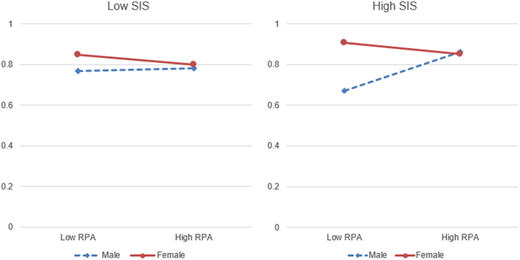
To further improve interpretability of the model’s interactions, we calculated predicted probabilities (as recommended by Hoetker, 2007) for the full model while holding control variables constant at their mean (for continuous variables) or reference category (for categorical variables). These values reflect the estimated likelihood of choosing the sustainable product across all combinations of RPA, SIS and gender conditions. In contrast, males’ probabilities of choosing a certified product clearly increase under high RPA, especially under high SIS. Figure 1 presents these predicted probabilities.
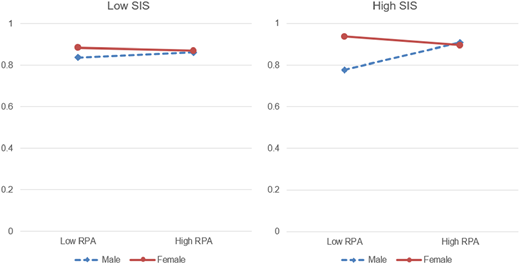
Notably, females tend to show higher predicted probabilities overall, but their likelihood of choosing the sustainable product decreases slightly in the RPA condition. This interaction is most visible under low SIS. For the comparison, in Figure 2, the means of product choices in each condition are plotted using the same (compare also to Table 3).
Therefore, we conclude that the statistical significance of our hypothesis testing results appears to be subject to the modelling choice. The loss of statistical significance may stem from the shift in estimation scale: OLS models change in probability directly, while logistic regression models change in log-odds, which can compress effect sizes depending on where in the distribution the change occurs (Mood, 2010). In a similar vein, Hellevik (2009, p. 74) notes that “With proportions near 0 or 1 on the dependent variable, where the two kinds of measures [referring to linear and logistic] show conflicting results, those from loglinear analyses in some cases appear to give little substantive meaning”. Specifically, Hellevik (2009) suggests that when the distribution of the dependent variable is skewed, this impacts the differences between p-values across the two methods.
In our case, the dependent variable is skewed, with 91.7% of females and 84.6% of males across all treatments choosing the certified choice. According to Hellevik (2009), in such an instance, the linear test is more robust with skewed distributions, not creating problems. Additionally, logistic regression relies on maximum likelihood estimation, which typically yields larger standard errors than OLS – particularly in small or moderate samples – reducing statistical power (Hellevik, 2009; Mood, 2010). Our sample size was relatively large, but even with OLS, we only witness weak statistical significance. Though logistic regression robustness failed, we see the main OLS analysis result as appropriate to discuss the general pattern of the results, which remain interesting and worth exploring further. We will thus focus on discussing the results as per our main analysis, returning to the robustness check in the limitations section.
6.3 Summary of results
As per our robustness check, we again note that statistical significance did not hold in logistic regression. This is a limitation, but also, it serves to show that interactions of gender, risk and sustainability in SCM are more complex than previously understood. Justifications for our main model choice of OLS being a better fit with our research design can be referred to in Section 4.3, while a discussion of the failed robustness check is provided in Section 6.2. Therefore, this section returns to the OLS results and theoretical implications of our main results, which indeed were mostly not supportive of our hypotheses or opposite to our hypotheses.
Table 7 summarizes the results of our hypotheses based on the main analysis method of OLS regression, including not only the primary purchasing managers sample (via Prolific) but also the extensive student pilot sample (in-class experiment).
Though the original purpose of the student sample was to pilot the experiment before testing with professionals, interesting results arose from the comparison between the two samples regarding gender effects. Students can provide directional insights that can inform studies of professional behaviour (Ma et al., 2021). Furthermore, in the experimental literature reviewed (see Section 2.4), it was noted that while there are separate studies with (MBA) students and purchasing professionals, hardly any study combines both samples. Yet contrasting gender differences with business school students (who in the studied institution typically have at least part-time work experience and thus can be seen as early career professionals) and professionals enables examining if and how gender roles may change along career progression.
We tested the impact of RPA and SIS (manipulated) as well as gender (not manipulated) on student and purchasing manager choice between a certified and non-certified product option. Though the effect of gender on product choice alone was not originally hypothesized, we did find that female students tended to choose the sustainable product more often than male students (significant effect, p = 0.034 in the OLS regression-controlled model). Female practitioners also chose the sustainable product slightly more than their male peers (p = 0.040 in controlled model), but the difference was smaller than that of students.
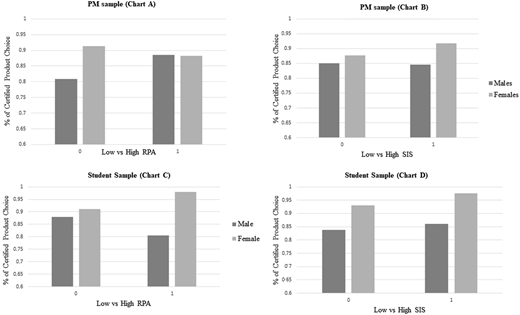
The finding that purchasing managers would generally increase their choice of certified product under high RPA was statistically insignificant, however, the interaction effect of RPA with gender was significant (p = 0.044), yet opposite to our hypothesis. The high RPA induced a noticeable increase in male purchasers’ certified choice while female purchasers were less likely to choose certified under the same high RPA. This is illustrated in Figure 3 (0 = baseline 1 = treatment), which shows the simple treatment differences between each sample group (visualization of ATE Tables 2 and 3).
As stated when introducing the pilot study, the student sample was small and not evenly distributed into treatment groups by gender. Though student results were not statistically significant, their raw results are also reported in Figure 3. Chart C shows that female students behave as we had hypothesized under high RPA by choosing the sustainable product more often. Students generally chose the certified option more when given SIS, but the effect was not stronger for females (Chart D). Comparedto managers, males increased their preference for the certified product under high RPA (insignificant) while females somewhat decreased theirs (p = 0.044 in the controlled OLS model) (Chart A). Chart B shows that only female managers increased their preference for the certified product under SIS compared to males whose preference did not change (both insignificant).
The only significant effect found related to the hypotheses was the exact opposite of H1b, where female managers were more risk-taking under ambiguity. Though the effect of gender on product choice alone was not originally hypothesized, we found a small effect that female practitioners chose the certified option more often overall (p = 0.040 in the OLS controlled model). These confounding results provided interesting theoretical reflections.
7. Discussion
Our review of literature around gender impacts in SCM decision-making and outcomes noted specific gaps in topics studied. Specifically, while there is evidence at the TMT/board level to support positive gender impacts on sustainable SCM, such evidence at functional levels and in specific SCM decisions is lacking. Furthermore, previous research has tended to address environmental rather than social sustainability, and gender and risks regarding sustainability are not examined. To address these gaps, our study focused on examining the potential differences between male and female purchasing managers when it comes to sustainable product selection. Given previous research findings on the association between gender and risk (Frey et al., 2021) and gender and ambiguity (see e.g. Balafoutas and Sutter, 2019), we sought to examine the extent to which ambiguity in the social sustainability risk itself or in its probability impacts male and female sustainable product selections in a global sourcing context.
Surprisingly, most of our hypotheses did not hold, and the few statistically significant findings (see Table 7) were opposite to our hypothesis or not hypothesized. As such, these findings prompt us to discuss critically how we should consider assumptions regarding gender and risk when it comes to sustainable supply chain management decisions and behaviour. Next, we discuss the theoretical contributions of our work, followed by managerial and policy implications.
7.1 Theoretical contributions
The literature strongly suggested that women are more sensitive to risk and avoidance of social cost (Blais, 2006; Frey et al., 2021; Weber et al., 2002). However, our research shows that such generalizations can be flawed in specific occupational contexts and/or missing critical nuance. Female professionals in our study did not respond to increasing ambiguity, neither in the probability nor impact of the social sustainability as expected. Instead, the high RPA induced a noticeable increase in male purchasers’ certified choice while female purchasers were less likely to choose certified (see Figure 3). Risk preferences between female students and female professionals were also noted, with students behaving more in line with GRT.
Ruel et al. (2020) have called for studies to better understand how gender diversity impacts sustainability performance in different supply chain areas. Yang et al. (2024) went one step further, making a proposition that diversity management will have a positive impact on social sustainability performance. We do not know the diversity (management) that exists within the actual organizations our professionals belonged to, but at least based on our experimental study results, simply increasing female purchasing managers may not improve social sustainability performance. While yes, females overall were more willing to choose the certified option, this was not the case when probability ambiguity increased. And in fact, males appear to become more risk-averse under such conditions.
GRT has been used to explain also how gender role expression can adapt when faced with contradictory occupational roles (Eagly and Karau, 2002), and our results would seem to indicate that perhaps females within the SCM profession begin to conform more to the occupational norms of cost savings than to gender roles (compared to students who tend to adhere more to gender norms). As such, we encourage further research on the interaction between gender roles and occupational norms, and how they impact decision-making. Because gender roles are constructed or reinforced based on social context, understanding the deeper intricacies of work, personal and social identity can offer a better understanding of behaviour.
Alternatively, of course, the occupation attracts females with a more risk-taking inclination. Indeed, as per Kelly et al. (2023), PSM job adverts often use the word “risk” in them. This also feeds into occupational norms, which are a product of the self-identity of PSM and the perception of its function by executives and other units (Murfield et al., 2021). The question then becomes how women respond to an institutionally male environment of supply management (Touboulic et al., 2020). Our female practitioners appear to behave in a similarly, if not more so, “masculine” way, particularly under ambiguity.
Newell et al. (2019) find that women hold negative bias against other women, supporting the idea that women will try harder to fit in with the dominant social group, which is male, by distancing themselves from anything associated with femininity. Across management, the practice of promoting a few females to higher level management positions does not improve equality (Sterk et al., 2018). Women who excel in male-dominated positions may behave in a hypermasculine way to both distance themselves from their female identity and align with their occupational role identity (Newell et al., 2019; Sterk et al., 2018). This suggests we could also examine gender, risk and supply chain outcomes from the perspective of regulatory focus theory (Gutermuth and Hamstra, 2024). Based on this theory, female members who want to reach higher levels in SCM will focus on risk-taking (promotion-oriented) behaviour (Yang et al., 2024).
There continues to be mixed evidence regarding ambiguity aversion. Particularly in contexts involving losses (as the social sustainability risk could here be interpreted), ambiguity aversion has not always been observed (White and Perfors, 2023). Previous research indeed shows individuals tend to avoid ambiguity, but they are less ambiguity averse when the likelihood of gaining is high (Di Mauro and Maffioletti, 2004). Interpreting our results from this perspective would suggest that the participants in a purchasing context are more motivated to seek the financial gains achieved through the noncertified product than to avoid the social losses from occurring (despite the 50% average likelihood of a social issue and the ensuing penalty occurring in both probability conditions). Aggarwal et al. (2022) note that in certain contexts, individuals may become ambiguity seeking because of optimism: hoping for the ambiguity to give them better odds – which may be the explanation behind some of our results.
We did not hypothesize on differences between the student and manager samples used, but surprisingly, some (though not statistically significant) observations can be noted. Regarding risk taking under ambiguity, gender roles were more adhered to amongst the student sample. Female students were more risk-averse in both risk attitudes (DOSPERT) and their product choices compared to male students when interacting with RPA (statistically not significant). However, this gender difference reversed in the practitioner sample when it interacted with RPA in the controlled OLS model (p = 0.044). With an average of 8 years of purchasing experience, our participant subset of females could be more risk-taking than females who are younger (students) with less experience and fall back into gender schemas (Bem, 1981; Frey et al., 2021). Koenig (2018) finds that while men were still subject to some stereotype pressures as they aged, feminine stereotypes “fell away” (p. 8). In comparison, young adults are extremely susceptible to gender stereotypes, which corresponds with educational and career stages (Koenig, 2018). This alone does not explain our sample because the managers were on average within the age group (30–50) that should have adhered more to their gender role even in the workplace (Koenig, 2018).
Individuals do not operate within a vacuum, how they are expected to behave plays a large role in actual behaviour. GRT provides an explanation for why females are more sensitive to sustainability risks that has less to do with morality and more to do with internalizing role expectations trained from an early age. The gendered differences in risk perceptions regarding social issues occurring and being exposed provide a glimpse into which risks may have influenced females. The female practitioners appeared more sensitive to the threat of exposure regarding their choice (irrespective of treatment) rather than a social issue occurring compared to males. This could mean that perhaps females did not choose the certified product more than males to avoid social issues occurring, but to avoid the social consequences of getting caught. This would make sense considering Montgomery and Cowen’s (2020) findings that females face more severe consequences when an ethical issue is discovered. This warrants a separate and focused exploration into gendered differences in motivation.
7.2 Managerial and policy implications
Both large governing bodies and private companies alike have invested heavily in developing gender diversity, equity and inclusion procurement policies as an important SDG for procurement policies (Rimmer, 2017). More diversity in management can help create an environment where sustainable decision-making is supported (Silva and Ruel, 2022). Our results would indicate that it is also important to embrace diversity in occupational norms – away from a strong cost-only focus in PSM. This means having a wider set of performance metrics for the function beyond cost focus.
Occupational roles that focus on reducing financial risk, not sustainable risk, such as procurement roles, tend to be (Murfield et al., 2021), compete with gender roles that expect women to behave for the social good (Montgomery and Cowen, 2020; Ben-Amar et al., 2017). This role incongruity can lead to women hitting the glass ceiling or dropping out of the field altogether (Touboulic et al., 2020) or simply cause modification of behaviour from one role expectation to the next, regardless of which role might better suit the individual’s own values. It can also prohibit interest in SCM by young females altogether (Ruel and Fritz, 2021), as we do know by observing the naturally occurring gender diversity amongst our student sample is that females are interested in SSCM. Bridging the gap between female interest in SSCM and firm’s willingness to attract and retain them lies at the feet of existing management structures.
The occupational dominance of men in SCM can reinforce masculine behavioural norms even amongst women, as our results suggest. This is also in line with the findings of Kafa et al. (2024), who find that both women and men accept masculinity but reject femininity as an important factor in SCM career advancement. Since employee evaluations play a role in promotions, Varty et al. (2021), for example suggest that this contributes to the leaky pipeline of females in senior positions of leadership. Male evaluators also showed prejudice when penalizing female candidates more so than male candidates for initiating negotiations because it violated their gender role (Bowles et al., 2007). This creates an environment that is not supportive of women in leadership, where they are penalized for behaviours that males are expected to perform as part of the job. Gender stereotypes, as well as profession stereotypes and their interactions, should be better evaluated within organizations through, e.g. employee surveys in order to challenge them on a meaningful, systemwide level.
Recognizing the double bind that women face in male-dominated fields, we need to rethink our narrative of how we discuss women in SCM/PSM. Alongside support for changing our bias regarding gender and risk, the risk culture in purchasing should be reevaluated. Even if value-adding activities by purchasing managers may avoid costly errors such as choosing a more expensive supplier that has a more sustainable track record, this does not often count towards PSM performance metrics (Murfield et al., 2021). Purchasing as a work culture is still dominated by low-cost, high-financial-rewards norms (Murfield et al., 2021). This often comes into conflict with sustainability, which tends to come with higher upfront costs to the buying firm (Goebel et al., 2018; Murfield et al., 2021). Even when firms have an organizational sustainability strategy, purchasing managers may not act accordingly due to conflicting values or departmental incentives (Li et al., 2022; Murfield et al., 2021). While managers may have a value preference for the more sustainable option, there may be financial or interpersonal costs that prohibit them from doing so. Overall, and regardless of gender, we should question how the occupational roles in SCM match the current social challenges we urgently face.
More focus on sustainability competencies is also severely needed (Schulze et al., 2022). Social issues require an ability to interpret ambiguous information and make value judgements without clear information, and the people who are hired to do so may not have such competencies (Schulze et al., 2022). Our results did not support the idea that female purchasers are better at picking up on subtle cues to influence their decision than male purchasers. If purchasing managers, regardless of their gender, do not perceive subtle information cues regarding production sustainability conditions, their risk calculations may be skewed. What might be seen as a “good” financial risk-taking behaviour (e.g. high risk and high reward) can come at a high human cost, high environmental cost, and directly or indirectly, also at a high business cost later. Our results suggest that purchasing managers require more training on contextual understanding of the supply chains for their products, and the sustainability risks therein.
GRT was more explanatory for younger female students than in the professional sample. While risk preferences may be shaped by experience, young females need to be given more chances to develop this experience before entering the job market. This can be done through education settings where the stakes are far lower. Females should be pushed to question their gender roles early before applying to jobs that align with their role schemas. There are plenty of female students who are qualified to go into SCM-related careers but do not. We must change the reputation of purchasing positions to appeal to more women early and continue to shape higher-level management positions to be more accessible to retain women (Kelly et al., 2023).
8. Conclusions
Procurement professionals play an important role in driving sustainability across supply chains (Villena, 2019), yet limited previous research examines procurement professionals’ decisions concerning sustainable alternatives (Khan and Hinterhuber, 2024; Son et al., 2019). We sought to understand the relationship between gender and PSM decision behaviour regarding socially sustainable choices, particularly in the context of information ambiguity. Overall, our results were both surprising and somewhat contradictory. Female practitioners were more likely to choose the sustainable product (p = 0.040 controlled OLS regression model), encouraging of the idea that women do have a preference for sustainable products, which has been suggested. However, female purchasers chose the sustainable product less under RPA (p = 0.044), which is inconsistent both concerning ambiguity effects (Balafoutas and Sutter, 2019) and general risk stereotypes that females are risk averse (Nelson, 2014). Though this was a hypothetical scenario, and we can only infer from it to a certain extent (particularly considering the failed robustness check), it does show the possibility that females are not the risk-averse individuals we think them to be in the workplace, at least in the PSM context. Occupational roles could supersede gender roles in explaining sustainability risk behaviour amongst female managers.
8.1 Limitations and future research
As the main limitation of our study, we again note the failed robustness check with the logistic regression. We maintain our primary model choice of linear over logistic regression because of our interest in causal, not predictive estimates, inclusion of interaction terms, and to improve the interpretability of our results. Regarding the failure of the robustness check to replicate statistical significance of the OLS regression, we refer to Hellevik (2009) whose arguments support the better applicability of linear as opposed to logistic regression when the binary dependent variable has a skewed distribution, which is the case for us with most males and females regardless of treatment choosing the sustainable product choice. Furthermore, the difference in the used estimation technique between OLS and logistic regression (maximum likelihood estimator) could lead us to lose statistical significance (Mood, 2010). This could be solved in future research with even higher statistical power (e.g. larger n) to replicate and verify our findings.
However, the technical explanations for why the models differed and lacked statistical significance can potentially distract from a simpler explanation: studies of gender and SCM decision-making tend to use student samples and/or lack gender balance. The hypotheses were developed based on previous empirical literature, which did not find behavioural difference between females and males not mediated by another factor. This led to omitting hypotheses regarding the main effects of gender on its own, yet an effect was found.
Future research can utilize GRT to address the shortcomings of existing behavioural economic and SCM literature regarding gender inclusion, particularly when it comes to the interactions of age and experience with gender. Building and advancing theoretical understanding specific to gendered behaviour is needed to understand the role of gender in a field that lacks gender equity. Overall, as most of our hypotheses based on gendered behaviour regarding ambiguity and risk did not hold, we invite research to critically examine practitioner, not just student, behaviour regarding ambiguity and risk (when it comes to gender) more broadly in SSCM decisions.
With both our samples, we used incentives for participants to make the decisions consequential as suggested in experimental research (Lonati et al., 2018). However, for ethical and practical reasons, the students were incentivized with extra credit, while the professionals with a small monetary bonus. It can be argued that the credit incentives for students are more consequential than the monetary bonus to professionals (given the size of the monetary bonus against a professional salary) and hence the impact of the incentives could have been somewhat more pronounced with the student sample.
Yesuf and Feinberg (2016) note that the width of the probability ambiguity intervals can impact ambiguity averseness. Our experimental manipulation only included one alternative width for the probability ambiguity, one that is arguably somewhat narrow. Testing different probability manipulations could provide different and more nuanced results regarding (gendered) decision-making in the context of social sustainability risks. Furthermore, this study only gauges sustainability-related risk preferences and behaviour as individuals. It does not include the dozens of environmental factors that would influence behaviour as they might in a department or office work setting, such as gender-power dynamics.
Additionally, this study largely ignores intersectionality within identities (e.g. race and socioeconomic class). For example, women of colour will have very different experiences in management than white women (O’Leary and Sandberg, 2017). However, assumptions based on country-level stereotypes should also be avoided when discussing gender. No country has achieved gender parity and too often it is viewed from a Western, colonialist perspective. More studies keeping multiple identities in mind are gravely needed in order to accomplish the goal of conducting inclusive research. Recognizing that gender and behaviour do not align strictly in such binary terms, there are limitations to our current frameworks for understanding minoritized groups in organizational settings.
Due to the actual class size, our student pilot sample was not fully sufficient for statistical purposes but did show some different (though statistically insignificant) decision preferences between males and females compared to the manager sample. This provides interesting avenues regarding gender role development and gender role and occupational role interactions. Hence, we suggest future research should more closely examine gendered behavioural differences between management students and experienced managers along their career paths, and what factors might explain potential differences.
As a field, we are moving more towards experimental studies that use the relevant practitioner sample. But our results would suggest that when it comes to individual decision-making, and particularly gender differences, it can be very interesting to include both student and manager samples for comparison to understand how decision-making and risk-taking differ. Longitudinal studies would achieve a fuller picture of how students evolve into professionals, parallel to changing social pressures to behave according to gendered stereotypes. Personality traits relating to risk can be partially reflected in DOPSERT scores (Blais, 2006), which were related to choice amongst the student sample but not professionals. Thus, the relationship between personality and product choices could yield interesting results as people get older.
Many of the above points relate to potential replications of our study in other settings. While we see the value of replicating research (see Pagell, 2021) and certainly a wider student sample along with sampling across career stages, we see a broader implication for future gender research in PSM/SCM. It is not enough to include more diverse samples; we must also reevaluate our underlying behavioural assumptions when designing studies for understanding broader ranges of behaviour. Keeping Pagell’s (2021) suggestions in mind, replicating our study may not be enough because the nomological assumptions that females would always be more risk-averse than males did not hold. Our (non)findings support a need to move away from individual gendered assumptions regarding decision behaviour and instead investigate the environments and norms they are acting within.
With increasing pressure to meet both climate and social justice goals, we need decision-makers who are better equipped to address mounting concerns. For example, evaluating how well managerial candidates interpret complex information may help predict future sustainability management performance. Diversity in decision-making increases ideation and creative solutions, something especially needed when addressing issues with high human costs (Nkomo et al., 2019). This requires more theory to address managerial tensions and understand why diversity rhetoric and organizational goals do not necessarily result in equity and inclusion (Nkomo et al., 2019). Overall, our results thus suggest we need to examine gender and interactions of different risk types within SCM decisions (e.g. sustainability vs financial) in general and particularly within the context of prevailing occupational norms. Theoretical work on gendered behavioural differences in PSM remains underdeveloped (Yang et al., 2024), and our results point to the further need to examine gender roles across different management levels in PSM.
The supplementary material for this article can be found online.