

Purpose
The purpose of this paper is to investigate purchasing practices in service triads by exploring the link between ex ante contracting and ex post contract management and how these practices influence the satisfaction of buyers and suppliers (in concessionary arrangements) with their relationship in terms of meeting the needs of the buyer’s customers.
Design/methodology/approach
An in-depth exploratory multiple case study was carried out in a shop-in-shop context. Multi-method and multi-source data collection included interviews, documents and the contracts between buyer and supplier, providing evidence of the formal and relational structures in both the contracting and contract management stages.
Findings
The case findings provide evidence that behavioural standards established in a social contract are important prerequisites for the establishment and subsequent management of a formal contract. Second, this study shows that, when outsourcing core services in a service triad, a combination of performance-oriented and behavioural-oriented contract terms, covering a mix of topics related to both the customer-experience and to buyer-supplier-oriented aspects, contribute to aligning the buyer’s, suppliers’ and customers’ interests. The main findings are presented in a causal model and formulated as propositions.
Originality/value
This paper is one of the first studies to explore how core services are outsourced in a service triad. It provides evidence that the social contract between buyer and supplier influences the establishment of the formal contract as well as contract management, and a mix of contract topics, some related to the customers’ experience and others purely buyer-supplier oriented, contribute to the alignment of buyer’s, suppliers’ and customers’ interests.
Introduction
When outsourcing services to suppliers, the overall performance of the buying organisation is highly dependent on how these suppliers perform. For example, a buyer might contract a supplier to deliver services directly to the buying organisation’s customers (Van der Valk et al., 2009; Van der Valk and Wynstra, 2012; Vedel et al., 2016), and poor performance by the supplier will immediately affect customer satisfaction (Van der Valk and Van Iwaarden, 2011; Holma, 2012; Modi et al., 2015). The relationships between buyer, supplier and customer can be viewed as a “service triad” (Li and Choi, 2009), where each actor in the triad has a direct connection with the other two (Wynstra et al., 2015). Buyers and suppliers often use formal contracts to reduce risk (Tate et al., 2009) and to safeguard correct and timely service delivery to customers (Van der Valk et al., 2006, 2009). These formal contractual arrangements are discussed and negotiated in the ex ante contracting phase in which both partners build up expectations that then need to be satisfied and managed ex post after closing the contract, i.e. in the contract management phase. Despite this, contracting and contract management are often treated as unrelated practices, and especially in the context of service triads, the definition, selection and use of contracts have hardly been studied (Wynstra et al., 2015).
In service triads that outsource core customer-facing services to independent providers (Zhang et al., 2015), as is the case in shop-in-shop arrangements, the buyer manages and connects a range of supplies in an integrated service offering. For example, a department store is attractive because it provides a sales channel for multiple suppliers and at the same times provides a diversity of core services to customers within the same facility. As such, the core value proposition is to an extent outsourced to multiple suppliers, and this outsourcing adds value through both supply and demand pooling. This makes contracting and contract management crucial when outsourcing core services (Grönroos, 2000) as the buyer is dependent on the performance of the supplier towards its customers.
Research linking contracting and contract management to performance is very limited (Kashyap et al., 2012; Kashyap and Murtha, 2017). Kashyap et al. (2012) showed that ex ante contractual completeness leads to less ex post monitoring during contract management. Further, Poppo and Zhou (2014) showed that ex post governance, through socialising and monitoring, moderates the relationship between key contractual dimensions (complexity and reoccurrence) and performance (perceived procedural and distributive fairness). The link between ex ante contracts and ex post enforcement has been studied by Mooi and Gilliland (2013) who found that, if contractual components focus on protecting the relationship, then less enforcement is likely, whereas a focus on transactional components makes more enforcement likely. Further, Kashyap and Murtha (2017) examined the joint effect of ex ante contractual completeness and ex post governance on compliance. However, all these studies have ignored the reality that, before the “formal” contract, a “social” contract is established that creates specific output and behavioural standards that serve as a foundation for a relationship (Heide et al., 2007). Hence, the literature falls short in recognising that it is not only the formal contract, but also the social contract, that can influence managing the supplier in the contract management phase. To address this shortcoming we formulated our research question as in service triad purchasing:
How do ex ante contracting practices influence ex post contract management?
How do both influence the satisfaction of the buyer and supplier in terms of meeting the needs of the buyer’s customers?
In this study, we draw on agency theory, not only because it focusses on the contract governing a relationship (Eisenhardt, 1989) but also because it provides a useful lens to study relationship problems in service triads (e.g. Zhang et al., 2015). A multiple case study was conducted that allows us to contribute to theory and practice in three important ways. First, by investigating the role of both ex ante contracting and ex post contract management practices, we provide evidence that behavioural standards established in a social contract are important prerequisites for establishing the formal contract as well as contract management. Second, this study adds new insights to the limited empirical knowledge on managing service triads, in particular when it comes to purchasing core services. We show how a combination of performance-oriented and behavioural-oriented contract terms covering a mix of topics related to both the customer-experience and to buyer-supplier-oriented aspects, contribute to aligning buyer’s, suppliers’ and customers’ interests. Further, our results also provide guidance to managers on what aspects, related to the content of the contract and to the relationship, to consider when purchasing services in a service triad.
The remainder of the papers is organised as follows. We first review the literature on agency theory, service triads, contracting and contract management in the next section. This is followed by a detailed description of our case study approach, which will allow us to derive findings related to the specific mechanisms linking contracting and contract management. Next, a discussion ties the findings to existing theory, from which propositions and a causal model are derived. We conclude by acknowledging the limitations of our study and offering suggestions for further research.
Contracting and contract management in service triads
Agency theory
Business transactions are usually based on a formal contract under which a principal (buyer) engages an agent (supplier) to undertake some action on the principal’s behalf (Jensen and Meckling, 1976). Agency theory is concerned with circumventing problems e.g. opportunism, differing goals or risk preferences) that might arise during the initiation, ongoing and termination phases of an agency relationship (Heide, 1994) by applying ex ante and/ or ex post governance (Eisenhardt, 1989). Ex ante, in the initiation phase of the relationship, governance seeks to eliminate goal divergence and align incentives during a socialisation process (Heide, 1994). In this process, buyers and suppliers establish specific output and behavioural standards as a foundation for their relationship, also referred to as social contracts (Heide et al., 2007). At the same time, governance through a legally binding formal contract is established.
Contracts control and coordinate the relationship between a buyer and a supplier by detailing the supplier’s obligations towards the buyer. The safeguarding (control) function of a contract is often reflected in the level of detail, its completeness, and the assignment of control and decision rights (Klein Woolthuis et al., 2005). The coordination function of a contract then details roles and responsibilities, the specification and operation of information sharing, decision making and feedback, as well as provisions for the monitoring process (Mayer and Argyres, 2004; Faems et al., 2008; Kashyap and Murtha, 2017). Here, the formal contract helps to govern the agency relationship by addressing incentive alignment and decisions rights, performance expectations, consequences of contractual breaches and the process for resolving disputes (Poppo and Zhou, 2014). The range and diversity of contracts is evident not only in their function (Schepker et al., 2014), but also in their dimensions (see e.g. Rosenbaum, 2013) such as their length (Enquist et al., 2011), the type of contractual topics (Klein Woolthuis et al., 2005), and whether the contractual terms are more performance-oriented or behavioural oriented (Selviaridis and Wynstra, 2015). As such, contracts “can range from a simple contract that conveys only the broad lines of exchange to an explicit contract that specifies as precisely as possible both parties’ responsibilities and remedies for foreseeable contingencies” (Wuyts and Geyskens, 2005, p. 103).
Nevertheless, formal contracts always have limitations because they are never complete as all possible events cannot be foreseen (see e.g. Sánchez et al., 2013) and the rigid application of formal contracts can negatively impact the flexibility of the cooperation and reduce trust (Faems et al., 2008). Consequently, the governance of a relationship through formal contracts might be complemented, or substituted, by trust and relational norms, i.e. relational governance, which functions in the same way as formal contracts (Poppo and Zenger, 2002). Trust provides mutual confidence that neither party will act opportunistically in a relationship, and relational norms help to provide a framework of reference that can guide actions by the buyer and supplier (Cao and Lumineau, 2015). There is an ongoing debate in the literature as to whether contractual and relational forms of governance are alternatives to each other or complementary (e.g. Cao and Lumineau, 2015). While it is beyond the scope of this paper to further elaborate on this discussion, it is relevant to note that a formal contract is inherently also relational in that it establishes a relationship of recognition and respect between the signing parties (Markovits, 2004): “Contracts may be envisaged as the sedimentation of the negotiation and commitment stages that partners go through. In this interpretation, contracts can be seen as both the basis and outcome of cooperation” (Klein Woolthuis et al., 2005, p. 835). However, what theory still lacks is insight into how ex ante contracting (both social and formal contracts) influence ex post contract management. As such, we have an incomplete picture of how governance, as rooted in agency theory, can help manage both ex ante and ex post purchasing relationships. The first part of our research question therefore asks how ex ante contracting practices influence ex post contract management?
Service triad contracting
While the alignment of objectives between two parties can be difficult, it is further complicated when the buyer subcontracts parts of its core service offering to a supplier that directly interacts with and delivers services to the customer on behalf of the buyer (Van der Valk et al., 2009; Van der Valk and Van Iwaarden, 2011; Wynstra et al., 2015). In such constructs, the customer has the impression that the supplier is responsible for their buying experience (Zhang et al., 2015). These so called business service triads are characterised by relationships among three different actors implying there is more than a simple reciprocal value-exchange relationship between each actor in the triad (Wynstra et al., 2015), and that multiple agency relationships exist simultaneously (Tate et al., 2010). In service triads, not only the buyer and the supplier but also the buyer’s customer and the supplier initiate and develop relationships. The supplier is therefore confronted with two principles: the buyer and the buyer’s customers (Van der Valk and Van Iwaarden, 2011).
The relationship and hence the social contract between the buyer and the supplier is initiated in the pre-outsourcing (bridge) stage and further developed during discussion and negotiation of the contractual agreement (bridge decay stage) (Li and Choi, 2009). This contract should reflect the objectives that the buyer wants to realise for its customers (Van der Valk and Van Iwaarden, 2011), while safeguarding service quality and protecting the reputation of the buyer (Zhang et al., 2015; Modi et al., 2015). Once a contract is signed (bridge transfer stage), the supplier starts to interact with the customer under the terms set in the contractual agreements between buyer and supplier. However, while there is a formal contract between the buyer and the supplier and another between the buyer and the customer, there is no formal contract between the supplier and the customer (Van der Valk and Iwaarden, 2011).
Depending on the type (core, supporting, facilitating) of service (Grönroos, 2000), service production and consumption might primarily involve the supplier and the customer, excluding the buyer from service delivery processes, as in the case of franchising (e.g. Zhang et al., 2015). Here, contractual governance can help assure compliance with the agreements made between the buyer and the supplier (Van Iwaarden and Van der Valk, 2013). However, a buyer might also choose to connect several service suppliers’ offers in an overall service package that is delivered to its customers in order to keep a connection with customers. For instance, suppliers in a shop-in-shop retail context might each provide a part of the value, such as cosmetics, clothes or shoes, while the buyer (i.e. the warehouse) provides the opportunity to customers to buy everything from the same facility and adds customer service aspects such as a returns policy, home delivery and payment facilities. Here, both supplier and buyer not only have a steady exchange relationship with each other but also with the customer, and jointly influence and depend on satisfying the buyer’s customers’ needs. Therefore, depending on the type of service offered, different agency relationships can exist that needs to be governed during both the ex ante and ex post contracting stages to create customer value. In the second part of our research question, we therefore ask how ex ante contracting and ex post contract management influence the buyer’s and the suppliers’ satisfaction in terms of meeting the needs of the buyer’s customers?
To sum up, agency theory provides useful guidance on how to avoid problems arising from buyer-supplier relationships in service triads. Nevertheless, we have an incomplete picture of how governance rooted in agency theory can help manage these relationships because of a lack of insight into how ex ante contracting (social and formal contracts) influences ex post contract management. Specifically, we have little knowledge of purchasing practices in service triads, where customer-value creation can be dependent on both the buyer and the supplier, as research to date has been largely conceptual. In line with the aims of our paper, we therefore employ a multiple case study approach to investigate how ex ante contracting practices influence ex post contract management and how both influence the satisfaction of the buyer and supplier in terms of meeting the needs of the buyer’s customers in service triads.
Methodology
Given the limited literature on purchasing in service triads, and the complexity of interactions between buyer, supplier and customers in the various possible agency relationships, we employ an exploratory multiple case study approach within the apparel industry. The case study approach allows us to not only research the phenomenon under investigation in its natural setting, but also to gain the in-depth insights required to unravel the mechanisms between contracting and contract management. We focus on the offline purchasing process in shop-in-shop triads. Shop-in-shops are service triads in which department stores (buyers) sublet parts of their core services, i.e. retail services within a designated space within the store, to brands (suppliers) who deliver services under their own brand name to the customers of the buyer (Jerath and Zhang, 2010). The main idea is that both the brand and the department store benefit from creating a symbiotic arrangement. This setting is particularly relevant for our research topic due to the maturity of business service triad management in this often highly competitive retail environment. Furthermore, relationships between buyers and suppliers in this industry tend to have short lifecycles and are therefore not easily governed by complete or explicit contracts (Wathne and Heide, 2004). These factors mean that we are likely to find rather mature and well thought through ex ante contracting and ex post contract management practices.
Our research was carried out at a single large buyer – a department store in the apparel industry with multiple branches in the Netherlands. The buyer, a leading multi-branded fashion company in women’s, men’s and children’s clothes, started its shop-in-shop concept four years ago. The department store target mid- and higher-segment customers.
Case selection and unit of analysis
We analysed the formal and social contracts between the buyer and each supplier (the unit of analysis) that aim to meet the needs of the buyer’s customers. Four embedded cases were chosen involving the one buyer with four different suppliers, and the customers. Cases were selected based on the level of detail contained within the formal contract as perceived by the buyer and by the supplier, and the perceived importance of the supplier to the buyer. Our expectation was that the variety in the level of detail and perceived importance of the supplier to the buyer would provide us with insights into the diverse roles played by the social contract, relative to formal contracts, in both ex ante and ex post governance. Table I provides an overview of the characteristics of the cases selected.
Case selection
| Cases | ||||
|---|---|---|---|---|
| Case selection criteria | A | B | C | D |
| Level of detail in the formal contract | Sufficient | Insufficient | Sufficient | Uncertaina |
| Perceived importance of the supplier to the buyer based on: | H | H/M | M | L |
| (a) % of total sales of the buyer | 3.5 | 1.1 | 1.4 | 0.4 |
| (b) % of profit paid to the buyer | 52 | 43 | 55 | 45 |
| (c) Role in buyer’s service offering | Unique | Unique | Replaceable but promising | Replaceable |
Note: aWhile the buyer regarded the contract as sufficiently detailed, the subcontractor did not
Data collection process
To ensure triangulation, we assembled data from contracts, fact sheets and 16 semi-structured interviews. For each case, we held interviews with a purchasing officer, the CEO and the account manager on the buyer’s side plus the brand manager from the supplier’s side. The interviews included both semi-structured questions and a few closed questions to enable comparison between cases. A case study protocol was established, based on existing literature and constructs, to guide the interviews and to analyse the documentation (see Table II for an overview). We asked questions in relation to the main variables such as “how did you discuss which contractual terms should be included?” “how long have you known this supplier and how did your relationship evolve?” “how do you control the relationship with your partner?” And “what other practices are put in place to manage the contract?” We encouraged the interviewees to describe the contracting phase in terms of what actually happened and provide specific examples to try to avoid memory bias (Schacter, 1999). All the interviews were face-to-face and took place at the department store and at the suppliers’ offices, were recorded, transcribed and sent to each interviewee for validation.
Operationalisation of variables
| Ex ante contracting practices | Contract management practices | Relationship satisfaction |
|---|---|---|
| Formal contract variables Perceived level of detail: the extent to which clauses, procedures and rules are discussed and specified in detail (Klein Woolthuis et al., 2005) Perceived contract completeness: the extent to which a contract includes an extensive overview of what is required from both parties (Klein Woolthuis et al., 2005) Inclusion of contractual safeguards: the extent to which protective clauses are included in the contract and the extent to which parties are able to “escape” the contract (Lusch and Brown, 1996) | Transactional variables Perceived clarity of tasks, authorities and responsibilities: the extent to which it is clear to both parties who has to carry out which tasks, has the right to give orders and make decisions, and is accountable for carrying out tasks (Lusch and Brown, 1996; Klein Woolthuis et al., 2005) Perceived ability to monitor performance: the extent to which a party is able to assess the performance of the other party (see e.g. Van der Valk and van Iwaarden, 2011) Perceived fairness of the contract: the extent to which an outcome is seen as balanced between both parties (Poppo and Zhou, 2014) | Perceived contract compliance with regard to the agreements on Task division Authority division Responsibilities division Satisfaction Buyer’s and supplier’s satisfaction with the ex-ante contracting practices Buyer’s and supplier’s satisfaction with the content of the formal contract Buyer’s and supplier’s satisfaction with the contract management phase Problems in guaranteeing the contract |
| Social contract variables Perceived flexibility: the extent to which a party is willing to adjust its contractual terms and clauses (Faems et al., 2008) Perceived cooperative attitude: the extent to which a party views the other party as an interdependent partner and shows willingness to work together to achieve common goals (Chen et al., 2011) Leading party in the contracting phase: the extent to which a party is most dominant in the contractual negotiations and in setting relational norms (inductive code) | Relational variables Main role in monitoring activities: the extent to which a party takes the initiative and invests resources in monitoring activities (inductive code) Information exchange on contract, performance and other relevant clauses: the extent to which data are shared and exchanged on contract, performance and other relevant clauses (Van Weele, 2010) Main authority in taking decisions: the extent to which a party is most dominant in taking decisions in the contract management stage (inductive code) Evaluation of the relationship and developing improvements: the extent to which both parties evaluate the performance of their partner and define ways to improve the relationship (Van Weele, 2010) |
Data analysis
We started by analysing the contracts in terms of number of pages and the kind of agreements made in order to derive key numerical data and insights on contractual dimensions. The 16 interviews, as the main source of data, were used to gain insights and details on the relationship between ex ante contracting (formal and social contracts) and ex post contract management practices. A three-stage coding procedure, going from descriptive coding to interpretive coding to pattern coding, as introduced by Miles and Huberman (1994), was followed. First, descriptive coding was used to allocate the data to one of the three main segmented aspects of our research: ex ante contracting, ex post contract management and relationship satisfaction. In doing so, we deduced codes based on constructs from the literature whenever possible, and otherwise introduced inductively developed codes (see Table II), Next, within the first two aspects, the data were analysed using interpretive codes to derive pattern codes examining how the ex ante formal and social contracts influenced contract management practices. The analysis of the third segment, concerning the satisfaction of all interviewees with their relationship, was based on the closed questions and the interviewees’ explanations of their answers to these closed questions. Here, we also scored the cases, relative to each other, as high, medium or low in terms of key aspects of interest (e.g. perceived clarity of contract regarding responsibilities) based on the data from the semi-structured and closed questions. After analysing each case separately as outlined above, we continued with a cross-case analysis to derive patterns that exist beyond the individual cases.
Findings
In analysing our data, we found an interesting phenomenon: that (the absence of) a social contract appeared to effect the dimensions in the formal contract. Consequently, before outlining how ex ante contracting practices influence ex post contract management (the aim of this paper), we first describe the link between the social and formal contracts that are both developed ex ante during contracting. Following this, we show how contracting and contract management influence the satisfaction of both the buyer and its suppliers in terms of meeting the needs of the buyer’s customers. Table III provides an overview of the key constructs that are relevant to our findings (underlined in the text below).
Cross-case analysis
| Case A | Case B | Case C | Case D | |
|---|---|---|---|---|
| Ex ante contracting | ||||
| Formal contract | ||||
| Number of contract pages | 3 pages | 7 pages | 11 pages | 11 pages |
| Perceived completeness (B)a | Sufficient | Sufficient | Sufficient | Sufficient |
| Perceived completeness (S) | Sufficient | Almost | Sufficient | Not at all |
| Perceived level of detail (B) | Sufficient | Insufficient | Sufficient | Sufficient |
| Perceived level of detail (S) | Sufficient | Insufficient | Sufficient | Insufficient |
| Contractual safeguards | Equal | Equal | Equal | Unequal |
| Social contract | ||||
| Perceived cooperative attitude of supplier (B) | High | High | High | High |
| Perceived cooperative attitude of buyer (S) | High | High | Medium | Low |
| Agreement between buyer and supplier on cooperative attitude | Yes | Yes | No | Yes |
| Lead in specifying contractual arrangements | Supplier | First buyer, later both | Buyer | Buyer |
| Flexibility shown by supplier | Low | Medium | High | Medium |
| Flexibility shown by buyer | High | High | Medium | Low |
| Ex post contract management | ||||
| Transactional arrangements | ||||
| Perceived clarity of contract regarding task division (B) | High | High | High | Low |
| Perceived clarity of contract regarding authority division (B) | High | High | First low, now high | High |
| Perceived clarity of contract regarding responsibility division (B) | Medium | Low | High | High |
| Perceived fairness of the contract (S) | High | High | High | Low |
| Perceived ability to monitor supplier’s performance (B) | Low | Low | High | High |
| Perceived ability to monitor buyer’s performance (S) | High | High | Low | Low |
| Sharing of figures between the partners | High | Medium | Low | Low |
| Relational arrangements | ||||
| Main role in monitoring activities | Supplier | Supplier | Buyer | Buyer |
| Information exchange on contract, performance and other relevant clauses between the partners | High | High | Average, Impro. focus | Low, unstructured |
| Main authority in taking decisions | Supplier | Supplier | Buyer | Buyer |
| Evaluate relationship and (jointly) develop improvements | Continuous, low frequency, informing each other | Continuous, average frequency, formal and informal discussions | Continuous basis, very often and informal, one-sided | Hardly, no improvement points set |
| Relationship satisfaction | ||||
| Compliance with contract agreements | ||||
| Task division (B) | Medium | Medium | Medium | Low |
| Authority division (B) | High | High | Medium | Low |
| Responsibilities division (B) | High | High | Medium | Medium |
| Satisfactionb | ||||
| Process of establishing the formal contract (B) | 3 | 4 | 3.6 | 4 |
| Process of establishing the formal contract (S) | 4 | 4 | 4 | 2.5 |
| Content of the contract (B) | 3.4 | 4 | 3.6 | 3.6 |
| Content of the contract (S) | 4 | 2 | 4 | 3 |
| Contract management (B) | 4 | 4.3 | 4 | 3.6 |
| Contract management (S) | 3 | 3 | 4 | 3 |
| Problems in guaranteeing the contract terms | No | Sometimes | Yes | Yes |
Notes: a(B)=buyer is respondent, (S)=subcontractor is respondent; b1=not at all satisfied, 5=extremely satisfied
Formal and social contracts in the ex ante contracting phase
Although, in three out of the four cases, negotiations in the contracting stage started based on the buyer’s standard contract, the final contracts showed a large range in terms of perceived completeness and level of detail. This was reflected in contracts varying in length from 3 pages (case A), 7 pages (case B) up to 11 pages (cases C and D). Table III provides insights into the reasons for these differences in length. Surprisingly, the number of pages in the formal contract did not seem to have a clear influence on either the perception of contract completeness or the level of detail, whereas the social contract did.
We observed that, in cases A and B, the contracting phase was primarily focussed on expressing how to do business together, i.e. establishing a social contract. In case A, both parties experienced the other party and themselves as very willing to cooperate and seek mutually beneficial agreements. The high scores given by both the buyer and the supplier on the perceived cooperative attitude and flexibility reflected their intentions. Consequently, both parties preferred a contract “based on the main issues, so that there is enough room to adjust things in practice” (CEO buyer). The formal contract reflected the negotiations and discussions that took place between the buyer and supplier. Supplier A commented that the safeguarding agreements in the contract were limited: “They are neutral but, for instance, it is unclear what would happen if we removed our fittings from the shops”. In case B, after the supplier was presented with an initial formal contract, it took two months of negotiation and adjustments on both sides to close a final contract. Nevertheless, a social contract helped them to get along: “I believe that we were both very willing to cooperate because we had already cooperated in the past, albeit in a different way” (supplier B). The buyer’s CEO stated: “Due to this former cooperation, trust between both parties was high, and we mutually figured out how this new way of working would be best for both of us”. The above reflects how both parties were quite flexible about their contractual terms and agreements due to the underlying social contract that guided the contracting process. This resulted in a “contract complete enough to make it work in practice” (supplier B), yet perceived as insufficiently detailed.
In cases C and D, the failure of the two parties to perceive the social contract similarly seemed to influence the features of the formal contract. In both cases, only very limited cooperative norms were developed during contracting, and these were perceived differently by the two parties. In case C, the buyer and supplier experienced the contracting phase differently. According to the supplier, both parties tried to establish a social contract even though they “did not understand each other at all times, which made it a bit difficult in the beginning […] I think the willingness was there, but it wasn’t going smoothly”. The buyer, on the other hand, perceived the flexibility of the supplier as indicative of a well-developed social contract: “They were very willing to cooperate, they accepted nearly all our entire contract, therefore I would say they were very keen on cooperation with us” (CEO buyer). These different perceptions of the social contract are reflected in the perceptions of the formal contract. Supplier C considered the contract sufficiently complete to allow cooperation, but unnecessarily detailed in terms of their duties towards the buyer, which were far more detailed than the buyer’s duties towards the supplier. At the same time, the buyer considered the contract as complete and not extremely detailed.
We found a similar situation in case D. Here, the supplier had a more positive perception of the social contract whereas the buyer was genuinely not interested in cooperating. The buyer found the supplier to be inflexible during contracting: “Even though they accepted our contract in the end, they moaned a lot and kept trying to change things” (CEO buyer). Again, the different perceptions of the social contract influenced perceptions of the formal contract: “Everything is unclear, nothing is detailed and we have no idea what clauses in the contract mean” (supplier D). On the other hand, the CEO of the buyer stated: “We offered a clear contract and said: ‘Take it or leave it’”. Here, our analysis of the contract found that many clauses specify the obligations of the supplier whereas, whenever something is stated about the duties of the buyer, there are no specifications, explanations or descriptions. Based on the four cases, we concluded that the development of a social contract based on a cooperative attitude, expressing a willingness to exchange information and showing flexibility in contractual terms, influences how the contract is perceived in terms of completeness and depth.
The influence of contracting on contract management
We observed, in cases A and B, that the cooperative attitude shaped by the social contract and formal contract in the ex ante contracting phase also created the basis for the evolving ex post relational structures: contract management was carried out with effort and in line with the contracts that contained only a few clauses. In case A, both parties considered information exchange during contract management to be timely, adequate, clear and aligned between the different levels of the organisations. This was despite, contractually, there being virtually no guidelines on what, when and how to communicate. Any ideas for improvements were discussed by both parties and implemented whenever possible. Comments such as “we want to take this cooperation to a higher level” (purchasing officer of the buyer concerning supplier A) and “we would like to improve whenever and wherever possible” (supplier B) reflect the strong mutual interest that was grounded in the social contract rather than in the formal contract developed ex ante. Although, in practice, the division authority between buyer and supplier in contract management was considered as clear and fair, supplier A was aware of missing information on the consequences of not complying with responsibilities (safeguarding issue) and hence their medium score for the clarity of responsibilities (Table III): “It is hard to communicate about this [presentation of the goods in the shop] if it’s not as we want it, and there are no consequences described yet, and there should be”. As such, contracts can simultaneously be perceived as clear and as incomplete, causing uncertainty in the contract management phase. In case B, the supplier wanted more knowledge on the details of the contract (here a concession contract where the inventory in the store is owned by the supplier), and had to work out how to align the contract with its own interests. Subsequently, the supplier took a leading role, and this formed the basis of the social contract. This role continued into the contract management phase where supplier B closely monitored results in the buyer’s stores: “Whenever something does not go as agreed, or is not in accordance with the contract, the supplier immediately confronts us with the consequences” (purchasing manager buyer). We see from these two cases that the buyer was either unable (“we lack information in order to monitor this supplier” (purchasing manager buyer about case A)) or had no interest in being able (“this supplier is performing so well that monitoring is not relevant” (purchasing manager buyer about case B)) to monitor the supplier.
Unlike in the above two cases, in cases C and D both the buyer and the suppliers experienced many problems in governing the contract. For the supplier in case D, contract management suffered from the same obscureness as the contracting phase had done: “We had to find out most of the task division in practice”. However, the buyer stated that they “used our standard contract, so in essence it should have been clear”. The authority division, as outlined in the formal contract, was experienced as clear but the parties disagreed as to whether it was fair: “Sometimes we have a say as well, but most of the time the buyer decides. I don’t think this is honest” (supplier D). Contradicting this, the account manager of the buyer stated that “we decide a lot in consultation, so the division is fair”. This highlights that both parties having different perceptions of the social contract not only influenced their perceptions of the detail and completeness of the formal contract, but it also influenced the execution of the contract during the contract management phase. This was also evident in case C, where both parties agreed upon the dominating role of the buyer during contracting: “Since they [the brand] are underperforming, they have to accept our suggestions and requirements” (CEO buyer). However, in the contract management stage, the buyer placed greater emphasis on their relational structures, i.e. their mutual cooperation and the sharing of figures, which up to that stage had not been part of their social contract. Yet, the supplier had no interest in moving from contractual to relational governance. In both these cases (C and D), the buyer monitored the suppliers very closely in terms of turnover per square metre, the collection being offered and stock levels to make up for the different perceptions of the social contract. Conversely, in case D, the supplier stated: “We are definitely not able to monitor the buyer. We would like to, but because of the ambiguities we are simply not able to”.
Satisfaction with the relationship
In cases A and B, the cooperative attitude shaped in the ex ante contracting phase also created the basis for the evolving ex post relational structures. This resulted in satisfactory performance and a high compliance rate. The opposite was seen in case D, where both parties gave low scores on performance aspects. However, as in cases A and B, in this case we saw that the governance pattern developed in the contracting phase continued into the contract management phase. However, in case D, the focus was on the contractual terms: since the buyer had shown no interest in investing in the relationship during the contracting phase, the relational structures remained underdeveloped in the contract management phase. Therefore, although there was considerable detail and coverage in the contract, both parties experienced a lack of clarity, dissatisfaction and a low compliance rate when managing the contract. Conversely, in case C, the buyer put much effort into encouraging the supplier to become a more equal partner during the contract management phase because this brand was seen as contributing to customer value. However, supplier C did not respond to the buyer’s invitation to develop the relationship: “We do not set points for improvement because we don’t think it is useful. The contract is solid and therefore we do not think we would be able to implement the points” (supplier C). This is reflected in the relatively poor performance in case C compared with cases A and B: more problems occurred in complying with the terms of the contact as task, responsibility and authority division were less clear.
Meeting the needs of the buyer’s customers
From the buyer’s perspective, selecting brands, working in conformity with the concession formula, and the relative positioning of the various suppliers – expressed in terms of the spatial size and location of their shop in each branch – are the main mechanisms available to meet its customers’ different needs. To the buyer in our study, the suppliers contribute to the profit and turnover targets and to customers’ overall service experience, in different ways: “Brand A as it generates many sales, brand B as it generates sales and we offer a sales channel to this brand, brand C as it is a very attractive brand to us and to our customers, and brand D as it does not require much space” (CEO buyer). When contracting, the main performance-based aspect in the formal agreement is the annual turnover per square metre. The topics in the contracts (such as operation of the shop area, layout and furnishing of the area, security of the building and entry rules for employees, supply of goods, advertising and sales campaigns, and termination of the contract) tend to mainly describe behavioural-based arrangements. In terms of content, these topics can be divided into customer-experience related and buyer-supplier-oriented aspects. While the former cover agreements are directly experienced by customers, such as assortment decisions in terms of the depth and breadth of the collection, inventory management decisions, personnel training, presentation of the goods within the shop, and sales price of the clothes, the latter are only indirectly experienced by customers via topics related to the buyer-supplier relationship, such as financial arrangements (profit division, periodic payments, payment for lost or stolen goods) or in contract management activities (such as order management and stock handling).
During the contract management phase, suppliers A and B, who the buyer saw as the “best-performing”, took full responsibility for the collection that was available each day in each branch. In an ongoing process, these suppliers updated their collection based on customer input (i.e. the sales pattern): “By using EDI, we have our daily sales report so we can see per item, per branch what runs well, and we analyse this with our tools and decide, OK, what needs to be produced once more; we check capacity, should we have more in store or not. […] we are not dependent on the buyer’s figures at all” (supplier B). The inventory in the store is owned by the supplier (a concession construction), and they decide for themselves when and what to send to each branch. Further, the suppliers arrange their space in each branch, own the fittings and check the presentation of their collection during monthly visits. Some quotes illustrate this intense involvement of the suppliers: “On a monthly basis, we check how sales staff handle our goods on the shop floor” (supplier B). In effect, the buyer takes on an advisory role: “[…] sometimes they [supplier A] supply too much […] and then the shops are too crowded. Clients cannot easily find their stuff anymore, and the storage rooms in the branches are full. Then they listen” (account manager buyer). The supplier has the main responsibility for pricing and discount actions and decides “for instance which article goes on sale when and against what price, but of course we have a kind of meeting to discuss this” (supplier A). Although the same topics are relevant in managing the overall customer experience for suppliers C and D, the buyer is much more in the lead. In case C, for instance, decisions on stock replenishment and discounts are taken by the buyer, albeit in close consultation. In case D, the supplier experiences hardly any control: “We deliver the goods, they decide the goods’ markdowns, a loyalty fee is applied and, ultimately, a certain amount of money comes out, and so much profit or loss, but where to attribute a loss is not clear” (supplier D).
Discussion and conclusions
This research is one of the first studies to investigate purchasing in a business service triad focussing on how ex ante contracting influences ex post contract management and how both influence the satisfaction of the buyer and supplier in terms of meeting the needs of the buyer’s customers. The main outcomes of this study are represented in a causal model (see Figure 1) and discussed below. The model represents the relationships that were replicated across the cases. Further, it was established that these relationships were similar in cases A and B, but reversed in cases C and D.
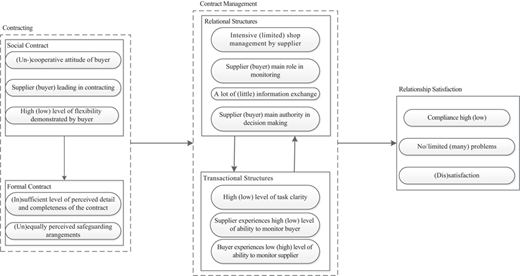
Causal model of relationship between contracting and contract management in service triads
Causal model of relationship between contracting and contract management in service triads
The link between contracting and contract management
Agency theory is concerned with circumventing problems that can arise during the initiation, ongoing and termination stages of an agency relationship (Heide, 1994) by applying ex ante and/ or ex post governance procedures (Eisenhardt, 1989). However, most of the literature that has so far drawn on agency theory has explored governance based either on the ex ante formal contract or on the ex post relationship (for exceptions, see Poppo and Zhou, 2014; Kashyap et al., 2012; Kashyap and Murtha, 2017; Mooi and Gilliland, 2013). To the best of our knowledge, no study on purchasing considered that the relationship originates in, and then builds on, an ex ante social contract. In line with Heide (1994), however, we find that the relationship formed ex ante during the contracting phase (i.e. the social contract) also needs to be governed. This allows the parties involved to avoid goal divergence and align interests to establish a satisfactory formal contract and then to manage this contract ex post. While previous research has illustrated that completeness, contractual one-sidedness and monetary-based incentives are ex ante features of a contract that influence ex post governance (Kashyap et al., 2012), our study has shown that perceptions of a cooperative attitude and flexibility during the social contract phase influence the required level of contract detail and completeness, and then contract management. That is, the social contract precedes and influences both the formal contract and, subsequently, contract management. Furthermore, we found that satisfaction with, and the perceived fairness of, the contract and contract management are determined by the mutual perceptions of the social contract. One of our four cases, case D, showed that despite the division of authority being perceived as clear, different perceptions of the social contract led to disagreements in relation to fairness when it came to executing the contract. While this in line with Poppo and Zhou’s (2014) findings that socialising mediates the relationship between contractual dimensions and perceived fairness, those authors considered socialising to be an ex post form of governance rather than an ex ante component originating in the social contract. As such, our findings might explain why ex ante contractual governance might not have any impact on a supplier’s behaviour or why a contract can work against the buyer’s objectives (Kashyap et al., 2012). Accordingly, we propose:
The social contract established during the contracting phase determines both the dimensions (e.g. length, completeness) of the formal contract and the subsequent contract management practices.
A mutually perceived social contract is an antecedent of a satisfactory formal contract and contract management practices.
Service triad purchasing
Furthermore, our findings add to the knowledge on service supply chain management and particularly on aligning interests in a service triad. As such, this research addresses the call to study the definition and use of contracts in the context of service triads. Our study extends earlier findings by Van der Valk et al. (2009), Van der Valk and Van Iwaarden (2011) and Zhang et al. (2015) in several ways. We believe our study to be the first to describe contracting and contract management practices when outsourcing core services to several suppliers. We show how the buyer and the various suppliers in our four cases align their interests by using performance-based contracts covering issues such as annual turnover per square metre. In addition, several behavioural-based contractual terms and monitoring activities safeguard the buyer: suppliers were able (cases A and B) and motivated (cases C and D) to comply with the buyer’s overall performance goals. The contract terms addressed a mix of topics, some related to customer experience and others not, that assisted in aligning the buyer’s and suppliers’ interests with those of the buyer’s customers. We therefore propose:
A buyer can synchronise the separate offerings of suppliers to provide a coherent core service offering by including contractual terms that cover a mix of topics related to both the customer experience and to buyer-supplier-oriented aspects.
A buyer and supplier can aim to achieve appropriate customer service value by applying a combination of performance and behavioural contractual arrangements.
Managerial implications
Our findings also provide insights for managers in relation to contracting and contract management, and more specifically for buyers in service triads. In particular, we would recommend that managers put effort into establishing a mutually perceived social contract as this will not only influence the contract and contract management, but also their satisfaction with the relationship. This means that both the buyer and the supplier need to have a clear idea about the kind and the intensity of the relationship they want to establish with each other when entering into contracting. Furthermore, it is important that both sides are transparent about their capabilities, aims and aspirations and do not make assumptions about the other party. Specifically, when it comes to outsourcing core services in service triads, it appears to be very relevant that both the buyer and the supplier take responsibility for using their specific expertise to fulfil the needs and preferences of the buyer’s customers through supply pooling and integration. To achieve this, we recommend buyers explicitly include both performance- and behavioural-based contractual terms that relate to customer experiences when contracting suppliers. Further, for the contractual agreements to work in practice, both parties need to be aware that it is not only the formal contract, but also the social contract that influences contract management. This can have personnel implications as the contracting phase, and hence the establishment of the social contract, is often carried out by other employees than those who will later be responsible for actual contract management; this might hamper cooperation in the ex post stage.
Limitations and directions for further research
The first limitation is that we studied four triads in which one specific buyer was common to all. Consequently, in all the cases, this buyer’s standard contract formed the basis for negotiations containing contractual terms related to the customer experience with a combination of performance- and behavioural-based contractual arrangements. Other buyers could invoke different standards and behave differently. Consequently, we recommend for P3 and P4 to be researched in a range of contexts involving various buyers. Furthermore, while we only studied the relationship between the suppliers and the buyer in service triads, our findings implicitly also involve the buyer’s customers as their preferences and needs are reflected in the contractual terms that relate to customer experience. As such, this study is one of the few empirical studies to shed light on how a buyer attempts to synchronise various core service components to create a comprehensive service offering for its customers. However, we have not addressed whether these practices are actually reflected in enhanced customer experiences. For instance, one might question whether suppliers have sufficient knowledge of the buyer’s customers to take the lead in determining the service offering (see case A), or would a more equal contract management partnership result in a more effective combination of the buyer’s knowledge of their customers’ needs and preferences and a supplier’s knowledge of their offering (case B)? To address this aspect, future research could explicitly include the influence of contracting and contract management practices on customer satisfaction. In this area, it would also be interesting to investigate if and how customers experience contractual aspects that are directly linked to the core service offering (e.g. assortment and pricing) compared to contract topics that define buyer-supplier interactions (e.g. payment arrangements).
To the best of our knowledge, this is the first study on contracting and contract management in service triads that focusses on core services rather than on facilitating or supporting services (Grönroos, 2000). While our investigation of buyer-supplier arrangements was in an offline triad setting, in which the buyer is present, this approach is becoming increasingly significant in virtual multi-sided platforms (Van Alstyne et al., 2016). This underlines the importance of similar research in e-business environments (see e.g. Hagiu and Wright, 2015). In such settings, it might be too time-consuming or too difficult to build relational structures due to the numerous suppliers and physical distances involved (e-business) and communication and cultural differences (distant services). Consequently, a different mix of governance practices might be required. Additionally, future longitudinal research could look at how the link between contracting and contract management develop over time to trace, in a stepwise fashion, how different aspects impact upon each other.
The authors would like to thank Rachel Hodenpijl for the support in data collection.

