


Public procurement is increasingly recognised as a tool for governing and shaping supply markets. Yet we still know little about how local authorities engage in market shaping through contracting practices, especially in newly decentralized markets. This study investigates the role of awareness, motivation and capabilities (AMC) in how municipalities influence (or fail to influence) social care markets, and how these dynamics manifest in contracting practice.
We combine secondary data with semi-structured interviews conducted with procurement professionals across municipalities, regional consortia, and expert organizations. The case context is Dutch social services procurement, which transitioned to a decentralised market in 2015. The AMC framework is used to classify buyer archetypes and explain variation in market-shaping behaviour across municipalities.
Municipalities shape social care markets, although not always intentionally. We identify four buyer archetypes (Disengaged, Aspiring, Short-sighted, Strategic Steward). We further introduce a fifth archetype, the Market Drifter, capturing municipalities that shift contracting approaches reactively.
This study contributes to the literature on strategic procurement and market governance by showing how local authorities influence markets along a spectrum from unconscious to deliberate shaping. Applying AMC highlights gaps in awareness, motivation and capability and points to activities (e.g. collaboration, capacity building) that can address these weaknesses. The findings offer both theoretical value, linking procurement to market-shaping debates, and practical guidance by stressing contextual fit rather than a one-size-fits-all path to strategic stewardship.
1. Introduction
Supply markets are often characterised by uncertainty, complexity and dynamic interactions between multiple actors. Much supply chain and strategic management research has focused on how organizations respond to these uncertainties, adapting to changing conditions rather than actively influencing them (Freitas et al., 2025; Moradlou et al., 2021; Skipworth et al., 2023). However, markets are not fixed: they can be governed and potentially shaped through purposeful actions. Nenonen et al. (2019) defined market shaping as a deliberate effort by an actor to influence how a market functions, for instance by restructuring relationships among stakeholders, or modifying the rules and norms that guide behaviour within the market. Understanding how actors can move from just operating within supply markets to actively shaping them is increasingly important in today’s world.
The influence of buyers in supply markets has been acknowledged, but research on this topic remains scarce. For example, in their review of 171 public procurement papers, Malacina et al. (2022) found that only six explicitly addressed the role of buyers in facilitating well-functioning supplier markets. This demonstrates that despite procurement’s strategic potential to contribute to social value creation and to accomplish policy objectives due to its significant economic impact (Grandia and Meehan, 2017; Selviaridis et al., 2023; Vluggen et al., 2020; Wontner et al., 2020), the literature has given limited attention to how public buyers can influence market dynamics.
Public procurement is particularly relevant because it represents a substantial share of public expenditure. Social spending alone accounts for around 20–26% of GDP in half of OECD countries (OECD, 2024a, b). Despite its economic scale and policy relevance, public procurement remains under-theorised as a mechanism through which buyers actively shape the structure and functioning of supply markets, rather than merely responding to them.
Within public procurement, local contracting authorities represent a particularly consequential yet understudied level of market governance. Apart from predominantly high-level analyses of central government policy, scholars have acknowledged that relatively little attention has been paid to the role of local authorities and non-governmental actors in governing markets (Green et al., 2024). This is surprising considering that a sizable portion of governmental procurement is done at the subnational level and these authorities are therefore the primary budgetary and decision-making authority over several public services (OECD, 2024c; Uyarra et al., 2017). In the Netherlands, municipalities are responsible for approximately 29% of total general government expenditure, and act as the main commissioners of decentralised social services following the 2015 reforms (Algemene Rekenkamer, 2018; OECD, 2024c). Through repeated contracting, provider selection and service design choices, municipalities often function as de facto market governors rather than neutral purchasers.
Despite this growing recognition of public procurement’s contribution to value creation on a macro level, we still lack a systematic understanding of how local authorities shape supply markets through public procurement, and why municipalities facing similar institutional environments adopt markedly different approaches. Existing research provides limited insight into how local contracting authorities move beyond administering procurement processes to actively influencing market structures, entry conditions, and long-term service continuity. This gap is especially clear in social care, where local governments often act as de facto market governors, balancing efficiency, access, quality and provider sustainability (Mackintosh, 1997). Notably, this market-governing role is exercised in markedly different ways across municipalities operating under comparable legal, regulatory and fiscal conditions. To address this gap, we focus on the behaviour of local contracting authorities and the conditions under which they engage (or not) in market shaping. Rather than treating market shaping as necessarily a uniform or intentional strategy, we examine how it may either emerge unintentionally through procurement choices or be deliberate.
Institutional and regulatory accounts alone cannot fully explain this variation, as they offer limited insight into how local authorities perceive their role, prioritise objectives and mobilise internal resources. Explaining these differences therefore requires an actor-level perspective that captures how strategic awareness, motivation and organisational capability shape procurement behaviour. In this context, we draw on the awareness-motivation-capability (AMC) framework, originally developed in strategic management research (Chen et al., 2007), as an analytical lens to explain variation in local market shaping behaviour. By focusing on awareness, motivation and capability, AMC allows us to explain why some local authorities act strategically to influence their markets, while others remain reactive, constrained or disengaged.
Our study builds on a natural experiment created by a decentralisation reform in the Netherlands, which provides a unique opportunity to analyse how localized market shaping can unfold in practice. In 2015, the Netherlands devolved a wide range of tasks, including social care contracting, from central government to municipalities. This reform granted municipalities new policy freedom and made them directly responsible for managing procurement locally. A decade later, contracting for social care services is characterised by complex interactions between triads of over 300 municipalities (clients), service providers (commercial and non-profit) and end-users (service recipients). Taking this decentralised landscape into account, we have a unique opportunity to analyse municipal decision-making from the ground up. This natural laboratory allows studying how local authorities approach procurement when not bound by uniform central rules, and how different choices influence market dynamics over time.
Against this background, we address the following research question:
In which ways do local contracting authorities, intentionally and unintentionally, shape social care supply markets through public procurement?
This study makes several contributions. The first is conceptual: we develop a taxonomy of municipal market-shaping approaches in social care procurement, grounded in the AMC framework. The taxonomy identifies five potential archetypes, based on the degree (high vs low) of awareness, motivation and capabilities exhibited in the cases under investigation, leading to the five classifications of the Disengaged, Aspiring, Short-sighted, Strategic Steward and Market Drifter. We show that these archetypes capture recurring patterns in how municipalities engage with supply markets. Consequently, by translating the abstract components of AMC into a concrete taxonomy of five archetypes, we provide a structured vocabulary that allows procurement scholars to re-use our model and systematically compare how organizations differ in their market engagement in future research. With this, we directly react to the call of scholars who argue that more typologies are needed in our field, as they help to structure comparison, highlight institutional diversity and inform practice and theory (Kurtmollaiev et al., 2024; Patrucco et al., 2019).
As second contribution, we advance understanding of public procurement’s contribution to value creation (Selviaridis et al., 2023; Wontner et al., 2020), providing novel insights into the understudied role of buyers in facilitating well-functioning supplier markets (Malacina et al., 2022). More specifically, we show how municipal procurement choices influence social care markets, often beyond what authorities explicitly recognise as “market shaping”. For example, we found that when authorities adjust contracting models under policy or short-term efficiency pressures, they frequently reshape markets unintentionally by altering entry conditions, innovation and provider diversity. This can have long-term consequences on market conditions and echoes findings on serendipitous market effects of organizational decision-making in the private sector (Busch, 2020, 2024). Nevertheless, we also found actors deliberately making market-shaping decisions and steering the market actively to influence favourable market conditions, such as long-term continuity and innovation. Together, these findings demonstrate not only that local governments can shape their respective markets but also that market-shaping behaviour occurs along a spectrum of perception, capabilities and intent, ranging from states of unconscious to proactive engagement. These findings offer implications for public procurement literature and local governance practice by revealing that market shaping is not a binary state, but a spectrum. As such, this study serves as a launchpad for future research to investigate in greater depth the mechanics influencing AMC characteristics of decision-makers and the specific shaping activities related to these characteristics. Additionally, as market shaping becomes an established element of procurement practice, future research can examine in more detail the degree to which specific procurement levers (Fontes et al., 2025) influence critical market outcomes, such as innovation and provider diversity, providing a comprehensive overview of suitable strategies in different public procurement contexts.
2. Background
2.1 Problematising dominant framings in strategic public procurement
There is a growing body of literature that conceptualizes public procurement as a strategic governance instrument rather than a purely transactional function (Patrucco et al., 2017, 2019; Uyarra and Flanagan, 2010). This includes support of broader government policies such as innovation (Edler and Georghiou, 2007; Uyarra et al., 2020), small business support (Dimand and Cheng, 2023), sustainability (Grandia and Kruyen, 2020; Halonen, 2021), environmental policy (Lundberg et al., 2016) and supporting local economies (Patrucco et al., 2017). Yet, while this literature demonstrates how procurement can be mobilised in support of specific policy objectives, it remains less explicit about how procurement practices influence the development of supply markets and the competitive dynamics within them more broadly (Caldwell et al., 2005; Hamilton, 2022; Malacina et al., 2022). As a result, strategic public procurement is most often examined through the lens of discrete policy goals, rather than as a set of practices that continuously shape market structures and behaviours over time. This limits our understanding of procurement’s broader market-shaping effects, particularly in decentralised and service-intensive contexts.
Markets are not neutral arenas that evolve independently of institutional or organisational choices; rather, they are continuously shaped by the actions and inactions of market actors (Flaig et al., 2021a), like public buyers. What is referred to as market shaping captures how actors intentionally or unintentionally influence the structure, rules and dynamics of a market (Flaig et al., 2021a; Nenonen et al., 2019). In this paper, we draw on market-shaping scholarship as a conceptual lens that allows us to consider limitations in how strategic public procurement has been theorised – especially regarding variation in buyer agency and the often-unintended market consequences of procurement decisions. This perspective enables a closer examination of how strategic intent, organisational capacity and everyday procurement practices interact in shaping markets over time.
In this context, recent scholarship has emphasized the importance of local actors, especially municipalities, in influencing markets at the frontline of public service delivery (Carey et al., 2020; Malbon and Carey, 2021). Yet, in literature that discusses strategic public procurement and how to govern markets, there are predominantly only high-level analyses of central government policy (Green et al., 2024; Van Winden and Carvalho, 2019). The local level perspective is largely missing, even though policy implementation and decision-making authority is often at local level (Uyarra et al., 2017). Consequently, the common focus on policymakers obscures the critical role of implementers, the actors who translate strategic intent into procurement decisions at the local level, eventually shaping their respective markets.
Initial research indicates that strategic procurement choices can influence the supply base, innovation trajectories and economic regeneration, particularly in complex service markets (Day and Merkert, 2023; Uyarra et al., 2017, 2020). At the same time, however, this literature is less explicit about how and why public buyers differ in their ability and willingness to act strategically. As a result, strategic capacity is often treated implicitly as a general attribute of public procurement, rather than as a variable shaped by perceived organisational position, resources and local context. This framing risks obscuring important variation in how public buyers interpret, enact and operationalise strategic procurement in practice and how this leads to (un)intentional market shaping. In this context, intentional market shaping refers to purposive efforts to influence market structures, rules or behaviours and presupposes a degree of awareness, motivation and capability on the part of the actor. Rather than relying solely on regulation or letting markets operate autonomously, market shaping aims to align service delivery mechanisms actively with societal and other strategic objectives that have a market-wide impact (Nenonen et al., 2019). Unintentional market shaping, by contrast, arises when decisions, taken for organizational or operational reasons, produce structural effects at the market level without being framed or intended as market interventions by the decision-maker (Busch, 2020; Flaig et al., 2021b; Nenonen et al., 2019). In welfare and social care markets, where public buyers exert substantial purchasing power, such (un)intentional shaping effects are difficult to avoid. Distinguishing between intentional and unintentional strategies requires a granular analytical approach. We need a view that allows us to disentangle the specific drivers of buyer behaviour, separating the practitioners’ cognitive recognition of their market roles from the limitations they face. To analyse how such factors combine into market shaping behaviours, we turn to the AMC framework, which will be introduced in the next section.
2.2 The AMC framework perspective for understanding market shaping
As explained previously, understanding how local public procurement professionals navigate markets requires looking beyond high-level policy. While regulatory frameworks set the stage, they do not explain the script; public buyers operating under identical institutional constraints often exhibit vastly different behaviours. To fully grasp if and how these professionals move from passive compliance to intentional market shaping, a theoretical lens is needed that meets specific criteria. For our research, this lens must offer an actor-level explanation, isolating the specific micro-foundations that drive individual decision-making. Second, it must be able to account for strategic, long-term actions rather than just ad-hoc reactions to crises. Finally, it must holistically link a practitioner’s cognitive understanding of the market with their intent and their actual ability to execute complex strategies.
The AMC framework satisfies these criteria. Originally developed by Chen (1996) for the private sector, the AMC framework’s utility has already been recognized in public administration and policymaking research. For example, during the COVID-19 pandemic, the AMC framework was used to examine the response behaviours of public procurement practitioners in the healthcare sector (Harland et al., 2021). Beyond public healthcare, the AMC framework has been applied to various public sector challenges, including disaster response, infrastructure development and public service delivery (e.g. Guo et al., 2024). Recently, Constant and Johnsen (2025) demonstrated the framework’s value by showing how awareness, motivations and capabilities drive purchasing’s contribution to innovation exploration. Hence, research shows that the AMC can provide actor-level micro-foundational explanations for variation in strategic behaviour among actors operating under similar institutional conditions, which makes it highly suitable for our research.
By using the AMC framework, we argue that market actors, such as procurement professionals at municipalities, differ in the extent to which they possess awareness, motivation and capability to recognise, initiate and intentionally engage in market shaping behaviour. Based on the original definitions and applied to the field of procurement, Awareness in our study relates to an understanding of market conditions, regulatory frameworks and stakeholder dynamics. Awareness should anticipate the broader implications of these choices under changing market conditions. Knight et al. (2015) emphasize that awareness of supply market uncertainties is vital for navigating and shaping markets sustainably. We define Motivation in terms of the explicit internal and external drivers that create incentives or disincentives to engage in particular contracting decisions. Rather than referring to outcomes such as efficiency or quality per se, motivation captures the willingness of actors to act, given perceived benefits, risks, political pressures and organizational constraints. Motivations such as the desire to actively shape a market as well as more tactical reasons might drive the choice of contracting methods. Finally, Capability relates to the ability to execute shaping strategies effectively, which require appropriate resources, skills and organizational structures. In summary, this framework allows us to examine the awareness, motivation and capabilities that underpin the prevalence and variation of how and whether local procurement professionals engage in market-shaping activities.
Crucially, by using the AMC, we focus on the behavioural antecedents of market shaping, rather than its market-level consequences. That is, AMC is used to explain engagement and intentionality in shaping behaviour, not to assess the effectiveness of procurement interventions in altering market structures. We aim to explain why and how actors recognize opportunities and strategically engage in shaping efforts, rather than measuring the efficacy of those interventions in altering supply market characteristics. While we acknowledge that these strategies are designed to generate impact, our contribution lies in isolating the decision-making drivers that initiate the process, leaving the assessment of realized market outcomes for future research. In line with previous observations (Chen et al., 2007), we expect that while awareness, motivation and capability are each vital determinants of action, none is sufficient on its own. Rather, market-shaping behaviour emerges from the interplay of all three. While analytically distinct, awareness, motivation and capability are not assumed to be independent in practice, as discussed in the next section.
2.3 Towards a taxonomy of local contracting authorities using the AMC framework
Early research on AMC theory argues that the simultaneous presence of all three dimensions predicts superior performance (Chen et al., 2007). In our context, “superior performance” refers to procurement choices that deliberately align with long-term service goals, foster sustainable provider markets and avoid unintended distortions. Rather than asking whether awareness, motivation and capability can be observed in local procurement, we focus on how their prevalence and characteristics influence the way municipalities engage in market shaping, and how different configurations give rise to distinct buyer roles. Through this approach, we treat the roles as analytical archetypes that allow us to classify municipal behaviours and explore how they are enabled, constrained or transformed in practice.
Drawing on the argument that awareness, motivation and capabilities are usually interwoven (Chen et al., 2007), we develop a set of archetypes that capture how we expect municipalities to engage in practice. Typological approaches such as this are often used in public management research to classify organizational behaviour and enable structured comparison across cases (see for example Kurtmollaiev et al., 2024; Patrucco et al., 2019). These four archetypes – The Disengaged, The Aspiring, The Short-sighted and The Strategic Steward (see Figure 1 and Table 1) – show how municipalities differ in their engagement with social care supply markets and highlight potential patterns of intentional and unintentional market shaping.
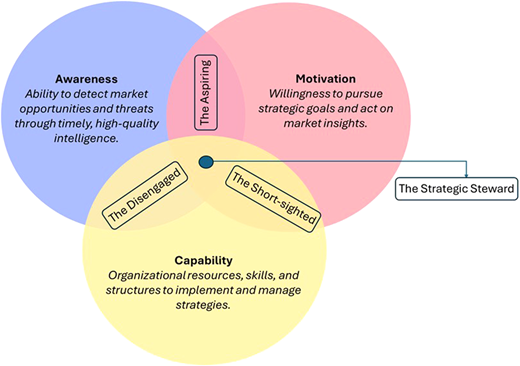
The AMC and the four archetypes of market shaping. Own creation
The AMC and the four archetypes of market shaping. Own creation
Public buyer market shaping archetypes based on the AMC framework
| Actors’ archetype | Description |
|---|---|
| The Disengaged | Passive followers who lack motivation or vision to engage strategically with procurement or market shaping |
| The Aspiring | Aspirational shapers who wish to shape the market but may lack capabilities, resources or power |
| The Short-sighted | Accidental Shapers whose actions shape the market unintentionally or in misaligned ways due to reactive or siloed behaviour, lacking awareness |
| The Strategic Steward | Deliberate Shapers with both capacity and intent to shape the market strategically and collaboratively |
“The Disengaged” (see in Figure 1, having Awareness and Capability): Awareness and capability together ensure that a municipality understands the market and has the necessary skills and resources to act. However, without motivation, there is no driving force to apply this knowledge and capability towards a strategic goal. Barney’s (1991) resource-based view highlights that simply possessing resources and capabilities does not automatically yield competitive advantage; these resources must also be valuable and applied in ways that create sustained value. Building on this, the AMC framework (Chen et al., 2007) adds that even when resources exist, actors must be motivated to deploy them and sufficiently aware of their environment to do so effectively. Similarly, public sector entities need motivation to apply their awareness and capabilities effectively.
“The Aspiring” (see in Figure 1, having Awareness and Motivation): While awareness can bolster motivation, the presence of both does not guarantee effective implementation without capability. A motivated and well-informed municipality that lacks the capability to manage contracts or determine and enforce policies will struggle to translate its strategies into effective actions. Capability is necessary to operationalize the motivations informed by awareness. The theory of planned behaviour (Ajzen, 1991) highlights that intention (motivation) alone is not sufficient for behaviour change; individuals (or organizations) also need the perceived behavioural control (capability) to execute their intentions.
“The Short-sighted” (see in Figure 1, having Motivation and Capability): Even with the capability and motivation to act, without awareness, a municipality may make ill-informed decisions that do not align with market realities or regulatory requirements. Awareness ensures that the actions taken are appropriate and effective within the specific market context. The concept of bounded rationality (Simon, 1991) suggests that decision-makers operate within the limits of their knowledge. Without sufficient awareness, even capable and motivated entities may make suboptimal decisions due to incomplete or inaccurate information.
“The Strategic Steward” (see in Figure 1, having Awareness, Motivation and Capability): The integration of awareness, motivation and capability ensures that municipalities can make informed, well-motivated and feasible decisions to positively shape the social care market. Awareness refers not only to general knowledge but, more importantly, to the availability of timely and high-quality information – conceptualized as market intelligence by Chen et al. (2007) – that enables actors to detect opportunities and threats in their environment. Motivation provides the willingness to translate this intelligence into strategic goals and actions, while capability ensures that these actions can be effectively implemented and managed. Together, these elements create a comprehensive framework for proactive and strategic market shaping.
Having conceptualised these archetypes representing varying degrees of market engagement, ranging from the passive “Disengaged” to the proactive “Strategic Steward”, we now turn to the empirical setting where these behaviours can be observed. To understand how differences in awareness, motivation and capability manifest in reality, we ground our study in the Dutch social care sector. This context is particularly relevant due to recent reforms that have fundamentally altered the market-shaping responsibilities of local governments, as explained next.
2.4 Research context: Supply markets and market shaping in social care contracting in the Netherlands
Following the development of four market-shaping archetypes, this section introduces the empirical setting in which these behaviours are examined. Our study focuses on the social care sector in the Netherlands, where the 2015 decentralisation reform transferred responsibility for organising and contracting most social care services from the national government to Dutch municipalities, giving them discretion to design their own procurement models. They could choose between public contracting (selective tendering with a limited number of contracted providers), “Open House” (open-entry systems in which all providers meeting predefined criteria may participate) or subsidy-based models (grant-based funding arrangements outside competitive procurement), each with distinct implications for control, competition and customisation (Uenk and Taponen, 2020). From a governance perspective, this shift reflects a broader move from centralized procurement coordination towards decentralized, locally embedded procurement strategies, a transition that strategic procurement scholars identify as enabling both experimentation and fragmentation (Patrucco et al., 2017, 2019). The result has been significant variation across municipalities in how social care markets are governed. Some opted for open systems with high provider diversity, others for selective partnerships with fewer, longer-term contracts. However, recent longitudinal data indicate this landscape is not static but actively evolving, providing a window into real-time market shaping (PPRC, 2024).
While early post-reform years were dominated by “passive” Open House models, recent trends (PPRC, 2024) show a decisive shift towards active market structuring. Municipalities are increasingly moving towards selective contracting, explicitly limiting the number of providers to reduce fragmentation and administrative burden. This shaping extends to market structure, with a notable rise in “main contractor” (consortium) models, where municipalities force the supply base to organize into collaborative networks rather than operating as atomized providers. Furthermore, market shaping is visible in financial incentives, as buyers increasingly adopt task-based (lump-sum) funding to shift provider focus from volume-driven outputs (P x Q) to population-level outcomes. Finally, the emergence of negotiation-based procedures highlights a growing sophistication in how public buyers combine selectivity with dialogue to align market conditions with public goals (PPRC, 2024).
This dynamic divergence provides an ideal setting to explore why and how local public actors (in this case, municipalities) engage in market shaping in practice. It enables observation not only of whether market shaping occurs, but how variations in awareness, motivation and capability underpin shifts from passive compliance to strategic intervention. The next section outlines the research design used to examine these dynamics at the local level.
3. Methodology
3.1 Research method and sampling for interviews
This research draws on a series of expert interviews with key stakeholders involved in the procurement of social care services in the Netherlands, including municipal buyers, consultants and suppliers. Expert interviews provide access to specialized, practice-based knowledge and informed perspectives on complex decision-making processes in public procurement (Bogner et al., 2009; Meuser and Nagel, 2009). Expert interviews allow for a focused exploration of how experienced actors interpret institutional roles, assess market dynamics and implement procurement strategies (Bogner et al., 2009). This method enables a thorough understanding of variations in procurement practice, and supports the study’s objective to analyse how awareness, motivation and capabilities are manifested and combined in shaping social care markets.
The focus of analysis in this study is the individual interviewee as an expert informant. Each interview is assigned a unique identifier (ID1−ID20), which refers to the interviewee rather than to a specific municipality or organization. These identifiers are used solely for analytical clarity and anonymisation purposes.
Though this research is not case study based, we wanted to interview experts with diverse experiences. Our starting point was a comprehensive dataset of tendering activities by Dutch municipalities for social care. This dataset was acquired from the Public Procurement Research Centre (Ketenbureau I-Social domein, 2022; Rijksoverheid, 2020) and analysed to develop a detailed picture of contracting since the time responsibility was devolved from central government. The dataset covers adult social care (seven service categories) and youth care (ten service categories), ranging from general to highly specialized services, and includes information on contracting instruments as well as pooling arrangements such as regional consortia. This quantitative dataset was not used for case-level analysis but served two purposes: (1) to contextualize observed changes in contracting practices over time and (2) to inform purposive sampling for expert interviews by identifying municipalities that had either maintained or changed their contracting approaches since decentralisation.
Two broad groups of municipalities were identified for sampling purposes: those that had maintained their contracting approach over time and those that had changed their contracting approach since decentralisation. The sample selection process also took account of geographic dispersion, the size of municipalities from large urban to small rural and demographic variations to ensure a comprehensive coverage of the Dutch municipality landscape. An overview of the sample characteristics is shown in Table 2. Ethical approval for the study was obtained from the University’s ethical board, and all participants received an information sheet prior to the interview and provided informed consent.
Profiles of respondents (n = 20)
| Respondent characteristic | Percentage | Respondent characteristic | Percentage |
|---|---|---|---|
| Employing organisation | Size of the employing organisation | ||
| Municipality | 45% | Small (1–499) | 42% |
| Consultant | 30% | Medium (500–999) | 17% |
| Supplier | 10% | Large (1,000–4,999) | 17% |
| Ministry | 5% | Very Large (+5,000) | 25% |
| Region | 10% | ||
| Years of experience | Position | ||
| 0–9 years | 10% | Director | 9% |
| 10–20 years | 50% | Policy advisor | 35% |
| 21+ years | 40% | Consultant | 13% |
| Account manager | 9% | ||
| Category Manager | 4% | ||
| Buyer | 9% | ||
| Contract Manager | 4% | ||
| Senior Advisor | 17% | ||
Table 2 reports characteristics of interviewees rather than of municipalities, for more details on each interviewee, please report to Appendix A. Percentages refer to the distribution of respondents across organizational background, organizational size, years of professional experience and functional role. Because several respondents held hybrid or cross-cutting roles (for example, an experienced contract manager at a municipality joined a consultancy firm and then worked with multiple municipalities), categories are not mutually exclusive.
By engaging with public stakeholders directly involved in social care contracting, including suppliers, consultants in the social domain, purchasing advisors, contract advisors, project leaders, managers and policy advisors, both at the municipality and regional level, we aimed to enrich our understanding of the factors influencing contracting methods and their impact locally or more widely at, say, regional level. A total of 20 interviews were conducted between April 2024 and January 2025, lasting between 45 and 90 min via Microsoft Teams software. To ensure linguistic accessibility, a choice was given to interviewees to conduct the interview in English or in Dutch, resulting in half of the interviews in English and half in Dutch.
3.2 Interview setup and analyses
The semi-structured interviews, drawing from the methodology outlined by Magaldi and Berler (2020), focused on the rationales, motivations and perceived consequences of contracting decisions in social care procurement. Interview guides were informed by prior research on strategic procurement and market shaping and by insights derived from the tendering dataset used to guide sampling. The interview protocol is provided in Appendix B.
Interview questions explored why municipalities maintained or changed contracting approaches, what outcomes were expected and how interviewees perceived the effects of these decisions. Importantly, interviews did not treat municipalities as cases; rather, they elicited expert reflections on patterns, mechanisms and decision logics across contexts. For municipalities that had not changed contracting methods, questions focused on reasons for stability or deliberate inaction.
As already introduced earlier, the interview setup was informed by the AMC framework as a set of concepts rather than as a deductive coding scheme. This means that awareness, motivation and capability guided the focus of questioning, without predetermining how these dimensions would appear in the data or how they would relate to one another. Of particular interest was understanding how municipalities perceive their role in influencing the competitiveness and dynamism of the provider market through their contracting choices. This included uncovering whether municipalities consciously shape their contracting strategies with the long-term goal of fostering market health, locally or more widely. Through these interviews, we aimed to capture nuanced insights into the motivations and implications of municipalities’ contracting decisions, thereby contributing to a deeper understanding of market dynamics in the context of social care services and relating to the three dimensions of AMC. By integrating the AMC framework into the interview design, the study ensured that all relevant aspects of market shaping were systematically explored, explaining how and why municipalities seek to influence market dynamics.
Interview audio recordings were transcribed verbatim using Microsoft Teams’ built-in transcription feature. The resulting transcripts were then carefully reviewed and manually cleaned to correct transcription errors, verify accuracy and ensure readability, so producing reliable qualitative data (Gioia et al., 2013). For interviews conducted in Dutch, transcripts were first anonymised to remove identifying information and then translated into English using the TurboScribe transcription and translation platform. The translated transcripts were subsequently checked against the original Dutch versions to ensure semantic accuracy and consistency.
An abductive approach was employed using Atlas.ti (version 25) for the analysis aligning with the exploratory nature of the research while being informed by sensitising concepts from the AMC framework (Nowell et al., 2017). This approach ensured that the analysis remained open to patterns emerging from the data, while also engaging iteratively with theoretical insights on market shaping and procurement decision-making. In this way, the analysis was not constrained by a priori categories yet remained analytically focused on understanding how procurement actors engage with market shaping in practice. The first author served as the primary coder, ensuring consistency across the interviews. Coding proceeded in two iterative rounds. A complete coding process can be found in Appendix C. In the first round, a set of broad, sensitising codes was developed to capture overarching aspects of procurement practices, governance dynamics and market engagement. These initial codes reflected general orientations towards market awareness, motivations for change, capabilities to influence market dynamics, contracting methods and perceived market impacts. While informed by the research focus and the AMC framework, these codes were deliberately kept broad and exploratory, serving to structure engagement with the data rather than to impose a fixed analytical template (Tracy, 2010). In the second round, the analysis moved to more fine-grained, empirically grounded coding. This stage generated a more detailed set of inductive codes capturing how awareness, motivation and capability were expressed, constrained or enacted in practice. These included actor-level themes (such as expressions of awareness, motivational intent and assessments of capability), as well as contextual and cross-cutting factors (such as administrative challenges, governance arrangements, supplier influence and cultural differences between municipalities). Several of these themes cut across the AMC dimensions, reflecting the intertwined nature of awareness, motivation and capability in practice. Rather than assigning codes to AMC categories, the AMC framework was used at a later stage of analysis as an interpretive lens to synthesise patterns across the derived codes. This synthesis involved examining how combinations of themes corresponded to different configurations of awareness, motivation and capability evident across the interview material. Through this process, the AMC framework supported the stratification of meaningful patterns of market engagement, without treating awareness, motivation and capability as independent or mutually exclusive variables. Throughout the analysis, direct quotes were selected to support emerging claims, not just as illustrations but as empirical evidence of the conceptual points being developed, following the approach suggested by Rockmann and Vough (2024).
To connect municipality-related insights from the interviews to the archetypes, we interpreted interviewees’ accounts of local procurement practices and experiences considering the patterns of awareness, motivation and capability identified across the dataset. Rather than mechanically assigning municipalities or interviews to predefined categories, the archetypes emerged through comparative interpretation of recurring configurations described by multiple respondents. This interpretive process focused on identifying dominant ways in which procurement actors engaged with market shaping, as reflected in the interview material, and abstracting these into analytically meaningful roles. The archetypes therefore represent synthesized patterns of behaviour inferred from the data.
4. Findings
Rather than treating municipalities as discrete cases, the findings draw on expert interviewees’ experiences and reflections across multiple organizational and municipal contexts to identify recurring patterns in how procurement decisions influence market dynamics. These findings, organized using the AMC framework, reveal significant shifts in contracting methods and their implications for market governance and supplier relationships (see Table 3 for illustrative interview excerpts).
Manifestations of awareness, motivation and capability in practice
| AMC component | Example quote |
|---|---|
| Awareness | “if you have too many suppliers, it is not … You have no proper contract management anymore. It gets out of control. […] The markets are too small for too many suppliers, they can't survive.” [ID18] |
| “We have said from the beginning: purchasing and contract management cannot be separated […] you should actually be around the table with purchasing from moment one.” [ID20] | |
| “So what I now see and I think that's a good sign, is that we're more considered in what we want to achieve with a certain contract and we're picking the right method just because it's helping you in your strategy and not just because of picking a method for the method itself.” [ID15] | |
| “We are now in two years of those contracts … we have more control over the suppliers. We can guarantee a certain standard of quality … we don't contract any new suppliers anymore” [ID1] | |
| Motivation | “You are now mainly expected to contract as few suppliers as possible. So the fewer suppliers I contract, the more I can bet on the relationship. And in that relationship, a party can then force the innovation of the care.” [ID19] |
| “We are moving towards more long-term relationships with a select group of providers. The goal is stability and ensuring that we can guarantee quality services for the community.” [ID15] | |
| “We need to make sure that we have fewer, but better-quality providers in the market. This allows us to focus on managing fewer, larger contracts and ensures service quality.” [ID19] | |
| “We started from the idea so much possible and everything Open House. […] At the same time we want to put a brake on the endless expanding number [of] providers. […] all new parties come on a waiting list and the party inflow [only happens] at the time that they solve a hole in our healthcare landscape.” [ID20] | |
| “We have even included in our contract that they [providers] must, within one year, submit an innovation. And we'll jointly assess whether that's valuable or not.” [ID 18] | |
| Capability | “We engage with providers early. We explore what is available and where the limits are, so we don't ask for things that can't be done, or miss opportunities that could work better.” [ID5] |
| “I think we've been talking about the whole [supply chain] line lately: we have to be more in touch with each other. And you can give that a place in your contract” (ID 20) | |
| “We have regional policy staff, and buyers and contract management all in the same organization.” (ID 20) | |
| “Being part of a regional consortium allows us to pool resources and increase our leverage during negotiations. We can coordinate across municipalities and leverage our collective bargaining power.” [ID18] | |
| “We really had to make a shift in our contracting during COVID. The whole situation forced us to reconsider what we needed from suppliers, and in some cases, we had to onboard new ones quickly. Open house gave us that flexibility.” [ID15] | |
| “We work nationally on contract standards to limit the administrative burden. But they are not applicable on subsidy […] For 80% you can make the same agreements. And for 20% you might have to colour in differently.” [ID20] |
Note(s): Table 3 presents illustrative excerpts selected to exemplify how awareness, motivation and capability were expressed across interviews. The quotes are not intended to represent complete accounts of individual municipalities, but to ground the analytical patterns discussed in Sections 4.1–4.3
The interviews show how municipalities are reshaping social care markets through strategic contracting decisions. Throughout this section, interview excerpts are used as empirical evidence of broader patterns, rather than as within-case narratives. Through interpretation of the interviewees’ reasoning, and our earlier definition of market shaping, we acknowledge that procurement decisions can generate market shaping effects both deliberately and without being explicitly framed as market interventions by the decision-maker. We first examine how the dimensions of the AMC framework emerged from our interview data. Subsequently, we provide a detailed analysis of the archetypes, illustrating how these dimensions interact to drive market-shaping behaviour.
Table 3 provides illustrative excerpts that exemplify how these themes were expressed across interviews and informed the interpretation of each AMC dimension.
4.1 Awareness
Following the decentralisation reform in 2015, municipalities became increasingly aware of their role in shaping the social care market through procurement. This awareness was not limited to responding to immediate needs or challenges but extended to recognising that procurement decisions influence broader market dynamics over time, including an awareness of the need for more predictable service outcomes. Importantly, this understanding was articulated by interviewees across different organisational positions and municipalities, indicating a shared recognition at the system level rather than isolated local trajectories.
Interviewees frequently highlighted growing awareness of the fragmented nature of local social care markets, particularly in rural regions and in municipalities with less mature procurement functions. Market fragmentation was associated with challenges related to quality control, administrative burden and complexity, as well as overall inefficiencies in service delivery. This led to recognition that greater coordination, including at the regional level, could improve the efficiency and coherence of contract management and service provision.
In addition, municipalities demonstrated awareness of their significant purchasing power within the social care market. Interviewees noted that through more collaborative procurement models, municipalities can leverage this power to influence contractual terms and conditions, including pricing, quality standards and the inclusion of innovation-related clauses. Procurement was thus understood not merely as an administrative function, but as a lever with the potential to shape market behaviour and outcomes over time.
Municipalities also recognised the increased complexity and uncertainty of the decentralised social care market, and the implications this has for procurement approaches. Interviewees described a growing understanding that navigating these conditions requires more strategic forms of procurement, moving beyond open and minimally regulated contracting arrangements towards approaches that support oversight, stability and longer-term relationships with providers. Taken together, these findings reflect a shared understanding across municipalities of how procurement shapes market dynamics, as reported by the expert respondents, rather than tracing case-specific accounts of individual local authorities.
4.2 Motivation
Municipalities’ contracting approaches are motivated by a desire to shape social care markets in ways that serve stakeholder needs and align with longer-term strategic goals. Interviewees identified motivations aimed at creating more efficient, resilient and sustainable social care markets, particularly in the context of growing demand and fiscal pressure.
When discussing their motivations, interviewees emphasised a sense of responsibility for social care market outcomes, rather than pointing to formal mandates or centralised policy requirements as primary drivers. This sense of responsibility was frequently articulated in relation to concerns about service quality, long-term sustainability and the adequacy of existing market arrangements to meet future needs.
A primary motivation for engaging in market shaping is to improve the quality and efficiency of service delivery while optimising the use of public budgets. Interviewees described increasing pressure on municipal resources as demand for social care services continues to rise, driven by various factors including demographic developments (Foster, 2025; Valkama and Oulasvirta, 2021). In this context, consolidation of supplier markets was framed as a way to gain greater control over both service quality and costs, thereby improving outcomes for citizens.
Municipalities were also motivated by the pursuit of greater stability and predictability in social care provision. Interviewees highlighted the importance of working with fewer, more reliable providers to ensure consistent service delivery and support long-term community needs, reflecting an intention to move beyond short-term cost considerations alone.
Reducing market fragmentation emerged as a further motivation, closely linked to these concerns. While Open House contracting arrangements offer flexibility, interviewees expressed concerns that fragmented supplier bases undermine efficiency and coherence in service delivery over time. Supplier consolidation was therefore described as a pragmatic response to fiscal pressure and service quality concerns, rather than as a normative preference for centralisation.
Finally, municipalities expressed motivation to use contracting approaches to foster innovation in social care delivery. Interviewees noted the importance of creating market conditions that balance competition and collaboration to encourage providers to develop new and improved service solutions. In summary, the findings describe motivational drivers evident across municipalities, rather than documenting case-specific strategic choices within individual local authorities.
4.3 Capability
Municipalities’ capability to implement market shaping strategies is largely determined by their knowledge, resources and institutional support. When interviewees referred to institutional support, they primarily meant the presence of dedicated procurement staff, access to market expertise and participation in regional consortia, rather than formal hierarchical authority. Overall, municipalities with more developed procurement and contractual structures were described as better equipped to engage in market shaping, while smaller municipalities faced more pronounced capability constraints.
A central capability concerns the availability of institutional support to manage the complexity of social care procurement. Larger municipalities and regional consortia were described as benefiting from dedicated procurement teams, access to market intelligence and more robust contract management systems. These arrangements supported informed decision-making by enabling municipalities to assess supplier capabilities, track market developments, and better understand cost structures, thereby strengthening their ability to manage procurement processes strategically.
Capability was also shaped by municipalities’ ability to coordinate procurement activities across organisational boundaries. Collaboration within regional consortia enabled municipalities to pool resources, standardise procedures and align contract award and management practices, including securing longer contract durations with providers, generating uniformity across municipalities and often across regions. Interviewees noted that such coordination simplified procurement processes, reduced administrative burdens and supported consistent application of quality standards across municipalities, contributing to more equitable service delivery.
The capacity to adapt procurement approaches to changing market conditions emerged as another important capability. Municipalities reflected on their ability to shift between public contracting and Open House methods in response to market developments, service demands and external disruptions, allowing them to remain responsive to both immediate needs and long-term shifts in the social care landscape. Interviewees linked this flexibility to the presence of dedicated procurement capacity and more mature procurement structures, while noting that less developed arrangements limited the ability to adjust contracting approaches in a timely and coordinated manner. This flexibility was particularly important in the wake of COVID-19, which disrupted supply chains, service delivery and procurement processes. Interviewees described how municipalities were able to reassess and adjust contracting approaches, including relying on Open House arrangements to rapidly mobilise additional providers.
Working with fewer providers was described as enabling municipalities to redeploy organisational resources towards more intensive contract management and provider engagement. Interviewees highlighted the importance of prioritising staff time and managerial attention to sustain closer relationships with selected suppliers. This resourcing capacity supported ongoing coordination, monitoring and problem resolution within more concentrated supplier markets.
Some municipalities further demonstrated capability in designing contractual arrangements that allocate coordination and risk responsibilities to selected providers. Interviewees referred to the use of prime contractor arrangements as a way to manage complex service delivery networks and simplify governance structures. In addition, municipalities described the use of contractual clauses and governance mechanisms that embed innovation objectives within procurement arrangements, making innovation a shared responsibility between municipalities and providers.
Finally, cooperative procurement arrangements not only provided cost savings but were described as facilitating knowledge sharing and learning across municipalities. By collaborating on procurement strategies, municipalities were able to exchange experiences, adopt successful practices and avoid common pitfalls. This knowledge-sharing also helps to standardize procurement processes across multiple municipalities, which reduces administrative burdens, minimizes the risk of errors and ensures consistent service delivery across regions.
Taken together, these findings highlight patterns in capabilities observed across municipalities, rather than detailing the development of capabilities within specific local cases. Cooperative procurement arrangements enhanced municipalities’ capability by enabling coordination, learning and scale-related resource pooling. While larger municipalities and regional consortia benefitted from more extensive support structures, interviewees did not suggest that smaller municipalities were incapable of shaping markets; rather, differences in capability shaped how municipalities engaged.
4.4 Synthesis of analyses of the individual AMC dimensions and their relationships
The data show that municipalities vary widely in how they engage with the market, and these differences can be understood through the lens of the different dimensions of the AMC framework. These variations do not imply linear development or temporal progression; instead, they reflect different configurations of awareness, motivation and capability observed across interviewees’ accounts. Municipalities that demonstrate high levels of awareness are those that recognize that they have an influence on market dynamics and understand the long-term consequences of their contracting choices in shaping supplier behaviour. This awareness is often reflected in more deliberate decision-making and strategic alignment with broader policy goals. Motivation emerged as a key driver of strategic behaviour. Municipalities motivated to shape the market often expressed goals such as improving service quality, consolidating supplier bases or fostering innovation. Notably, motivation is not solely mandate-driven; a sense of responsibility is also important. However, the presence of motivation alone was not sufficient. The final dimension, capability, proved to be a critical enabler of action. Capability emerged as a critical condition shaping how municipalities were able to engage in market shaping, influencing the scope, form and intensity of their contracting approaches. Regional consortia and long-term investment in procurement expertise were particularly important in supporting this capability development.
Together, these three dimensions form the basis for understanding how municipalities navigate and shape the social care provider market. However, the combination of these dimensions varies across contexts. Some municipalities show strong engagement in all three areas, while others show only limited engagement. To capture these differences, we returned to the archetypes introduced earlier and examined how the observed configurations of awareness, motivation and capabilities correspond to distinct roles municipalities assume in market shaping.
4.5 Applying the market shaping archetypes to Dutch social care
Based on our conceptual framework and analysis of the interview data, we were able to empirically substantiate the previously developed four archetypes: The Disengaged, The Aspiring, The Short-sighted, and The Strategic Steward. Each represents a distinct configuration of the AMC dimensions, revealing how municipalities engage (or fail to do so) in market shaping. In addition to these four anticipated roles, our evidence points to a fifth, emergent archetype that was not originally part of our framework. This group, which we term The Market Drifter, consists of municipalities whose actions influence the market, but do so reactively and without strategic direction. While they do not consistently demonstrate awareness, motivation or capabilities related to market shaping, their choices still shape the provider landscape. Below, we illustrate how these archetypes are reflected in the interviews and what they imply for understanding the diversity of procurement practices in the social care sector (Table 4).
Mapping buyers’ archetypes for market shaping
| Section | Interviews | Description | Examples |
|---|---|---|---|
| The Disengaged [A + M− C+] | [ID4], [ID12], [ID3] | Lack motivation or vision to engage strategically; passive in market shaping | [ID4]: continued Open House use by default |
| [ID12]: focus on continuity, not strategy | |||
| The Aspiring [A + M + C−] | [ID5], [ID1], [ID3] | Motivated to shape markets but lack sufficient resources or capacity | [ID5]: intention to increase market accessibility despite limited authority |
| [ID1]: recognised challenges with large supplier base | |||
| The Short-sighted [A− M + C+] | [ID19], [ID11], [ID15] | Shape markets unintentionally or inefficiently due to low awareness or siloed behaviour | [ID19]: unintended splintering of market |
| [ID11]: overlap and lack of coordination in provider roles | |||
| The Strategic Steward [A + M + C+] | [ID8], [ID10], [ID18] | Actively shape markets with coordinated strategies and long-term intent | [ID8]: proactive long-term planning |
| [ID10]: mix of dialogue-based procurement and structured supplier management | |||
| The Market Drifter [A− M− C−] | [ID1], [ID2], [ID15], [ID17] | Reactive, non-strategic decision-making; shift practices without long-term intent | [ID1]: reactive to supplier lobbying without clear policy |
| [ID17]: procurement changes made under pressure (e.g. financial) without long-term strategy |
Note(s): Key: [IDx] refers to the interviewees who spoke about the relevant municipalities. [A* M* C*] refers to awareness – motivation – capability with the absence or presence marked in superscript. Interviewee Note: IDs may appear across multiple archetypes, reflecting descriptions of different municipalities rather than individual trajectories
The evidence from interviews helps enrich the a priori market shaper profiles, contextualising them for the Dutch social care sector. Note the IDs listed in Table 4 and below refer to interviewees who described municipalities which clearly reflected each configuration; they do not imply that a single interviewee or municipality is exclusively associated with one archetype.
4.5.1 The Disengaged [A+ M− C+]
Disengaged municipalities have the necessary awareness and capabilities to shape the market but lack the motivation to do so. These actors understand how procurement decisions can influence market dynamics and may even have the institutional capacity or governance structures in place to act. However, they refrain from engaging strategically due to perceived political risks or administrative convenience. In this sense, disengagement is not due to ignorance or incapacity, but rather a lack of internal drive or leadership to pursue market-shaping goals. Procurement in these municipalities tends to remain compliance-focused and procedural, with little interest in innovation or long-term impact.
For example, ID4 maintained their original contracting method, despite recognising its shortcomings, prioritising continuity and legal simplicity over the potential benefits of reform. Similarly, ID12 emphasised the importance of stability and minimal disruption, even when existing arrangements were inefficient or fragmented. In both cases, municipalities had the tools and knowledge to engage more proactively but opted for a low-risk approach. ID3 also demonstrated disengagement by acknowledging market challenges without initiating changes, reflecting a passive stance rather than a lack of understanding.
4.5.2 The Aspiring [A+ M+ C−]
Aspiring municipalities express a clear desire to shape the market and improve procurement outcomes but often fall short due to a lack of institutional support, capacity or political mandate. These actors show motivation but lack the capabilities, such as dedicated procurement teams or decision-making autonomy to implement their ideas. Their awareness of problems in the market is often strong, and they can articulate goals related to service quality or market access. However, their initiatives are often prevented by resource constraints, governance structures or institutional uncertainties.
ID5 expressed strong motivation to increase accessibility and responsiveness in the care market, particularly for local providers, but lacked sufficient formal structural authority – and therefore resources and capability – to translate these ambitions into procurement reforms. ID1 explained that in recent years they had come to recognise that managing a supplier base of over 300 was unsustainable and misaligned with their goals, but at the time struggled to initiate change without broader support and investment. ID3 similarly described their desire to introduce more strategic tools but noted limited capacity within their team and competing priorities. In each case, municipalities had intent but lacked the means to move beyond aspiration.
4.5.3 The Short-sighted [A− M+ C+]
Short-sighted municipalities engage in procurement reforms or contracting decisions that end up shaping the market, but in ways that are unintended or misaligned with long-term policy goals. These actors are often motivated and have some operational capacity, but their decisions are made in reactive ways, driven by isolated problems, incomplete market understanding or siloed decision-making. This leads to fragmented supplier landscapes and inefficient coordination, overlapping provider responsibilities and contracting arrangements that undermine rather than support long-term objectives.
ID19 discussed how the Open House model unintentionally led to a splintered supplier landscape, increasing administrative complexity and reducing efficiency. While well-intentioned, the procurement approach lacked a guiding vision to manage the long-term consequences of provider proliferation. Similarly, ID11 shared that a lack of coordination between providers created overlaps and confusion, complicating service delivery. ID15 emphasised a shift to performance-based contracts, but the interview highlighted that these were not always embedded within a broader strategic framework, limiting their impact. These examples illustrate that municipalities can influence market dynamics significantly, even unintentionally, when procurement choices are not grounded in holistic, long-term thinking.
4.5.4 The Strategic Steward [A+ M+ C+]
ID8, ID10 and ID18 described municipalities that deliberately redesigned procurement arrangements to steer innovation, build longer-term relationships and manage market health over time. The interviews also highlighted municipalities that demonstrate high levels of awareness, motivation and capabilities, aligning with what we conceptualise as strategic steward. These municipalities approach procurement not just as a technical or legal task but as a policy tool to influence the market and improve long-term outcomes through higher performing care providers. They actively reflect on how their decisions affect market dynamics, engage with suppliers in a purposeful way, and invest in resources and governance mechanisms that allow them to manage complexity over time.
ID10 described a striking example: a municipality which had around 80 contracts made a deliberate shift to just 10 main providers through public procurement, with the aim of improving coordination, accountability and long-term stability. This transition was driven by the recognition that the previous model made it impossible to maintain meaningful oversight or relationships with providers. ID18 similarly emphasised the importance of using contractual instruments, such as an innovation clause requiring providers to propose new initiatives within the first year to stimulate service improvement and forward-looking partnerships. Both cases illustrate how municipalities can use procurement as a strategic lever to actively shape their local care markets.
4.5.5 A new archetype: The Market Drifter [A− M− C−]
While many municipalities show partial or growing engagement with strategic market shaping, the interviews also revealed a group of municipalities that exhibit little to no awareness, motivation or capability, which we label market drifters. These municipalities operate in a reactive mode, adjusting their procurement practices only in response to external pressures or internal crises, rather than through intentional design. In these cases, there is no coherent strategy, and procurement decisions tend to be driven by short-term needs, administrative overload or political concerns, rather than by long-term goals for service quality, efficiency or market structure.
Interviewees described these market drifters as municipalities that appear overwhelmed by the complexity of managing dozens or even hundreds of providers and, instead of developing a governance strategy, simply reproduce existing procedures or default to the status quo. As explained by ID15, some municipalities “don’t have a vision” and simply accept the market situation as it is. Others, like ID1, admitted that in the past they did not set out to shape the market and that procurement was handled in a way that responded to crises rather than anticipated them. ID2 explained that smaller municipalities were described as having “no people, no knowledge,” and delegate most procurement decisions to larger regional actors, without much involvement or influence of their own. The capabilities they rely on are to commission others to represent their interests and are not directly concerned with market shaping. Finally, ID17 described adapting procurement practices under external and time pressures, without evaluating long-term consequences.
What defines these market drifters is not passivity alone, but a form of structural drift, in which procurement systems evolve in unplanned ways due to lack of internal direction. This often results in unintended market outcomes: overly fragmented supplier bases, reduced quality control and missed opportunities for innovation or collaboration. These municipalities neither leverage their purchasing power nor engage in collective action, and while they may not be seen as failing, they are also not steering the market towards better outcomes. Instead, the market shapes them. While the Market Drifter archetype appears visually distinct in Figure 1, this does not imply the absence of procurement capability. Rather, market drifters possess limited or fragmented capabilities that are insufficiently mobilised for strategic market shaping, resulting in reactive rather than purposive engagement.
5. Discussion and conclusion
5.1 Discussion of findings and contribution to literature
The aim of our study was to examine how local contracting authorities influence the structure and functioning of their markets through their procurement practices. Specifically, we sought to understand the role of awareness, motivation and capabilities when engaging (or failing to engage) in market shaping actions.
Our findings align with prior work from Uenk and Telgen (2019) who show that Dutch municipalities, even under capacity constraints and complexity, actively (although not always deliberately) change their social services markets through procurement choices. Similarly, Patrucco et al. (2017) highlight the role of public buyers as agents of change, noting that procurement is increasingly a strategic function rather than a purely administrative task. We build on these insights by examining in greater depth how such influence occurs and why it varies across municipalities. In this respect, our findings also resonate with Carey et al.’s (2020) framework of institutional capacity for market stewardship. The results of the interviews shed light on several key dynamics shaping the social care market. Municipalities have progressively moved from more reactive approaches to more strategic procurement, aiming to shape the market in ways that benefit both the providers and the communities they serve. This observed shift parallels broader arguments in the strategic procurement literature that emphasise procurement’s transformation from a compliance-oriented function to a mechanism through which public actors actively structure markets and inter-organizational relationships (Caldwell et al., 2005; Patrucco et al., 2019; Uyarra and Flanagan, 2010). At the same time, our findings indicate that this transformation is uneven and contingent, rather than uniformly realised across local authorities.
An important finding of this study is that, although most interviewees did not explicitly describe their actions as “market shaping” strategies, they nonetheless considered the longer-term implications of their procurement decisions for the structure and functioning of local social care markets. Few respondents used the language of market design or market shaping; instead, they referred to “strategic procurement”, “streamlining supplier relations” or “reorganizing contracts”. This implicit orientation towards market outcomes suggests that market shaping in this context emerges through accumulated procurement decisions embedded in everyday administrative routines. This complements, but contrasts with, explicit market design logics in work in the market shaping literature (Araujo et al., 2008; Flaig et al., 2021b; Nenonen et al., 2019).
These findings engage with debates in the literature on strategic procurement and market governance. Prior work has emphasised procurement’s potential as a tool for innovation and systemic change (Edler and Georghiou, 2007; Patrucco et al., 2017; Uyarra and Flanagan, 2010), and more recently as an instrument of market governance in quasi-markets (Carey et al., 2020; Malbon and Carey, 2021). Building on these perspectives, our study shows how procurement influences markets through both deliberate and unintended effects, and why such influence varies across municipalities. In some cases, municipalities adjusted contracting methods in response to policy pressure or operational inefficiencies, producing significant structural effects such as excluding smaller providers, or altering market entry conditions. In these instances, market shaping emerged as an unintended outcome of routine procurement decisions, echoing earlier work on serendipitous effects in organizational decision-making (Busch, 2020, 2024).
At the same time, we observed municipalities that explicitly considered the longer-term effects of their procurement choices on market dynamics and deliberately employed instruments such as using multi-year contracts to foster collaboration, stability and innovation. Taken together, these findings demonstrate that market shaping may occur both unintentionally and deliberately, and that variation across municipalities reflects different configurations of awareness, motivation and capability rather than the presence or absence of strategic intent alone. In doing so, our study responds to the gap identified by Malacina et al. (2022) concerning the underexplored role of public buyers in shaping well-functioning supplier markets, and nuances procurement scholarship that tends to equate strategic intent with market influence.
Another key contribution of this paper is the development of an empirically grounded typology of public buyers’ roles in shaping social care markets, interpreted through the AMC framework. While prior literature has often characterised public procurement actors as either active or passive actors in the market (e.g. Caldwell et al., 2005; Uenk and Telgen, 2019), our findings reveal more differentiated and dynamic patterns of engagement. By applying the AMC framework to local public procurement in decentralised social care markets, we extend recent research that has examined procurement’s strategic role in crisis management (Harland et al., 2021) and private-sector innovation (Constant and Johnsen, 2025) to a context that has received comparatively little attention.
Our analysis shows that awareness, motivation and capabilities are equally relevant in municipal contracting, but manifest differently under conditions of decentralisation, political accountability and uneven capacity. In this setting, market shaping does not depend solely on deliberate strategic intent, but emerges through varying configurations of AMC dimensions, including reactive and adaptive forms of engagement that are not fully captured in existing applications of the framework. By identifying these configurations and linking them to distinct buyer roles, our typology refines the AMC perspective to better account for how market governance effects arise in fragmented institutional environments. In doing so, we contribute to procurement and market governance scholarship by situating AMC within the practical realities of decentralised public service provision, while also offering insight into how municipalities may strengthen their role as intentional market stewards over time.
In Table 1, we proposed a four-section model of archetypes that differentiates buyers based on their AMC to shape markets. Each section represents an ideal-type role that highlights variations of contracting methods which may (not) influence the markets in which they operate. Our empirical analysis largely confirmed the conceptual logic of this framework. Across the interviews, we found numerous instances where the behaviours and challenges described by actors aligned with the characteristics of the four archetypes. For example, some municipalities rely on pre-existing procurement structures without strategic intent and delegate decisions to external actors, while others actively engage with suppliers and articulate ambitions for change but lack the internal support to execute those ambitions (Aspiring). In other cases, municipalities restructure their supplier bases or introduce new contracting arrangements to address immediate constraints, but in doing so reshape market incentives without a broader strategic orientation (Short-sighted). Finally, a few municipalities deliberately design procurement arrangements to steer innovation, build longer-term relationships and manage market health over time, corresponding to the Strategic Steward role.
The interviews also revealed a pattern of behaviour that was not captured in our initial application of AMC, leading us to identify a fifth archetype, the Market Drifter, which challenges assumptions that market shaping necessarily reflects coherent strategy or intentional design. These municipalities shift between contracting models not with the intention to shape markets, but in response to emerging dysfunctions such as high administrative burden, supplier overload or legal and financial pressures. While they are not entirely unaware or unmotivated, their actions are reactive and adaptive, rather than purposive, driven by practical constraints and producing market effects without a stabilised vision or consistent strategic intent.
Importantly, these archetypes should not be interpreted as fixed categories. Several interviews reflected combinations of roles, either because municipalities were in transition or because different organisational functions exhibited different profiles. Taken together, these findings suggest that while market shaping is an inherent feature of procurement activity, its visibility and intentional steering depend on configurations of awareness, motivation and capability. This reinforces the view of market shaping as a dynamic and evolving process, in which municipalities may move between configurations of awareness, motivation and capability over time rather than occupying a single, static position.
5.2 Implications for policy and practice
The findings provide novel insights helping to connect local (in)action and national-level policy concerns and assumptions about market dynamics. In recent years, the Ministry of Health, Welfare and Sport has voiced strong criticism of the open house system in youth care, with Minister De Jonge explicitly calling for its abandonment due to inefficiency and poor quality (de Koster, 2019). At the same time, alternative approaches such as consolidation around a limited number of prime contractors carry their own risks, including reduced provider diversity and over-concentration of market power. Our findings suggest that such policy debates cannot be resolved through uniform prescriptions, as municipalities differ substantially in their awareness, motivation and capability to shape local social care markets through procurement. The archetypes identified in this study illustrate how similar policy instruments may generate markedly different market outcomes depending on how they are interpreted, implemented and governed at the local level.
From a policy perspective, the typology developed in this study offers a way to better appreciate both the expertise that already exists at the municipal level and the gaps that constrain effective market shaping. By distinguishing between municipalities that are disengaged, aspiring, short-sighted, strategically stewarding or drifting, the typology can serve as a diagnostic tool to identify whether limitations in market shaping stem primarily from insufficient awareness of market dynamics, weak or conflicting motivations or a lack of organisational capabilities such as procurement expertise, data or coordination capacity. This distinction is critical, as each configuration implies different forms of policy support and intervention. In this sense, the typology can also serve as a diagnostic tool, helping policymakers distinguish whether constraints on market shaping stem primarily from limited awareness, weak motivation or insufficient capability and to target support accordingly. Rather than imposing one-size-fits-all solutions, central government could draw on these insights to encourage more distributed forms of market shaping rather than centralised regulation, by supporting municipalities in developing the awareness, motivation and capabilities required to adopt contracting approaches that fit their specific contexts while remaining aligned with national objectives. In this way, procurement strategies function not only as tools of local governance but also as mechanisms through which municipal practice can be aligned with broader policy aims of achieving well-functioning, competitive and high-quality social care markets.
5.3 Implications for future research: scope, limitations and opportunities
While this study provides valuable early insights into contracting practices for social care services, it also has limitations that should be considered when interpreting the findings. The interview sample was carefully designed to capture diversity across municipalities of different size, regional context and organisational arrangements. At the same time, the study is situated within the Dutch social care system, and the patterns identified reflect the specific institutional and regulatory context in which market shaping takes place. Accordingly, the findings are not intended to support empirical generalisation but instead offer analytically transferable insights into buyer roles and market-shaping capacity. Future research could extend this work by examining how the AMC-based typology of buyer roles applies in other national or sectoral contexts, and by comparing how different institutional settings shape the configuration and enactment of awareness, motivation and capability.
A further methodological consideration concerns the interpretive nature of the qualitative analysis. Close-up coding and interpretation were led by a single researcher, reflecting the interpretive and sensemaking orientation of the study. Alongside careful and systematic coding, rather than prioritising coder convergence, the analysis emphasised reflexivity, transparency and plausibility of interpretation. Importantly, interpretation was not conducted in isolation: emerging insights were discussed extensively within the author team, bringing together complementary forms of expertise, including deep familiarity with the empirical field, practical experience within the sector and accumulated supervisory experience across related research projects. These discussions functioned as a form of analytic triangulation, supporting critical interrogation of emerging interpretations and helping to surface alternative readings of the data. As with all interpretive qualitative research, the findings reflect informed and situated judgements rather than definitive or exhaustive accounts; their value lies in the coherence and usefulness of the explanations offered, rather than in claims of objectivity or replicability.
Having only one respondent per organisation or municipality interviewed is a further limitation of the study, which necessarily constrains the range of perspectives captured. Respondents were selected for their central role in procurement and contracting, and many had accumulated experience across several municipalities, enabling them to reflect not only on their immediate organisational context but also on broader patterns of practice. This expert-oriented approach was well suited to the study’s aim of developing an empirically grounded understanding of how awareness, motivation and capability for market shaping are framed in relation to procurement practice by key actors. Nevertheless, future research could extend this work through multi-actor case studies within municipalities or procurement consortia. Such designs would allow a more fine-grained analysis of how awareness, motivation and capability are distributed across functional roles (e.g. buyers, contract managers, policy advisors), and how organisational culture, leadership or interdepartmental coordination shape collective market-shaping capacity. This would also enable analysis at the level of organisations or networks, for example by examining how different organisational configurations align with the “aspiring” or “strategic steward” archetypes identified in this study.
Beyond these design-related limitations, the findings open several important opportunities for future research, both in terms of substantive focus and methodological approach. Across the interviews, respondents frequently reflected on concrete market-shaping strategies and interventions, often implicitly linking these to varying levels of awareness, motivation and capability. This suggests that AMC may offer a useful lens not only for characterising buyer roles, as in the present study, but also for analysing how different forms of market-shaping practice emerge and are combined in public procurement contexts. Building on this insight, future research could examine more systematically how specific procurement strategies – such as supply-side vs demand-side interventions (Edquist and Zabala-Iturriagagoitia, 2012) – align with different configurations of awareness, motivation and capability, and how these configurations relate to particular patterns of market engagement and longer-term outcomes. Such research would support a more practice-oriented operationalisation of AMC in public procurement, while also enabling closer examination of the mechanisms through which market-shaping capacity is built and exercised over time.
A second, more methodological opportunity concerns the design of future empirical research on market shaping in public procurement. Longitudinal, multi-actor case studies are widely recognised as necessary for capturing the dynamics and outcomes of market-shaping processes, yet they are also difficult to conduct given the complexity, time horizons and institutional fragmentation involved. The AMC-based role typology developed in this study offers a way to structure and simplify such research by providing an analytically grounded lens for case selection, comparison and process tracing over time. In this respect, expert interviews of the kind employed in the present study can be seen not merely as a standalone method, but as a valuable first stage in a sequenced research design, helping to establish contextual understanding, surface key tensions and orient subsequent in-depth case analysis. Together, these approaches offer a pragmatic pathway for advancing research on public procurement market shaping without losing analytical coherence.
5.4 Conclusion
This study examined how contracting practices in Dutch municipalities shape social care supply markets through public procurement. Drawing on interview-based insights, it highlights the complex interplay of factors that influence procurement decisions and their cumulative effects on market structure and dynamics. In response to the research question, the findings show that differences in awareness, motivation and capability crucially shape how municipalities engage with and influence their supplier markets. Market shaping is ubiquitous in public procurement, but becomes visible, intentional and steerable only under certain configurations of awareness, motivation and capability.
Across the cases, municipalities’ changes in contracting strategies were shown to have market-shaping effects regardless of whether these effects were explicitly recognised or deliberately pursued. In contexts characterised by higher levels of awareness, motivation and capability, market shaping tends to be articulated more explicitly and pursued more strategically, for example through deliberate choices aimed at fostering collaboration, continuity or innovation. In other contexts, including those represented by the Market Drifter archetype, contracting decisions are primarily reactive and adaptive, driven by operational, legal or financial pressures, yet still produce significant market effects. These patterns underscore that intentionality in market shaping should be understood not as a binary attribute, but as an emergent outcome that varies with municipalities’ configurations of awareness, motivation and capability.
Looking ahead, a key implication of this study is that sourcing decisions and contracting methods should not be treated as purely administrative choices, but rather as strategic levers through which public authorities shape social care markets over time. When procurement choices are made with sufficient awareness, motivation and capability, municipalities are better positioned to steer markets towards greater stability, innovation and accountability. In doing so, they not only improve the effectiveness of contract management but also enhance public value creation by contributing to more consistent and higher-quality social care outcomes within well-functioning supplier markets.
The supplementary material for this article can be found online.

