This study investigates the persistent gap between sustainability commitments and their systemic integration within European higher education institutions (HEIs). Drawing on institutional decoupling theory, the study identifies organizational practices that lead to policy-practice decoupling across environmental, social, and governance (ESG) dimensions, hindering the transition toward a sustainable future.
Employing a qualitative, interpretive methodology, the study utilizes thematic analysis of 20 semi-structured interviews with diverse stakeholders (students, academic staff, administration, leadership, and representatives from industry) across four European universities. This multi-stakeholder, cross-institutional design provides nuanced insights into the manifestations of decoupling.
The analysis reveals widespread decoupling across ESG dimensions: environmental education gaps, digitalization inefficiencies, and misaligned infrastructure investments; social support inadequacies and persistent inequalities; and governance deficits characterized by short-term budgetary thinking, poor strategic coordination, and transparency limitations. These organizational practices collectively constitute the decoupling mechanisms through which formal sustainability commitments are reproduced without substantive operational change.
This study advances the literature on the implementation gap in HEIs by integrating institutional decoupling theory with a comparative ESG analysis. By disaggregating findings across ESG dimensions, the research identifies specific organizational practices that operate as structural buffers between formal policies and operational realities. Governance deficits function as the structural catalyst sustaining concurrent decoupling across all three ESG domains, and the study offers a diagnostic typology to foster institutional integration and systemic sustainability.
1. Introduction
Higher education institutions (HEIs) are increasingly recognized as key actors in driving societal movement toward a sustainable future, a role underscored by global agendas such as the United Nations Sustainable Development Goals (SDGs; Alenezi and Alanazi, 2024; Munaro and John, 2025). This critical position demands that HEIs move beyond fragmented environmental actions to integrated sustainability, framed by environmental, social, and governance (ESG) principles, across their entire organizational structure — from curriculum to campus operations and governance (Ankareddy et al., 2025). However, despite decades of advocacy and proliferating sustainability initiatives, achieving this desired systemic integration remains an underexplored challenge. For HEIs, systemic sustainability signifies a state where they integrate environmental stewardship, social equity, and robust governance across all functions and decision-making processes.
Existing research has documented the sustainability commitments of HEIs. Research confirms that HEIs globally, particularly in Europe, express strategic alignment with sustainability principles and goals (Munaro and John, 2025; Mokski et al., 2023; Bautista-Puig and Sanz-Casado, 2021). Common obstacles such as departmentalism, rigid structures, leadership gaps, discursive struggles, and curricular fragmentation are also well-acknowledged (Gale et al., 2015; Giovanelli et al., 2025; Bautista-Puig and Sanz-Casado, 2021; Dziubaniuk et al., 2024; Munaro and John, 2025; Farinha et al., 2020; Mokski et al., 2023; Angelaki et al., 2024; Tomasella et al., 2024). However, this body of literature is characterized by fragmented evidence, focusing on specific HEIs, narrow course curricula, and treating sustainability as an aggregated, monolithic practice. This approach provides limited distinction between environmental, social, and governance sustainability aspects. It offers insights into particular cases without a comprehensive understanding of common, cross-institutional practices. Furthermore, the literature has not systematically applied a theoretical lens to explain why these well-intentioned sustainability initiatives fall short of translating into substantive organizational change.
This study addresses these research gaps by examining how different stakeholder groups of multiple European HEIs perceive and experience the implementation of sustainability policies across ESG dimensions, thereby offering a nuanced understanding of systemic sustainability in higher education. The study argues that HEIs, while appearing legitimate through formal ESG policies, exhibit institutional decoupling — a separation between their stated strategic commitments and operational practices. Drawing on institutional theory (Meyer and Rowan, 1977; Scott, 2008, 2013), the study investigates the organizational practices that perpetuate this decoupling within the European higher education sector. Understanding and addressing this decoupling challenge are important for navigating the transition toward systemic sustainability. This study specifically seeks to answer the central research question: What are the organizational practices that undermine the implementation of systemic sustainability in the higher education sector across environmental, social, and governance sustainability dimensions?
This study contributes a theoretically grounded, cross-dimensional analysis of how formal sustainability commitments become decoupled from operational practice in HEIs. By applying institutional decoupling theory across environmental, social, and governance dimensions — drawing on a qualitative, thematic analysis of interviews across four European universities and five stakeholder groups — the research moves beyond documenting the existence of implementation gaps to explaining the organizational mechanisms through which they are reproduced. The findings map specific decoupling practices within each ESG domain and identify governance deficits as the structural enabling condition across all three dimensions simultaneously, an explanatory contribution that extends the existing barrier-focused literature. Practically, the study provides university leaders, policymakers, and accrediting bodies with a diagnostic typology for identifying the organizational practices that obstruct systemic sustainability integration across ESG dimensions.
The remainder of the paper is structured as follows. Section 2 reviews the literature and presents the theoretical framework. Section 3 describes the methodology and dataset. Section 4 presents the findings. Section 5 discusses the broader implications, and Section 6 concludes the paper by synthesizing the findings and their contributions to theory and practice.
2. Theoretical framework and literature review
2.1 Theoretical framework
This study is theoretically grounded in institutional theory, specifically employing the concept of decoupling as an analytical lens. Institutional theory posits that organizations are institutionalized entities that are deeply embedded in and shaped by their social environments. They are compelled to conform to external social norms, beliefs, and expectations, leading to the adoption of institutionalized practices (Scott, 2008). This conformity is primarily driven by legitimacy pressures, as organizations strive to gain and maintain social acceptance, resources, and credibility from their stakeholders and the wider society (Meyer and Rowan, 1977; DiMaggio and Powell, 1983).
HEIs, as highly visible public organizations and critical societal actors, face intense institutional pressures to demonstrate their commitments to sustainability and SDGs. HEIs are widely expected to be key actors in the societal movement toward sustainability, tasked with preparing future generations with the necessary knowledge, skills, and values. However, this pressure can inadvertently lead to a phenomenon known as ceremonial adoption, where organizations embrace formal sustainability strategies and policies primarily to signal compliance and maintain social acceptance and funding, rather than to genuinely improve internal operational efficiency and achieve substantive transformation (Meyer and Rowan, 1977; Carruthers, 1995).
The specific dimension of institutional theory — decoupling — is most relevant for the investigation into sustainability in HEIs. Decoupling refers to the separation between an organization's formally stated commitments and its actual operational activities (Meyer and Rowan, 1977; Laine, 2009; Dillard et al., 2004). As Deegan (2023, p. 473) eloquently puts it, decoupling involves the creation of “gaps or ‘buffers’ between the formal structures of the organization which people actually see and the actual work processes that create internal functional and technical efficiency which ‘outside’ people do not necessarily see”. In essence, organizations may present a façade of compliance to external societal expectations — a form of rationalization to confer legitimacy — while their underlying operational realities remain largely unchanged (Carruthers, 1995). This view of decoupling (Meyer and Rowan, 1977) focuses on policy-practice decoupling — where organizations symbolically adopt policies without substantively implementing them. This form is rooted in the interpretive paradigm and the phenomenological social constructionist tradition (Haack and Schoeneborn, 2015).
Therefore, this study critically applies the theoretical lens of decoupling, specifically policy-practice decoupling from a social constructionist perspective. The study argues that HEIs may exhibit institutional decoupling, manifesting as a disconnect between their stated sustainability commitments and their actual operational practices across the ESG dimensions of sustainability. Such decoupling constitutes a key organizational practice that undermines the implementation of systemic sustainability, as it prioritizes symbolic gestures over substantive actions.
2.2 Conceptual framework
The environmental, social, and governance (ESG) framework has originated in corporate settings, conceptually rooted in the triple bottom line model of Elkington (1998) — a triad of economic prosperity, social equity, and environmental stewardship. Transposing these corporate constructs into HEIs necessitates contextualization to reflect the sector's unique institutional missions and multi-stakeholder structures (Lozano, 2006). This study reframes ESG dimensions within higher education as three interconnected domains.
First, the environmental dimension encompasses HEIs' environmental responsibility across three areas: campus operations such as infrastructure, carbon emissions, energy, and resource management (Amaral et al., 2020, 2023; Leal Filho et al., 2019a; Farinha et al., 2020; Munaro and John, 2025; Bautista-Puig and Sanz-Casado, 2021), research and innovation, including sustainability-focused curriculum development, environmental impact assessments, and environmental research initiatives (Lozano et al., 2015; Findler et al., 2019; Wals, 2014), and sustainable procurement such as green supply chain policies and life cycle considerations (Leal Filho et al., 2019b; Schiffini et al., 2025).
Second, the social dimension recognizes HEIs as simultaneously educational institutions, employers, and community anchors. This domain covers the equity area, including diversity and inclusion for marginalized populations, affordability initiatives, and accessibility principles (Perez et al., 2020; Collins et al., 2019; Dayne et al., 2023; Abrica et al., 2023; Angelaki et al., 2024; Alenezi and Alanazi, 2024), well-being such as mental health and campus safety for students and staff (Campbell et al., 2022; Cortese, 2003), and broader societal engagement including community-engaged research and social impact partnerships (Chen and Vanclay, 2021; Alomoto et al., 2022; O'Brien et al., 2021).
Third, the governance dimension addresses institutional structures, decision-making processes, and accountability mechanisms that enable sustainability implementation. This involves management and accountability, including transparent decision-making, regulatory compliance, and academic freedom (Raza et al., 2025; Wise et al., 2020; Jongbloed et al., 2018; Dziubaniuk et al., 2024; Mokski et al., 2023; Lee, 2025; Gale et al., 2015), ethics and integrity such as anti-corruption and risk management (Mattar, 2022; Chaves and Raufflet, 2025), digital readiness, including cybersecurity and digital competence (Fouad, 2021; Cheng and Wang, 2022), and stakeholder engagement such as strategic communication and transparency to diverse stakeholder groups (Ferrero-Ferrero et al., 2017; Falqueto et al., 2020). As the primary driver of institutional strategy, governance is the site at which long-term sustainability goals most directly encounter the short-term institutional logics that sustain decoupling.
Sustainability requires simultaneous and integrated implementation across all dimensions — what this study terms systemic sustainability, following Lozano (2006). This holistic approach engages the entire university system across teaching, research, campus operations, community outreach, assessment, and reporting (Lozano, 2006; Cortese, 2003). This contrasts with fragmented, project-based efforts that have historically characterized institutional responses (Lozano, 2006; Velazquez et al., 2006). The ESG framework of this study provides the analytical domains through which it investigates organizational practices. By disaggregating sustainability across environmental, social, and governance dimensions, the framework enables a more precise mapping of decoupling than studies treating sustainability as a monolithic construct permit. Each dimension constitutes a distinct site where formal policy commitments become decoupled from operational practice, and where the specific organizational practices sustaining that gap can be empirically identified and differentiated.
2.3 Previous literature
The pursuit of sustainability within HEIs represents a critical field of organizational study, recognizing universities as pivotal entities for achieving sustainable development (Angelaki et al., 2024; Munaro and John, 2025; Lee, 2025). The existing literature documents both the institutional pressures compelling HEIs to adopt formal sustainability commitments and the organizational obstacles preventing their substantive implementation — the two conditions that together constitute the decoupling phenomena this study investigates. Prior research confirms that HEIs face intense societal and institutional pressures to formally declare and demonstrate their commitment to sustainable development (Angelaki et al., 2024; Munaro and John, 2025; Tomasella et al., 2024). Angelaki et al. (2024) highlight the pervasive societal expectation that HEIs educate future generations and professionals to confront sustainability challenges. Mokski et al. (2023) find that institutional pressures, driven by the SDGs and the Agenda 2030, compel HEIs to integrate sustainability into curricula and research initiatives, and to sign and adhere to major international declarations such as the Talloires Declaration — a ten-point action plan signed in 1990 that has grown from 31 founding signatories to over 527 institutions across more than 60 countries, creating a comparative standard against which institutional performance is measured. Overall, the pervasive pressure on HEIs is rooted in the expectation that their actions should align with evolving societal norms concerning sustainability.
A growing body of research has indicated that practical implementation remains fragmented, inconsistent, and confined to isolated projects rather than systemic transformation (Lee, 2025; Munaro and John, 2025). Implementation focuses narrowly on environmental impacts, particularly energy consumption and waste reduction (Bautista-Puig and Sanz-Casado, 2021; Gale et al., 2015). For example, Munaro and John (2025) find that HEIs concentrate their efforts on visible greening activities. Farinha et al. (2020) document that Portuguese public universities engage in waste separation, recycling, and energy reduction. These implementation deficits reflect deeper organizational obstacles that the literature has begun to systematically document as structurally embedded features of HEIs.
HEIs face multifaceted obstacles that prevent a genuine sustainability transition. Gale et al. (2015) and Giovanelli et al. (2025) identify inter-institutional fragmentation and departmentalism as structural impediments that obstruct interdisciplinary dialogue. Gale et al. (2015) find that academic staff resist interdisciplinary learning. Hopkinson and James (2010) and Mokski et al. (2023) highlight the perception that adding new sustainability content overcrowds the existing curriculum. A critical obstacle is the lack of consistent support from the administration and senior leadership, who shift responsibility for sustainable development to other teams (Mokski et al., 2023; Gale et al., 2015; Munaro and John, 2025). Mokski et al. (2023) further find that accreditation and promotion schemes favor mono-disciplinary work, which undermines interdisciplinary collaboration. Munaro and John (2025) identify financial resources as the most significant obstacle for sustainable infrastructure projects. This allows HEIs to declare sustainability goals without providing the necessary financial means for their implementation. Finally, the inherent conceptual multiplicity of sustainability creates confusion (Gale et al., 2015), compounded by divergent stakeholder understandings and low engagement from students, academic staff, and administrative personnel (Dziubaniuk et al., 2024; Mokski et al., 2023). These findings collectively confirm that HEIs systematically reproduce the gap between institutional rhetoric and substantive action, a pattern that institutional decoupling theory is well positioned to explain.
To synthesize the academic evidence, Table 1 presents an overview of common barriers identified in recent studies, grouped into four categories: structural and organizational fragmentation, governance and strategic deficits, resource constraints, and behavioral or cultural resistance. This typology highlights the complexity of sustainability implementation, where organizational rigidity, misaligned incentives, and conceptual ambiguity intersect to hinder progress. Table 1 thus serves as the empirical baseline for the findings that follow, which examine how these organizational practices operate as decoupling mechanisms within each ESG domain.
3. Methodology
3.1 Research design
This study employs a qualitative, interpretive research design (de Loo and Lowe, 2017; Wiesner, 2022) to investigate the organizational practices that undermine ESG implementation and facilitate decoupling in the higher education sector. An interpretive approach is suited to this inquiry because it allows for an in-depth, experiential examination of how social realities are actively constructed, understood, and contested within specific organizational contexts (de Loo and Lowe, 2017). By moving beyond surface-level descriptions of what is being done, this approach focuses on deep exploration of how sustainability-related practices are constructed within HEIs (Wiesner, 2022). Accordingly, this study is designed to elicit a nuanced understanding of how stakeholders interpret sustainability commitments and their organizational consequences, thereby exposing systemic challenges to integration.
Methodologically, the study centers on a cross-institutional thematic analysis of detailed narrative evidence collected across multiple European HEIs. This cross-institutional approach facilitates the exploration of context-specific analyses while simultaneously enabling the identification of consistent, recurrent organizational patterns of ESG integration across various institutional settings. By synthesizing insights from different national and institutional contexts, this approach strengthens the transferability of the findings within the interpretive approach. It enables the construction of a coherent narrative that addresses the central research question.
3.2 Data
The study draws upon a dataset of detailed narrative records derived from semi-structured interviews conducted with diverse stakeholder groups across four European universities between June and October 2024. The sample includes four distinct institutions: the University of Almeria (Spain), the University of Lodz (Poland), Linnaeus University (Sweden), and Belgrade Metropolitan University (Serbia). These institutions were selected through purposive sampling based on three criteria, including geographic diversity, varied organizational configurations, and documented formal sustainability commitments. By encompassing Southern, Eastern, Northern, and Southeastern European contexts, the dataset captures a broad spectrum of regulatory and cultural landscapes. This cross-institutional heterogeneity ensures that the identified patterns of decoupling reflect systemic organizational practices, thereby strengthening the analytical transferability of the findings across the European HEI sector.
The data sources consisted of twenty transcribed interviews with various stakeholders from the four sampled universities. The sample size aligns with the established principles of information power in interpretive qualitative research, where the quality of the interviews and theoretical saturation, rather than statistical representativeness, serve as the standard for determining sample adequacy (Guest et al., 2006; Wiesner, 2022; Malterud et al., 2016). The dataset achieved strong information power through four dimensions: (1) the inclusion of multiple perspectives by engaging a broad spectrum of actors, including students, academic staff, administrative personnel, and leadership; (2) the focused research aim targeting specific organizational practices; (3) the depth of narrative data generated through semi-structured interview sessions, each lasting between sixty and ninety minutes; (4) the iterative achievement of saturation, with consistent thematic patterns emerging by the fifteenth interview and subsequent sessions confirming no substantially new themes. This sample size is consistent with recent multi-institutional qualitative studies examining organizational practices in higher education (Farinha et al., 2020; Dziubaniuk et al., 2024).
In the analysis, participants were assigned codes reflecting their stakeholder group to facilitate a systematic comparison of perspectives. The coding system employed a prefix indicating stakeholder group (LEAD for university leadership, ACAD for academic staff, ADMIN for administrative staff, STUD for students, and EXT for external partners) followed by a numeric identifier. The complete stakeholder details are presented in Table 2. The semi-structured interview protocol utilized open-ended questions concerning the SDGs, implementation challenges, institutional policies, and stakeholder expectations.
Consistent with the established practices in qualitative investigation (Beattie et al., 2004; Beattie and Thomson, 2007), the analysis focuses on the entire narrative content pertaining to sustainability, rather than on isolated keywords and topics. This engagement with the data captures the complex context in which organizational practices manifest as challenges, ensuring that the final analysis reflects the full spectrum of disclosures, implicit assumptions, and reported actions. This approach uncovers the nuanced interplay of factors that contribute to decoupling.
3.3 Data analysis
The qualitative data were analyzed using thematic content analysis, a systematic procedure commonly used in the social sciences for classifying textual units into defined categories to derive valid inferences (Beattie et al., 2004; Nowell et al., 2017; Bengtsson, 2016). This technique generates a rich analytical profile of organizational challenges by moving from qualitative assessment of narrative content to systematic categorization analysis. The systematic identification of themes across multiple universities strengthens the analysis by detailing recurrent organizational patterns and highlighting cross-institutional commonalities (Bengtsson, 2016).
To address the multi-dimensional nature of the research question (practices undermining E, S, and G), a four-stage analytical framework was employed, drawing from established methodologies for analyzing organizational narratives (Beattie et al., 2004). This analytical framework was structured to operationalize the conceptual ESG framework established in Section 2.2, enabling systematic mapping of empirical findings onto the theoretical dimensions and their constituent operational areas.
Defining the unit of analysis: The foundational unit of analysis was the text unit, defined as a phrase or segment containing a single, meaningful piece of information (Beattie et al., 2004; Beattie and Thomson, 2007). This definition captures the granular detail that can be overlooked in broader analyses, enabling the identification of multiple pieces of information relating to different categories of organizational challenges or ESG dimensions within a single sentence. This approach ensured analytical specificity and mitigated the loss of data inherent in coding only dominant themes or larger textual blocks.
Iterative category development: The coding scheme's categories were developed iteratively. An initial set of categories was deductively derived from the existing literature on organizational barriers to sustainability in HEIs (e.g. “Departmental Fragmentation”, “Lack of Administrative Support”, and “Conceptual Multiplicity”). These preliminary categories were then continuously refined and expanded inductively during the coding process as new, emergent themes and nuances were identified directly from the interview transcripts. This method ensured that the coding framework was both theoretically informed and empirically grounded.
Multi-dimensional coding against ESG dimensions: Each identified organizational practice (the emergent theme) was systematically coded against the three ESG dimensions (Environmental, Social, and Governance) that it directly impacts, with additional specification of which operational area(s) within each dimension the practice affects. This mapping enabled identification of how specific organizational practices simultaneously affect multiple dimensions of sustainability, thereby illustrating the systemic nature of the challenges.
Contextualized narrative evidence and illustration: To provide contextualized evidence and enhance the interpretive depth of the study, the analysis systematically linked the coded textual units back to the detailed narrative excerpts from the interviews. These selected narratives serve as empirical anchors, illustrating precisely how specific organizational practices manifest as operational decoupling within the HEIs. Integrating selected quotations throughout the findings section provides the contextual depth required for this study, allowing the voices of the stakeholders to illuminate the abstract categories of barriers and illustrate their operational manifestation.
4. Findings
This section presents findings from the qualitative thematic analysis of organizational practices that underpin institutional decoupling across ESG dimensions. Each dimension identifies specific practices that impede sustainability implementation, maps emergent themes to corresponding SDGs, and demonstrates how institutional contexts manifest global sustainability frameworks.
4.1 Environmental dimension
4.1.1 Integrated awareness and environmental education (SDG 4 – quality education)
Curricular integration represents the operational test of formal environmental commitment — the point at which stated institutional priorities either translate into educational practice or remain at the level of policy declaration. In institutional practice, environmental content appears nominally in courses, and no clear holistic strategy exists for embedding environmental literacy across the university curriculum as a whole. This absence constitutes ceremonial adoption: formal commitments signal legitimacy to external audiences without compelling the substantive curricular reform it would require.
Stakeholder evidence confirms this pattern across both dimensions — the absence of institution-wide awareness initiatives and the deficit of curriculum-specific integration. External partners emphasize the need to “involve the entire university community (students, teaching and administrative staff) in raising awareness about the responsible use of resources and waste management” (EXT-1). Students document both a general awareness gap — “not all students are aware of what sustainable development is. You can learn a little about it in different subjects, but it would be nice to have activities that familiarize students with it” (STUD-1) — and a curriculum-specific deficit, highlighting “the lack of sustainability topics during the classes. Education for possible future professional careers seems to be very important” (STUD-2). The absence of awareness initiatives and curricular integration confirms that formal environmental commitments function as rationalized myths, conferring institutional legitimacy without generating the operational restructuring that substantive environmental literacy would require (Meyer and Rowan, 1977).
4.1.2 Digitalization of environmental goals (SDG 12 – responsible production and consumption)
Campus operations represent the domain where formal environmental policy commitments face their immediate operational test — and digitalization, as a stated mechanism for reducing paper consumption and ecological footprint, demonstrates how that gap between commitment and practice can persist without institutional accountability. Inefficiencies in digitalization processes create excessive reliance on paper for printing and certifying documents, contradicting responsible consumption and ecological stewardship. The gap between stated policy and operational practice is acknowledged by leadership without generating corrective action, maintaining buffers between formal structures and actual work processes.
Stakeholder accounts from across the institutional hierarchy confirm this gap, revealing both the operational limitations of digitalization initiatives and the absence of a corrective response. Administrative staff explicitly document the persistence of paper-based processes despite the stated digital transition: “state attempts to reduce paperwork through the e-science portal have failed, as printing, signing, certifying, and scanning of documents are still required, which affects paper usage persistently” (ADMIN-2). Leadership corroborates this, acknowledging that “digitalization was supposed to reduce our environmental footprint, but we have not seen significant changes” (LEAD-4). Framing the gap as a technical failure rather than an organizational one insulates existing arrangements from accountability pressure, allowing ceremonial adoption of digitalization policy to persist without structural reform (Meyer and Rowan, 1977).
4.1.3 Infrastructure and use of energy resources: focus on energy sources (SDG 11 – sustainable cities and communities)
Energy management within campus operations illustrates how symbolically legible environmental initiatives displace operational transformation. Environmental initiatives are made in areas such as renewable energy sources, including the installation of photovoltaic panels. The prevalence of older buildings lacking energy efficiency measures increases overall energy consumption, and investment in visible, externally reportable interventions neglects the comprehensive efficiency upgrades that aging building stock requires.
Stakeholder accounts confirm this selective pattern, revealing both the institutional preference for visible interventions and the displacement of responsibility for deeper reform. External partners advocate to “optimize energy consumption in the university's facilities, and not only focus on the origin of the energy (renewable or not), but also on its efficient use to reduce the carbon footprint” (EXT-1). Leadership confirms the narrow framing, noting that “solar panels have been installed, the lighting has been replaced with LEDs, and water-saving measures have been implemented” (LEAD-1). Leadership's account of environmental action is organized entirely around visible source-based interventions, with no corresponding account of efficiency strategy — the pattern of ceremonial adoption in which formal structures confer legitimacy without necessitating change in core operational practices. Academic staff attribute the gap to “a lack of systemic/governmental support”, asserting that “individuals alone cannot achieve significant changes without the support of the state and government” (ACAD-2). By locating responsibility outside the institution, the framing removes the organizational imperative from internal reform.
4.1.4 Stakeholder perspectives across environmental practices
The three environmental themes reveal differential visibility of implementation gaps based on organizational position. Students experience decoupling through curriculum deficits, documenting the absence of integrated sustainability education. Administrative staff identify operational gaps, noting that digitalization policies leave paper consumption unchanged despite the e-portal infrastructure. Academic staff highlight external constraints, citing inadequate governmental support as preventing infrastructure improvements. External partners provide systemic perspectives, advocating for comprehensive energy efficiency strategies and community-wide awareness. Leadership acknowledges environmental initiatives while admitting implementation gaps.
Across these stakeholder positions, a consistent interpretative pattern emerges. Academic staff and leadership frame implementation gaps as products of resource constraints and inadequate external support. External partners and students frame the same gaps as institutional failures to match rhetoric with action. This divergence in causal attribution is the organizational mechanism through which decoupling is reproduced. By locating the source of implementation gaps in exogenous forces rather than in internal strategic choices, the institution constructs a legitimating narrative that insulates existing arrangements from accountability while leaving formal environmental commitments intact.
This pattern confirms the ceremonial adoption dynamic identified across the preceding subsections. Organizations sustain formal commitments that confer legitimacy while constructing narratives that make the gap between policy and practice appear circumstantially inevitable rather than organizationally produced. Environmental decoupling is thus sustained by the absence of integrated practices and by the reproduction of a legitimating account that forecloses corrective action — a dynamic that can persist because the governance mechanisms that would otherwise generate corrective pressure remain formally present but operationally inert.
4.2 Social dimension
4.2.1 Communication and work conditions (SDG 8 – decent work and economic growth)
Working conditions and communication channels represent the material dimension of the social sustainability commitments HEIs formally articulate. The material provision, including adequate facilities, functional communication channels, and favorable daily working and living conditions such as dining facilities, remains insufficient. The formal policy structure functions as a rationalized myth — institutionally elaborated and externally valued, yet decoupled from the organizational investment that substantive social sustainability requires.
Stakeholder accounts across all groups confirm the persistence of these material deficits, spanning working conditions, communication failures, and inequitable access. Students articulate these systemic challenges: “Students face unfavorable working conditions, especially regarding health and safety, such as the lack of adequate food at the faculty. They also face poor communication with the management” (STUD-4). Administrative staff corroborate this from an operational perspective, highlighting that “the working space is very cramped, which can lead to frustration and negative energy among employees” (ADMIN-2) and identify significant intra-institutional disparities between campuses. External partners further identify equity and accessibility dimensions, noting that “equitable access to education and resources for all students, regardless of background, remains unresolved” (EXT-2). Across these accounts, the persistence of material deficits alongside comprehensive formal policy commitments constitutes loose coupling: formal social structures remain disconnected from the daily social realities within the institution (Haack and Schoeneborn, 2015).
4.2.2 Gender equality and diversity (SDG 5 – gender equality)
Gender equality and diversity represent the structural dimension of the social sustainability commitments HEIs formally articulate. Despite comprehensive and publicly elaborated gender equality policies, persistent structural inequalities in leadership representation and advancement opportunities remain, especially in science, technology, engineering, and mathematics fields, where the diversity of research staff constitutes an ongoing organizational challenge. The sophistication of the policy architecture substitutes for operational impact, functioning as a rationalized myth in which formal equality structures confer legitimacy without driving the structural changes that would close persistent gender gaps (Meyer and Rowan, 1977; Carruthers, 1995).
Stakeholder accounts confirm this pattern, revealing the co-existence of comprehensive policy elaboration and persistent implementation gaps across leadership representation and professional culture. Leadership outlines comprehensive policies, spanning equality planning, diversity training, harassment prevention, and gender-based violence protection (LEAD-1). Despite these commitments, leadership acknowledges that “challenges remain in terms of creating a truly inclusive environment” and that “ensuring policies that recognize and respect self-determination of gender identity and providing safe and respectful spaces remain a priority in action plans” (LEAD-1). This co-occurrence of comprehensive policy statement and acknowledged implementation failure is analytically significant: formal recognition of persistent gaps is incorporated into the legitimating apparatus itself rather than generating corrective structural action — a pattern Carruthers (1995) identifies as characteristic of decoupling, where formal structures confer legitimacy while underlying practices remain unchanged. Academic staff further point to the “difficulty in integrating social aspects, such as gender equality and staff diversity, in research collaborations” (ACAD-1). This suggests that the gap operates at the level of professional culture and incentive structures that formal policy has not reached.
4.2.3 Adequate spaces and equitable access to education and resources (SDG 11 – sustainable cities and communities and SDG 4 – quality education)
Spatial conditions and equitable access to educational resources represent the infrastructural dimension of the social sustainability commitments HEIs formally articulate — the domain where formal inclusion commitments are tested by actual resource allocation decisions. Leadership articulates institutional commitments to inclusive environments and equal opportunities. The spatial conditions and resource investment that would operationalize those commitments remain limited. Formal policy elaboration extends into the material domain of spatial and resource infrastructure without generating the allocation decisions that substantive social sustainability requires — a rationalized myth in which institutionalized structures confer legitimacy without compelling corresponding operational change (Meyer and Rowan, 1977).
Stakeholder accounts confirm this infrastructural deficit across spatial conditions, equity concerns, and disability access. Academic staff highlight the “lack of space that would enable more interaction between teachers and students” (ACAD-2), pointing to systemic underinvestment in social infrastructure relative to academic facilities. External partners contextualize these spatial challenges within broader equity concerns, noting issues including “the unemployment of newly naturalized female citizens, the lack of training and physical activities, and the lack of a safe environment” (EXT-3), further noting “the need to improve physical conditions for disabled people” (EXT-4), and emphasizing “the social aspects for sustainable buildings, and the life cycle perspective for sustainable buildings and their effects on citizens” (EXT-3). Leadership outlines initiatives for “inclusion and support for people with functional diversity” and “equal academic and social opportunities”, including “scholarships and extraordinary aid” (LEAD-1). The persistence of these spatial and resource deficits despite stated leadership commitment confirms that formal policy elaboration is not generating the resource allocation decisions that systemic social sustainability requires — a manifestation of decoupling in which the policy of inclusion satisfies external expectations without embedding equity in operational infrastructure.
4.2.4 Stakeholder perspectives across social practices
The social dimension themes reveal direct experiences of implementation gaps, as social sustainability shortcomings impact daily working and learning conditions. Students document unfavorable working conditions and deficient communication channels. Academic staff identify spatial limitations and barriers to integrating gender equality into research practice. Administrative staff experience policy inadequacy through cramped conditions and inter-campus disparities. External partners emphasize community engagement deficits and infrastructure inadequacies for people with disabilities. Leadership implements comprehensive policies while acknowledging persistent implementation challenges.
The social dimension exposes how institutional decoupling affects human experiences more immediately than environmental gaps, with policy-practice disconnects producing tangible daily consequences for working and living conditions. What is analytically significant across the three social themes is the consistent relationship between policy elaboration and material provision: formal equality plans, inclusion strategies, and well-being frameworks constitute visible and comprehensive policy architectures that satisfy external legitimacy expectations, while the spatial infrastructure, communication systems, and resource investments that would operationalize them remain underdeveloped. These policy structures function as rationalized myths — institutionally elaborated and externally valued, yet decoupled from the material investments that operational practice requires. The sophistication of formal social commitments can itself function as evidence of institutional responsiveness, foreclosing accountability without generating substantive change. This is particularly evident in the governance of gender equality (4.2.2), where leadership's acknowledgment of persistent gaps is incorporated into the legitimating apparatus rather than prompting structural reform. The social dimension thus illustrates how decoupling can be institutionally maintained through policy performance, with elaborate formal structures substituting for the material conditions that would embed social sustainability into organizational life.
4.3 Governance dimension
4.3.1 Strategic connection and operational coordination in the SDGs (SDG 17 – partnerships for the goals)
Strategic coordination and SDG operationalization represent the accountability dimension of the governance commitments HEIs formally articulate. Institutional commitments to global SDGs are formally adopted but not effectively integrated into the university's internal, localized ESG strategy and operational plans. The difficulty in connecting SDGs to specific ESG criteria and in prioritizing sustainability goals reflects a strategic disconnect whose organizational consequences extend across dimensions. Without operationalized SDG targets, environmental initiatives escape measurement and corrective feedback, while social equity commitments escape scrutiny and contestation. The absence of accountability mechanisms and follow-up routines structurally enables the decoupling patterns observed across the environmental and social dimensions. Governance thus functions as the institutional architecture through which ceremonial adoption is reproduced across the organization — making it structurally normal to sustain elaborate formal commitments while leaving operational practices fundamentally unchanged.
Stakeholder accounts across all levels confirm this governance deficit, revealing a structural disconnection between formal SDG endorsement and institutional practice. Leadership admits that “no specific SDGs are prioritized” and that “SDGs are not operationalized, but are assessed based on the publications” (LEAD-2; LEAD-3), while acknowledging that “there is no information about how ESG is used at the university” (LEAD-3). External partners corroborate this with observations of “underdeveloped guidelines” and “lack of routines for follow-up of projects/initiatives” (EXT-3). Academic staff cite a “complex, large organizational structure, making it hard to integrate departmental goals with university-wide goals” (ACAD-1). The absence of follow-up routines is analytically decisive: it is precisely the accountability mechanism whose absence allows the rationalized myths sustaining environmental and social decoupling to go uncontested within the organization. Formal commitment to SDGs signals legitimacy externally; the lack of operationalization ensures that internal practices face no corrective pressure.
4.3.2 Governance transparency and stakeholder participation (SDG 16 – peace, justice, and strong institutions)
Transparency and stakeholder participation represent the relational dimension of the governance commitments HEIs formally articulate. Transparent and participatory governance is a core institutional principle. The organizational mechanisms through which it would be realized — accessible communication channels, empowered stakeholder bodies, accountable decision processes — remain underdeveloped, a pattern consistent with Meyer and Rowan's (1977) argument that formal structures confer legitimacy without necessarily driving operational change.
Stakeholder accounts across administrative, leadership, external, and student perspectives confirm this relational deficit, revealing the distance between stated governance principles and the mechanisms that would give them operational force. Administrative staff document governance compliance burdens, noting responsibility for simultaneously implementing multiple frameworks — environmental requirements, data protection, digital communication, and equality measures — while lacking the formal authority to address the structural barriers they encounter (ADMIN-1). This position as governance intermediaries without commensurate authority reflects a structural feature of decoupled organizations: responsibility for implementation is distributed without the decision-making power that substantive implementation would require. Leadership articulates the “principles of governance” as “respect for people, participation in decision-making, transparency and accountability in management” (LEAD-1). However, external partners note the challenge of “ensuring transparent decision-making” (EXT-2), further calling for greater student parliament involvement (EXT-4), and students document “problems in communication with professors and administration” (STUD-4). These findings confirm a governance decoupling in which formal commitments to democratic participation are undermined by bureaucratic structures and ineffective communication channels, removing the conditions for meaningful stakeholder engagement.
4.3.3 Budgetary restrictions and short-term decision-making (SDG 8 – decent work and economic growth)
Resource allocation and financial decision-making represent the operational core of the governance commitments HEIs formally articulate — the domain where annual budgetary cycles determine whether long-term sustainability investment is embedded or systematically displaced. Annual financial cycles and cost-containment culture systematically override long-term ESG investment, ensuring that governance structures make short-term financial prudence organizationally normal and long-term sustainability commitments structurally marginal. This is the operationalization of Carruthers' (1995) rationalization argument: formal governance structures confer institutional legitimacy while leaving the financial logic that drives operational decisions fundamentally unchanged.
Stakeholder accounts confirm this financial displacement dynamic, revealing how cost-containment logic operates across administrative, leadership, and external perspectives to foreclose long-term sustainability investment. External partners note that “short-term perspective and focus on short-term costs would be difficult to change and address” (EXT-3). Administrative staff note that “cost-saving initiatives are in place, with leadership involving everyone to generate cost-saving ideas” (ADMIN-3), yet the emphasis on immediate financial prudence is structurally reinforced by traditional management control systems that prioritize annual financial cycles over the longer-term performance metrics required for systemic sustainability. The challenge articulated by leadership, “Is sustainability more important than controlling costs for the university?” (LEAD-4), is an analytically significant symptom. The framing of sustainability as a competitor to financial prudence, rather than as a long-term organizational strategy, reflects governance structures that have made this trade-off structurally normal. It is the institutional expression of the decoupling dynamic: formal sustainability commitments satisfy external expectations while financial governance operates on a logic that systematically defers them.
4.3.4 Training and internal communication (SDG 4 – quality education)
Internal communication and training represent the coordination infrastructure of the governance commitments HEIs formally articulate — the domain where the competency and communication routines necessary for cross-institutional ESG integration are either functional or structurally absent. Without functional coordination routines and shared technical competencies, the institution-wide ESG integration that formal governance commits to cannot be achieved. The policy-practice gap here is not a matter of resources alone but of organizational infrastructure — the absence of the coordination mechanisms that would make policy commitments operationally real.
Stakeholder accounts confirm this coordination deficit, revealing communication breakdowns and competency gaps across academic staff and student perspectives. Academic staff highlight “problems in communication and cooperation among colleagues” and competency gaps regarding new technologies among senior professors (ACAD-2). Students document “professors not responding to emails or lacking sufficient interest” (STUD-5), illustrating a deterioration of internal communication that hinders coordinated ESG implementation. Despite stated institutional policies of improved communication and cooperation, the evidence confirms a pattern of loose coupling. Formal governance commitments to coordinated ESG implementation exist, yet are not tightly linked to the operational practices — communication norms, training programmes, technology adoption — that would make coordination possible. The absence of operationalized SDG targets (4.3.1) and effective participatory mechanisms (4.3.2) means that internal communication failures have no governance structure within which they could generate a corrective response.
4.3.5 Stakeholder perspectives across governance practices
The governance dimension themes reveal systematic structural barriers that enable decoupling. Administrative staff document compliance burdens without commensurate authority. Academic staff highlight organizational complexity impeding departmental-university goal integration alongside communication and competency gaps. Students experience governance shortcomings as communication problems and insufficient support. External partners identify structural gaps — underdeveloped guidelines, absent follow-up routines — and document how short-term financial logic undermines long-term sustainability commitments. Leadership articulates comprehensive principles, while acknowledging persistent implementation challenges — a pattern that itself exemplifies decoupling, where awareness of governance shortcomings becomes separated from governance transformation.
A cross-domain reading reveals that governance decoupling is not a third category alongside environmental and social decoupling — it is constitutive of the decoupling dynamic across all ESG domains. The absence of operationalized SDG targets, the lack of follow-up routines, and the dominance of annual financial cycles eliminate the accountability mechanisms, performance metrics, and coordination routines that would otherwise compel policy-practice alignment — actively sustaining the rationalized myths operating in the environmental and social dimensions. Without operationalized ESG criteria, environmental initiatives escape corrective feedback; without participatory governance structures, social equity commitments escape scrutiny; without transparent resource allocation, short-term financial logic overrides long-term ESG investment across all domains. In Meyer and Rowan's (1977) terms, governance structures function as the institutional architecture through which ceremonial adoption is reproduced across the entire organization, making it structurally normal to sustain elaborate formal commitments while leaving operational practices fundamentally unchanged. Addressing decoupling in HEIs therefore requires prioritizing governance reform as the foundational condition for environmental and social sustainability integration rather than as one of three parallel agendas.
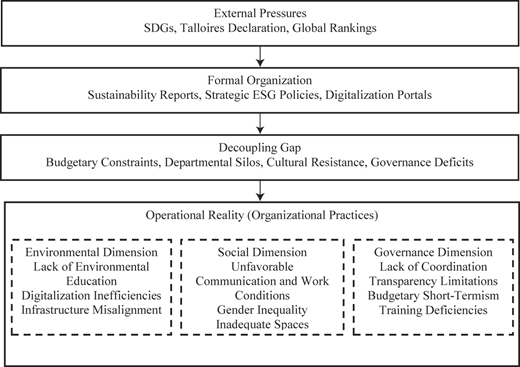
Together, these organizational practices constitute decoupling as a systemic phenomenon, reproduced consistently across environmental, social, and governance dimensions through the mechanisms identified above. Figure 1 illustrates the dynamics of systemic decoupling. In Figure 1, the formal policy layer — comprising highly visible sustainability initiatives and formal equality plans — meets external requirements, such as the Talloires Declaration and SDG rankings. However, the decoupling gap functions as a filter, where traditional budgetary cycles prioritize short-term financial prudence over long-term systemic change. This filter ensures that the operational reality within the ESG dimensions remains largely unchanged, manifesting in persistent implementation gaps identified across the sampled institutions.
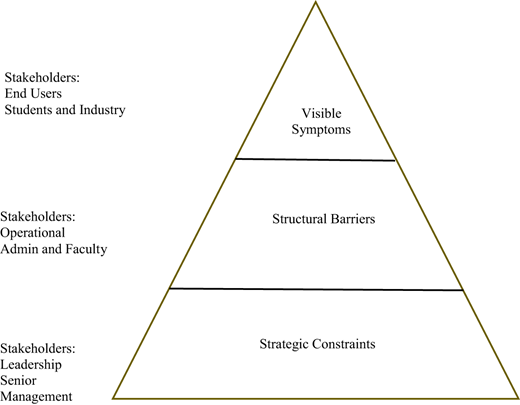
Moreover, stakeholders reveal differential visibility of decoupling based on organizational position, as Figure 2 demonstrates. Students and external partners primarily experience the friction points where institutional rhetoric diverges from operational reality. Administrative and academic staff identify the structural barriers that prevent the translation of policy into practice. Leadership frames the implementation gap as a consequence of strategic and financial constraints. This framing explains why leadership responses, which often focus on awareness campaigns, leave unaddressed the root structural causes identified by operational personnel.
In sum, these organizational practices characterize decoupling as a systemic phenomenon. Sustainability rhetoric consistently diverges from substantive actions across environmental, social, and governance dimensions. The findings confirm that institutional cultures, governance frameworks, and resource allocation paradigms serve to structurally embed ceremonial commitment. ESG integration, therefore, requires a fundamental reconceptualization of organizational structures that currently privilege symbolic compliance over substantive, transformative change.
5. Discussion
This study aimed to investigate the organizational practices that lead to the decoupling of formal sustainability commitments from substantive action within HEIs, drawing on institutional decoupling theory. The findings demonstrate a consistent pattern of ceremonial adoption across all three ESG dimensions, where formal sustainability commitments confer external legitimacy without compelling substantive operational change — producing what Deegan (2023) describes as “gaps or buffers between the formal structures … and the actual work processes”. The theoretical lens of decoupling (Meyer and Rowan, 1977; Dillard et al., 2004; Laine, 2009) proves relevant in explaining why HEIs, despite intense institutional pressures to conform to sustainability norms (Angelaki et al., 2024; Munaro and John, 2025), struggle with systemic sustainability. The findings further identify governance deficits as the structural enabling condition through which decoupling is reproduced across all three dimensions simultaneously — an explanatory contribution that extends beyond documenting barriers to identifying the organizational architecture that sustains them. The empirical findings of this study also suggest that these buffers are not viewed equally by all stakeholders.
Across the environmental dimension, the observed lack of awareness and environmental education, inefficiencies in digitalization and operationalization, and issues with infrastructure and use of energy resources reflect a decoupling of stated environmental goals from internal organizational practices. HEIs are formally committed to responsible consumption (SDG 12) and sustainable cities (SDG 11). However, the continued reliance on paper-based processes, the absence of integrated environmental education across curricula, and misaligned infrastructure investments (e.g. prioritizing renewable energy sources over fundamental energy efficiency) exemplify ceremonial adoption. These findings substantiate the notion that institutions implement what Meyer and Rowan (1977) term “rationalized myths” – formal environmental structures that confer legitimacy without necessitating corresponding changes in core operational practices. This aligns with Farinha et al.’s (2020) observation of isolated greening activities rather than holistic, system-wide transformation. The findings extend this by identifying causal attribution as a specific decoupling mechanism: when implementation gaps are framed as products of exogenous constraints rather than internal strategic choices, the institution constructs a legitimating narrative that forecloses corrective action without formally abandoning its environmental commitments.
A similar pattern emerges in the social dimension, where unfavorable communication, poor work conditions, and gender inequality remain prevalent. These challenges, combined with a lack of inclusive physical spaces, reveal a persistent disconnect between HEIs' formal policies and the day-to-day lived experiences of stakeholders. Formal equality plans and strategies and commitments to inclusion and support for people with functional diversity are undermined by insufficient resources, inadequate communication channels, and the presence of structural inequalities. This resonates with arguments that the practical implementation of ESG strategies remains fragmented and superficial (Lee, 2025; Munaro and John, 2025), failing to create inclusive and equitable environments. The lack of space for interaction and productivity further highlights how formal promises of a supportive learning environment are decoupled from tangible infrastructure and resource provision. This manifests as loose coupling, where formal social commitments exist, yet are not tightly linked to the daily social realities within the institution. The sophistication of formal social policy architectures can itself function as evidence of institutional responsiveness, foreclosing accountability without generating substantive change — a mechanism particularly evident where formal recognition of persistent gaps is incorporated into the legitimating apparatus rather than prompting corrective structural action (Carruthers, 1995).
Furthermore, the structurally enabling dimension of decoupling is governance. The identified lack of strategic connection and coordination in the implementation of SDGs, limitations in governance and participation, budgetary restrictions leading to short-term decision-making, and deficiencies in training and internal communication collectively illustrate how high-level strategic commitments fall short of translating into actionable, integrated practices. The inability to operationalize SDGs, the complex organizational structures hindering systemic collaboration, and a focus on short-term costs over long-term sustainability investments embody the rationalization aspect of decoupling (Carruthers, 1995), where formal structures confer institutional legitimacy while underlying organizational practices remain unchanged. The cross-dimensional analysis of the findings reveals that governance decoupling is not a third category alongside environmental and social decoupling — it is constitutive of the decoupling dynamic across all ESG domains. The absence of operationalized SDG targets, follow-up routines, and participatory mechanisms removes the accountability infrastructure through which policy-practice alignment would otherwise be compelled, actively sustaining the rationalized myths operating in the environmental and social dimensions. The observed lack of transparency and stakeholder participation further reinforces how formal governance principles are disconnected from actual decision-making practices.
The findings of this study confirm the common barriers identified in the literature and advance scholarly understanding by demonstrating how these barriers facilitate the phenomenon of decoupling. The literature highlights departmentalism and resistance to interdisciplinarity as key structural impediments (Gale et al., 2015; Giovanelli et al., 2025). The findings of this study regarding the lack of integrated awareness and environmental education, as well as deficiencies in training and internal communication, directly correspond to this. This fragmentation prevents a clear, coherent, and integrated sustainability strategy across university education and hinders the interdisciplinary collaboration necessary for systemic sustainability. Similarly, the complex, large organizational structure noted in the findings of this study mirrors the inter-institutional fragmentation discussed in the literature (Gale et al., 2015), leading to difficulties in connecting global SDGs with specific ESG criteria and making overall strategic alignment challenging.
Furthermore, the existing literature points to a lack of coherent policy and strategy and insufficient support from senior leadership as significant obstacles (Munaro and John, 2025; Gale et al., 2015). The findings of this study corroborate these observations of limitations in governance and participation, a distinct lack of connection and coordination in the implementation of SDGs and ESG, and the dominant influence of budgetary restrictions and short-term decision-making. The empirical evidence that SDGs are not operationalized and have limited influence on how sustainability activities are governed aligns with the argument that an absence of a strong, consistent institutional framework hinders implementation. The short-term perspective and focus on short-term costs reflect the greenwashing risk identified by Dziubaniuk et al. (2024), where financial prudence undermines long-term strategic alignment.
Resource constraints are well-documented obstacles in the literature, including a lack of funding and financial resources and a lack of qualified staff and expertise (Munaro and John, 2025; Farinha et al., 2020). This study supports these claims through the articulated challenges of budgetary restrictions and the lack of skills among academic staff, particularly regarding new technologies essential for modern sustainability practices. The limited resources for students and the lack of adequately equipped spaces further underscore the impact of resource constraints on fostering an inclusive, productive, and sustainable learning environment. A key insight here is that while institutions implement cost-saving initiatives, they exacerbate the decoupling by prioritizing immediate financial goals over substantive, long-term investments in systemic sustainability, creating a cycle of reactive, rather than proactive measures.
Finally, the literature identifies conceptual multiplicity and a lack of common understanding (Gale et al., 2015) as well as academic staff resistance and low motivation (Mokski et al., 2023; Munaro and John, 2025) as significant behavioral and cultural barriers. The findings of this study regarding the lack of awareness and environmental education and observed problems in communication and cooperation among colleagues, directly resonate with these points. The observations that “not all students are aware of what sustainable development is” and that “professors are lacking sufficient interest” illustrate the underlying cultural and cognitive resistance that prevent the substantial integration of sustainability into organizational practices. This highlights a crucial gap in shared mental models necessary for collective action toward systemic sustainability.
Overall, this study provides empirically grounded insights for HEIs aiming to move beyond symbolic commitments toward systemic sustainability. The ingrained nature of the organizational practices that drive decoupling suggests that surface-level policy changes and isolated initiatives are insufficient. Prioritizing governance reform as the foundational condition for ESG integration — rather than as one element of a parallel multi-agenda approach — is the organizational precondition for making the following measures effective.
Integrated education and awareness. Moving beyond sporadic courses to a holistic integration of sustainability principles across all curricula and continuous professional development for all staff to foster a shared understanding and build necessary competencies.
Operationalizing ESG and accountability. Translating high-level SDG commitments into measurable, actionable operational plans, supported by digitalization, robust data collection, and transparent evaluation frameworks that track actual impact, rather than mere rhetoric.
Strategic and participatory governance. Fostering transparent, accountable governance structures that actively involve diverse stakeholders, consistently prioritize long-term sustainability goals over short-term financial objectives, and demonstrate strong leadership commitment.
Addressing structural impediments. Actively working to break down departmental silos, promoting interdisciplinary collaboration, and making strategic investments in infrastructure and resources that support sustainable practices and foster inclusive learning environments.
Cultivating a culture of sustainability. Proactively addressing behavioral and cultural resistance through continuous communication, providing incentives for engagement, recognizing and rewarding sustainability initiatives, and fostering a shared understanding of sustainability as a core institutional value, not an optional add-on.
By systematically addressing these organizational practices, HEIs can mitigate the phenomenon of decoupling, allowing their formal commitments to translate into substantive, transformative action toward a more sustainable and resilient future. This requires a structural reorientation of governance priorities, moving from ceremonial compliance toward the full integration of ESG principles at every level of the organization.
6. Conclusion
This study provides a systematic, multi-institutional empirical analysis of how organizational practices drive the decoupling of formal sustainability commitments from substantive action across ESG dimensions in European higher education, extending the literature characterized by a single-institution focus and monolithic treatment of sustainability. Drawing upon institutional decoupling theory and employing an interpretive qualitative methodology, the study investigated sustainability implementation through the experiences of diverse stakeholders across four universities, revealing persistent patterns of policy-practice disconnect that undermine systemic transformation.
The findings underscore that despite intense institutional and societal pressures for HEIs to contribute to sustainable development, their practices manifest as ceremonial adoption rather than systemic transformations. Across all three ESG dimensions, the study identified a consistent array of organizational practices, including a lack of integrated environmental education, inefficiencies in digitalization, misaligned infrastructure investments, inadequate social support systems, persistent inequalities, insufficient spatial resources, poor strategic coordination, limitations in transparent governance, a dominant culture of short-term budgetary thinking, and internal communication deficiencies. These deficiencies collectively undermine the realization of embedded ESG integration.
These identified organizational practices are not isolated; they are mapped onto established, common barriers to sustainability transition in HEIs. This study demonstrates how structural fragmentation and siloed departmentalism, governance deficits, resource constraints, and behavioral and cultural resistance collectively contribute to the pervasive phenomenon of decoupling. This synthesis confirms the relevance of these known challenges and enriches the theoretical understanding by illustrating their direct role in creating a disconnect between stated policy and actual practice within HEIs. The resulting conceptual framework highlights that this decoupling ultimately leads to a state of ceremonial adoption, where HEIs project an image of institutional legitimacy and compliance to external stakeholders without necessarily achieving profound, transformative internal changes that are essential for systemic sustainability. Critically, the findings identify governance deficits as the structural enabling condition through which decoupling is reproduced across all three ESG dimensions simultaneously — not as a parallel barrier alongside environmental and social obstacles, but as the organizational architecture that actively sustains them.
For HEIs to genuinely embed sustainability at their core and fulfill their critical role as agents of societal change, a structural reorientation of governance priorities is imperative. Moving beyond ceremonial commitments requires a concerted and sustained effort to dismantle the entrenched organizational practices that perpetuate decoupling. This transformation entails fostering holistic environmental and social education and awareness, operationalizing ESG goals with measurable strategies, and establishing transparent and participatory governance frameworks. Additionally, it necessitates breaking down structural silos to foster interdisciplinary collaboration and cultivating an institutional culture that supports long-term sustainability over short-term expediency.
Ultimately, this study contributes to the literature by systematically applying the lens of decoupling to illuminate the complex implementation gaps preventing substantive sustainability in HEIs. It serves as a contribution that invites higher education leaders, policymakers, and stakeholders to critically re-evaluate existing approaches. By addressing these organizational challenges, HEIs can transition from merely articulating sustainability goals to embodying them, thereby fostering systemic sustainability that contributes meaningfully to a more equitable, resilient, and sustainable future.
The study has several limitations that warrant acknowledgment and open promising avenues for future research. First, the geographic scope encompasses four European universities. Although purposively selected to represent diverse European contexts, the findings may not fully transfer to non-European settings where institutional pressures, regulatory frameworks, and cultural norms surrounding sustainability differ substantially. Universities in North America, Asia, Africa, and Latin America may face distinct manifestations of decoupling shaped by different institutional environments. Future research can investigate the applicability of these organizational practices across different geographic contexts to identify potential region-specific decoupling patterns, thereby establishing the boundary conditions of the study.
Second, the cross-sectional design captures perceptions and practices at a single temporal point. Sustainability integration can evolve dynamically as institutions progress through different transition stages. Future longitudinal research can illuminate whether identified organizational practices represent temporary transition challenges or persistent structural impediments, providing insights into the temporal dynamics of institutional decoupling. Third, while the twenty interviews achieved information power for the research question, they represent only a proportion of each institution's community. Future research incorporating larger, stratified samples across multiple institutional levels would enable statistical generalization.
Finally, the study examines ESG implementation through stakeholder perceptions. While these subjective experiences prove crucial for understanding organizational realities, they may not perfectly correlate with measurable sustainability outcomes. Future research combining qualitative insights with quantitative ESG performance indicators can provide a comprehensive assessment of decoupling's manifestation and consequences, bridging the gap between perceived and measured organizational performance. Despite these limitations, this study makes important theoretical and empirical contributions by systematically mapping organizational practices to ESG dimensions and demonstrating how institutional decoupling manifests across multiple European HEIs. Future scholarship addressing these boundary conditions can advance theoretical understanding of institutional decoupling mechanisms. It can also enhance practical knowledge of pathways toward systemic sustainability transformation in higher education.
The author gratefully acknowledges the partner institutions — the University of Almeria (Spain), the University of Lodz (Poland), Linnaeus University (Sweden), and Belgrade Metropolitan University (Serbia) — for their institutional support and their contribution to data collection. The author also wishes to thank the anonymous reviewers and the editorial team of the International Journal of Organization Theory and Behavior for their constructive and thoughtful engagement with the manuscript.