


This research aims to unravel the micro-mechanisms that underpin the macro-level correlations between cultural tolerance and innovation. Our study centers on the micro-mechanisms of indirect minority influence among workers with diverse domain expertise. We posit that influence stemming from minorities who have different domain expertise in workers’ collaboration networks can be a pivotal driver for organizational innovation in changing market environments, and cultural tolerance is critical for such minority-induced social innovation.
The model includes components such as tolerance, cognitive diversity and network structure and examines the organization’s ability to adapt to changing market conditions and foster innovation. Through simulation experiments, we seek to identify a potential optimal combination of micro-mechanisms – direct majority influence, indirect minority influences and cross-domain consistency – that enables organizations to rapidly adapt to new market environments.
Our systematic simulation experiment identified the sweet spot of tolerance and consistency that produced robustly faster adaptation speed in response to abrupt market shifts. Organizational culture characterized by a medium level of tolerance (t = 0.6) and a small consistency (κ = 0.05) facilitated rapid adaptation to new market needs. It should be emphasized that this level of tolerance corresponds to interacting in a balanced way with people with similar domain expertise and those with differing domain expertise, with slightly more interaction outside of one’s group than within it. This finding provides evidence that indirect minority influence can be a micro-mechanism underlying the link between cultural tolerance and innovation. Intriguingly, our simulation experiment also revealed that a decrease in tolerance from 0.6 to 0 necessitates an increase in the level of consistency (from 0.05 to 1) to optimize the adaptation speed. This implies that organizations with a tight culture might need to go further and increase cross-domain consistency – in other words, further tighten across domains – to ensure faster adaptation in the face of market shifts.
This study explains the conflicting evidences on the relation between cultural tightness and/or looseness and innovation. Our finding explains how cultural looseness is generally associated with innovation in cross-cultural data (Deckert and Shomaker, 2022) as well as data within loose culture (Jackson et al., 2019). Our finding also explains Chua et al.’s (2019) seemingly contrary evidence that across 31 provinces in China, provinces with tight cultures exhibit higher rates of incremental innovation. Also, high cross-domain consistency prevents the emergence of radically innovative domains, which explains why provinces with tight cultures exhibit lower rates of radical innovation in the same paper.
1. Introduction
1.1 Challenges of innovation in organizations
Organizations face the challenge of nurturing innovation and driving change to adapt to a rapidly evolving landscape, marked by technological advancements, shifting societal norms, and changing consumer preferences. Balancing these elements with the maintenance of organizational cohesion and efficient operations is critical (March, 1991). A dynamic capability that allows organizations to intricately balance these seemingly contradictory demands, termed organizational ambidexterity (Tushman and O'Reilly, 1996), enables organizations to adeptly address the perennial innovator’s dilemma (O’Reilly and Tushman, 2008; Christensen, 2013).
The delicate equilibrium between innovation and coordination hinges on organizational culture (Gelfand, 2018; Prokopowicz et al., 2021). Loose cultures, characterized by a high tolerance of deviance, a celebration of diversity, and a fostering of varied perspectives (Pelto, 1968; Triandis, 1989; Witkin and Berry, 1975), are increasingly recognized as a catalyst for innovation (Gelfand et al., 2006). Notably, cultural looseness correlates significantly with creativity and innovation (Deckert and Schomaker, 2022; Jackson et al., 2019; Uz, 2015). Yet, the very nature of cultural looseness might make organizations more susceptible to excessive exploration of untested and potentially risky paths (Gelfand, 2012; Gelfand et al., 2021). In such contexts, cultural tightness, characterized by strict social norms and associated sanctions, can be important for effective organizational coordination (Gelfand, 2021).
The significance of this balance is amplified in organizations where diverse talents must coordinate their innovative ideas with emerging technologies in highly specialized domains (Phillips, 2014). Take creative organizations as a prime example. From the imaginative prowess of designers, animators, and writers to the analytical acumen of creative technologists and developers, coupled with the market insights of producers and strategists—these organizations meld this multiple domain knowledge to address both enduring and novel challenges. Innovative ideas in one domain (e.g. animation), if not coordinated with other domains (e.g. design, writing, production), cannot be materialized into final products. Creative synergy does not arise from a lone innovator or mere diversity. Instead, it emerges from coordinated innovation across knowledge domains, facilitated by complex collaborative networks of workers and open-minded communications among them (Page, 2019). This coordinated innovation process is determined by organizational culture (Martins and Terblanche, 2003).
1.2 Bridging the elusive link: tolerance and innovation
While many studies have illuminated the individual components of these complex dynamics–the role of diverse talent in innovation (Cox, 1994, van Knippenberg et al., 2004; Hong and Page, 2004; Horwitz and Horwitz, 2007; Woolley et al., 2010), the impact of organizational culture on worker behavior (Denison, 1990; Nishii, 2013; Schein, 2010), or the dynamics of organizational networks (Borgatti and Halgin, 2011; Cross and Parker, 2004; Tichy et al., 1979)–few have holistically combined these elements to understand how they interact in real-world settings with a dynamically changing market environment (Dahlander and O'Mahony, 2011; Fleming, 2007).
Empirical studies have started to shed light on the association between cultural looseness and innovation. For instance, cultural looseness in the U.S., as gauged through loose-word prevalence in the Google Books corpus, displayed a positive correlation with various metrics of creativity, from patents to baby-naming conformity (Jackson et al., 2019). While self-reported measures of tightness-looseness (Gelfand et al., 2011) didn’t reveal a significant correlation with national-level innovativeness, a different operationalization of cultural looseness—dispersion (measured by their standard deviation) of responses to survey items of values, norms, and behaviors (Uz, 2015)—was positively associated with national-level innovativeness, measured by the Global Innovation Index (Deckert and Schomaker, 2022). These studies underscore the macro-level patterns of cultural tolerance and innovation.
Notably, there exists counter-evidence. A study that mapped cultural tightness and its correlation with innovation across 31 provinces in China revealed that provinces with tight cultures exhibit lower rates of substantive/radical innovation yet higher rates of incremental innovation (Chua et al., 2019). These conflicting pieces of evidence highlight the complexity of understanding how cultural dimensions impact innovation, varying possibly due to contextual and environmental differences across regions and nations.
Nevertheless, the intricate dynamics of cultural tolerance and its influence on innovation diffusion at the microscopic level, particularly within multi-domain knowledge organizations, remain largely uncharted (Ely and Thomas, 2001; Ibarra, 1995; Nembhard and Edmondson, 2006). While some evidence suggests that cultural tolerance enhances information sharing and creativity (Carmeli et al., 2010; Homan et al., 2007), others highlight potential challenges like coordination complexity and the risk of groupthink in highly inclusive environments (Cronin and Weingart, 2007; Jehn et al., 1999).
A recent systematic review on empirical studies of multidisciplinary collaboration in innovation in design (Nguyen and Mougenot, 2020, 2022) indicated various factors that contribute to the functioning of multidisciplinary collaboration. The facilitators included cross-disciplinary communications and diversity of knowledge. The inhibitors include misunderstanding by team members from other disciplinary backgrounds, differences in disciplinary jargon and communication barriers due to cultural differences. The potential implications of tolerance-driven innovation patterns may be profound, especially in sectors like the creative industry, where agility (Gibson and Birkinshaw, 2004) and adaptability (Nadler and Tushman, 1999) are essential for long-term success. The confluence of diverse talents, guided by an inclusive cultural compass, can either be a wellspring of innovative breakthroughs or a pitfall of missed opportunities. How such an organizational culture interfaces with organizational collaboration networks to shape innovation trajectories is not merely a theoretical question but holds the key to unlocking sustainable competitive advantages in an ever-evolving creative industry.
Agent-based modeling and social simulations have been applied to the study of innovation diffusion within organizations (Kiesling et al., 2012). Studies have explored a variety of organizational behaviors and structures influencing innovation diffusion patterns, including the comparison between agents’ decision-making rules, such as simple heuristic versus deliberative processes (Schwarz and Ernst, 2009), the interplay between agents’ reflexive capacities and the organizational network structure (Córdoba and García-Díaz, 2020), and so forth.
However, little research has investigated potential micro-mechanisms underlying the relationship between cultural tolerance (in the sense of cultural tightness/looseness) and organizational innovation using agent-based modeling and social simulation. Importantly, no research has provided explanations for the elusive and even paradoxical macro-patterns between cultural tolerance and innovation. Agent-based modeling and social simulations have been employed as research methods to understand complex macro-patterns (Miller and Page, 2009), and to understand how complex macro-patterns can be generated by a set of simple micro-mechanisms (Wolfram, 1984). The current work takes an agent-based approach to establish a stronger link between culturally driven individual behaviors and innovation within organizations.
2. Theoretical foundations
2.1 Micro-mechanisms of the macro-level tolerance-innovation link
The macro-level correlation between cultural tolerance and innovation provides an overarching view of organizational dynamics. Yet, as with many macro-phenomena, the true action often transpires at the microscopic level, where individual interactions, decisions, and behaviors combine and recombine in myriad ways, forging the actual path of innovation (Hargadon and Sutton, 1997).
Several potential micro-mechanisms have been posited. Gelfand et al. (2006), for example, propose that individuals in loose societies tend to exhibit a greater promotion focus and prefer a cognitive style of innovators. Moreover, organizations in loose societies may impose fewer constraints on worker experimentation and trial-and-error learning.
Yet, these considerations might not fully capture the intricate dynamics inherent in creative organizations, where productive collaborations among workers with diverse domain expertise are central to organizational success. Therefore, a more comprehensive grasp of the micro-level processes necessitates a shift from focusing on individual cognitive styles to a broader appreciation of meso-scale subgroups and the nuances of the collaborative interplay between people within and across these subgroups.
2.1.1 Indirect minority influence on social change
The current investigation centers on the micro-mechanisms of indirect minority influence that drive the macro-level tolerance-innovation link. Indirect minority influence has been studied in social psychology over the past half century (Martin and Hewstone, 2008; Moscovici et al., 1969, Moscovici, 1980; Nemeth, 1986; Pérez and Mugny, 1987; Prislin, 2022; Prislin and Crano, 2012). Indirect minority influence refers to a type of minority influence that operates by changing focal issues indirectly via opinion change in related issues first, then in the focal issue through internal consistency between the related and focal issues (Crano, 2010; Wood et al., 1994).
The most important factor that enables indirect minority influence is the majority’s open-minded and tolerant listening to minority voices (Crano, 2010). The majority listens to others from minority subgroups with an open mind rather than ignoring or derogating because they share group membership with the minority. Because the majority wants to maintain the viability and cohesion of the group as a whole, such a group-oriented goal makes the majority tolerant toward minorities and makes them listen with an open mind. The majority’s open-minded elaboration of the minority opinion creates cognitive pressure which results in a change of related attitudes first.
As opinion changes in related issues accumulate, an opinion change in the focal issue occurs due to the psychological tendency to maintain internal consistency across multiple opinions within the opinion constellation (Abelson et al., 1968; Crano and Chen, 1998; Fink et al., 1993; Judd et al., 1991). Opinions on various different issues exist not as isolates but are connected to one another. For example, an opinion on abortion rights is closely connected to an opinion on euthanasia (Alvaro and Crano, 1997). In creative organizations, opinions in various domains (e.g. design, 2D animation, CG) should be closely connected to one another. Thus, an opinion change in one domain may spill over to opinions in other domains, and vice versa.
To clarify, two psychological mechanisms—(1) the majority’s open-minded tolerance toward minority subgroups and (2) internal consistency—are essential for innovative minorities to successfully change the majority’s opinion toward the direction of the minority opinion (Crano, 2001; Jung and Bramson, 2016; Moscovici, 1985).
Although the micro-mechanisms of indirect minority influence on individual majority’s opinion change had been empirically validated for numerous studies (see Wood et al., 1994 for meta-analysis), it remained uncertain whether these mechanisms could drive societal shifts in norms and cultural practices against prevailing conformity pressures until Jung and colleagues established the generative causality between indirect minority influence and social change (Jung and Bramson, 2014; Jung et al., 2018).
Using agent-based modeling and simulation, Jung and colleagues translated the verbal theory of indirect minority influence into opinion-updating algorithms and simulated the model to test whether indirect minority influence can spread an initial minority opinion into society and change social norms in the face of a conformity force to the status quo (Jung et al., 2018; Jung, 2023). This is the first agent-based model that formalizes the dual process of minority-majority influence documented in the social psychology literature (Martin and Hewstone, 2008; Moscovici, 1980; Levine and Prislin, 2013).
Their research indicated that indirect minority influence can gradually spread minority opinions to society and bring them into equal standing with the status quo ideology (Jung and Bramson, 2014, 2016; Jung et al., 2018). It also identified a tipping point of tolerance threshold such that tolerance toward minority dissents must reach a certain threshold to tip the system (Jung et al., 2018). Notably, the pattern of social change is characterized as a coordinated change where opinions on multiple issues change together and emerge a new zeitgeist (Jung et al., 2017, 2021).
Lastly, cultural tolerance and social network topology interact to generate distinct patterns of belief dynamics. When society is prejudiced and people are connected within parochial networks, societal belief distribution becomes homogenized and the cognitive belief system becomes disconnected and incoherent. As society becomes more tolerant reaching a tipping point and people in different groups become more connected to display small-world characteristics, societal belief distribution becomes polarized and the cognitive belief system becomes coherent and rigid. Then, as society becomes just slightly more tolerant or people in different groups get further connected, societal belief distribution becomes diversified and the cognitive belief system becomes coherent yet malleable (Jung et al., 2021).
2.1.2 Indirect minority influence on social innovation in multi-domain organizations
In organizations that comprise a rich tapestry of domain expertise, the interplay between varied skill sets and expertise becomes pivotal. We conceive of each domain expertise group (which might be thought of as a traditional “department”) as a group with a set of important shared characteristics, with the rest of the workers in the firm having somewhat different characteristics – though all workers in the firm have a shared organizational identity. When forming a collaboration network, workers within a department can be expected to work closely with one another, making their departmental identity and skill set a local majority identity from their perspective. The workers’ contacts in other departments are therefore perceived as a local minority. For example, a 2D animator might work with a dozen other 2D animators, but only a few 3D animators, designers, etc. This makes the 2D animator characteristics function as the majority characteristics from the perspective of that worker. A worker in a different department would be expected to form an analogous network, making that worker’s departmental colleagues a functional majority from the perspective of that worker.
The most groundbreaking innovations often reside at the intersections of diverse domains. By challenging and complementing the majority perspective with their specialized knowledge, these “minority” domains often birth solutions that are holistic and groundbreaking. Cross-domain knowledge transfer and lateral thinking are recognized as drivers of institutional innovation (Hargadon, 2002; de Bono, 2014).
Framed in terms of indirect minority influence, cross-domain knowledge transfer has two parts. First, workers in one domain listen to workers from other domains, but do not update their opinion about how to do their own job. Rather, they update their understanding of how the other experts do their own jobs. This is analogous to the mechanism of tolerant and open-minded listening to minority dissent. Secondly, the workers seek cross-domain consistency by aligning their opinions about their own area of expertise with their understanding of other areas. This is analogous to the mechanism of internal consistency. To operate, this model requires experts in one domain to listen to experts in another and – eventually – find ways to apply what they have learned about the other domain in their own domain.
At the same time, workers need to maintain coordination with their colleagues within the same department. If all workers emulate different workers in different domains, it could disrupt the coordination of their own department. For this reason, workers need to balance intradomain and interdomain learning. If workers are too quick to make all of their opinions internally consistent, the environment can become rigid, producing departmental or organization-wide groupthink that can lock the organization into sub-optimal strategies and make innovation impossible.
A core problem of innovation, in this framing, is striking the right balance between cross-domain listening and intra-domain conformity, while simultaneously finding the optimal level of cross-domain consistency that will enable learning without producing group think.
2.2 Overview of the study
To understand the micro-mechanisms that underpin the macro-level correlations between cultural tolerance and innovation, our study centers on the micro-mechanisms of indirect minority influence among workers with diverse domain expertise. We posit that influence stemming from minorities who have different domain expertise in workers’ collaboration networks can be a pivotal driver for organizational innovation in changing market environments.
Using an agent-based simulation, we examine the interplay between cultural tolerance, diversity, and innovation in organizational settings. We posit that achieving a balance between cultural tightness and looseness, harnessing the power of indirect minority influence, and understanding the intricate network of organizational collaborations can provide actionable insights to organizations striving for sustainable innovation.
To accomplish this, we adapt an agent-based model of indirect minority influence to an organizational context, considering elements like cultural tolerance, internal consistency, cognitive diversity, and dynamic market environments (Jung et al., 2021). This model gauges organization adaptability in response to an abrupt market shift. We explore the ripple effects of cultural tolerance on innovation diffusion through simulations on an organizational collaborative network of multi-domain experts.
Our overarching objective is to clarify the micro-mechanisms linking cultural tolerance and innovation. Through simulation experiments, we aim to identify an optimal combination of the micro-mechanisms of direct majority influence, indirect minority influence, and cross-domain consistency that can allow an organization to quickly adapt to new market environments.
3. Model description
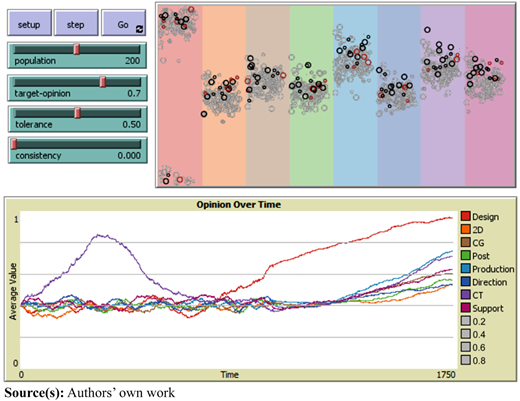
We implement an agent-based model in the NetLogo simulation environment (Figure 1). The overall purpose of the model is to investigate the micro-mechanisms that link cultural tolerance and innovation diffusion within organizations. The model includes components such as tolerance, cognitive diversity, and network structure and examines the organization’s ability to adapt to changing market conditions and foster innovation. Through simulation experiments, we seek to identify a potential optimal combination of micro-mechanisms—direct majority influence, indirect minority influence, and cross-domain consistency—that enables organizations to rapidly adapt to new market environments. By simulating the interactions between workers with diverse domain expertise and projects in a dynamic environment the model aims to provide actionable insights for organizations striving for sustainable innovation and to help them understand the balance between cultural tightness and looseness that drives innovation diffusion.
To explore these relationships, we model a hypothetical organization with 200 workers that is loosely based on a mid-sized creative firm. Our choice of 200 workers is driven by the observation that organizations often face challenges with internal communication and coordination as they exceed about 150 workers (Dunbar, 2010).
Figure 1 shows the NetLogo interface for the simulation model. This complex visualization provides a rich and dynamic view of model behavior as the model proceeds. This section provides a description of the interface elements. The full definition of these model elements and their mechanics are described in the sub-sections that follow.
In the upper left corner are buttons for setup, step (single step), and go (repeated steps). Below these buttons are a slider for population (which is fixed at 200 in the runs that follow), a set of sliders to adjust the values target project opinion, tolerance, and consistency.
In the upper right part of the future, worker agents are visualized as circles. Red circles indicate workers that are currently engaged in a project, while black circles are waiting for a project. While black and red circles indicate the opinion of workers on their own departmental knowledge, gray circles indicate the opinions of workers on departmental knowledge on domains other than their own – so eight opinions are represented for each worker – one for each departmental knowledge domain. Each worker agent is positioned in terms of their opinion, expertise, and performance record. Each of the colored bands represents eight departmental knowledge domains: design, 2D animation, computer graphics, post-production, production, creative direction, creative technology, and support. Each agent’ vertical position indicates its opinion on a knowledge domain. Lower performing agents are closer to the left side of each departmental band, while higher performing agents are closer to the right side of the band.
The bottom graph tracks the average opinion of each department over time. Traces are colored to match the departmental knowledge domain bands in the worker visualization. The x-axis on this plot is time as measured in abstract model ticks and the y-axis is the same wraparound opinion scale ranging from 0 to 1. The constant values 0.2, 0.4, 0.6, and 0.8 are shown to provide visual reference within this scale.
In the figures that follow, the agent visualization and departmental average opinion windows will be presented to provide snapshots of the model trajectory and state. The model, simulation data, and analysis files are available: https://osf.io/hab29/.
3.1 Agent properties
There are two types of agents: workers and projects. Workers have four properties: opinions, expertise, cognitive diversity, and performance record. Projects have three properties: optimal opinion, optimal staffing size, and project performance.
3.1.1 Workers
Each of the 200 workers in the organization has several properties:
Opinions. Each worker has opinions in the 8 knowledge domains—design, 2D animation, computer graphics, post-production, production, creative direction, creative technology, and support.
Opinions are represented by real numbers ranging from 0 to 1. However, it is essential to note that the value of opinions is on a circular scale: 0 and 1 are adjacent, much like a color wheel where red and violet are adjacent on the color wheel despite being at opposite ends of a linear spectrum. Thus, the value of these opinions doesn’t carry inherent significance. Instead, what matters is the relative difference between the values.
Let’s consider Agent 6, described below. This agent holds an opinion of 0.98 for production, 0.40 for post-production, and 0.03 for creative direction. The difference between 0.98 and 0.40 is 0.42, but the difference between 0.98 and 0.03 is only 0.05, considering the wrap-around nature of the circular scale. So, even though 0.98 may seem farther from 0.03 than from 0.40 on a linear scale, it’s actually closer when we consider them on a circular scale. Hence, in terms of similarity in opinions, Agent 6’s opinion on production and direction is more closely aligned than its view on production and post-production.
Expertise. Each worker has one domain of expertise among the 8 domains. A worker can be a designer, 2D animator, computer graphics specialist, post-production specialist, producer, creative director, creative technology specialist, or supporter. The domain a worker specializes in is called the focal domain of the worker. The opinion of that domain is the focal opinion of the worker. If agent 6 above were a 2D animator, its focal domain is “2D” and focal opinion is 0.74.
Cognitive Diversity. Each worker possesses a unique predisposition to perceive the opinions of others with a slight deviation from their actual opinions. This predisposition manifests as a bias inherent in each worker. The bias values for individual workers are assigned, following a normal distribution with a mean of 0 and a standard deviation of 0.05. We selected the normal distribution to represent agents’ cognitive diversity based on empirical evidence indicating that human cognitive styles typically follow a normal distribution (Kirton, 2004).
For instance, if Agent 6 has a bias of 0.03, it perceives the opinions of its colleagues with a corresponding bias of 0.03. To illustrate, suppose Agent 4, serving in the role of a creative technologist, holds a focal opinion valued at 0.54. In this scenario, Agent 6 would perceive that Agent 4’s opinion in the domain of creative technology is 0.57, accounting for its inherent bias.
Performance Record. Each worker maintains a record of their project performance. Upon the completion of a project, a worker updates this record by averaging the newly acquired performance data with the existing performance record. Conversely, if a worker is not assigned to any project, their performance record experiences a decay, reduced to 99% of its previous value at each iteration.
3.1.2 Projects
A new project is introduced into an organization at every step. Each project has a duration of 10 steps.
Optimal Opinion. Each project possesses what is termed an optimal opinion. This represents the most favorable or desired standpoint regarding a particular aspect or decision of the project. Numerically, it is denoted by a real number that falls within a range from 0 to 1. For the sake of simplicity at this stage of model development, all projects have the same optimal opinion, though this optimal opinion can shift to a different value that is also shared across all projects. This property allows for a simple implementation of the idea of cross-domain consistency and posits that there is some significant element of similarity across domains. Future iterations of the model may introduce heterogeneous optimal opinions and a more elaborate mechanism for internal consistency.
Optimal Staffing Size. Each project has an optimal staffing level, representing the ideal number of workers needed to ensure the project’s successful and efficient completion, without resource excess or deficiency. This optimal number is sampled from a gamma distribution, capped at a maximum of 30. The gamma distribution is chosen because it is a convenient way to represent the positively skewed distribution of project sizes that is common in organizations, with a small number of larger projects and a large number of smaller projects (Baccarini, 1996).
Project Performance. Upon conclusion, the project undergoes an evaluation, assessing the extent to which the focal opinions of the assigned workers are in alignment with the project’s optimal opinion.
3.2 Workers’ collaboration networks and project staffing
3.2.1 Workers’ collaboration networks
The collaboration network represents the connections between workers in the organization, which determine how they interact and influence each other’s opinions. It is constructed by running through each worker and establishing 20 links to workers with the same domain expertise as the focal worker, while out-group neighbors are workers with different domain expertise and 20 links to workers with different domains of expertise. This network construction results in a network where workers are connected to a mix of peers with the same and different domain expertise.
To illustrate, consider Agent 6, a specialist in 2D animation, who establishes 20 connections with fellow 2D animators and 20 more with professionals from varied domains such as design, creative direction, production, etc. In this arrangement, 2D animation takes the majority status in Agent 6’s immediate network as it predominantly consists of other 2D animators. And, experts from distinct domains constitute multiple minority groups within Agent 6’s collaborative sphere.
3.2.2 Project staffing procedure
When a new project is introduced, the model selects a leader and a team of workers to be assigned to the project based on their performance records and domain expertise. The staffing process consists of the following steps:
Identify available workers: The model first identifies workers who are not currently assigned to any project. These workers are considered available for staffing the new project.
Select a leader: The model selects a leader for the project by choosing the worker with the highest performance record among the available workers.
Identify possible team members: The leader identifies possible team members for the project among its link-neighbors (connected workers in the network) who are also available for staffing.
Determine team size: The model calculates the desired team size by subtracting one from the project’s optimal staffing size (since the leader is already included). The actual team size is determined by taking the minimum of the desired team size and the number of possible team members.
Assemble the project team: The leader selects workers from the possible team members based on their domain expertise and their fit with the leader’s opinion in their domain. The selection process is repeated until the desired team size is reached. The leader and the selected team members are then combined into a single team.
The staffing process starts with selecting a team leader who has the best available performance record. However, that leader chooses team members not based on their performance record, but rather based on how well their opinion about their own area of expertise aligns with the leader’s opinion about that area of expertise. Project success thus requires that the leader have a reasonably accurate understanding of the optimal opinion across all domains.
3.3 Workers’ interaction rules
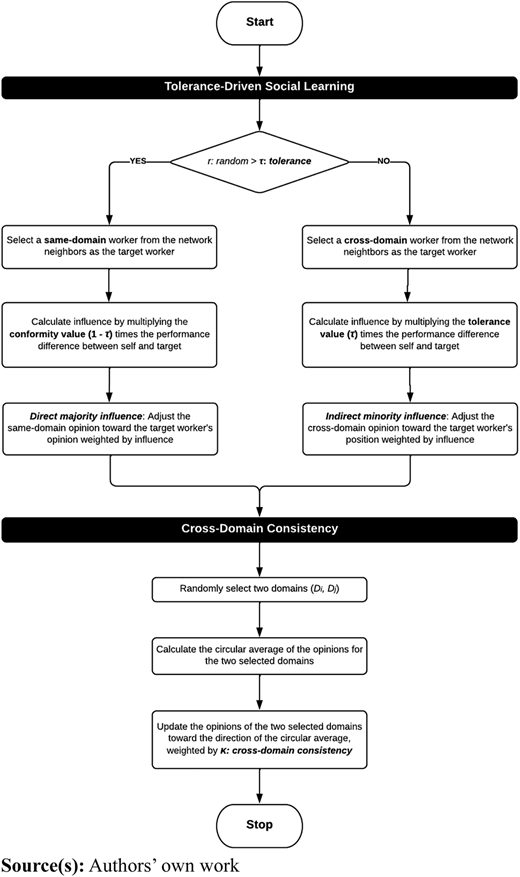
Workers update their opinions across eight domains following the interaction rules described below (see Figure 2). Two parameters determine how workers interact with other workers and update their opinions: tolerance (τ) and consistency (κ).
3.3.1 Tolerance-driven social learning
The first parameter tolerance (τ), has a range between 0 and 1. Specifically, workers, with a probability equivalent to τ, opt to select cross-domain colleagues, who are considered a minority in their respective ego networks, as their influence targets. The value of τ also determines the extent to which workers modify their opinion in the domain of the selected minority target, aligning more closely with the minority target’s opinion. Conversely, with a probability of 1- τ, workers choose colleagues from the same domain, who constitute a majority in their ego networks, as their influential targets. Furthermore, 1- τ delineates the degree to which workers update their focal opinions to align with the opinions of the chosen majority target.
An important consideration with this specification for tolerance-driven social learning is that , which we will commonly refer to as “tolerance” here, is set up in such a way that it covers a more extreme range of behavior than would be covered by the conventional use of the term tolerance. At = 0, a worker interacts only with people who share their domain of expertise. This notion corresponds reasonably with the conventional idea of being intolerant of those with minority identity in this context. However, at = 1, the worker interacts only with people who do not share their domain expertise. This could be thought of as being extremely tolerant of minority identity, but intolerant of majority identity. Values of between 0 and 1 represent various levels of balance between these two extremes.
It is crucial to note that, in both scenarios, the adjustments made in workers’ opinions are also weighted according to the relative performance record between their own and the chosen target’s performance records. This implies that a higher performance record of the target leads to larger adjustments in the workers’ opinions toward the target’s opinion. This corresponds to the intuitive notion that people are inclined to emulate other people who are more successful than themselves.
Examples: Let’s imagine the case of Agent 6: a6 = {0.81, 0.74, 0.68, 0.40, 0.98, 0.03, 0.67, 0.62} who is a 2D animator. Organizational culture is characterized by a tolerance value of 0.2. With a probability of 0.2, Agent 6 would choose one of its local minority colleagues with different domain expertise in its ego network. Let’s say Agent 6 chose Agent 4, who is a creative technologist: a4 = {0.64, 0.42, 0.57, 0.46, 0.62, 0.43, 0.54, 0.45} and listens to Agent 4’s opinion on creative technology (0.54) with an open mind.
Next, Agent 6 updates its opinion on creative technology, weighted by (a) a tolerance value of 0.2 and (b) the performance difference between itself (a6) and target agent (a4). Specifically, if Agent 6 has a performance record of 0 (very low) and Agent 4 has a performance record of 1 (very high), the total influential weight is 0.2. Thus, Agent 6 updates its opinion (formerly 0.67) on creative technology by 20% closer to the direction of Agent 4’s opinion, which is 0.644: a6 = {0.81, 0.74, 0.68, 0.40, 0.98, 0.03, 0.644, 0.62}. However, if Agent 6 has the performance record of 1 and Agent 4 has the performance record of 0, Agent 6 will not change its opinion on creative technology: a6 = {0.81, 0.74, 0.68, 0.40, 0.98, 0.03, 0.67, 0.62}. Last, if Agent 6 has a performance record of 0.8 and Agent 4 has a performance record of 0.9. Agent 6 updates its opinion on creative technology by 2% (tolerance*performance difference: 0.2*(0.9–0.8) = 0.02) closer to the direction of Agent 4’s opinion, which is 0.6674: a6 = {0.81, 0.74, 0.68, 0.40, 0.98, 0.03, 0.6674, 0.62}.
Steps for Tolerance-Driven Social Learning: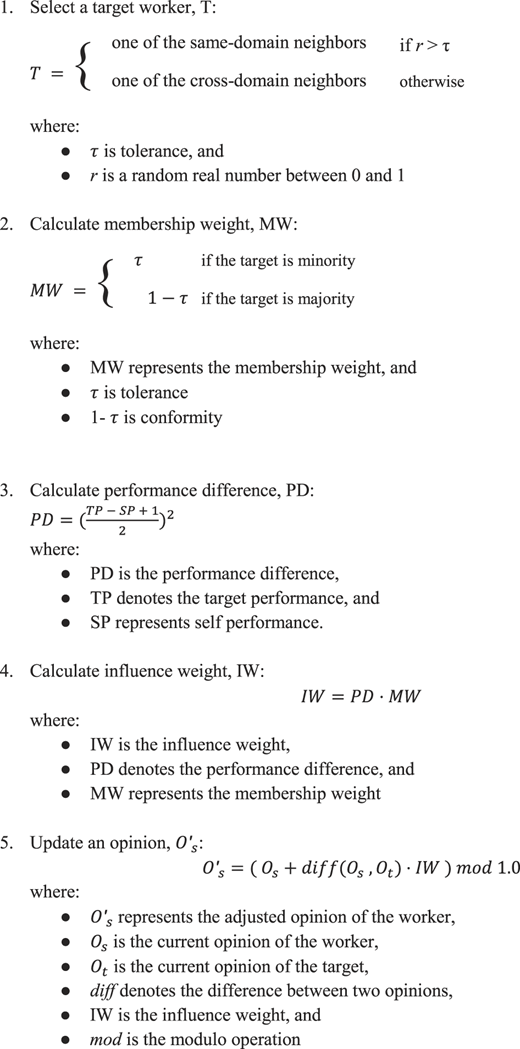
3.3.2 Cross-domain consistency
The second parameter, cross-domain consistency (κ), ranges from 0 to 1 and quantifies the extent to which workers synchronize their opinions across different domains. Specifically, at each time step, each worker selects two domains at random from a possible eight and computes the circular mean of the opinions associated with these chosen domains. Subsequently, each opinion is adjusted toward this circular mean, with the magnitude of adjustment being proportional to the value of κ.
At a setting of 0, no force toward cross-domain consistency exists. At a setting of 1, opinions are quickly set to the circular average of the worker’s eight opinions. Intermediate values represent corresponding movements toward the average.
Steps for Cross-Domain Consistency: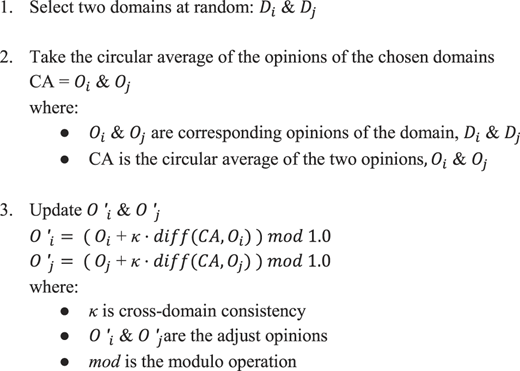
Examples: Let’s come back to Agent 6: a6 = {0.81, 0.74, 0.68, 0.40, 0.98, 0.03, 0.6674, 0.62}. After it updates its opinion on creative technology by learning from its minority target, Agent 4, Agent 6 may choose two domains at random. Let’s say these two domains happen to be 2D animation and creative technology and cross-domain consistency (κ) is 0.1. Agent 6 updates their opinions on 2D animation and creative technology with 0.73637 and 0.67103: a6 = {0.81, 0.73637, 0.68, 0.40, 0.98, 0.03, 0.67103, 0.62}.
Notably, the combination of social learning from a cross-domain colleague and cross-domain consistency, Agent 6 eventually changed its focal opinion toward the opinion of Agent 4, the minority target. In this way, local minorities can indirectly change workers’ focal opinions.
3.4 Adaptation speed
The key system-level measure is how quickly after the shock workers find the new market optimal opinion. Specifically, we operationalize this adaptation as the average project performance aligning within 94% to the market optimal opinion consecutively for 300 steps, and the simulation stops when this condition is met. The point of successful adaptation is taken as the step at which performance enters this final 300-step window. The simulation stops if adaptation fails at the 5000th step.
4. Exploratory simulations of culture change
In our exploratory simulations, we simulate three different scenarios of cultural change in organizations. The first scenario characterizes organizational changes from tight, to tolerant, and then to inclusive culture. In the second scenario, the organization changes from tight directly to inclusive culture. Last, we explore the cases of extreme cultures including extremely tight culture and extremely loose culture. At the same point in each of these three scenarios we introduce a shock (a new optimal opinion set at 0.7) at the first step while maintaining workers’ opinions aligned with the previous status quo (0.4).
This exploration is intended to be helpful in developing intuition about the qualitative nature and relative speed of these transitions within the model. In section 5, we will move away from exploring transitions to more rigorously examining the adaptive capability of organizations in a systematic orthogonal parameter sweep of the two key parameters explored in this section.
4.1 Simulating change from tight to tolerant to inclusive culture
In our initial exploratory investigation, we simulate the culture change of organizations, beginning with a tight culture, progressing through a tolerant state, and ultimately achieving an inclusive cultural state. Specifically, the organization starts as a tight culture, transitions to a tolerant culture at the 1000th step, and finally adopts an inclusive culture at the 2800th step. The tight, tolerant, and inclusive cultural states are simulated through combinations of two parameters: tolerance (τ) and cross-domain consistency (κ), as described below.
Tight Culture (τ = 0, κ = 0): In this scenario, the organization adopts a tight cultural stance. Here, workers only update their focal opinions based on contact with their same-domain workers – a process termed as direct majority influence. This reflects Triandis’ (1989, p. 511) observation that “in-group members behave according to the in-group norms.”
Tolerant Culture (τ = 0.5, κ = 0): Transitioning from the tight culture, the organization’s tolerance level increases to 0.5. This means that 50% of their conversations occur with cross-domain workers in their collaboration network. In this phase, workers update their focal opinions influenced by their same-domain colleagues’ performance. Concurrently, they also update knowledge from cross-domain workers, but without allowing this cross-domain knowledge to influence their focal opinions.
Inclusive Culture (τ = 0.5, κ = 0.05): Finally, the organization evolves into a more inclusive state. As the organization transitions to an inclusive state, it transcends mere tolerance, which primarily emphasizes coexistence with differences. Instead, in an inclusive culture, these differences are actively embraced and integrated. Here, not only do workers update knowledge from different domain experts, but they also recalibrate their focal domain opinions based on this updated cross-domain knowledge, ensuring consistency between their expert domain views and their understanding of other domains, a process referred to as indirect minority influence.
4.1.1 Tight culture
Figure 3 illustrates the pattern of innovation diffusion in organizations characterized by a tight culture. The left panel of Figure 3 depicts workers’ focal and other domain opinions, their current project involvement, and their performance levels. Specifically, workers are positioned within color blocks corresponding to their focal domain (red for design, orange for 2D animation, brown for computer graphics, green for postproduction, blue for production, navy for creative direction, purple for creative technology, and fuchsia for support). Within each color block, the horizontal placement of workers is proportional to their performance record, with placement towards the right indicating higher performance. The vertical placement of workers corresponds to their opinions, ranging from 0.0 at the bottom to 1.0 at the top. Workers in red are currently engaged in project teams, while those in black are available for recruitment. Gray shadows depict workers’ opinions regarding other domains. The right panel of Figure 3 shows the average opinion values across the eight domains over time.
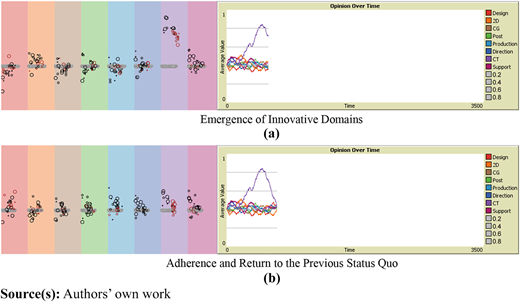
The pattern of innovation diffusion in tight culture (τ = 0, κ = 0). (a) workers in a couple of domains may drift toward a new optimal opinion (upper); however, (b) they eventually drift back to the previous status quo (bottom)
The pattern of innovation diffusion in tight culture (τ = 0, κ = 0). (a) workers in a couple of domains may drift toward a new optimal opinion (upper); however, (b) they eventually drift back to the previous status quo (bottom)
In a tight culture, workers within specific domains, such as creative technology, may innovate, initially distancing themselves from the prevailing status quo (0.4) to better align with emerging market demands (0.7), as depicted in Figure 3a. However, these innovative shifts tend to be transient, with these domains often reverting to their previous status quo (0.4), as illustrated in Figure 3b.
This reversion can be attributed to the absence of effective cross-domain interactions and the consequent stagnation of knowledge; workers in the other domains fail to update their understanding of developments in innovative domains and remain oblivious to advancements occurring therein. Subsequently, less innovative workers within these innovative domains get to be recruited more frequently, find greater representation in project teams, and achieve superior performance records. This phenomenon inadvertently pulls the innovative domains back to the previous norms and practices, nullifying the initial deviations and advancements made. This indicates that pluralistic ignorance prevents innovation diffusion at the level of domain and organization as a whole, especially when the organization requires cross-domain collaborations and cooperation (Prentice & Miller, 1996).
4.1.2 Tolerant culture
Staring at the 1000th step, the organization’s level of tolerance increases. In this phase of heightened tolerance (tolerance set at 0.5), workers continue to update their focal opinion from the majority same-domain colleagues in their ego network, which leads to domain-level drift toward the new market signal. Simultaneously, workers also update their understanding of what different domain experts do from the minority cross-domain colleagues in their ego network. This augmented level of tolerance enhances the accuracy of knowledge regarding the states of different domains, a process referred to as transactive memory (Wegner et al., 1985). Knowing the changes and innovation in other domains helps workers recruit innovative workers in the innovative domains. This is the reason that workers in the innovative domains maintain their innovativeness, under a tolerant culture—as opposed to a tight culture.
In consequence, workers across domains move toward the new optimal opinion (Figure 4a). Each domain develops their own domain norm—these are relatively similar to one another but maintain distinct nuances to ensure a degree of cross-domain variability (Figure 4b). This indicates that workers in each domain find their own path toward new market needs, and the development of transactive memory enables the sustenance of inter-domain diversity.
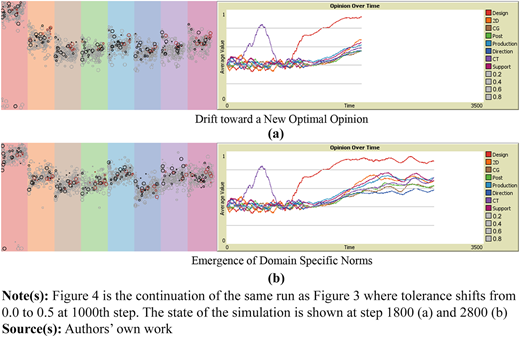
The pattern of innovation diffusion in a tolerant culture (τ = 0.5, κ = 0). (a) as workers across all domains move toward the new optimal opinion (upper); (b) different domains find their distinct norms that differ from one another (bottom)
The pattern of innovation diffusion in a tolerant culture (τ = 0.5, κ = 0). (a) as workers across all domains move toward the new optimal opinion (upper); (b) different domains find their distinct norms that differ from one another (bottom)
4.1.3 Inclusive culture
Finally, the organizational culture shifts into a more inclusive state at the 2800th step. In this state, workers do not simply update knowledge from cross-domain experts but also adjust their focal opinions to improve alignment with the newly acquired cross-domain knowledge. Workers across domains synchronize their opinions, aligning them precisely with the emerging market needs (Figure 5).
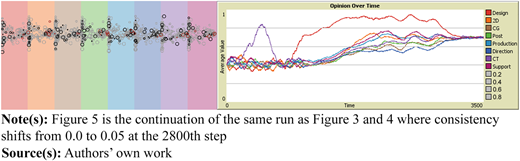
The pattern of innovation diffusion in an inclusive culture (τ = 0.5, κ = 0.05). Workers across all domains coordinate with one another and closely align with the new optimal opinion
The pattern of innovation diffusion in an inclusive culture (τ = 0.5, κ = 0.05). Workers across all domains coordinate with one another and closely align with the new optimal opinion
This process of cross-domain learning enhances the organization’s adaptability and overall performance by facilitating a coordinated diffusion of innovation. It paves the way for a more harmonized approach to addressing market demands, reflecting a synthesis of diversified knowledge and fostering a collaborative ambiance conducive to sustained organizational success.
4.2 Simulating change from tight to inclusive culture
In our subsequent exploratory investigation, we simulate the cultural change of organizations, starting with a tight state and directly transitioning to an inclusive cultural state. Specifically, the organization begins with a tight culture and adopts an inclusive culture at the 1800th step. The tight and inclusive cultural states are modeled through combinations of two parameters: tolerance (τ) and cross-domain consistency (κ). It is important to note that the variant of the tight culture in this simulation differs from that in the previous simulation, as detailed below.
Tight Culture (τ = 0, κ = 0.05): Here, workers update their focal opinions solely from their same-domain colleagues, a process termed as direct majority influence. Importantly, workers calibrate their cross-domain knowledge based on their focal domain opinion (consistency set at 0.05). This variant of a tight culture differ from that in the previous simulation. Here, internal consistency functions as projection (Robbins & Krueger, 2005), such that workers’ knowledge about the other domains is derived from their focal opinions in their own expert domain.
Inclusive Culture (τ = 0.5, κ = 0.05): Transitioning from the tight culture, the organization’s tolerance level increases to 0.5. Workers now update knowledge from cross-domain workers. Because the internal consistency mechanism operates throughout the entire simulation, not only do workers update knowledge from different domain experts, but they also recalibrate their focal domain opinions based on this updated cross-domain knowledge, a process referred to as indirect minority influence or cross-domain learning. Note that the same internal consistency mechanism can manifest either as projection or as cross-domain learning, depending on the level of tolerance.
4.2.1 Tight culture
Figure 6 depicts the pattern of innovation diffusion in organizations characterized by this variant of a tight culture with cross-domain consistency. While a few pioneering domains diverge rapidly from the previous status quo, all domains gradually move toward emerging market demands. This adaptation pattern is facilitated by cross-domain consistency. In scenarios where cross-domain consistency exists without tolerance, it manifests as a projection—aligning opinions on other domains to their in-group norm. This dynamic enables workers in innovative domains to recruit workers from other domains whose opinions align closely with their innovative perspective. Such integration not only boosts the performance records of innovative workers in other domains but also drives a collective shift of all domains toward emerging market demands, with the innovative department acting as a “tugboat” that progressively guides other departments towards meeting market needs.
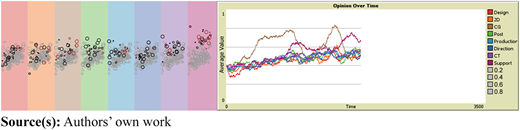
The pattern of innovation diffusion in a tight culture (τ = 0, κ = 0.05). Workers across domains move toward a new optimal opinion. The state of the simulation is shown up to the 1800th step
The pattern of innovation diffusion in a tight culture (τ = 0, κ = 0.05). Workers across domains move toward a new optimal opinion. The state of the simulation is shown up to the 1800th step
4.2.2 Inclusive culture
With an increase of the organization’s level of tolerance to 0.5, workers update their knowledge about different domains from cross-domain colleagues and recalibrate their focal domain opinions based on this updated cross-domain knowledge, ensuring consistency between their expert domain views and their understanding of other domains. Workers across domains coordinate to gradually move toward the new market needs (Figure 7). An interesting dynamic is observed wherein the pioneers of innovation within the organization appear to retract to prior organizational norms and status quo initially. This counterintuitive maneuver, however, is not a regression but rather a strategic recalibration for coordinating with other domains. It’s a step back to ensure cohesive forward movement, and eventually, workers from all domains reach the market needs precisely in a coordinated manner.
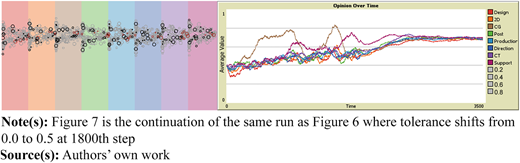
The pattern of innovation diffusion in an inclusive culture (τ = 0.5, κ = 0.05). Workers across all domains coordinate with one another and closely align with the new optimal opinion
The pattern of innovation diffusion in an inclusive culture (τ = 0.5, κ = 0.05). Workers across all domains coordinate with one another and closely align with the new optimal opinion
4.3 Simulating extreme scenarios
In our earlier simulations of cultural change within organizations, we observed the influence of cultural tolerance and cross-domain consistency on coordinated innovation diffusion and overall organization adaptation. To further this exploration, we conduct a third investigation, simulating and comparing two extreme scenarios: extremely tight culture and extremely loose culture.
Extremely Tight Culture (τ = 0, κ = 1): In this scenario, workers rely exclusively on their same-domain colleagues to update their focal opinion, and derive their knowledge about the other domains purely from their focal opinions in their own expert domain. Consequently, there is an imposition of their domain norms onto others, excluding cross-domain workers with different opinions when recruiting project teams.
Extremely Loose Culture (τ = 1, κ = 1): Here, workers recalibrate their focal domain opinions based on input from cross-domain colleagues.
4.3.1 Extremely tight culture
In organizations characterized by extreme cultural tightness with cross-domain consistency, we don’t observe distinctively innovative domains as we did for tolerance culture in section 4.1. However, all domains march toward the new market demand with slightly different domain norms. As they approach the new optimal opinion, they align closely to the new optimal opinion, without any overshooting (Figure 8).
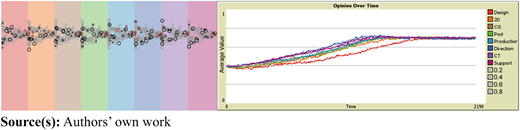
The pattern of innovation diffusion in an extremely tight culture (τ = 0, κ = 1). Different domains form slightly different norms and March toward the new optimal opinion
The pattern of innovation diffusion in an extremely tight culture (τ = 0, κ = 1). Different domains form slightly different norms and March toward the new optimal opinion
4.3.2 Extremely loose culture
In organizations characterized by extreme cultural looseness with cross-domain consistency, a phenomenon akin to organization-level groupthink is observable. All domains adopt a uniform norm, thereby eradicating inter-domain diversity. As they shift towards the new market demand in unison, they exceed the optimal opinion target of 0.7, nearing 0.8 instead. This necessitates a regression to align correctly and organizations take longer to adapt (Figure 9).
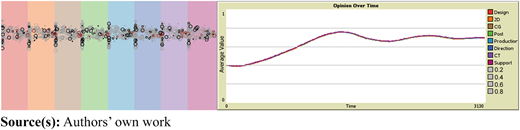
The pattern of innovation diffusion in an extremely loose culture (τ = 1, κ = 1). Different domains form uniform normative opinions, displaying organization-level groupthink and overshooting above the optimal opinion (0.7)
The pattern of innovation diffusion in an extremely loose culture (τ = 1, κ = 1). Different domains form uniform normative opinions, displaying organization-level groupthink and overshooting above the optimal opinion (0.7)
5. Simulation experiment to identify a sweet spot
The exploratory simulations discussed in the prior section elucidate insights into the patterns of innovation diffusion within organizations undergoing cultural change. The simulations of the extreme scenarios illuminate a potential sweet spot of cultural tolerance and cross-domain consistency, pivotal for organizational adaptation in the face of shifting market environments.
In this section, we conduct a systematic simulation experiment. We systematically vary the parameters of tolerance (τ) and consistency (κ). This is done to discern their impacts on innovation diffusion and organizational adaptation. We search for a potential sweet spot of tolerance and consistency that robustly accelerates collective adaptation in response to an abrupt market shift.
5.1 Experiment design
Tolerance (τ) is manipulated in increments of 0.1, ranging from 0 to 1, while consistency (κ) is explored with finer gradations, particularly towards the lower end of the scale, ranging between 0 and 1. This results in a total of 110 unique (τ,κ) combinations, with each combination undergoing 50 simulation runs, culminating in a total of 5,500 simulation experiments.
At the initiation of each run, a shock is introduced by setting a new optimal opinion at 0.7, contrasting with the prevailing status quo opinion value of 0.4. The primary metric of interest is adaptation speed, gauging how swiftly the different organizational cultures acclimate to the new optimal opinion post shock introduction, providing a nuanced understanding of the innovation diffusion trajectories under varied cultural and operational parameters.
5.2 Simulation results
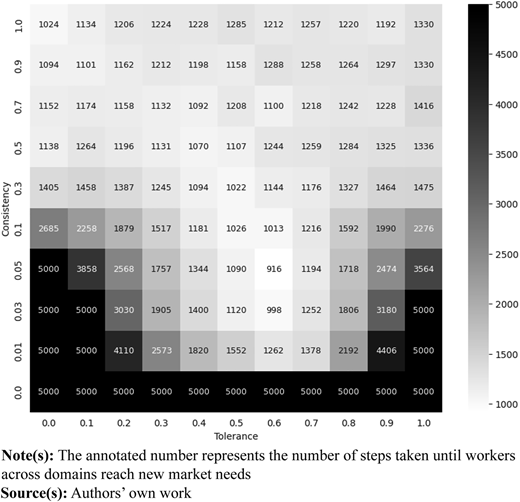
We find that there is a sweet spot of tolerance and consistency. Organizational culture characterized by a medium level of tolerance (τ = 0.6) and a small consistency (κ = 0.05) produce robustly faster adaptation speed in response to an abrupt market shift (Figure 10). In the sweet spot, it takes 916 steps for organizations to adapt to a new market shift. Organizations with a smaller or larger tolerance take a longer time to adapt than ones with the optimal range of tolerance.
We also identify the optimal level of tolerance at different levels of consistency (Figure 11). At low levels of consistency (κ 0.1) (upper boxplots in Figure 11), optimal tolerance is 0.6. As tolerance deviates from the optimal level, adaptation takes longer. At high levels of consistency (κ 0.3) (bottom boxplots in Figure 11), as the effect of tolerance gets attenuated.
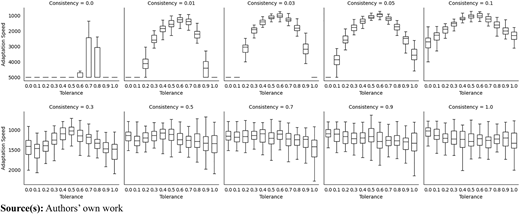
Boxplots delineate the effect of tolerance on adaptation speed at different levels of consistency
Boxplots delineate the effect of tolerance on adaptation speed at different levels of consistency
It is worth noting that a decrease in tolerance from 0.6 to 0 necessitates an increase in the level of consistency to optimize the adaptation speed (Figure 12). For example, the optimal consistency is 0.3 for tolerance at 0.5, and the optimal consistency is 0.5 for tolerance at 0.3. When there is zero tolerance, maximal consistency (1.0) produces fastest adaptation.
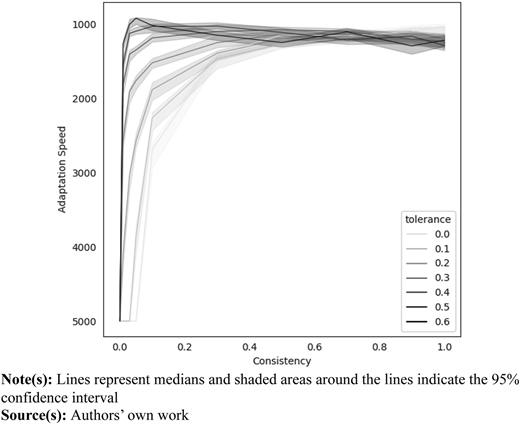
Line plots of adaptation speed for different consistency and tolerance levels
Line plots of adaptation speed for different consistency and tolerance levels
6. Discussion
This study aims to explore the micro-mechanisms that mediate the effect of tolerance and inclusive culture on coordinated innovation diffusion within an organization where workers with specialized domain knowledge collaborate in project teams. We apply social psychological insights on minority influence to social innovation phenomena in organizational science. Our intent is to strike a balance between these extremes, harnessing the dynamics of indirect minority influence in organizations where workers who have cognitive diversity and different domain expertise collaborate with one another.
We developed an agent-based model to explore the dynamics of innovation diffusion and organizational adaptation in response to abrupt market shifts across different cultural states. We have adapted and enriched an existing agent-based model of indirect minority influence (Jung et al., 2021) by integrating elements like cultural tolerance, internal consistency, cognitive diversity, and dynamic market trends, allowing us to scrutinize organizational adaptability following unexpected market alterations. Our model incorporated two key parameters, tolerance (τ) and consistency (κ), to simulate the culture change of organizations from tight to inclusive cultures. We also construct workers’ collaborative networks inspired by real organizations where workers tend to collaborate with the majority of others from the same department but also with a minority of others from different departments. Through a series of exploratory simulations and systematic simulation experiments, we have identified a sweet spot of tolerance and consistency that produces robustly faster adaptation speed in response to market shifts.
Through this approach, we have sought to clarify the micro-mechanisms that underpin the yet-elusive connection between cultural tolerance and innovation diffusion in organizational contexts and to provide guidelines that can direct organizations towards cultivating a culture of inclusion, ensuring the diffusion of coordinated innovation throughout their structures in an ever-evolving landscape.
6.1 Key findings and implications
Our exploratory simulations revealed distinct patterns of organizational adaptation across tight, tolerant, and inclusive cultures. In a tight culture, innovative shifts in certain domains were short-lived, as these domains eventually reverted to the previous status quo due to the absence of effective cross-domain interactions and knowledge stagnation. In a tolerant culture, workers across domains moved toward the new optimal opinion, developing their own domain norms with distinct nuances to ensure cross-domain variability. In an inclusive culture, workers not only updated knowledge from cross-domain experts but also adjusted their focal opinions, ensuring alignment with the newly acquired cross-domain knowledge. Workers across domains synchronized their opinions, aligning precisely with the emerging market needs.
Our systematic simulation experiment identified the sweet spot of tolerance and consistency that produced robustly faster adaptation speed in response to abrupt market shifts. Organizational culture characterized by a medium level of tolerance (τ = 0.6) and a small consistency (κ = 0.05) facilitated rapid adaptation to new market needs. It should be emphasized that this level of tolerance corresponds to interacting in a balanced way with people with similar domain expertise and those with differing domain expertise, with slightly more interaction outside of one’s group than within it. This finding provides evidence that indirect minority influence can be a micro-mechanism underlying the link between cultural tolerance and innovation. This explains how cultural looseness is generally associated with innovation in cross-cultural data (Deckert and Schomaker, 2022) as well as data within loose culture (Jackson et al., 2019).
Intriguingly our simulation experiment also revealed that a decrease in tolerance from 0.6 to 0 necessitates an increase in the level of consistency (from 0.05 to 1) to optimize the adaptation speed. This implies that organizations with a tight culture might need to go further and increase cross-domain consistency, in other words, further tighten across domains, to ensure faster adaptation in the face of market shifts. This explains Chua et al. (2019)’s seemingly contrary evidence against Deckert and Schomaker (2022) and Jackson and his colleagues (2019) that across 31 provinces in China, provinces with tight cultures exhibit higher rates of incremental innovation. The same study finds that high cross-domain consistency prevents the emergence of radically innovative domains, which explains why provinces with tight cultures exhibit lower rates of radical innovation.
These findings have several important implications for organizations seeking to foster a culture of innovation and adaptability.
First, our results highlight the significance of cultural tolerance in promoting cross-domain interactions and knowledge exchange, which are essential for sustainable innovation diffusion and organizational adaptation in ever-changing environments. The presence of a sweet spot underscores the necessity of carefully crafting organizational culture to foster innovation and adaptability across the collective. To identify a sweet spot tailored to a specific organization, the model would need to be adjusted to accommodate the unique characteristics and circumstances of various organizations, which differ in aspects such as the number of knowledge domains, expertise ratios, project team sizes, duration of project teams and the quantity of teams, task difficulty and complexity, and patterns of market change. For instance, in environments where workers have a higher proportion of collaborators from different domains within their network, a lower level of tolerance might still effectively facilitate innovation diffusion.
Second, it’s crucial to understand that cultural tolerance, as used here, has a distinct definition. It refers to the extent to which an organization’s culture permits workers to be receptive to co-workers with different areas of expertise within their workplace collaborative networks. This concept of cultural tolerance is directed towards the minorities within each employee’s collaborative network, which they have individually developed. For instance, in the collaborative network of a specific designer, while the majority of collaborators may be fellow designers, a minority might consist of 2D animators and CG specialists. Greater cultural tolerance enhances the opportunity to listen to and learn from cross-disciplinary minority members in one’s network. Therefore, in this context, cultural tolerance does not imply mutual openness between majority and minority members but is specifically about openness towards minority viewpoints and dissenters (Gelfand, 2018; Jung, 2023).
Third, our findings underscore the importance of consistency in facilitating the alignment of workers’ opinions across domains. In an inclusive culture, workers not only update their knowledge from cross-domain experts but also recalibrate their focal domain opinions based on this updated cross-domain knowledge. This process of cross-domain learning enhances the organization’s adaptability and overall performance by fostering a coordinated diffusion of innovation and a harmonized approach to addressing market demands.
Fourth, the cognitive process of internal consistency takes on different forms as psychological phenomena, influenced by the degree of cultural tolerance. As detailed in Section 4.2, in culturally tight organizations where workers adhere strictly to the approach of their focal domain, disregarding the opinions of minority teammates from other areas, the consistency process results in a phenomenon known as projection, where workers’ understanding of other domains is shaped by their own domain-specific perspectives. Conversely, in more culturally loose organizations where employees give equal consideration to the insights of experts from minority domains within their collaborative networks, this consistency process fosters indirect minority influence, prompting workers to integrate knowledge from different domain experts, leading to an adjustment of their focal domain views based on this comprehensive cross-domain insight. Therefore, the internal mechanism of consistency can lead to either projection or learning through indirect minority influence, contingent on the organization’s cultural tolerance level.
Finally, our results suggest that there is an optimal balance between tightness and looseness that organizations should aim for in order to achieve the fastest adaptation speed in response to market shifts. Striking this balance is crucial for organizations to remain agile and responsive to changing market conditions, ensuring their long-term success and competitiveness. The identification of this optimal balance suggests that the elusive and seemingly contradictory patterns linking cultural tolerance to innovation, as reported in prior cross-cultural studies (Chua et al., 2019; Deckert and Schomaker, 2022; Jackson et al., 2019), may actually represent variations of the same underlying processes at different parameter values, rather than fundamentally distinct mechanisms.
6.2 Limitations and future research
While our study provides valuable insights into the dynamics of innovation diffusion and organizational adaptation across different cultural states, it is not without limitations. First, our agent-based model is a simplification of real-world organizations and may not capture all the complexities and nuances of organizational culture and innovation processes. Future research could extend our model by incorporating additional factors, such as organizational structure, leadership styles, and individual-level characteristics, to provide a more comprehensive understanding of the interplay between culture, innovation, and adaptation.
Second, our study focused on the impact of tolerance and consistency on organizational adaptation in response to abrupt market shifts. However, organizations may also face gradual or continuous changes in their external environment, which could have different implications for innovation diffusion and adaptation processes. Future research could explore the dynamics of organizational adaptation under different types of environmental changes and examine the role of culture in shaping organizations’ responses to these changes.
Third, our study identified the sweet spot of tolerance and consistency that produced the fastest adaptation speed in response to market shifts. However, it is important to recognize that the optimal balance of these parameters may vary depending on the specific context and characteristics of an organization. Future research could investigate the factors that influence the optimal balance of tolerance and consistency in different organizational settings and develop tailored recommendations for organizations to foster a culture of innovation and adaptability.
Lastly, although our study offers internally valid multi-level causal explanations for the elusive and seemingly conflicting macro-patterns between cultural tolerance and innovation observed in existing empirical research (Chua et al., 2019; Deckert and Schomaker, 2022; Jackson et al., 2019), these relationships are based on simulated results. The next step involves validating these theoretical micro-macro causal links through field experiments on diversity training in organizations (Chang et al., 2019; Paluck et al., 2021), as well as through correlational cross-cultural studies examining cultural looseness, diversity, and innovation (Osborne and Atari, 2024).
It should also be pointed out that this paper presents a theoretical model that is designed to isolate and elucidate the relationship between direct majority influence and indirect minority influence as they relate to innovation within an organization. Real organizations are much more complex and involve a host of mechanisms operating simultaneously. These might be social, psychological, economic, technological, geographic, etc – covering the breadth of mechanisms discussed by organizational scientists. Understanding of the observed sweet-spot is a novel tool that a manager or management scientist can bring to bear in understanding innovation in the institutional context.
Importantly, our modeling and simulation work provides a new avenue for organizational science research on cultural tolerance and diversity training in organizations such as Chang et al. (2019) by suggesting that such research will need to examine not only individual workers’ inclusive behaviors but also pay attention how such training affects workers’ collaboration network patterns and organizational innovations to understand the complete picture of both individual and system-level consequences of cultural tolerance and diversity training (Paluck et al., 2016).
6.3 Conclusion
Our study explores the underpinnings of cultural tolerance and innovation, providing a pathway for understanding the ripple effects of cultural tolerance on innovation diffusion in organizational settings populated by multi-domain knowledge experts. By identifying the sweet spot of tolerance and consistency, our study pinpoints the optimal combination of direct majority influence, indirect minority influence, and cross-domain consistency. Our study has illuminated potential pathways for organizations to adapt swiftly to new market environments, substantiating the role of nuanced organizational collaborations and indirect minority influence in fostering sustainable innovation.

