


As information technology becomes more ubiquitous in the workplace, it becomes increasingly important to understand how employees' experiences with these technologies impact their well-being and turnover intention. Technostress, the inability to relate to new technologies in a positive way, has been studied as a cause of turnover, but these studies tend to ignore the possibility of turnover intention also leading to heightened feelings of technostress.
The present study aimed to assess the relationship between technostress, well-being and turnover intent (TI) among a sample of 428 workers, through both a top-down (mediation) and a bottom-up (network analysis) methodology.
Results coincided with previous models of turnover, indicating that turnover intention usually results from reduced workplace well-being, originating from technostress. Yet, network analysis showed that TI had a significant relationship with both technostress and well-being, indicating that a positive feedback loop might be present in this process. The results highlight the importance of constant training in information technology to maintain worker well-being and reduce turnover.
This is the first paper to compare mediation with network analysis within TI. Beyond identifying cyclical effects, the paper identifies how different elements of technostress affect TI and the pathways through which this association is established.
Introduction
On average, one-third of employees' lives is spent working (Ramos, 2001). Given the significant portion of life dedicated to professional activities, it becomes evident that maintaining proper well-being and mental health in the workplace is essential for fostering a balanced and healthy lifestyle. Ensuring that employees' psychological needs are met is not only beneficial to the individual worker but also yields positive outcomes for organizations as a whole, influencing several key factors, including job performance, workplace commitment and overall employee engagement (Judge et al., 2001). Additionally, it plays a critical role in reducing absenteeism and turnover rates, both of which can have substantial financial and operational consequences for employers (Khalid and Syed, 2024), as absences due to stress or psychological strain can disrupt team workflows and increase the burden on remaining staff, further exacerbating workplace stress. Beyond professional outcomes, workplace well-being also affects personal aspects of employees' lives, such as their ability to balance work and family responsibilities, which, if neglected, can lead to increased stress and dissatisfaction (Khalid and Syed, 2024). Understanding both the antecedents and consequences of workplace well-being is crucial for designing effective intervention and prevention programs aimed at improving employees' overall experience in the workplace. Organizations that take a proactive stance on mental health tend to report higher retention rates and improved employee morale. In a systematic review, Khalid and Syed (2024) identified inadequate job demands as one of the most common organizational-level barriers to mental health, emphasizing the need for organizations to address these challenges to promote a healthier and more sustainable work environment.
This inhibitor is particularly problematic given the dynamic nature of job demands. Technostress, the inability to relate to new technologies in a positive way (Salanova et al., 2013), has grown in interest recently due to technology's growing role in the workplace. Technostress can occur due to various reasons, such as feeling that technology is too complex for the task or provides too much information for the individual to realistically process (techno-overload); feeling that technology's complexity leads to problems or difficulties (techno-complexity); being unable to manage a healthy work-life balance due to technology's prevalence in all aspects of life (techno-invasion); believing that technology keeps updating at such a rapid pace that the individual cannot, or eventually will not be able to keep up (techno-uncertainty); or seeing technology as a threat, either to interpersonal relationships in the workplace or to their job security (techno-insecurity) (Kumar, 2024). These concerns have been significantly amplified in the post-pandemic era, with the widespread adoption of remote and hybrid work models (Vermila and Kurniawati, 2025). These new work arrangements, while offering flexibility, have also blurred the boundaries between work and private life, leading to new challenges that are critical to understand. Those who suffer from technostress feel highly pressured to accept and use these technologies, and the consequences of technostress are often negative (Kena, 2015). Employees may feel overwhelmed by the pace of digital transformation and uncertain about their ability to keep up with evolving expectations, particularly when insufficient training or support is provided. Workplace relationships are also affected by new technologies, with the perception that individuals may be replaced by them (Duarte et al., 2018), a concern that continues to become more prevalent and relevant as Artificial Intelligence becomes more commonplace in work environments (Sharma et al., 2024). Workers who experience technostress are more likely to face productivity drops, delays, or even absenteeism (Park and Cho, 2016). The excessive workload, limited time, difficulty in working with new technologies and constant use of the Internet can have a negative impact on individuals (Carlotto and Câmara, 2010). Furthermore, it has been empirically proven that workers' satisfaction with technologies positively influences their organizational performance (Tarafdar et al., 2010). More specifically, workers who feel happy and satisfied with familiar technologies they use at work are able to process information more effectively, improving the quality of their work. Similarly, employees satisfied with the information and communication technologies implemented in their organizations tend to have more free time and are more willing to explore additional functions of the technologies they use. They also seek more efficient ways to execute work processes, becoming more creative and innovative (Tarafdar et al., 2010).
Job demands-resources (JD-R) theory (Bakker and Demerouti, 2017) can provide a useful framework to understand technostress. JD-R suggests that worker well-being is mainly impacted by job demands, working as stressors and resources, which support the worker and help them to face these demands (Bakker and Demerouti, 2017). Within this framework, technological stressors function as job demands (aspects of the job that require sustained effort and are associated with psychological costs). When these demands are not buffered by adequate job resources (technical support, training, or supportive leadership, for example), they can lead to negative outcomes like burnout, disengagement and reduced well-being (Kumar, 2024). Sharma and Tiwari (2023) attempted to model technostress's impact on turnover intention from a JD-R perspective, finding that technostress led to turnover intent (TI) by increasing burnout and reducing work-life balance, while also finding that workers' psychological resources mitigated this effect. Despite the important insights obtained from this study and others similarly using mediation and moderation (e.g. Öztürk, 2021), these models show particular vulnerabilities in regard to detecting covariance as a predictive effect and in being unable to detect cyclical effects (Hevey, 2018). This can be particularly problematic in cases such as that of technostress. In a practical example, one can imagine a certain worker who has a hard time adapting to a new piece of software that has been added to their company. Such a worker can feel frustrated and begin to consider leaving the company, at which point it would be fair to assume that they will be less willing to adapt to any new software implemented from then on, leading to them feeling more alienated from the company, cyclically, until they move on to a different place of employment. These real-world dynamics are often difficult to capture using conventional analytical tools, which assume linear and temporally stable relationships between variables. However, the process of disengagement often accelerates and intensifies through feedback loops that amplify employees' dissatisfaction over time. This underlines the importance of using analytic techniques that are sensitive to these cyclical or self-reinforcing effects. More recent research has begun to challenge the simple models obtained through mediation analysis by engaging in alternative, more complex analyses. For example, Zhang et al. (2025) utilized network analysis to explore the relationship between technostress factors and burnout in a sample of nurses.
Network analysis is a data analysis approach that has been steadily gaining traction in psychological research due to its ability to provide a more detailed and nuanced understanding of complex relationships between variables. This method is particularly useful for mapping out intricate patterns of interactions that may contribute to or influence one or multiple outcomes within a given system. Unlike traditional linear models, network analysis allows researchers to visualize and analyze how different variables are interconnected, rather than assuming a strictly unidirectional or hierarchical relationship between them. Structurally, network analysis consists of nodes and edges, where nodes represent individual variables, such as psychological constructs, and edges signify the relationships or associations between these variables (Hevey, 2018). A key advantage of this approach over conventional mediation models lies in its ability to address some of their inherent limitations, such as the assumption of a strictly causal or sequential influence between predictors, mediators and outcomes. By utilizing network analysis, researchers can identify clusters of interconnected variables, detect reciprocal or cyclical relationships and uncover hidden structures within the data that might not be apparent through traditional mediation models. Consequently, this method provides a more comprehensive and dynamic perspective on the interdependencies between psychological constructs, making it a valuable tool for exploring complex systems in behavioral research. Additionally, network analysis lends itself well to practical applications by allowing organizations to pinpoint highly central or influential variables that could be strategic targets for intervention, which is why, within organizational psychology, it is being increasingly used to challenge traditional linear models and explore the complex, dynamic relationships between constructs such as burnout and work engagement (e.g. Hafstad et al., 2025).
Although prior research has established a link between technostress and turnover intention (e.g. Sharma and Tiwari, 2023), it has largely relied on linear mediation models, and while more recent research has explored technostress and turnover-related variables, namely burnout (Zhang et al., 2025), using network analysis, the present study is the first to explore both technostress and turnover intention directly using this methodology. Focusing on TI can be particularly important because turnover is understood as the endpoint of a process marked by continuous disengagement with a company, but the present study posits that it is, in fact, part of the process itself. From a JD-R perspective, technostress is an ever-demanding job demand (Kumar, 2024) that, if not addressed, will lead to worse well-being and eventual turnover. The current investigation uses a dual methodology to test this assertion using mediation analysis (Hypothesis 1), while also exploring more complex bottom-up interdependencies and potential feedback loops through network analysis (Hypothesis 2). The implication of these hypotheses would be that unmet demands not only lead to dissatisfaction with the company, but also that dissatisfaction exacerbates the psychological impact of these unmet needs. By putting the following hypotheses forward, we aim to provide a more comprehensive and dynamic model of how technostress influences well-being and turnover, highlighting the limitations of relying on one methodology alone.
Well-being will mediate the relationship between technostress and turnover intention.
A network analysis of the pertinent variables will demonstrate a cyclical relationship between technostress and TI.
Well-being will be significantly associated with both technostress and TI.
Method
Measures
A sociodemographic questionnaire was used to collect information from participants, including questions about age, gender, educational level, frequency of Internet use and confidence in using information and communication technologies.
Technostress
The Technostress Scale by Salanova et al. (2013), adapted and validated for the Portuguese population by Hormann (2020), is a self-report questionnaire consisting of 19 items distributed across four dimensions: techno-skepticism, techno-fatigue, anxiety generated by beliefs of inefficacy and techno-addiction. This scale uses a 7-point Likert scale (0 – Never, 6 – Every day), where participants indicate the degree to which each item best describes their relationship with information and communication technologies (example item: “I am scared of accidently losing/deleting information when using information technology”). The internal consistency of the instrument is above 0.93 (Cronbach's Alpha values) for all dimensions, Barlett (1,71) = 3934.649; p < 0.00.
Well-being
The Reduced Scale of the Psychological Well-Being Index, developed and validated for the Portuguese population by Novo (2000), by adapting the Psychological Well-Being Scales (Ryff, 1989; Ryff and Keyes, 1995), consists of 18 items rated on a six-point Likert scale ranging from “Completely disagree” to “Completely agree” (example item: “Looking back, I am not sure that my life was worth it”). For the Well-Being instrument, we obtained Kaiser–Meyer–Olkin (KMO) = 0.892 and Barlett's test = (153) = 2575.438; p < 0.000. Cronbach's alpha in the present sample for the full scale was 0.87. The complete instrument also comprises six subscales, namely Autonomy (α = 0.61), Mastery (α = 0.53), Personal Growth (α = 0.50), Positive Relationships (α = 0.62), Life Goals (α = 0.73) and Self-Acceptance (α = 0.64). Cronbach's alpha for the complete instrument supports its reliability. The subscales' α can be considered low, which is expected given their brief nature (three items per subscale). Yet, inter-item correlation fell between 0.17 and 0.48 for all subscales, indicating acceptable fit.
Turnover intent
The Intention to Leave Scale by Bártolo-Ribeiro (2018), originally developed and validated for the Portuguese population, consists of eight items and assess three parameters of turnover intention (1) the nature of the intention (to leave vs. stay in the organization); (2) the materialization of the intention: based on behaviors (e.g. “I am currently looking for another job”; “I will stay at this company for more than a year”) versus thoughts/judgments (e.g. “I am considering staying in this organization for a while longer”); and (3) the temporal dimension: immediate intention (e.g. “If I could, I would leave this organization today”) versus deferred intention (e.g. “It is very likely that I will leave this organization in the near future”). The items are rated on a 5-point Likert scale ranging from “Does not apply to me at all” to “Applies completely to me.” In the present sample, the scale showed good reliability (α = 0.89).
Participants and procedure
Six Portuguese organizations were contacted in total, encompassing the healthcare, public administration, education and information technology sectors. Data collection was done for a period of one month and no target sample size was set, but a minimum of 300 was established, due to network analysis's relatively high demands for sample power (Constantin, 2018). The sample for this study consists of 428 workers, aged between 19 and 68 years (M = 44.51, SD = 10.13) and was 69.9% female. Participants were varied in educational background and marital status, as well as in the nature of their work. Detailed information regarding the sample can be found in the results section.
Data was collected by distributing a form containing all the aforementioned measures to the various organizations so that it could be distributed among their workers. Along with the form, information about the study's objectives and the procedures for data collection, processing and dissemination was also distributed. To ensure the anonymity and confidentiality of the questionnaire responses, no identifying information about the participants was collected. Informed consent was obtained from all participants, and the participants were also thanked for their participation. All procedures involving human participants were performed in accordance with the ethical standards of the institutional and national research committee and with the 1964 Helsinki Declaration and its later amendments. The investigation and its procedures were approved by the research center under which it was performed [information hidden for peer-review].
Data analysis
A dual-method approach was adopted to leverage the distinct strengths of both mediation and network analysis. Mediation analysis using structural equation modeling (SEM) was chosen to conduct a confirmatory, “top-down” test of the proposed hypothesis (H1). This method is the established standard for testing a specific, theory-driven directional pathway and allows for the estimation of specific indirect effects. In contrast, network analysis was employed as a complementary “bottom-up” approach. This approach can reveal complex relationships between the variables, particularly the feedback loop proposed in the hypotheses (H2). By using both SEM and network analysis, it is possible to test the established theory (technostress leads to turnover by decreasing well-being) while also revealing dynamic relationships within the data (particularly, cyclical effects), providing a more comprehensive picture of the underlying phenomena.
After initial descriptive and correlational analyses were conducted, using Statistical Package for the Social Sciences (SPSS) v.29.00.0, non-normality of the data was confirmed (pShapiro-Wilk < 0.001) for all study variables; therefore, all subsequent analyses were complemented with bootstrapping (1,000 bootstrapped samples unless otherwise specified). Mediation analysis (Maximum Likelihood Estimation) was subsequently carried out in SPSS Analysis of Moment Structures (AMOS), an SEM software, chosen due to its capacity to handle latent constructs, model indirect pathways and visually represent relationships between variables in a path diagram, facilitating interpretation of both direct and indirect effects. Prior to running the mediation analysis, all continuous variables were centralized to reduce multicollinearity and to allow for more interpretable interaction terms, particularly given the multiple predictors included in the model. To assess the individual contributions of each technostress and well-being variable, an initial predictive screening was performed using simple linear regressions, allowing for the identification of statistically meaningful relationships to be carried forward into the SEM framework. In handling missing data, the study applied stochastic regression imputation, a method that preserves the randomness of the data while minimizing bias and maintaining statistical power, particularly useful in psychological datasets with partial item non-responses. The statistical significance of each path coefficient was evaluated using bias-corrected bootstrapping with 200 bootstrap samples and a single bootfactor, a robust non-parametric technique for estimating confidence intervals that does not rely on normality assumptions. This approach allowed for a more accurate estimation of indirect effects. Based on the results of this iterative process, a final, parsimonious model was constructed, retaining only those predictors and mediators that exhibited statistically significant direct or indirect effects on turnover intention, thereby enhancing the clarity and interpretability of the overall mediation structure.
Network analysis was conducted using R (Core Team, 2017), by calculating Gaussian Graphical Models, appropriate for continuous variables, with Least Absolute Shrinkage and Selection Operator (LASSO; Friedman et al., 2008) penalization, a correction that leads to more parsimonious networks while minimizing false positives (Hevey, 2018), essentially cleaning up the map by erasing weak or spurious connections. The tuning parameter (γ), which can be between 0 and 1, was set to 0, meaning that the model was set to maximize the number of edges that are present in the model. Although this can be considered an overly sensitive approach, LASSO regularized models where γ = 0 tend to produce sparser networks than non-regularized networks with higher γ values (Hevey, 2018). By using the LASSO correction while keeping γ = 0, we are able to take an exploratory approach, where we maximize the amount of interactions observable on the map, without risking overfitting the data. Subscales for each individual measure were used to define the nodes in the network. Additionally, the relaimpo package (Grömping, 2006) for R was used to calculate the relative importance of the various factors. Relaimpo achieves this hierarchy by calculating every single permutation of the variables, in order and calculating the average independent contribution of each variable to the model (Grömping, 2006).
Results
Descriptive analysis of the sample
Table 1 contains descriptive and correlational data for each study variable. Correlations were only presented for the total measures, as the intent of this analysis was to establish significant relationships between the main study variables. As expected, well-being correlated negatively with technostress and turnover intention.
Mean value and correlations for each main study variable
| Mean (SD) | Technostress | Well-being | Turnover intention | |
|---|---|---|---|---|
| Technostress | 36.44 (29.17) | – | −0.478** | 0.180** |
| Skepticism | 8.50 (6.15) | 0.664** | −0.242** | 0.109* |
| Fatigue | 6.33 (4.98) | 0.771** | −0.363** | 0.172** |
| Anxiety due to feelings of inefficacy | 10.37 (9.31) | 0.854** | −0.430** | 0.144** |
| Addiction | 11.02 (6.57) | 0.520** | −0.296** | 0.129** |
| Well-Being | 81.88 (13.62) | −0.478** | – | −0.265** |
| Autonomy | 12.55 (3.30) | −0.208** | 0.589** | −0.077 |
| Mastery | 12.15 (3.07) | −0.486** | 0.758** | −0.233** |
| Personal Growth | 14.94 (2.44) | −0.356** | 0.733** | −0.128** |
| Positive Relationships | 13.43 (3.31) | −0.332** | 0.756** | −0.225** |
| Life Goals | 14.77 (3.27) | −0.430** | 0.849** | −0.249** |
| Self-Acceptance | 14.04 (2.87) | −0.342** | 0.796** | −0.270** |
| Turnover Intention | 12.61 (5.83) | 0.180** | −0.265** | – |
Note(s): SD= Standard deviation
Table 2 contains demographic information for the entire sample, as well as information about each outcome divided by demographic group. There were small sex differences regarding technostress, which were not present for well-being or TI. There were also significant differences between married and single individuals for well-being, which were not present for any other variable across marital status. There were no significant differences for any other demographic groups.
Descriptive statistics categorized based on demographic group
| N | Technostress | Well-being | Turnover intent | ||||
|---|---|---|---|---|---|---|---|
| M | SD | M | SD | M | SD | ||
| Sex | |||||||
| Male | 129 | 32.60 | 16.48 | 83.16 | 12.53 | 13.10 | 5.76 |
| Female | 299 | 38.14 | 20.04 | 81.32 | 14.05 | 12.40 | 5.85 |
| Marital Status | |||||||
| Married/Domestic Partnership | 267 | 35.06 | 17.96 | 83.61 | 11.98 | 12.31 | 6.10 |
| Single | 102 | 40.55 | 21.18 | 77.45 | 14.80 | 13.47 | 5.15 |
| Divorced | 53 | 35.69 | 20.90 | 82.17 | 17.17 | 12.75 | 5.68 |
| Widowed | 6 | 36.20 | 14.34 | 77.33 | 11.74 | 9.83 | 4.21 |
| Education | |||||||
| Higher Education | 283 | 35.74 | 19.20 | 82.98 | 13.08 | 12.79 | 5.80 |
| Secondary Education | 97 | 35.62 | 17.25 | 80.28 | 13.36 | 11.93 | 5.82 |
| Vocational Training | 28 | 37.67 | 19.72 | 80.50 | 14.50 | 13.11 | 5.83 |
| Third Cycle of Basic Education | 11 | 46.00 | 25.94 | 75.09 | 18.06 | 12.00 | 5.93 |
| Second Cycle of Basic Education | 5 | 53.40 | 27.82 | 75.20 | 21.04 | 13.80 | 8.87 |
| First Cycle of Basic Education | 4 | 47.25 | 14.24 | 79.25 | 24.28 | 13.25 | 5.68 |
| Employment | |||||||
| Full-Time | 424 | 36.05 | 19.05 | 81.99 | 13.60 | 12.52 | 5.81 |
| Part-Time | 24 | 43.00 | 20.30 | 80.00 | 14.13 | 14.08 | 6.08 |
| Labor Type | |||||||
| Skilled Workers | 187 | 35.80 | 18.59 | 83.34 | 13.18 | 12.59 | 5.70 |
| Administrative Positions | 174 | 33.81 | 15.08 | 13.39 | 13.39 | 10.79 | 5.78 |
| Managerial Positions | 67 | 38.24 | 20.00 | 82.50 | 12.80 | 12.13 | 5.85 |
Mediation analysis
Following this initial analysis, simple linear regression was used to pre-test the various pathways that were hypothesized. As can be seen in Table 3, only Autonomy showed a non-significant effect on TI and all Technostress subscales correlated with the remaining well-being subscales.
Standardized regression weight and significance for each variable proposed in the model
| Autonomy | Mastery | Growth | Relatedness | Goals | Self-acceptance | Turnover intent | |
|---|---|---|---|---|---|---|---|
| Skepticism | −0.065 | −0.222** | −0.204** | −0.167** | −0.230** | −0.210** | 0.109* |
| Fatigue | −0.132* | −0.430** | −0.273** | −0.244** | −0.325** | −0.231** | 0.172** |
| Anxiety | −0.133* | −0.397** | −0.354** | −0.313** | −0.415** | −0.331** | 0.144* |
| Addiction | −0.237* | −0.342** | −0.115* | −0.191** | −0.239** | −0.175** | 0.129* |
| Autonomy | – | – | – | – | – | – | −0.077 |
| Mastery | – | – | – | – | – | – | −0.233** |
| Growth | – | – | – | – | – | – | −0.128* |
| Relatedness | – | – | – | – | – | – | −0.225** |
| Goals | – | – | – | – | – | – | −0.249** |
| Self-Acceptance | – | – | – | – | – | – | −0.270** |
Note(s): *p < 0.050; **p < 0.001
Following this analysis, a model was set up in AMOS, containing all technostress variables as predictors and all well-being variables, with the exception of autonomy, as mediators, and TI as the outcome. Table 4 summarizes the direct, indirect and total effects of the various technostress and well-being variables on TI.
Total, direct and indirect effects of the study variables on TI
| Predictor | Total effect | Direct effect | Indirect effect |
|---|---|---|---|
| Skepticism | 0.048 | 0.032 | 0.016 |
| Fatigue | 0.149 | 0.120 | 0.029 |
| Anxiety | 0.015 | −0.030 | 0.044* |
| Addiction | 0.078 | 0.028 | 0.050* |
| Mastery | −0.172 | – | |
| Growth | 0.252 | – | |
| Relatedness | −0.140 | – | |
| Goals | 0.080 | – | |
| Self-Acceptance | −0.380* | – | |
Finally, each latent construct was individually validated, and assumptions were checked before running the full mediation model. For Techno-Anxiety, factor loadings ranged between 0.69 and 0.80 (p < 0.05); Techno-Addiction loadings ranged between 0.63 and 0.86; Self-Acceptance ranged between 0.50 and 0.72; and TI loadings ranged between 0.66 and 0.90. Additionally, heterotrait-monotrait ratio of correlations (HTMT) was calculated to assess discriminant validity (Henseler et al., 2015), ranging from 0.152 to 0.452 (ideally, below 0.85). Regarding model assumptions (normality, linearity, homoscedasticity and multicollinearity), non-normality was previously addressed was accounted for using bootstrapping; linearity was confirmed for all considered variables; homoscedasticity was confirmed by plotting standardized residuals for all predictors; and multicollinearity was within normal parameters (Tolerance> 0.87 for all variables; variance inflation factor < 1.15 for all variables).
Following this analysis, the final mediation model was represented by Figure 1. Despite having no direct influence on TI, anxiety due to perceived inefficacy and addiction to technology had a significant influence on self-acceptance, which, in turn, significantly influenced TI. Model fit statistics support the proposed model: (χ2/df) = 1.63/2 = 0.81; comparative fit index (CFI) = 0.99; root mean square error of approximation (RMSEA) = 0.09. Although χ2/df should ideally be between 3 and 5, values below 5 are generally considered acceptable. Similarly, RMSEA <0.10 are acceptable (ideally, <0.08). CFI is considered good/excellent, and standardized root mean square residuals could not be calculated due to missing values.
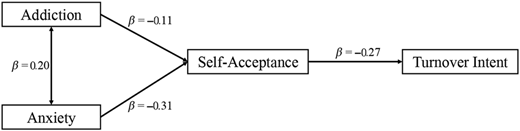
Mediation model containing only variables with significant influence. Note. β = standardized beta; all β were significant at p ≤ 0.05
Mediation model containing only variables with significant influence. Note. β = standardized beta; all β were significant at p ≤ 0.05
In sum, SEM results indicate that addiction to technology and anxiety related to its use reduce self-acceptance, leading to higher TI. When comparing the significant mediator (self-acceptance) to non-significant mediators (growth and mastery, for example), such findings indicate that workers who feel that they are not in control of their use of technology might end up leaving their current workplace because their experiences lead them to feel unsatisfied with who they perceive themselves to be, rather than, for example, due to them feeling that the company does not provide them with opportunities to grow or belong. These results are consistent with H1 and will be further considered in the discussion.
Network analysis
Figure 2 contains the network produced, where each circle represents one of the variables, the color of the edges (lines) represents the directionality (blue = positive relationships; red = negative relationships) of the relationship and the thickness of the edges is representative of the relationship's strength. The distance between nodes is also indicative of closeness between the associated constructs.
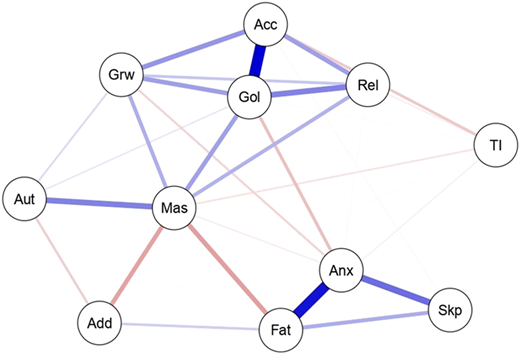
Network of technostress, well-being and TI. Note. Fat = Fatigue; Anx = Anxiety over perceived inefficacy; Add = Addiction; Aut = Autonomy; Mas = Mastery; Grw = Growth; Rel = Relatedness; Gol = Goals; Acc = Self-Acceptance; TI = Turnover Intent
Network of technostress, well-being and TI. Note. Fat = Fatigue; Anx = Anxiety over perceived inefficacy; Add = Addiction; Aut = Autonomy; Mas = Mastery; Grw = Growth; Rel = Relatedness; Gol = Goals; Acc = Self-Acceptance; TI = Turnover Intent
As predicted in H2, there was a cyclical effect, shown by TI's small effect on anxiety due to feelings of inefficacy. Addiction's closeness to other constructs such as autonomy and mastery, compared to the remaining technostress variables, shows that addiction to technology use might be more closely related to well-being, or, in this case, ill-being, than to technostress. TI was directly related to all well-being variables, with the exception of autonomy. All variables were either directly or indirectly related to turnover intention. Within well-being, autonomy and mastery's distance from turnover intention and from the remaining well-being variables might indicate that there are two classes of well-being variables, at least within the context of workplace well-being and turnover intention. Within the context of technostress, each variable seems to have a unique relationship with well-being and TI, with skepticism being a particularly unique case, seeing as it almost exclusively affects well-being and TI indirectly, perhaps suggesting that a serial mediation effect would better represent the data when compared to a parallel mediation model.
As stated in the data analysis section, assessment of relative importance was also done, with the various measures' subscales. Figure 3 shows the bar plot of the relative importance of explanatory variables. Fatigue and anxiety due to perceived inefficacy had the most explanatory power, followed by self-acceptance, goals, mastery of the domain and personal growth.
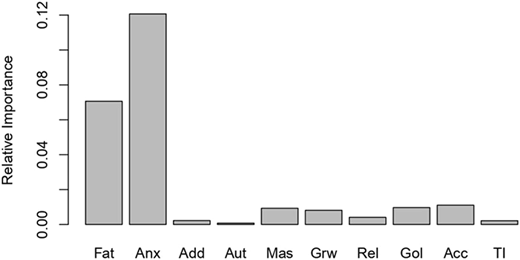
Relative importance of each study variable. Note. Fat = Fatigue; Anx = Anxiety over perceived inefficacy; Add = Addiction; Aut = Autonomy; Mas = Mastery; Grw = Growth; Rel = Relatedness; Gol = Goals; Acc = Self-Acceptance; TI = Turnover Intent
Relative importance of each study variable. Note. Fat = Fatigue; Anx = Anxiety over perceived inefficacy; Add = Addiction; Aut = Autonomy; Mas = Mastery; Grw = Growth; Rel = Relatedness; Gol = Goals; Acc = Self-Acceptance; TI = Turnover Intent
Taken as a whole, the analysis can be understood as a map of relationships, where the thickness of each vector is indicative of the strength of the relationship between the variables (nodes). This map revealed a key finding that the mediation model missed: a direct link between TI and Anxiety (Anx). This suggests a potential “vicious cycle”: tech anxiety may lead to wanting to leave, and already wanting to leave may make someone more anxious and less tolerant of new technology. The relative importance analysis shows that technology-related fatigue and anxiety are the “central actors” in the network. This indicates that these are the variables most present within all the interactions found and, therefore, have the most explanatory power in relation to all other variables. Such findings can be useful when deciding which variables to target in an intervention, as will be further discussed below.
Discussion
The primary objective of this study was to examine the impact of technostress on turnover intention, specifically by investigating how well-being mediates this relationship. Additionally, the study aimed to highlight the advantages of utilizing network analysis as an alternative to traditional mediation models in understanding these complex psychological and organizational dynamics. By employing both analytical approaches, the research sought to provide a more comprehensive perspective on how technostress influences employees' decisions to leave their organizations. The findings supported both hypotheses, confirming that higher levels of technostress are associated with an increased likelihood of turnover intention, which is, in turn, associated with technostress. This effect occurs through a reduction in overall well-being, demonstrating that employees experiencing high levels of stress related to workplace technologies tend to feel less satisfied and engaged, which in turn leads them to consider leaving their jobs, at which point their experience with technology worsens as well. These results align with existing literature on workplace stressors and turnover, reinforcing the importance of addressing technostress as a significant factor in employee retention and organizational stability.
Traditionally, much of the work on employee turnover and well-being has relied on linear, unidirectional models that presume a fixed order of influence. Despite their usefulness, the present study indicates that these models might be oversimplifying a rather complex relationship. By incorporating a network approach, the current study reveals that technostress has a reciprocal relationship with TI, indicating that employee attrition is not simply the endpoint of a linear process. It would be interesting to investigate whether other stressors show similar effects. It's possible that technostress is a unique stressor, in the sense that its “origin point”, that being information technology, requires continuous engagement and increasingly so, particularly with the advent of remote work. The present work reveals network analysis as a valid way of researching these phenomena, and possibly as a useful tool for those who wish to investigate these factors within their own organizations.
When looking at specific factors within technostress, it is apparent that addiction is differently placed within the network in comparison to the remaining factors. Although the Technostress Scale (Salanova et al., 2013) envisions four factors within its structure, the present results seem to support two higher-order factors: technology aversion, represented by anxiety, fatigue and skepticism, and technology overuse, represented by addiction. Although both of these supposed factors reflect an unhealthy relation to technology, it could be the case that those who belong to each group could present different risk factors or different progression throughout the turnover process. For example, although the commonsense expectation of those intending to leave a company is that they get less work done, it is possible that a technology overuser could keep up with the workplace demands by utilizing their familiarity with technology as a way to cut corners. Future studies could dig deeper into these hypotheses by including variables such as absenteeism and presenteeism as precursors to turnover. Those who wish to intervene with technostress may also have to consider whether their target audience comprises technology-averse workers or overusers. While for the former group it might be crucial to increase training and access to tools where one can become more familiar with information technology through gradual exposure, overusers might need more targeted training, focusing mostly on boundary-setting or developing coping skills that reduce the necessity of using technology to deal with work-related stressors. Incorporating qualitative methods, such as interviews or diary studies, could provide insight into how employees from each group perceive their digital environment and how these perceptions influence their coping mechanisms, engagement and ultimate decision to stay or leave. In doing so, future research could move beyond static assessments of technostress and instead capture the lived experience of digital strain, offering a richer context for both theory and intervention.
As was posited, technostress seems to fit into Khalid and Syed's (2024) ecological model of workplace well-being. Technostress is expected to be an organizational inhibitor of well-being, probably categorized as a job demand. Although both mediation and network analysis support this claim, the latter indicates that the relationship might be more complex than the model initially indicates. Turnover intention's effect on both well-being and technostress variables is indicative of a positive feedback loop, meaning that, once an individual starts to consider leaving their place of employment, they might be more sensitive to increased ill-being and stressors, specifically technostress. This bidirectional dynamic raises important questions about the temporal evolution of workplace well-being and its entanglement with employees' cognitive and emotional withdrawal. If turnover intention can amplify the experience of technostress, it suggests that organizational disengagement may not simply be a consequence of poor well-being, but a catalyst for further deterioration. This reframes TI as a critical inflection point in the employee experience, where proactive interventions might be most effective. For instance, employees who begin to disengage may become less tolerant of technical issues or difficulties, more resistant to adopting new tools, or more likely to interpret digital demands as intrusive or unfair. These perceptions could be shaped by an erosion of perceived alignment between personal values and organizational direction, particularly if digital transformations are implemented without adequate employee input or support. Future studies should explore the mechanisms through which this effect occurs, such as, possibly, reduced investment in the company, reduced psychological resources or feelings of disconnection between one's work and their life goals, for example.
When considering studies that investigated technostress specifically within this context, Sharma and Tiwari (2023) observed that TI was predicted by technostress and mediated by work-life balance and burnout, while also identifying psychological capital as a moderator between technostress and burnout. These results also coincide with the present study, but once again, the question of positive feedback must be introduced. The moderating effect of psychological capital, defined as “an individual's positive psychological state of development” (Luthans et al., 2006, p. 3), found within these results, could be a clue as to how increased TI can lead to reduced well-being. When an individual is considering leaving their workplace, this could reflect a feeling that they do not believe their current state of employment is stimulating positive self-development, meaning that TI could “erase” the protective effect that psychological capital has on burnout. So far, the literature has mostly focused on psychological capital as a predictor of TI (e.g. Li et al., 2021), but a reciprocal or inverse relationship should be considered by future studies.
The present study was largely limited by the sample's characteristics, reporting relatively low levels of technostress. This is notable, as prior literature has consistently shown that older professionals tend to experience higher levels of technostress, often due to lower digital fluency, slower adaptation to new technological tools, or heightened anxiety regarding obsolescence in rapidly evolving digital work environments (Garde et al., 2006). While this does not invalidate the findings of the current study, it does suggest that the observed effects may underestimate the full magnitude of technostress and its potential consequences in more age-diverse or older populations. Nonetheless, the significant relationships identified between technostress, well-being and turnover intention indicate that the mechanisms explored remain relevant and meaningful, even in a younger sample. These findings, therefore, serve as a valuable foundation for future research to build upon. One promising avenue would be a longitudinal cohort study that explicitly differentiates between younger and older employee groups, allowing for direct comparison of model structures, such as network configurations and mediational pathways, across age brackets. Additionally, such a study could investigate how age-related differences in technostress influence key organizational processes, such as the training and mentoring of new employees. Since training responsibilities often fall to older, more experienced staff, elevated technostress in this group may simultaneously impact their own performance and satisfaction and the quality of training received by younger workers. Additionally, the study's findings intersect with broader societal questions about equity and inclusion in digital workplaces. If technostress disproportionately affects older employees, those with lower digital literacy, or those in lower-resourced organizational contexts, then workplace digitalization could unintentionally deepen existing inequalities. Organizations with insufficient training, poor IT support, or an expectation of constant digital availability may inadvertently create exclusionary environments for employees who cannot easily adapt. Exploring these generational dynamics could yield important insights for improving digital training strategies, intergenerational collaboration and age-inclusive workplace design. Future studies could also utilize longitudinal designs to explore turnover directly, rather than TI. Such a methodology would not only surpass limitations inherent to cross-sectional designs but also help to distinguish between workers who effectively leave a company and those who simply disengage from it while remaining employed (absenteeism and presenteeism).
In the advent of remote work becoming an increasingly common and, in many sectors, default mode of employment, the present study opens up valuable opportunities for follow-up investigations that explore the unique dynamics of technostress in virtual environments. Remote work introduces a distinct set of technological and psychosocial demands, which may alter how technostress manifests and interacts with well-being and turnover intention. A natural next step would be to replicate the present methodology with a sample composed entirely of remote or hybrid workers, who tend to be younger and, as research suggests, are generally more comfortable with digital technologies and less prone to technophobia (Hamouche and Parent-Lamarche, 2023). Perhaps such a sample could experience less symptoms of anxiety and fatigue, with addiction taking on a more central role in those who intend to leave their workplace but don't struggle with understanding technology, instead struggling with its overuse. Additionally, other factors could be interplayed with the present ones, perhaps through variables such as loneliness (Bowers et al., 2022). Feelings of isolation may exacerbate the emotional impact of technostress and reduce the buffering effects of peer support that are more readily available in physical office settings. The transition to remote work represents a profound shift in the landscape of employee experience, and studying technostress within this evolving context may be crucial to developing companies that can effectively maintain their workers and provide them with effective opportunities for growth.
Beyond the cyclical nature of the relationship between the relevant constructs, there were other relevant differences between the mediation model and the network analysis. Most notable is the fact that, although the mediation model did not find any direct effects of technostress on TI, such a relationship was present in the network. This highlights one major limitation in mediation models, where, if closely related variables are included in the same model, certain effects can be “dissipated” along these variables, leading to situations where no total effects are found, yet indirect effects are present, as was the case in this study. Still, it is important to highlight that although relative importance analysis did not consider self-acceptance as strongly as techno-anxiety and fatigue, SEM was identified as the central well-being mechanism underlying technostress's impact on TI, highlighting the strengths of both methodologies, particularly when considered simultaneously.
Regarding practical implications, previous studies have suggested that implementing procedures in organizations, such as technology training, strong technical support and involving workers in the selection of information and communication technologies, can reduce the impact of technostress on employees (Tarafdar et al., 2010). However, according to Ninaus et al. (2015), there is a need for continuous training, even for those who are already highly familiar with information and communication technologies, due to the constant updates and innovations these technologies undergo. The present study develops on these findings in three ways: first, relative importance analysis indicated that anxiety and fatigue related to technology are prime targets for intervention, while also indicating that addiction plays a distinct role in technostress. Future studies could explore whether populations that are inherently more familiar with technology, such as workers from the information technology sector, are more vulnerable to addiction-related technostress. Second, given the role self-acceptance played in mediation analysis, we suggest that interventions can and should, go beyond training, implementing well-being modules, particularly by dissociating the worker's performance from their self-worth. Previous literature has also suggested that tying one's self-worth to performance can negatively impact the latter (e.g. Lavrijsen et al., 2023). Finally, the cyclical relationship between technostress and TI suggests that earlier is better, highlighting the need to focus on prevention rather than implementing reactive interventions. Based on these results, future studies could implement practices that support self-acceptance in the workplace, such as mindfulness and self-compassion-based interventions. This is an emerging field showing promising results for addressing technostress (Ioannou et al., 2024), and the present study provides new mechanisms worth exploring in these interventions.
Beyond training, there are additional factors within a company that may contribute to or alleviate technostress. For instance, Rademaker et al. (2023) found that empowering and supportive leadership can serve as a protective factor, helping to buffer employees from the negative effects of technostress. This suggests that leadership style and organizational culture play an important role in shaping employee experiences. Moreover, other contextual factors within the workplace environment could be explored using this methodological approach. In particular, incorporating non-latent variables, such as the quality and reliability of technological equipment, may provide a clearer understanding of the reciprocal relationship between technostress and turnover intention. Furthermore, more sophisticated models could be designed to include a wider range of contextual variables, such as the quality of organizational support or the availability of mentoring programs, as highlighted in previous studies (e.g. Woo et al., 2019).
Conclusion
In the digital age and following a period of significant changes in the job market due to the digitalization of professional tasks and the effects of the COVID-19 pandemic, this study contributes new insights to the literature on workers' relationships with technology use. It also highlights the importance of organizations in promoting well-being to improve the relationship between work and workers. Furthermore, it reinforces the understanding that technostress is associated with workplace stress, the imbalance between task demands and professional resources and the feeling of being constantly connected to work through technology – even when not physically present at the workplace, but with full and continuous access to information (Ninaus et al., 2015; Park and Cho, 2016). The findings of this study align with Khalid and Syed's (2024) ecological model of workplace well-being, further supporting the idea that technostress functions as an inhibitor of well-being within organizational settings. Additionally, this study provides the literature with new and important data on workers' intentions to leave organizations and on tools to mitigate high turnover rates.
Interpreting the results suggests that technostress may be categorized into two broad dimensions: technology aversion, which includes anxiety, fatigue and skepticism; and technology overuse, which is represented by addiction. Both aversion and overuse showed cyclical effects with TI through well-being. This differentiation opens new avenues for research into how these subtypes may affect employees differently. For example, employees who experience technology aversion may struggle with adapting to digital tools and feel overwhelmed by technological changes, while those experiencing technology overuse may rely heavily on digital tools, potentially masking the negative effects of technostress by leveraging their familiarity with technology to maintain productivity. Future studies could attempt to establish distinct profiles through methodologies such as latent profile analysis, subsequently exploring how these profiles interact with TI, absenteeism and presenteeism, among other factors.
By complementing a mediation model with network analysis, the present study developed important insight into the turnover process by explaining how workplace stressors can impact turnover, which, in turn, can also impact one's reactions to the stressors themselves. The results indicate a cyclical relationship, where the experience of technostress not only predicts turnover intention but is also exacerbated once an employee begins considering leaving their job. This feedback loop suggests that turnover intention may play a role in amplifying workplace dissatisfaction, which could further reinforce the negative effects of technostress. Future research should explore these reciprocal effects in more depth, possibly through longitudinal studies that capture the progression of technostress and turnover intention over time. Complementing the present results with other studies that characterize positive and negative work environments (e.g. Gaspar et al., 2024) can be crucial in optimizing workplace conditions that facilitate positive mental health and development for workers.
Overall, this study contributes valuable knowledge to the expanding body of research focused on technostress and turnover. By shedding light on the cyclical nature of the relationship between these two factors, distinguishing among different subtypes of technostress and showcasing the methodological strengths of network analysis, the findings offer a comprehensive and robust foundation for future research. These insights are especially relevant for organizations striving to enhance employee well-being and reduce turnover rates. Employers and policymakers should carefully consider these findings when developing and implementing workplace policies and intervention strategies aimed at mitigating the harmful effects of technostress, particularly in an increasingly digital and technology-driven work environment.
There are no outstanding acknowledgments.

