Using an abductive perspective, this study aims to review the scientific literature about the governance and management of the digital supply chain (DSC) in the context of the business organizations, providing an overview of the state of the art of the research and outlining a future research agenda with a knowledge management (KM) focus.
After investigating the Scopus database, 54 articles were identified as relevant and then subjected to an initial discernment. After this assessment, 34 articles focusing on operations management were further analyzed through both a bibliometric analysis and a content analysis.
The DSC represents a research area of increasing attention, with relevant contributions to several aspects of the field, as well as about KM. At the same time, the results show that the scientific literature on DSC models, solutions and applications is fragmented. Although the analysis has found a heterogeneous literature, two main streams of research seem to emerge: KM in the business culture development about DSC and KM in the business technological evolution about DSC.
Although there exists growing interest in the scientific community, or perhaps because of this, area of research remains fragmented and under-theorized, thus requiring more systematic studies considering both economic and social aspects of the DSC. This study aims to provide innovative insights about this evolution, especially highlighting the two main contributions of KM in DSCs that have been revealed (business culture development and business technological evolution).
1. Introduction
Technological progress and subsequent digitalization are revolutionizing business environments, markets, models and, more specifically, the ways enterprises work (Xu et al., 2018; Rajput and Singh, 2019). The advent of innovative computer science applications, such as the Internet of Things (IoT), cloud computing (CC), blockchain (BC), big data analysis (BDA), artificial intelligence (AI), machine learning (ML) and so on, drives business organizations to embrace digitalization even in the supply chain (SC) (Queiroz et al., 2019).
The adoption of SC digitalization will improve the entire organizational process, from numerous perspectives (information sharing, transparency, productivity, resilience, sustainability and so on), although naturally even negative consequences must be accurately considered, for example about the work experience (Orhan et al., 2022); more generally, in a supply chain management (SCM) context, business organizations will enhance customer support by building better business relationships and generating more revenue opportunities (Ageron et al., 2020; Preindl et al., 2020). Digital supply chain (DSC) has thus become a standard term within a generic business scenario, with the intent to transform the SC processes by adopting digital technologies (MacCarthy et al., 2016; Legner et al., 2017).
In the scientific literature, the potential definitions of DSC have been discussed from several perspectives, with related focus on the new digital technologies that have each characterized all the types and activities of the SC; these always provide evidence that the use of digitalization in the SC is no longer simply a choice but a requirement for companies to remain competitive in the market. In this respect, the change from traditional SC to DSC, therefore, is fundamental for the survival of business organizations (Hartley and Sawaya, 2019; Agrawal et al., 2020).
In addition, the coronavirus disease 2019 (COVID-19) pandemic has provoked significant disruptions across the globe in the integrated SCM, such as border closures, social distancing and trade restrictions (Belhadi et al., 2021; Narayanan et al., 2021). However, the outbreak of the COVID-19 crisis has increasingly highlighted the importance of digital technologies and the subsequent SCM digitalization by simultaneously providing innovation and sustainability to the business models in the vast field of SC (Chatterjee et al., 2022).
For all these reasons, this study aims to provide support and guidance in evaluating the adoption of the DSC, its design, implementation and valorization, assuming knowledge management (KM) as the fundamental focus of the investigation, due to the increasing success of the knowledge era, society and economy, both in the SC context (Desouza et al., 2003; Anand et al., 2022) and the DSC context (Dhaigude et al., 2021; Sanderson et al., 2022). Starting from these considerations, this study elaborates on a bibliometric analysis of the scientific literature in the field to determine the main trends in this direction, with subsequent considerations in terms of theoretical and practical implications, highlighting the possible limits of the investigation and suggesting potential future research developments.
2. Theoretical background
Since the current research is based on a bibliometric literature review (BLR), an analysis of the previous scientific literature in the field, upon which an investigation is based. This may not appear to be strictly indispensable, because the precise aim of a BLR is to ascertain (and not to move from) existing patterns of research. However, a general introduction to the theme of SCM in terms of the potential impact of the digitalization is vital to comprehensively outline the issue under analysis (Seyedghorban et al., 2020; Hennelly et al., 2020; Bigliardi et al., 2022).
In truth, the increasing success currently interesting the SC world is not recent, meaning that the governance of the overall system of the operators involved in the integration of the manufacturing and of the distribution streaming is not a necessity/opportunity that regards only the ongoing digital disruption; above all, this starts with more general sensitivity about the managerial perspective of the context (Bendavid et al., 2010; Klaas Jagersma, 2011; Dehghan-Bonari et al., 2021). At the same time, however, the literature must admit that, although the concept of SC is undoubtedly connected to an organizational point of view, it was only with the adoption of ever more interconnected technologies, from the Electronic Data Interchange to the internet, that the success of the SCM has become unstoppable (Fabbe-Costes and Lechaptois, 2022).
In addition, this continuous growth and development has been hugely expanded with the advent of Industry 4.0, which focuses on increasing the efficiency, productivity and resilience of the operator performance of those involved in the manufacturing and distribution flow (Chauhan and Singh, 2020). Furthermore, a new approach is emerging, i.e. Industry 5.0, which combines Industry 4.0's orientation with a more human-centered vision (Nayeri et al., 2022) and which has been officially adopted as the main trajectory of development by the European Union, being a declared policy of the European Commission more specifically (research-and-innovation.ec.europa.eu/research-area/industrial-research-and-innovation/industry-50_en).
Therefore, the theme of digitalization in connection to the SCM is physiological and relevant, most of all considering that the technological evolution is expected to be increasingly fast, sophisticated and impactful (Solís-Quinteros et al., 2022); in this vein, the opportunity to investigate the potential relationships and interactions with the KM sphere is very attractive, more specifically if adopting a BLR. In fact, a search on Scopus, operated in April 2022, on “TITLE” OR “ABSTRACT” OR “KEYWORDS”, using the following query:
And it returned no result, thus revealing a theoretical gap in the field. Accordingly, the following investigation has been conducted.
3. Research design
This study has been conceived in the form of a BLR to investigate and determine the potential main research areas that interest the world of digitalization in the SCM, aiming to recognize trends, progress and potentialities in the field (Tranfield et al., 2003; Petticrew and Roberts, 2006; Massaro et al., 2016; Ardito et al., 2019; Kraus et al., 2020; Durach et al., 2021). More specifically, as previously mentioned, the focus concerns the role of knowledge in these contexts; in this respect, the main research questions of this study are.
How has the scientific SC literature been developed according to the prominent adoption of knowledge in digitalization?
What are the main focuses of the scientific literature investigating the adoption of knowledge in digitalization for SCM?
A specific protocol for the document search, the article selection and the data analysis has been engineered. First, it has been deliberated to investigate the Scopus database, one of the most relevant at the international level and preferred to Scholar (which is larger, but even vaguer) and to Web-Of-Science (which is more severe in including publications, but consequently even smaller) (Waltman, 2016; Mishra et al., 2017; Thelwall, 2018); the Scopus database, detailing research focused on knowledge, was initially enlarged to include socio-economic areas (and related fields).
Regarding the survey perimeter, the query has investigated the following fields: “Title” OR “Keywords” OR “Abstract”. Each of these fields has been investigated adopting the following syntax: “supply chain” AND “digitalization” AND “knowledge”.
The initial outcome of the research provided a total of 92 documents published in the period from 2005 to 2022, because 2005 is the year in which the first paper respecting the query criteria was published. All the data were collected in April 2022.
Subsequently, the 92 documents were initially investigated to detect papers suitable for further analysis. In this discernment, the following steps were implemented.
92 documents were extracted from the Scopus database as results of the query.
23 documents were excluded as not specifically pertinent to the fields of Business, Management and Accounting (considering the vast impact of knowledge in other scientific fields) (thus, 92–23 = 69).
15 documents were excluded after investigating their titles and abstracts, because they did not show correspondence with DSC, with the terms “supply chain” and “digitalization” not being mentioned in combination, but only as terms in the text (thus, 69–15 = 54).
54 documents were finally detected as properly in line with the focus of the research, i.e. to investigate the knowledge role in the DSC.
The dataset under investigation includes case studies and empirical studies, developed both qualitatively and quantitatively. All these documents have been subjected to a bibliometric investigation.
4. The analysis
The investigation on the 54 documents/papers/articles has been implemented using VOSviewer, specific software for visualizing and constructing bibliometric networks and clusters (Van Eck and Waltman, 2014). This application allows researchers to aggregate and analyze the relationships among articles through a bibliographic coupling analysis, i.e. evaluating the relationships of the articles in the sample under analysis (Kessler, 1963). This technique occurs when a paper is cited by two other papers (Li et al., 2017) to appraise the overlapping literature between/among the studies.
The starting point of the clustering process (Waltman et al., 2010) is to consider the distances between nodes; therefore, the groups are determined by minimizing such distances. The fractional counting is used for all the analyses performed with VOSviewer (Leydesdorff and Opthof, 2010).
4.1 The bibliometric study: the descriptive analysis
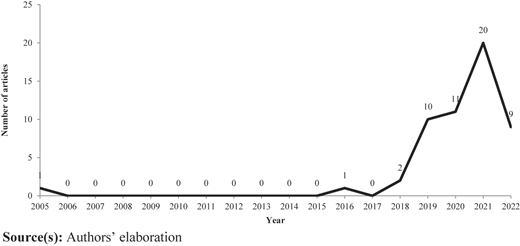
As illustrated by Figure 1, which examines the time interval of the publications, the research area under consideration appears rather recent. Indeed, as mentioned in Section 3, the first article was published in 2005. However, the BLR shows that no other papers were published until 2016, with subsequent increasing interest by the scientific community commencing in 2018, highlighting that the topic remains in the early stages of its development.
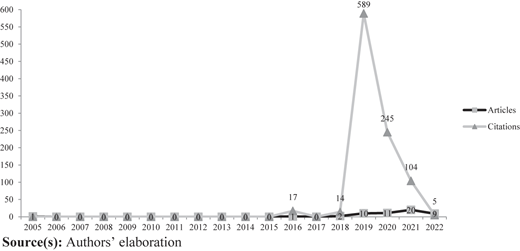
When providing a time comparison of the number of published papers in relation to the number of citations, Figure 2 shows consistent growth from 2019 to 2021. This evidence confirms the recent interest of the scientific community towards the theme of DSC when focused on knowledge.
As concerns the journals that have been retrieved from the inquiry, Table 1 lists the 15 most relevant journals based on the number of scientific publications. Based on this investigation, the International Journal of Production Research is the journal with the highest values, both for the number of published articles (3) and the number of citations (588).
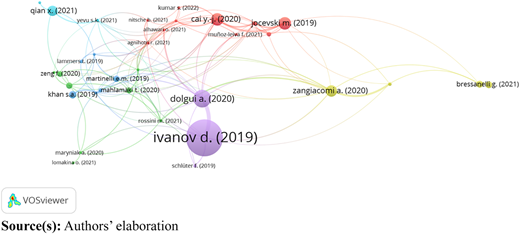
Table 2 provides the ranking of the first ten articles and, therefore, their authors, according to the number of Citations Per Year (CPY) of the articles under investigation. The CPY is a measure of the scientific influence on the academic community and Ivanov et al.'s (2019) article is the most cited in general and the most cited per year.
In summary, the descriptive analysis of the bibliometric study seems to provide the following two answers to RQ1 (“How has the scientific SC literature been developed according to the prominent adoption of knowledge in digitalization?”). First, publications in the field commenced in 2005, but it was only in 2019 that a significant number of studies began to enter the scientific debate (and this is true even for related citations), demonstrating that this research topic is undoubtedly a novelty. Second, the journal with the highest number of citations (overall; other journals do feature on the list) is the same as the journal publishing the articles with the highest number of citations per article, showing some concentration of the scientific community on some specific scopes.
4.2 The bibliometric study: bibliographic mapping
To identify the key issues that may link the concept of SCM with that of digitalization, another technique belonging to the bibliometric analysis process has been adopted: bibliographic mapping. The mapping methodology allows researchers to extract information about the most influential research, with a double advantage: on the one hand, scholars may turn their scientific interest towards both more or less frequently investigated topics; on the other hand, managers may be provided with an exhaustive, more comprehensible and up-to-date perspective of the topic in question, intending to rapidly translate theoretical knowledge into best practices (Börner et al., 2005; Mital et al., 2018).
Of the overall 54 scientific articles, 34 have been selected through a bibliometric clustering process (cf. Table 3 and Figure 3), because they are the “only” articles that possess themes in common. These 34 articles were subsequently subjected to a content analysis, adopting the technique of the affinity diagrams to identify the potential main aggregations with scientific interest. In this respect, two primary Research Areas (RAs) were finally identified: KM in the business culture development in the DSC and KM in the business technological evolution in the DSC. These constitute the two main answers of the bibliographic mapping within the bibliometric study, specifically concerning RQ2 (“What are the main focuses of the scientific literature investigating the adoption of knowledge in digitalization for SCM?”).
4.3 RA no. 1. knowledge management in the business culture development in the DSC
Knowledge transfer seems to emerge as the most prominent area of specialization of the debate. Several contributions have been identified in this area focusing on models of knowledge transfer from theory to practice.
The most relevant articles belonging to this first perspective are: Pal (2016), Khan et al. (2019), Martinelli and Tunisini (2019) and Khan et al. (2021). When aggregating the different contributions, there is a substantial proposal for the implementation of an integrated knowledge-based system to assess the impact of the DSC on business organizations.
The survey contexts were different, from manufacturing to textiles. Through the development of such knowledge systems, there is a significant expectation about the managerial potentiality to better monitor and coordinate company performance when adopting a DSC, with improvements in the transparency of the processes and greater collaboration in the creation of business value.
4.4 RA no. 2. knowledge management in the business technological evolution in the DSC
This aggregation includes all the studies that have qualitatively and quantitatively described the importance of technology maturity in the development of the DSC. For example, a relevant topic in the field is connected to the adoption of BC: Qian and Papadonikolaki (2021) highlight just how applying the BC technology to the SCM could provide mechanisms of protection to avoid possible risks and, therefore, to render the global process of SCM more robust. Similarly, Yang et al. (2021) conducted an experimental study and stressed the validity of the BC technology to govern and manage the problems of knowledge sharing among the several SC stakeholders.
Other studies are highly relevant to the literature, because they provide an overview of the current state of the art about DSC from different points of view. For example, Yevu et al. (2021) suggest that in the construction industry the integration between Building Information Modeling systems and Industry 4.0 solutions is essential for future research opportunities, with the goal of advancing the DSC technology in a sustainable environment. By contrast, Lammers et al. (2019) and Dolgui et al. (2020) both provide useful contributions to business managers for deciphering opportunities and especially barriers in the transformation from the traditional SC to the DSC, suggesting practical achievements at the organizational, technological and managerial levels in terms of decision support systems to incentivize progress towards the DSC.
5. Theoretical and practical implications
From a scientific perspective, one of the most relevant outcomes seems to regard the RAs (both RA1 and RA2) that emerged from the analysis. In other words, knowledge and consequent KM (in the form of knowledge accumulation, sharing, enhancement and so on) are vital in facilitating and valorizing the digitalization of the SCM processes, with particular reference to the BC technology, as concluded by several studies (Hennelly et al., 2020; ElRefae and Nuseir, 2021; Kwon and Ahn, 2021), ensuring greater transparency and trust for the various stakeholders, even in terms of the sustainability of the global SC (Chin et al., 2022).
However, the literature must observe that this role is evident, attracting increasing interest from the scientific community, but there does not yet exist a mature vision about the KM in the DSCs, with a blatant fragmentation not only as concerns the different themes of research, but also as concerns the different contexts of the case studies analyzed so far. Thus, the current state of the art, the most relevant implication of the research, in addition to RA1 and RA2 as potential avenues to continuously explore, is the necessity and/or opportunity of finding conceptual aggregations that could provide major stability to this undoubtedly innovative theme of study.
Furthermore, from a managerial point of view, the development of KM in DSCs is fundamental, through guidelines, protocols, platforms and projects, inevitably respecting the different contexts of action. In fact, through the operational application of KM methodologies, techniques and tools in the DSC it will be possible to move from an initial stage to a more consolidated and even more advanced phase of this phenomenon, particularly emphasizing the contributions of RA1, i.e. in terms of business culture development.
Secondly, with specific reference to RA2, i.e. in terms of business technological evolution, it is to highlight the significant contribution that KM may provide in terms of professional competences when evolving to increasingly advanced digital solutions. In this respect, above all, the “traditional” operations of knowledge sharing (i.e. socialization, interiorization, exteriorization and combination) should coherently evolve with the progress of the technological level of the overall SC, remembering, as previously described, that SCM, before being an integrated computer science architecture, was an integrated managerial platform.
6. Research limits
The main limitation of the study is still the small number of articles in the dataset under investigation, due to the innovative and still mostly unexplored research theme in the scientific literature. In the future, a comparative analysis, including Scholar and Web-Of-Science, with all the relating limits, could provide a different overview of the phenomenon, but this potential enlargement should be managed very carefully, considering the specific characteristics of these databases that have been mentioned.
Another limitation likely concerns the shortness of the time interval, i.e. from 2005 (and then 2016 and 2018) onwards. However, this limit is structural and cannot be solved by adopting a different research methodology; this thus requires major production in the field to expand the validity of similar research in the future.
7. Conclusion
To understand the state of the art and to outline the potential research agenda about the role of KM in the context of DSC, a complete review of the scientific literature of this topic has been considered appropriate. More specifically, in this study a BLR has been conducted, examining the evolution over time of the most relevant studies in the field. In addition, a bibliographic mapping has helped to determine the main themes of the extant literature, essentially resumable in RA1 (KM in the business culture development in the DSC) and RA2 (KM in the business technological evolution in the DSC).
These two RAs are the most promising in the evolution of the studies in the field, also because the research production is very fragmented and only 34 papers of the 54 under analysis have potential themes in common, emphasizing the role of RA1 and RA2 as stable aggregations of scientific interest; this is true at least at the forefront and for the foreseeable future, even considering the relative newness of the topic (as shown by the descriptive analysis of the BLR). However, the limited sample of studies emerging from the literature review, together with the unstoppable diffusion of KM, suggests that this is a field of research with very limited investigation, providing huge opportunities for development at the scientific and managerial levels.