


Demand forecasting is crucial for effective operations and supply chain management, particularly at the manufacturing stage. This study aims to explore the application of Organizational Information Processing Theory in AI-driven demand forecasting, examining how AI reshapes organizational processes and addressing the enablers and challenges of its implementation.
Through action research conducted in collaboration with an Italian manufacturing company, this study developed a deep learning-based demand forecasting system. Adopting abductive reasoning, it offers a theoretical examination of the system’s impact, focusing on the interplay between AI implementation and organizational dynamics.
This study reveals the organizational changes needed to implement AI in demand forecasting, focusing on iterative adjustments to align information processing amid evolving and uncertain data. Key factors such as data perception, nervousness, and data unreliability affect how information is trusted and used across departments and with suppliers. Building mutual trust and shared interpretive capabilities helps overcome collaboration barriers and reduces risks such as the bullwhip effect, highlighting the importance of negotiation within the organization alongside technology adoption.
We extend organizational information processing theory by introducing new constructs that capture AI’s implementation challenges, such as data perception and nervousness. Our study shows how AI-specific factors increase information processing demands, while organizational reshipment and trust enhance capacity. This refined framework offers a novel perspective on AI adoption, emphasizing both internal and supply chain information dynamics.
Introduction
Demand forecasting is essential for organizational planning, guiding decision-making across various business functions (Danese and Kalchschmidt, 2011). Accurate forecasts are crucial for efficient operations and robust supply chain management, directly influencing customer satisfaction by ensuring product availability and preventing stock-outs (Feizabadi, 2022). This predictive capability plays a critical role in inventory management and serves as a key input for production planning. Ultimately, reliable demand forecasting supports both immediate and strategic goals, underpinning decisions related to production schedules, sales targets, and new product introductions (Danese and Kalchschmidt, 2011).
Despite this importance, achieving accurate forecasts using conventional methodologies has become increasingly challenging in today's dynamic business environment. Intensified competition, rapidly evolving customer needs, and shifting market trends have diminished the effectiveness of traditional forecasting techniques (Feizabadi, 2022; Zhu et al., 2021). AI has emerged as a promising alternative, capable of learning from historical data to generate intelligent predictions. By integrating AI into forecasting, businesses can enhance accuracy, optimize inventory levels, and improve supply chain resilience, marking a significant shift toward data-driven decision-making (Kumar et al., 2020).
While enthusiasm for AI is growing, its application in research and practice is uneven. Many studies highlight AI's ability to outperform traditional methods by capturing complex, non-linear relationships (Aktepe et al., 2021; Helo and Hao, 2022; Nguyen, 2023; Toorajipour et al., 2021). Yet, contrasting findings suggest that statistical approaches can achieve comparable or superior accuracy in specific contexts (Feizabadi, 2022). These discrepancies stem from factors such as data characteristics (Feizabadi, 2022; Mediavilla et al., 2022), organizational dynamics (Danese and Kalchschmidt, 2011), and the type of AI technique applied (Abbasimehr et al., 2020). Moreover, AI's complexity can sometimes hinder its adoption (Feizabadi, 2022; Mediavilla et al., 2022). This ongoing debate underscores the need for further research into the contextual factors that determine the optimal application and value of AI in demand forecasting (Durach and Gutierrez, 2024; Revilla et al., 2023; Uren and Edwards, 2023).
Beyond these more technical concerns, the scope of AI-driven demand forecasting research remains limited. Much of the existing literature is concentrated on the retailer's perspective, reflecting a downstream focus. Mediavilla et al. (2022) and Dieudonné et al. (2023) observe that most studies overlook applications at other levels of the supply chain, particularly upstream partners such as manufacturing. This imbalance suggests that opportunities to explore the role of AI in supporting manufacturing decision-making, where forecasting is equally critical but often more complex, remain underdeveloped.
Demand forecasting is a critical, knowledge-intensive activity within supply chain management (SCM) that serves as the empirical context for this study. It involves complex information processing due to the need to integrate historical data, market trends, and multiple organizational inputs to generate accurate predictions. These characteristics make demand forecasting an ideal setting to investigate the organizational challenges associated with the AI implementation process.
To frame this investigation, we adopt Organizational Information Processing Theory (OIPT) (Galbraith, 1974; Tushman and Nadler, 1978) as the theoretical foundation for our intervention. OIPT posits that organizational performance depends on the fit between information processing requirements (IPRs), the amount and complexity of information needed to perform a task, and information processing capabilities (IPCs), the organization's capacity to collect, interpret, and act on that information. A misalignment between IPRs and IPCs reduces decision-making effectiveness and can hinder operational performance.
This research was prompted by the need at Adige S.p.A. – BLM Group, a global leader in machine tool manufacturing, to address a clear challenge in which the IPRs for accurate upstream demand forecasting exceeded the company's available IPCs. This imbalance led to forecasting inaccuracies that propagated into production planning inefficiencies, inventory imbalances, and suboptimal resource allocation. To address this, we conducted an action research study (Coughlan and Coghlan, 2002) aimed at enhancing IPCs through the development of a deep learning (DL) algorithm that integrates both historical data and market trends, enabling managers to better align IPRs and IPCs. OIPT is particularly well-suited to guide such organizational changes in contexts shaped by technological advancements (Galbraith, 1974; Guida et al., 2025; Roßmann et al., 2018).
Given that demand forecasting is a knowledge-intensive activity, we worked with the company to identify relevant information needs and strategies to meet them. The project, carried out between 2023 and 2024, unfolded through multiple iterative cycles of data gathering, algorithm development, implementation, and evaluation, ensuring the solution addressed a real operational challenge while allowing us to examine its impact across different organizational levels.
Based on this, and addressing the need for empirical studies examining managerial and organizational implications of the AI implementation process in real-world SCM contexts (Durach and Gutierrez, 2024; Guida et al., 2023; Handfield et al., 2019), we developed the following research question:
How does the artificial intelligence implementation process affect information processing in achieving a fit between requirements and capabilities in manufacturing demand forecasting?
This study contributes to theory by offering new insights developed through abductive reasoning (Eriksson and Engström, 2021; Kovács and Spens, 2005), extending OIPT to better capture the distinctive dynamics of AI implementation. Through the iterative development of a demand forecasting Decision Support System (DSS), we identified how factors such as outcome uncertainty, project scalability challenges, and data unreliability heighten information processing demands. At the same time, organizational enablers, such as technological readiness, effective cross-functional communication, and sustained managerial support, emerged as critical in enhancing information processing capacity and enabling AI diffusion across units. Furthermore, our findings introduce new constructs, including data perception and nervousness, which influence how information is interpreted and trusted during AI adoption. These theoretical advancements are complemented by actionable recommendations for managers seeking to strategically guide and sustain AI implementation across organizational boundaries.
The remainder of the paper is structured as follows. First, a theoretical background on AI in demand forecasting and a theoretical framing centered around OIPT are provided. Then the methodology used is extensively described followed by the design and development steps. Then evaluation of the results is provided together with the discussion of the finding. Finally, conclusions provide an overview of limitations and future developments of the study.
Theoretical background and framing
Definition of artificial intelligence
In this work, we adopt a broad computer science–based definition of AI. Following Russell and Norvig (2016), the European Commission (2018) defines AI as “systems that display intelligent behavior by analyzing their environment and taking actions, with some degree of autonomy, to achieve specific goals.” AI differs from technologies like big data and predictive analytics (Hazen et al., 2014; Hofmann et al., 2020) due to its autonomous decision-support capability, providing actionable insights rather than merely presenting analytical results.
Among AI approaches, machine learning (ML) and DL are most common. ML enables machines to improve performance on tasks by extracting knowledge from raw data, while DL, an ML subset, relies on artificial neural networks with multiple layers to capture complex patterns (Goodfellow et al., 2016).
AI has diverse applications: Natural Language Processing for text analysis and generation (Dwivedi et al., 2021), Computer Vision for image and video interpretation (Choi et al., 2018), robotics for physical automation (Hengstler et al., 2016), and optimization for tasks such as automated scheduling or route planning (Min et al., 2019).
Although AI is increasingly applied in supply chain management (SCM) (Culot et al., 2024) literature remains fragmented, with definitions shaped by context and application (Cui et al., 2022; Huang and Rust, 2018; Syam and Sharma, 2018). Its ability to process large datasets and generate accurate predictions underscores AI's transformative potential in complex, data-intensive environments like SCM, enhancing both decision-making and operational efficiency.
AI in demand forecasting
Demand forecasting has emerged as one of the most promising SCM processes to benefit from AI (Helo and Hao, 2022; Toorajipour et al., 2021). Traditional forecasting methods, such as ARIMA (Babai et al., 2013) and Exponential Smoothing (Quintana and Leung, 2007), often struggle with non-linear demand patterns, while AI offers the ability to learn from historical data and capture complex relationships (Aktepe et al., 2021). Despite encouraging results in research settings, however, real-world applications remain limited due to challenges such as industry-specific constraints, data availability, and integration with existing decision-making processes (Klumpp and Ruiner, 2022).
Beyond technical performances, the scope of current research is narrow, with most studies focusing on retailers. This downstream bias overlooks manufacturing supply chain contexts, such as supplier coordination and production planning, where forecasting is equally critical but more complex (Dieudonné et al., 2023; Mediavilla et al., 2022). In such contexts risks like bullwhip effect can be exacerbated by misinterpreted demand signals. While AI may help reduce forecast errors, its effectiveness depends on how fast information is shared and acted upon across supply chain partners (Yang et al., 2021).
Finally, although various AI approaches, from neural networks to deep learning, have shown strong predictive capabilities, their success is highly context dependent. Some studies even suggest that traditional statistical models can outperform AI in certain scenarios (İfraz et al., 2023). This highlights the need to evaluate not only algorithms but also organizational factors such as data quality, analytical capabilities, and readiness for technological change (Danese and Kalchschmidt, 2011; Guida et al., 2025).
Organizational information processing theory driving demand forecasting system design
During the early stages of the intervention, it became evident that the AI implementation process was not solely a technical undertaking, but also required substantial organizational adaptation to manage new types of information, coordinate across functions, and respond to heightened environmental volatility. Initial conceptual framings provided a useful starting point, yet they did not fully capture the dynamic interplay observed between uncertainty, information needs, and the mechanisms deployed to address them. This prompted an examination of theoretical perspectives that explicitly address the relationship between environmental uncertainty, information processing requirements, and the organizational capabilities necessary to meet those requirements. OIPT (Galbraith, 1974; Tushman and Nadler, 1978) emerged as the most appropriate analytical lens, as its central premise, the fit between information processing requirements (IPRs) and information processing capabilities (IPCs), directly reflected the challenges identified in implementing AI for demand forecasting in a complex industrial setting.
In recent years, OIPT has been increasingly used to understanding the adoption and impact of new technologies, including AI, within organizations (Guida et al., 2023, 2025; Lorentz et al., 2021; Schlegel et al., 2021). For instance, Guida et al. (2023) applied OIPT to investigate the impact of AI in supplier scouting, while Guida et al. (2025) applied the theory to the spend classification, demonstrating how AI-based tools can enhance IPCs to address the IPNs arising from uncertainty in the procurement process. Our research builds upon this application of OIPT by examining its relevance in the context of AI-enhanced demand forecasting. We argue that the implementation of an AI-based forecasting system is a strategic effort to augment an organization's IPCs to better align with the information processing demands of forecasting in a complex and uncertain environment.
To offer a more nuanced understanding of how OIPT can be effectively applied to demand forecasting, the following section will analyze two key components of the framework, information processing requirements and capacities, and discuss their role in demand forecasting systems.
Information processing requirements in demand forecasting
IPRs arise from the uncertainty and complexity of the organization's environment and task. According to Tushman and Nadler (1978), uncertainty can be defined as the gap between the information available and the information required to successfully complete a task. In the context of demand forecasting, IPNs can be heightened by several factors such as market variability, dynamic task environment and the need to consider numerous influencing attributes.
Environmental dynamism and complexity (Bensaou and Venkatraman, 1995), represented by evolving market trends, economic fluctuations, social events, and competitor behavior (Singh et al., 2023) are among the most prominent sources of environmental uncertainty. Such uncertainty drives the necessity for collecting and processing vast amounts of information from diverse sources to anticipate demand patterns effectively and align production strategies accordingly, increasing the overall IPNs.
Task uncertainty, and more in particular the organizational functional and staff unit components (Guida et al., 2025), arises due to the high interunit task interdependence typical of demand forecasting. In the context of this process, collaboration and information exchange across multiple organizational units is crucial (Revilla et al., 2023; Tushman and Nadler, 1978). Effective forecasting relies on data inputs from various departments, including production, finance, and marketing. This cross-departmental exchange substantially increases information processing requirements, as diverse datasets must be integrated, interpreted, and aligned to generate accurate predictions. Moreover, forecasts derived from this process have a cascading effect on other functions, particularly production and procurement. In our specific context, where production follows a make-to-forecast approach (Meredith and Akinc, 2007), demand forecasting plays a pivotal role in enabling the procurement department to order raw materials in advance. At the same time, production planning depends on forecasts to determine capacity requirements and allocate human resources effectively. Accurate forecasts help maintain workforce stability, avoiding inefficiencies caused by overproduction, underproduction, or workforce fluctuations.
Task complexity is another source of task uncertainty that arises when it is required the identification of multiple influencing factors, understanding their interdependencies, and selecting appropriate models or approaches to address them (Yasir et al., 2022). In demand forecasting, this complexity is inherently high and strongly correlated with environmental uncertainty. Accurately predicting demand necessitates identifying critical demand drivers, analyzing their correlations, and determining the most suitable forecasting model. These activities require the processing of vast amounts of data to account for variability and non-linear relationships, further amplifying information processing requirements.
In the context of interorganizational relationships, Bensaou and Venkatraman (1995) identified another form of uncertainty defined as partnership uncertainty. It is important to recognize that demand forecasting at the manufacturing level, rather than at the retail level, is strongly influenced by interactions with downstream supply chain partners. These partners are expected to share their knowledge of end-customer demand to help prevent the bullwhip effect. Simultaneously, the forecasted demand affects upstream partners, who depend on this shared information to plan their production activities. Therefore, developing mutual trust between firms is essential to reduce uncertainty and mitigate opportunistic behavior along the supply chain (Bensaou and Venkatraman, 1995).
To navigate this uncertainty, the organization must reshape their organizational processes for collecting, analyzing, and processing information about its external environment, internal performance, and evolving demand trends (Tushman and Nadler, 1978).
Information processing capabilities in demand forecasting
OIPT emphasizes that an essential consideration in designing an organizational unit is achieving alignment between IPRs and IPCs. Bensaou and Venkatraman (1995) formalized three mechanisms of IPCs which are respectively: structural, process and technological.
The first builds on the structural models developed by Galbraith (1974), and are constituted by a set of rule and procedures for information exchange and coordination and control. In his theorization, Galbraith (1974) distinguished between two primary structural models: organismic and mechanistic. An organismic structure is particularly well-suited for managing high levels of uncertainty, as is the case with demand forecasting. This structure fosters informal communication channels, enables flexibility in handling information, and supports adaptive responses to rapidly changing conditions. However, this flexibility comes at a cost, it often results in increased communication expenses and slower decision-making processes due to the lack of standardized procedures.
To address these trade-offs, it is essential to strike a balance between structural flexibility and formalization through well-defined rules and procedures. Over-reliance on either extreme can lead to inefficiencies, redundancies, or decision-making bottlenecks. Galbraith's model suggests that in contexts characterized by high complexity and significant information processing demands, such as demand forecasting, a formal information system represents the most effective coordination mechanism. Such systems enable structured and systematic data collection, analysis, and dissemination across various organizational units. By leveraging a formal information system, organizations can centralize critical forecasting data, standardize analytical processes, and ensure that insights are consistently communicated to relevant stakeholders.
Process mechanisms primarily refer to interorganizational collaboration and can be broken down into three key dimensions: conflict resolution, joint action, and commitment (Guida et al., 2023). As previously discussed in the context of demand forecasting, joint action is particularly important to prevent disruptions along the supply chain, such as those caused by the bullwhip effect, and to ensure effective upstream information flow. Bensaou and Venkatraman (1995) define joint action as the degree of cooperation among firms in critical areas such as long-term planning, production scheduling, and other essential operations. Given that demand forecasting plays a central role in production planning, this dimension of process mechanisms must be carefully considered when implementing AI-based forecasting systems.
In addition, technological mechanisms, which were not included in the original OIPT framework, refer to the use of information technologies to support coordination and control. Guida et al. (2023) identify four dimensions within this mechanisms, two related to data, one to ERP integration and one to inter-firm cooperation. This study focuses on the data-related and ERP integration aspects, data quality and data processing capabilities, as they are most relevant to demand forecasting. Data processing capabilities refer to the organization's ability to collect, analyze, and derive actionable insights from data using appropriate tools and techniques, thereby enabling data-driven operational planning (Agarwal and Dhar, 2014). Data quality, on the other hand, concerns the extent to which available data is suitable and reliable for effective information processing (Cegielski et al., 2012).
Key constructs described in these sections are summarized in Table 1, which, for both IPRs and IPCs, provides the macro-category, the specific construct, a brief definition, and an example of its operationalization in the context of demand forecasting.
Summary of the key OIPT constructs, with each construct accompanied by a short definition and an example of its operationalization in the context of demand forecasting
| Information processing requirements | |||
|---|---|---|---|
| Uncertainty type | Component | Definition | Example |
| Environmental uncertainty | Complexity | Uncertainty caused by the need to process diverse and interrelated information from multiple sources | Necessity to gather data on evolving market trends, competitor behavior, economic fluctuations, and social events to forecast demand |
| Dynamism | Uncertainty resulting from rapid and unpredictable changes in the environment | Sudden market shifts altering demand patterns, requiring quick adaptation in forecasting models | |
| Task uncertainty | Personnel | Uncertainty linked to skills, capabilities, and adaptability of human resources in performing forecasting tasks | Internal push toward digitalization requiring staff to adapt to AI-based forecasting tools |
| Functional | Uncertainty arising from interdependencies between organizational units that require information exchange and coordination | Need for collaboration between departments to merge diverse data sources | |
| Complexity | Uncertainty caused by the need to consider many interrelated variables and relationships | Identifying multiple demand drivers, analyzing their interdependencies, and selecting appropriate forecasting models | |
| Partnership uncertainty | Trust | Uncertainty arising from reliance on supply chain partners and lack of mutual trust | Limited communication with suppliers leading to disruptions |
| Information processing capabilities | |||
|---|---|---|---|
| Mechanism | Dimension | Definition | Example |
| Structural | Organismic | Flexible, adaptive structures with informal communication channels suitable for high-uncertainty environments | Cross-departmental informal discussions to adapt forecasts quickly during market disruptions |
| Mechanistic | Formal, standardized structures and procedures for systematic information exchange and control | Implementation of a formal information system to centralize forecasting data, standardize analysis, and ensure consistent dissemination | |
| Process | Conflict resolution | Mechanisms to address and resolve disagreements between units or partners to enable coordinated action | Establishing protocols to resolve discrepancies between forecasts form different departments |
| Joint Action | Collaborative activities between units or partners to achieve aligned planning and operations | Instantiation of cross-departmental initiatives to improve overall performance | |
| Commitment | Long-term dedication of parties to shared goals and cooperative arrangements | Maintaining ongoing partnerships with suppliers to ensure continuous forecast alignment and information sharing | |
| Technological | Data quality | The degree to which data is accurate, complete, reliable, and suitable for decision-making | Ensuring datasets used for forecasting are cleaned, verified, and consistent across departments |
| Data processing capabilities | Ability to collect, analyze, and derive actionable insights from data using appropriate tools and techniques | Implementation of digital tools for forecasting to support decision making | |
| ERP integration | Integration of forecasting systems with enterprise resource planning platforms for seamless data flow | Linking digital forecasting outputs directly into ERP to automate production planning and procurement scheduling | |
Methodology
Forecasting is not only about algorithms but also involves people, processes, and digital tools (Phillips and Nikolopoulos, 2019). Improving such systems requires an audit of the current state and the design of an idealized future state (Moon et al., 2003). Action research (AR) is well-suited to this context as it addresses problems in their natural setting through direct company involvement and reciprocal knowledge exchange (Coughlan and Coghlan, 2002; Schmidberger et al., 2009).
This choice aligns with recent calls for methodological diversity in SCM (van Hoek et al., 2022a, b; Näslund, 2025; Russo et al., 2024; Wieland et al., 2024), which challenge traditional expectations that qualitative research should always prioritize validity, reliability, and generalizability (Wieland et al., 2024). In demand forecasting, AR remains underrepresented (Caniato et al., 2011; Phillips and Nikolopoulos, 2019). A notable example is Phillips and Nikolopoulos (2019), who used AR to improve forecasting systems and emphasized the often-overlooked social dynamics shaping such processes.
Following this direction, we employed AR to develop and validate a demand forecasting system, analyzing how its implementation reshapes organizational processes. Consistent with Reason and Bradbury (2001), AR is evaluated by the quality of its process and outcomes rather than conventional validity measures. We adopted Levin's (2003) framework, which emphasizes four dimensions: (1) participation, ensured through continuous collaboration with the partner company; (2) grounding in practical problems linked to organizational change; (3) joint construction of meaning between researchers and practitioners; and (4) actionable results, as evidenced by Adige's commitment to implementing the proposed model within its enterprise system.
To ensure the trustworthiness of this action research, we followed established qualitative criteria (Lincoln and Guba, 1985) and tailored them to the interventionist nature of the study. Credibility was enhanced through triangulation of data sources, prolonged engagement with the organization, and iterative validation of findings with participants. Transferability was supported by providing a thick description of the organizational context and by grounding emerging constructs in established theory, allowing analytical generalization beyond the focal case. Dependability was addressed through systematic documentation of each action research cycle, including protocols, reflections, and decision logs, which created an audit trail of the research process. Confirmability was pursued through reflexive journaling, explicit linkage of evidence to claims, and peer debriefing with supervisors. In addition, criteria specific to action research were considered: dialogical validity was ensured through collaborative problem framing and joint reflection with organizational actors, while catalytic validity was demonstrated by the practical improvements generated through the intervention. Together, these measures strengthen the robustness of the study and provide confidence in the rigor of the findings.
Building on these foundations and guided by our research questions and theoretical framing, we developed the research framework shown in Figure 1.
 The flowchart starts with a first text box at the top labeled “Artificial Intelligence” which represents the context fo the analysis. A downward arrow from “Artificial Intelligence” leads to a circle below labeled “RQ”. Two diagonal downward arrows labeled “Data needs” and “Organizational changes” lead to the second and third text boxes labeled “Information processing requirements in demand forecasting” and “Information processing capabilities in demand forecasting”. A dashed text box between the second and third text boxes, labeled “Information processing fit in demand forecasting” represente the connection between requirements and capabilities. Double-headed arrows are present between the second text box and the dashed text box, and the dashed text box and the third text box.
Research framework. Authors' own elaboration
The flowchart starts with a first text box at the top labeled “Artificial Intelligence” which represents the context fo the analysis. A downward arrow from “Artificial Intelligence” leads to a circle below labeled “RQ”. Two diagonal downward arrows labeled “Data needs” and “Organizational changes” lead to the second and third text boxes labeled “Information processing requirements in demand forecasting” and “Information processing capabilities in demand forecasting”. A dashed text box between the second and third text boxes, labeled “Information processing fit in demand forecasting” represente the connection between requirements and capabilities. Double-headed arrows are present between the second text box and the dashed text box, and the dashed text box and the third text box.Research framework. Authors' own elaboration
Abductive reasoning
This study employs abductive reasoning to navigate the challenges inherent in AR and SCM studies. Unlike deductive or inductive reasoning, AR often produces unexpected observations that cannot be fully explained by existing theories, creating a need for abductive reasoning to bridge empirical findings and theoretical understanding.
As noted by Kovács and Spens (2005), both case studies and AR often involve abductive reasoning, though not always explicitly recognized. Coghlan and Shani (2021) emphasize its role in generating hypotheses that connect theory with practice. In SCM, context-dependent phenomena frequently defy single-theory explanations, particularly when emerging technologies (Canals and Heukamp, 2020) interact with existing frameworks (Eriksson and Engström, 2021).
Abductive reasoning is applied when conventional theories cannot fully account for observations or when intuition guides the research alongside logic (Eriksson and Engström, 2021; Kovács and Spens, 2005). We adopted the systematic combining approach proposed by Dubois and Gadde (2002), which aligns empirical observations with theory. Operationally, each AR cycle involved three steps: (1) comparing empirical observations from data analysis, stakeholder feedback, and process mapping with the initial theoretical framing; (2) identifying gaps and consulting literature for complementary constructs; and (3) using the revised constructs to guide subsequent data collection and analysis. This iterative process ensures that theoretical constructs emerge from continuous alignment between evidence and theory rather than being pre-selected.
The goal of this abductive process is to generate new theories in the form of propositions. Following Kovács and Spens (2005), propositions were derived from observations during AR cycles. Figure 2 provides a detailed illustration of the abductive approach employed in this study.
 The flowchart irepresents the “Demand forecasting context”. The flowchart is enclosed within a dashed rectangle labeled “Parts of the research” that is divided into two sections labeled “Theoretical” at the top and “Empirical” at the bottom. In the “Theoretical” section, three steps are labeled as follows: “(0) Organizational information processing theory”, “(2) Theory matching”, and “(3) Proposition development”. In the “Empirical” section, two steps are labeled as follows: “(1) Unexplained action research observations” and “(4) Application of conclusions”. An arrow from (0) leads to (1). An arrow from (1) leads to (2). An arrow from (2) leads back to (1). An arrow from (2) leads to (3). An arrow from (3) leads to (4).
Abductive reasoning adopted in the context of demand forecasting. Source: Adapted from Kovács and Spens (2005)
The flowchart irepresents the “Demand forecasting context”. The flowchart is enclosed within a dashed rectangle labeled “Parts of the research” that is divided into two sections labeled “Theoretical” at the top and “Empirical” at the bottom. In the “Theoretical” section, three steps are labeled as follows: “(0) Organizational information processing theory”, “(2) Theory matching”, and “(3) Proposition development”. In the “Empirical” section, two steps are labeled as follows: “(1) Unexplained action research observations” and “(4) Application of conclusions”. An arrow from (0) leads to (1). An arrow from (1) leads to (2). An arrow from (2) leads back to (1). An arrow from (2) leads to (3). An arrow from (3) leads to (4).Abductive reasoning adopted in the context of demand forecasting. Source: Adapted from Kovács and Spens (2005)
The starting point for this research was the preliminary development of an AI-based demand forecasting system, driven by both external uncertainty and internal digitalization pressures. This dual pressure aligns with prior work on managerial support and resource alignment in AI adoption (Hamm and Klesel, 2021; Merhi and Harfouche, 2024). Early findings showed that while managerial backing reduced task uncertainty (Guida et al., 2023, , 2023), environmental volatility remained a major challenge.
To better understand these dynamics, we (0) reviewed literature on AI in forecasting and on OIPT, which informed the design of our intervention and guided the first action research iteration. Empirical evidence (1) quickly revealed that AI adoption, while enhancing technological capability, created new dependencies on data quality, amplifying task complexity and uncertainty. This pointed us to the importance of behavioral as well as technical factors.
Following an abductive approach, we (2) revisited OIPT (Galbraith, 1974) and related streams, which led us to identify nervousness, a psychological reluctance to share data for fear of misinterpretation, as distinct from information withholding (Carson, 2001). Further iterations highlighted data perception, the ability to contextualize and assess the reliability of data, as a key enabler of collaboration.
Building on these insights, we (3) derived propositions linking nervousness and data uncertainty to information sharing and extending data perception to supply chain relationships. The derived propositions (4) drove the subsequent implementation of the action in the company allowing to overcome identified barriers.
Problem description
We collaborated with Adige S.p.a.-BLM Group, a leading Italian manufacturer of high-precision laser cutting and tube bending CNC machines. For the past five years, the company has relied on a Planning Management Assistant (PMA) tool to synchronize real-time production with customer orders. While effective for execution, the PMA lacks advanced forecasting capabilities, limiting its ability to anticipate demand fluctuations and market dynamics. To address this gap, Adige initiated the development of complementary tools to enhance forecasting and production planning.
Adige operates under a make-to-forecast approach (Meredith and Akinc, 2007), where accurate demand forecasting is critical given the wide variety of machine configurations and a three-week target lead time. With more than half of components outsourced, some requiring long production cycles, timely forecasts are essential to align procurement and production. Complexity further increases with a customer base spanning 56 industrial sectors across 37 countries, compounded by external uncertainties such as geopolitical events, supply chain disruptions, and macroeconomic shifts. This environment demands robust forecasting solutions to support reliable planning and customer responsiveness.
The AI forecasting system focuses on long-term demand projections, identifying market trends and providing a macroeconomic perspective to guide strategic decisions such as resource allocation and product development. Integrated with the PMA, it complements real-time production management with foresighted insights, creating a seamless link between long-term planning and short-term execution. This integration strengthens agility and responsiveness, enabling Adige to align operations more effectively with evolving market needs.
Research process
The research process spanned one year (October 2023–October 2024) and involved two complementary teams. The researchers included two AI engineers and one management engineer. During the initial phase, all members spent two days per week in the company. After the first design iteration, one AI engineer contributed as a data scientist and the other as a developer, each one day per week. Adige's team, comprising the Operations Director (OD), Chief Information Officer (CIO), and Marketing Manager (MM), provided domain knowledge and contextual insights, essential for framing the problem, aligning the solution with workflows, and refining results.
The intervention unfolded through three iterative cycles, resulting in a pilot AI-based Decision Support System (DSS) for demand forecasting (Figure 3). Research was triangulated through shared datasets, empirical data, interviews, and meeting records. Initially, the company provided historical order and offer data for analysis. Multiple meetings were held with at least two researchers, one leading and one documenting, to map the existing forecasting process and stakeholders' roles.
 The flowchart starts with a horizontal rightward arrow at the top labeled “LITERATURE REVIEW - DATA ANALYSIS”. Below the arrow, the flowchart is divided into five sections labeled “PROBLEM”, “FIRST ITERATION (Technological advancement)”, “SECOND ITERATION (Internal re-organization)”, “THIRD ITERATION (Supply chain extension)”, and “OUTPUT ARTIFACT”. In the “PROBLEM” section, a first text box is labeled “Increased Environmental Uncertainty”. A rightward arrow from the first text box leads to the second text box in the “FIRST ITERATION” section labeled “DIAGNOSIS OF O I P T framing”. An arrow from the second text box leads to the third text box labeled “DESIGN A I algorithm”. An arrow from the third text box leads to the fourth text box labeled “DEVELOPMENT Clustering approach”. An arrow from the fourth text box leads to the fifth text box labeled “EVALUATION Poor accuracy”. An arrow from the fifth text box leads to the sixth text box in the “SECOND ITERATION” section labeled “DIAGNOSIS Internal nervousness”. An arrow from the sixth text box leads to the seventh text box labeled “DESIGN Joint project”. An arrow from the seventh text box leads to the eighth text box labeled “DEVELOPMENT New ops perception”. An arrow from the eighth text box leads to the ninth text box labeled “EVALUATION Improved communication”. An arrow from the ninth text box leads to the tenth text box in the “THIRD ITERATION” section labeled “DIAGNOSIS S C disruption”. An arrow from the tenth text box leads to the eleventh text box labeled “DESIGN Supplier integration”. An arrow from the eleventh text box leads to the twelfth text box labeled “DEVELOPMENT New suppl. perception”. An arrow from the twelfth text box leads to the thirteenth text box labeled “EVALUATION Improved collaboration”. An arrow from the thirteenth text box leads to the fourteenth text box in the “OUTPUT ARTIFACT” section labeled “PILOT A I-BASED D S S FOR DEMAND FORECASTING”.
Action research cyclical process, authors' own elaboration
The flowchart starts with a horizontal rightward arrow at the top labeled “LITERATURE REVIEW - DATA ANALYSIS”. Below the arrow, the flowchart is divided into five sections labeled “PROBLEM”, “FIRST ITERATION (Technological advancement)”, “SECOND ITERATION (Internal re-organization)”, “THIRD ITERATION (Supply chain extension)”, and “OUTPUT ARTIFACT”. In the “PROBLEM” section, a first text box is labeled “Increased Environmental Uncertainty”. A rightward arrow from the first text box leads to the second text box in the “FIRST ITERATION” section labeled “DIAGNOSIS OF O I P T framing”. An arrow from the second text box leads to the third text box labeled “DESIGN A I algorithm”. An arrow from the third text box leads to the fourth text box labeled “DEVELOPMENT Clustering approach”. An arrow from the fourth text box leads to the fifth text box labeled “EVALUATION Poor accuracy”. An arrow from the fifth text box leads to the sixth text box in the “SECOND ITERATION” section labeled “DIAGNOSIS Internal nervousness”. An arrow from the sixth text box leads to the seventh text box labeled “DESIGN Joint project”. An arrow from the seventh text box leads to the eighth text box labeled “DEVELOPMENT New ops perception”. An arrow from the eighth text box leads to the ninth text box labeled “EVALUATION Improved communication”. An arrow from the ninth text box leads to the tenth text box in the “THIRD ITERATION” section labeled “DIAGNOSIS S C disruption”. An arrow from the tenth text box leads to the eleventh text box labeled “DESIGN Supplier integration”. An arrow from the eleventh text box leads to the twelfth text box labeled “DEVELOPMENT New suppl. perception”. An arrow from the twelfth text box leads to the thirteenth text box labeled “EVALUATION Improved collaboration”. An arrow from the thirteenth text box leads to the fourteenth text box in the “OUTPUT ARTIFACT” section labeled “PILOT A I-BASED D S S FOR DEMAND FORECASTING”.Action research cyclical process, authors' own elaboration
Data analysis was conducted in Python (spreadsheets and Jupyter notebooks). The preliminary design was presented to the OD and CIO for validation, followed by weekly feedback meetings to ensure alignment and foster shared knowledge. The prototype was developed in Python, trained on Google Colab for cost-effective computation, and shared in notebook form to remain accessible even to stakeholders with limited programming expertise.
To assess the impact of the AI solution across the value chain, one year later interviews were held with three key stakeholders: a purchasing manager (PM), the OM, and the MM. Each interview was conducted by two researchers, one leading the conversation and the other taking notes. All interviews were recorded, transcribed, and subsequently coded against the constructs of OIPT as described in the Theoretical background and framing section.
Results and discussion
First iteration: increase of technological processing capabilities
The first iteration of the intervention focused on the preliminary development of an AI-based demand forecasting system, which enhanced technological processing capabilities but also introduced new challenges, notably the need for high-quality data, increasing task complexity. This initiative was shaped by both external and internal factors, revealing that the phenomenon under investigation extends beyond the internal forecasting process and involves the broader supply chain. Externally, the COVID-19 pandemic and geopolitical tensions in Eastern countries heightened sociopolitical uncertainty, encouraging manufacturers to restructure their supply chains to better cope with volatility, while the need for more flexible supply chains capable of adapting to radical shifts in the global market contributed to a dynamic and rapidly evolving environment. Internally, the enthusiasm of the OD for AI technologies, combined with the recognized need for a more accurate forecasting system, motivated a timely intervention aimed at enhancing the digital infrastructure of the department.
The project began with joint meetings to define the problem and a literature review to assess state-of-the-art forecasting approaches. Guided by OIPT, we analyzed Adige's existing forecasting process, which was managed solely by the OD and relied on six-month forecasts of varying reliability: one-month forecasts based on confirmed orders drove production schedules, while three and six month forecasts informed procurement and long-term trends. These forecasts were largely experience-based, supplemented by informal sales input, and consolidated in Excel. Demand forecasting was characterized by high levels of uncertainty due to market variability and dynamic task environments, generating IPRs that exceeded the company's existing capacities.
The decision to explore AI was shaped by evidence of its superior performance relative to statistical models in uncertain environments and by strong management support, which was instrumental in reducing task uncertainty (Guida et al., 2023), though insufficient to fully counterbalance environmental volatility. Using three years of historical orders and offers, we conducted preliminary data analysis and selected a machine learning approach combining customer clustering and regression. Clustering segmented customers into groups with similar ordering patterns based on discriminative variables such as industrial sector, geographic region, and product family, while regression within each cluster identified relevant predictors and generated tailored forecasts. This stepwise approach allowed us to capture heterogeneity in the customer base while maintaining model interpretability.
Early collaboration revealed communication challenges between technical and managerial teams, which slowed progress. Weekly meetings were introduced to build a shared vocabulary, improving trust, alignment, and organizational readiness. This initiative substantially improved the validation of research assumptions and provided clearer interpretations of the results, facilitating mutual understanding and the translation of business needs into technical requirements. Although this ML-based approach provided a structured, data-informed foundation for demand forecasting in line with OIPT principles, historical validation showed that accuracy was insufficient to justify full deployment.
These findings highlight a critical mechanism: technological advancement enhances capabilities but also generates dependencies on reliable and abundant data, a barrier commonly reported in AI projects (Merhi and Harfouche, 2024). This observation extends prior literature emphasizing the importance of managerial support for AI adoption and resource allocation under uncertainty (Hamm and Klesel, 2021; Guida et al., 2023) and underscores the role of process-level transformations in early-stage AI adoption (Xu and Pero, 2023).
Although this ML-based approach provided a structured, data-informed foundation for demand forecasting in line with OIPT principles, the accuracy achieved in historical validation was insufficient to justify full deployment. At this critical stage, the strong support and continued enthusiasm of the operations department proved essential in sustaining the project and enabling further development.
Second iteration: need for organizational changes
The second iteration highlighted the need for organizational changes, as the shift toward data-driven forecasting revealed that advanced technological solutions alone were insufficient without cross-functional collaboration and trust in shared data. To address earlier challenges, a DL approach was introduced, given its capacity to capture complex, non-linear relationships in the data. However, the effectiveness of this approach hinged on accessing a broader dataset to support robust predictions. At this stage, the OD suggested incorporating macroeconomic indicators, particularly market indices, which the marketing department was already collecting for budgeting and sales forecasting. Recognizing the potential of the initiative, MM expressed strong interest and requested active involvement, noting that the project's outcomes would also support strategic planning activities.
During these discussions, it emerged that marketing also maintained a valuable but previously siloed data source: sales “opportunities.” Recorded at first customer contact, these entries precede offers and include a probability of success based mainly on the status of the purchase project of the end customer, thereby providing insights into real-time market dynamics. Yet, these opportunities were not shared with operations, not due to poor communication, but because of concerns that their uncertainty might be misinterpreted by a team primarily focused on execution. Beyond this, success probabilities were highly subjective, as no standardized guidelines were provided to sales representatives. Marketing's involvement triggered two new interdepartmental initiatives: first, closer collaboration among IT, operations, and marketing to align customer relationship management (CRM) and enterprise resource planning (ERP) systems; and second, a joint project between marketing and operations to develop guidelines for assigning opportunity success probabilities. This cross-functional effort fostered interdependence between departments and improved operations' ability to interpret uncertainty in the data, ultimately supporting a more unified forecasting process.
The introduction of these data-sharing practices also surfaced a form of resistance: the marketing department's nervousness about sharing data. While OIPT traditionally assumes that improved communication mechanisms reduce uncertainty (Galbraith, 1974), this case revealed that advanced data processing capabilities can introduce a new behavioral limitation. Nervousness, defined here as a psychological state of apprehension that collaborators may misinterpret shared data, differs from deliberate information withholding (Carson, 2001) common in the context of competitive interaction, as in this case. Instead, it represents a behavioral antecedent to processing challenges, rooted in a lack of trust rather than technical incapacity. Conceptually, this resembles supply chain nervousness (Magableh et al., 2024) that typically affects interaction among different stakeholders in the supply chain, but our findings extend the notion to intra-organizational contexts, highlighting how one department's fear of misinterpretation by another can limit the effectiveness of data sharing. Accordingly, we propose that:
The effective implementation of AI in demand forecasting requires careful management of data uncertainty to prevent overreliance on outputs and to mitigate nervousness in interdepartmental data sharing.
Further examination revealed that this nervousness stemmed from another layer of uncertainty: the inherent unreliability of opportunity-related data, shaped by volatile market dynamics and unpredictable customer behavior. As Pujawan et al. (2014) warn, responding too directly to uncertain market signals can cause inefficiencies and increased costs, reinforcing marketing's cautious stance. This leads us to extend our earlier insight:
Perceived data unreliability limits interdepartmental information sharing, as actors seek to avoid the emergence of nervousness and misinformed decisions.
Interestingly, the collaboration also generated a positive outcome: through frequent interaction, operations developed an improved capacity to understand the origin, nature, and uncertainty of marketing data. This development, described by the MM as a “changed perception of uncertainty,” helped align both departments' views and reduced resistance to sharing information. This result supports Haines et al. (2017), who show that increased analyzability, the perception of cause-effect clarity, enhances the effective use of demand information. We therefore propose the concept of data perception as a capability that enables improved communication and coordination across departments. Defined as the ability to contextualize the origin, reliability, and limitations of data, data perception reshapes both how departments interpret information and how they perceive each other's informational needs. As such, it emerges as a critical organizational capability for integrating advanced forecasting systems under uncertainty.
Based on these redefined requirements, a DL architecture was developed and tested using historical data combined with market indices. The results were promising: the DL model achieved an average prediction accuracy of 88% and outperformed human-generated forecasts by 45% over a one-year horizon (with a one-month lag), underscoring its potential for more reliable long-term demand predictions.
Third iteration: go behind company borders
The third iteration demonstrated that implementing AI-based forecasting within the company was insufficient to address broader supply chain challenges. While the prototype DL solution provided the operations department with more reliable forecasts at the machine-family level, external disruptions revealed the necessity of extending forecasting practices to suppliers. This stage underscored that successful AI implementation in demand forecasting requires not only internal integration but also inter-organizational information sharing.
The iteration was triggered by a supply chain disruption in late 2024, when a sudden demand surge combined with limited supplier visibility caused delays in component deliveries. One of Adige's strategic suppliers reported insufficient production capacity and attributed this to a lack of timely communication, which undermined their trust in Adige. To mitigate these risks, the OD proposed extending forecast sharing to suppliers, while the purchasing department was involved to align the initiative with supplier expectations and relationship dynamics.
However, similar to the concerns observed earlier with the marketing department, the PM expressed nervousness about sharing uncertain data. The main fear was that suppliers might misinterpret forecasts, leading to premature production adjustments, reduced orders, or misguided strategic decisions, all behaviors known to fuel the bullwhip effect (Yang et al., 2021). To overcome these risks, the research team recommended enhancing suppliers' ability to interpret shared data through workshops, joint seminars, and site visits. This mechanism aimed to build trust, increase transparency, and improve suppliers' perception of uncertainty, thereby facilitating more balanced collaboration.
This finding is consistent with earlier insights that nervousness represents a behavioral antecedent to information-sharing challenges. Extending this to the supply chain context confirms that the barriers to data sharing are not merely technical but also relational, rooted in concerns over misinterpretation. Based on this we developed our second proposition:
In the context of AI implementation in demand forecasting, data perception, the way individuals interpret and trust the meaning and reliability of data, acts as an enabler for effective information sharing both within and across organizational boundaries.
This resonates with literature emphasizing that behavioral factors, such as demand misperception, play a critical role in supply chain distortions (Yang et al., 2021). By showing that enhanced data perception can mitigate nervousness, this iteration advances OIPT by introducing a mechanism that improves inter-organizational information processing under uncertainty.
Summary
Table 2 summarizes the interaction between emerging needs and actions throughout the intervention, linking each to an OIPT construct as defined in the Theoretical Background and Framing section. Constructs that emerged inductively to capture unexpected dynamics are highlighted in bold.
Analysis of the interaction between needs and undertaken actions, divided into the three action research iterations
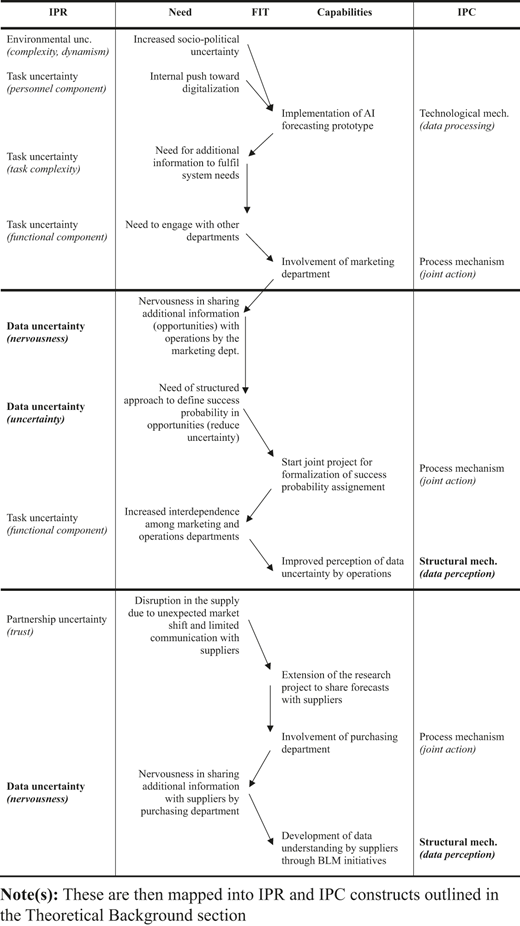 |
Focusing on the evolution of information processing capabilities throughout the action research process, we observe that all three mechanisms are influenced by the introduction of AI. Among them, the process mechanism emerges as the most critical capability, as collaboration between departments proved essential for promoting the extension and successful completion of the AI project.
As expected, the technological mechanism is affected in several ways. The implementation of AI fundamentally changes how information is processed, which in turn influences the structural mechanism. On one side, as highlighted by P2, there is a need to develop a proper understanding of the data and assess their reliability. On the other side, consistent with Galbraith's (1974) theory, the introduction of a formal information system fosters a shift from an organismic to a mechanistic structure.
Originally, the demand forecasting process relied mainly on data gathered through informal communication among managers such as emails, phone calls, and personal exchanges. While an organismic structure is often seen as the best solution for highly uncertain tasks (Galbraith, 1974), its value lies primarily in speeding up decision-making to keep pace with rapidly changing markets. However, in the case of Adige S.p.A., the pace required to manage uncertainty is not as high, since market fluctuations affect their customers more directly than the company itself as a manufacturer. This upstream position enables Adige to adopt a proactive uncertainty management strategy by monitoring market indexes and adjusting accordingly.
At the same time, a key need identified during the intervention was to build consensus across departments and ensure information sharing. This was made possible by the introduction of a formal information system, in this case the AI-based demand forecasting system, which allowed objective evaluation of information from heterogeneous sources and its distribution across the different departments involved in the process, such as Marketing and Purchasing. A summary of the deductive process is provided in Table 3.
Abductive process description
| Observation | Mismatch with OIPT constructs | Abductive inference | Resulting action | Evidence of effect |
|---|---|---|---|---|
| AI adoption enhanced forecasting capability but created dependency on high-quality data | OIPT addresses task/uncertainty fit but not new data dependencies | Data-related uncertainty requires new behavioral and cognitive constructs | Integrated marketing into forecasting to improve data quality | Cross-functional collaboration improved data quality and alignment |
| Marketing dept. reluctant to share data due to fear of misinterpretation | OIPT assumes better communication reduces uncertainty | Identified nervousness as a behavioral antecedent to information withholding | Formalized nervousness construct and analyzed its impact | Demonstrated limits of interdepartmental data sharing despite technical tools |
| Operations dept. misunderstood the reliability of marketing's data | OIPT lacks mechanisms to account for differences in data interpretation | Developed data perception as capability to assess origin and reliability of data | Introduced joint interpretation practices and shared understanding mechanisms | Improved trust, reduced nervousness, enabled better use of shared forecasts |
| Suppliers misinterpreted forecasts and feared over-adjusting production | OIPT mainly intra-organizational, less on cross-boundary uncertainty | Extended data perception to supply chain context | Organized joint seminars and visits to align interpretation | Supplier trust rebuilt, improved forecast sharing across boundaries |
Note(s): For each observation the mismatch with OIPT is described together with abductive inference and consequent action. For each of this the evidence of the results is provided
Implications
Theoretical implications
From a theoretical standpoint, the study both applies and extends OIPT to the context of AI-enabled demand forecasting. Specifically, we use OIPT to explain the organizational challenges observed during AI implementation, while also proposing conceptual extensions that refine the theory's assumptions and expand its boundary conditions. The study contributes to the ongoing development of OIPT by introducing the construct of data perception as a critical dimension of organizational adaptation. Traditional formulations of OIPT (Galbraith, 1974; Tushman and Nadler, 1978) emphasize formal mechanisms such as decentralization, vertical integration, and information systems to handle uncertainty. However, our findings suggest that these structural tools are not sufficient unless actors also develop cognitive and interpretive capabilities to process and contextualize the information they receive (Yang et al., 2021). In this sense, data perception acts not only as an explanatory variable but also as an extension of OIPT, highlighting behavioral and interpretive dimensions that were previously underemphasized.
This research also reconceptualizes the construct of nervousness, which has typically been used in supply chain literature to describe reactions to external uncertainty (Magableh et al., 2024). Here, we show that nervousness can emerge internally within organizations, as departments grapple with asymmetric information and differing interpretations of shared data. This internal nervousness can disrupt coordination unless mitigated through mutual learning and perceptual alignment, thereby extending the relevance of behavioral supply chain constructs to intra-organizational dynamics.
Furthermore, we introduce data unreliability as a distinct dimension of uncertainty. Unlike task or environmental uncertainty (Guida et al., 2023, 2025), which are typically addressed through technological or structural adaptations, data unreliability stems from limitations in the predictive validity of available information and is amplified by AI-driven processes. This proposes a boundary extension of OIPT, emphasizing that organizations must develop interpretive capabilities in addition to technological capacities to manage the ambiguity of AI-generated forecasts.
Additionally, the study challenges the assumption that enhanced information processing capabilities automatically reduce uncertainty (Galbraith, 1974; Tushman and Nadler, 1978). We observe a recursive relationship in which technological advancements, such as AI implementation, generate new information processing needs, including higher data demands and coordination requirements. This insight extends OIPT by highlighting the dynamic interplay between capability development and evolving uncertainty, rather than assuming a static fit.
Finally, the emergence of joint action as a response to rising partnership uncertainty offers a more granular understanding of organizational adaptation. While collaborative actions are often discussed in the context of dynamic capabilities (Teece et al., 1997), our findings provide an OIPT-based explanation that integrates behavioral, structural, and processual mechanisms: as uncertainty increases, coordination evolves not only through structure but also through mutual perception and interpretive alignment. These theoretical extensions position OIPT as a more behaviorally grounded and generative framework, capable of explaining AI implementation and offering novel constructs that refine the theory for contemporary, data-intensive, and uncertain organizational environments.
Managerial implications
This study highlights several key managerial takeaways for organizations seeking to implement AI-based demand forecasting systems. First and foremost, the intervention process demonstrates that AI adoption is not simply a technological upgrade but an organizational transformation. Effective implementation requires coordinated efforts across departments, particularly operations, marketing, and purchasing. Managers should foster cross-functional collaboration to ensure shared understanding and co-ownership of new processes.
One of the most significant insights from the interventions is the role of data perception, that is, the capacity of individuals and departments to understand the origin, relevance, and uncertainty of data. As observed, building this capability substantially reduces nervousness around data sharing, which in turn enhances trust between departments. This suggests that managerial efforts should go beyond deploying technical tools and should focus on improving interpretive understanding through joint meetings, collaborative workshops, and transparent data contextualization.
Additionally, the recurring issue of data unreliability, particularly in the form of uncertain forecasts or externally-driven demand variability, demonstrates that organizations must treat data quality and trust as dynamic managerial concerns. This is especially important when data originates outside the firm's direct control, as in the case of potential orders or market-driven shifts. Building organizational routines to acknowledge, assess, and communicate around this unreliability is essential to support effective decision-making and reduce information-related anxiety.
Furthermore, trust management emerged as a critical component in successful data sharing, especially when interdepartmental or interorganizational boundaries are involved. Managers must be aware that behavioral responses such as reluctance or fear of misinterpretation, can significantly hinder effective information exchange. Addressing these responses through consistent interaction and education can help mitigate resistance.
Moreover, the findings reveal that forecasting systems should not be confined to internal use but strategically extended to key suppliers. However, this must be done carefully. Suppliers may misinterpret shared forecasts, leading to decisions that create distortions in the supply chain. Therefore, managers in supply chain and procurement roles must act as facilitators, ensuring that both the content and context of shared information are well understood.
Finally, the study suggests that even accurate and well-intentioned forecasts can trigger the bullwhip effect if they are not accompanied by proper communication channels and mutual understanding. Behavioral risks in data interpretation must be recognized and managed, particularly in environments characterized by high volatility and interdependence.
Conclusions
This study contributes to the evolving discourse on the strategic integration of AI by extending OIPT through the development and deployment of an AI-enabled demand forecasting system. Thanks to the longitudinal understanding offered by AR, we reveal the organizational transformation necessary to recalibrate information processing requirements and capabilities in an iterative, uncertain, and data-intensive environment. Unlike traditional automation, AI introduces not only process complexity but also interpretive challenges, as objectives and data inputs evolve continuously. This demands new organizational mechanisms to assess not only the quantity but also the quality and reliability of information.
Our findings underscore the pivotal role of emerging constructs, such as data perception, nervousness, and data unreliability, in shaping how information is interpreted, trusted, and used. The study illustrates that successful AI implementation hinges on more than technological readiness; it requires interdepartmental negotiation, mutual trust, and the co-development of interpretive capabilities. As the alignment of data perception between marketing and operations reduced barriers to collaboration, similar dynamics were observed in supplier relationships, where trust and interpretability of shared data mitigated the risks of misperception and the bullwhip effect. These insights suggest that AI adoption transforms not only operational systems but also the underlying information ecology of the organization.
This study relies on rich contextual information stemming from the AR process. This may limit its generalizability in other contexts; however, this is a peculiar characteristic of AR, which aims at generating context-specific knowledge (Coughlan and Coghlan, 2002).
By refining and extending the OIPT framework, this study offers a more nuanced understanding of the social and organizational mechanisms that support AI adoption. Building on our findings, several avenues for future research emerge. First, scholars should explore how distinct types of uncertainty, such as demand volatility, supply disruptions, or data unreliability, create different configurations of information processing requirements, and how these configurations shape the design of AI-enabled forecasting systems. A contingency-based approach (Bortolotti et al., 2024) could reveal whether particular combinations of uncertainty necessitate unique forms of organizational adaptation.
Second, future work should examine the evolution of information processing capabilities over time. While this study documents the transition from human judgment to digital infrastructures and AI, the sequencing, interplay, and orchestration of these capabilities remain underexplored. Longitudinal and cross-industry studies could clarify whether firms follow staged, recursive, or hybrid trajectories in capability development, and how these paths influence resilience under uncertainty. In this context, the lens of Dynamic Capabilities Theory offers a promising theoretical perspective, as it emphasizes the firm's ability to sense, seize, and reconfigure resources and capabilities in response to changing environments (Le and Behl, 2024). Applying this framework could illuminate how organizations systematically develop IPCs, integrate technological and human resources, and adapt routines to maintain effective information processing under evolving conditions.
Third, the findings highlight the importance of considering AI implementation across multiple organizational levels. At the worker level, research could investigate how interpretive capabilities such as data perception are developed (Wang et al., 2024); at the team level, how nervousness is negotiated within cross-functional collaboration (Lima et al., 2024); at the firm level, how structural and processual mechanisms evolve (Guida et al., 2025); and at the supply chain level, how trust and data perception travel across organizational boundaries (Hendriksen, 2023). Studying the escalation of these dynamics across levels would extend the scope of OIPT and provide a richer account of AI's systemic implications.
Finally, further empirical studies could test the generalizability of the constructs introduced here, data perception, nervousness, and data unreliability, beyond the AI-enabled forecasting context. Investigating their role in other digital technologies (e.g. digital twins, blockchain, advanced analytics) and across industries with varying levels of environmental volatility would help determine the breadth of their relevance and refine the revised OIPT framework.
We thank Alberto Longobardi, Operations Director at Adige Spa - BLM Group and Adige Sys - BLM Group; Emanuele Magistri, Marketing Manager at BLM Group; Annamaria Croci, Chief Information Officer at BLM Group; and Davide Moranduzzo, Purchasing manager at BLM Group. Their contributions in defining the company's needs, organizing feedback sessions with key stakeholders, and providing essential data were instrumental in ensuring this research delivers meaningful insights.

